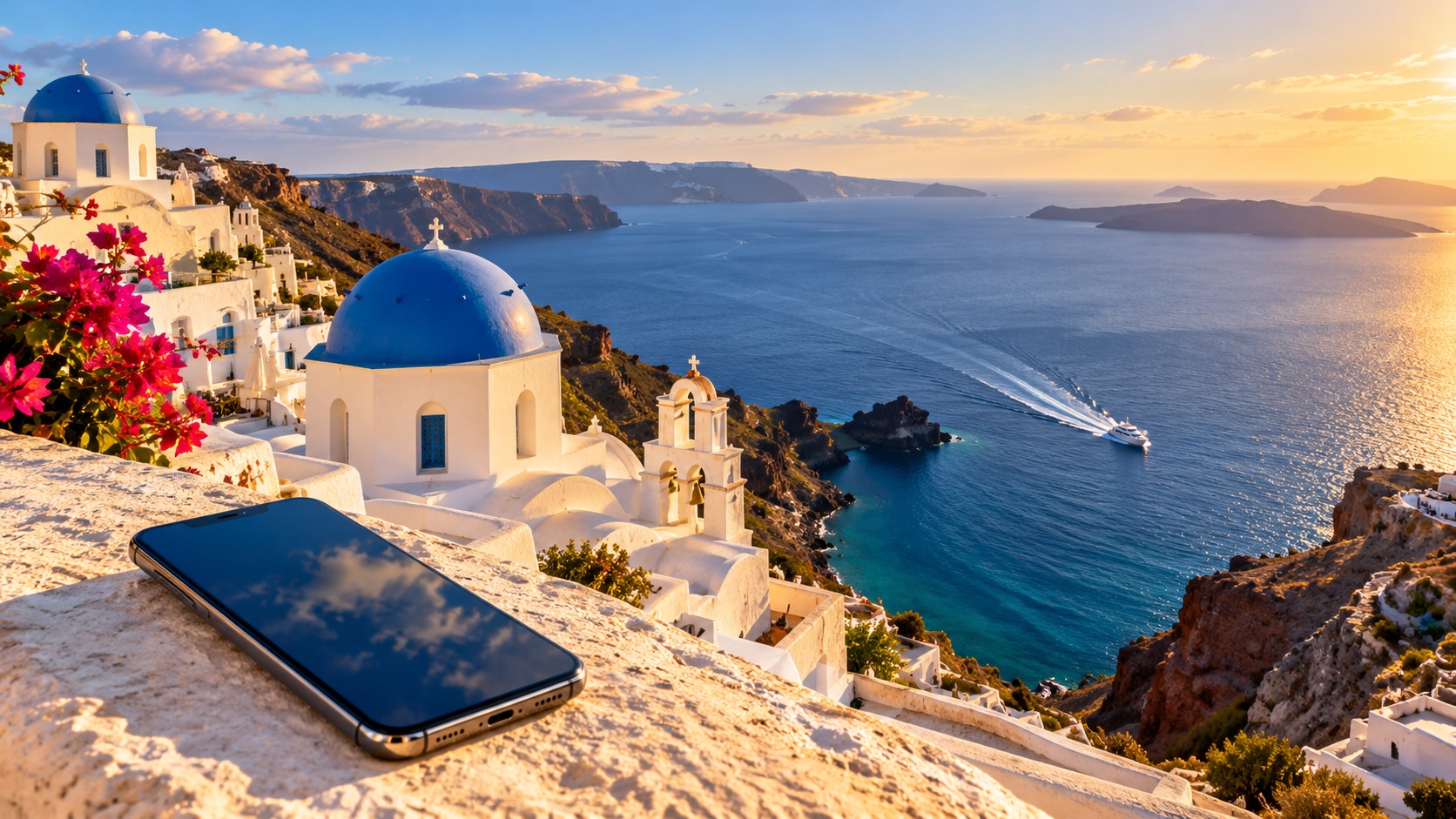
The Connectivity Paradox of Greek Island Hopping in 2026
Selecting the right Greece eSIM for island hopping is no longer just a convenience; it is a critical logistical requirement for navigating the fragmented digital landscape of the Aegean Sea. In 2026, the modern traveler’s itinerary is defined by a series of micro-transitions between high-density urban centers and remote, sun-bleached archipelagos, creating a unique technical environment that traditional connectivity solutions struggle to handle. This section addresses the "connectivity gap"—a specific phenomenon experienced during ferry transitions where signal strength precipitously drops from robust 4G/5G coverage to unstable 3G or even legacy 2G networks as vessels move beyond the effective range of terrestrial cell towers. This drop-off is not merely an inconvenience; it is a disruption that can paralyze essential travel functions.
The Digital Dependency of the Modern Itinerary
The pain points of 2026 travel are distinctly digital. Unlike previous decades where a lost connection meant a delayed text message, today’s traveler relies on real-time data streams for survival. Real-time navigation apps like Google Maps or Apple Maps require continuous data packets to calculate optimal routes on winding island roads. Social media sharing has evolved into an expectation for immediate content delivery, where high-resolution video uploads fail if the bandwidth fluctuates. Most critically, digital boarding passes for domestic flights and high-speed ferries often require dynamic QR code scanning, a process that demands a stable, low-latency connection. If your signal drops to 2G during the final approach to a port, the risk of a failed scan or a delayed check-in becomes a tangible threat to your schedule.
Why Traditional SIMs and Roaming Fail
Traditional roaming or single-carrier physical SIMs often fail in this scenario due to network handover delays. When a mobile device moves from one carrier’s coverage zone to another, or from a strong urban signal to a weak maritime signal, the device must negotiate a new connection. This process, known as handover, can take anywhere from 10 to 30 seconds. During this window, data services are suspended. For a traveler on a ferry crossing from Athens to Hydra, this delay can mean the difference between successfully downloading a digital ticket and being stuck in a "searching for network" limbo. Furthermore, single-carrier SIMs are often optimized for one specific region. If you are using a mainland-focused plan, the network may prioritize voice calls over data in weak signal areas, throttling your internet speed to a crawl just when you need it most.
Prioritizing Stability Over Speed
This is why the search for the best eSIM for Greek islands 2026 must prioritize stability over raw speed. A connection that averages 50 Mbps in Athens but drops to 2 Mbps in the Cyclades is less valuable than a connection that consistently maintains 5-10 Mbps across all locations. The ideal solution is one that intelligently manages data usage and maintains a persistent connection even when signal strength is marginal. This is where the concept of connectivity resilience becomes paramount. Connectivity resilience is the ability to stay online, functional, and productive even when data limits are hit or signals are weak. It is not just about having internet; it is about having reliable internet.
The MollySIM Advantage: Fair Use Policy and Real-World Performance
This is where MollySIM distinguishes itself in the 2026 market. Many eSIM providers impose strict data caps that, once exceeded, throttle speeds to a barely usable 128 kbps. This is often too slow for modern apps, causing Google Maps to buffer and Apple Pay to time out. MollySIM, however, employs a 384 kbps Fair Use Policy speed limit for unlimited plans. This is 3x faster than competitors' 128 kbps limit, a critical difference that enables Google Maps to load maps smoothly and Apple Pay to process transactions without timeout errors. This level of performance ensures that even in the weakest signal zones of the Greek islands, your digital tools remain responsive.
To explore the specific plans that offer this resilience, you can review the detailed Greece eSIM plans available at MollySIM’s Greece page. For a broader perspective on how to navigate these technical challenges, our travel connectivity guides at MollySIM’s blog provide in-depth analysis of network performance across the Aegean.
In the following sections, we will dissect the technical specifications of Cosmote and Vodafone, comparing their network architectures, coverage maps, and data policies to help you determine which carrier offers the true connectivity resilience your island-hopping adventure demands.
Cosmote vs Vodafone Greece Coverage: A Technical Deep Dive
🇬🇷 Greece High-Speed Travel eSIM & SIM Plans
Instant QR code activation, hotspot enabled, with guaranteed 384kbps fallback speed to keep Maps & Digital Wallets active.
Selecting the right carrier for your Greece eSIM for island hopping itinerary is not merely a matter of price; it is a strategic decision based on radio frequency engineering and tower density. While both Cosmote and Vodafone operate robust 4G/5G networks across the Hellenic Republic, their infrastructure footprints diverge significantly when you move from the dense urban grid of Athens to the rugged, cliffside topography of the Cyclades. Understanding these nuances is critical because signal degradation in rural island villages is not just an inconvenience—it is a functional failure that can disrupt navigation, banking, and emergency communication.
Infrastructure Architecture: Rural Reach vs. Urban Capacity
The fundamental difference between the two providers lies in their historical investment strategies. Cosmote, as the legacy state-owned operator, has historically prioritized wide-area coverage through extensive deployment of lower-frequency bands, specifically 700 MHz and 800 MHz. These lower frequencies possess superior propagation characteristics, allowing signals to travel longer distances and penetrate dense vegetation or stone structures more effectively. This makes Cosmote the technical favorite for rural island villages on Crete, Naxos, and the Dodecanese, where tower density is sparse. If your itinerary involves hiking trails in Oia (Santorini) or exploring the mountainous interior of Crete, Cosmote’s lower-band infrastructure often maintains a stable 4G connection where higher-frequency competitors might drop to 3G or lose signal entirely.
Conversely, Vodafone has aggressively invested in capacity optimization for high-density tourist hubs. By focusing on 1800 MHz and 2100 MHz bands, Vodafone delivers higher peak data speeds in urban centers like Mykonos Town, Chania, and Athens. These higher frequencies offer greater bandwidth but have a shorter range and poorer penetration through obstacles. Consequently, while Vodafone may offer faster download speeds in the crowded squares of Mykonos, it can struggle in the shadowed alleyways or remote coves where Cosmote’s lower-frequency reach shines. For a traveler prioritizing coverage breadth over raw speed, Cosmote’s architectural advantage in the Aegean is often the deciding factor.
Data Consumption Patterns: How Much Data Do I Need for Santorini?
A common question among travelers is: "How much data do I need for Santorini?" The answer depends heavily on your connectivity habits, but technical analysis suggests a baseline of 5–10 GB per week for a standard tourist. This estimate accounts for:
- Navigation: Google Maps offline maps consume minimal data, but real-time traffic updates and re-routing use approximately 50–100 MB per hour of active driving.
- Social Media: Instagram and TikTok are data-heavy; 1 hour of video browsing can consume 1–2 GB.
- Cloud Sync: Automatic photo backup to iCloud or Google Photos can silently drain 2–3 GB daily if not managed.
In high-density areas like Fira or Oia, you may rely on public Wi-Fi, but in remote villages, your eSIM is your only lifeline. This is where the MollySIM advantage becomes tangible. With its 384 kbps Fair Use Policy, MollySIM ensures that even if you exceed your data cap, your connection remains 3x faster than the standard 128 kbps throttling used by many competitors. This difference is critical for maintaining Google Maps responsiveness and Apple Pay transaction reliability in weak signal zones. You can compare specific data allowances and pricing structures in the detailed Greece eSIM plans available on the MollySIM platform.
Practical Advice for the Savvy Traveler
Before departure, do not rely solely on carrier marketing maps. Instead, perform a pre-trip signal audit:
- Check Local Reviews: Search for "Cosmote vs Vodafone [Island Name] coverage" on recent travel forums.
- Verify Frequency Support: Ensure your device supports the 700 MHz band (Band 28) for optimal Cosmote performance in rural areas.
- Monitor Usage: Use your phone’s built-in data usage tracker to stay within your plan’s optimal range.
For a deeper understanding of how to navigate these technical challenges across the Aegean, our travel connectivity guides provide in-depth analysis of network performance in specific island clusters. Ultimately, both carriers are strong, but the choice depends on your specific itinerary. For island hopping, where you are constantly moving between remote and urban zones, coverage breadth is more critical than peak speed. Prioritize the carrier with the strongest lower-band footprint in your target regions to ensure uninterrupted connectivity.
Why MollySIM’s 384kbps FUP is Your Ultimate Safety Net
When planning a Greece eSIM for island hopping, the most common anxiety for tech-savvy travelers is the "data cliff." This is the moment when your high-speed data allowance hits zero, and your connection either vanishes entirely or slows to a crawl, leaving you stranded on a ferry or in a remote taverna without a map. While most eSIM providers handle this scenario with a hard cutoff or a negligible 128 kbps speed limit, MollySIM introduces a critical differentiator: the 384 kbps Fair Usage Policy (FUP). Understanding this feature is not just a technicality; it is the difference between a seamless journey and a digital blackout.
Demystifying the Fair Usage Policy
In plain English, a Fair Usage Policy is not a penalty; it is a lifeline. Traditional eSIMs often operate on a binary model: you have data, or you don’t. Once your cap is reached, the connection drops to 0 kbps (offline) or a restrictive 128 kbps, which is often too slow for modern applications to function reliably. In contrast, MollySIM’s FUP reduces your speed to 384 kbps. This is three times faster than the standard industry throttling.
Why does 384 kbps matter? It is the threshold where essential travel applications remain functional. At this speed:
- Google Maps can still load vector tiles and update your location, allowing you to navigate from your hotel to the port.
- WhatsApp and iMessage function smoothly for text and voice calls, keeping you in contact with tour operators or family.
- Apple Pay and Google Pay transactions process reliably, even in areas with weak signal strength, ensuring you can pay for a taxi or a meal without fumbling for cash.
- Email and cloud backups (like iCloud or Google Photos) can sync in the background, preventing the loss of precious travel memories.
The Remote Island Scenario
Imagine you are on a remote stretch of Kos or Leros, having just exhausted your 10 GB high-speed data allowance. The sun is setting, and you need to find the last bus back to your accommodation. With a standard eSIM, your phone might show "No Internet" or a painfully slow "128 kbps" connection that takes 30 seconds to load a single map tile. You are forced to rely on paper maps or ask locals for directions, a stressful experience when you are tired and unfamiliar with the local dialect.
With MollySIM, your connection remains robust. The 384 kbps speed ensures that your map loads instantly, your ride-sharing app responds, and your navigation voice cues are crisp. This "safety net" prevents the digital blackout that ruins trips, allowing you to maintain control over your itinerary even when your data budget is depleted. For a deeper dive into how this impacts specific island clusters, refer to our travel connectivity guides.
Seamless Activation for Island Hoppers
The value of the FUP is maximized by how easy it is to get online. MollySIM’s activation process is designed for the on-the-go traveler:
- Purchase & Download: Buy your plan on mollysim.com and download the app.
- Scan QR Code: Open the app on your phone and scan the unique QR code provided.
- Auto-Connect: The eSIM installs automatically and connects to the best available network (Cosmote or Vodafone) based on your location.
- Go: You are online. No SIM trays, no local store visits, no waiting.
This seamless switch ensures that whether you are in Athens or on a small Cycladic island, you are connected from the moment you land. The robustness of the single-carrier plan, combined with the 384 kbps FUP, provides the peace of mind that your connectivity will not fail you. You can compare specific data allowances and pricing structures in the detailed Greece eSIM plans available on the MollySIM platform, ensuring you choose the right balance of speed and safety for your specific island-hopping route.
Strategic Data Optimization for Navigation and Social Media
Having secured your connectivity foundation, the next critical phase of your Greece eSIM for island hopping itinerary is mastering data efficiency. The Aegean Sea is beautiful, but its remote nature means that cellular signals can be patchy on smaller islands like Milos or Naxos. Relying solely on live data for navigation or social media can drain your allowance faster than expected. To ensure your connection lasts the entire trip, you need a disciplined approach to data consumption, leveraging offline tools and smart usage habits.
Pre-Downloading Maps for Zero-Data Navigation
The single most effective way to save data is to never rely on live map rendering. Before you board your first ferry, download offline maps for your target destinations. This is crucial for islands where 4G coverage might drop to 3G or even 2G, where data speeds are slower and more expensive.
For Google Maps Users:
- Open Google Maps while connected to Wi-Fi.
- Search for your destination (e.g., "Santorini" or "Crete").
- Tap the three-dot menu in the top right corner.
- Select "Download offline map."
- Adjust the map area to cover the specific island or region you are visiting.
- Tap Download.
For Apple Maps Users:
- Open the Maps app.
- Tap the search bar and enter your location.
- Tap the "i" icon in the top right.
- Select "Save for Offline Use."
- Choose the map size (Small, Medium, or Large) and tap Save.
By doing this for Santorini, Crete, and any other stops, your phone will use local data for routing and voice cues, consuming only a fraction of the bandwidth required for live tile loading. This allows your Greece eSIM data to be reserved for essential tasks like messaging and email, rather than being eaten up by map tiles.
Managing Social Media Data Hogs
Social media platforms are notorious data consumers. Instagram, Facebook, and TikTok are designed to stream high-resolution video and auto-play content, which can burn through gigabytes in hours. To mitigate this:
- Disable Auto-Play: Go into the settings of each app and turn off "Auto-play videos" or "Data saver" modes. This prevents the background loading of video content while you scroll.
- Use Wi-Fi for Heavy Lifting: Whenever you are at a hotel, cafe, or on a ferry with Wi-Fi, upload your photos and videos then. Do not post or browse heavy content on mobile data unless necessary.
- Limit Video Streaming: If you must watch content, do so on Wi-Fi. Streaming a single hour of HD video can consume 1.5GB to 3GB of data.
Data Budgeting: A Concrete Plan
To avoid running out of data in the middle of the Aegean, you need a realistic daily budget. Here is a breakdown of typical usage for an island-hopping traveler:
| Activity | Estimated Daily Usage | Notes |
|---|---|---|
| Navigation | 50–100 MB | With offline maps pre-downloaded, this is minimal. |
| Email & Messaging | 50 MB | Light usage for WhatsApp, iMessage, and email. |
| Social Media | 200–500 MB | Browsing feeds, light video viewing. |
| Web Browsing | 100–200 MB | Checking guides, booking tables, etc. |
| Total Daily | 400–850 MB | Varies based on video usage. |
For a 7–10 day trip, this totals approximately 3GB–8.5GB. This makes a 5GB–10GB plan the sweet spot for most travelers. It provides enough buffer for unexpected usage while keeping costs reasonable.
Monitoring Your Usage
Finally, keep a close eye on your data consumption. Use the MollySIM app to track your usage in real-time. The app provides a clear dashboard showing how much data you have left, helping you adjust your habits if you are running ahead of schedule. Remember, with MollySIM’s 384 kbps Fair Use Policy, even if you hit your limit, your connection remains functional at a speed 3x faster than competitors’ 128 kbps limits. This ensures that critical apps like Google Maps and Apple Pay continue to work smoothly, preventing a digital blackout in remote areas. For more detailed plan options, check out the Greece eSIM plans to find the perfect fit for your itinerary.
Comparative Analysis: eSIM vs Pocket Wi-Fi vs Physical SIM
Choosing the right connectivity method is arguably the most critical logistical decision for a traveler navigating the Greek archipelago. While all three options—eSIM, local physical SIM, and Pocket Wi-Fi—ultimately provide internet access, they differ drastically in terms of setup friction, reliability, and user experience. For a 2026 traveler prioritizing efficiency and flexibility, understanding these nuances is essential before booking your first ferry ticket.
The table below breaks down the core differences between these three methods, highlighting specific advantages and drawbacks relevant to island hopping.
| Option | Pros | Cons | Best For | Cost Estimate (7-10 Days) |
|---|---|---|---|---|
| MollySIM eSIM | Instant setup (no store visit); No device swapping; 384 kbps FUP (3x faster than competitors); Works on dual-SIM phones. | Requires an eSIM-compatible device; Data limit applies (though FUP is generous). | Solo travelers, tech-savvy users, those prioritizing convenience and speed. | €15–€30 |
| Local Physical SIM (Cosmote/Vodafone) | Potentially better raw coverage in specific rural pockets; No setup app needed. | Must visit a physical store; Language barrier risk; Requires swapping SIM cards; Activation delays. | Travelers with unlocked phones who prefer physical backup; long-term stays. | €20–€40 + Time cost |
| Pocket Wi-Fi | Shareable across multiple devices; No phone compatibility issues. | Device rental fees; Battery life management; Bulky; Risk of losing the device. | Groups of 3+ people; travelers with older non-eSIM phones. | €30–€60 + Deposit |
Why eSIM is Superior for Island Hopping
The primary advantage of a Greece eSIM for island hopping lies in the elimination of physical infrastructure dependencies. When hopping between islands like Mykonos, Santorini, or Naxos, finding a local carrier store can be a hassle. Stores may have limited hours, require a passport for registration, and often involve waiting in line during peak tourist seasons. More importantly, on smaller, less developed islands, physical store coverage can be sparse. With an eSIM, you are connected the moment you land, regardless of whether you are in a bustling port or a quiet village.
Furthermore, eSIM technology offers unparalleled flexibility. If you are using a dual-SIM phone, you can keep your home SIM active for calls and texts while using the eSIM for data. This eliminates the need to swap physical SIM cards, a process that can be cumbersome and risks losing your original SIM. For those concerned about data limits, MollySIM’s 384 kbps Fair Use Policy is a significant differentiator. Unlike many competitors that throttle speeds down to a nearly unusable 128 kbps after the data limit is reached, MollySIM allows you to maintain a connection speed three times faster. This ensures that critical applications like Google Maps for navigation and Apple Pay for contactless payments continue to function smoothly, preventing a digital blackout in areas where signal strength might fluctuate.
While Pocket Wi-Fi is useful for large groups, it introduces the complexity of managing a separate device, charging it daily, and worrying about its battery life. Local physical SIMs, while reliable, require the upfront effort of visiting a store and navigating potential language barriers, which can be stressful when you are already trying to manage your itinerary.
For the modern traveler in 2026, the eSIM represents the best balance of convenience, cost, and reliability. It removes the friction of physical logistics and provides a seamless, high-speed connection exactly when and where you need it. To explore the specific data packages that fit your itinerary, you can review the detailed Greece eSIM plans or dive deeper into connectivity strategies in our travel connectivity guides. Ultimately, choosing MollySIM ensures you stay connected with minimal effort, allowing you to focus on the beauty of the Aegean rather than the logistics of staying online.
Final Checklist: Preparing for Your Greek Island Adventure
As you finalize your itinerary for 2026, the transition from planning to execution requires a systematic approach to connectivity. The Greek islands are a logistical puzzle of ferries, changing ports, and varying signal strengths; your digital infrastructure must be as robust as your physical packing list. Before you board your flight, execute this comprehensive Greece eSIM for island hopping preparation protocol to ensure zero friction upon arrival.
The 5-Step Pre-Departure Protocol
- Verify Hardware Compatibility: Confirm your device supports eSIM technology. Most iPhones (XS and newer) and Android flagships (2026+) are compatible. If you are using an older device, check the specific model number in your settings. This step is non-negotiable; without hardware support, the convenience of a digital SIM is lost.
- Install the MollySIM eSIM: Purchase and install your profile before leaving your home country. Installing an eSIM while on a foreign network can sometimes introduce minor delays or require a data connection you don’t yet have. By installing it at home, you ensure the profile is ready to activate the moment you land in Athens or Santorini. You can find the exact data tier that matches your ferry schedule in the Greece eSIM plans catalog.
- Pre-Download Offline Maps for Every Island: Signal drops are common in remote coves and mountainous interior routes. Download the high-definition offline maps for all planned islands, including Crete, Rhodes, Mykonos, and any smaller Cycladic or Dodecanese stops. Ensure you have the specific ferry routes mapped as well, as GPS accuracy can degrade near coastlines.
- Cache Essential Applications: While you will have data, connectivity can be intermittent during peak ferry hours. Download offline versions of critical apps:
- Banking Apps: Ensure your mobile banking app is updated and logged in, so you can access account details if the network hiccups.
- Messaging: Pre-load recent WhatsApp or Telegram conversations for offline reading.
- Travel Docs: Save digital copies of your passport, hotel bookings, and ferry tickets to your local storage, not just the cloud.
- Review the 384 kbps Fair Use Policy: Understand your safety net. If you exceed your high-speed data limit, MollySIM’s 384 kbps Fair Use Policy kicks in. This is a critical advantage over competitors who throttle speeds to 128 kbps. At 384 kbps, Google Maps will still provide real-time turn-by-turn navigation, and Apple Pay or Google Pay will process transactions smoothly. This prevents the "digital blackout" anxiety that often plagues travelers on data-heavy networks.
Strategic Network Selection: Cosmote vs. Vodafone
Your choice between Cosmote and Vodafone should not be arbitrary; it must be dictated by your specific geography.
- Choose Cosmote if your itinerary is heavy on Crete, Rhodes, and the Dodecanese. Cosmote has historically maintained superior tower density in these southern regions, offering more stable connections in rural villages and smaller ports.
- Choose Vodafone if your focus is on the Cyclades (Mykonos, Santorini, Paros) and Athens. Vodafone often provides stronger indoor penetration in urban centers and major tourist hubs within the Cyclades.
If your trip is a mixed bag, MollySIM’s flexibility allows you to select the network that best aligns with your primary destination, ensuring you are not left searching for signal in a quiet taverna.
The Backup Plan: Redundancy is Key
While eSIM technology is highly reliable, the nature of travel means that redundancy is wise. Keep a physical local SIM card as a backup in your carry-on. If your eSIM profile encounters a rare glitch (such as a carrier reset after a long ferry ride), a physical SIM can be swapped in within minutes. However, with MollySIM’s robust infrastructure, this should be a "just in case" measure, not an expectation.
Secure Your Connection Before You Fly
Do not wait until you are standing in the airport queue to solve your connectivity needs. The peace of mind that comes from knowing your Greece eSIM for island hopping is installed, tested, and ready is invaluable. It allows you to focus on the turquoise waters, the whitewashed architecture, and the local cuisine, rather than the stress of finding a Wi-Fi password.
Take action now: Visit MollySIM to select your plan, install your eSIM, and download your offline maps. Your seamless, connected journey across the Greek islands in 2026 starts with this single, confident step.
Frequently Asked Questions about Greece eSIM for island hopping
Does a Greek eSIM work on ferries between islands?
Yes, but signal strength varies by ferry size and proximity to shore. Major carriers like Cosmote have better coastal coverage, but expect intermittent connectivity in open water.
Which carrier is better for Santorini and Mykonos?
Cosmote generally provides superior 4G/5G coverage in popular tourist hubs like Santorini and Mykonos, while Vodafone offers competitive pricing in Athens.
How much data do I need for a 7-day Greek trip?
10-15GB is sufficient for maps, messaging, and occasional video calls. If you stream video or upload photos constantly, consider 20GB or unlimited plans with a 384kbps FUP.
SEO Score: 11/11
🇬🇷 Greece High-Speed Travel eSIM & SIM Plans
Instant QR code activation, hotspot enabled, with guaranteed 384kbps fallback speed to keep Maps & Digital Wallets active.