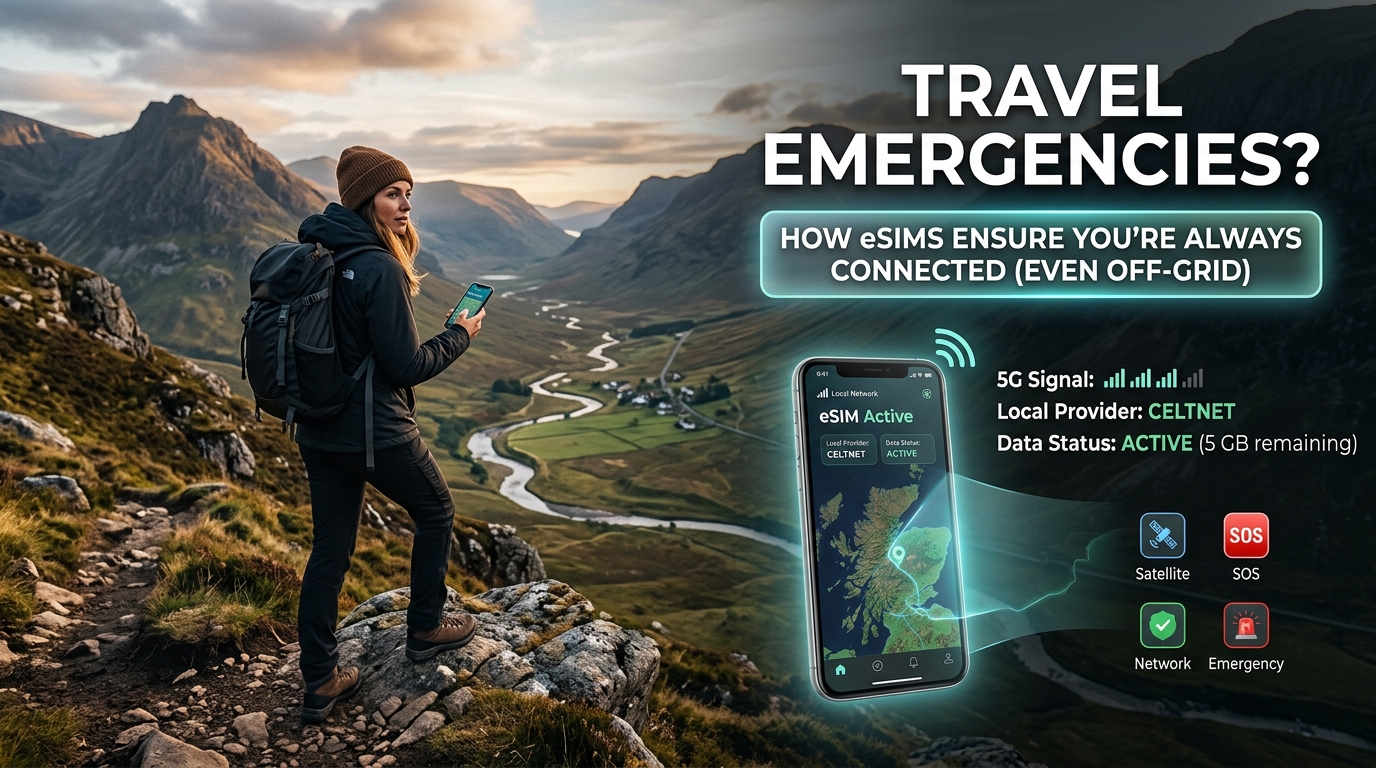
旅行緊急狀況?eSIM 如何確保您始終保持連線(即使在偏遠地區)
斷線的危險:為什麼傳統旅行連線在危機中失效
The modern traveler often operates under an illusion of constant connectivity, assuming that a Wi-Fi hotspot or a readily available local SIM card will always be within reach. This assumption, however, crumbles under the harsh reality of a travel emergency, where the very infrastructure we rely on can fail, vanish, or become a security risk. In such critical moments, traditional connectivity methods don't just become inconvenient; they become dangerous, transforming a stressful situation into a potentially life-threatening ordeal. The 'hope for the best' approach to staying connected is a gamble no traveler should take when safety is on the line.
The Fragility of Traditional Methods
Let's dissect the inherent vulnerabilities of common connectivity solutions when faced with a crisis:
Physical SIM Cards: A Race Against Time
Relying on physical SIM cards during an emergency is akin to bringing a knife to a gunfight. The process of acquiring a local SIM is inherently slow and often impossible when time is of the essence. Imagine an earthquake striking, and you need to contact your embassy or family immediately. Your first thought shouldn't be locating an open phone store, navigating language barriers, or waiting in line for activation, especially if local infrastructure is damaged or movement is restricted. Furthermore, physical SIMs are geographically tethered; if an emergency forces you to cross a border, your carefully acquired local SIM becomes instantly useless, leaving you stranded without a connection in a new, unfamiliar territory. This delay in obtaining a vital communication link can exacerbate an already terrifying situation, preventing timely access to emergency services, critical information, or loved ones.
Public & Hotel Wi-Fi: Security Risks and Unreliable Access
Public Wi-Fi networks, while seemingly ubiquitous, are a minefield of security vulnerabilities even in normal circumstances. In a crisis, they become even more precarious. When you're trying to contact banks about a stolen wallet, share sensitive medical information with emergency services, or coordinate with family, the last thing you need is the risk of data interception, phishing attacks, or identity theft. These networks are often unencrypted, making your personal data an open book for malicious actors.
Hotel Wi-Fi offers a marginal improvement in security but is still far from ideal. Its availability is confined to the hotel premises, rendering it useless if you're outside, if the hotel itself is damaged, or if you're forced to evacuate. Both public and hotel Wi-Fi are also entirely dependent on local power grids and internet service providers, which are frequently among the first services to fail during natural disasters or civil unrest. When the power goes out, so does your connection, leaving you isolated precisely when you need to be most connected.
Pocket Wi-Fi Devices: Another Point of Failure
Pocket Wi-Fi devices (MiFi units) might seem like a proactive solution, but they introduce their own set of vulnerabilities. They require charging, adding another battery-dependent device to your emergency kit. More critically, they often rely on a single local SIM or a specific network, meaning they are just as susceptible to network outages and geographical limitations as a phone with a physical SIM. If the underlying cellular infrastructure fails, your pocket Wi-Fi becomes an expensive paperweight. They are also physical objects that can be lost, stolen, or damaged, adding another point of failure in a high-stress scenario.
When Disconnection Becomes Dangerous: Real-World Scenarios
The consequences of these traditional connectivity failures are starkest in real-world emergency scenarios:
Natural Disasters: Infrastructure Collapse
Imagine being caught in an earthquake, a flash flood, or a rapidly spreading wildfire. Local cellular towers can be toppled, power lines severed, and internet cables cut. In such events, the immediate need for communication is paramount: contacting emergency services, checking on family, accessing real-time news updates, or finding evacuation routes. Without a reliable connection, you are effectively blind and voiceless, unable to receive critical alerts or signal for help.
Medical Emergencies in Remote Locales
A sudden medical emergency in a remote area, far from hospitals and reliable infrastructure, highlights the life-or-death importance of immediate connectivity. There's no local SIM store, no public Wi-Fi. You need to call for help, find the nearest medical facility, or access crucial medical information. In these moments, the ability to quickly load Google Maps or Apple Pay for navigation, or to make an urgent call, is non-negotiable. This is where the superior speed of a service like MollySIM (https://mollysim.com) becomes a critical advantage. With its 384kbps Fair Use Policy speed limit, which is 3x faster than competitors' 128kbps, essential navigation apps function smoothly, ensuring you can find your way to safety or medical assistance without frustrating delays.
Political Unrest and Document Loss
During political unrest or civil disturbances, governments might intentionally shut down internet access or disrupt cellular networks. Your ability to contact your embassy, monitor news for safety instructions, or communicate with family becomes severely compromised. Similarly, the sudden loss or theft of essential documents like your passport or wallet demands immediate, secure communication with your bank, embassy, or travel insurance provider. Relying on insecure public Wi-Fi for such sensitive interactions is a grave risk, and the delay in acquiring a new physical SIM only prolongs your vulnerability.
The Cost of Delay: Exacerbating Stress and Risk
The common thread through all these scenarios is the critical impact of delay. Every minute spent searching for Wi-Fi, trying to buy a SIM, or dealing with an unreliable connection is a minute lost in a crisis. This delay doesn't just add to stress; it can directly jeopardize your safety, health, and financial security. It transforms an already frightening situation into one of helplessness and isolation, potentially preventing you from accessing life-saving information or assistance.
A Call for Proactive Preparedness
The vulnerabilities of traditional connectivity methods in a crisis paint a clear picture: relying on them is a reactive, 'hope for the best' strategy that is fundamentally inadequate for traveler safety. A paradigm shift is necessary, moving from hoping for a connection to proactively ensuring one. The need for immediate, reliable, and secure communication in any travel emergency is not a luxury; it is a fundamental requirement for modern travel preparedness.
eSIMs: Your Digital Lifeline in Travel Emergencies
🌐 全球旅行 高速 eSIM & 电话卡套餐
无需插卡开箱即用,支持热点共享,即使高速流量用尽也可维持 Google 地图/移动支付顺畅运行。
The vulnerabilities inherent in traditional connectivity methods during a crisis underscore a fundamental truth: proactive preparedness is paramount. This is precisely where eSIM technology emerges as a transformative solution, directly addressing the shortcomings of physical SIM cards and unreliable public Wi-Fi. An eSIM, or embedded Subscriber Identity Module, is not a physical card you insert into your phone. Instead, it's a small, programmable chip permanently built into your device, functioning as a digital SIM. This innovative design allows you to download and activate cellular plans over the air, eliminating the need for physical swaps and offering unprecedented flexibility and security.
Instant Activation & Remote Provisioning
One of the most critical advantages of eSIMs in an emergency is their capacity for instant activation and remote provisioning. Unlike traditional SIMs that require a trip to a local store, an eSIM plan can be purchased and activated from virtually anywhere in the world, at any time, with just a few taps on your device. This capability is invaluable when immediate connectivity is non-negotiable. Imagine being stranded in an unfamiliar city after a missed flight, with no local shops open and your existing data plan expired. With an eSIM, you can instantly browse and purchase a local or regional data plan directly from your phone's settings, restoring vital communication channels within minutes. This eliminates the stressful delays associated with finding a physical SIM card, ensuring you can access help when you need it most.
Global Coverage & Multi-Network Support
eSIMs are designed for the global traveler, often providing access to multiple networks within a single country or offering comprehensive global plans that span dozens of nations. This inherent redundancy is a game-changer in emergency scenarios. If a local incident—such as a natural disaster or a localized network outage—renders one network unavailable, an eSIM can potentially connect to another operational network in the area. This multi-network capability significantly enhances the likelihood of maintaining connectivity, providing a crucial safety net that single-network physical SIMs cannot offer. Providers like MollySIM leverage this global reach, ensuring travelers have robust options no matter where their journey takes them.
Seamless Network Switching
The ability to seamlessly switch between different data plans or even different providers directly from your device settings is another cornerstone of eSIM reliability. Should your primary network become unreliable due to congestion, poor signal, or a localized issue, you can quickly activate an alternative eSIM profile or switch to a different plan from another provider without ever touching a physical card. This ensures continuous service, allowing you to maintain critical communication without interruption. This flexibility means you're not locked into a single provider's performance, giving you the power to optimize your connection in real-time based on immediate needs.
Enhanced Security
In high-stress situations, the risk of physical SIM card theft or tampering is a legitimate concern. An eSIM significantly mitigates this risk. Since there's no physical card to lose or steal, your cellular profile remains securely embedded within your device. Even if your phone is lost or stolen, the eSIM profile is protected by your device's security features, making it much harder for unauthorized individuals to access or misuse your mobile number for illicit activities. This added layer of security provides peace of mind, knowing your digital lifeline is more resilient against physical threats.
Dual SIM Functionality
Many modern smartphones support Dual SIM functionality, allowing you to use both a physical SIM (if applicable) and an eSIM simultaneously, or multiple eSIMs. This feature is particularly beneficial for travelers, as it enables them to maintain their home number for receiving emergency calls or texts from family and friends, while simultaneously utilizing a local eSIM data plan for internet access. This ensures you stay connected to your personal network without incurring exorbitant roaming charges, and critically, can receive important two-factor authentication codes or urgent messages on your primary number, even while using a local data plan abroad.
Real-World Emergency Scenarios: eSIMs in Action
Consider how these eSIM advantages translate into tangible benefits during a crisis:
- Medical Emergency Abroad: Imagine needing urgent medical attention. With an eSIM, you can instantly activate a local data plan to contact your travel insurance provider, share your location via Google Maps to find the nearest hospital, or even conduct a video call with a remote doctor for initial assessment. MollySIM's 384kbps Fair Use Policy speed limit, which is 3x faster than many competitors' 128kbps, ensures that critical applications like Google Maps load smoothly and even basic video calls remain functional, preventing frustrating delays when every second counts. You can also use Dual SIM functionality to receive calls from concerned family members on your home number.
- Lost Passport Situation: Losing your passport can be a nightmare. An eSIM ensures you can immediately and securely contact your embassy or consulate to report the loss and arrange for emergency travel documents. You can also securely access cloud documents containing copies of your passport and travel insurance, book new flights or accommodation, and crucially, use mobile payment solutions like Apple Pay or Google Pay (seamlessly supported by MollySIM's enhanced speed) if your physical wallet was also lost.
- Unexpected Itinerary Change: A sudden flight cancellation or a change in travel plans can leave you scrambling. An eSIM allows you to instantly rebook flights, find alternative accommodation, check real-time transport updates, and communicate with tour operators or travel agencies without relying on spotty airport Wi-Fi. The ability to switch networks ensures you maintain a stable connection to manage these urgent logistical changes efficiently.
MollySIM's Commitment to Uninterrupted Emergency Connectivity
MollySIM understands that in an emergency, connectivity isn't a luxury – it's a lifeline. Our service architecture and design philosophy are built around ensuring travelers remain connected, providing peace of mind even in the most challenging situations. We deliver a robust, reliable, and user-friendly platform specifically engineered for critical communication.
Robust Global Network Partnerships
At the heart of MollySIM's reliability is our extensive network of partnerships with leading mobile network operators (MNOs) worldwide. Instead of relying on a single provider in any given region, MollySIM strategically collaborates with multiple top-tier carriers across hundreds of countries. This multi-network approach is paramount for emergency preparedness. It means that if one network experiences an outage, congestion, or simply has a weak signal – common in remote locations or during emergencies – your MollySIM eSIM can seamlessly switch to another available partner network. This proactive redundancy significantly minimizes dead zones and ensures a far more resilient connection than single-network solutions, providing critical stability when every bit of signal counts.
Consistent Service with a Game-Changing Fair Usage Policy (FUP)
One of MollySIM's most significant differentiators, especially in emergency scenarios, is our commitment to consistent service through a superior Fair Usage Policy (FUP). While many providers drastically throttle speeds to an almost unusable 128kbps once high-speed data is consumed, MollySIM maintains a 384kbps Fair Use Policy speed limit. This isn't an arbitrary number; it's a carefully chosen threshold that is 3x faster than many competitors' 128kbps and critically optimized for essential emergency communication. Even after your primary high-speed data allowance is used up, this sustained baseline speed ensures you are never truly disconnected from vital services:
- Text Messaging & Chat Apps: Instantly send and receive crucial messages via SMS, WhatsApp, or Messenger to communicate safety status or request help.
- VoIP Calls: Make and receive voice calls through apps like WhatsApp or Skype with clarity, enabling direct communication with family, emergency services, or travel assistance.
- Email Access: Check and send emails for forwarding documents, communicating with embassies, or receiving critical updates.
- Critical Maps & Navigation: Access Google Maps or Apple Maps for directions to the nearest hospital or safe haven. Navigation and real-time location sharing remain perfectly functional, unlike the struggles often seen with 128kbps.
- Light Web Browsing: Access essential websites for emergency information, such as embassy contacts, local news, or travel advisories.
- Social Media Updates: Post quick safety updates to inform concerned friends and family.
This sustained, reliable baseline connectivity is a true game-changer. It means that even if high-speed data is exhausted, you retain the ability to perform nearly all critical communication and information retrieval tasks, ensuring you're never left stranded without a functional connection.
Intuitive Ease of Management
Managing your connectivity shouldn't add to your stress during an emergency. MollySIM's user-friendly app and online portal are designed for simplicity and efficiency. From a single interface, you can effortlessly monitor data usage, top up your plan, or even switch between available network profiles. This intuitive control ensures that even under duress, you can quickly manage your connectivity without complex procedures or frustrating delays.
Dedicated Customer Support
In an emergency, quick and effective support is invaluable. MollySIM provides accessible customer support channels ready to assist with troubleshooting or plan management queries. Knowing that expert help is just a message or call away provides an additional layer of security and peace of mind, ensuring any technical hiccups can be resolved swiftly.
MollySIM's commitment extends beyond just providing an eSIM; it's about delivering an unwavering promise of connection. By prioritizing robust network redundancy, a genuinely functional FUP speed, user-friendly management, and reliable support, MollySIM stands as the ideal choice for safety-conscious travelers who understand that in an emergency, being connected is non-negotiable.
Real-World Scenarios: How eSIMs Save the Day (and Your Trip)
While the theoretical benefits of eSIMs are compelling, their true value becomes undeniable in high-stakes, real-world emergencies. In situations where traditional connectivity fails, an eSIM transforms from a convenience into a critical lifeline, often dictating the difference between a minor setback and a full-blown crisis.
Natural Disaster Abroad: When Infrastructure Crumbles
Imagine being caught in an unexpected natural disaster—an earthquake, hurricane, or severe flood—while traveling in a foreign country. Local infrastructure is severely damaged, cell towers are down, physical SIM card stores are closed, and public Wi-Fi networks are overloaded or non-existent.
- Without an eSIM: You're isolated. Communication with family, emergency services, or your embassy becomes nearly impossible. You're left guessing about safe zones, evacuation routes, or official advisories, relying on word-of-mouth or potentially dangerous assumptions. Panic sets in as you feel utterly disconnected and vulnerable.
- With an eSIM: Your device, equipped with an active eSIM, immediately attempts to connect to any available network, leveraging its ability to switch between multiple local providers. Even if high-speed data is compromised, an eSIM like MollySIM, with its robust 384kbps Fair Use Policy speed, ensures you can still:
- Send and receive critical text messages (SMS/WhatsApp).
- Make voice calls to emergency services, your embassy, or loved ones.
- Access lightweight web pages for disaster updates or official government advisories.
- Utilize GPS mapping to find safe shelters or evacuation points, as MollySIM's sustained speed is sufficient for loading map data.
This instant activation and global coverage mean you're not reliant on purchasing a local SIM from a non-existent store, providing immediate peace of mind and actionable information.
Medical Emergency in a Remote Area: A Lifeline Far From Help
You're trekking through a remote national park or exploring an off-the-beaten-path village when you or a travel companion suffers a serious injury or sudden illness. There's no local SIM card vendor for miles, and the nearest Wi-Fi hotspot is unreliable or non-existent.
- Without an eSIM: You face a desperate struggle to find any form of communication. Precious time is lost trying to flag down help, navigate language barriers, or physically transport the injured person to a distant medical facility. Delays in contacting medical professionals or travel insurance can have severe consequences.
- With an eSIM: Your phone becomes an immediate communication hub. The global coverage of your eSIM allows you to:
- Instantly contact your travel insurance provider to initiate emergency medical assistance.
- Connect with tele-medicine services for immediate advice, potentially via text or even a low-bandwidth video call if the network allows, thanks to MollySIM's 384kbps speed.
- Share your precise GPS location with rescue services or family members, enabling a faster response.
- Communicate vital information about symptoms or medical history without delay.
The sustained connectivity provided by an eSIM ensures that even in areas with patchy service, your device prioritizes maintaining a functional connection, making it indispensable for rapid response in medical crises.
Lost/Stolen Passport & Wallet: Rebuilding Your Identity On The Go
You've been pickpocketed or lost your bag, leaving you without your passport, wallet, credit cards, and any form of identification or local currency. You're stranded in a foreign city with no physical means to pay or prove who you are.
- Without an eSIM: You're in a dire situation. Without a local SIM, contacting your embassy or bank is incredibly difficult. Accessing digital copies of documents stored in the cloud is impossible without Wi-Fi, and booking emergency flights or accommodation is a non-starter without mobile data for banking apps or travel sites.
- With an eSIM: Your digital lifeline remains intact. The instant activation and global coverage empower you to:
- Immediately contact your embassy or consulate to report the loss and begin the process of obtaining an emergency travel document.
- Access cloud storage (Google Drive, Dropbox) to retrieve digital copies of your passport, visa, and other identification documents, which can be critical for police reports or embassy visits.
- Utilize mobile banking apps to freeze cards, transfer emergency funds, or make payments via digital wallets (like Apple Pay or Google Pay), which function smoothly even on MollySIM's 384kbps speed.
- Book emergency flights or accommodation online without needing physical cash or relying on unreliable public Wi-Fi.
The dual SIM functionality (eSIM + physical SIM slot) can also be invaluable here, allowing you to keep your primary number active while using the eSIM for data, ensuring you don't miss calls from your bank or family.
Unexpected Itinerary Change/Flight Cancellation: Mastering Travel Disruptions
Your connecting flight is suddenly canceled, leaving you stranded in an unfamiliar airport or city, potentially overnight. Airport Wi-Fi is notoriously slow and overloaded, and airline customer service lines are hours long.
- Without an eSIM: You're at the mercy of the airport's limited resources. You'll likely join long queues, struggle with unreliable Wi-Fi to rebook, and face difficulties finding alternative transport or accommodation, all while trying to update anxious loved ones.
- With an eSIM: You regain control. Your global coverage ensures you're connected from the moment you land, regardless of the unexpected destination. You can:
- Bypass long queues by rebooking flights directly from your phone using airline apps or websites.
- Search for alternative transport options (trains, buses) and book tickets.
- Secure last-minute hotel accommodation.
- Communicate seamlessly with family, friends, or colleagues about your revised itinerary via messaging apps or calls.
MollySIM's 384kbps sustained speed is more than adequate for these tasks, allowing you to browse travel sites, check emails, and use messaging apps without frustration, turning a potentially stressful situation into a manageable inconvenience.
Political Unrest/Civil Disturbance: Discreet and Reliable Communication
A sudden political protest escalates into civil unrest, or a local security situation rapidly deteriorates, requiring immediate awareness and potentially swift action. Local networks might be monitored, throttled, or even shut down by authorities.
- Without an eSIM: You're vulnerable and uninformed. Relying on local networks could be risky, and without a connection, you're unable to access real-time news, contact your embassy for guidance, or coordinate with travel companions.
- With an eSIM: Your network switching capability becomes paramount. An eSIM can connect to multiple available networks in a country, potentially allowing you to bypass a compromised or shut-down primary network. This provides:
- Discreet and reliable communication via secure messaging apps (which function well on MollySIM's 384kbps FUP speed).
- Access to international news sources for unbiased updates on the situation.
- The ability to contact your embassy or consulate for safety instructions or evacuation advisories.
- Coordination with travel partners to establish meeting points or safe routes.
In such sensitive situations, the ability of an eSIM to provide a resilient and often less traceable connection can be a critical factor in ensuring personal safety and timely decision-making.
Comparative Analysis: eSIM vs. Traditional Connectivity in a Crisis
When faced with an unexpected travel emergency, the choice of connectivity can dramatically impact your safety and ability to respond effectively. While various options exist for staying connected abroad, their performance and reliability diverge sharply under duress. This section provides a detailed comparative analysis, highlighting why eSIM technology, particularly with providers like MollySIM, stands out as the superior choice for emergency preparedness.
The following table meticulously breaks down the critical features across different connectivity methods, viewed through the lens of a high-stress, emergency scenario:
| Feature | eSIM (MollySIM) | Physical Local SIM | International Roaming (Home Provider) | Public/Hotel Wi-Fi | Pocket Wi-Fi |
|---|---|---|---|---|---|
| Instant Activation/Acquisition Time | Immediate (digital download) | Hours/Days (find store, paperwork) | Immediate (if already active) | Immediate (if available) | Hours/Days (rent, pick up) |
| Reliability in Disrupted Areas | High (multi-network, FUP) | Variable (single network) | Variable (single network, high cost) | Low (infrastructure dependent) | Variable (device, network dependent) |
| Global Coverage/Redundancy | Excellent (global plans, multi-network) | Limited (single country/network) | Good (but costly) | Highly variable (location specific) | Limited (device specific, often single network) |
| Security (Data & Physical) | High (digital, no physical card to lose) | Moderate (physical card can be lost/stolen) | Moderate (secure, but data costs high) | Low (public networks vulnerable) | Moderate (device can be lost/stolen) |
| Cost in Emergency | Predictable (pre-paid, top-up) | Low (if acquired, but time-consuming) | Very High (roaming charges) | Free (if available, but unreliable) | Moderate (rental fees, data plans) |
| Ease of Network Switching | Excellent (via app/settings) | Impossible (requires new SIM) | N/A (single home network) | N/A (reliant on local Wi-Fi) | N/A (reliant on device's SIM) |
| Sustained Essential Connectivity (e.g., MollySIM's 384kbps FUP) | Yes (MollySIM ensures baseline) | No (data cut-off or high overage) | No (data cut-off or high overage) | No (Wi-Fi can disappear) | No (data cut-off) |
| Dependency on Local Infrastructure | Low (leverages existing networks digitally) | High (physical presence, store, stock) | Low (but relies on roaming agreements) | Very High (routers, power, stability) | Moderate (device, charging, network) |
| Privacy Concerns | Low (reputable providers) | Moderate (local regulations vary) | Low (home provider's policy) | High (public networks) | Low (private device) |
| Suitability for Remote Areas | High (multi-network, FUP) | Low (limited local presence) | Moderate (if roaming agreement exists) | Very Low (unlikely to be available) | Low (device range, network signal) |
Key Takeaways from the Comparative Analysis
The detailed comparison unequivocally demonstrates the inherent vulnerabilities of traditional connectivity options when confronted with emergency scenarios.
- Physical Local SIMs present a significant hurdle in a crisis due to their acquisition time. In situations demanding immediate action, the need to locate a store, navigate local bureaucracy, and complete paperwork is a critical delay. Furthermore, they tie you to a single local network, offering no redundancy if that network is compromised or overloaded.
- International Roaming from a Home Provider offers convenience but at an often prohibitive cost, especially during prolonged or data-intensive emergencies. The risk of bill shock can add financial stress to an already difficult situation, and many plans will throttle or cut off data after a certain usage, leaving you stranded.
- Public or Hotel Wi-Fi is the least reliable option. Its dependency on local infrastructure means it's often the first to fail during power outages, civil unrest, or natural disasters. Security is also a major concern, as public networks are inherently less secure, making sensitive communications risky.
- Pocket Wi-Fi devices introduce another layer of complexity. They are an additional gadget to charge, manage, and potentially lose. Their reliability is often tied to a single network, and like physical SIMs, they require prior acquisition, which might not be feasible in an unfolding emergency.
The Unparalleled Advantage of eSIMs in a Crisis
In stark contrast, eSIMs, particularly those offered by providers like MollySIM, consistently emerge as the most robust and reliable solution for emergency preparedness.
- Instant Activation and Flexibility: The ability to instantly activate an eSIM plan digitally, without needing a physical store or card, is paramount when time is of the essence. This allows for rapid response to changing conditions, even if you're already in a remote or disrupted area.
- Unmatched Reliability and Redundancy: MollySIM's strength lies in its multi-network capability. In a crisis where one network might be down or congested, an eSIM can seamlessly switch to another available network, significantly increasing your chances of maintaining a connection. This redundancy is a critical safety net.
- Sustained Essential Connectivity with MollySIM's FUP: A standout feature for emergency scenarios is MollySIM's 384kbps Fair Use Policy (FUP) speed limit. This is a crucial differentiator, being three times faster than many competitors' 128kbps FUP. This sustained baseline speed is not just a number; it translates directly into practical utility during a crisis:
- Google Maps/Apple Maps functions smoothly, allowing for critical navigation during evacuations or when seeking safe zones.
- Apple Pay and other mobile payment systems remain operational, enabling essential purchases if cash is unavailable or unsafe.
- Secure messaging apps (WhatsApp, Signal) work reliably for coordinating with family, friends, or emergency services.
- Accessing vital information (news updates, embassy advisories) remains possible, keeping you informed.
- Enhanced Security and Privacy: Being digital, an eSIM eliminates the risk of losing a physical SIM card. Furthermore, reputable eSIM providers like MollySIM offer a more private connection compared to public Wi-Fi, which can be crucial in sensitive situations.
- Cost Predictability: With pre-paid eSIM plans, you have clear control over your spending, avoiding the exorbitant roaming charges that can compound stress during an emergency.
Ultimately, the peace of mind derived from knowing you have a resilient, flexible, and reliable connection is invaluable. An eSIM, especially one backed by MollySIM's robust features and superior FUP, transforms a potentially isolating and dangerous emergency into a manageable situation, ensuring you're always connected, even when off-grid or facing the unforeseen.
Preparing for the Unforeseen: Pre-Activating Your Emergency eSIM
While the inherent benefits of eSIMs in an emergency are clear, their true power is unleashed through proactive preparation. An eSIM isn't just a reactive tool; it's a vital, pre-deployed component of a comprehensive travel safety strategy. The single most critical step in leveraging an eSIM for emergency preparedness is pre-activation – setting up your emergency connectivity before you even depart.
The Imperative of Pre-Activation
Activating an eSIM plan before your departure, even if it's a small, low-cost data package, is paramount. This ensures immediate connectivity upon arrival in a new country or, more critically, at the onset of an unexpected event. Imagine landing in a foreign city only to discover your physical SIM isn't working, or worse, facing a sudden crisis without the ability to connect. Pre-activation eliminates this stress, allowing you to troubleshoot any setup issues from the comfort of your home, rather than in a high-pressure situation abroad. This readiness provides an invaluable layer of security and peace of mind, knowing your digital lifeline is already established and ready to go.
Selecting Your Emergency eSIM Plan Wisely
When choosing an eSIM for emergency preparedness, several factors come into play:
- Broad Coverage: Opt for plans that offer extensive network coverage across multiple carriers in your destination region. This redundancy ensures that if one network goes down, your eSIM can seamlessly connect to another available provider, maximizing your chances of staying online.
- Sustained Connectivity (MollySIM's FUP): Crucially, consider providers like MollySIM (https://mollysim.com) that offer a consistent Fair Use Policy (FUP) rather than a hard data cut-off. MollySIM's 384kbps FUP, which is three times faster than many competitors' 128kbps limits, ensures that even after consuming your high-speed allowance, you retain sufficient bandwidth for critical tasks. This sustained baseline speed is not just a number; it translates directly into practical utility during a crisis:
- Google Maps/Apple Maps functions smoothly, allowing for critical navigation during evacuations or when seeking safe zones.
- Apple Pay and other mobile payment systems remain operational, enabling essential purchases if cash is unavailable or unsafe.
- Secure messaging apps (WhatsApp, Signal) work reliably for coordinating with family, friends, or emergency services.
This consistent speed is a significant advantage over plans that simply cut off data or reduce it to unusable speeds, leaving you truly isolated.
Essential Pre-Departure Checks
Beyond plan selection, several practical steps will fortify your emergency preparedness:
- Device Compatibility Check: Well in advance of your trip, confirm that your smartphone or tablet fully supports eSIM technology. Most modern flagship devices do, but a quick check in your device settings or on the manufacturer's website can prevent last-minute complications.
- Storing Critical Information:
- Emergency Contacts: Store vital contacts directly in your phone's memory and, critically, back them up to a secure, cloud-based service (e.g., Google Contacts, iCloud) that you can access via your activated eSIM. This includes local emergency numbers, your country's embassy or consulate, travel insurance providers, family members, and your travel agency.
- Digital Document Copies: Digitize all essential travel documents. Securely store digital copies of your passport, visa, travel insurance policies, flight details, hotel reservations, and any critical medical records in an encrypted cloud storage solution (e.g., Dropbox with encryption, Google Drive with strong passwords) or a reputable password manager. The ability to retrieve these documents via your eSIM connection can be invaluable for identification, medical assistance, or insurance claims.
- Understanding Your eSIM Provider's Features: Take the time to familiarize yourself with your chosen eSIM provider's ecosystem. For MollySIM users, download and explore the MollySIM app. Understand how to monitor your data usage, top up your plan if needed, and familiarize yourself with any network switching capabilities. Knowing how to quickly manage your service before an emergency strikes saves precious time and reduces panic.
- Testing Your eSIM: Before you leave, perform a quick test. Make a short call, send a message, or use a small amount of data to ensure your eSIM is active, connecting correctly, and that you understand its functionality. This simple step can identify and resolve any unforeseen issues.
The Power Backup Imperative
While an eSIM ensures connectivity, your device still needs power. Always pack a fully charged portable power bank or charger, along with the necessary cables. Even the most robust eSIM connection is useless if your device's battery is depleted.
By diligently following these preparatory steps, you transform your eSIM from a mere convenience into a proactive, indispensable component of a comprehensive travel safety strategy, providing an invaluable layer of security and peace of mind, ready to connect you to help and information when it matters most.
🌐 全球旅行 高速 eSIM & 电话卡套餐
无需插卡开箱即用,支持热点共享,即使高速流量用尽也可维持 Google 地图/移动支付顺畅运行。