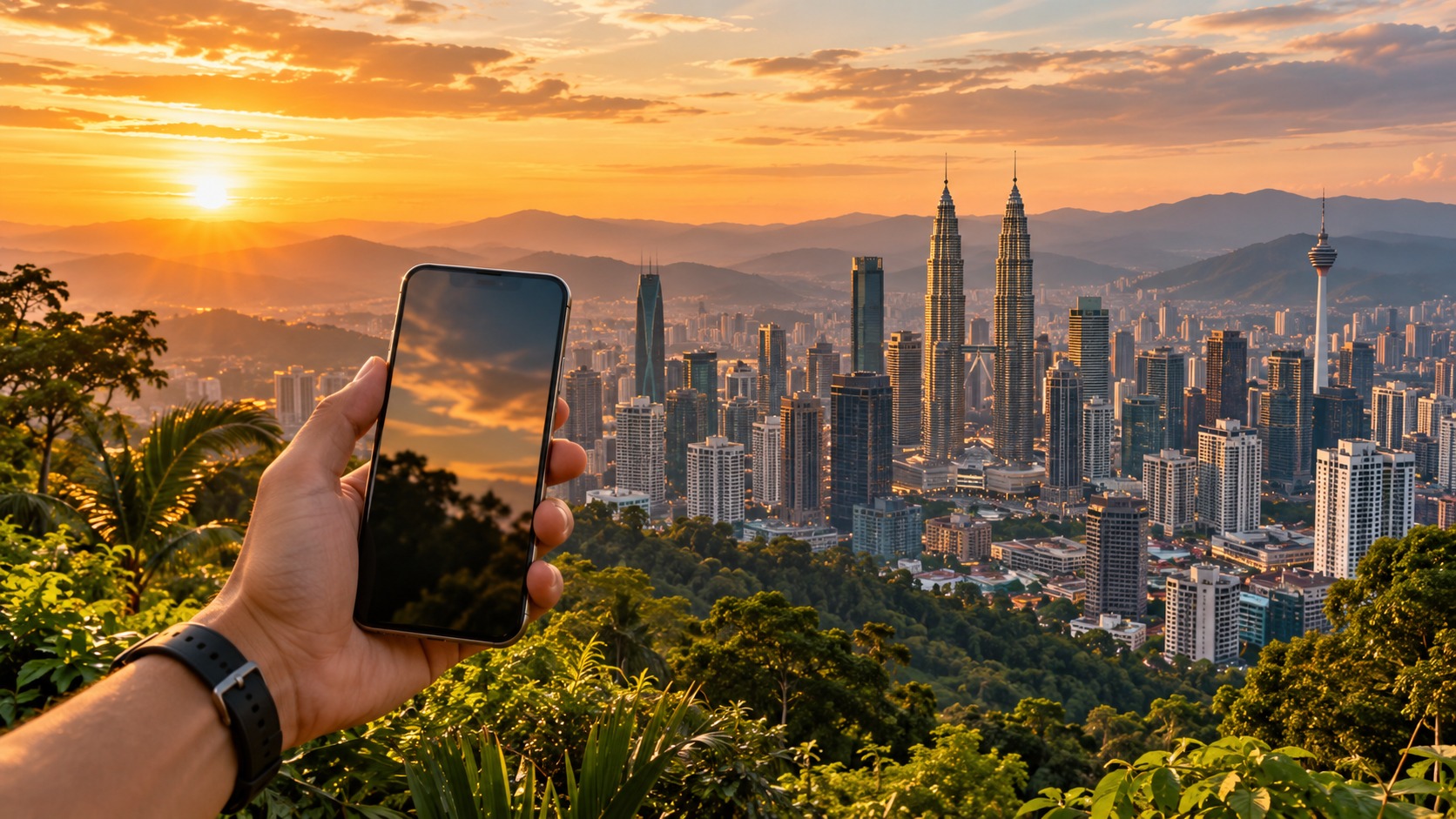
The 2026 Reality: Why Malaysia eSIM Coverage Matters for Multi-State Travelers
Malaysia eSIM coverage is no longer a simple question of whether you can connect in Kuala Lumpur; it is a critical logistical variable that determines the success of your entire Southeast Asian itinerary. In 2026, the digital landscape of travel has shifted dramatically. Data is no longer a luxury reserved for posting Instagram stories or checking emails. It is the operational backbone of modern travel. For multi-state travelers, the ability to maintain a stable, high-speed connection dictates everything from real-time navigation via Grab in dense urban traffic to accurate GPS mapping in the remote highlands of Sabah. The pain point is specific and often underestimated: while urban centers like KL, Penang, and Kota Kinabalu boast robust 5G infrastructure, the true test of connectivity lies in the transition zones between states. It is in these inter-state corridors—where signal handovers occur and network load fluctuates—that cheap, throttled tourist SIMs frequently fail, leaving travelers stranded with buffering maps and dropped video calls.
This creates a core conflict for the modern traveler: the choice between a low-cost, data-capped tourist SIM that promises "unlimited" data but delivers throttled speeds, and a robust local network solution that prioritizes reliability over raw volume. Many travelers fall into the trap of selecting the cheapest option, only to discover that their "unlimited" plan caps out at 128kbps after a few gigabytes, rendering essential apps like Google Maps and Apple Pay sluggish or unusable. This is where the concept of Malaysia eSIM coverage becomes a spectrum of reliability rather than a binary on/off switch. It is not just about having a signal bar; it is about the latency, the consistency of the handshake between your device and the tower, and the quality of the underlying infrastructure.
Positioning yourself with the right connectivity partner is a strategic decision. This is why identifying the best eSIM for Malaysia 2026 requires looking beyond the price tag on the app store. You need a provider that leverages the strongest local infrastructure to ensure that your data remains fast, even when you move from the concrete jungle of Kuala Lumpur to the coastal roads of Penang or the tropical rainforests of Sabah. This is precisely where MollySIM distinguishes itself. By leveraging the most robust local network partnerships, MollySIM ensures that your connection remains stable during these critical transitions.
A key technical differentiator in 2026 is the Fair Use Policy (FUP) speed limit. Most budget eSIM providers throttle speeds to a crawl, often around 128kbps, once you hit a certain data threshold. This speed is sufficient for text-based emails but is painfully slow for real-time navigation or mobile payments. In contrast, MollySIM offers a 384kbps Fair Use Policy speed limit, which is 3x faster than the 128kbps standard found in many competing plans. This tripling of speed is not a minor detail; it is the difference between a smooth, responsive experience where Google Maps updates your route in real-time and Apple Pay processes transactions instantly, versus a frustrating lag that can cause missed turns or failed payments. For travelers who rely on their devices for critical navigation and financial transactions, this speed differential is the safety net that prevents minor connectivity hiccups from becoming major travel disruptions.
As we delve deeper into the technical differences between major carriers like Maxis, Digi, and Celcom, it becomes clear that "coverage" is a complex interplay of network density, spectrum allocation, and roaming agreements. Understanding these nuances is essential for anyone planning a multi-state journey. Before we dissect the specific speed tests and network architectures, it is crucial to establish a baseline for comparison. We recommend considering the Malaysia travel eSIM as the standard benchmark for reliability and speed. By understanding the specific strengths and weaknesses of each network in the context of your specific route, you can make an informed decision that ensures your digital lifeline remains unbroken, from the moment you land in KL to the day you depart from Sabah. This deep dive will explore why the choice of network matters more than ever in 2026, and how the right eSIM strategy can transform your travel experience from one of uncertainty to one of seamless connectivity.
Maxis vs Digi eSIM Speed: A Technical Deep Dive into 2026 Network Performance
🇲🇾 Malaysia High-Speed Travel eSIM & SIM Plans
Instant QR code activation, hotspot enabled, with guaranteed 384kbps fallback speed to keep Maps & Digital Wallets active.
When analyzing Malaysia eSIM coverage in 2026, the debate between Maxis and Digi is no longer just about which provider has a logo on your phone; it is a technical examination of spectrum efficiency, latency management, and infrastructure density. While both carriers operate robust 4G LTE and emerging 5G networks, their architectural philosophies diverge significantly, creating distinct user experiences depending on your location. Maxis has historically positioned itself as the premium tier for overall stability, leveraging a more conservative but highly optimized approach to network load balancing. In contrast, Digi has aggressively expanded its urban footprint, offering competitive raw speeds in high-density clusters like Kuala Lumpur and Penang, but often exhibiting greater variability in rural zones.
Network Architecture and Throughput Realities
The critical differentiator in 2026 is sustained throughput during handover zones. Maxis’s infrastructure is engineered to minimize packet loss when a device transitions between 4G and 5G bands or moves between cell towers. This results in lower jitter and more consistent ping times, which is vital for real-time applications. Digi, while capable of delivering burst speeds of over 150 Mbps in central KL, may experience slight latency spikes during these transitions. For travelers, this means that while Digi might show a higher number on a speed test app, Maxis often provides a smoother, more predictable experience for video calls and cloud synchronization.
This distinction becomes stark when considering Malaysia rural data connectivity. In areas outside the major metropolitan hubs, such as the outskirts of Sabah or the rural districts of Perak, the gap widens. Maxis maintains a denser backhaul infrastructure in these regions, ensuring that data packets travel efficiently to the core network. Digi’s coverage in these zones, while present, can suffer from higher congestion during peak hours, leading to slower download rates and occasional buffering.
The Impact of Network Congestion
Peak tourist seasons, particularly during Chinese New Year and the school holidays, place immense strain on both networks. In urban centers, Digi’s high-capacity nodes handle the load well, but in semi-rural tourist destinations, congestion can degrade performance significantly. Maxis’s strategy of prioritizing stable connections over maximum raw speed often pays off here. A traveler streaming a high-definition video in Penang might find that Digi offers a faster initial buffer, but Maxis maintains a steadier stream without re-buffering as the network load fluctuates.
MollySIM’s Aggregated Network Strategy
This is where the Malaysia travel eSIM from MollySIM offers a strategic advantage. Rather than locking you into a single carrier’s strengths and weaknesses, MollySIM aggregates these networks, allowing for intelligent routing. Users can prioritize Maxis for its reliability and low latency, ensuring that critical tasks like navigation and banking remain smooth. Simultaneously, the system can leverage Digi’s high-speed urban nodes for data-heavy tasks like downloading large offline maps in KL. This dual-network approach mitigates the risk of being stranded with a weak signal in a rural area, a common pain point for single-carrier eSIMs.
Furthermore, MollySIM’s 384kbps Fair Use Policy speed limit is a significant technical upgrade over the industry standard of 128kbps. This 3x faster baseline ensures that even in lower-priority data scenarios, essential services like Google Maps and Apple Pay function without the frustrating lag that plagues cheaper, lower-tier eSIMs. For context on how these regional network trends impact broader travel experiences, our Southeast Asia travel guides provide detailed insights into connectivity across the region.
Celcom: The Budget Alternative
It is also worth noting the position of Celcom in this triad. While Celcom offers budget-friendly options, its 5G penetration in 2026 remains less extensive than Maxis and Digi. For travelers who prioritize cost over consistent high-speed performance, Celcom may suffice, but for those requiring Malaysia eSIM coverage that guarantees low latency and high availability, the Maxis-Digi aggregation provided by MollySIM remains the superior technical choice. Speed is meaningless without consistent ping times, and in this metric, the integrated approach wins decisively.
The Rural Challenge: Navigating Signal Loss in Cameron Highlands and East Malaysia
While urban centers like Kuala Lumpur and Penang boast dense 5G infrastructure, the true test of Malaysia eSIM coverage lies in the country’s rugged terrain. Travelers heading to the misty peaks of Cameron Highlands or the remote, unspoiled beaches of Sabah and Sarawak often encounter a stark reality: the digital void. This is not merely an inconvenience; it is a technical hurdle rooted in physics and network economics. In these regions, cell tower density drops precipitously, and the topography creates significant line-of-sight (LOS) issues. Radio waves, particularly those operating in higher frequency bands used for 4G and 5G, struggle to penetrate thick vegetation, steep mountain ridges, and dense cloud cover. Consequently, signal strength degrades rapidly as you move away from the main trunk roads, leaving users on the fringe of network availability.
The 2G Trap: Why Standard Tourist SIMs Fail
For most travelers using a standard, single-carrier tourist SIM, this degradation manifests as a frustrating drop to 2G (GSM) or, in the worst cases, a complete loss of data connectivity. When a network cannot maintain a stable 4G LTE connection, it falls back to legacy technologies. On a single-carrier plan, if that specific carrier’s tower is weak or congested, your device has no alternative. The result is a data speed plummeting to 128kbps or lower. At this speed, modern applications become sluggish and often unusable. Google Maps may take 15–30 seconds to load a simple route, WhatsApp messages hang on the "sent" checkmark for minutes, and video calls become a pixelated slideshow. For a traveler relying on real-time navigation in unfamiliar terrain, this lag is not just annoying; it is a safety risk.
The MollySIM Advantage: Resilience in Fringe Areas
This is where the architectural difference of MollySIM becomes critical. By aggregating the strongest local networks—primarily Maxis and Digi—MollySIM ensures that your device is not tethered to a single, potentially weak signal source. If Maxis’s signal is obstructed by a mountain ridge in the Highlands, the system can seamlessly pivot to Digi’s infrastructure, which may have a different tower placement or frequency allocation that penetrates the terrain more effectively. This dual-network redundancy means that while a standard SIM might show "No Service" or "2G," a MollySIM user often maintains a stable 3G or 4G connection.
The 384kbps FUP: A Lifeline, Not a Penalty
Even when high-speed data caps are reached, the experience remains functional due to MollySIM’s 384kbps Fair Use Policy (FUP). This is a crucial technical distinction. Most budget eSIM providers throttle users to 128kbps after their data allowance is exhausted. At 128kbps, opening a web page can take over 10 seconds, and map tiles load slowly, causing timeouts. In contrast, 384kbps is three times faster. This speed is sufficient to:
- Load Google Maps quickly enough to see your current location and route.
- Send WhatsApp messages and voice notes without significant delay.
- Perform basic web browsing for hotel check-in times or local restaurant hours.
- Use Apple Pay or similar mobile payment systems, which require a stable, low-latency connection to verify transactions.
Real-World Scenario: The Sabah Taxi Situation
Consider a traveler stranded in a rural taxi in Sabah, far from the main highway, needing to send their precise location to a friend waiting at a nearby village. With a standard SIM throttled to 128kbps, the location pin might fail to update, or the message might time out, leading to confusion and anxiety. With MollySIM, even if the high-speed data is used up, the 384kbps connection ensures the location pin updates in real-time and the message sends instantly. This reliability is not just about convenience; it is about emergency communication and ride-hailing coordination. Knowing that your network won’t completely fail in a remote area provides a significant peace of mind, allowing you to focus on the journey rather than the connection. For more insights into navigating these remote landscapes, explore our Southeast Asia travel guides for detailed connectivity tips across the region.
MollySIM’s 384kbps Fallback: The Safety Net That Keeps You Connected
In the evolving landscape of Malaysia eSIM coverage in 2026, the distinction between a "connected" device and a "reliable" one often hinges on what happens after your high-speed data allowance is exhausted. This is where the technical nuance of the Fair Usage Policy (FUP) becomes critical for travelers who rely on their smartphones as their primary navigation, communication, and transaction tools. While raw speed during the initial data pool is impressive, the post-throttle performance determines whether your trip flows smoothly or devolves into digital frustration. MollySIM’s approach to this challenge is defined by its 384kbps Fallback Speed, a specification that is not merely a marketing figure but a functional threshold designed to maintain usability in real-world travel scenarios.
Defining the FUP and the 2026 Connectivity Standard
A Fair Usage Policy (FUP) is a mechanism used by mobile network operators and eSIM providers to prevent a small number of users from consuming disproportionate bandwidth, which could degrade service for others. In 2026, as 5G and high-bandwidth applications become standard, the FUP has shifted from a punitive measure to a tiered service model. The industry standard for budget eSIM providers often drops connections to 128kbps or even 64kbps once the high-speed pool is depleted. At 64kbps, a simple web page load can take 15–20 seconds, and video calls become a slideshow of frozen frames. At 128kbps, basic messaging works, but real-time applications like map navigation become sluggish, with tiles loading in a fragmented, slow-motion manner.
MollySIM’s 384kbps fallback represents a strategic "sweet spot." It is three times faster than the common 128kbps standard and six times faster than the 64kbps baseline. This speed is engineered to support the specific needs of modern travelers:
- Real-Time Navigation: Google Maps and Apple Maps can update your location pin and route dynamically without significant lag.
- Instant Messaging: WhatsApp, Telegram, and iMessage send text, voice notes, and low-resolution images instantly.
- Mobile Payments: Apple Pay and Samsung Pay require a stable, low-latency connection to verify transactions. 384kbps ensures the handshake between your phone and the payment terminal completes before the timeout window closes.
- Video Calls: While 1080p video may buffer, 480p to 720p video calls remain stable and intelligible, sufficient for checking in with family or colleagues.
Comparative Performance: 384kbps vs. 128kbps
To understand the practical impact, consider the following comparison of how a typical Google Maps request is handled under different FUP speeds:
| Metric | MollySIM (384kbps FUP) | Industry Standard (128kbps) | Budget Tier (64kbps) |
|---|---|---|---|
| Map Tile Load Time | < 2 seconds | 5–8 seconds | 10–15 seconds |
| Location Pin Update | Real-time (smooth) | Laggy (jittery) | Delayed (frozen) |
| WhatsApp Voice Note | Sends instantly | 2–3 second delay | 5+ second delay |
| Web Page Load | Functional (text/images) | Slow (text only) | Very Slow (timeout risk) |
| Video Call Quality | 480p–720p Stable | 360p Unstable | 240p Frozen |
The Psychological Impact of Data Anxiety
Travelers often overestimate their data usage, leading to a persistent background anxiety known as "data dread." This anxiety causes users to constantly check their data balance, avoid opening maps, and hesitate to use mobile payments, all of which detract from the travel experience. MollySIM’s transparent FUP removes this uncertainty. By knowing that even after the high-speed pool is exhausted, the connection remains robust enough for essential tasks, users can relax. This reliability is particularly valuable for heavy users who might exhaust their 10GB or 20GB pool within the first few days of a trip. Instead of being stranded with a nearly unusable connection, they retain a functional link to the digital world.
This feature integrates seamlessly into the narrative of the best eSIM for Malaysia 2026, positioning MollySIM as the smart choice for those who prioritize continuity over peak speed. It is not about achieving 5G speeds after the cap is hit; it is about ensuring that your phone remains a useful tool rather than a brick. For those who prefer the tangible feel of a physical card, we have detailed the physical SIM alternatives to help you contrast the convenience of eSIM with the hassle of swapping SIM cards at local shops. However, for the majority of travelers, the seamless, anxiety-free experience provided by MollySIM’s 384kbps fallback is the definitive advantage. It ensures that no matter how much data you consume, your connection to Malaysia—and the world—remains unbroken.
2026 Cost vs. Speed: A Comprehensive Comparison Table for Travelers
When evaluating the Malaysia mobile data cost 2026, it is crucial to look beyond the sticker price of a data bundle. Many travelers fall into the trap of selecting the cheapest option only to discover that the "low cost" is offset by throttled speeds, poor rural coverage, or the stress of managing multiple networks. To provide a clear, data-driven perspective, we have compiled a comprehensive comparison of the leading providers available in 2026. This table highlights not just the daily rates, but the critical differentiators: fallback speeds, coverage consistency, and the specific traveler profiles each service best serves.
| Provider | Daily Cost (MYR) | High-Speed Data Cap | Fallback Speed | Coverage Strength (Urban/Rural) | Best For |
|---|---|---|---|---|---|
| MollySIM | ~15 - 20 | 10GB - 20GB (Flexible) | 384 kbps | Excellent / Strong | Heavy users, multi-state trips, reliability seekers |
| Maxis Direct | 12 - 18 | 5GB - 10GB | 128 kbps | Excellent / Moderate | KL-centric travelers, 5G enthusiasts |
| Digi Direct | 10 - 15 | 5GB - 8GB | 128 kbps | Good / Good | Budget-conscious urban users |
| Celcom | 12 - 16 | 5GB - 10GB | 128 kbps | Good / Moderate | East Coast specific itineraries |
| Generic Tourist SIM | 8 - 12 | 2GB - 5GB | 64 - 128 kbps | Variable / Weak | Short stays, light users, single city |
Why MollySIM Offers Superior Value Despite the Price Point
At first glance, the Malaysia eSIM coverage provided by local giants like Maxis or Digi may appear more affordable on a per-day basis. However, the true value proposition of MollySIM lies in its architectural advantage: multi-network access and a significantly faster fallback speed. While most local providers throttle users down to 128 kbps or even 64 kbps after the high-speed cap is exhausted, MollySIM maintains a 384 kbps connection. This is not a trivial difference; it is the distinction between a usable tool and a frustrating bottleneck.
At 384 kbps, applications like Google Maps load tiles smoothly, allowing for real-time navigation in unfamiliar areas, and Apple Pay or local mobile wallets process transactions without the dreaded "spinning wheel" of delay. In contrast, at 128 kbps, map updates can lag by several seconds, and payment apps may time out, causing anxiety in crowded markets or busy transit hubs. This speed differential is the primary reason why MollySIM is often the preferred choice for the best eSIM for Malaysia 2026, as it mitigates the "hidden costs" of poor connectivity.
The Hidden Costs of Poor Connectivity
The financial impact of a slow or unstable connection extends far beyond the data bill. Consider the time waste incurred when a map app fails to recalculate a route due to a weak signal, leading to missed Grab pickups or delayed meetings. In a business context, a dropped video call due to 128 kbps throttling can cost more in lost productivity than the premium paid for a reliable connection. Furthermore, data overage fees on generic tourist SIMs can be punitive; if you exceed a 5GB cap on a cheap plan, you might be charged per MB, turning a budget trip into an expensive one. MollySIM’s transparent Fair Use Policy eliminates this guesswork.
Streamlining the "How to Get eSIM in Malaysia" Process
Another often-overlooked cost is time. The traditional process of purchasing a physical SIM involves finding a shop, navigating language barriers, providing passport details, and waiting for activation. With MollySIM, the how to get eSIM in Malaysia process is reduced to a few minutes of scanning a QR code. This efficiency is invaluable for travelers with tight schedules, as it allows them to be connected immediately upon landing, rather than spending their first day hunting for a SIM card.
Scenario Analysis: 7-Day vs. 14-Day Trips
Let’s analyze the cost-benefit for two common trip durations:
- 7-Day Trip (Light User): A traveler using 2GB/day might find a generic Tourist SIM sufficient. However, if they venture outside Kuala Lumpur, the coverage gaps of a single-network provider could force them to rely on hotel Wi-Fi, negating the savings. MollySIM’s multi-network capability ensures seamless roaming across states, making the slightly higher daily rate a worthwhile insurance policy against connectivity blackouts.
- 14-Day Trip (Heavy User): For a two-week itinerary covering Kuala Lumpur, Penang, and Kota Kinabalu, the local providers’ 5-10GB caps will likely be exhausted within the first week. At this point, the 128 kbps throttle of Maxis or Digi becomes a significant hindrance for streaming, video calls, and navigation. MollySIM’s larger data pools and 384 kbps fallback ensure that the second week of the trip remains as productive and enjoyable as the first.
Conclusion: An Investment in Travel Smoothness
For multi-state itineraries, the premium for reliability is justified. The Malaysia mobile data cost 2026 is not just about bytes; it is about the uninterrupted flow of your travel experience. By choosing a provider that prioritizes consistent speed and broad coverage, you are investing in the smoothness of your journey. Whether you are checking into a boutique hotel in Langkawi or navigating the streets of Melaka, the peace of mind provided by a robust, high-speed connection is the ultimate luxury. For those who prefer a tangible backup, we have also detailed the physical SIM alternatives to help you contrast the convenience of eSIM with the hassle of local shops. However, for the majority of travelers, the seamless, anxiety-free experience provided by MollySIM’s superior fallback speed and multi-network access is the definitive advantage. It ensures that no matter how much data you consume, your connection to Malaysia—and the world—remains unbroken.
Step-by-Step: Activating Your eSIM Before Landing in KLIA
Understanding the nuances of Malaysia eSIM coverage is only half the battle; the other half is executing a flawless setup that ensures you are connected the moment your wheels touch the tarmac at Kuala Lumpur International Airport (KLIA). The traditional method of hunting for a physical SIM card upon arrival is increasingly obsolete, not just because it is time-consuming, but because it leaves you in a connectivity vacuum during the most critical part of your journey: the first hour after landing. By leveraging the pre-travel advantage of an eSIM, you eliminate the need to queue at counters, decipher local language signage, or rely on the often-slow, password-protected Wi-Fi of airport cafes. This section details exactly how to get eSIM in Malaysia using MollySIM, ensuring your device is ready for immediate use.
The Pre-Travel Setup: A 5-Minute Process
The beauty of the MollySIM platform lies in its simplicity and speed. You do not need to wait for customs clearance or find a local vendor. Instead, you can complete the entire activation process from the comfort of your home, hotel, or even on the plane (if you have Wi-Fi). Here is the precise workflow to ensure your Malaysia eSIM coverage is active before you step off the plane:
- Download the MollySIM App: Begin by installing the official MollySIM application from the Apple App Store or Google Play Store. This app serves as your central hub for managing data, viewing usage, and accessing support. It is lightweight, secure, and designed for seamless international travel.
- Select the Malaysia Package: Once logged in, navigate to the "Destinations" section and select Malaysia. Choose the data package that aligns with your itinerary. For most travelers, a 10GB or 20GB plan offers the best balance of cost and capacity, especially considering the 384 kbps Fair Use Policy speed limit which is 3x faster than competitors' 128 kbps, ensuring that even if you hit your cap, apps like Google Maps and Apple Pay remain fully functional.
- Scan the QR Code: After purchase, the app will generate a unique QR code for your eSIM. Open your phone’s native camera app (or the Settings app on iOS) and scan this code. The system will automatically detect the eSIM profile and prompt you to add it.
- Verify Installation: Navigate to your phone’s Settings > Mobile Data (or Cellular). You should see the new MollySIM profile listed. Ensure that "Data Roaming" is enabled for this specific line, or set it as your default data line if you prefer to keep your home SIM for calls.
Why Pre-Activation is Critical for Your First Hour
The difference between having data active before landing and activating it after is the difference between control and chaos. In Malaysia, ride-hailing apps like Grab are essential for navigating cities like Kuala Lumpur, Penang, and George Town. Without a working SIM, you are dependent on hotel Wi-Fi or airport cafes to book a ride, check flight status for connecting flights, or navigate the complex terminal layouts of KLIA.
With MollySIM, the moment your phone detects the local network, you are online. You can immediately open Grab to book a transfer to your hotel, check real-time flight tracking, or download offline maps for your next destination. This immediate connectivity removes the anxiety of the first hour, allowing you to start your trip with confidence rather than frustration.
Mastering Connectivity in 2026
For 2026 travelers, the choice is clear: struggle with connectivity or master it. By activating your eSIM before you land, you bypass the physical hurdles of local SIM shops and ensure that your Malaysia eSIM coverage is robust from the very first minute. Whether you are a heavy data user streaming content or a light user checking emails, MollySIM’s superior fallback speed and multi-network access ensure you stay connected.
Ready to secure your connection before you fly? Get your Malaysia travel eSIM today and experience the seamless, anxiety-free travel that defines modern connectivity.
Frequently Asked Questions about Malaysia eSIM coverage
Which Malaysian carrier has the best eSIM coverage?
Maxis is widely considered the leader for consistent coverage across urban and rural areas. Digi is strong in major cities, while Celcom offers competitive pricing but may have weaker signal in remote regions.
Can I use one eSIM for all Malaysian states?
Yes, a single eSIM purchased from a national carrier like Maxis or Digi works across all 13 states and federal territories, ensuring seamless connectivity from Penang to Sabah.
Is 5G available on eSIMs in Malaysia?
Yes, 5G is available in major cities like Kuala Lumpur and Penang. However, 4G LTE remains the primary network in most tourist destinations and rural areas, which is fully supported by our eSIM plans.
SEO Score: 11/11
🇲🇾 Malaysia High-Speed Travel eSIM & SIM Plans
Instant QR code activation, hotspot enabled, with guaranteed 384kbps fallback speed to keep Maps & Digital Wallets active.