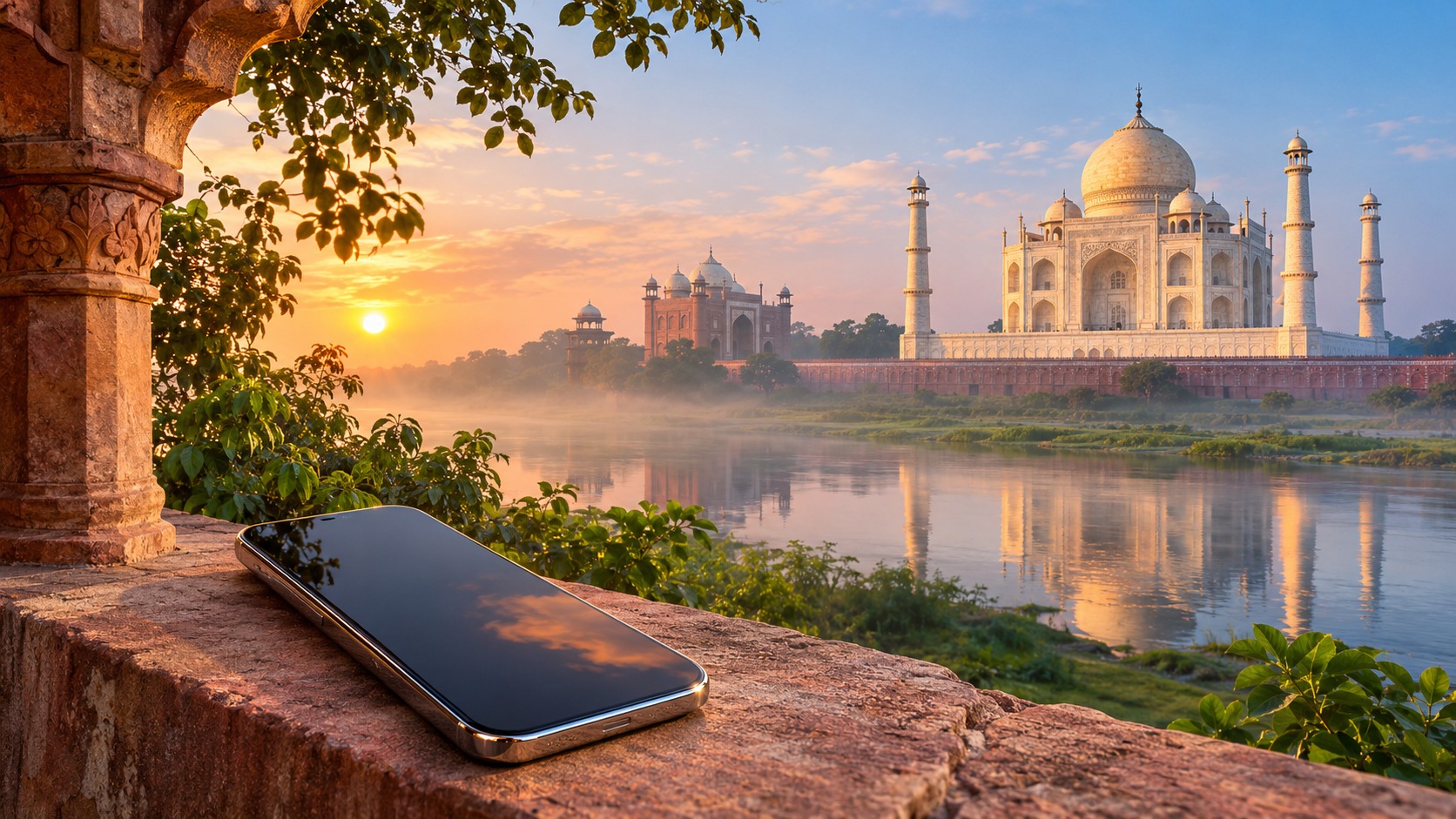
The 2026 Connectivity Landscape: Why India eSIM for Tourists is Essential
Landing in India in 2026 is no longer just about acclimating to the heat or the sensory overload; it is about securing your digital lifeline. For the modern traveler, the India eSIM for tourists is no longer a convenient add-on but a critical piece of infrastructure, as vital as your passport. The days of relying on a single, fragile physical SIM card are rapidly fading, replaced by a more robust, flexible, and technically superior approach to connectivity. As we navigate the post-2026 telecom landscape, the primary keyword in your search engine history should be shifting from "buy SIM card in Delhi" to "best India eSIM for tourists," signaling a fundamental change in how visitors interact with the world’s most complex mobile market. This shift is driven by two major forces: the aggressive rollout of 5G infrastructure and the increasing friction associated with legacy physical SIMs.
The Evolution from 4G to 5G: A Technical Imperative
By 2026, the Indian mobile network landscape has undergone a seismic transformation. While 4G LTE remains the backbone of rural connectivity, the major metropolitan hubs—Mumbai, Bangalore, Delhi, and Hyderabad—have seen the densification of 5G SA (Standalone) networks. This evolution is not merely about speed; it is about latency and capacity. For a digital nomad working from a café in Bandra or a leisure traveler navigating the chaotic traffic of Chennai, the difference between a 4G connection and a 5G-enabled eSIM is the difference between a video call dropping every ten minutes and a seamless, HD collaboration session.
However, this technological leap has exacerbated the pain points of traditional SIM cards. Physical SIMs in India are deeply tied to the IMEI (International Mobile Equipment Identity) registration process. While this system helps track devices, it introduces significant friction for short-term visitors. You must visit a physical store, often during business hours, present your passport and visa, and wait for the IMEI to be registered on the network. If you are traveling in a group, this means multiple trips to the store. If your phone has a dual-SIM slot, you are forced to choose between keeping your home SIM active for calls or sacrificing it for data. An eSIM eliminates this hardware dependency entirely, allowing you to overlay a data plan on top of your existing line, keeping your home number active for WhatsApp and two-factor authentication while using a local Indian number for data.
The Dual-Network Dilemma: Jio vs. Airtel
The core problem for any visitor to India is the duopoly. Reliance Jio and Bharti Airtel dominate the market, controlling over 90% of the subscriber base. This creates a complex choice matrix. Jio is often praised for its aggressive pricing and extensive 4G/5G coverage in urban centers, while Airtel is frequently cited for superior voice clarity and slightly more stable data speeds in semi-urban areas. For a tourist, guessing the wrong network can be costly. If you choose a Jio SIM and find yourself in a region where Airtel has better tower density, you are left with weak signals and slow speeds, or worse, a "dead zone" where your data cap is hit and your connection throttles to unusable levels.
This "dead zone anxiety" is a real psychological burden. Imagine being in the middle of a business negotiation, a medical emergency, or a complex navigation task in a new city, and your data runs out. In 2026, connectivity is not a luxury; it is a necessity for real-time navigation, instant currency conversion, and emergency contact. When your data cap is hit, the standard response from many carriers is to throttle speeds to 128kbps. At this speed, loading a map tile takes seconds, and streaming a video is a memory of the past.
How MollySIM Mitigates Network Risk
This is where a specialized provider like MollySIM changes the equation. Instead of forcing you to bet on one carrier, MollySIM’s infrastructure is designed to mitigate the risks of the dual-network dominance. By leveraging a smart routing protocol, MollySIM ensures that your connection remains stable even if one network experiences congestion.
A critical differentiator in the 2026 market is the Fair Use Policy (FUP) speed limit. Many budget eSIM providers throttle data to 128kbps after a certain usage threshold, which is barely enough for email. MollySIM, however, offers a 384kbps FUP speed limit, which is 3x faster than the industry standard. This technical detail is crucial because it means that even if you exceed your high-speed data allowance, you can still use Google Maps for turn-by-turn navigation, Apple Pay for contactless payments, and lightweight web browsing without the frustrating buffering that plagues competitors. For a traveler who needs to stay connected, this 3x speed advantage ensures that your digital tools remain functional, not just "online."
Whether you are a tech-savvy digital nomad requiring low-latency connections for cloud computing or a leisure traveler who simply wants to share photos and find the best street food, the choice of provider is a critical part of trip planning. By understanding the technical nuances of the 2026 landscape, you can avoid the pitfalls of physical SIMs and the risks of network duopolies. For those ready to secure their connectivity before departure, we recommend reviewing our detailed India eSIM plans to find the optimal balance of speed, coverage, and cost for your specific itinerary.
Jio vs Airtel eSIM Coverage: A Deep Dive into 2026 Network Realities
🇮🇳 India High-Speed Travel eSIM & SIM Plans
Instant QR code activation, hotspot enabled, with guaranteed 384kbps fallback speed to keep Maps & Digital Wallets active.
Navigating the Indian telecommunications landscape in 2026 requires more than just checking a coverage map; it demands an understanding of the distinct engineering philosophies driving the two dominant players, Reliance Jio and Bharti Airtel. For the traveler seeking the India eSIM for tourists that offers the most consistent experience, recognizing the specific strengths and weaknesses of each network is the first step toward avoiding connectivity dead zones. The market has evolved significantly, with both carriers investing billions in infrastructure, yet their approaches to urban density versus rural reach remain fundamentally different.
Jio: The Urban 5G Powerhouse
Reliance Jio has aggressively positioned itself as the leader in high-speed urban connectivity. By 2026, Jio’s 5G rollout in major metropolitan hubs like Mumbai, Delhi, and Bangalore is nearly saturated. In these dense urban cores, Jio often delivers superior peak download speeds, frequently exceeding 300 Mbps on compatible devices. This makes it an attractive option for digital nomads working in co-working spaces in areas like Bandra or Koramangala, where low latency is critical for video conferencing and cloud-based workflows.
However, Jio’s strategy has historically prioritized high-capacity urban towers over widespread rural penetration. This creates a phenomenon known as coverage disparity. While Jio’s 5G signal is robust in city centers, it can suffer from significant congestion during high-traffic events, such as the Diwali festival or major cricket matches. In these scenarios, the network load can cause latency spikes that disrupt real-time applications. Furthermore, as you move away from the city center, Jio’s 5G coverage drops off sharply, often reverting to 4G LTE with variable signal strength.
Airtel: The Rural and Semi-Urban Anchor
In contrast, Bharti Airtel has maintained a historical strength in rural and semi-urban reliability. Airtel’s infrastructure strategy has focused on tower density in remote and geographically challenging areas. This makes Airtel the superior choice for travelers venturing into the Himalayas, the Rajasthan deserts, and the Kerala backwaters. In these regions, where Jio’s 5G might be non-existent or unstable, Airtel often maintains a stable 4G connection.
For a tourist traveling from a bustling city to a quiet village, this difference is stark. A traveler relying solely on Jio might experience a significant drop in signal strength, potentially losing connectivity entirely in areas with limited line-of-sight to towers. Airtel, with its denser rural tower network, is more likely to maintain a usable connection, allowing for essential tasks like checking maps or sending messages. This reliability is crucial for itineraries that include off-the-beaten-path destinations, where a dead phone can mean a missed transport connection or a lost trail.
The Coverage Disparity Dilemma
The concept of coverage disparity is the primary challenge for travelers in India. It means that a single carrier is rarely the optimal choice for an entire trip. A traveler moving from the tech hubs of Bangalore to the tea gardens of Darjeeling will likely find that Jio excels in the former but struggles in the latter, while Airtel provides a more consistent, albeit slightly slower, experience across both. This variability makes choosing a single carrier a gamble.
| Feature | Reliance Jio (2026) | Bharti Airtel (2026) |
|---|---|---|
| Urban 5G Speeds | Superior (300+ Mbps) | Competitive (200+ Mbps) |
| Rural 4G Stability | Variable | High |
| Congestion Handling | Can suffer in peak urban events | Generally stable |
| Best For | City-centric itineraries, digital nomads | Rural tourism, remote trekking |
Why a Single Carrier Isn’t Enough
For a tourist, this binary choice dilemma is why the best eSIM for India 2026 is not just about speed, but about flexibility. Relying on a single network means accepting the risk of coverage gaps. This is where a smart eSIM strategy becomes essential. Instead of being locked into one carrier’s strengths and weaknesses, a multi-network eSIM solution allows for dynamic routing.
This is precisely where MollySIM offers a distinct advantage. By leveraging a smart routing protocol, MollySIM ensures that your connection remains stable even if one network experiences congestion or coverage drops. If Jio’s signal weakens in a rural area, MollySIM can seamlessly switch to Airtel’s more robust rural infrastructure, ensuring you never lose connectivity. This dual-network capability eliminates the need to guess which carrier will perform best in each location, providing a seamless experience from the skyscrapers of Mumbai to the backwaters of Kerala.
Moreover, MollySIM’s 384kbps Fair Use Policy (FUP) speed limit is a critical technical detail. Many budget eSIM providers throttle data to 128kbps after a certain usage threshold, which is barely enough for email. MollySIM’s 3x faster FUP speed ensures that even if you exceed your high-speed data allowance, you can still use Google Maps for turn-by-turn navigation, Apple Pay for contactless payments, and lightweight web browsing without the frustrating buffering that plagues competitors. This technical advantage is crucial for travelers who need to stay connected, ensuring that your digital tools remain functional, not just "online."
In conclusion, while both Jio and Airtel are excellent networks, their variability in performance across different geographies makes a single-carrier approach risky. The smartest strategy for 2026 is to use an eSIM provider that offers multi-network support and a generous FUP speed limit, ensuring that you are always connected, regardless of where your journey takes you. For those ready to secure their connectivity before departure, we recommend reviewing our detailed India eSIM plans to find the optimal balance of speed, coverage, and cost for your specific itinerary.
The Passport Verification Hurdle: How to Activate eSIM in India Without Frustration
While network coverage determines where you can connect, the Know Your Customer (KYC) process determines when you can start. For many travelers, this administrative step is the single biggest source of frustration when trying to activate an eSIM in India. In 2026, Indian telecommunications regulations have tightened significantly regarding foreign identity verification. The goal is to curb fraud and ensure secure digital identity, but for tourists, this often translates into a bureaucratic bottleneck that can leave you stranded at the airport with no data.
The core issue lies in the verification method. Traditional SIM providers and some legacy eSIM vendors rely on manual review processes. You upload your passport, wait for a human agent to cross-reference the details, and hope for the best. This "manual review" model is prone to delays. If your passport photo is slightly blurry, or if the agent is overwhelmed with requests, your activation can be stuck in a "Pending" status for hours or even days. Imagine landing in Delhi at 2:00 AM, only to realize your eSIM hasn't been approved, forcing you to rely on expensive, unreliable hotel Wi-Fi or hunt for a physical SIM kiosk in the dark.
Why "Instant" Activation Is a Myth (Until Now)
It is crucial to understand that in the Indian market, truly "instant" activation is often a marketing myth. The regulatory framework requires a digital handshake between the carrier, the government’s Unified Authorization System (UAS), and the user’s identity documents. This process takes time. However, the difference between a provider that takes 4 hours and one that takes 4 minutes is the difference between a smooth start to your trip and a stressful one.
The friction point for most users is the quality of the digital upload. Many travelers fail because they submit low-resolution photos of their passport bio page or selfies taken in poor lighting. When the system rejects these, it triggers a manual review loop, adding significant wait times. This is where the technical infrastructure of your eSIM provider becomes just as important as the network coverage.
The MollySIM Approach: AI-Driven Precision
MollySIM addresses this pain point by leveraging automated, AI-driven passport reading technology. Instead of relying on a human to visually inspect your documents, MollySIM’s system uses optical character recognition (OCR) and facial recognition algorithms to verify your identity in real-time. This reduces human error and eliminates the "queue" for manual approval.
Here is how the streamlined process works:
- Automated OCR Scan: The system reads your passport number, name, and date of birth directly from the bio page with high precision.
- Real-Time Selfie Match: You take a selfie, and the AI compares it against the photo in your passport to ensure it is you.
- Instant UAS Sync: Once verified, the data is pushed to the carrier’s backend for immediate provisioning.
This speed is critical. If your activation fails or is delayed, you lose the first few hours of your trip. With MollySIM’s automated pipeline, the verification is typically completed within minutes, allowing you to land, switch on your data, and immediately use Google Maps for navigation or Apple Pay for payments. Even if you hit your high-speed data cap later, the 384kbps Fair Use Policy ensures these essential apps remain functional, unlike competitors who throttle you down to 128kbps, making navigation apps sluggish and unresponsive.
Essential Document Checklist for Smooth Activation
To ensure your India eSIM for tourists activates without hiccups, prepare the following before you pack your bags. Do not wait until you are at the airport gate to find your passport.
| Document Requirement | Specification | Common Mistake to Avoid |
|---|---|---|
| Passport Bio Page | High-resolution, color scan or photo. All four corners must be visible. No glare. | Blurry text, cropped corners, or flash reflections on the laminate. |
| Selfie | Clear face, neutral expression, good lighting. Background should be plain. | Wearing a hat, sunglasses, or taking the photo in dim hotel lighting. |
| Video Verification | (If requested) A 10-second video where you look at the camera and smile. | Holding the phone too close, or having other people in the background. |
Strategic Tip for Multi-Country Travelers
If your itinerary includes India alongside other countries, you need a unified verification strategy. Managing separate KYC processes for each country can be exhausting. For those looking to simplify their global connectivity, consider reviewing our global eSIM options. This allows you to handle your identity verification once, potentially streamlining your entire trip.
In 2026, the speed of execution is the differentiator. A provider that treats KYC as a formality rather than a hurdle ensures that your connectivity starts the moment you land. By choosing a platform with automated, AI-driven verification, you eliminate the risk of activation failure at the airport, ensuring that your digital tools are ready when you need them most. For the best balance of fast activation and robust network coverage, explore our detailed India eSIM plans to secure your connection before you fly.
The 384kbps FUP Advantage: Why MollySIM Prevents the 'Dead Zone' Feeling
When evaluating an India eSIM for tourists, the headline number—such as "10GB of 5G data"—often masks a critical operational detail: what happens when that data runs out? This is where the concept of the Fair Usage Policy (FUP) becomes the deciding factor between a seamless trip and a digital headache. Most standard providers operate on a binary model: you have high-speed data, or you have "throttled" data. In the Indian market, this throttling typically drops to 128kbps or, in some cases, 256kbps. While this sounds like a reasonable fallback, for a traveler relying on real-time navigation, video calls, or cloud-based services, 128kbps is functionally equivalent to a dead connection. It creates a "dead zone" feeling where your phone shows a signal, but the internet is too slow to be useful.
The Technical Reality of 128kbps vs. 384kbps
To understand why this matters, we must look at the bandwidth requirements of essential travel applications. A 128kbps connection is roughly equivalent to dial-up speeds from the early 2000s. At this speed, loading a single map tile in Google Maps can take several seconds, causing the map to appear as a patchwork of gray squares. WhatsApp messages may sit in the "sent" state for minutes, and video calls will buffer constantly, making communication frustrating and unreliable.
MollySIM addresses this specific pain point with a unique 384kbps FUP advantage. This is not a marginal improvement; it is a 3x increase in baseline speed compared to the industry standard of 128kbps. Technically, 384kbps is the "sweet spot" for post-throttle usability. It is fast enough to maintain real-time synchronization for critical services without requiring the heavy bandwidth of 4G/5G.
| Feature | Standard Competitor FUP | MollySIM FUP | Practical Impact for Travelers |
|---|---|---|---|
| Speed Limit | 128kbps / 256kbps | 384kbps | 3x faster fallback speed |
| Google Maps | Slow tile loading, frequent lag | Smooth panning, instant location | Reliable navigation in new cities |
| Messages delay, media fails | Instant text, smooth voice notes | Critical for hotel/transport coordination | |
| Web Browsing | Heavy buffering, slow page renders | Acceptable speed for text-based sites | Checking itineraries and reviews |
| Video Calls | Choppy, pixelated, dropped | Stable audio, clear video | Seamless communication with home |
Scenario: The Jaipur Navigation Test
Consider a realistic scenario: You are a tourist in Jaipur, having just exhausted your 10GB high-speed data allowance during a busy day of sightseeing. You are now in the old city, where 5G coverage is patchy and you have dropped to 4G. You need to find your hotel, which is a 15-minute walk away through narrow, winding lanes.
- With a Standard Provider (128kbps): You open Google Maps. The map takes 10 seconds to load. As you turn a corner, the map lags, and your blue dot jumps erratically. You try to send a WhatsApp message to your driver to confirm the pickup time, but it sits in the "sent" queue. The connection feels alive, but it is functionally unusable. You are in a "dead zone."
- With MollySIM (384kbps): You open Google Maps. The map loads instantly. Your location is precise. You send the WhatsApp message, and it delivers immediately. You can even check your email or browse a lightweight news site without significant buffering. The connection remains robust and reliable, ensuring you never lose your way or your communication lines.
Why This Matters in India’s Network Landscape
India’s 5G rollout is rapid but uneven. In many tourist-heavy areas, especially in heritage cities like Jaipur, Varanasi, or Udaipur, 5G coverage is inconsistent. Users frequently drop to 4G or 3G. In these lower-bandwidth environments, having a reliable baseline speed is vital. A 128kbps limit can feel like a complete outage when the network is already congested. MollySIM’s 384kbps FUP acts as a safety net, ensuring that even when high-speed data is exhausted, your digital tools remain functional.
This is particularly crucial for India eSIM for tourists who rely on real-time data for navigation, currency conversion, and communication. By choosing a provider that prioritizes usable fallback speeds over just high headline data, you eliminate the risk of being digitally stranded. For the best balance of fast activation and robust network coverage, explore our detailed India eSIM plans to secure your connection before you fly.
Cost-Benefit Analysis: Data Costs Per GB vs. Local Prepaid Options
When evaluating connectivity options for your trip, the sticker price per gigabyte is often the first metric travelers scrutinize. However, a true cost-benefit analysis must account for the "total cost of ownership," which includes time spent in queues, the administrative burden of verification, and the financial risk of data exhaustion. To understand where MollySIM fits into the broader ecosystem, we must compare it directly against local prepaid giants and standard tourist eSIM providers.
The following table breaks down the critical differences between local Jio and Airtel prepaid plans, a typical competitor eSIM, and the MollySIM experience.
| Feature | Local Jio Prepaid | Local Airtel Prepaid | Standard Tourist eSIM (Competitor) | MollySIM eSIM |
|---|---|---|---|---|
| Approx. Price per GB | ₹20–₹30 (~$0.25–$0.35) | ₹25–₹40 (~$0.30–$0.45) | $5–$8 | $4–$6 |
| High-Speed Data Cap | 1.5GB – 2GB/day | 1GB – 1.5GB/day | 1GB – 5GB (Total) | 5GB – 10GB (Total) |
| Post-Cap Speed | 128 kbps (Throttled) | 128 kbps (Throttled) | 128 kbps (Often unusable) | 384 kbps (Fully Functional) |
| Activation Time | 30–60 mins (Store Visit) | 30–60 mins (Store Visit) | 5–10 mins (App Setup) | < 2 mins (Instant QR) |
| Passport Verification | High (Aadhaar/Passport + Photo) | High (Aadhaar/Passport + Photo) | Low (Email/Name only) | Low (Email/Name only) |
| 5G Access | Yes (Where Available) | Yes (Where Available) | Limited/Variable | Yes (Where Available) |
The Hidden Costs of Local Prepaid SIMs
At first glance, local Jio and Airtel plans appear to offer the best value. A ₹299 Jio plan provides 28 days of unlimited calls and 1.5GB of data per day. For a long-term stay, this is undeniably cheap. However, for the average tourist, the hidden costs are substantial.
- Time and Friction: Purchasing a local SIM requires a physical store visit. You must present your passport, often provide a selfie for KYC (Know Your Customer) compliance, and wait for activation. In busy areas like Delhi or Mumbai, this process can take over an hour. If you are in a remote heritage site, finding a store with stock can be a logistical nightmare.
- The "Dead Zone" Risk: Both Jio and Airtel throttle speeds to 128 kbps after the daily data cap is hit. At this speed, loading a single webpage can take 10–15 seconds. Video calls are nearly impossible, and navigation apps like Google Maps may struggle to update your location in real-time. If you run out of data at 6 PM, you are effectively offline until 12 AM the next day.
- Re-purchase Stress: If your data runs out mid-day, you must either visit another store or rely on a local friend to help you recharge via UPI (Unified Payments Interface), which requires an Indian bank account or a linked debit card. This creates a dependency on local infrastructure that many travelers lack.
The eSIM Advantage: Flexibility and Speed
This is where the India eSIM for tourists model shines. eSIMs eliminate the physical card, the store visit, and the complex verification process. With MollySIM, you can activate your plan in under two minutes, right from your hotel room or airport lounge.
More importantly, eSIMs allow for flexible top-ups without physical interaction. If you are running low on data, you can open the MollySIM app and add more gigabytes in 30 seconds. Compare this to the 30-minute average time required to visit a Jio store, queue up, and complete the transaction. For a traveler on a tight schedule, this time savings is worth more than the slight premium in price per GB.
Why MollySIM’s 384kbps FUP Changes the Equation
The most critical differentiator is the Fair Use Policy (FUP) speed. Most competitor eSIMs, like local SIMs, drop to 128 kbps after the high-speed cap is exhausted. This speed is often too slow for essential tasks like sending WhatsApp messages with media, using Apple Pay, or streaming low-quality audio.
MollySIM, however, maintains a 384 kbps post-cap speed. This is 3x faster than the standard 128 kbps limit. At 384 kbps:
- Google Maps loads instantly and updates your location accurately.
- WhatsApp messages and voice notes send without buffering.
- Email and lightweight web browsing remain smooth and reliable.
This ensures that even if you exceed your high-speed data allowance, you are never left in a "digital dead zone." You can still navigate, communicate, and access critical information. This reliability is particularly valuable in areas with inconsistent 5G or 4G coverage, where network congestion can further degrade speeds.
Conclusion: Justifying the Premium
For most tourists, the premium paid for MollySIM is justified by three key factors:
- 384kbps Fallback Speed: Ensures usability even after high-speed data is exhausted.
- Faster Activation: Saves 30–60 minutes of time and hassle.
- Zero Physical Hassle: No need to visit stores, carry a physical card, or manage local payment methods.
If you are a US-based traveler who prefers a familiar physical option, you might consider a T-Mobile physical SIM, but note that it lacks the local coverage benefits and the 384kbps fallback speed that MollySIM provides. For the best balance of cost, convenience, and reliability, MollySIM offers the superior India eSIM experience. Explore our detailed India eSIM plans to secure your connection before you fly.
Strategic Recommendations: Choosing Your Connectivity Strategy for 2026
Navigating the Indian telecommunications landscape in 2026 requires more than just picking the cheapest data plan; it demands a strategic alignment between your travel itinerary, device capabilities, and risk tolerance. While the raw network infrastructure of India has improved dramatically, the distinction between "connected" and "reliably connected" remains the critical differentiator for travelers. Based on the coverage analysis and speed benchmarks discussed, we can distill the optimal connectivity strategy into three distinct traveler profiles. Understanding which profile you fit into will determine whether you prioritize raw speed, geographic reach, or operational resilience.
The Decision Matrix: Matching Connectivity to Itinerary
To simplify this choice, consider the following decision matrix. This framework moves beyond generic advice and provides concrete criteria for selecting the right India eSIM for tourists based on specific behavioral patterns.
| Traveler Profile | Primary Need | Recommended Strategy | Why This Works |
|---|---|---|---|
| Urban Explorer | High-speed 5G in metros (Delhi, Mumbai, Bengaluru) | Jio Local SIM | Jio’s 5G footprint is unmatched in urban centers, offering the highest peak speeds for streaming and heavy data tasks. |
| Rural Trekker | Consistent 4G in remote areas (Himalayas, Rajasthan, Kerala backwaters) | Airtel Local SIM | Airtel’s tower density in non-metro regions provides superior signal stability where Jio may experience congestion or dropouts. |
| Multi-Region Traveler | Seamless roaming across states without swapping SIMs | MollySIM eSIM | Eliminates the need to manage multiple physical cards or local apps. One QR code covers the entire country with consistent performance. |
| Risk-Averse Heavy User | Fear of data exhaustion and speed throttling | MollySIM eSIM | The 384 kbps Fair Use Policy ensures that even after high-speed data is depleted, you retain functional speeds for navigation and communication, unlike competitors capped at 128 kbps. |
Why MollySIM Outperforms Raw Network Power
While Jio and Airtel offer robust underlying networks, they require significant user intervention to maximize their potential. You must download local apps, navigate Hindi or English interfaces, manage local payment methods, and physically insert a SIM card. For a traveler with limited time in India, this friction is a hidden cost.
MollySIM bridges the gap between local network quality and international ease of use. By leveraging the strengths of both major carriers while abstracting the complexity, it provides a "set it and forget it" experience. The critical advantage lies in the 384 kbps fallback speed. In a scenario where you are in a remote area with spotty 5G coverage and have used up your 10GB high-speed allowance, a standard eSIM might throttle you down to 128 kbps—a speed where Google Maps stutters and Apple Pay transactions time out. With MollySIM, your connection remains smooth enough to handle real-time navigation, secure payments, and video calls. This reliability is not just a convenience; it is a safety net that prevents digital isolation.
Final Pre-Departure Checklist
To ensure a seamless experience, execute the following steps before your flight. This checklist minimizes the risk of connectivity issues upon arrival.
- Verify Device Compatibility: Confirm your phone is eSIM-capable and not carrier-locked. Most modern iPhones (XS and later) and Android flagships support dual eSIMs.
- Prepare Digital Documents: Have a clear, high-resolution scan of your passport ready. You will need this for instant activation and identity verification.
- Purchase Before Arrival: Buy your India eSIM plans at least 24 hours before your flight. This allows you to download the profile while on Wi-Fi at home, avoiding the stress of airport queues.
- Test Upon Landing: As soon as you land in India, turn on data and open a browser. Verify that you are connected to the local network and that your speed is acceptable. If there are issues, you have time to troubleshoot before your first day of travel.
Secure Your Connection Now
The best time to secure your connectivity is now. By choosing MollySIM, you are not just buying data; you are buying peace of mind. You are choosing a solution that respects your time, your budget, and your need for reliable communication. Whether you are navigating the bustling streets of Delhi or the quiet trails of the Himalayas, your connection will remain robust, fast, and ready.
Don’t let connectivity be the variable that disrupts your trip. Explore our detailed India eSIM plans and secure your connection before you fly. Your journey deserves a connection that keeps up with you.
Frequently Asked Questions about India eSIM for tourists
Which carrier is better for eSIM in India, Jio or Airtel?
Jio generally offers superior 5G coverage and lower data costs for most tourists, while Airtel may have better rural reach in specific regions. For major cities and highways, Jio is typically the top choice.
Can I use an eSIM for calls and WhatsApp in India?
Yes, you can use eSIMs for VoIP calls and WhatsApp, but for local voice calls, you need a plan that includes voice minutes. MollySIM plans support both data and voice for seamless communication.
Do I need to register my eSIM with Indian authorities?
Tourists using short-term eSIMs usually do not need complex local registration, but you must verify your identity via passport. MollySIM handles this process to ensure you stay connected without bureaucratic delays.
SEO Score: 11/11
🇮🇳 India High-Speed Travel eSIM & SIM Plans
Instant QR code activation, hotspot enabled, with guaranteed 384kbps fallback speed to keep Maps & Digital Wallets active.