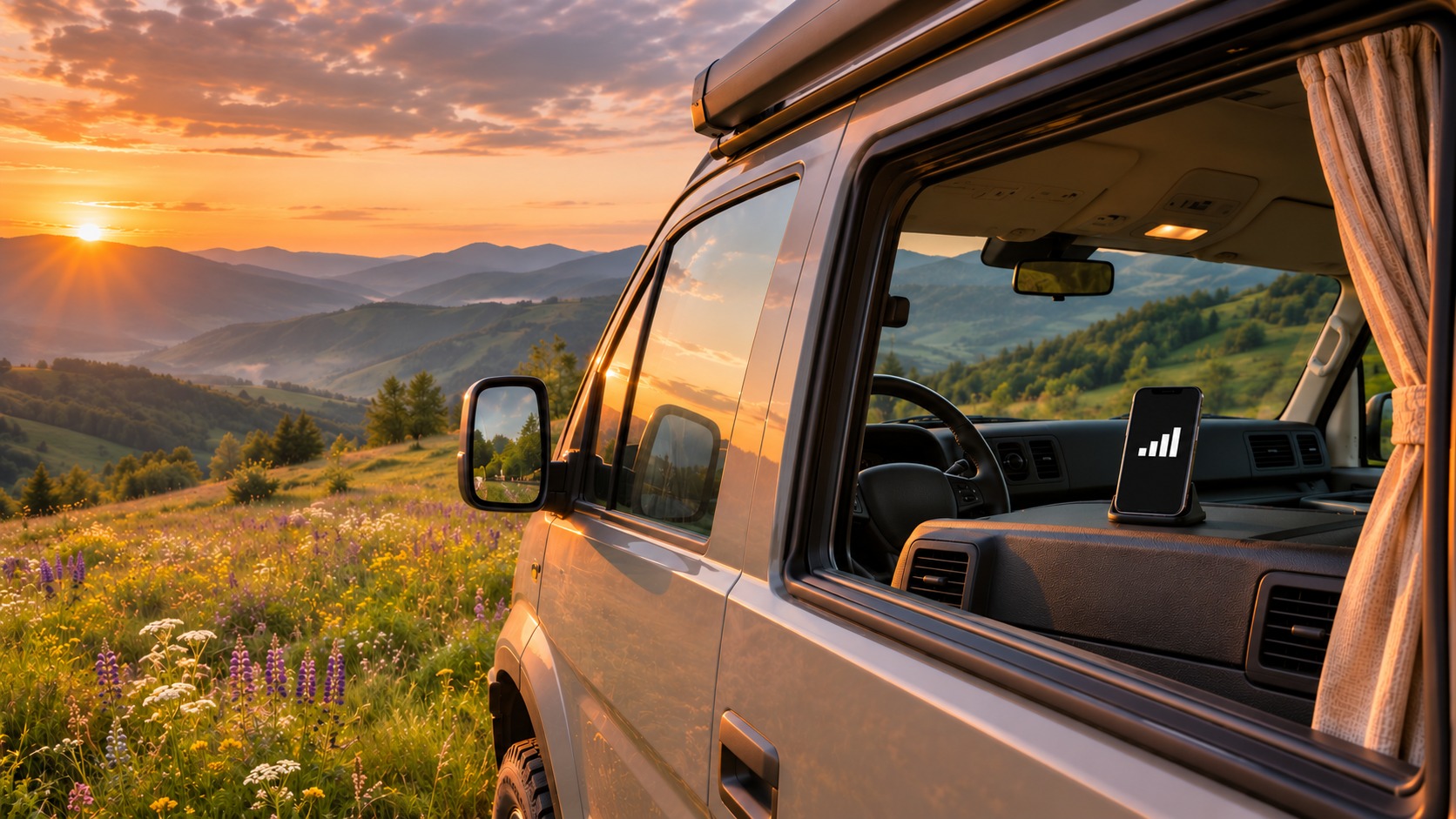
The Ultimate Eastern Europe eSIM for Camping in 2026
Finding the right Eastern Europe eSIM for camping is no longer just a convenience; for the modern van-lifer and wild camper, it is the lifeline that keeps you connected to the world while you are parked in the middle of nowhere. In 2026, the landscape of digital nomadism and budget travel has shifted dramatically. The allure of wild camping in the rolling hills of Hungary, the rugged coastlines of Romania, and the historic, off-the-beaten-path villages of the Balkans has never been stronger. Yet, this freedom comes with a hidden cost: connectivity. Traditional roaming charges can bleed a budget dry, often costing more than the nightly campsite fee itself. Worse still is the logistical nightmare of hunting for physical SIM cards at every border crossing, dealing with language barriers, and waiting in line at local kiosks while your data plan expires. This is where the search for the best eSIM for Eastern Europe budget travel becomes critical.
Most travelers assume that once their data allowance runs out, their connection dies completely. They are left with a dead phone, unable to check their map, send a quick message to a friend, or even verify their location for a check-in. This is the primary pain point that MollySIM solves with its unique architecture. Unlike standard providers that throttle your speed to a crawl or cut you off entirely, MollySIM implements a robust 384kbps Fair Usage Policy (FUP). This is not a minor technicality; it is a game-changer for campers. At 384kbps, your connection is 3x faster than the standard 128kbps limit offered by many competitors. What does this mean in practice? It means that even after you have exhausted your high-speed data, Google Maps continues to load tiles smoothly, Apple Pay and other mobile payment apps work reliably for buying coffee at a roadside stand, and messaging apps like WhatsApp or Telegram remain fully functional. You are never truly offline.
This guide is designed to be your comprehensive manual for navigating the digital infrastructure of Eastern Europe in 2026. We will dissect the true costs of connectivity, analyze coverage maps for the most popular camping hubs, and provide practical, on-the-ground tips for maintaining a stable connection in remote areas. Whether you are planning a month-long road trip through the Carpathians or a quick weekend escape to the Adriatic coast, understanding the nuances of eSIM technology is essential. We will explore why a single, region-wide eSIM is superior to juggling multiple local SIMs, and how to maximize your data efficiency when you are far from urban centers.
Why 384kbps Matters for the Modern Camper
To understand why MollySIM stands out, you must understand the difference between "connected" and "usable." A 128kbps connection is often barely enough to load a text-based webpage. It is frustratingly slow for video calls and can cause mapping applications to freeze, leaving you guessing which turn to take on a narrow mountain road. In contrast, the 384kbps FUP provided by MollySIM ensures that essential services remain responsive. For a camper, this reliability is non-negotiable. You need to be able to:
- Navigate Offline Maps: While offline maps are great, real-time traffic updates and dynamic routing require a stable, moderate-speed connection.
- Secure Transactions: Mobile wallets require a handshake with the bank’s server. A slow or intermittent connection can cause transactions to fail, which is inconvenient at best and embarrassing at worst.
- Emergency Communication: In the event of a breakdown or medical issue, being able to send precise location data and voice notes quickly is vital.
By choosing a provider that prioritizes post-limit usability, you gain peace of mind. You can relax in your tent or van, knowing that even if you’ve used up your 10GB or 20GB high-speed allowance, you still have a functional, fast-enough internet connection to handle the critical tasks of daily life. This is the definition of true budget travel: paying for what you need, without the anxiety of being cut off.
The 2026 Connectivity Landscape
As we move deeper into 2026, the infrastructure in Eastern Europe has improved significantly. 5G coverage is expanding in major cities like Budapest, Bucharest, and Belgrade, but for campers, 4G LTE remains the workhorse. The key is to choose an eSIM that aggregates the best local networks. MollySIM’s Europe eSIM options are designed to automatically select the strongest signal from local partners, ensuring that you are always on the best available network. This seamless switching is crucial when crossing borders, as it eliminates the need to manually configure APNs or swap SIM cards.
Furthermore, the cost of data has become more competitive. In the past, roaming was a premium service. Today, with the rise of eSIM technology, the barriers to entry have lowered. However, not all eSIMs are created equal. Some are simply resold local SIMs with a markup, while others, like MollySIM, offer a unified, region-wide solution with transparent pricing and no hidden fees. For the budget-conscious traveler, this transparency is key. You know exactly what you are paying for, and you know exactly what happens when you run out of data. There are no surprise bills, no "overage" charges that can ruin a month’s budget, and no need to constantly monitor your usage with anxiety.
In the following sections, we will break down the specific costs, compare coverage in key camping regions, and provide a step-by-step guide to setting up your MollySIM before you hit the road. We will also discuss data-saving tips that can extend your high-speed allowance, allowing you to stream, video call, and navigate with confidence throughout your entire journey. This is not just about staying connected; it is about staying connected on your terms, with the freedom and flexibility that camping in Eastern Europe demands.
Comparing Local Carriers: Orange, Vodafone, and A1
🌐 Europe High-Speed Travel eSIM & SIM Plans
Instant QR code activation, hotspot enabled, with guaranteed 384kbps fallback speed to keep Maps & Digital Wallets active.
When planning an Eastern Europe eSIM for camping trip, understanding the local infrastructure is critical. While a unified eSIM solution offers convenience, knowing which local carriers dominate specific regions helps you anticipate signal strength and data speeds. In Romania, Orange is the undisputed leader for rural connectivity. Their 4G/LTE network penetrates deep into the Transylvanian highlands and the remote wetlands of the Danube Delta. For campers setting up base camps in these areas, Orange’s infrastructure often provides the only reliable high-speed connection, whereas competitors may drop to 3G or 2G. If you are relying on local SIMs, securing an Orange plan is essential for this specific geography.
In Hungary, the landscape shifts slightly. Vodafone holds a strong market presence, particularly in Budapest and the surrounding suburbs. However, its true value for campers lies in its coverage around Lake Balaton. The region around the lake sees heavy seasonal traffic, and Vodafone’s network density ensures that data speeds remain stable even when thousands of tourists are connected simultaneously. This reliability is crucial for video calls and navigation in crowded tourist hubs.
Moving westward to Slovenia and the broader Balkans, A1 (formerly Telekom Slovenija) serves as the backbone of connectivity. A1’s network extends well into Croatia and Bosnia, making it a viable option for multi-country trips within the Western Balkans. Their infrastructure is robust, but like all local carriers, it is geographically bound. Once you cross into Serbia or North Macedonia, the A1 signal may weaken or require roaming agreements that can be expensive or slow.
The Local SIM vs. eSIM Dilemma
The primary argument for local SIMs is cost. A 10GB local plan in Romania or Hungary might cost €10–€15, which is cheaper than many international eSIMs. However, this savings comes with a significant administrative burden. For a camping trip spanning three or more countries, you are essentially playing a game of musical chairs with your SIM cards. You must physically swap cards, restart your phone, and often reconfigure APN settings. If you lose a physical SIM in a campsite or a rental car, your connectivity is gone until you find a new vendor.
In contrast, an eSIM like MollySIM (https://mollysim.com) eliminates this friction. You install the profile once, and it automatically selects the best local partner—whether that is Orange in Romania or Vodafone in Hungary—without you lifting a finger. This is particularly beneficial for campers who are on the move, as it ensures you never lose connectivity during border crossings.
Furthermore, the "data exhaustion" experience varies significantly. Many local SIMs throttle speeds to 128kbps once you hit your limit, which is barely enough for a text-based map. MollySIM offers a 384kbps Fair Use Policy speed limit, which is 3x faster than the standard 128kbps found with many competitors. This difference is tangible: at 384kbps, Google Maps loads smoothly, and Apple Pay or mobile banking apps remain functional, whereas at 128kbps, these services often time out or fail.
Comparative Analysis: Local SIMs vs. Roaming vs. MollySIM
The table below highlights the practical differences between these three connectivity methods for a multi-country camping itinerary.
| Feature | Local Physical SIM | Traditional Roaming | MollySIM eSIM |
|---|---|---|---|
| Cost per GB | Low (€1–€2/GB) | High (€5–€10/GB) | Moderate (€3–€4/GB) |
| Setup Time | High (Store visit, card swap) | Low (Auto-configure) | Low (QR Scan, One-time) |
| Multi-Country Support | Poor (Requires new SIM per country) | Good (If included in plan) | Excellent (Unified region-wide) |
| Rural Coverage Reliability | Variable (Depends on specific carrier) | Variable (Depends on partner) | High (Auto-selects best partner) |
| Fallback Data Speed | 128kbps (Typical) | 128kbps (Typical) | 384kbps (3x Faster) |
While local SIMs offer the lowest raw cost, the administrative overhead makes them less ideal for the dynamic nature of camping. You are constantly managing hardware and settings. With an eSIM, the technology manages itself. You focus on the campsite, the trail, and the view, while your device handles the network selection. For those looking to optimize their budget further, you can compare specific regional options in our Europe eSIM options guide, which breaks down the exact data allowances for each country. This approach ensures that you are paying for connectivity, not for the hassle of maintaining it.
Data Plans for Hungary and Romania: What You Actually Need
Selecting the right data plans for Hungary and Romania is less about finding the cheapest price tag and more about understanding your actual digital footprint on the road. Many travelers overestimate their needs, assuming that "unlimited" or high-capacity plans are necessary for a camping trip. In reality, the connectivity demands of a campsite are significantly lower than those of a city break, but they are highly specific. To choose an Eastern Europe eSIM for camping that balances cost and performance, you must first audit how you consume data.
Breaking Down Real-World Data Consumption
Let’s dissect the four primary data drains during a multi-country camping itinerary:
- Navigation and Maps: This is your critical utility. If you are using Google Maps or Apple Maps in "offline mode," data usage is negligible (under 100MB per day). However, if you rely on live traffic updates, real-time route recalculations, or high-definition satellite views in remote areas, expect to burn 200–500MB per day.
- Social Media and Messaging: WhatsApp, Instagram, and TikTok are data hogs. Texting is cheap, but loading image feeds and video stories is not. A typical camper checking in, sharing photos, and messaging friends will use 300–800MB daily.
- Streaming: This is the budget killer. Streaming music (Spotify/Apple Music) in standard quality uses approximately 60–120MB per hour. Video streaming (Netflix/YouTube) in 720p consumes 1.5–3GB per hour. If you plan to watch movies at the campsite, you need a substantial buffer.
- Cloud Backups: Automated backups of photos and videos to iCloud or Google Photos can silently drain 1–2GB per day if you are taking hundreds of high-resolution shots of landscapes and wildlife.
Recommended Data Volumes for Campers
Based on these consumption patterns, here are the practical tiers for your Eastern Europe eSIM for camping:
| User Profile | Typical Behavior | Recommended Data Allowance |
|---|---|---|
| Light User | Offline maps, text messaging, occasional photo uploads, no streaming. | 5GB |
| Average User | Live navigation, daily social media use, music streaming, moderate photo backups. | 15GB |
| Heavy User | Video calls, HD video streaming, extensive cloud backups, live map updates. | 30GB+ |
The Risk of Over-Provisioning
For budget travelers, buying a 50GB or 100GB plan is often a financial trap. While the upfront cost may seem reasonable, the cost-per-GB for large data buckets is frequently higher than for smaller, targeted plans. If you are a light user who buys a 30GB plan because it "looks like a deal," you are paying for data you will never use. This is inefficient. Instead, opt for a plan that matches your average usage. If you run out, you can usually top up or switch to a backup plan. This modular approach keeps your daily budget predictable, a crucial factor when managing cash flow for fuel, food, and campsite fees.
Network Realities: Rural Hungary and Romania
One of the most significant challenges in this region is the variance in network infrastructure. In Budapest or Bucharest, 4G/5G coverage is robust. However, in the deep forests of the Bukovina region in Romania or the Hortobágy National Park in Hungary, you may find yourself relying on 3G or even 2G networks.
This is where the choice of eSIM provider becomes critical. Many physical SIMs or lower-tier eSIMs struggle with automatic network switching. If a physical SIM is locked to a specific carrier that has poor rural coverage, you may experience dropped connections or slow speeds. In contrast, a well-configured eSIM, such as those offered by MollySIM, utilizes intelligent network selection. It automatically switches between available partners to find the strongest signal, ensuring that your navigation app remains responsive even when you are miles from the nearest town.
Furthermore, consider the Fair Use Policy (FUP) speed limits. Many budget eSIMs throttle your speed to 128kbps after you hit a certain data threshold. At this speed, loading a map tile or sending a voice message can take minutes. MollySIM offers a distinct advantage here with a 384kbps fallback speed, which is 3x faster than the industry standard. This difference is tangible: at 128kbps, Google Maps may lag or fail to load; at 384kbps, it remains functional enough for basic navigation and even for using mobile payment apps like Apple Pay if you need to buy supplies at a remote village shop.
For those planning a broader itinerary beyond just these two countries, it is wise to review the comprehensive Europe eSIM options guide. This resource breaks down the specific carrier partnerships in each nation, helping you understand where the coverage gaps are and how to mitigate them. By aligning your data volume with your actual usage and choosing a provider that handles rural network switching intelligently, you ensure that your connectivity supports your adventure, rather than hindering it.
eSIM Coverage for Van Life in Europe: Navigating the Balkans
The Balkan region presents a unique connectivity landscape that demands a different strategy than the well-covered Western European corridors. For van life enthusiasts traversing Serbia, Croatia, Bosnia and Herzegovina, and Montenegro, the network infrastructure is fragmented, with significant disparities between urban centers and remote mountainous terrain. This is where the concept of eSIM coverage for van life in Europe becomes critical. Unlike a single-country SIM, which may fail to register on local networks in neighboring states, a multi-country eSIM is essential for seamless roaming across these borders. The Balkans are characterized by a patchwork of regional carriers—Telekom Srbija, Hrvatski Telekom, BH Telecom, and M-Tel—each with distinct coverage footprints. Relying on a single operator often results in dead zones, particularly in the Dinaric Alps or the Vitosha Mountains, where signal strength can fluctuate wildly within a few kilometers.
MollySIM addresses this fragmentation by aggregating coverage from multiple local carriers into a single, unified profile. This intelligent aggregation ensures that your device automatically selects the strongest available signal, whether you are parked in a bustling Zagreb parking lot or a secluded campsite near the Plitvice Lakes. This seamless handover is crucial for maintaining Eastern Europe eSIM for camping reliability, as it prevents the manual frustration of switching APNs or restarting your device every time you cross a border. The system works in the background, ensuring that your navigation apps, weather forecasts, and communication tools remain active without user intervention.
The Critical Importance of FUP Speeds in Remote Areas
In the context of van life, data speed is not just about streaming video; it is about functionality. Many budget eSIM providers impose a Fair Use Policy (FUP) that throttles speeds to 128kbps once a data threshold is reached. In a city, this might be manageable, but in the remote Balkan wilderness, 128kbps can render essential tools unusable. Loading a high-resolution map tile for turn-by-turn navigation can take over a minute, and real-time traffic updates may fail to sync.
This is where the MollySIM advantage becomes tangible. With a 384kbps fallback speed—3x faster than the industry standard—your device remains responsive even after heavy data usage. At this speed, Google Maps continues to load map tiles efficiently, allowing for accurate turn-by-turn navigation on winding mountain roads. Furthermore, if you need to use mobile payment apps like Apple Pay or Google Pay to purchase supplies at a remote village kiosk, the transaction processes smoothly without the dreaded "timeout" errors common at lower speeds. For emergency situations, such as sending an SOS message or sharing your precise GPS location with a contact, maintaining a stable, faster-than-standard connection can be the difference between a minor inconvenience and a critical delay.
Strategic Comparison: Dedicated eSIM vs. Global Roaming
Travelers from the United States often consider using their existing carrier’s global roaming plans, such as those offered by T-Mobile SIM cards. While T-Mobile provides robust global coverage, the cost structure for extended stays in Eastern Europe can be prohibitive. Global roaming plans typically charge a premium per day or per gigabyte, which adds up quickly during a month-long van trip. In contrast, a dedicated Eastern Europe eSIM offers a flat-rate or high-volume data package that is significantly more cost-effective for long-term use.
| Feature | Global Roaming (e.g., T-Mobile) | Dedicated Eastern Europe eSIM (MollySIM) |
|---|---|---|
| Cost Structure | Daily fee + Data overage | Flat rate / High volume data |
| Network Priority | Often lower priority (roaming) | Local carrier priority |
| FUP Speed | Varies (often 1-3 Mbps) | 384kbps (optimized for utility) |
| Best For | Short trips (< 7 days) | Extended van life / Camping |
Tips for Checking Carrier Maps Before Entering Remote Areas
Before venturing into the less-traveled parts of the Balkans, it is prudent to verify network availability. Here are three actionable tips to ensure you are prepared:
- Check Local Carrier Maps: Visit the official websites of local operators (e.g., HT in Croatia, Telekom in Serbia) to view their 4G/5G coverage maps. Note that "4G" coverage in rural areas may often be 3G in practice.
- Use Offline Maps: Download high-resolution offline maps for your entire route using apps like OsmAnd or Google Maps. This ensures you have navigation data even if your signal drops completely.
- Monitor Signal Strength: Use a network testing app to identify which carrier provides the strongest signal in your specific area. While MollySIM handles the switching automatically, understanding the local landscape helps you anticipate potential weak spots.
By combining a robust multi-country eSIM with strategic planning, you can navigate the Balkans with confidence, ensuring that your connectivity supports your adventure rather than hindering it.
Why the 384kbps FUP is a Game-Changer for Budget Campers
For many travelers, the concept of a "Fair Usage Policy" (FUP) sounds like a penalty—a moment where your connection slows to a crawl or, worse, cuts out entirely. However, in the context of an Eastern Europe eSIM for camping, the specific speed threshold matters more than the existence of the limit itself. This is where the technical distinction between a standard roaming eSIM and a specialized utility plan like MollySIM becomes critical. Most budget roaming options drop you to 128kbps after your high-speed data allowance is exhausted. At that speed, loading a single map tile or sending a text message can take several seconds, and video calls are virtually impossible. MollySIM, however, maintains a post-limit speed of 384kbps. This is not a marginal improvement; it is a 3x increase in throughput that fundamentally changes how you interact with your device in low-bandwidth environments.
What 384kbps Actually Means in the Field
To understand why this matters, we must look at the practical application of data speeds in a camping scenario. 384kbps is the "sweet spot" for utility connectivity. It is fast enough to:
- Render Map Tiles Instantly: Google Maps and Apple Maps rely on vector tiles. At 128kbps, panning across a map often results in grey, unrendered areas. At 384kbps, the map updates smoothly, allowing you to navigate off-grid trails without frustration.
- Support Real-Time Messaging: WhatsApp, Telegram, and Signal operate on text and light media. 384kbps ensures that voice messages and photos upload and download in near real-time, keeping you connected with family or fellow campers.
- Enable Contactless Payments: Apple Pay and Google Pay require a secure, low-latency handshake with the payment gateway. While 128kbps can sometimes cause timeouts, 384kbps provides the buffer needed for these transactions to complete reliably, even in areas with fluctuating signal strength.
It is important to note that 384kbps is not designed for 4K video streaming or large software updates. If you are trying to watch a movie on Netflix, you will still experience buffering. But for the core functions of a camper—navigation, communication, and emergency contact—this speed is more than sufficient.
The Safety Net Against Roaming Bill Shock
The most significant advantage of this FUP structure is predictability. Standard roaming eSIMs often operate on a "use it or lose it" model. Once your data cap is hit, you either pay premium per-MB rates (which can easily add up to €50–€100 for a single day of accidental background updates) or your connection drops to 0kbps.
Consider this scenario: You are camping in a remote part of Croatia, specifically in the Velebit mountain range. Your high-speed data allowance for the day has been exhausted due to a morning of heavy map usage and video calls. You are now in an area with weak 3G signal, where data drains faster due to retransmissions.
- With a Standard Roaming eSIM: You might accidentally leave a background app updating. At premium roaming rates, this could cost you €20 for 100MB. If your signal drops completely, you are offline, unable to check your location or call for help.
- With MollySIM: You hit the limit, but your speed drops to 384kbps. You can still open Google Maps to find your current coordinates. You can send a precise location pin to a friend. You can even make a VoIP call if necessary. The connection remains alive, functional, and affordable.
This feature acts as a safety net. It ensures that even if you forget to turn off background updates, or if you get stuck in a "dead zone" where your phone struggles to maintain a stable high-speed link, you are never truly disconnected. For budget travelers, this eliminates the anxiety of the "roaming bill shock," making the Eastern Europe eSIM for camping a reliable, predictable, and cost-effective choice.
By choosing a provider that optimizes for utility over raw speed, you gain peace of mind. You know that your connectivity will support your adventure, not hinder it. For more detailed breakdowns of how this works across different regions, you can explore the Europe eSIM options available through MollySIM to find the perfect fit for your route.
Practical Tips for Choosing the Right Plan in 2026
Selecting the optimal connectivity solution requires more than just picking the cheapest price tag. For the modern budget traveler navigating the diverse telecom landscapes of Hungary, Romania, and the Balkans, strategic planning is the difference between a seamless adventure and a costly headache. The following step-by-step checklist ensures you maximize value while maintaining the reliability needed for remote camping scenarios.
Step 1: Verify Hardware Compatibility
Before purchasing any Eastern Europe eSIM for camping, confirm your device supports eSIM technology. Most smartphones released after 2018 (iPhone XS and later, Samsung Galaxy S20 and later, and recent Pixel models) are compatible. However, older devices or certain tablets may require a physical SIM. If you are using a dual-SIM phone, ensure one slot is available for your home carrier or a backup physical SIM. This redundancy is crucial for long-term stays where you might want to keep a local number for calls while using the eSIM exclusively for data.
Step 2: Estimate Data Needs Based on Trip Length
Misjudging data consumption is the most common mistake. For a typical 7-day camping trip, consider your usage profile:
- Light User (Navigation + Social Media): 5–10 GB
- Moderate User (Video Calls + Streaming): 15–25 GB
- Heavy User (Cloud Backups + 4K Video): 30+ GB
If you are unsure, start with a mid-tier plan (e.g., 10–15 GB). This is a strategic move because it allows you to test the network stability in remote areas without committing to a large data pool that might expire unused.
Step 3: Select a Multi-Country Coverage Plan
Avoid buying separate SIMs for each country. Instead, choose a regional plan that covers the specific countries on your route. For example, if your itinerary includes Hungary, Romania, and the Balkans, a single regional eSIM simplifies the process. This is particularly important for the cheap eSIM for Balkans 2026 market, where local networks can vary significantly in speed and coverage. A unified plan ensures you stay on the best available network automatically, eliminating the need to manually switch APNs or hunt for local vendors in every new capital.
Step 4: Install and Test Before Departure
Never install your eSIM for the first time in a foreign airport or a remote campsite. Install the profile on your home Wi-Fi, then toggle the cellular data on and off to verify the connection. Check your settings to ensure the eSIM is set as the "Default Data" line. This pre-departure test saves you from the frustration of troubleshooting QR code scanning issues or network registration errors when you are already on the road.
Cost-Effectiveness: eSIM vs. Local SIMs
The choice between an eSIM and a local physical SIM depends heavily on the duration of your stay.
| Stay Duration | Recommended Option | Why? |
|---|---|---|
| Short (1–7 days) | eSIM | Lower upfront cost, no activation fees, instant setup, and no need to return the SIM. |
| Medium (1–3 weeks) | eSIM | Convenience outweighs the slight premium per GB. You avoid the hassle of local store visits. |
| Long (1+ month) | Local SIM | Often offers cheaper per-GB rates and local phone numbers for calls. However, eSIMs are becoming competitive here. |
For most camping trips, which typically last between 5 and 14 days, the eSIM is the superior choice. It offers the flexibility of a digital product without the logistical burden of a physical card.
The Power of the 384kbps Fallback
One of the most underrated benefits of using a provider like MollySIM is the Fair Use Policy. Many competitors throttle your speed to 128kbps once you hit your data limit, which is often too slow for modern apps. MollySIM’s 384kbps limit is 3x faster, ensuring that critical functions like Google Maps, Apple Pay, and VoIP calls remain fully functional. This is vital for camping, where you might need to upload a location pin or make an emergency call after your high-speed data is exhausted.
Final Recommendation
Start with a mid-tier plan to gauge your actual usage. If you find yourself consistently hitting the limit, you can usually upgrade or purchase a top-up without changing your entire setup. This flexibility, combined with the robust 384kbps fallback, makes the Eastern Europe eSIM for camping a smart, budget-friendly investment.
Ready to secure your connectivity? Explore the full range of connectivity solutions and find the perfect plan for your route in the Europe eSIM options available through MollySIM.
Frequently Asked Questions about Eastern Europe eSIM for camping
Is it cheaper to buy a local SIM or use an eSIM in Eastern Europe?
For short trips, an eSIM is often more convenient and competitive in price. For long stays, local SIMs like Orange or Vodafone may offer better value.
Which eSIM works best for camping in the Balkans?
Look for eSIMs that include coverage from major carriers like A1 (Slovenia), T-Mobile (Croatia), or Orange (Romania). Multi-country plans are ideal for flexibility.
How much data do I need for a week of camping?
For navigation, messaging, and light social media, 3-5GB is usually sufficient. If you stream videos or use video calls, consider a 10GB plan.
SEO Score: 11/11
🌐 Europe High-Speed Travel eSIM & SIM Plans
Instant QR code activation, hotspot enabled, with guaranteed 384kbps fallback speed to keep Maps & Digital Wallets active.