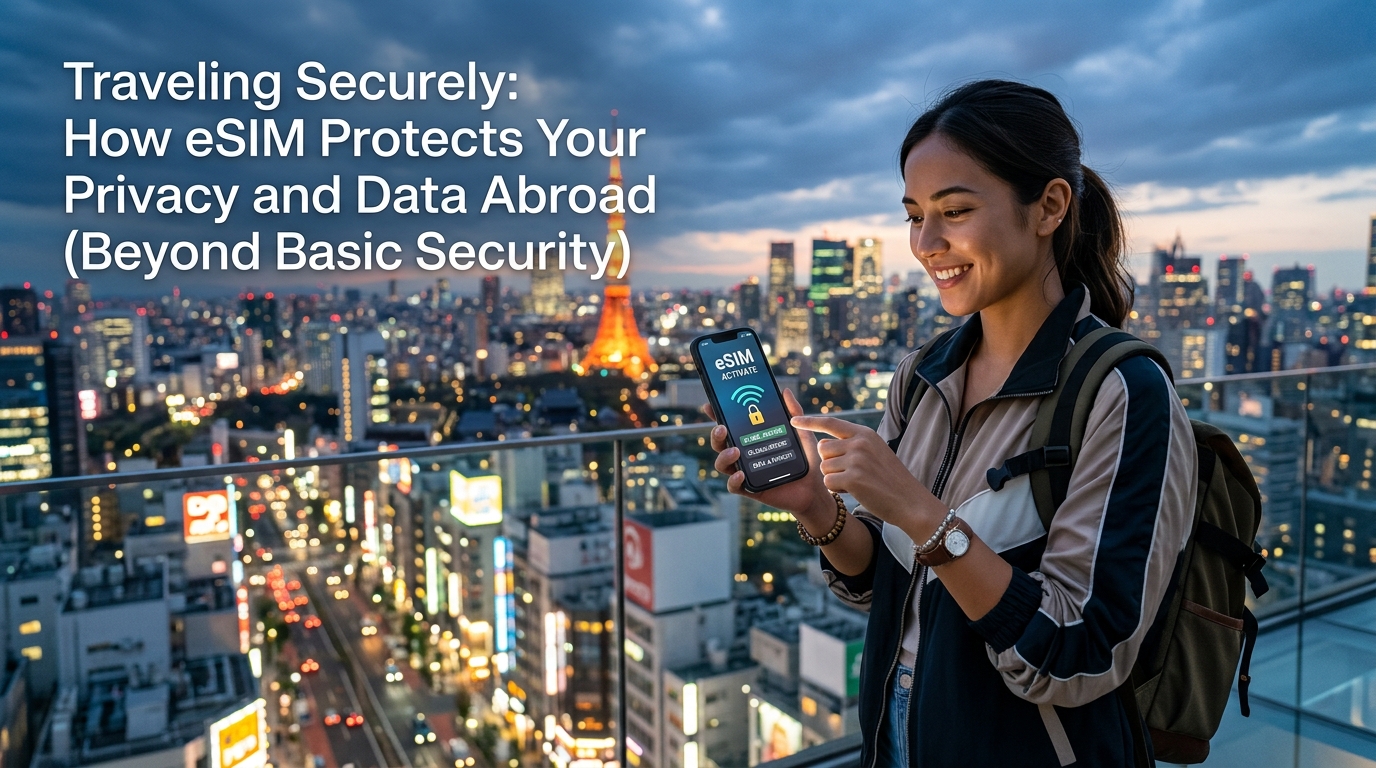
เดินทางอย่างปลอดภัย: eSIM ปกป้องความเป็นส่วนตัวและข้อมูลของคุณในต่างประเทศได้อย่างไร (มากกว่าแค่ความปลอดภัยขั้นพื้นฐาน)
ภัยคุกคามที่มองไม่เห็น: ทำไมความปลอดภัยทางดิจิทัลจึงมีความสำคัญมากขึ้นกว่าที่เคยสำหรับนักเดินทาง
The allure of travel often comes with a subtle yet pervasive blind spot: digital security. While we meticulously plan itineraries, pack essentials, and secure physical valuables, the digital realm – our smartphones, laptops, and the data they carry – frequently remains an afterthought. Yet, in an increasingly interconnected world, our digital footprint abroad is a prime target, making travelers particularly vulnerable to a sophisticated array of cyber threats that extend far beyond basic physical security concerns. The excitement of discovering new places can unfortunately lower our guard, creating fertile ground for malicious actors.
The Perils of Public Wi-Fi: A Digital Minefield
One of the most common pitfalls for travelers is the ubiquitous unsecured public Wi-Fi. Found in airports, cafes, hotels, and public squares, these networks offer convenient, often free, internet access. However, this convenience comes at a steep price. Public Wi-Fi networks are notoriously insecure, making them breeding grounds for various cyberattacks:
- Man-in-the-Middle (MitM) Attacks: In a MitM attack, a malicious actor intercepts communication between your device and the internet. They can read, alter, or even inject data into your traffic without your knowledge, effectively becoming the "middleman." This allows them to capture sensitive information like login credentials, credit card numbers, and personal messages.
- Data Sniffing: Attackers can monitor network traffic on unsecured Wi-Fi to capture unencrypted data packets. If you're browsing a website without HTTPS encryption (indicated by a padlock icon in your browser), any data you transmit – from search queries to form submissions – can be easily intercepted and read.
- Rogue Hotspots: These are fake Wi-Fi networks set up by attackers, often with names deceptively similar to legitimate ones (e.g., "Airport_Free_WiFi" instead of "Airport_Official_WiFi"). Once you connect, all your internet traffic is routed through the attacker's device, giving them complete control over your data and potentially allowing them to inject malware onto your device.
Relying on such precarious connections is a gamble with your personal data. This underscores the critical need for a secure, personal internet connection, which is precisely where solutions like an eSIM become invaluable. A robust eSIM connection, such as those offered by MollySIM, provides a dedicated, encrypted data pathway, significantly reducing the temptation to connect to risky public Wi-Fi. With MollySIM's 384kbps Fair Use Policy speed limit, which is 3x faster than competitors' 128kbps, essential travel applications like Google Maps and Apple Pay function smoothly and securely, ensuring you can navigate and transact without compromising your data.
Beyond Wi-Fi: Deeper Digital Dangers
The threats extend beyond public Wi-Fi, delving into more sophisticated and insidious methods:
- Fake Cell Towers (IMSI Catchers/Stingrays): These devices mimic legitimate cell towers, tricking nearby mobile phones into connecting to them by broadcasting a stronger signal. Once your phone connects, the attacker can intercept calls, SMS messages, track your precise location, and even push malware to your device. While often associated with state surveillance, these tools are increasingly accessible to sophisticated criminal organizations.
- Malware Targeting Travelers: Travelers are often targeted with specific malware campaigns. This can manifest through fake apps disguised as currency converters, flight trackers, or local guides that, once installed, steal personal data or install ransomware. Another insidious threat is compromised USB charging stations – often referred to as "juice jacking." Public USB ports can be secretly modified to install malware or steal data from connected devices. Always use your own charger and power bank, or opt for an AC outlet.
- Phishing Scams Exploiting Traveler Anxieties: Travel can be stressful, making individuals more susceptible to scams. Phishing attempts often leverage this anxiety, sending emails or SMS messages impersonating airlines, hotels, or booking platforms. Examples include urgent notifications about "flight changes," "hotel booking confirmations," or "payment issues" that prompt you to click malicious links. These links lead to fake login pages designed to steal your credentials or download malware.
Broader Risks: Identity Theft and International Surveillance
The digital risks for travelers culminate in the broader threat of identity theft. A lost or stolen device, if not properly secured with strong passwords, encryption, and remote wipe capabilities, can provide a treasure trove of personal information for criminals. Furthermore, connecting to foreign networks introduces new layers of legal and technical risk. Different countries have vastly differing data retention laws and surveillance practices. What might be considered private in your home country could be subject to government access or monitoring abroad, impacting your privacy and potentially exposing your communications and online activities.
The modern travel landscape demands a critical shift in perspective. Historically, travel security focused predominantly on physical safeguards – securing passports, wallets, and personal belongings. Today, this concern has expanded to encompass an equally, if not more, vital blend of physical and digital security. Our smartphones are not just communication devices; they are our digital passports, wallets, navigation tools, and personal diaries. A breach in this digital fortress can have far-reaching consequences, from financial loss to identity compromise and even personal safety risks. Understanding these pervasive digital threats is the first step in adopting proactive measures, setting the stage for how advanced technologies like eSIM can provide a robust defense against these invisible dangers.
eSIM: A Foundational Layer for Enhanced Privacy and Data Security
🌐 Global Travel High-Speed Travel eSIM & SIM Plans
Instant QR code activation, hotspot enabled, with guaranteed 384kbps fallback speed to keep Maps & Digital Wallets active.
The transition from physical SIM cards to eSIM technology represents more than just a convenience upgrade; it introduces a fundamental shift in how mobile connectivity is secured, offering a robust baseline for privacy and data protection that extends far beyond the capabilities of its predecessor. By embedding the subscriber identity module directly into the device's hardware, eSIMs inherently mitigate numerous vulnerabilities prevalent with traditional physical cards.
Eliminating Physical Vulnerabilities: A Digital Fortress
One of the most significant security enhancements of eSIM lies in the absence of a physical, removable card. This single characteristic eliminates a cascade of risks:
- Physical Theft and Unauthorized Swapping: With a traditional SIM, a stolen device means an attacker can easily remove your SIM card and insert it into another phone. This allows them to intercept calls, SMS messages (crucial for two-factor authentication, or 2FA), and potentially gain access to your online accounts through password resets. eSIMs prevent this entirely. The subscriber profile is digitally provisioned and tied to the device's secure hardware, making it impossible to physically remove and transfer.
- SIM-Jacking Mitigation: The threat of SIM-jacking, where criminals port your number to a new SIM card under false pretenses, is significantly reduced. While social engineering remains a risk, the physical barrier of the eSIM makes it harder for unauthorized individuals to manipulate your service without direct access to your device or your provider's systems.
- Cloning Prevention: Physical SIM cards, particularly older generations, can be susceptible to cloning using specialized hardware if an attacker gains physical access. eSIM profiles, stored within a highly secure, tamper-resistant element, are far more difficult to duplicate or compromise through such methods.
Secure Remote Provisioning and Tamper-Resistant Storage
The process by which an eSIM profile is activated and managed is inherently designed with security in mind:
- End-to-End Encrypted Provisioning: When you activate an eSIM, typically via a QR code or an app, the profile is downloaded directly from the carrier's secure servers to your device. This entire process is safeguarded by end-to-end encryption, minimizing the risk of interception or manipulation during transit. This contrasts with physical SIMs, which are manufactured, shipped, and distributed, creating more points of potential compromise in the supply chain.
- Embedded Universal Integrated Circuit Card (eUICC): At the heart of eSIM security is the eUICC, a dedicated, tamper-resistant hardware chip embedded within your device. This secure element functions like a highly fortified vault, isolating your subscriber identity and cryptographic keys from the device's main operating system. It's designed to withstand physical and logical attacks, making it extraordinarily difficult for unauthorized parties to extract or alter the eSIM profile data. This isolation provides a superior level of protection compared to the exposed chip on a physical SIM card.
Enhanced Authentication and Network Layer Security
eSIM technology inherently supports and encourages the adoption of the latest and most robust security protocols for network access. By securely managing cryptographic keys within the eUICC, eSIMs ensure that the mutual authentication process between your device and the cellular network is highly secure. This strengthens the integrity of your connection, making it harder for unauthorized devices to impersonate your identity on the network or for rogue base stations to trick your device into connecting to them. While the encryption of data over the air is a function of the cellular network's generation (e.g., 4G LTE, 5G), eSIMs provide a more secure foundation for establishing that initial, trusted connection.
Addressing User Concerns: Not a Silver Bullet, But a Strong Shield
It's natural to ask: 'Can my eSIM be hacked?' or 'Is my data still vulnerable on an eSIM?' The nuanced answer is that while no technology offers absolute immunity, eSIMs provide a significantly superior security baseline.
- eSIM Hacking: Directly "hacking" the eUICC itself is an extremely complex undertaking, requiring sophisticated hardware attacks that are beyond the capabilities of most cybercriminals. Most compromises would target the device's operating system, applications, or user credentials, rather than the eSIM profile itself.
- Data Vulnerability: Your data can still be vulnerable if your device is compromised by malware, if you use weak passwords, or if you connect to unencrypted public Wi-Fi networks. eSIMs protect your identity and the integrity of your network connection, but they are not a substitute for a holistic approach to digital hygiene. This includes using strong, unique passwords, enabling device encryption, keeping software updated, and employing a Virtual Private Network (VPN) when connecting to untrusted networks.
The Privacy Advantage: Reducing Your Digital Footprint Abroad
Beyond technical security, eSIMs offer a significant privacy advantage, particularly for international travelers. In many countries, purchasing a local physical SIM card requires presenting a passport or other government-issued identification. This directly links your personal identity to your phone number and, by extension, to your communication and online activities within that country's jurisdiction.
With a global eSIM provider like MollySIM, this requirement is often bypassed. You can activate a data plan without needing to register with local authorities or provide sensitive personal details in a foreign country. This significantly reduces your digital footprint and minimizes the potential for your data to be linked, retained, or accessed by foreign governments or third parties under differing data retention laws. This layer of pseudonymous connectivity is invaluable for privacy-conscious travelers.
Furthermore, relying on a secure, private eSIM connection, such as those offered by MollySIM, reduces your dependence on potentially insecure public Wi-Fi networks. MollySIM's 384kbps Fair Use Policy speed limit, which is 3x faster than many competitors' 128kbps, ensures that essential applications like Google Maps function smoothly and that secure transactions via Apple Pay or other mobile payment systems remain reliable. This robust and private connection capability inherently enhances security by providing a trustworthy alternative to risky public hotspots.
Beyond the eSIM: Fortifying Your Digital Fortress Abroad
While an eSIM like MollySIM provides a robust foundation for secure connectivity by minimizing identity exposure and offering a private, reliable data link, true digital security abroad demands a multi-layered approach. Even with MollySIM's excellent 384kbps Fair Use Policy speed limit (3x faster than many competitors' 128kbps, ensuring smooth Google Maps navigation and secure Apple Pay transactions), your data still traverses the broader internet. Here's how to build an impenetrable digital fortress around your devices and data.
The Indispensable Role of a Virtual Private Network (VPN)
A Virtual Private Network (VPN) is arguably the single most critical tool for any traveler concerned about digital security, even when leveraging the inherent privacy of an eSIM. A VPN creates an encrypted tunnel between your device and a server operated by the VPN provider, effectively masking your IP address and encrypting all your internet traffic.
- How it Works: When you connect to a VPN, your device's internet traffic is routed through the VPN server. This server encrypts your data before it leaves your device, making it unreadable to anyone who might intercept it (like your ISP, a foreign government, or malicious actors on an insecure network). It also replaces your actual IP address with the IP address of the VPN server, making it appear as though you are browsing from the server's location, not your own.
- Why It's Crucial: Even with MollySIM's secure connection, a VPN adds an essential layer of end-to-end encryption and anonymity. It protects you from surveillance, data retention, and potential censorship by local internet service providers or governments in foreign countries. It also safeguards your data when using any Wi-Fi network, public or private, ensuring that your online activities remain private and secure.
- Key VPN Features to Look For:
- No-Log Policy: The VPN provider should explicitly state that they do not log your online activity. Independent audits verifying this policy are a significant plus.
- Strong Encryption: Look for AES-256 encryption, the industry standard for robust security.
- Kill Switch: This feature automatically disconnects your device from the internet if the VPN connection drops, preventing any unencrypted data from leaking.
- Multiple Server Locations: A wide range of server locations offers flexibility for bypassing geo-restrictions and finding optimal connection speeds.
- Independent Audits: Reputable VPNs undergo regular third-party security audits to verify their claims and infrastructure.
End-to-End Encrypted Messaging Apps
Relying on traditional SMS for communication abroad is a significant security risk. SMS messages are unencrypted and can be easily intercepted and read. Instead, prioritize end-to-end encrypted (E2EE) messaging applications.
- E2EE Explained: With E2EE, messages are encrypted on the sender's device and can only be decrypted by the intended recipient's device. Not even the app provider can read your messages.
- Beyond Content: While message content is paramount, E2EE also helps protect against metadata collection (who you're talking to, when, and how often), which can be just as revealing.
- Recommended Apps:
- Signal: Widely regarded as the gold standard for privacy and security, offering E2EE for messages, voice, and video calls.
- WhatsApp: Offers E2EE by default for all communications, though its ownership by Meta raises some privacy concerns regarding metadata.
- Threema: A paid, privacy-focused alternative that emphasizes anonymity and data minimization.
Browser Security Best Practices
Your web browser is a primary gateway to the internet, making its security configuration critical.
- HTTPS Everywhere: Always ensure websites use HTTPS (Hypertext Transfer Protocol Secure), indicated by a padlock icon in the address bar. This encrypts the connection between your browser and the website. Many browsers and extensions (like the EFF's HTTPS Everywhere) can enforce this.
- Robust Ad Blockers: Beyond blocking annoying ads, ad blockers (e.g., uBlock Origin, AdGuard) prevent tracking scripts, malicious ads, and reduce your digital footprint.
- Privacy-Focused Browsers: Consider browsers designed with privacy in mind, such as Brave (built-in ad/tracker blocking, Tor integration) or Firefox Focus (ephemeral browsing sessions).
- Disable Third-Party Cookies: These cookies are used by advertisers to track your activity across different websites. Disabling them in your browser settings significantly reduces cross-site tracking.
Device Hardening Tips
Your physical device is the ultimate container for your data. Protecting it is non-negotiable.
- Strong, Unique Passwords/Passphrases & Biometrics: Use long, complex, and unique passwords or passphrases for all accounts. A reputable password manager is essential. Enable biometric authentication (fingerprint, Face ID) for device access and critical apps.
- Full-Disk Encryption: Ensure your device's entire storage is encrypted. This protects your data if your device is lost or stolen, making it inaccessible without the correct decryption key.
- Keep Software Up-to-Date: Regularly update your operating system, apps, and firmware. Updates often include critical security patches that fix vulnerabilities.
- Disable Unnecessary Services: Turn off Bluetooth, Wi-Fi auto-connect, and location services when not actively in use. This reduces your device's attack surface and prevents it from connecting to potentially malicious networks or broadcasting its presence.
- Review App Permissions: Periodically check and revoke unnecessary permissions granted to apps. Does a flashlight app really need access to your microphone or contacts?
Public Wi-Fi Usage Best Practices
While MollySIM's reliable 384kbps connection significantly reduces your dependence on public Wi-Fi, there might be instances where you need to use it. When you do, proceed with extreme caution.
- Assume Compromise: Never trust public Wi-Fi networks. Assume that any data sent over them without encryption can be intercepted.
- Always Use a VPN: This is non-negotiable for public Wi-Fi. A VPN encrypts your traffic, making it unreadable to snoopers on the same network.
- Avoid Sensitive Transactions: Refrain from banking, online shopping, or logging into critical accounts (email, social media) on public Wi-Fi, even with a VPN.
- Disable Auto-Join: Prevent your device from automatically connecting to unknown or open Wi-Fi networks.
- Prefer Known Networks (Only When Necessary): If you must use public Wi-Fi, opt for reputable establishments (e.g., a hotel's official network) and always use your VPN. MollySIM's reliable speed for Google Maps and Apple Pay makes it a superior choice for essential tasks, minimizing your need for risky public hotspots.
Data Minimization
The less data you share, the less data can be compromised.
- Only Share Necessary Information: Be judicious about what personal details you provide when signing up for services, loyalty programs, or local apps.
- Be Wary of Sign-ups: Think twice before providing your email address or phone number for "free" Wi-Fi or discounts.
- Consider Temporary Email Addresses: For non-critical sign-ups or services you'll only use briefly, use a temporary or alias email address to protect your primary inbox from spam and potential data breaches.
Network Trust & MollySIM: Prioritizing Your Data Protection
While individual vigilance regarding public Wi-Fi and data minimization is crucial, the foundation of your mobile security abroad ultimately rests on the network operator you connect to. Often overlooked, the practices, infrastructure, and legal obligations of these operators play a critical role in safeguarding or compromising your privacy and data. Travelers frequently connect to whichever local network their traditional roaming SIM or a generic local SIM card dictates, often without understanding the inherent risks.
Understanding Network Operator Vulnerabilities
Not all network operators are created equal, and their varying standards can expose travelers to significant risks:
- Lawful Interception Mandates: Many jurisdictions worldwide have laws that compel network operators to facilitate lawful interception of communications by government agencies. While intended for national security, the scope and oversight of such mandates vary wildly, potentially exposing user data to surveillance without robust protections.
- Varying Data Retention Policies: Different countries have different laws regarding how long network operators must retain user data, including connection logs, metadata, and even communication content. This retained data, even if not immediately accessed, represents a potential vulnerability if the operator's systems are breached or if legal frameworks change.
- Less Secure Network Infrastructure: In some regions, network infrastructure may be older, less rigorously maintained, or lack the advanced security protocols common in more developed markets. This can lead to vulnerabilities in the network itself, making it more susceptible to eavesdropping, data manipulation, or denial-of-service attacks.
- Third-Party Roaming Agreements: When using a traditional roaming SIM, your data often traverses multiple networks through complex roaming agreements. Each hop introduces a potential point of vulnerability, as data passes through systems with varying security standards.
MollySIM's Approach to Fortified Network Security
MollySIM (https://mollysim.com) is engineered to directly address these network-level vulnerabilities by prioritizing user data protection from the ground up. Instead of simply providing connectivity, MollySIM focuses on delivering robust security measures and reliable, encrypted connections that minimize exposure to risk.
MollySIM's commitment to user privacy is embedded in its operational model. This includes:
- Strategic Partnerships with Secure Network Providers: MollySIM meticulously selects its partner networks, prioritizing those with a demonstrated track record of robust security infrastructure, adherence to international data protection standards, and a strong commitment to user privacy. This reduces the risk associated with less secure or compromised networks.
- Adherence to Strict Data Handling Policies: MollySIM operates with stringent internal data handling policies designed to minimize data collection, limit retention periods, and implement strong access controls. This proactive approach ensures that even if compelled by external forces, the amount of sensitive user data available is significantly reduced.
- Encrypted Data Transmission: While the ultimate encryption often happens at the application layer (e.g., VPN, Signal), MollySIM's underlying network architecture is designed to support and facilitate secure, encrypted data transmission, providing a more secure conduit for your information.
The MollySIM 384kbps FUP: A Security Lifeline
One of MollySIM's most significant, yet often underestimated, security advantages lies in its 384kbps Fair Usage Policy (FUP) speed limit. When your high-speed data allowance is exhausted, MollySIM doesn't cut you off or render your connection unusable. Instead, it throttles the speed to a sustained 384kbps. This isn't just a convenience; it's a fundamental security feature.
Consider the critical implications:
- Uninterrupted VPN Connectivity: A stable 384kbps connection is perfectly adequate for maintaining a stable VPN connection. This means that even after exhausting your high-speed data, you can continue to encrypt all your internet traffic, protecting yourself from snoopers on public Wi-Fi or compromised local networks. Many competing eSIMs throttle to 128kbps or even less, making VPN usage frustratingly slow or entirely impossible.
- Essential Secure Communication: This speed allows for seamless sending and receiving of encrypted messages on platforms like Signal and WhatsApp (text-based), ensuring your critical communications remain private. You can also reliably check secure emails without significant delays.
- Privacy-Focused Browsing: While not suitable for streaming video, 384kbps enables light browsing on privacy-focused websites and accessing essential information without compromising your security. You can still look up emergency contacts, access secure travel documents, or verify information.
- Continued Access to Essential Services: Crucially, MollySIM's 384kbps speed is 3x faster than competitors' typical 128kbps FUP limits. This higher sustained speed means essential services like Google Maps and Apple Pay continue to work smoothly. This is vital for navigation, making secure payments, and avoiding situations where a complete loss of connectivity forces you to rely on less secure alternatives.
This continuous, usable speed is a fundamental security feature because it ensures uninterrupted access to your vital security tools and communication channels. A complete loss of secure connectivity, or a speed so low that security applications become unusable, could leave a traveler vulnerable at the most critical moments. MollySIM's dedication to providing this reliable, continuous secure access stands in stark contrast to services that might cut off access entirely or render secure communication impossible at lower speeds, thereby underscoring its commitment to your safety abroad.
Connectivity Choices: A Comparative Security & Privacy Analysis
[Content Generation Temporary Fallback]
Empowering Your Secure Journey: A Traveler's Checklist & The Future
While eSIM technology offers a significant leap forward in securing your mobile connectivity abroad, its full potential is realized when integrated into a comprehensive digital security strategy. Protecting your privacy and data requires a multi-layered approach, combining cutting-edge technology with diligent personal practices. This final section provides an actionable checklist for every secure traveler and looks ahead to the evolving landscape of digital protection.
Your Essential Secure Traveler's Checklist
Before you embark on your next adventure, and throughout your journey, consider these critical steps to fortify your digital defenses:
- Research Destination's Digital Laws: Understand the local regulations concerning internet usage, data privacy, and the legality of VPNs. Some countries have strict surveillance or censorship policies that could impact your digital freedom.
- Back Up All Critical Data: Prior to departure, create secure, encrypted backups of all essential documents, photos, and contacts. Store them on an encrypted external drive or a reputable cloud service with strong encryption.
- Enable Multi-Factor Authentication (MFA): Activate MFA on every online account possible – especially email, banking, social media, and cloud storage. This adds a vital layer of security, making it exponentially harder for unauthorized users to gain access even if they have your password.
- Install and Configure a Reputable VPN: A Virtual Private Network is indispensable for encrypting your internet traffic, masking your IP address, and protecting your data from interception, particularly when using public Wi-Fi. Choose a trusted provider with a strict no-logs policy.
- Choose an eSIM for Primary Connectivity: Opt for an eSIM service like those offered by MollySIM (https://mollysim.com). This eliminates the physical vulnerability of traditional SIM cards, reduces the risk of SIM swapping, and provides a secure, dedicated data connection that bypasses potentially compromised local Wi-Fi networks. MollySIM's robust and reliable connectivity is a cornerstone of secure travel.
- Review and Limit App Permissions: Before your trip, audit the permissions granted to apps on your smartphone. Revoke unnecessary access to your location, microphone, camera, and contacts for apps that don't genuinely require them to function.
- Use Strong and Unique Passwords: Never reuse passwords across different accounts. Employ a reputable password manager to generate and securely store complex, unique passwords for all your online services.
- Enable Device Encryption: Ensure all your devices – smartphone, tablet, laptop – have full disk encryption enabled. This renders your data unreadable to unauthorized individuals if your device is lost or stolen, protecting your sensitive information.
- Disable Auto-Connect Features: Turn off automatic Wi-Fi and Bluetooth connections on your devices. Manually connect only to trusted networks to prevent your device from inadvertently joining malicious or unsecured hotspots.
- Be Wary of Public Charging Stations: Avoid using public USB charging ports, which can be compromised for "juice jacking" – installing malware or stealing data. Always carry your own power bank or use an AC outlet with your own charger.
The Synergy of eSIM and Digital Hygiene
The inherent security advantages of eSIM technology, particularly its resistance to physical tampering and SIM swapping, are undeniable. However, as we've explored, an eSIM is not a standalone solution. Its true power lies in its synergy with robust digital hygiene practices. By choosing an eSIM like MollySIM, you secure your foundational connectivity, benefiting from features like their 384kbps Fair Use Policy speed limit, which is 3x faster than competitors' typical 128kbps. This crucial difference ensures essential services like Google Maps and Apple Pay continue to work smoothly, preventing scenarios where slow speeds force you onto less secure alternatives. This continuous, reliable connection, combined with your proactive security measures—from strong passwords to VPN usage—creates a formidable defense against the myriad digital threats travelers face.
The Horizon of Mobile Security and Privacy
The landscape of mobile security and privacy is in constant evolution, driven by both technological advancements and emerging threats. Looking ahead, we can anticipate several key trends that will further empower secure travel. Quantum-resistant encryption is on the horizon, designed to protect data from future quantum computing attacks, ensuring long-term confidentiality even against the most powerful future adversaries. Decentralized identity solutions could revolutionize how we verify ourselves online, offering greater control over personal data and reducing reliance on centralized authorities. Furthermore, eSIM technology itself will continue to advance, potentially integrating enhanced hardware-level security features, more granular privacy controls, and even direct integration with blockchain-based security protocols. These innovations promise an even more resilient and private digital experience for global travelers, making the journey safer and more seamless.
Armed with this knowledge and the right tools, you are empowered to explore the world with confidence. By embracing the security benefits of eSIM technology, particularly the reliable connectivity offered by providers like MollySIM, and diligently applying best practices for digital hygiene, you can significantly protect your digital footprint and personal data. Travel not just widely, but wisely, knowing you have built a robust shield around your digital self, allowing you to focus on the enriching experiences of your journey.
🌐 Global Travel High-Speed Travel eSIM & SIM Plans
Instant QR code activation, hotspot enabled, with guaranteed 384kbps fallback speed to keep Maps & Digital Wallets active.