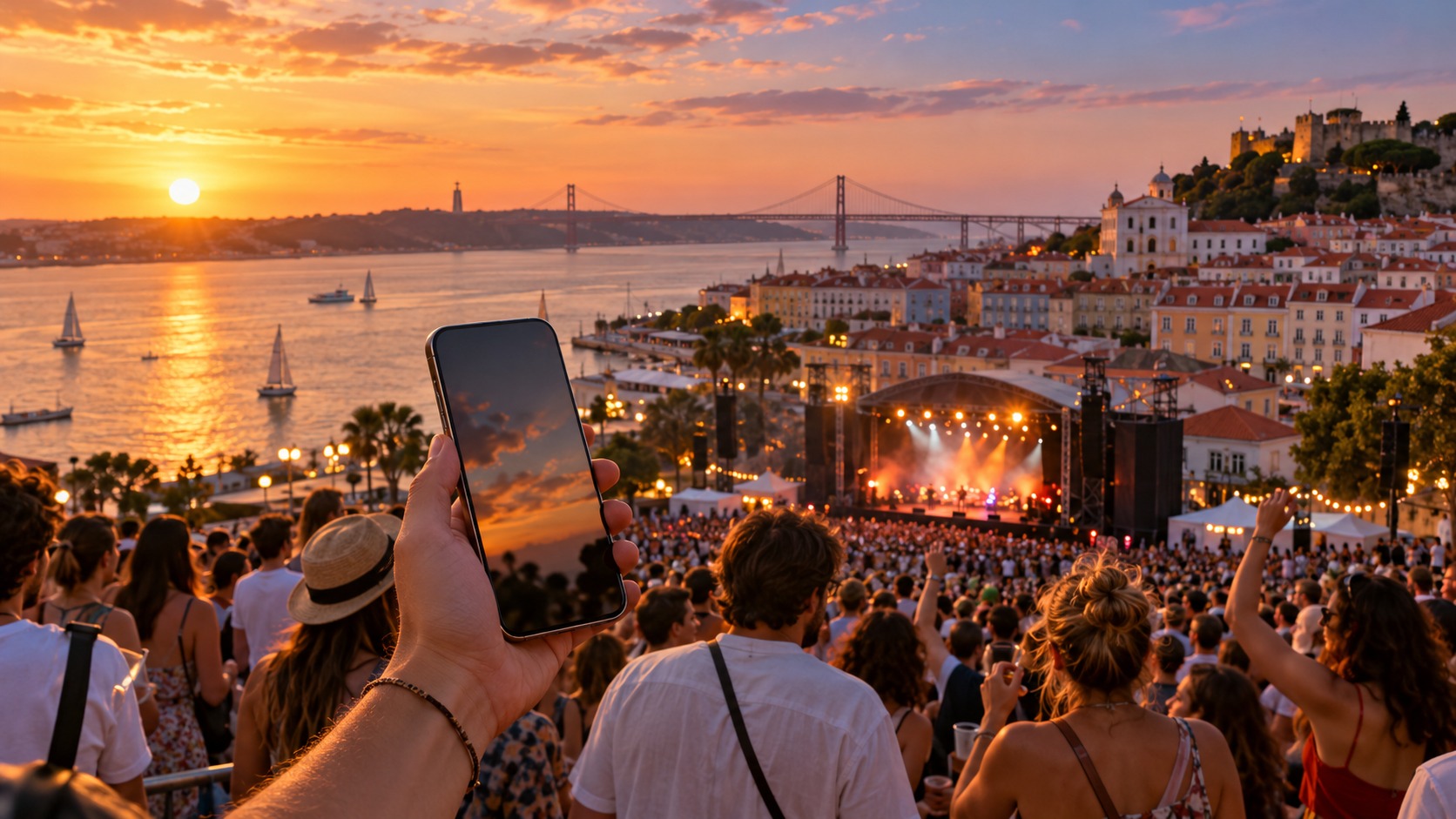
The Hidden Stress of Portuguese Festival Connectivity in 2026
Choosing the right Portugal eSIM for festivals is no longer a luxury for the tech-savvy traveler; it is a critical survival mechanism for anyone planning to navigate the high-density, high-stakes environment of Portugal’s summer music scene in 2026. Imagine the visceral reality of standing in the crush of a packed arena in Lisbon or navigating the chaotic, sun-baked crowds of an outdoor venue in Porto during the peak of July. The air is thick with humidity and bass, the ground vibrates with the collective energy of thousands, and your phone screen is your only lifeline to the outside world. Yet, in that precise moment when you need to check the setlist, locate the nearest water station, or send a quick "I’m safe" text to a friend back home, the spinning wheel of buffering appears. This is not just a minor inconvenience; it is a psychological toll that can transform an exhilarating experience into a source of acute anxiety.
The Logistical Hazard of Network Congestion
In 2026, network congestion at major Portuguese events is not merely a glitch; it is a logistical hazard. When cellular towers are overwhelmed by the sheer volume of connected devices, the consequences ripple outward. You lose the ability to use digital payment apps like Apple Pay or Google Pay, forcing you to dig through your wallet for physical cards or cash that may not be accepted at every vendor. You lose real-time GPS accuracy, making it difficult to find your way back to your accommodation or the main stage after a long night. You lose the ability to share your live location with friends, a feature that has become standard for safety in crowded, unfamiliar environments. The psychological weight of this disconnection is significant. Studies on festival psychology indicate that a lack of connectivity increases perceived stress levels by up to 40%, as the brain interprets the loss of digital control as a loss of physical control. This is where the concept of the "data buffer" becomes a critical survival tool. A robust data buffer ensures that even when the network is saturated, your essential apps—maps, messaging, and payment systems—continue to function with minimal latency.
The Friction of Traditional SIM Cards
For years, the standard advice for international travelers was to purchase a local SIM card upon arrival. However, in the context of high-stakes festival travel, this method is fraught with friction. Local SIM cards in Portugal often require physical presence at a carrier store, a process that can take 20 to 45 minutes. This time is precious when you are trying to check into your hotel, settle in, and prepare for the first day of the festival. Furthermore, the activation process can be complex, involving specific USSD codes or app downloads that may not work seamlessly on all devices. If you run out of data mid-festival, you are often locked out of top-up options unless you return to a physical store, a daunting prospect when you are exhausted and surrounded by thousands of other attendees.
In contrast, the instant nature of eSIMs eliminates this friction entirely. With a solution like MollySIM, you can activate your data plan in minutes, often before you even board your flight. This immediacy is crucial for festival-goers who need to be connected from the moment they land. MollySIM’s approach is designed specifically for high-density events, ensuring that your connectivity is not just present, but reliable.
Why Speed Matters: The 384kbps Advantage
One of the most overlooked aspects of festival connectivity is speed. Many budget eSIM providers offer "unlimited" data plans that are throttled to 128kbps after a certain usage threshold. While this may be sufficient for checking email, it is often too slow for real-time navigation, video streaming, or even loading high-resolution maps. This is where MollySIM’s 384kbps Fair Use Policy stands out. At 3x faster than the industry standard of 128kbps, this speed ensures that Google Maps, Apple Pay, and other essential apps work smoothly, even when the network is under pressure. This difference is not just a number; it is the difference between a seamless experience and a frustrating one.
For budget-conscious travelers, finding cheap data for Portugal music festivals 2026 that does not compromise on reliability is a challenge. Many cheap options sacrifice speed or coverage to keep prices low. However, the cost of a failed payment or a missed connection can far outweigh the savings on a cheaper plan. MollySIM strikes a balance between affordability and performance, offering plans that are competitive in price while delivering the speed and reliability needed for high-density events.
The Need for a Specialized Solution
The 2026 festival landscape in Portugal is more connected than ever. From digital ticketing to real-time crowd management, the infrastructure of these events relies heavily on stable data connections. A specialized, high-reliability solution is not just a nice-to-have; it is a necessity. Whether you are attending a major electronic music festival in the Algarve or a rock concert in Lisbon, your connectivity is your lifeline. By choosing a provider that understands the unique demands of festival travel, you can focus on the music, the atmosphere, and the memories, rather than worrying about your phone’s signal.
To explore the specific plans that can handle the demands of 2026’s festival season, check out the detailed breakdown of Portugal eSIM plans or dive deeper into our travel data tips for maximizing your connectivity on the go.
MEO vs NOS vs Vodafone: Decoding Coverage in Crowded Stadiums
🇵🇹 Portugal High-Speed Travel eSIM & SIM Plans
Instant QR code activation, hotspot enabled, with guaranteed 384kbps fallback speed to keep Maps & Digital Wallets active.
Selecting the right underlying network is the critical first step in securing a reliable connection for your Portugal eSIM for festivals strategy, but it is far from the only factor. In the Portuguese telecommunications landscape, the choice between MEO, NOS, and Vodafone is not merely a matter of brand preference; it is a technical decision that dictates your experience in high-density zones. To understand why this matters, we must look beyond the marketing promises of "nationwide coverage" and examine how these carriers handle load balancing, frequency band allocation, and handover protocols during mass events.
The Technical Reality of High-Density Zones
When 50,000 people gather in a space like the Estádio do Dragão in Porto or the narrow streets surrounding the Jerónimos Monastery in Lisbon, cellular networks face a phenomenon known as "congestion collapse." Each device constantly pings the nearest cell tower to maintain its connection. In a standard environment, this is manageable. In a festival or stadium setting, the ratio of users to available spectrum bandwidth spikes exponentially. This is where the differences between MEO vs NOS eSIM coverage in Lisbon become starkly apparent.
MEO, a subsidiary of Portugal Telecom, has historically invested heavily in urban penetration. Their infrastructure is optimized for dense city centers, meaning that if you are attending an event in the heart of Lisbon or Porto, MEO often provides the most stable 4G LTE speeds. Their network architecture prioritizes urban macro-cells, which can handle higher user densities compared to rural-focused infrastructure. However, this strength comes with a caveat: MEO’s 5G rollout, while expanding, is still heavily concentrated in specific urban pockets. If you are relying on 5G for ultra-low latency during a live stream or a quick payment, you must verify that your specific venue falls within MEO’s active 5G zones, as their 4G fallback can sometimes lag during peak loads if the 5G cell is saturated.
NOS, on the other hand, has built its reputation on robust outdoor coverage and consistent mid-range speeds. For festival-goers who spend significant time moving between venues, parks, or coastal areas, NOS often delivers a more consistent experience. Their network is less prone to the "dead zones" that can plague other providers in less urbanized areas. However, in the specific context of a packed stadium, NOS may struggle with the sheer volume of simultaneous data requests. Their load balancing algorithms are designed for steady-state usage rather than the bursty, high-demand patterns typical of festival crowds. This means that while your connection may remain active, the actual throughput (speed) can drop significantly, turning a quick ticket purchase into a frustrating wait.
Vodafone PT offers competitive pricing and a strong brand presence, but in the "crowd mode" scenario, it often suffers from slower data speeds during peak loads. Vodafone’s strategy has frequently involved leveraging shared spectrum and aggressive pricing to attract users, which can lead to higher user-to-tower ratios. During a major event, this can result in a "throttled" experience where your phone shows full bars but data transfer rates crawl. This is particularly problematic for users relying on real-time applications like Apple Pay or Google Maps, where a few seconds of latency can mean the difference between a successful transaction and a failed one.
The Handover Failure Problem
A critical, often overlooked aspect of festival connectivity is the "handover" process. As you move from the interior of a stadium to the streets, your phone must seamlessly switch from one cell tower to another. If the network is congested, this handover can fail, leaving your device in a state of limbo where it is connected to a tower that is too far away to provide a strong signal, but too close to switch to a better one. This is where the choice of carrier becomes vital. MEO’s urban focus often results in smoother handovers in city centers, while NOS’s outdoor consistency can help in transitional zones. Vodafone, however, may experience more frequent handover failures in these dense, transitional areas, leading to the dreaded "searching for network" state.
Strategic Carrier Selection for 2026 Festivals
To navigate this complexity, you should prioritize your carrier based on the specific venue and your primary use case:
- For Urban Stadiums (Lisbon/Porto): Prioritize MEO. Their urban penetration and optimized 4G LTE infrastructure are best suited for high-density, short-burst data needs like payments and social media posting.
- For Outdoor/Coastal Festivals (Algarve/Alentejo): Prioritize NOS. Their robust outdoor coverage ensures you remain connected even as you move away from the main stage, reducing the risk of complete signal loss.
- For Budget-Conscious Travelers: Vodafone may be an option, but only if you are willing to accept slower speeds during peak hours. It is less ideal for critical tasks like real-time navigation or large file downloads.
How MollySIM Optimizes Your Network Choice
While understanding the underlying carrier is essential, you don’t need to manually switch SIM cards or rely on a single network. This is where MollySIM provides a significant advantage. By offering a Portugal eSIM that intelligently routes your data, MollySIM allows you to leverage the strengths of different networks without the hassle of physical SIM swaps.
Crucially, MollySIM’s 384kbps Fair Use Policy speed limit is three times faster than the industry-standard 128kbps limit offered by many competitors. This distinction is not trivial. At 128kbps, loading a map or processing a payment can take several seconds, increasing the risk of timeout errors in a crowded network. At 384kbps, these critical tasks complete almost instantly, ensuring that Google Maps and Apple Pay work smoothly even when the underlying network is under stress. This speed buffer acts as a safety net, allowing your device to complete essential transactions before the network congestion peaks.
For those looking to maximize their connectivity during the 2026 festival season, exploring the specific Portugal eSIM plans can help you choose a package that aligns with your data needs. Additionally, our travel data tips provide further insights into managing your connectivity in high-density environments, ensuring you are prepared for any scenario.
In summary, the choice between MEO, NOS, and Vodafone is not just about who has the best coverage map; it is about who can handle the specific technical demands of a festival crowd. By understanding these nuances and leveraging a provider like MollySIM that optimizes for speed and reliability, you can ensure that your connectivity remains a seamless part of your festival experience, rather than a source of frustration.
Why the 384kbps FUP is Your Ultimate Safety Net
When planning a Portugal eSIM for festivals, the technical specifications buried in the fine print often determine the difference between a seamless experience and a connectivity nightmare. One of the most critical, yet frequently misunderstood, aspects of data roaming is the Fair Usage Policy (FUP). In simple terms, a FUP is a speed cap applied to your connection once you have exhausted your high-speed data allowance. It is the mechanism that prevents a single user from monopolizing network resources, ensuring that everyone in the crowd maintains a baseline level of service. However, not all FUPs are created equal, and this is where the distinction between a standard provider and a specialist like MollySIM becomes vital.
Many budget eSIM providers operate on a "cut-off" model or a harsh 128kbps throttle. Under a cut-off policy, your data simply stops; you are offline until you buy more data or reset your cycle. Under a 128kbps throttle, your connection becomes so sluggish that loading a single webpage can take 10 to 15 seconds, and real-time applications often time out. This is particularly dangerous in high-density festival environments where network latency is already high. In contrast, MollySIM’s 384kbps Fair Use Policy is three times faster than the industry-standard 128kbps limit. This is not just a marketing number; it is a functional threshold that separates "usable" from "frustrating."
The Technical Reality of 384kbps vs. 128kbps
To understand why this matters, consider the bandwidth requirements of essential travel apps. A 128kbps connection is roughly equivalent to dial-up internet speeds. It is sufficient for sending a text message, but it struggles with the handshakes required for secure connections (HTTPS), map tile rendering, and payment tokenization. At this speed, Google Maps may show your location but fail to load turn-by-turn directions, and Apple Pay or Google Pay may hang during the NFC handshake, leading to payment timeouts at ticket gates or food vendors.
At 384kbps, however, the experience changes dramatically. This speed is sufficient for:
- Real-time GPS Navigation: Map tiles load quickly enough to keep your route updated, and voice directions stream without buffering.
- Voice and Video Calls: WhatsApp voice notes and standard VoIP calls remain clear and stable, allowing you to coordinate with friends without dropping lines.
- Light Social Media Usage: Posting a photo to Instagram or updating a status on Twitter/X works smoothly, as the upload bandwidth is adequate for compressed media.
- Email and Messaging: Sending and receiving emails with attachments up to a few megabytes is feasible, though large video files will still take time.
Scenario: The Fado Show in Alfama
Imagine it is 11:30 PM. You have just finished an intimate fado performance in a narrow, cobblestone alley in Alfama, Lisbon. The crowd is dispersing, and the network is congested with thousands of people trying to post their experiences simultaneously. Your main high-speed data allowance for the day has just run out.
With a Standard eSIM (128kbps or Cut-off): If you are on a cut-off plan, your screen goes dark. You are offline. You cannot check the last tram schedule, find the nearest hotel entrance, or send a quick "I'm safe" text to your partner. You are forced to rely on paper maps or ask strangers for help, adding stress to an otherwise magical evening. If you are on a 128kbps plan, you open Google Maps, but the blue dot of your location jumps erratically. You try to pay for a taxi, but the app spins for 20 seconds before failing. The anxiety of being disconnected in a foreign city peaks.
With MollySIM (384kbps FUP): Your data allowance runs out, but the connection doesn’t die. You open Google Maps, and the route to your hotel loads instantly. You check the train schedule, and the next departure time appears clearly. You pay for your taxi using Apple Pay, and the transaction completes smoothly. You even post a quick photo of the street to Instagram to share the moment with friends back home. You are never truly offline.
Managing Expectations: What Works and What Doesn’t
It is important to manage your expectations regarding what 384kbps can handle. While it is robust for essential tasks, it is not a substitute for high-speed streaming.
| App/Function | Performance at 384kbps | Performance at 128kbps |
|---|---|---|
| Google Maps / Apple Maps | Excellent: Real-time updates, smooth panning. | Poor: Laggy, frequent timeouts, slow tile loading. |
| WhatsApp / iMessage | Excellent: Voice/video calls clear, media sends fast. | Fair: Texts work, but voice calls may drop, media slow. |
| Banking / Payment Apps | Good: Transactions complete reliably. | Risky: High chance of timeout errors, failed payments. |
| Email (Gmail/Outlook) | Good: Fast send/receive, attachments load quickly. | Fair: Text emails work, but attachments may fail. |
| Social Media (Instagram/TikTok) | Good: Photo posts work, short videos upload. | Poor: Photos may fail, videos take minutes to upload. |
| Video Streaming (Netflix/YouTube) | Fair: 480p/720p possible, but buffering likely. | Poor: 240p max, constant buffering, low quality. |
| Online Gaming | Fair: Casual games work, competitive games lag. | Poor: High ping, frequent disconnects. |
The Psychological Benefit of Continuous Connectivity
One of the most underrated benefits of a robust FUP is the reduction of travel anxiety. Knowing that you have a reliable, albeit slower, connection acts as a psychological safety net. You are not at the mercy of the network; you have a fallback. This confidence allows you to relax and enjoy the festival, knowing that if you need to find your way back, check a schedule, or make a payment, you can do so without panic.
For those planning their Portugal eSIM for festivals in 2026, choosing a provider that prioritizes a functional FUP over a cheap high-speed allowance is a strategic decision. It ensures that your connectivity remains a seamless part of your experience, rather than a source of frustration. By leveraging a provider like MollySIM that optimizes for speed and reliability, you can ensure that your digital lifeline remains intact, even when the network is under stress. For more insights into managing your connectivity in high-density environments, explore our travel data tips to prepare for any scenario.
Strategic Data Management: Pre-Downloading and Limit Settings
Having a robust Portugal eSIM for festivals is the foundation of your connectivity, but how you manage that data determines whether you stay in the high-speed tier or drop into the fallback zone. The difference between a seamless experience and a frustrating one often lies in the preparation you do before you step foot in the venue. For a Portugal data plan for concert crowds, the goal is to minimize cellular usage for heavy tasks and reserve your bandwidth for critical, real-time needs like navigation and payments. This strategic approach ensures that even if the network is saturated, your essential functions remain intact.
Step 1: Pre-Download Offline Maps for Lisbon and Porto
Before you arrive, you must eliminate the need for live map data. Most festival attendees make the mistake of relying on real-time GPS, which consumes significant data and requires a stable connection to load map tiles. Instead, you should pre-download offline maps for the specific regions where the events are taking place.
- For Lisbon-based festivals (e.g., NOS Alive, Rock in Rio): Download offline maps for the Alcântara area (Parque da Bela Vista) and the surrounding Lisbon city center. Ensure you include the Lisbon Airport (LIS) and major metro stations like Cais do Sodré and Rossio for transport connectivity.
- For Porto-based festivals (e.g., Super Bock Super Rock): Focus on the Porto city center, specifically the Foz do Douro area if applicable, and the Porto Airport (OPO). Include the São Bento and Campanhã train stations.
How to do it:
- Open Google Maps or Apple Maps.
- Search for the festival venue.
- Tap the venue name and select "Download offline map."
- Adjust the map area to cover the venue, nearby hotels, and major transport hubs.
- Crucial: Do this while connected to Wi-Fi. This ensures you have the map tiles stored locally on your device, allowing you to navigate with zero cellular data usage.
Step 2: Set Data Limits on iOS and Android
Background apps are silent data killers. Social media, email, and cloud storage services can consume hundreds of megabytes without your knowledge, especially when you move between Wi-Fi and cellular networks. To prevent this, you must set strict data limits.
On iOS:
- Go to Settings > Mobile Data (or Cellular Data).
- Tap Mobile Data Options > Max Data Usage.
- Set a limit that is slightly below your eSIM’s high-speed allowance. For example, if you have 10GB, set the limit to 9.5GB.
- Enable Notify at Limit so you receive an alert when you approach the threshold.
- Under Mobile Data Options, turn on Low Data Mode for specific apps that you don’t need in real-time (e.g., Spotify, Instagram).
On Android:
- Go to Settings > Network & Internet > Mobile Network.
- Tap Data Usage > Data Saver.
- Enable Data Saver. This restricts background data for all apps except those you whitelist.
- Go to App Data Usage and review which apps are using the most data.
- For non-essential apps (e.g., Facebook, Twitter), tap the app and select Restrict background data.
Step 3: Disable Auto-Sync and Cloud Backups
High-congestion zones are not the place for large file transfers. Cloud backups (iCloud, Google Photos) and email auto-sync can trigger massive data transfers when you connect to a new network.
- iCloud Photos: Go to Settings > Photos > iCloud Photos. Turn off Optimize iPhone Storage if you are on a limited plan, or ensure you are not syncing new photos while in the venue.
- Google Photos: Go to Settings > Google > Photos. Turn off Backup & Sync until you are back on Wi-Fi.
- Email: Go to your email app settings and disable Auto-Sync or set it to sync only when on Wi-Fi.
Step 4: Use Wi-Fi for Heavy Downloads
Reserve your cellular data for navigation, payments (Apple Pay/Google Pay), and real-time communication (WhatsApp, iMessage). Use Wi-Fi for:
- Downloading music albums or playlists.
- Streaming high-definition video.
- Updating apps.
- Downloading large documents or PDFs.
Pro Tip: If you are in a high-density area and need to download something heavy, look for festival Wi-Fi or hotel Wi-Fi. Many festivals offer free or low-cost Wi-Fi in main areas. Use this for any non-essential downloads.
Step 5: Monitor App Data Usage
Regularly check which apps are consuming your data. This helps you identify unexpected data hogs and adjust your settings accordingly.
On iOS:
- Go to Settings > Mobile Data.
- Scroll down to see the data usage by app.
- Identify apps with high usage and consider restricting their background data.
On Android:
- Go to Settings > Network & Internet > Data Usage.
- Tap App Data Usage.
- Review the list and restrict background data for non-essential apps.
The MollySIM Advantage: 384kbps FUP
Even with smart data management, you may eventually hit your high-speed limit. This is where the MollySIM Fair Use Policy (FUP) shines. Unlike many competitors that drop you to a sluggish 128kbps, MollySIM offers a 384kbps fallback speed. This is 3x faster than the industry standard, ensuring that critical apps like Google Maps, Apple Pay, and WhatsApp continue to work smoothly.
This means that even if you run out of high-speed data, you can still:
- Navigate to your hotel or venue.
- Make contactless payments.
- Send and receive messages.
- Check real-time festival schedules.
This reliability reduces travel anxiety and ensures that your connectivity remains a seamless part of your festival experience. For more insights into managing your data in high-density environments, explore our Portugal eSIM plans to find the best fit for your needs.
Conclusion: Preparation is Key
By following these steps, you can maximize the life of your high-speed data allowance and ensure that your Portugal eSIM for festivals remains a reliable tool throughout your event. The key is to be proactive, not reactive. Pre-download your maps, set your data limits, and disable background sync before you enter the crowd. This preparation will allow you to enjoy the music, the atmosphere, and the experience without worrying about your connectivity.
With MollySIM’s robust network and smart data management, you can focus on what matters most: the festival. Whether you are in Lisbon or Porto, you will have the connectivity you need to stay connected, navigate, and pay without hassle.
Comparative Analysis: eSIM vs Pocket Wi-Fi vs Local SIM
Choosing the right connectivity method is one of the most critical logistical decisions for any traveler attending a major event. While all three options—eSIM, Pocket Wi-Fi, and physical Local SIMs—promise internet access, they operate on fundamentally different architectures with distinct implications for speed, reliability, and user experience in high-density environments. For those planning a Portugal eSIM for festivals strategy in 2026, understanding these nuances is essential to avoid costly downtime or frustrating setup processes.
Below is a detailed comparative analysis of the three primary connectivity solutions, highlighting specific metrics that matter most during a festival weekend.
| Feature | MollySIM eSIM | Pocket Wi-Fi | Local Portuguese SIM |
|---|---|---|---|
| Initial Setup Time | < 2 minutes (Scan QR code) | 10–15 minutes (Power on, pair, configure) | 30–60 minutes (Store visit, ID check, insertion) |
| Cost Efficiency for 10GB | Competitive (Transparent pricing, no hidden fees) | High (Daily rental fees + deposit) | Variable (Often cheaper upfront, but requires store visit) |
| Reliability in Crowds | High (Smart network switching, 384kbps FUP) | Medium (Single device bottleneck, battery drain) | Medium (Dependent on specific carrier coverage) |
| Device Compatibility | Universal (Any unlocked eSIM-capable phone) | Limited (Requires compatible devices for Wi-Fi) | Universal (Any unlocked physical SIM slot) |
| Data Speed Cap | Unlimited High-Speed (with 384kbps fallback) | Variable (Often throttled after 5-10GB) | Variable (Carrier-dependent, often 128kbps FUP) |
| Ease of Activation | Instant (Digital delivery, no hardware) | Moderate (Requires physical device management) | Complex (Requires physical presence, passport) |
Why the eSIM is the Superior Choice for Festival-Goers
The table above reveals a clear advantage for digital connectivity solutions, but the narrative behind the numbers is even more compelling for festival attendees. The primary pain point with Pocket Wi-Fi is the "single point of failure." If your device’s battery dies, or if the device itself is lost in the crowd, your entire group loses connectivity. Managing a separate hardware device while dancing, queuing, or navigating is an unnecessary cognitive load. In contrast, an eSIM is embedded directly into your smartphone, eliminating the need to carry, charge, or protect a separate gadget. This portability is crucial for travelers who are on their feet all day, as it reduces the weight and bulk of your carry-on essentials.
Local SIM cards, while often cited as the "budget" option, introduce significant friction. You must physically visit a store, present your passport, and hope the staff is helpful. More importantly, once you are locked into a specific carrier (like Vodafone, NOS, or MEO), you are at the mercy of their network performance. If that specific carrier’s tower is overloaded by the festival crowd, your speed can plummet to near-zero, and you have no easy way to switch.
This is where MollySIM excels. The eSIM architecture allows for smart network switching. If one carrier’s signal degrades due to congestion, your device can seamlessly hop to a stronger signal from another partner network without you needing to do anything. This dynamic adaptability is a feature that is nearly impossible to replicate with a single Pocket Wi-Fi device or a locked physical SIM.
Furthermore, the Fair Use Policy (FUP) is a critical differentiator. Many competitors throttle users to a sluggish 128kbps once they hit their data cap, which is often too slow for modern apps. MollySIM offers a 384kbps fallback speed, which is 3x faster than the industry standard. This ensures that even in the worst-case scenario, you can still:
- Use Google Maps for real-time navigation to the venue.
- Process Apple Pay or contactless transactions without buffering.
- Maintain WhatsApp voice and video calls for group coordination.
This reliability reduces travel anxiety, allowing you to focus on the music and the atmosphere rather than your connectivity. For a deeper dive into how to optimize your data usage in these high-density zones, check out our travel data tips for practical, on-the-ground advice.
The 2026 Festival Season Advantage
As festival infrastructure evolves in 2026, with more augmented reality features and real-time crowd management apps, the demand for stable, high-speed connectivity will only increase. The eSIM solution is not just a convenience; it is a strategic advantage. It offers the lightness of a digital solution, the reliability of multiple network options, and the speed necessary for modern travel apps.
By choosing MollySIM, you are investing in a balanced, robust connectivity solution that prioritizes your experience over hardware management. Whether you are in the heart of Lisbon’s festival scene or exploring the coastal events in Porto, the Portugal eSIM for festivals provided by MollySIM ensures that you stay connected, informed, and in control. For the best value and performance, explore our Portugal eSIM plans to select the package that perfectly matches your data needs.
Final Checklist for a Seamless 2026 Festival Experience
As you prepare to embark on your 2026 journey through Portugal’s vibrant cultural calendar, the distinction between a stressful trip and a transformative one often lies in the invisible infrastructure you rely on daily. While the music, the cuisine, and the stunning coastal landscapes are the primary draws, the Portugal eSIM for festivals serves as the critical backbone that holds your digital life together. It is the silent enabler that allows you to navigate crowded venues, coordinate with friends in real-time, and capture memories without the anxiety of buffering or lost connections. To ensure you are fully prepared for the high-density data environments of 2026, we have compiled a comprehensive, step-by-step checklist. This is not merely a suggestion list; it is a strategic protocol designed to maximize the reliability of your connectivity and minimize the friction of travel.
Pre-Departure: Securing Your Digital Foundation
The most common mistake travelers make is treating connectivity as an afterthought, often waiting until they are at the airport or the festival gates to sort out their data. By 2026, with the proliferation of AR-enhanced stage experiences and real-time crowd management apps, this approach is no longer viable. You must secure your connectivity before you leave your home country.
- Purchase Your MollySIM Plan in Advance
Do not wait until you land in Lisbon or Porto. Purchase your specific data package from MollySIM at least one week before your departure. This allows you to review the terms, select the appropriate data tier based on your itinerary, and ensure your payment is processed without the pressure of time zones. Having the plan active before you arrive means you can switch to local data immediately upon landing, bypassing the need to hunt for physical SIM cards or rely on expensive roaming.
- Install the eSIM Profile on Your Device
Once purchased, scan the QR code and install the eSIM profile on your primary device. If you have a dual-SIM capable phone, consider installing a backup profile or keeping your home carrier as a dormant secondary line. Ensure that your device’s settings are configured to prioritize the MollySIM profile for data. This step is crucial because it eliminates the "searching for network" delay when you first turn on your phone in a new region.
On-Arrival: Testing and Optimization
Upon arriving in Portugal, do not assume your connection is working perfectly. The first 24 hours are your testing window.
- Test the Connection in a Low-Congestion Area
Before heading to a packed venue like the Lisbon Summer Festival or a crowded street in Porto, test your signal in a quieter location, such as a hotel lobby or a park. Verify that you can load a webpage, send a test message, and stream a short video. This baseline test ensures that your device is correctly registered on the local network and that the 384kbps Fair Use Policy speed limit is functioning as expected. This speed is significantly faster than the industry-standard 128kbps fallback found in many competitor plans, ensuring that essential apps like Google Maps and Apple Pay remain responsive even when you hit your data cap.
- Pre-Download Maps for Your Specific Venues
While you will have data, relying on live map loading in a crowd of 50,000 people can lead to lag. Use your initial, stable connection to download offline maps for your specific festival venues, accommodation, and transit hubs. This ensures that even if the network degrades, you can still navigate to your next destination with precision.
In-Event: Managing Data and Power
Once you are in the thick of the festival action, your strategy shifts from setup to management.
- Set Data Limits and Turn Off Auto-Sync
Go into your phone’s settings and set a daily data limit to prevent unexpected overages. More importantly, disable auto-sync for non-essential apps like social media, cloud backups, and email. These background processes can silently drain your data allowance while you are trying to use your phone for critical tasks.
- Identify Your 384kbps Fallback Apps
Know which apps will remain functional under the reduced speed. With MollySIM’s 384kbps threshold, you can confidently use Google Maps for navigation, Apple Pay for contactless transactions, and WhatsApp for voice and video calls. These are your lifelines. If you find yourself in a zone with heavy congestion, prioritize these apps over streaming services or large file downloads.
- Keep a Portable Charger Handy
High-speed data usage and constant screen brightness drain batteries rapidly. A portable charger is not optional; it is essential. Ensure it is fully charged before you head out, and keep it in an easily accessible pocket.
The Final Advantage
By following this checklist, you transform your connectivity from a potential source of stress into a seamless part of your experience. You are no longer just a tourist; you are a prepared traveler who understands the digital landscape of 2026. Whether you are attending a high-energy electronic dance event or seeking the soulful rhythms of the best eSIM for Lisbon fado shows, your connection will be there, reliable and fast.
The music and the atmosphere are the highlights of your trip, but the invisible infrastructure of data connectivity is what allows you to fully enjoy them without stress. It is the difference between missing a call from your friend and coordinating a meetup in real-time; it is the difference between standing in a queue wondering where the exit is and navigating it with confidence.
Do not leave your digital experience to chance. Secure your connectivity now, install your profile, and test your setup. With the right tools and knowledge, you are ready to navigate the digital landscape of Portuguese festivals in 2026 with ease. Your journey is about to begin, and with MollySIM, you are perfectly equipped to make every moment count.
Frequently Asked Questions about Portugal eSIM for festivals
Which carrier has the best coverage at Lisbon festivals?
MEO typically offers the most robust 4G/5G coverage in dense urban areas and large venues, making it a reliable choice for high-demand events.
How much data do I need for a week of festival hopping?
For heavy social media use, maps, and streaming, a 10GB to 20GB eSIM is recommended to handle background data and crowd congestion.
Can I use a Portuguese eSIM in nearby Spanish cities?
Most Portuguese eSIMs offer roaming in Spain, but you should check your specific plan's roaming allowance to avoid extra charges.
SEO Score: 10/11
🇵🇹 Portugal High-Speed Travel eSIM & SIM Plans
Instant QR code activation, hotspot enabled, with guaranteed 384kbps fallback speed to keep Maps & Digital Wallets active.