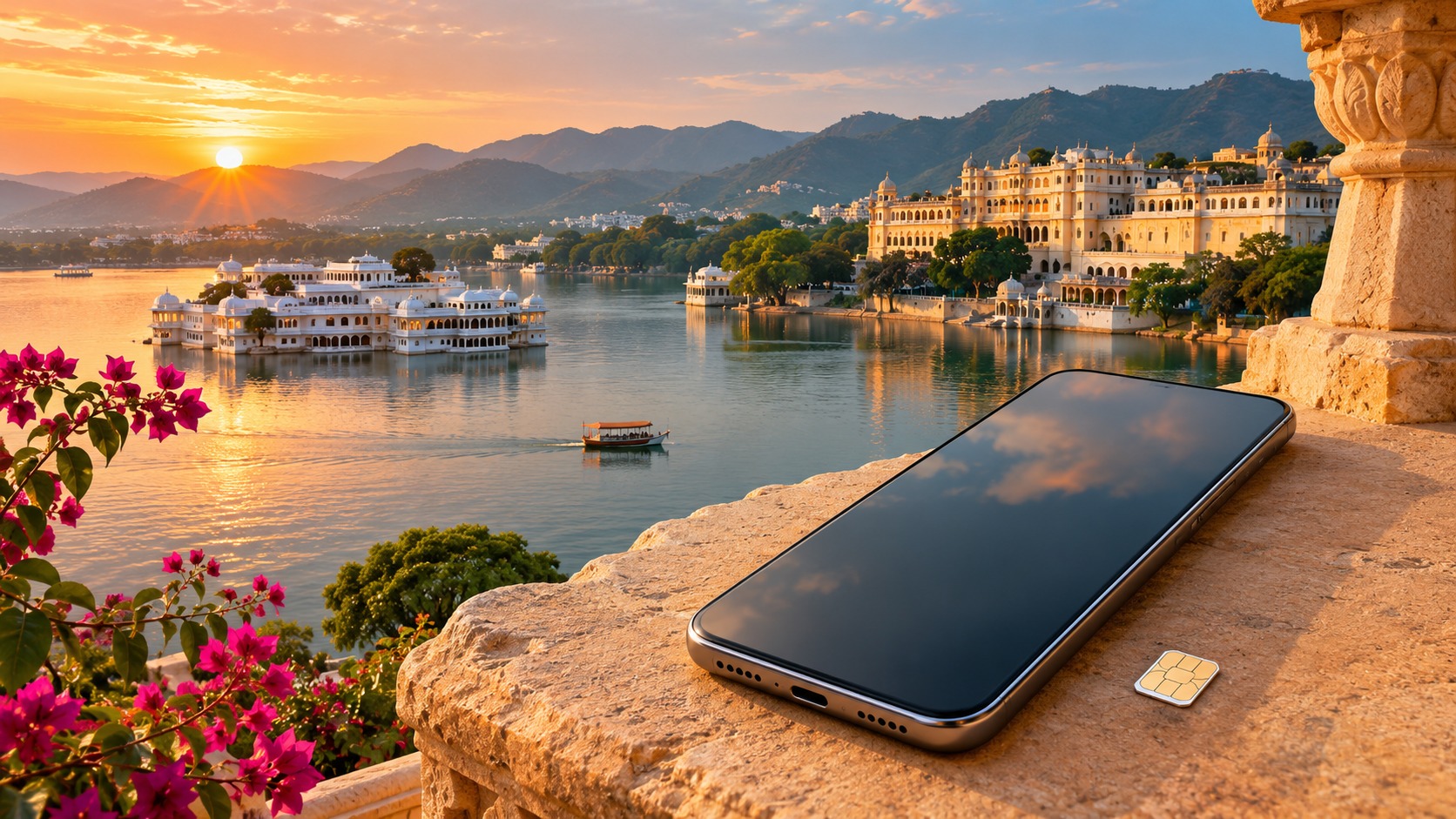
Choosing an India eSIM vs local SIM comes down to when you want connectivity, whether you need an Indian number, and how much setup you can handle after landing. A travel eSIM can be arranged before departure and ready for data setup on your phone. A physical prepaid SIM may fit better if you specifically need a local number or want a particular plan sold in India.
Those are different purchase paths, not simply two versions of the same product. A travel eSIM depends on a compatible phone that is not carrier-locked and the plan's network and data terms. Buying locally can involve identity verification and provider-specific purchase and activation steps. Either way, you should check the exact plan, its validity, high-speed allowance, hotspot terms and top-up rules before you rely on it for maps, ride-hailing, messaging or QR payments.
India eSIM vs local SIM: what changes for a tourist?
With a travel eSIM, you can arrange a data plan before departure, receive an activation QR code by email, and install it when you have a connection for setup. It can reduce the amount of mobile service you need to arrange after you arrive. It does not automatically provide an Indian phone number: check whether the specific plan is data-only or includes calls and SMS.
A local physical SIM gives you a separate SIM card and may suit you if a local number is important or if you have selected a specific local plan. The tradeoff is that purchase and activation can require identity verification, and the exact steps depend on the provider. Allow time for those steps instead of assuming that inserting a card will make it work immediately.
A home-carrier roaming plan is a third shape. It keeps your existing service arrangement, but you need to check your carrier's India coverage, charges, data limits and calling terms directly. Do not treat roaming as equivalent to either a local plan or a travel eSIM; its cost and allowance depend on the offer you already have.
| Option | Before departure | Number | Main setup check |
|---|---|---|---|
| Data-only travel eSIM | Can be arranged ahead; QR code is delivered by email | Usually use your existing number for calls and SMS on its SIM; the eSIM supplies data | eSIM-compatible phone that is not carrier-locked, listed network, plan validity and data terms |
| Local prepaid SIM | Usually purchased after arrival | May provide a local number; confirm the specific plan | Current identity requirements and provider activation steps |
| Home-carrier roaming | Check and arrange through your home carrier | Keeps your home number | India availability, included data, charges and roaming conditions |
India eSIM vs local SIM: decide whether you need a local number
🇮🇳 India High-Speed Travel eSIM & SIM Plans
Instant QR code activation, hotspot enabled, with guaranteed 384kbps fallback speed to keep Maps & Digital Wallets active.
For many visitor tasks, mobile data is the immediate need: opening maps, requesting a ride, messaging a host, checking email or completing a QR payment. A data-only plan can support those internet tasks while you keep your regular SIM active for its number, calls and SMS. The phone must support dual SIM operation for this arrangement, and you must select the correct line for mobile data.
An Indian number can matter if a service, contact or local plan requires one. Do not assume that a travel eSIM supplies it. Read the plan description for included voice and SMS, and consider whether your trip actually needs local calling or whether internet messaging and your existing number are enough. The value of a number depends on the specific services you will use, not on the SIM format by itself.
This is the practical question behind “travel eSIM or physical SIM for India”: are you buying data access, or do you need a local number and a particular local plan? If a number is essential, confirm that the provider's offer supplies one and that you can complete its purchase and activation process. If data is the priority, compare eSIM compatibility and plan terms before you leave.
Check the phone before buying an India eSIM for short trip
An India eSIM for short trip planning is useful only if your handset can install and use it. Check that the phone is not carrier-locked, supports eSIM, and can run the travel eSIM alongside the existing SIM if you want to retain your usual number. Device compatibility depends on the exact phone model and its configuration, so inspect the device settings and manufacturer information rather than relying on the phone's age or brand alone.
Then check the plan page for its supported network and destinations. Depending on the plan, an India travel eSIM may use Jio, Airtel or Vi. Network coverage and availability vary by area, so check the listed network against your itinerary, especially if you will leave dense city areas for highways or rural destinations. A network name is not a promise of identical service everywhere.
Review the plan's validity period, high-speed data allowance, hotspot rules and top-up options before paying. Compare plans on the same basis: total cost, number of days, how much data is available at high speed, what happens after that allowance, and whether hotspot use is permitted. A low total price can still be a poor fit if validity ends before your trip or the high-speed allowance does not match your intended use.
What your travel apps use
Your data use comes from what you do in each app and how it is configured. A map app needs data to load map areas, search places and refresh routes. Ride-hailing uses data to request a vehicle, exchange trip updates and display the route. Messaging uses less for text exchanges than for sending photos, voice notes or video. Email use rises when you download attachments or sync large files. A QR payment needs a working connection for the payment app to load and complete its exchange; other content inside the app can add to that use.
There is no single reliable data cost for each app without knowing your settings, how often you open it, and what media or map content it loads. For planning, separate essential tasks from heavy use. Navigation, messages and payment checks call for a plan that remains available throughout your itinerary. Video, large downloads and repeated media sharing consume more data than text and basic lookups. If you expect to use those, compare the high-speed allowance carefully and use Wi-Fi for large transfers when practical.
| Activity | What drives data use |
|---|---|
| Maps and navigation | Map detail loaded, searches and route refreshes |
| Ride-hailing | Booking requests, trip updates and map display |
| Messaging | Text versus photos, voice notes and video |
| Message sync and downloaded attachments | |
| QR payments | Payment app connection and any extra app content |
This comparison describes relative drivers, not fixed app rates. You can reduce surprises by limiting automatic media downloads, avoiding large uploads on mobile data, and checking your phone's data usage during the trip. Those controls do not change your plan's terms, so check the provider's allowance and hotspot policy as well.
India travel eSIM activation: steps before and after arrival
For an eSIM, make the setup sequence simple and check each stage:
- Confirm your phone is not carrier-locked, supports eSIM and can use the line configuration you want.
- Select a plan whose listed network and destination fit your itinerary. Read its validity, high-speed allowance, post-allowance behavior, hotspot terms and top-up instructions.
- Arrange the plan and receive the activation QR code by email. Keep access to the email and QR code available on a device or screen that your phone can scan.
- Install the eSIM using the phone's mobile-service settings while you have a suitable internet connection. Follow the plan's instructions for when to enable it.
- Set the travel eSIM as the mobile-data line. Keep your regular SIM selected for calls and SMS if you want to continue using your usual number and the phone supports that setup.
- When you are ready to use the plan, enable the line as directed and test connectivity. Open a webpage or map, then check that data is using the intended line.
Do not wait until you urgently need a ride or a route to discover that the phone is locked, the QR code is inaccessible, or the wrong line is selected. If a step differs by device, use the phone and plan instructions for that model and plan. An installation screen alone does not prove that the data connection is working; test it.
For a physical SIM, confirm the provider's current documentation requirements and activation steps before purchase. Ask what identity information is needed, how activation is completed, and what confirmation indicates that service is active. Keep the plan and top-up details available. Tourists may be able to buy a physical SIM, but verification and provider steps can affect how soon it works, so leave time for setup.
Compare plan terms and the post-allowance experience
Total cost is only one part of the comparison. Check the price for the whole validity period, whether the plan covers the full trip, how much data runs at high speed, the rules for using a hotspot, and whether additional top-ups are available. Also check whether a top-up extends validity, adds data, or does both; those details are plan-specific. For a local SIM, include the purchase and activation requirements in your planning. For a travel eSIM, confirm delivery, installation and network compatibility before departure.
MollySIM travel eSIMs use a fair-use policy: after the high-speed allowance is used, data continues at 384 kbps. That can keep basic services such as maps, messaging, email and QR payments available, while the reduced speed limits what feels practical. It is not equivalent to full-speed data. Large downloads, video and other data-heavy tasks may be slow at that rate. Plan around the high-speed allowance for demanding use and treat continued basic access as a fallback for lighter tasks.
A physical SIM can also be delivered as an eSIM: write eSIM in the order note to receive an activation QR code by email. This is useful if you want an eSIM form of a listed physical-card product, but still check that your phone supports it and that the plan is appropriate for India before relying on it.
Avoid two common setup mistakes
The first mistake is buying an eSIM before checking the handset. A phone that lacks eSIM support, remains locked, or cannot keep the desired SIM lines active will not match the intended setup. Check the actual device first, then choose the plan.
The second mistake is assuming a local SIM activates immediately after purchase. Identity verification and provider-specific activation can be part of the process. Confirm the current steps with the provider and allow time to complete them. The same planning discipline applies to either option: know which network the plan uses, where you intend to travel, and how you will confirm that data is working.
Browse India eSIM options for travelers to compare available plans, and use MollySIM travel connectivity guides to frame questions about setup and plan types. The India plan's own network and terms decide what it supports.
Frequently Asked Questions
Is an eSIM or local SIM better for tourists in India?
A travel eSIM can be convenient to arrange before departure, while a local SIM may suit you if you want a local number or a particular plan. Compare the current purchase requirements and plan terms before deciding, and check your phone's compatibility if you choose eSIM.
Can tourists buy a physical SIM card in India?
Tourists may be able to buy one, but purchase and activation can involve identity verification and provider-specific steps. Check the current requirements with the provider and allow time for setup rather than expecting immediate service.
Which networks can an India travel eSIM use?
Depending on the plan, it may use Jio, Airtel or Vi. Check the network named for the plan and compare it with your destinations because coverage and availability vary by area.
What should I do after I install an India travel eSIM?
Select it as the mobile-data line, enable it according to the plan instructions, and test connectivity by opening a webpage or map. Confirm that data is using the intended line before depending on it for navigation or other travel tasks.
SEO Score: 11/11
🇮🇳 India High-Speed Travel eSIM & SIM Plans
Instant QR code activation, hotspot enabled, with guaranteed 384kbps fallback speed to keep Maps & Digital Wallets active.