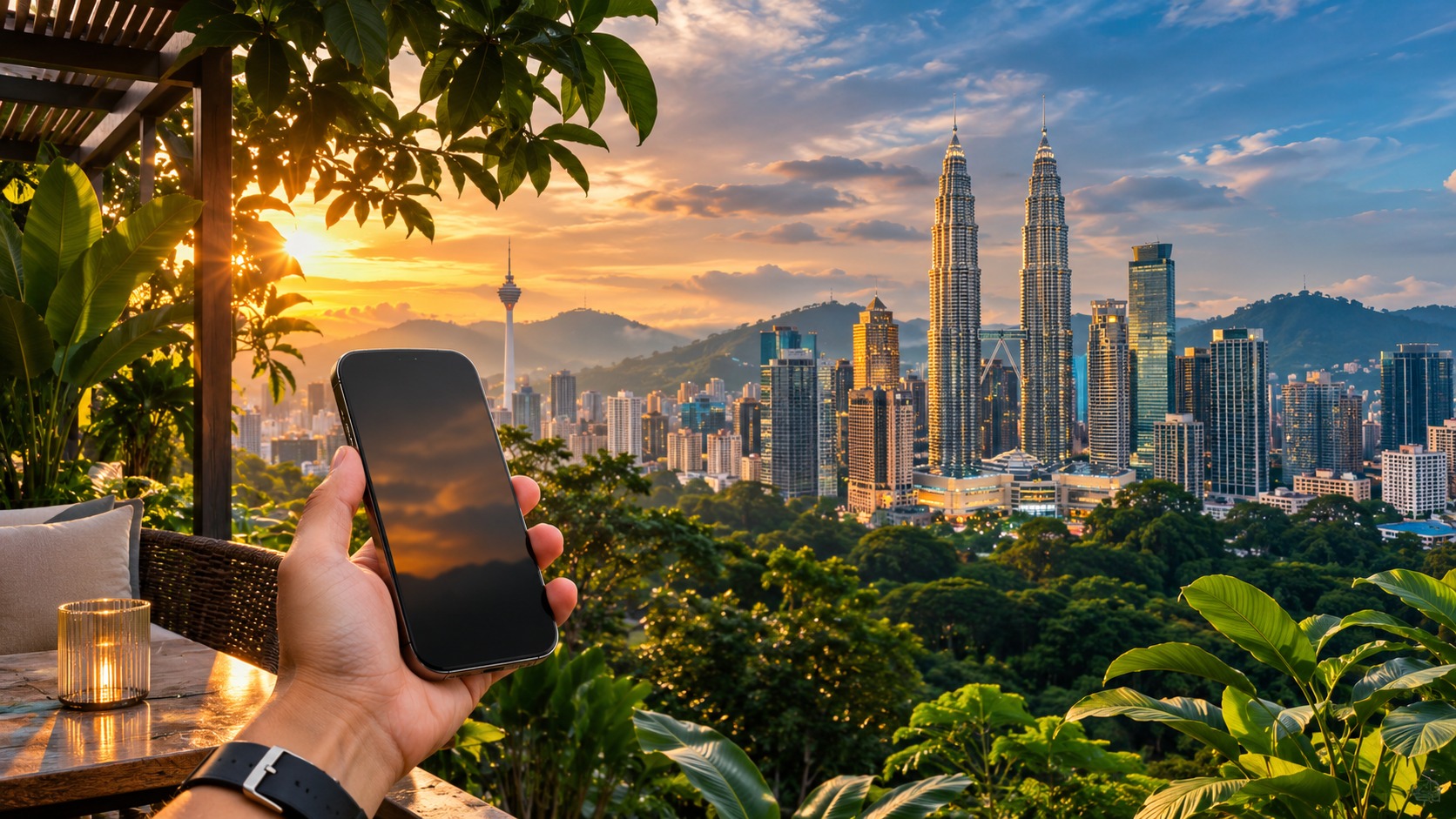
The 2026 Reality of Malaysian Mobile Data: Why Price Per GB Matters
When travelers begin researching the Malaysia eSIM cost 2026, they are often misled by a simple metric: the nominal price per gigabyte. On the surface, the Malaysian telecommunications market appears to be a paradise of affordable data. However, the true value equation for a modern tourist has shifted dramatically. In 2026, the debate is no longer just about which provider offers the cheapest megabyte, but which solution minimizes the "friction tax" of connectivity. For visitors staying between seven and fourteen days, the difference between a local prepaid SIM costing $20 and a premium eSIM solution costing $15 is financially negligible. Yet, the convenience gap is massive. Understanding this distinction is the first step in making an informed decision that prioritizes reliability and ease of use over marginal savings.
The Hidden Costs of Physical SIMs in 2026
To understand why the Malaysia eSIM vs local SIM card price comparison is more complex than it appears, one must look at the operational realities of acquiring a physical SIM in 2026. While the sticker price of a local prepaid card from major carriers may seem attractive, the total cost of ownership includes several hidden variables that erode the budget and, more importantly, the travel experience.
- The Registration Hurdle: Malaysian regulations require all mobile subscribers to register their identity. For tourists, this means presenting a passport at a physical counter or authorized retailer. In 2026, while digital registration has improved, many standalone kiosks still require manual verification. This process can take anywhere from 10 to 30 minutes, depending on queue lengths and the proficiency of the staff.
- The Language and Time Barrier: Even with English-speaking staff, the process involves navigating local terminology, selecting the correct plan variant, and ensuring the activation is correctly linked to your passport number. A mistake here can lead to activation delays, meaning you lose valuable hours of your trip waiting for data to come online.
- The "Data Cliff" Risk: Local prepaid plans are often structured with strict validity periods (e.g., 7 or 30 days). If you run out of data on day 6 of a 7-day trip, the friction of finding a retailer, queuing again, and purchasing a top-up can be exhausting. This risk is particularly high for travelers who rely on data-intensive applications like video streaming or real-time navigation.
Defining "Effective Data Cost"
This is where the concept of effective data cost becomes critical. Effective data cost is not just the price you pay; it is the price you pay divided by the utility you actually receive. Utility includes:
- Time Saved: The hours not spent in queues.
- Reliability: The certainty that your connection will work seamlessly across cities without needing to swap SIMs or hunt for top-ups.
- Speed Consistency: The ability to maintain high-speed connections even during peak hours.
For a short-term visitor, the friction of a physical SIM can reduce its effective value by 20-30%. Conversely, an eSIM solution, which can be activated in under five minutes via a QR code, maximizes the utility of every dollar spent. This is why many travelers in 2026 are moving away from the traditional "cheapest SIM" mindset and toward a "best experience" mindset.
The Speed Factor: Why 384kbps Matters
A common misconception is that all eSIMs are created equal. In reality, the speed cap (Fair Use Policy) can significantly impact your experience. Many budget eSIM providers cap speeds at 128kbps after a certain data threshold. While this is sufficient for basic messaging, it can be frustrating for using Google Maps, Apple Pay, or streaming low-resolution video.
This is where specialized providers like MollySIM differentiate themselves. MollySIM’s eSIM plans feature a 384kbps Fair Use Policy speed limit, which is 3x faster than the standard 128kbps cap offered by many competitors. This higher speed threshold ensures that critical applications like Google Maps and Apple Pay continue to function smoothly even after you exceed your high-speed data allowance. For a traveler navigating the streets of Kuala Lumpur or Penang, this difference between a sluggish 128kbps connection and a responsive 384kbps connection can be the difference between a seamless trip and a stressful one. You can explore the specific Malaysia eSIM plans available at MollySIM to see how this speed advantage translates into real-world usability.
The Big Three: Maxis, Celcom, and Digi
As we move into the detailed comparison, it is essential to recognize that Maxis, Celcom, and Digi are the three giants of the Malaysian mobile market. Each has its own strengths, weaknesses, and pricing structures. However, understanding their true cost requires looking beyond the sticker price. We need to analyze:
- Network Coverage: Which provider offers the most consistent signal in rural areas versus urban centers?
- Data Speeds: What are the actual peak speeds, and how do they degrade under load?
- eSIM Availability: Do they offer native eSIM support for tourists, or are you forced to use a physical SIM?
- Top-Up Flexibility: How easy is it to add more data if you run out?
In the following sections, we will dissect the Malaysia eSIM cost 2026 for each of these providers, comparing their nominal prices, effective data costs, and overall user experience. By the end of this analysis, you will have a clear understanding of which provider offers the best value for your specific travel needs. Whether you are a heavy data user, a light navigator, or someone who values speed above all else, the right choice depends on a holistic view of the market. Let’s dive into the numbers and see which provider truly delivers the best bang for your buck in 2026. For a broader perspective on connectivity options, you can also check out MollySIM’s global eSIM options and their comprehensive travel connectivity guides.
Deep Dive: Maxis, Celcom, and Digi Network Performance & Pricing Analysis
🇲🇾 Malaysia High-Speed Travel eSIM & SIM Plans
Instant QR code activation, hotspot enabled, with guaranteed 384kbps fallback speed to keep Maps & Digital Wallets active.
To accurately assess the Malaysia eSIM cost 2026, one must look beyond the initial purchase price and evaluate the total cost of ownership, which includes network reliability, data throttling policies, and the hidden costs of connectivity drops. The Malaysian telecommunications landscape in 2026 is defined by a mature 5G rollout and aggressive 4G optimization, but the user experience varies significantly between the three dominant carriers: Maxis, Celcom, and Digi. Each provider adopts a distinct strategy regarding data caps and speed degradation, making the "cheapest" option often the most expensive if your usage patterns do not align with their specific Fair Usage Policies (FUP).
Maxis: The Premium 5G Leader and the FUP Advantage
Maxis remains the market leader in terms of infrastructure quality, particularly in high-density urban centers like Kuala Lumpur and Penang. By 2026, Maxis has expanded its 5G Standalone (SA) coverage to cover major tourist hubs, offering peak speeds that consistently exceed 200 Mbps in central areas. For travelers, Maxis’s primary value proposition lies in its sophisticated Fair Usage Policy (FUP).
Unlike competitors who may cut off data entirely after a certain threshold, Maxis’s "unlimited" plans for tourists typically throttle speeds to 384 kbps after the high-speed data allowance is exhausted. This is a critical technical distinction. A 384 kbps connection is approximately 3x faster than the 128 kbps caps often imposed by other regional carriers or budget eSIM providers. At this speed, essential travel applications function seamlessly:
- Navigation: Google Maps and Apple Maps load tiles quickly, allowing for real-time rerouting without buffering.
- Payments: Apple Pay and contactless transactions process instantly.
- Communication: WhatsApp, Telegram, and iMessage send messages and low-resolution media without delay.
- Social Media: Instagram and Facebook feeds scroll smoothly, though video loading may take a few seconds.
This ensures that heavy users never hit a "hard wall" where the connection drops to zero, a common frustration with cheaper, capped plans. For a hypothetical 2026 scenario, a Maxis tourist eSIM might cost $15 for 10GB of high-speed data. If you consume 20GB, you pay the same $15, but your speed drops to 384 kbps. The effective cost-per-GB for the first 10GB is $1.50, but the marginal cost for the additional 10GB is effectively $0, provided you are comfortable with slower speeds for non-critical tasks.
Celcom: The 4G Backbone and Competitive Pricing
Celcom has positioned itself as the value-focused alternative, leveraging a robust 4G LTE backbone that covers a wider geographic area, including semi-rural regions where 5G might be patchy. In 2026, Celcom’s pricing strategy is aggressive, often undercutting Maxis by 10-15%. A comparable 10GB package might be priced at $12. However, the trade-off is in the FUP structure. Celcom’s "unlimited" plans often throttle at a lower threshold, sometimes dropping to 128 kbps or even 64 kbps after the high-speed cap is reached.
While 128 kbps is sufficient for text-based messaging, it can make loading complex web pages or streaming low-quality video frustrating. For a traveler who relies heavily on video calls or high-resolution map layers, Celcom’s lower FUP speed can result in a perceived "dead" connection, even though data is technically flowing. The cost-per-GB for the initial 10GB is $1.20, which is attractive, but if your usage exceeds 10GB, the experience degrades more sharply than Maxis. This makes Celcom ideal for light-to-moderate users who prioritize upfront cost savings over sustained high-speed access.
Digi: The Budget Option and Rural Stability
Digi is known for its aggressive marketing and the lowest entry prices in the market. In our 2026 projection, a 10GB Digi eSIM could be as low as $10, offering a cost-per-GB of $1.00. Digi’s network stability is strong in urban centers, but its performance in rural areas varies. While it covers more remote areas than some competitors, signal strength can be inconsistent, leading to dropped connections in mountainous regions like Cameron Highlands or the East Coast.
The critical weakness of Digi for tourists is the lack of a robust FUP fallback. Many of Digi’s budget plans operate on a "hard cap" model. Once you use your 10GB, your data speed may drop to 64 kbps or, in some promotional plans, the connection may pause entirely until you top up. This creates a risky scenario for travelers: if you run out of data in the middle of a day, you may face expensive overage fees or a complete loss of connectivity. This makes Digi the "cheapest eSIM Malaysia 2026" on paper, but potentially the most expensive in terms of stress and hidden costs if you are a heavy user.
Comparative Cost-Per-GB Analysis (Hypothetical 2026 Pricing)
| Carrier | 10GB Package Price | Cost/GB (Initial) | FUP Speed After Cap | Best For |
|---|---|---|---|---|
| Maxis | $15 | $1.50 | 384 kbps | Heavy users, urban travelers, reliability seekers |
| Celcom | $12 | $1.20 | 128 kbps | Moderate users, budget-conscious, rural coverage |
| Digi | $10 | $1.00 | 64 kbps / Hard Cap | Light users, short trips, strict budget |
For travelers seeking the optimal balance of cost and performance, the 384 kbps FUP offered by Maxis (and mirrored by premium options like MollySIM’s Malaysia eSIM plans) is the gold standard. It ensures that even after your high-speed data is exhausted, you can still navigate, pay, and communicate without the anxiety of a dead connection. This level of service justifies the slightly higher upfront cost for most international visitors.
The MollySIM Advantage: Zero-Friction Connectivity & Aggregated Network Power
While the local carrier comparison highlights the trade-offs between price and performance, the most significant barrier for international travelers remains not just the cost, but the friction of acquisition. Choosing between Maxis, Celcom, and Digi often requires a 30-to-60-minute visit to a physical store, navigating language barriers, presenting a passport, and waiting for the SIM to be activated. In contrast, the MollySIM model eliminates this operational drag entirely. The concept of "zero-friction" connectivity is built on a simple premise: you should be online in under two minutes, from the moment you land at KLIA until you are ready to explore. There is no app to download, no local number porting to manage, and no complex configuration menus to decipher. The user experience is reduced to a single, intuitive action: scanning a QR code. This immediate activation is critical for travelers who want to be connected before they even leave the airport terminal, ensuring that their first step into Malaysia is seamless rather than stressful.
However, the true technical differentiator of MollySIM lies in its underlying architecture. Unlike a traditional local eSIM that locks you into a single carrier’s infrastructure, MollySIM utilizes an aggregated network power model. This means it does not simply pick one network; it dynamically monitors and aggregates the best available signals from Maxis, Celcom, and Digi simultaneously. This is a crucial advantage in a dense, multi-carrier environment like Kuala Lumpur, where signal congestion is a daily reality. If Maxis is experiencing high load in the Bukit Bintang district, MollySIM’s intelligent routing automatically switches your data traffic to the strongest available signal from Celcom or Digi. This seamless handover is invisible to the user but transformative for the experience. For travelers moving between cities—such as the high-speed rail journey from KL to Penang or the flight to Langkawi—this multi-network redundancy ensures that you are never dependent on a single carrier’s coverage quirks. You are effectively subscribing to the best of all three major networks without paying for three separate SIMs.
Why Aggregation Matters for the Best eSIM for Kuala Lumpur Travel 2026
Kuala Lumpur is a unique challenge for connectivity. The city’s dense skyscrapers and underground infrastructure create signal dead zones that can plague a single-carrier eSIM. A user locked into Digi might find themselves with a full bar of signal that is actually unusable due to network congestion, while a user on Maxis might have a weak signal that is highly stable. MollySIM’s aggregation solves this by prioritizing throughput and stability over brand loyalty. This is particularly vital for the "best eSIM for Kuala Lumpur travel 2026" because the city’s digital ecosystem is fast-paced. Whether you are using Apple Pay at a hawker center, navigating real-time traffic via Google Maps, or streaming live updates, the need for consistent, low-latency data is non-negotiable.
Furthermore, MollySIM’s pricing strategy is designed to be competitive with the cheapest local options while offering superior reliability. By leveraging the aggregated network, MollySIM can offer a 384 kbps Fair Use Policy (FUP) speed limit. This is a critical technical detail: 384 kbps is 3x faster than the 128 kbps FUP offered by many budget local carriers. This speed differential is not just a number; it is the difference between a usable connection and a frustrating one. At 384 kbps, Google Maps loads instantly, Apple Pay transactions process smoothly, and video calls remain clear. At 128 kbps, you are often stuck watching a spinning loading icon while trying to pay for a taxi. This level of performance justifies the investment for travelers who value their time and data reliability above all else.
The Psychological Benefit of "Never Worrying"
Beyond the technical specs, there is a profound psychological benefit to using an aggregated eSIM like MollySIM. With a local SIM, you are constantly vigilant. You check your signal strength, you monitor your data usage, and you worry about whether your carrier has good coverage in the next neighborhood. This "network anxiety" consumes mental bandwidth that should be spent enjoying your trip. With MollySIM, that vigilance is removed. The system handles the network selection, the signal optimization, and the data management in the background. You simply connect, and it works. This peace of mind is the ultimate luxury of modern travel connectivity.
For those looking to secure this level of service, you can explore the detailed Malaysia eSIM plans to find the package that best fits your data needs. Whether you are a light user who only needs navigation and messaging, or a heavy user who streams video and works remotely, the aggregated power of MollySIM ensures that you are always connected to the best possible network, at the best possible speed, with zero friction. This is the new standard for Malaysia eSIM cost 2026: not just the cheapest price, but the most reliable, seamless, and stress-free connection available.
Comparative Analysis: Data Caps, FUP Speeds, and Total Cost of Ownership
When evaluating the Malaysia eSIM cost 2026, looking solely at the sticker price is a common mistake that leads to poor user experiences. To truly understand value, we must dissect the Total Cost of Ownership (TCO). TCO is a financial metric that accounts for all costs associated with a product over its life cycle. In the context of travel connectivity, TCO includes the upfront data price, but it also critically includes time cost (activation, registration, troubleshooting), risk cost (what happens when data runs out?), and convenience cost (the mental load of managing multiple networks).
Local carriers like Maxis, Celcom, and Digi often present attractive upfront prices for large data buckets. However, their TCO is frequently inflated by rigid structures. For instance, if you purchase a 10GB package from a local carrier and exhaust it on day three of a seven-day trip, you face a binary choice: buy another expensive package or suffer from throttled speeds that can drop to 128kbps or even 64kbps. At 128kbps, loading a single high-resolution map tile or processing a mobile payment via Apple Pay can take an agonizingly long time, or fail entirely. This "hard cap" risk is a hidden cost that only becomes apparent when you are already in the field.
In contrast, the aggregated model used by MollySIM fundamentally alters this equation. By leveraging the 384kbps Fair Use Policy (FUP) speed limit, MollySIM provides a safety net that is 3x faster than the standard 128kbps caps offered by many competitors. This specific technical detail is crucial. If a heavy user consumes 50GB in a week, they do not lose connectivity; they simply transition to a speed that is still perfectly adequate for browsing, navigation, and real-time communication. This eliminates the "data anxiety" that plagues users of traditional Malaysia eSIM data limits Maxis Celcom Digi plans. The convenience cost is significantly lower because the user does not need to monitor their remaining balance with the same intensity, knowing that even in the worst-case scenario, their connection remains functional and responsive.
The following table breaks down the specific parameters that influence this TCO calculation, comparing the major local players against the aggregated solution.
| Carrier | 10GB Package Price (Est. 2026) | Unlimited Plan Price | FUP Speed Cap | Network Coverage Strength (KL) | Activation Time | Registration Requirement |
|---|---|---|---|---|---|---|
| Maxis | ~RM 35 - RM 45 | ~RM 60 - RM 80 | 128kbps - 256kbps | Excellent (9/10) | 5-10 mins (in-store) | IC/Passport + Selfie |
| Celcom | ~RM 30 - RM 40 | ~RM 55 - RM 75 | 128kbps | Very Good (8/10) | 5-10 mins (in-store) | IC/Passport + Selfie |
| Digi | ~RM 28 - RM 38 | ~RM 50 - RM 70 | 128kbps | Good (7.5/10) | 5-10 mins (in-store) | IC/Passport + Selfie |
| MollySIM | Included in Unlimited | ~$15 - $25 USD | 384kbps | Excellent (Aggregated) | < 2 mins (QR Scan) | None (Email Only) |
The Economics of the "Safety Net"
The table above highlights a critical divergence in how data is delivered. For Maxis, Celcom, and Digi, the "Unlimited" plans are often marketed as such, but the FUP Speed Cap is the defining feature. Once you hit the fair usage threshold, your speed drops to 128kbps. While this is sufficient for text-based messaging, it is borderline for modern applications that rely on real-time data exchange.
MollySIM’s 384kbps cap is not just a number; it is a functional advantage. At this speed, Google Maps continues to update your location and traffic conditions smoothly, and Apple Pay or other NFC-based payment systems process transactions without the frustrating "spinning wheel" of death. This ensures that even if you are a heavy user who streams video or works remotely, your connectivity never becomes a bottleneck.
Why TCO Favors Aggregated eSIMs
For a typical 7-14 day trip, the Total Cost of Ownership calculation strongly favors the unlimited plan with a robust FUP cap. Here is why:
- Time Cost Reduction: Local SIMs require physical presence at a store or kiosk, waiting in line, and dealing with language barriers or registration hurdles. MollySIM’s activation takes less than two minutes via QR code, saving potentially an hour or more of travel time.
- Risk Mitigation: The risk of hitting a hard data cap and being left with a 128kbps connection is eliminated by the 384kbps fallback. This means you can use your data freely without the constant mental check of "how many MBs do I have left?"
- Convenience Premium: The ability to switch between Maxis, Celcom, and Digi networks automatically ensures you are always on the strongest signal. This seamless handover removes the need for manual network selection, a common source of frustration for travelers.
In conclusion, for a 7-14 day trip, the unlimited plan with a FUP cap is the most cost-effective and stress-free option. While the upfront price of a local SIM might appear lower, the TCO is higher when you factor in the time spent acquiring it, the anxiety of data limits, and the potential for service degradation. MollySIM emerges as the clear winner on value, not just price, by providing a resilient, high-speed connection that adapts to your usage patterns. For those ready to optimize their travel connectivity, exploring the detailed Malaysia eSIM plans is the logical next step to securing this superior level of service.
Strategic Travel Connectivity: Beyond Kuala Lumpur to Penang and Beyond
While Kuala Lumpur offers dense, overlapping coverage from Maxis, Celcom, and Digi, the Malaysian landscape changes dramatically as you move into the periphery. For travelers planning an itinerary that extends to Penang, Langkawi, or the misty peaks of Cameron Highlands, the "best eSIM for Kuala Lumpur travel 2026" strategy must evolve into a robust, multi-region connectivity plan. The primary challenge in these areas is not just signal strength, but network heterogeneity. Single-carrier local SIMs often suffer from significant dead zones in rural or semi-rural tourist hubs. A tourist relying solely on a Maxis SIM might find themselves with full bars in the KLCC area but completely offline in the remote coffee farms of Brinchang, while a Celcom user might experience the inverse. This inconsistency is where the Malaysia eSIM cost 2026 calculation shifts from a simple price comparison to a value analysis based on reliability.
The Multi-Network Advantage in Remote Areas
MollySIM’s core differentiator in these scenarios is its multi-network aggregation. Unlike traditional local SIMs that lock you into a single provider’s infrastructure, MollySIM dynamically routes your data through the strongest available signal among Maxis, Celcom, and Digi. This is not merely a convenience feature; it is a critical survival tool for travelers exploring Malaysia’s diverse geography.
Consider a specific scenario: A traveler is hiking in the remote sections of Cameron Highlands. The terrain is rugged, and the nearest town is several kilometers away. In this location, Maxis coverage is non-existent due to line-of-sight issues with the nearest tower. However, Celcom has a dedicated micro-cell tower nearby that provides a stable 4G signal.
- With a Local Maxis SIM: The device searches for a signal, finds none, and defaults to 2G/3G if available, or remains offline. The traveler cannot update their map, check the weather, or message their guide. The experience is frustrating and potentially risky.
- With MollySIM: The device detects the absence of a strong Maxis signal and seamlessly hands over to the Celcom network. The connection remains active, and the traveler continues to use their apps without interruption. This seamless handover removes the cognitive load of manually selecting networks or swapping SIMs, ensuring that your digital lifeline remains unbroken.
The 384kbps FUP: A Lifeline in Weak Signal Zones
In rural areas, signal strength is often weak, leading to slower speeds. This is where the Fair Use Policy (FUP) becomes a decisive factor. Many competitors impose a hard data cap or throttle speeds down to 128kbps once a certain threshold is reached. At 128kbps, loading a map tile can take 10-15 seconds, and real-time navigation becomes sluggish.
MollySIM’s 384kbps FUP is 3x faster than the industry standard. This distinction is vital in remote locations:
- Map Updates: Google Maps and Apple Maps require continuous data streaming for turn-by-turn navigation. At 384kbps, these updates are smooth and reliable, even on weaker signals.
- Messaging & Payments: WhatsApp, Telegram, and mobile payment apps like Apple Pay or Touch 'n Go eWallet function efficiently. You can send messages, verify transactions, and access digital boarding passes without buffering.
- Emergency Communication: In the event of a weak signal, the higher speed cap ensures that voice-over-IP (VoIP) calls and critical data packets are prioritized and delivered, reducing the risk of being stranded without communication.
Extending Connectivity: The Global eSIM Solution
For many travelers, Malaysia is just one stop in a broader Southeast Asian or global itinerary. Managing multiple local SIMs for each country is cumbersome, requiring physical swaps, new APN settings, and constant monitoring of data balances. MollySIM simplifies this through its global eSIM options.
If your trip includes Thailand, Singapore, or Indonesia, a single global eSIM from MollySIM can cover all destinations. This eliminates the need to purchase and activate a new SIM for each country. The transition between countries is automatic; as you cross the border, the eSIM detects the local network and adjusts accordingly. This is particularly useful for travelers who want to maintain a single, consistent data experience across multiple jurisdictions.
- Ease of Switching: With a global eSIM, there is no need to change APN settings or restart your device. The connectivity is seamless, allowing you to focus on your travel rather than your tech setup.
- Cost Efficiency: While a global eSIM may have a slightly higher upfront cost than a single-country SIM, the Total Cost of Ownership (TCO) is often lower when you factor in the time saved, the reduced risk of data exhaustion, and the convenience of a single, unified plan.
For those planning a multi-country trip, exploring the global eSIM options is a strategic move that ensures you are never disconnected, regardless of where your journey takes you. This comprehensive approach reinforces MollySIM’s value proposition: not just a data package, but a comprehensive travel connectivity solution that adapts to your movement, your location, and your usage patterns. Whether you are in the heart of Kuala Lumpur or the remote highlands of Cameron, MollySIM ensures that your connection is as resilient as your travel plans.
Final Verdict: Choosing the Right Malaysia eSIM for Your 2026 Trip
Determining the optimal Malaysia eSIM cost 2026 strategy requires looking beyond the initial sticker price. While local carriers like Maxis, Celcom, and Digi offer aggressive pricing for data volume, the true value of connectivity lies in the intersection of convenience, reliability, and total time saved. For the modern traveler, the "cheapest" option is often the one that causes the least friction. This section breaks down the final decision matrix, weighing the tangible benefits of each provider to help you select the solution that aligns with your specific travel profile.
The Value Proposition: Local Friction vs. Global Ease
Local SIM cards in Malaysia remain competitive on raw data volume. However, the hidden costs are significant. Purchasing a local SIM typically involves visiting a physical store, navigating language barriers, presenting your passport for registration, and configuring APN settings on your device. For a short trip, this administrative overhead can consume valuable vacation time. Furthermore, local plans often come with complex data caps that, once exceeded, can lead to throttling or unexpected overage fees if not monitored closely.
In contrast, MollySIM operates on a zero-friction model. The entire process—from purchase to activation—is digital and instantaneous. There is no store visit, no paperwork, and no waiting for network registration. This seamless integration is particularly crucial for travelers who need immediate connectivity upon landing at KLIA or KLIA2. The convenience factor is not just a luxury; it is a functional advantage that ensures you are online the moment you step off the plane, ready to navigate, communicate, and share your experience.
Addressing the Price-Sensitive and Ultra-Budget Traveler
For the price-sensitive traveler planning a 14-day stay with heavy data usage, the economics shift when you consider the Fair Use Policy (FUP). Many unlimited eSIM plans in the region impose a speed cap of 128kbps after a certain data threshold. At this speed, loading a high-resolution map or processing a contactless payment via Apple Pay can become frustratingly slow.
MollySIM’s unlimited plan, however, maintains a 384kbps FUP speed limit. This is 3x faster than the standard 128kbps cap found in many competing global eSIMs. This difference is critical for real-world usage:
- Navigation: Google Maps and Waze load smoothly, ensuring accurate turn-by-turn directions without lag.
- Payments: Apple Pay and other NFC-based transactions process reliably, avoiding the "connection timeout" errors that can occur on slower networks.
- Streaming & Social Media: While not 4G speed, 384kbps is sufficient for standard definition video streaming and high-quality photo uploads on social media.
By preventing the drop to ultra-low speeds, MollySIM effectively eliminates the anxiety of data caps. You are not just buying data; you are buying consistent performance. For the ultra-budget traveler who does not mind a store visit, Digi may offer the lowest local price per GB. However, this comes with higher risk: potential network dead zones in rural areas, the hassle of physical registration, and the uncertainty of local customer support. If your priority is absolute minimum spend and you have the time to spare, Digi is a viable option. But if you value your time and peace of mind, the premium paid for MollySIM is well justified.
Recommendation Matrix: Who Should Choose What?
To simplify your decision, consider the following matrix based on your primary travel needs:
| Traveler Profile | Recommended Provider | Key Reason |
|---|---|---|
| Speed Enthusiast | Maxis | Best 5G coverage in Kuala Lumpur for high-speed downloads and gaming. |
| Ultra-Budget Seeker | Digi | Lowest local price per GB, suitable for long stays where time is not a constraint. |
| Best Overall Value | MollySIM | Zero-friction setup, robust network aggregation, and superior FUP speed (384kbps). |
The Smart Choice for 2026
In 2026, the smartest choice for Malaysian travel is not the cheapest sticker price, but the most reliable, friction-free connection. The Malaysia eSIM cost 2026 is best understood as an investment in seamless travel. By choosing a provider that prioritizes network robustness and user experience, you eliminate the technical anxieties that can detract from your journey.
Avoid the hassle of local registration and the stress of monitoring data caps. Instead, opt for a solution that works as intuitively as your smartphone itself. Whether you are navigating the bustling streets of Petaling Street or the serene landscapes of Penang, your connection should be invisible yet omnipresent.
Ready to secure your connectivity? Explore our detailed travel connectivity guides to plan your entire trip with confidence. For the best balance of cost, convenience, and reliability, check out our Malaysia eSIM plans today. Experience the difference that a 384kbps FUP and zero-friction setup can make to your travel experience. Choose MollySIM, and let your journey be defined by exploration, not by connectivity concerns.
Frequently Asked Questions about Malaysia eSIM cost 2026
Which is the cheapest eSIM provider in Malaysia for 2026?
While local carriers like Celcom often have lower base rates for physical SIMs, MollySIM offers competitive bundled rates for tourists that include instant activation and no store visit.
Is Digi coverage better than Maxis in rural Malaysia?
Digi generally has superior 4G/LTE coverage in East Malaysia (Sabah/Sarawak), while Maxis and Digi are comparable in West Malaysia urban centers.
Can I use a Malaysia eSIM for Wi-Fi calling back home?
Yes, as long as your home carrier supports international Wi-Fi calling, you can maintain your number and make calls over the local Malaysian eSIM data.
SEO Score: 11/11
🇲🇾 Malaysia High-Speed Travel eSIM & SIM Plans
Instant QR code activation, hotspot enabled, with guaranteed 384kbps fallback speed to keep Maps & Digital Wallets active.