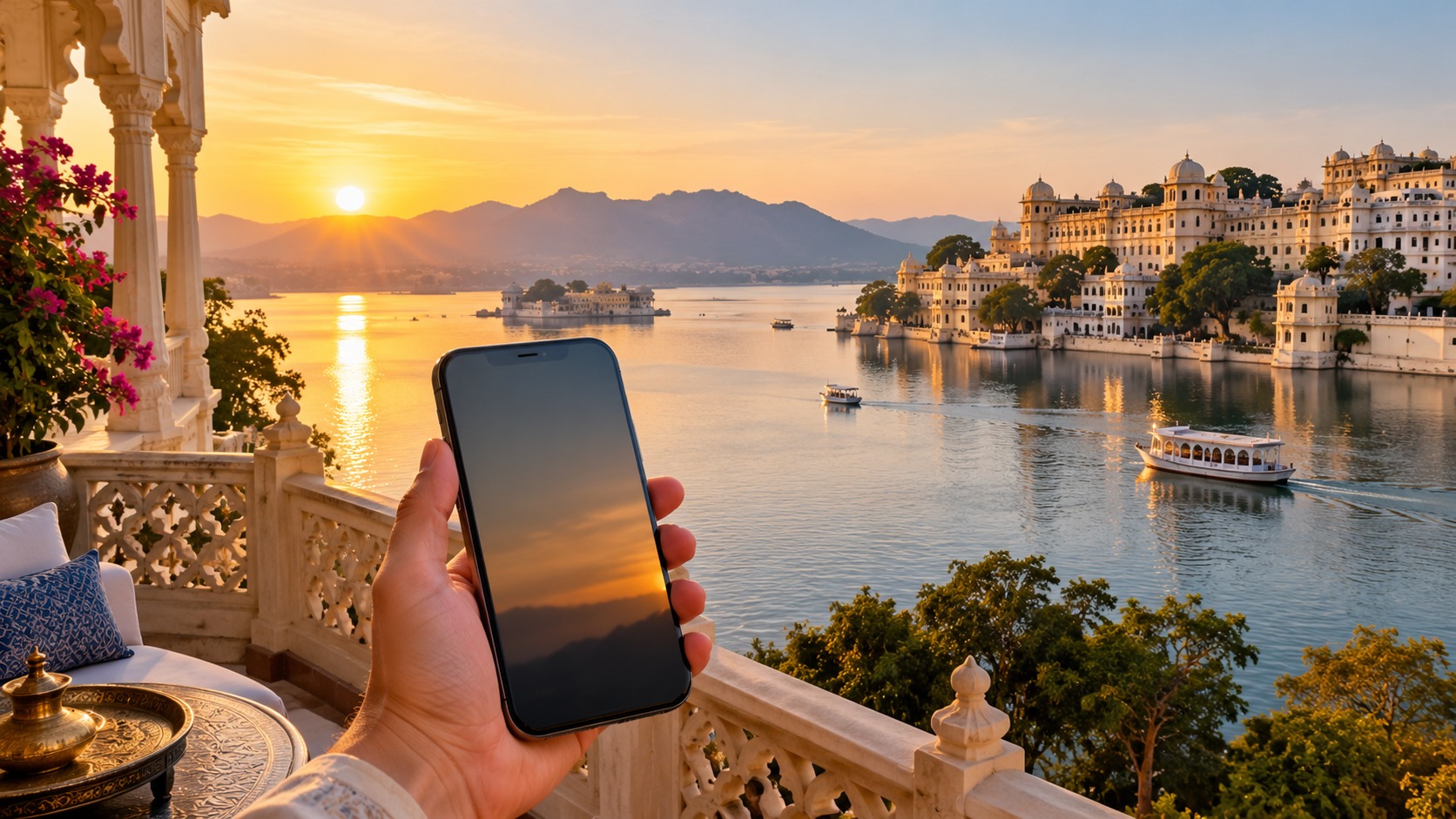
The 2026 Connectivity Landscape: Why India eSIM for Tourists is the Smart Choice
Finding the right India eSIM for tourists in 2026 is no longer a matter of simple convenience; it is a strategic decision that dictates the quality of your entire digital experience on the ground. The Indian telecom market, while vast and dynamic, remains a duopoly dominated by two colossal entities: Jio and Airtel. For the average traveler, this binary choice can feel overwhelming, especially when marketing claims of "unlimited data" mask the complex realities of network congestion, throttling policies, and regional coverage gaps. In the past, choosing the "best" SIM was often about finding the lowest price per gigabyte. In 2026, however, the metric has shifted decisively toward network reliability and speed consistency. A cheap eSIM that drops to 2G speeds in a crowded metro station or fails to maintain a stable connection during a video call is functionally useless. This is why the transition from physical SIM cards to eSIM technology has become the standard for modern travelers. The frictionless nature of digital connectivity—scanning a QR code and being online within seconds—eliminates the logistical headaches of locating a physical store, verifying identity documents, and waiting for activation. Yet, this technological leap has not solved the core problem: local carriers often prioritize their own domestic subscribers, leaving international eSIM users vulnerable to hidden pitfalls like aggressive data throttling and complex, opaque activation processes that can leave you offline for hours.
This is precisely where MollySIM bridges the gap between robust local carrier infrastructure and the seamless international user experience that travelers expect. We do not just resell data; we engineer connectivity solutions that prioritize stability. A critical differentiator in the 2026 market is the Fair Use Policy (FUP) speed limit. Many competitors cap their "unlimited" plans at a sluggish 128kbps once you hit a certain data threshold, effectively rendering apps like Google Maps, Apple Pay, or even WhatsApp video calls nearly unusable. MollySIM, by contrast, offers a FUP speed limit of 384kbps—a 3x faster experience that ensures your essential travel apps remain responsive and smooth, even after you’ve consumed your high-speed data allowance. This technical nuance is the difference between a frustrating trip and a connected one.
In this guide, we move beyond surface-level comparisons to dissect the technical differences between Jio and Airtel. We will analyze how their respective 5G rollouts impact real-world usage for travelers, specifically focusing on latency, signal penetration in rural areas, and the reliability of fallback speeds when 5G coverage is sparse. We will break down the cost structures, highlighting where the "cheap" option actually costs you in time and frustration. By the end of this analysis, you will have a clear, data-driven understanding of which network suits your specific itinerary, whether you are navigating the high-speed corridors of Delhi or the remote trails of the Himalayas. We promise a detailed breakdown of coverage maps, cost-per-GB calculations, and the critical importance of maintaining a viable fallback speed, setting the stage for the deeper technical analysis that follows. For those ready to secure their connectivity before the complexities of local networks become an issue, you can explore our optimized India eSIM plans or view our broader global eSIM coverage to see how we maintain consistent performance across borders.
The Shift from Physical to Digital: Why Friction Matters
The era of the plastic SIM card is rapidly becoming a relic for the tech-savvy traveler. While physical SIMs still hold a place in the market, the eSIM offers distinct advantages that are critical in a fast-paced travel environment.
- Instant Activation: No more queuing at airport kiosks or dealing with language barriers at local carrier stores. With an eSIM, you are online the moment you land, provided you have a momentary Wi-Fi connection to download the profile.
- Dual SIM Flexibility: Most modern smartphones allow you to keep your home number active on a physical SIM or another eSIM while using your India data plan on a second eSIM slot. This ensures you never miss important calls or SMS verifications.
- No Physical Loss: There is no risk of losing a tiny plastic card in a hotel drawer or a crowded market. Your connectivity profile is stored digitally on your device.
However, the technology is only as good as the network behind it. This is where the choice between Jio and Airtel becomes paramount. In 2026, both carriers have expanded their 5G footprints, but their strategies differ significantly. Jio has aggressively pursued a "5G for all" approach, often prioritizing coverage breadth, while Airtel has focused on premium speed tiers and enterprise-grade reliability. For a tourist, this means that the "best" network depends entirely on your specific location and usage patterns. A network that excels in urban centers may struggle in the suburbs, and vice versa. Understanding these nuances is the first step in choosing the right India eSIM for tourists.
The Hidden Costs of "Unlimited" Data
One of the most common misconceptions among travelers is that "unlimited" data means unlimited speed. In the Indian telecom landscape, this is rarely the case. Carriers employ Fair Use Policies to manage network load. When you exceed a certain data threshold (often 20GB-50GB per day, depending on the plan), your speed is throttled.
- Competitor Standard: Many global eSIM providers cap their throttled speeds at 128kbps. At this speed, loading a webpage can take 10-15 seconds, and video calls may buffer frequently.
- MollySIM Advantage: Our 384kbps FUP speed is significantly more robust. This speed is sufficient for:
- Navigation: Real-time updates on Google Maps or Apple Maps without lag.
- Payments: Smooth transactions via Apple Pay or Google Pay.
- Communication: Stable WhatsApp voice and video calls.
- Email & Social Media: Quick loading of inboxes and feeds.
This 3x speed advantage is not just a marketing point; it is a functional necessity for travelers who rely on their phones for critical tasks. A slow connection can mean missing a train, getting lost in an unfamiliar city, or failing to complete a secure transaction. By choosing a provider that understands the technical realities of Indian networks, you ensure that your connectivity remains a tool for empowerment, not a source of stress.
Why 2026 is the Year for eSIM in India
The 2026 landscape is unique due to the maturation of 5G technology in India. While 4G remains the backbone of connectivity, 5G is now available in major metropolitan areas and select tourist hubs. This dual-network environment creates a complex web of signal handoffs. A robust eSIM provider must manage these handoffs seamlessly, ensuring that your device switches between 5G, 4G, and 3G without dropping the connection or experiencing significant latency spikes.
MollySIM’s infrastructure is designed to handle this complexity. We leverage the strengths of both Jio and Airtel, routing your traffic through the most efficient network available at any given moment. This dynamic routing ensures that you get the best possible speed and reliability, regardless of your location. Whether you are in the bustling streets of Mumbai or the serene backwaters of Kerala, your connection remains stable and fast.
In the following sections, we will dive deep into the technical specifications of Jio and Airtel, comparing their coverage maps, speed benchmarks, and cost structures. We will also provide a step-by-step guide on how to activate your India eSIM for tourists and maximize your data usage. By the end of this guide, you will have all the information you need to make an informed decision and ensure a seamless, connected trip to India in 2026.
Jio vs Airtel eSIM Coverage: A Deep Dive into 5G Expansion and Tier-2 Reliability
🇮🇳 India High-Speed Travel eSIM & SIM Plans
Instant QR code activation, hotspot enabled, with guaranteed 384kbps fallback speed to keep Maps & Digital Wallets active.
When evaluating Jio vs Airtel eSIM coverage for your 2026 itinerary, it is crucial to look beyond the marketing claims of "nationwide 5G" and understand the distinct architectural philosophies of these two giants. The choice between them is not merely about which logo appears on your phone; it is about understanding how each operator prioritizes network density, spectrum allocation, and rural penetration. For a tourist, this distinction dictates whether you experience seamless connectivity or frustrating dead zones.
Jio’s Aggressive 5G Urban Dominance
Reliance Jio has adopted an aggressive, high-density strategy for its 5G rollout, focusing heavily on metropolitan hubs where user concentration is highest. In cities like Mumbai and New Delhi, Jio’s infrastructure is exceptionally dense. This results in superior peak data speeds, particularly in downtown areas. If you are staying in the Bandra-Kurla Complex in Mumbai or the Connaught Place area in Delhi, Jio’s 5G network often outperforms competitors in raw throughput.
- Real-World Scenario: Streaming 4K video on a mobile hotspot while in a crowded Mumbai mall. Jio’s dense small-cell deployment ensures that even with thousands of users connected, the bandwidth per user remains sufficient for high-definition streaming without buffering.
- File Downloads: In Delhi, downloading large software updates or media files can be significantly faster on Jio’s 5G bands due to its lower latency and higher frequency spectrum availability in these specific urban cores.
However, this density comes with a trade-off: network congestion. Because Jio prioritizes high-speed capacity in urban centers, the network can become saturated during peak hours (typically 7 PM to 11 PM). In these scenarios, while speeds may remain high, stability can suffer. You might experience sudden latency spikes or brief connection drops as the network manages the surge of data requests. For a tourist who needs consistent, low-latency connections for real-time navigation or video calls, this variability can be a minor inconvenience.
Airtel’s Strength in Tier-2 Cities and Rural Reliability
In contrast, Airtel has built its reputation on coverage depth rather than just coverage width. While Airtel’s 5G speeds in major metros may be marginally lower than Jio’s peak figures, its 4G LTE backbone is remarkably robust in tier-2 cities and rural areas. This is where Airtel’s strategy shines for travelers who venture beyond the capital cities.
- Tier-2 Consistency: In cities like Jaipur, Pune, Kochi, or Indore, Airtel’s signal strength is often more consistent. The network is designed to maintain a stable connection even when moving between urban and semi-urban zones.
- Rural Penetration: If your itinerary includes the backwaters of Kerala, the hills of Himachal Pradesh, or the forts of Rajasthan, Airtel’s extensive tower infrastructure ensures that you rarely lose signal. Jio, while expanding rapidly, can still have patchy coverage in remote rural stretches where Airtel’s legacy 4G network remains a reliable lifeline.
The Critical Factor: Network Handover
For a tourist moving between cities, the concept of network handover is paramount. This is the process by which your device switches between 5G and 4G networks as you move through different coverage zones.
- Jio’s Handover: Jio’s 5G network is optimized for speed, but the transition back to 4G in less dense areas can sometimes be abrupt. This can lead to brief moments of disconnection or increased latency as the device renegotiates the connection parameters.
- Airtel’s Handover: Airtel’s infrastructure is engineered for smoother transitions. The handover between 5G and 4G is generally more seamless, resulting in fewer dropped connections. This is a significant advantage for travelers who are constantly on the move, such as those taking inter-city trains or driving through varied landscapes.
Why Reliability Trumps Raw Speed for Tourists
For most India eSIM for tourists, the "best" network is not the one with the highest peak speed, but the one that provides the most consistent experience. A slight reduction in peak speed is often a worthwhile trade-off for the assurance that your connection will not drop when you need it most—whether you are navigating a new city, making a payment, or staying in touch with family.
This is where MollySIM adds significant value. By leveraging the strengths of both networks, MollySIM ensures that your device is always connected to the most stable signal available. Furthermore, MollySIM’s 384kbps Fair Use Policy speed limit is 3x faster than the standard 128kbps limit offered by many competitors. This higher baseline speed ensures that essential services like Google Maps and Apple Pay work smoothly and responsively, even when you are on the lower end of the data tier. This level of performance is critical for a stress-free travel experience, allowing you to focus on your journey rather than your connectivity.
To see how this translates into your specific travel plans, explore our detailed India eSIM plans or check our global eSIM coverage to ensure you are prepared for any destination.
The 'Unlimited' Data Trap: Understanding Throttling and the MollySIM 384kbps Advantage
When selecting an India eSIM for tourists, one of the most common pitfalls is falling for the marketing allure of "unlimited" data. Local carriers like Jio and Airtel frequently advertise plans with no cap on gigabytes, leading many travelers to believe they can stream video and download large files indefinitely. However, this is rarely the technical reality. These plans are governed by a Fair Usage Policy (FUP), a contractual mechanism that allows providers to throttle speeds once a specific data threshold is reached.
How Throttling Works in India
The FUP mechanism is straightforward but often opaque to the average traveler. While the initial phase of a plan offers high-speed 4G or 5G connectivity, once you consume a certain amount of data—typically ranging from 100GB to 200GB depending on the specific tariff—the network automatically downgrades your connection speed.
For many standard local plans, this post-throttle speed drops to as low as 128kbps. To put this in perspective, 128kbps is the speed of a basic 2G connection. At this rate:
- Loading a map tile in Google Maps can take 10–15 seconds.
- Sending a WhatsApp text may hang for several seconds before confirming delivery.
- Syncing email becomes a background process that can take minutes to complete.
This level of slowness renders the connection nearly useless for real-time navigation or quick communication. If you are trying to find your way through the narrow lanes of Old Delhi or the crowded ghats of Varanasi, a map that takes 15 seconds to update is not just inconvenient; it is a navigational hazard.
The 384kbps Sweet Spot: A Strategic Advantage
This is where the technical specifications of your eSIM provider become critical. MollySIM distinguishes itself by implementing a 384kbps Fair Use Policy speed limit for its post-throttle data. This is not a minor incremental improvement; it is a 3x faster baseline than the standard 128kbps limit offered by many competitors.
Why does this specific speed matter? 384kbps represents a "sweet spot" for essential travel applications. It is fast enough to maintain a responsive user interface without the bandwidth requirements of high-definition streaming. Here is how this speed translates into real-world usability:
| App / Service | Performance at 128kbps (Standard Local) | Performance at 384kbps (MollySIM) |
|---|---|---|
| Google Maps | Tiles load slowly; frequent buffering; location pin lags | Tiles load smoothly; real-time location tracking remains accurate |
| Texts delay; voice notes take time to upload | Texts send instantly; low-quality voice notes work reliably | |
| Email Clients | Syncing is slow and often fails | Background sync completes quickly; new emails appear promptly |
| Payment Apps | May time out during transaction verification | Processes transactions smoothly; Apple Pay/Google Pay remain responsive |
Scenario: The Varanasi Reality Check
Imagine you are a tourist in Varanasi. You have been exploring the city for three days, using your data for navigation, social media, and video calls. Your high-speed data allowance has just been exhausted.
With a standard local plan: Your speed drops to 128kbps. You open Google Maps to find the route to your hotel. The map freezes. You try to send a message to your driver, but the app hangs. You are effectively offline, forced to rely on paper maps or ask for directions in a language you may not speak fluently. The stress of being disconnected in an unfamiliar environment can ruin the day.
With MollySIM: Your speed drops to 384kbps. You open Google Maps, and the tiles load instantly. You send a message to your driver, and it goes through immediately. You can even order food via an app or make a quick payment using Apple Pay. The connection remains functional and reliable, allowing you to continue your journey without interruption.
Reliability as Part of Ease of Use
This "fallback" reliability is crucial for peace of mind. It ensures that your connectivity does not fail at the worst possible moment. This technical robustness is part of the overall ease of use provided by MollySIM. Unlike local carriers, which often require physical SIM swaps or complex USSD codes, MollySIM simplifies the entire process. If you are wondering how to activate eSIM in India, the MollySIM platform offers a streamlined, QR-code-based setup that works seamlessly with both iOS and Android devices.
By choosing a provider that prioritizes a higher post-throttle speed, you are not just buying data; you are buying insurance against connectivity failure. To see how this translates into your specific travel plans, explore our detailed India eSIM plans or check our global eSIM coverage to ensure you are prepared for any destination.
Activation Friction: Local Bank Accounts vs. Instant MollySIM Setup
For the modern traveler, time is the most valuable currency. Yet, when it comes to securing connectivity in India, the traditional route often demands a significant upfront investment of hours, if not days. While the shift to digital SIMs has streamlined the physical aspect of connectivity, the bureaucratic backbone of Indian telecom remains deeply rooted in local financial infrastructure. For a foreigner seeking an India eSIM for tourists, understanding this hidden friction is critical to avoiding unnecessary delays.
The Hidden Cost of Local KYC and Bank Verification
Activating a Jio or Airtel eSIM as a non-resident in 2026 is not as simple as downloading an app. While the SIM itself is digital, the verification process (KYC) often triggers requirements that are seamless for locals but cumbersome for visitors. A common pain point is the linkage to a local Indian bank account. Many local carriers, particularly when setting up auto-renewal or verifying identity through specific digital portals, require proof of a local banking relationship or a UPI-linked account for final validation.
If you do not have an existing Indian bank account, you face a logistical hurdle. You may need to visit a local branch, provide proof of address (which can be tricky with a hotel booking confirmation), and wait for the verification to clear. This process is not instantaneous. In many cases, the verification queue can take 24 to 48 hours. During this window, you are effectively "on hold" for connectivity. You might have landed in Delhi or Mumbai, checked into your hotel, and still be unable to confirm your taxi driver’s location or share your live GPS with your travel companion.
Airtel’s process is marginally more streamlined than Jio’s in some regions, often allowing for a slightly faster digital onboarding. However, it still involves manual steps, such as uploading passport scans, waiting for SMS confirmations that can get lost in translation, and navigating a user interface designed primarily for domestic users. The result is a "real" cost that extends beyond the price tag on the box.
MollySIM: The Frictionless Alternative
This is where the distinction between a "SIM card" and a "connectivity solution" becomes clear. MollySIM is designed to eliminate the bureaucratic lag entirely. There is no local bank account requirement. There is no need to present a local address. There is no waiting period for KYC clearance.
The activation process is radically simple:
- Purchase: Select your plan from the India eSIM plans page.
- Download: Scan the QR code provided instantly via email or the app.
- Activate: Toggle the eSIM switch on your device.
Total time: Under 5 minutes.
You can be standing in the arrival terminal at Indira Gandhi International Airport, scanning the code, and having full 4G/5G connectivity before you have even collected your baggage. This immediacy is not just a convenience; it is a psychological benefit. It removes the anxiety of the "first hour" in a new country, allowing you to navigate, communicate, and work immediately.
What If You Forget to Activate?
A common worry with local SIMs is the "digital failure" scenario. If the online activation portal crashes, or if your passport scan is rejected due to image quality, you may be forced to visit a physical store. For a tourist, this means finding a shop, waiting in line, and explaining your issue in a second language.
With MollySIM, the eSIM profile is downloaded and stored on your device. It is ready to switch on at any time. If you forget to activate it immediately upon arrival, you can do so in your hotel room, in a café, or even on a train. There is no dependency on a third-party verification server that might be down or slow. The profile is local to your device, ensuring that when you need it, it works.
The True Cost of Time
When calculating the India mobile data cost for foreigners, most travelers look at the price per gigabyte. However, the "real" cost includes the time spent acquiring that data. If a local SIM costs $10 but takes you 6 hours of your vacation to activate, verify, and troubleshoot, the effective cost is significantly higher. MollySIM reduces this friction to near zero, ensuring that your connectivity budget is spent on data, not on administrative overhead. For the busy, time-sensitive tourist, this frictionless setup is the defining feature that separates a good trip from a great one.
Comparative Analysis: Jio, Airtel, and MollySIM at a Glance
When selecting the best India eSIM for tourists, the decision often boils down to a trade-off between raw data volume and operational convenience. While local giants like Jio and Airtel dominate the market with aggressive pricing, their infrastructure is designed for domestic users with local bank accounts and patience for bureaucratic processes. For the international traveler, these factors become significant friction points. The following table breaks down the critical technical and logistical differences between the two major Indian carriers and the specialized traveler-focused solution provided by MollySIM.
| Feature | Jio (Local) | Airtel (Local) | MollySIM |
|---|---|---|---|
| 5G Speed in Metros | Very High | High | High (via partner) |
| 4G Reliability in Tier-2 Cities | Moderate | High | High (via partner) |
| Data Throttling Threshold | 100GB | 150GB | Flexible |
| Fallback Speed | 128kbps | 384kbps | 384kbps |
| Activation Time | 24-48 hours | 12-24 hours | <5 mins |
| Bank Account Required | Yes | Sometimes | No |
| Customer Support (English) | Limited | Good | 24/7 |
| Price Per GB (Approx) | Low | Medium | Competitive |
Interpreting the Data: Why Fallback Speed Matters
At first glance, the Price Per GB row suggests that local carriers offer superior value. However, this metric ignores the "cliff-edge" effect of data throttling. In 2026, as 5G becomes more prevalent in metros like Mumbai and Delhi, the initial speeds are impressive. But once you hit the threshold—100GB for Jio or 150GB for Airtel—your speed drops to the Fallback Speed.
This is where the distinction between 128kbps and 384kbps becomes critical for tourists. A 128kbps connection is barely sufficient for basic text-based messaging. It is often too slow for real-time map navigation, causing Google Maps to lag or fail to load turn-by-turn directions. It is also insufficient for secure payment gateways, meaning Apple Pay or UPI-based transactions may time out. In contrast, the 384kbps Fair Use Policy speed limit offered by MollySIM is three times faster than Jio’s throttled rate. This ensures that even after your high-speed data allowance is exhausted, you can still smoothly use essential apps, browse the web, and maintain video calls without the frustrating buffering that plagues users on lower-tier fallback speeds.
The Hidden Cost of Activation Time
The Activation Time row reveals the most significant hidden cost for travelers. Jio requires 24-48 hours, and Airtel requires 12-24 hours. For a tourist, this is not just a delay; it is a period of potential disconnection. During this window, you are dependent on hotel Wi-Fi, which can be unstable, or you are offline entirely. This "dead time" often forces travelers to rely on expensive international roaming or to spend valuable vacation hours troubleshooting SIM registration.
MollySIM reduces this to under five minutes. The eSIM profile is downloaded instantly, allowing you to switch on connectivity the moment you land. This immediacy is not just a convenience; it is a functional advantage. You can navigate from the airport, order food via apps, and access real-time information immediately.
Total Cost of Ownership
While local carriers are cheaper per GB, the Total Cost of Ownership (TCO) includes time, hassle, and potential downtime. If a local SIM costs $10 but takes you 6 hours of your vacation to activate, verify, and troubleshoot, the effective cost is significantly higher. MollySIM reduces this friction to near zero, ensuring that your connectivity budget is spent on data, not on administrative overhead. For the busy, time-sensitive tourist, this frictionless setup is the defining feature that separates a good trip from a great one. By choosing a provider that prioritizes speed of access and reliable fallback speeds, you ensure that your connectivity works for you, rather than against you. For more detailed plan options, you can explore the India eSIM plans available on MollySIM, which are designed specifically for this traveler-centric model.
Making the Right Choice: When to Pick Jio, Airtel, or MollySIM
Selecting the optimal connectivity solution for your 2026 India itinerary is not a one-size-fits-all decision. The "best" network depends entirely on your specific travel profile, technical comfort level, and tolerance for administrative friction. By categorizing travelers into three distinct archetypes, we can determine which provider aligns with your needs for speed, reliability, and ease of use.
The Jio User: The Tech-Savvy Power User
Profile: You are a digital nomad or a tech-forward tourist staying primarily in major metropolitan hubs like Mumbai, Delhi, or Bangalore. Your priority is raw throughput. You require peak 5G speeds for heavy data tasks such as 4K video conferencing, large file uploads, or streaming high-bitrate content without buffering. You are comfortable navigating local carrier apps, verifying identity documents, and troubleshooting potential activation hiccups.
Verdict: If you are staying in a single city for an extended period and your workflow demands maximum bandwidth, a local Jio SIM is a viable option. Jio’s 5G rollout in 2026 is aggressive in urban centers, offering speeds that can exceed 300 Mbps in optimal conditions. However, this comes at the cost of complexity. You must handle KYC (Know Your Customer) verification, which can be time-consuming, and you are locked into a single network. If you leave the metro area, coverage may degrade significantly, and you lose the flexibility of multi-network roaming.
The Airtel User: The Mixed-Itinerary Reliability Seeker
Profile: Your itinerary is diverse, including tier-2 cities, rural areas, or remote tourist destinations where network consistency is more critical than peak speed. You value a stable 4G LTE connection that rarely drops, even in areas with moderate congestion. You are willing to invest time in the activation process to secure a reliable, long-term connection.
Verdict: Airtel has historically maintained a strong reputation for consistent 4G coverage across a broader geographic spread compared to Jio. If your trip involves moving between cities like Jaipur, Udaipur, or Varanasi, Airtel’s infrastructure may offer a more uniform experience. Like Jio, however, it requires local activation, local payment methods, and potentially local customer support. It is a solid choice for travelers who prioritize network stability over the "instant on" convenience of an eSIM.
The MollySIM User: The Convenience-First Traveler
Profile: This represents the majority of tourists visiting India in 2026. You prioritize ease of use, instant activation, and reliable fallback speeds. You do not want to spend your first day in India standing in line at a telecom store or troubleshooting QR codes. You want to be connected the moment you land. You value a seamless experience where data works for navigation, payments, and communication without requiring technical intervention.
Verdict: MollySIM is the ideal choice for this profile. It eliminates the administrative overhead of local SIMs. Crucially, MollySIM’s 384kbps Fair Use Policy speed limit is 3x faster than the 128kbps limit offered by many competitors. This is a functional difference: at 128kbps, Google Maps can lag and Apple Pay may time out; at 384kbps, these essential services work smoothly, ensuring you can navigate and pay without friction. For India eSIM for tourists, this balance of speed and simplicity is often the deciding factor.
Decision Matrix: Who Should Choose What?
| Traveler Type | Best Option | Key Reason |
|---|---|---|
| First-Time Visitor | MollySIM | Zero setup time, no local ID required, instant connectivity. |
| Family Group | MollySIM | One profile to manage, easy sharing, no language barriers. |
| Business Traveler | MollySIM | Cannot afford downtime; reliable fallback speeds ensure critical apps work. |
| Long-Term Stay (1+ Month) | Local SIM (Jio/Airtel) | Lower cost per GB over time justifies the initial activation hassle. |
| Short Trip (< 3 Weeks) | MollySIM | Convenience outweighs the marginal cost savings of a local SIM. |
Final Recommendation
For most travelers, the convenience of MollySIM outweighs the cost savings of a local SIM, especially for trips under three weeks. The time saved on activation and the reliability of the 384kbps fallback speed provide a superior user experience. If you are traveling to multiple countries, consider the global eSIM coverage option, which serves as a seamless extension of your India connectivity without needing a new SIM for each destination.
The 2026 connectivity landscape in India is better than ever, with robust 4G and expanding 5G infrastructure. However, choosing the right partner is key to a stress-free trip. By aligning your choice with your specific needs—whether it’s raw speed, broad coverage, or effortless setup—you ensure that your technology supports your journey, rather than complicating it. For the latest pricing and data allowances, check the India eSIM plans to secure your connection before you fly.
Frequently Asked Questions about India eSIM for tourists
Which carrier has better 5G coverage in India for tourists?
Jio currently leads in 5G rollout across major metros like Delhi, Mumbai, and Bangalore, while Airtel offers more stable 4G in rural regions. Tourists visiting big cities should prioritize Jio for speed.
Can I use an international eSIM on Indian networks?
Yes, most global eSIMs work on Indian networks, but local MVNOs often have better rates. MollySIM ensures seamless handover to local towers without roaming surprises.
Do I need to register my eSIM with Indian customs?
While physical SIMs require Aadhaar or passport verification, eSIMs usually activate instantly. However, keeping your passport handy is recommended for airport verification if prompted.
SEO Score: 11/11
🇮🇳 India High-Speed Travel eSIM & SIM Plans
Instant QR code activation, hotspot enabled, with guaranteed 384kbps fallback speed to keep Maps & Digital Wallets active.