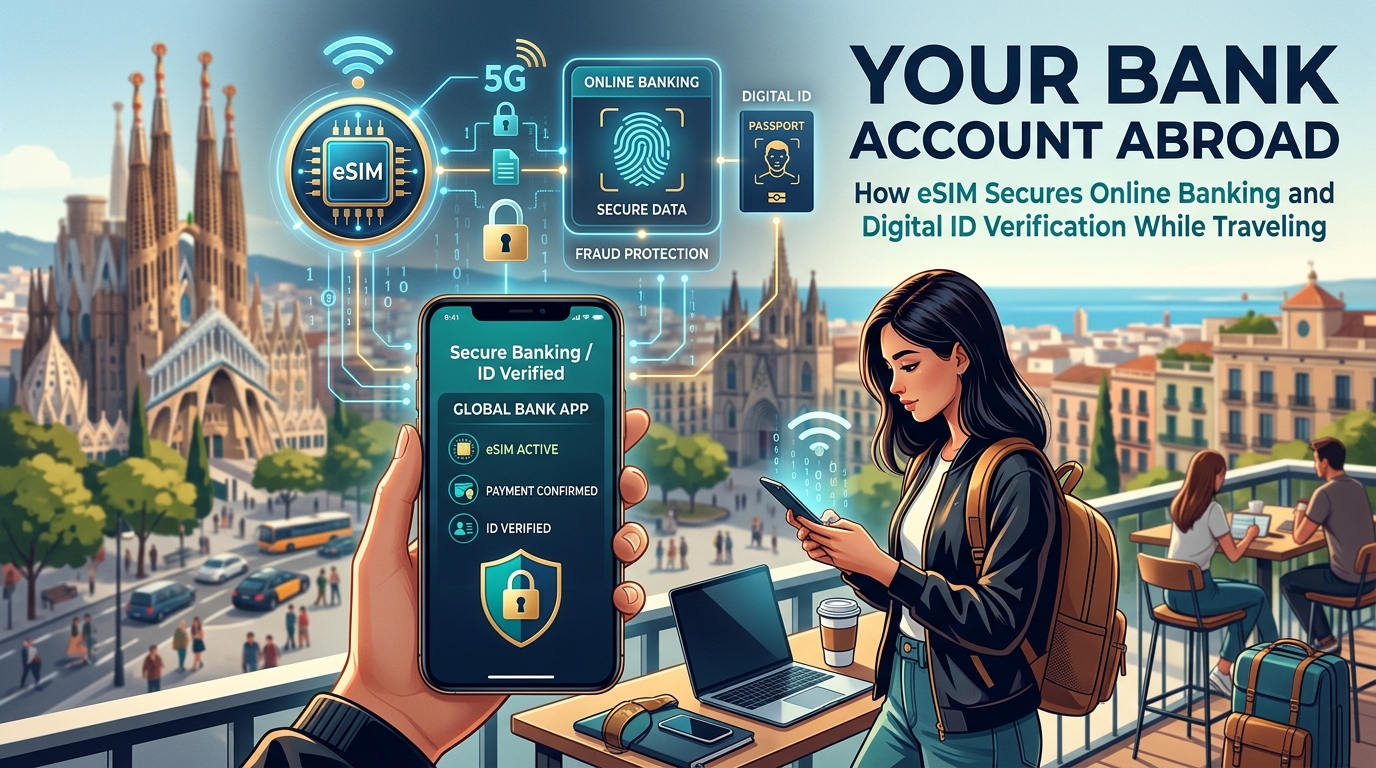
海外での銀行口座:eSIMがオンラインバンキングとデジタルID認証をどのように保護し、旅行中のセキュリティを確保するか
危険な道:従来の接続が海外での金融取引において失敗する理由
Traveling abroad introduces a thrilling sense of adventure, but it also elevates the stakes for your financial security and digital identity. In an increasingly interconnected world, accessing online banking, making secure payments, and completing critical digital ID verification processes are no longer conveniences but necessities. Yet, the very connectivity methods many travelers rely on — public Wi-Fi and traditional physical SIM cards — are riddled with vulnerabilities and limitations that can turn a financial transaction into a high-risk gamble. These conventional approaches create profound security gaps and operational hurdles, leaving your sensitive financial data exposed and your access to essential services compromised.
The Treacherous Terrain of Public Wi-Fi
The allure of free public Wi-Fi in airports, cafes, and hotels is undeniable, but beneath its convenient surface lies a cesspool of potential threats to your financial well-being. These networks are inherently insecure, often lacking robust encryption and making them prime targets for malicious actors.
- Data Interception: On an unencrypted public network, your data travels in plain sight. This means that any information you send or receive – including banking login credentials, credit card details, and personal identification numbers – can be easily intercepted by sophisticated hackers using readily available tools. This is akin to shouting your bank account details across a crowded room.
- Man-in-the-Middle (MITM) Attacks: A common threat on public Wi-Fi, MITM attacks involve an attacker positioning themselves between your device and the server you're trying to reach (e.g., your bank's website). They can then eavesdrop on your communications, alter data, or even redirect you to a fake website designed to steal your credentials.
- Phishing and Malware Injection: Public Wi-Fi networks can be exploited to deliver phishing attempts or inject malware onto your device. A compromised network might redirect you to a fraudulent banking site, or a pop-up might trick you into downloading malicious software that logs your keystrokes or steals your information.
- Lack of Encryption: Many public Wi-Fi hotspots offer little to no encryption, leaving your entire browsing session vulnerable. Even if a banking website uses HTTPS, the initial connection to the Wi-Fi network itself can be compromised, paving the way for further attacks.
Attempting to log into your bank, make a payment, or verify your identity using a public Wi-Fi network is a significant security risk that no traveler should underestimate.
The Hidden Costs and Vulnerabilities of Traditional SIMs
Beyond the perils of public Wi-Fi, traditional roaming services and local physical SIM cards, while offering more privacy, present their own set of financial and operational challenges.
Exorbitant Roaming Costs and Unreliable OTPs
Relying on your home country's traditional roaming plan for data and calls abroad is often an exercise in financial pain. The exorbitant costs for data, calls, and SMS can quickly deplete your travel budget, making even routine financial checks expensive. More critically, traditional roaming can lead to unreliable SMS and One-Time Password (OTP) delivery. Many banks and financial institutions use SMS-based OTPs for two-factor authentication (2FA) to secure logins and transactions. If your roaming service is spotty, delayed, or if your home network experiences issues, you could find yourself locked out of your bank account or unable to complete a crucial payment, creating immense frustration and potential financial distress. Furthermore, if you lose access to your primary number (e.g., if your phone is lost or stolen, or if your home SIM is deactivated due to extended international use), regaining access to accounts tied to that number for OTPs becomes a nightmare.
The Pitfalls of Local Physical SIMs
While a local physical SIM might seem like a cost-effective alternative, it introduces its own set of complications:
- Difficulty Acquiring and Activating: In many countries, acquiring a local physical SIM card can be a bureaucratic ordeal, requiring passport registration, proof of address, and often a visit to a specific store. This consumes valuable travel time and can be particularly challenging in non-English speaking regions.
- SIM Swapping Vulnerabilities: When you swap out your primary SIM for a local one, your home number becomes inactive. This creates a window of vulnerability for SIM swapping attacks, where fraudsters trick your home carrier into porting your number to their device, thereby gaining access to your SMS-based OTPs and potentially your bank accounts.
- Loss of Primary Number Access: For critical digital ID verification processes, many services require access to your primary, long-standing phone number. Swapping to a local SIM means you temporarily lose access to this number, making it impossible to receive verification codes or calls from services tied to your home identity.
- Inconsistent Data Speeds: Not all local SIMs offer reliable, high-speed data. Imagine trying to complete a critical bank transfer or verify your identity for a new financial service, only to have your connection drop or be too slow to load the necessary authentication pages. This is where the reliability of your data connection becomes paramount. While many basic eSIMs or local SIMs offer speeds that barely suffice for messaging, a robust solution like MollySIM provides a 384kbps Fair Use Policy speed limit, which is 3x faster than competitors' 128kbps. This enhanced speed isn't just about faster browsing; it's about ensuring essential applications like Google Maps for navigation to an ATM or Apple Pay for secure transactions function smoothly and without frustrating delays, directly impacting your financial operations abroad.
These traditional methods collectively create profound security gaps and operational hurdles for accessing online banking, making secure payments, and completing critical digital identity verification processes. They leave travelers vulnerable to cyber threats, financial lockouts, and unnecessary stress. It becomes clear that a modern, secure, and reliable connectivity solution is not just a luxury but an indispensable foundation for managing your finances safely while exploring the world. This is precisely where eSIM technology emerges as the modern, indispensable solution, addressing these vulnerabilities head-on and providing a secure foundation for all digital financial interactions.
eSIM: Your Fortress for Financial Transactions and Digital Identity on the Go
🌐 Global Travel High-Speed Travel eSIM & SIM Plans
Instant QR code activation, hotspot enabled, with guaranteed 384kbps fallback speed to keep Maps & Digital Wallets active.
As the world becomes increasingly digital, managing finances and verifying identity online while traveling is no longer a convenience but a necessity. However, this convenience comes with inherent risks, especially when relying on insecure connectivity. This is precisely where eSIM technology transforms from a mere connectivity tool into a robust digital fortress, safeguarding your sensitive financial transactions and critical digital identity verification processes. Unlike the perilous landscape of public Wi-Fi, a dedicated travel eSIM provides a private, encrypted, and direct conduit to the internet, drastically reducing your exposure to cyber threats.
The Inherent Vulnerabilities of Public Wi-Fi
To truly appreciate the security advantages of an eSIM, it's crucial to understand the profound risks associated with public Wi-Fi networks. These ubiquitous, often free, hotspots found in airports, cafes, and hotels are a magnet for cybercriminals. When you connect to public Wi-Fi, your data travels through a shared, often unencrypted, network that is accessible to anyone else connected. This creates a fertile ground for various attacks:
- Man-in-the-Middle (MitM) Attacks: Attackers can intercept, read, and even modify the data passing between your device and the websites you visit, including banking portals. They can trick you into connecting to a malicious hotspot disguised as a legitimate one.
- Data Snooping and Packet Sniffing: Without encryption, anyone on the same network with basic tools can "listen in" on your internet traffic, potentially capturing login credentials, credit card numbers, and other personal information.
- Malware Distribution: Compromised public Wi-Fi networks can be used to inject malware onto your device, leading to data theft or system compromise.
- Lack of Control: You have no control over the security protocols, firewall settings, or server integrity of a public Wi-Fi network, making it impossible to verify its trustworthiness.
Attempting to access your bank account, make a payment, or submit sensitive documents over such a network is akin to shouting your personal information across a crowded room – an unacceptable risk for any financially active traveler.
eSIM: A Private, Encrypted Data Tunnel
In stark contrast, a travel eSIM establishes a private, encrypted, and direct connection to a trusted, carrier-grade mobile network. This fundamental difference is the cornerstone of its security superiority:
- Direct Carrier Connection: An eSIM connects directly to a mobile network operator's infrastructure, bypassing shared public routers and servers. This eliminates the "middleman" that public Wi-Fi introduces, significantly reducing the attack surface for MitM attacks.
- Inherent Cellular Security Protocols: Modern cellular networks (3G, 4G LTE, 5G) are built with robust security protocols, including strong encryption standards (like WPA2/WPA3 for Wi-Fi access points within the cellular network infrastructure, and advanced encryption for data transmission over the air interface). Your data is encrypted from your device to the carrier's network, making it incredibly difficult for unauthorized parties to intercept or decipher.
- Dedicated Bandwidth: Unlike shared public Wi-Fi where bandwidth is contended, your eSIM provides a dedicated connection to the cellular tower, ensuring not only speed but also a more isolated data path.
- Reduced Exposure: By not broadcasting your presence on a shared local network, an eSIM inherently makes your device less visible to potential attackers looking for vulnerable targets.
This secure data tunnel is paramount for any sensitive online activity abroad.
Paramount for Sensitive Banking, Payments, and Digital ID Verification
The secure connection provided by an eSIM is not merely a convenience; it is an indispensable requirement for maintaining financial security and digital identity integrity while traveling.
- Accessing Sensitive Banking Applications: Whether you're checking balances, initiating international transfers, or managing investment portfolios, your banking app requires an uncompromised connection. An eSIM ensures that your login credentials, transaction details, and personal financial data remain confidential and are not exposed to eavesdropping.
- Executing Online Payments: From purchasing flight tickets to paying for accommodations or using digital wallets like Apple Pay and Google Pay, secure online payments are critical. A reliable and secure eSIM connection, such as that offered by MollySIM with its 384kbps Fair Use Policy speed limit (3x faster than competitors' 128kbps), ensures that these transactions complete smoothly and without frustrating delays. This enhanced speed is crucial not just for convenience, but for preventing timeouts or retries that could inadvertently expose payment details on less secure, slower connections.
- Ensuring Integrity and Confidentiality of Digital Identity Verification: The need for digital ID verification is growing, especially for opening new accounts, accessing government services, or complying with Know Your Customer (KYC) regulations. These processes often involve:
- Submitting Personal Documents: Uploading scans of passports, driver's licenses, or other official identification.
- Performing Biometric Scans: Using facial recognition or fingerprint scans for authentication.
- Accessing Government Portals: Applying for visas, managing taxes, or interacting with official government websites.
An eSIM ensures that when you transmit these highly sensitive personal documents and biometric data, they travel through an encrypted channel, safeguarding them from interception and unauthorized access. The integrity of these verification steps relies entirely on the security of your connection.
MollySIM: Prioritizing Secure Network Partners
Providers like MollySIM understand that the foundation of secure travel connectivity lies in the reliability and integrity of the underlying network. MollySIM prioritizes partnerships with secure, carrier-grade network operators globally, ensuring that your eSIM connects directly to trusted infrastructure. This commitment means:
- Vetted Network Partners: MollySIM selects partners known for their robust security protocols and reliable service, minimizing the risk of connecting to compromised networks.
- Direct, Uncompromised Connections: By facilitating direct connections, MollySIM helps users avoid the vulnerabilities inherent in shared, public Wi-Fi environments.
- Reliable Performance for Critical Tasks: The enhanced speed of MollySIM's 384kbps FUP ensures that time-sensitive security protocols, multi-factor authentication steps, and large data uploads for ID verification can be completed efficiently, without the frustration or security risks associated with slow, unreliable connections. This ensures that essential applications like Google Maps for finding a secure ATM or Apple Pay for quick, secure payments function flawlessly, directly supporting your financial operations abroad.
In essence, an eSIM transforms your mobile device into a secure gateway for all your financial and identity-related digital interactions while traveling. It's not just about staying connected; it's about staying secure.
Mastering Multi-Factor Authentication (MFA) and Digital ID Verification with eSIM
For the modern traveler, securing online accounts and verifying identity remotely are no longer conveniences but absolute necessities. However, traditional connectivity methods often transform these critical tasks into frustrating security vulnerabilities. Multi-Factor Authentication (MFA), particularly reliance on One-Time Passwords (OTPs) delivered via SMS, frequently becomes a major hurdle. Travelers commonly face delayed or undelivered SMS messages due to network incompatibilities or roaming restrictions, leading to lockout from essential services. The alternative – enabling international roaming on a traditional SIM – often incurs exorbitant roaming charges just for receiving a few text messages, making it an impractical and costly solution. Furthermore, the inconvenience and security risk of swapping physical SIMs to access a local data plan means potentially losing access to your primary number, which is inextricably linked to your banking, social media, and communication apps.
The eSIM Advantage: Seamless MFA with Your Primary Number Intact
This is where eSIM technology fundamentally redefines secure travel. Modern smartphones equipped with eSIM functionality allow for dual-SIM operation, meaning you can keep your primary physical SIM card active in your device while simultaneously using an eSIM for data connectivity abroad. This setup is the ultimate and most seamless solution for uninterrupted MFA. Your primary number remains active, allowing you to receive SMS-based OTPs and verification codes without interruption, often at no additional cost (as receiving SMS while roaming is typically free, even if sending texts or making calls incurs charges).
Consider these step-by-step scenarios where this capability is absolutely critical:
- Logging into Banking Apps: Accessing your bank account abroad requires robust security. An eSIM ensures you receive the necessary OTP to log in, transfer funds, or view statements, preventing lockouts that could leave you stranded financially.
- Confirming Credit Card Transactions: Many credit card companies send verification codes for high-value or unusual transactions. With your primary number active via eSIM, you can instantly approve these, avoiding card freezes or declined payments.
- Accessing Investment Platforms: Managing investments often involves highly secure logins and transaction confirmations. An eSIM provides the reliable SMS delivery needed to access these sensitive platforms from anywhere.
- Using Secure Messaging Apps: Re-verifying apps like WhatsApp or Signal after a device reset or prolonged inactivity requires SMS verification. Keeping your primary number active ensures you regain access to your communication lifeline.
- Accessing Government Services: Many government portals, especially for visa applications or tax services, require phone verification for identity confirmation. An eSIM ensures you don't miss these crucial messages.
Powering Complex Digital ID Verification
Beyond simple OTPs, the modern world increasingly demands complex digital ID verification processes. These often involve uploading high-resolution documents, participating in video calls for identity checks, or securely transmitting sensitive personal data. Such processes are common when:
- Submitting Visa Applications: Online visa portals frequently require uploading passport scans, financial statements, and other large documents, often with strict file size and quality requirements.
- Completing Online Hotel Check-ins: Many hotels now offer digital check-in, requiring guests to upload ID photos or even perform facial recognition scans.
- Opening New Bank Accounts Abroad: Know Your Customer (KYC) regulations necessitate rigorous identity verification, which can involve video interviews, document uploads, and biometric data submission.
- Accessing Remote Work Portals: Securely logging into company networks, participating in video conferences, or uploading large project files demands a consistently robust internet connection.
For these data-intensive and time-sensitive operations, the absolute necessity of a stable, secure, and consistent internet connection cannot be overstated. A dropped connection during a document upload could mean starting over, while an unstable link during a video ID verification could lead to rejection. This is precisely where MollySIM's reliable network infrastructure shines. By prioritizing partnerships with secure, carrier-grade network operators, MollySIM ensures your eSIM provides a consistent and robust connection. The enhanced 384kbps Fair Use Policy (FUP) speed limit offered by MollySIM – which is three times faster than many competitors' 128kbps – is particularly crucial here. This speed ensures that large data uploads for ID verification, smooth video calls for bank account openings, or seamless navigation on essential apps like Google Maps (for finding a secure ATM) and Apple Pay (for quick, secure payments) proceed without interruption, data loss, or security compromise. This superior connectivity provides invaluable peace of mind for all your sensitive financial and identity-related operations while traveling.
MollySIM's Unrivaled Security & Connectivity for the Global Traveler: A Comparative Look
For the modern global traveler, managing finances and verifying digital identity abroad demands more than just internet access; it requires a connection that is consistently secure, reliable, and robust. MollySIM (https://mollysim.com) is engineered precisely for these critical needs, offering a connectivity solution that stands head and shoulders above conventional options. Our strategic approach centers on premium network partnerships and intelligent fallback mechanisms to guarantee uninterrupted, high-quality data access across diverse international destinations.
Strategic Network Partnerships: The Foundation of Reliability
MollySIM's commitment to superior connectivity begins with its rigorous selection of network partners. We exclusively collaborate with top-tier, carrier-grade network operators worldwide. This strategic alliance ensures that your eSIM taps into the most robust and secure infrastructures available in each region. Unlike solutions that might prioritize cost over quality, MollySIM prioritizes consistent performance, low latency, and enhanced security protocols. This means that whether you're initiating a large bank transfer, undergoing a video-based identity verification for a new account, or simply checking your account balance, you benefit from a dedicated, high-quality data connection designed to protect your sensitive financial and personal information.
The Critical Assurance of MollySIM's 384kbps Fallback Speed
A cornerstone of MollySIM's reliability is its enhanced 384kbps Fair Use Policy (FUP) speed limit. This isn't merely a technical specification; it's a crucial security and operational guarantee. While primary network speeds are typically much higher, this 384kbps fallback ensures that even in scenarios of weaker primary signals, network congestion, or when exceeding high-speed data allowances, your essential functions remain fully operational and secure. This speed is three times faster than many competitors' 128kbps fallback, making a tangible difference:
- Uninterrupted Banking: Accessing banking apps, receiving critical One-Time Passwords (OTPs) for multi-factor authentication (MFA), and executing secure transactions proceed without frustrating delays or security compromises.
- Seamless Digital ID Verification: Crucial steps like uploading documents, participating in video interviews, or biometric data submission for digital ID verification processes maintain their integrity and speed, preventing data blackouts during sensitive, time-critical operations.
- Essential App Functionality: Even when primary speeds dip, vital applications like Google Maps for navigation to a secure ATM or Apple Pay for quick, secure contactless payments continue to function smoothly, providing invaluable convenience and peace of mind.
This robust fallback mechanism acts as a digital safety net, ensuring that your financial and identity-related activities are never left vulnerable due to a fluctuating connection.
Connectivity Options for Travelers: Security & Reliability Comparison
Understanding the landscape of connectivity options highlights MollySIM's distinct advantages. Many travelers default to solutions that, while seemingly convenient or cheap, carry significant risks for sensitive operations like online banking and digital ID verification.
- Public Wi-Fi: Inherent risks include data interception, phishing attacks, and malware injection. These networks are often unsecured, making them a dangerous choice for accessing bank accounts or submitting personal data.
- Traditional Roaming (Primary SIM): While convenient for maintaining your primary number, traditional roaming is notoriously unreliable in terms of consistent speed and coverage, and prohibitively expensive, with hidden fees for data, calls, and SMS. Delays in receiving OTPs via SMS can also be a major issue.
- Local Physical SIMs: These offer local data rates but often require removing your primary SIM, meaning you lose access to your home number for critical OTPs, calls, and SMS – a significant drawback for MFA and communication.
MollySIM's eSIM solution circumvents these pitfalls by providing a secure, dedicated data connection that operates independently, allowing your primary SIM to remain active for calls and SMS (crucial for MFA) while benefiting from MollySIM's reliable data.
| Feature | Public Wi-Fi | Traditional Roaming (Primary SIM) | Local Physical SIM (Data Only) | MollySIM eSIM (Data Only, Primary SIM Active) |
|---|---|---|---|---|
| Security Level | Very Low (High Risk) | Moderate (Carrier Dependent) | Moderate (Carrier Dependent) | High (Dedicated, Encrypted) |
| Primary Number Access | N/A (Data Only) | Full (Expensive SMS/Calls) | None (SIM Swap Required) | Full (Primary SIM Remains Active) |
| MFA/OTP Reliability | Low (Dependent on Wi-Fi) | Moderate (SMS Delays/Costs) | Low (No Primary Number Access) | High (Primary SIM Active + Stable Data) |
| Digital ID Verification | Risky (Data Interception) | Moderate (Dependent on Roaming) | Moderate (Data Reliability) | High (Stable, Secure Data) |
| Cost Predictability | Free (But Risky) | Very Low (High, Hidden Fees) | Moderate (Local Rates) | High (Prepaid Plans, No Surprises) |
| Network Reliability | Highly Variable | Variable (Roaming Agreements) | Variable (Local Carrier) | High (Premium Network Partners + Fallback) |
| Setup Ease | Instant (But Risky) | Automatic (But Costly) | Moderate (Purchase/Activation) | Very High (Digital Activation) |
| 384kbps Fallback | No | No | No | Yes (Ensures Essential Connectivity) |
| Data Privacy | Low (Monitored) | Moderate (Carrier Policy) | Moderate (Local Laws) | High (Dedicated, Secure) |
As the table illustrates, MollySIM offers a unique blend of high security, unwavering reliability, and crucial primary number access, all within a predictable cost structure. This comprehensive approach empowers travelers to confidently manage their financial lives and digital identities, knowing their connection is both robust and protected.
Best Practices for Ironclad Financial Security with Your eSIM Abroad
While an eSIM like MollySIM significantly enhances your connectivity and security while traveling, adopting a proactive approach to digital hygiene is paramount. By integrating these best practices, you can create a robust defense against potential threats, ensuring your online banking and digital ID verifications remain ironclad.
### VPN Integration: An Essential Layer of Encryption
Even with the inherent security of a dedicated eSIM connection, a Virtual Private Network (VPN) adds an indispensable layer of encryption and anonymity. A VPN encrypts your internet traffic, routing it through a secure server, making it virtually impossible for third parties to intercept your data.
- Choose a Reputable 'No-Logs' VPN: Select a VPN provider with a strict 'no-logs' policy, meaning they do not track or store your online activity. Prioritize providers known for strong encryption protocols (e.g., OpenVPN, WireGuard) and a wide network of servers.
- Always Be Connected: Make it a habit to activate your VPN whenever you're online, especially when accessing sensitive financial information, performing digital ID verification, or even just browsing. This proactive measure ensures your data is consistently protected.
- Complementary Security: While MollySIM provides a secure and stable connection, a VPN acts as an additional shield, particularly useful if you ever find yourself needing to briefly connect to public Wi-Fi (though this should be avoided for sensitive tasks).
### Data Usage Monitoring: Your Early Warning System
Regularly monitoring your data usage patterns can serve as an early warning system for potential security compromises. Unusual spikes or activity from unfamiliar apps could indicate unauthorized access or malware.
- Leverage Device Settings: Both iOS and Android offer detailed breakdowns of data usage by application. Periodically review these reports to identify any discrepancies.
- MollySIM Dashboard: Keep an eye on your MollySIM account dashboard for overall data consumption. While MollySIM provides predictable pricing, unusual usage could still signal an issue on your device.
- Investigate Anomalies: If you notice an app consuming excessive data unexpectedly, investigate immediately. This might involve uninstalling the app, running a security scan, or changing relevant passwords.
### Network Stability Awareness: The Foundation of Trust
For sensitive transactions, network stability isn't just about convenience; it's about security. An interrupted transaction can lead to data exposure, incomplete processes, or even financial limbo.
- MollySIM's Advantage: MollySIM's consistent connection and robust network partners provide a reliable foundation. Crucially, its 384kbps Fair Use Policy speed limit (3x faster than competitors' 128kbps) ensures that even if you hit your high-speed data cap, essential services like online banking, Google Maps navigation, and Apple Pay will continue to function smoothly. This prevents transactions from failing due to sudden drops in speed, a common frustration with less reliable providers.
- Avoid Risky Environments: Refrain from initiating critical financial transactions or ID verifications in areas with known poor signal or highly congested public networks.
### Device Security Fundamentals: Your First Line of Defense
Your mobile device is the gateway to your financial life. Maintaining its security is non-negotiable.
- Strong, Unique Passwords: Use complex, unique passwords for all accounts, ideally managed by a reputable password manager.
- Biometric Authentication: Enable fingerprint or face ID for device unlock and app access whenever possible.
- Keep Software Updated: Regularly update your device's operating system and all applications. These updates often include critical security patches that protect against newly discovered vulnerabilities.
- Avoid Jailbroken/Rooted Devices: These modifications compromise your device's security architecture, making it highly susceptible to malware and data breaches.
### Financial App Security: Smart Usage Abroad
Using banking and payment apps securely requires discipline and awareness, especially when traveling.
- Always Log Out: Never stay logged into banking or payment apps after completing a transaction.
- Disable Password Saving: Do not allow browsers or apps to save your financial login credentials.
- Enable App-Specific Security: Utilize features like two-factor authentication (2FA), transaction alerts, and spending limits offered by your financial institutions.
- Official App Stores Only: Download banking and payment apps exclusively from the official Apple App Store or Google Play Store to avoid malicious fakes.
- Rely on MollySIM's Secure Connection: These apps depend on a stable, secure internet connection, which MollySIM is designed to provide, minimizing the risk of data interception during transmission.
### Emergency Protocols: A Plan for the Unexpected
Despite all precautions, incidents can occur. Having a clear emergency plan is vital.
- Lost or Stolen Device:
- Immediately use your device's remote wipe/lock feature (e.g., Find My iPhone, Find My Device).
- Contact your banks and credit card companies to freeze accounts and report suspicious activity.
- Change passwords for critical accounts (email, banking, social media).
- Report the theft to local authorities and obtain a police report for insurance purposes.
- Suspicious Financial Activity:
- Contact your bank's fraud department immediately.
- Review all recent transactions meticulously.
- Change relevant passwords and enable additional security measures.
### Digital ID Best Practices: Verifying with Confidence
When submitting documents or verifying your identity online, security is paramount to prevent identity theft.
- Secure Connection is Key: Always use a secure connection, ideally combining your MollySIM eSIM with a VPN, when uploading sensitive documents. This prevents data interception during transit.
- Verify Platform Legitimacy: Before submitting any personal information, double-check the URL for HTTPS and ensure the platform is legitimate and reputable. Phishing sites are common.
- Minimize Information Sharing: Only provide the absolute minimum information required for verification.
- Avoid Public Computers: Never use public computers or unsecured networks for digital ID verification. MollySIM's reliable and secure connection ensures you can complete these tasks safely from your own device.
🌐 Global Travel High-Speed Travel eSIM & SIM Plans
Instant QR code activation, hotspot enabled, with guaranteed 384kbps fallback speed to keep Maps & Digital Wallets active.