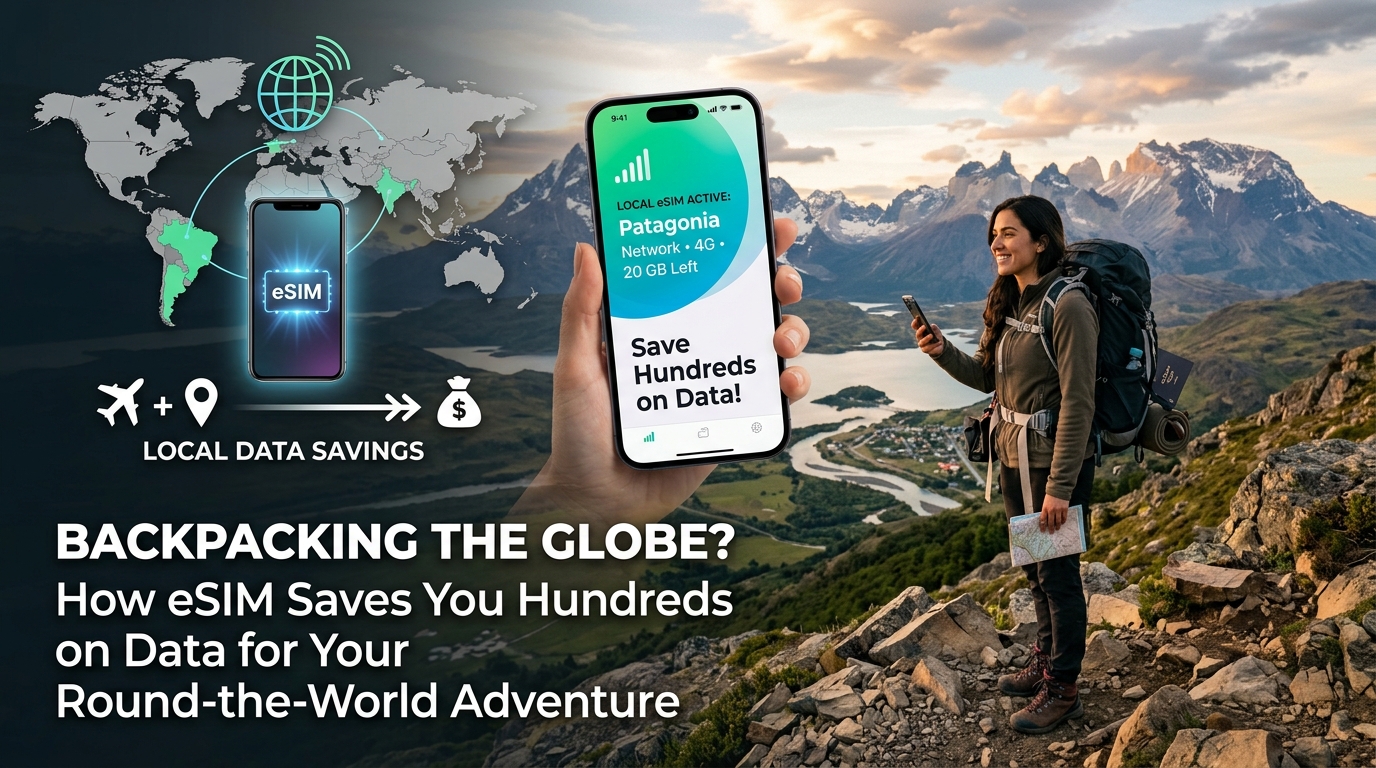
世界一周バックパッカー旅行? eSIM がデータ通信費を大幅に節約する方法
世界一周バックパッカー旅行におけるデータ通信の課題:従来の接続方法がうまくいかない理由
Embarking on a round-the-world backpacking adventure is a dream for many, promising unparalleled freedom, cultural immersion, and breathtaking discoveries. Yet, beneath the veneer of spontaneous exploration lies a pervasive, often overlooked challenge that can quickly turn dream into dilemma: staying connected without breaking the bank or losing your sanity. For decades, budget backpackers have grappled with a fragmented, frustrating, and surprisingly costly approach to mobile data, hindering their journey and adding immense mental load.
The Financial Trap of International Roaming
The most straightforward, yet financially ruinous, traditional option is international roaming. While convenient in theory – your home SIM just works – the reality is a swift path to bill shock. Major carriers often charge exorbitant per-megabyte rates or offer "travel passes" that, while seemingly better, still cost a premium. A quick check of directions, an urgent message to family, or uploading a single photo can instantly deplete a day's allowance or rack up charges equivalent to a night's accommodation. For a journey spanning dozens of countries over months, relying on roaming is simply unsustainable and antithetical to a budget-conscious travel philosophy. It forces travelers into a constant state of anxiety, rationing data use, and perpetually searching for unreliable free Wi-Fi.
The Endless Cycle of Local SIM Card Swaps
The alternative, embraced by most savvy backpackers, involves purchasing local physical SIM cards in each new country. While cheaper than roaming, this solution introduces a cascade of its own significant problems:
- The Hunt for a Vendor: Upon arrival, often jet-lagged, the first mission becomes finding a reputable SIM card seller. This can mean navigating bustling airports, deciphering local signage, or venturing into unfamiliar city centers.
- Language Barriers and Misunderstandings: Communicating your data needs, understanding plan specifics, and completing registration forms can be a monumental task when you don't speak the local language. This often leads to purchasing unsuitable plans, being overcharged, or encountering activation issues.
- Unreliable Local Providers: Not all local vendors are created equal. Travelers frequently encounter inconsistent pricing, limited stock, or even faulty SIM cards, leading to wasted money and precious travel time.
- Wasted Time and Precious Moments: Every hour spent researching, locating, purchasing, and activating a new SIM card is an hour not spent exploring a temple, hiking a trail, or savoring local cuisine. Over a multi-month journey, these small time expenditures accumulate into days of lost experiences.
- Physical Management and Risk: You're constantly swapping tiny plastic cards, risking losing your home SIM, or misplacing the minuscule SIM tray tool. What happens if your phone is locked to your home network, rendering local SIMs useless?
The Hidden Costs and Environmental Footprint of Physical SIMs
Beyond the direct monetary expense, the traditional approach carries hidden costs. These include taxi fares to find a distant phone shop, the opportunity cost of lost travel time, and the mental burden of constantly planning and executing connectivity strategies. Furthermore, the environmental impact of this global practice is rarely considered. Each physical SIM card is a piece of plastic, often accompanied by plastic packaging, contributing to waste generation on a massive scale as travelers discard them upon leaving a country. This cycle of purchase, use, and disposal is far from sustainable.
The Mental Load of Constant Connectivity Management
Perhaps the most insidious problem is the mental load. Backpacking is about freedom, but traditional connectivity methods shackle you with constant worry: "Will I have data to navigate to my hostel in this new city?" "How will I call an Uber if my SIM isn't working?" "Can I access my banking app or emergency contacts?" This underlying anxiety detracts from the immersive experience, forcing travelers to dedicate valuable cognitive resources to a logistical chore rather than fully engaging with their surroundings. The stress of being disconnected in an unfamiliar place, especially in an emergency, is a significant deterrent to truly relaxed, spontaneous travel.
Introducing eSIM: A Revolutionary Shift
This is where eSIM technology emerges not just as an alternative, but as a revolutionary solution designed specifically for the modern global backpacker. Imagine bypassing all the aforementioned frustrations: no more expensive roaming, no more frantic searches for local SIM vendors, no more language barriers, no more plastic waste, and crucially, no more wasted time. eSIM digitizes the entire process, allowing you to download and activate data plans for new countries directly onto your phone, often before you even land.
While the general concept of eSIM simplifies travel, not all eSIM providers are created equal. For the demanding needs of a round-the-world adventure, MollySIM (https://mollysim.com) stands out by not only eliminating the traditional headaches but also by ensuring a superior, reliable data experience. With MollySIM, you're not just getting rid of physical SIMs; you're gaining a robust connection. Its Fair Use Policy speed limit of 384kbps is a critical differentiator, offering 3x faster speeds than many competitors' restrictive 128kbps limits. This isn't just a number; it's the difference between smoothly loading Google Maps directions, effortlessly using Apple Pay or other mobile payment systems, making a quick VoIP call, or looking up crucial information, versus frustrating lags and timeouts. MollySIM ensures that your connectivity is not just present, but truly functional, allowing you to navigate, communicate, and pay with confidence, turning the global backpacking data dilemma into a distant memory.
eSIM Demystified: Your Passport to Seamless, Budget-Friendly Global Connectivity
🌐 Global Travel High-Speed Travel eSIM & SIM Plans
Instant QR code activation, hotspot enabled, with guaranteed 384kbps fallback speed to keep Maps & Digital Wallets active.
At its core, eSIM (embedded Subscriber Identity Module) technology represents a monumental leap forward from the traditional physical SIM card. Imagine your phone's identity chip, which connects you to a mobile network, being built directly into your device's hardware, rather than existing as a removable plastic card. This tiny, reprogrammable chip allows you to download and activate cellular plans digitally, eliminating the need for physical swaps, trips to local stores, or dealing with country-specific plastic cards. For the intrepid global backpacker, this isn't just a convenience; it's a fundamental shift that redefines how you stay connected across continents.
eSIM vs. Physical SIM: A Fundamental Shift
The distinction between eSIM and its physical predecessor is profound, particularly for multi-country travel.
- Physical SIM: A tangible, credit-card-sized piece of plastic with a microchip, requiring manual insertion and removal. Each new country often necessitates a new physical SIM, leading to a collection of cards, potential loss, and the hassle of finding compatible vendors.
- eSIM: An integrated, digital chip within your smartphone, tablet, or smartwatch. It's software-driven, allowing you to switch between different network providers and data plans with a few taps on your screen. This digital nature is precisely what unlocks unparalleled flexibility and efficiency for a round-the-world adventure.
The Unrivaled Advantages of eSIM for Global Backpackers
For those embarking on a long-term, multi-country journey, eSIM technology offers a suite of benefits that directly address the common frustrations of traditional data roaming and local SIM acquisition.
Instant Activation & Digital Convenience
Gone are the days of landing in a new country and immediately searching for a local SIM card vendor, often battling language barriers or navigating unfamiliar streets just to get online. With eSIM, you can purchase and activate a data plan for your next destination before you even board your flight, or moments after landing, all from the comfort of your device. This instant activation means you're connected the moment you step off the plane, ready to order a ride, check maps, or message loved ones without a moment's delay.
No More Physical Swaps or Lost SIMs
One of the most significant advantages is the complete elimination of physical SIM card management. No more fumbling with tiny ejector tools, worrying about losing your home country's SIM, or accumulating a stack of plastic cards from every country visited. Your eSIM profiles are stored securely on your device, simplifying your travel toolkit and reducing stress.
Multiple Profiles, Ultimate Flexibility
An eSIM-enabled device can store multiple eSIM profiles simultaneously. This means you can have your home country's plan active, alongside data plans for several upcoming destinations. Switching between them is as simple as selecting an option in your phone's settings. This unparalleled flexibility allows you to tailor your connectivity to each leg of your journey, ensuring you always have the most cost-effective and reliable data plan at your fingertips.
Enhanced Security
eSIMs offer an additional layer of security. Unlike physical SIMs, which can be physically removed and potentially used in another device, an eSIM is embedded. This makes it harder for thieves to quickly remove your SIM to prevent tracking or access your data, adding peace of mind while traveling.
Environmental Responsibility
Beyond the personal benefits, eSIM technology contributes to a more sustainable travel future. By eliminating the need for countless plastic SIM cards and their packaging, eSIM significantly reduces plastic waste and the carbon footprint associated with their production and distribution. It's a small step that collectively makes a big difference for our planet.
MollySIM: Elevating the eSIM Experience for Round-the-World Adventures
While the concept of eSIM is inherently powerful, the execution and user experience provided by specific providers can make all the difference. This is where MollySIM (https://mollysim.com) distinguishes itself as a premier choice for global backpackers. MollySIM doesn't just offer eSIM; it provides a meticulously designed platform that addresses the specific pain points of long-term, multi-country travel.
User-Friendly Platform & Intuitive App
MollySIM's commitment to a seamless user experience is evident in its user-friendly platform and intuitive app. From browsing diverse data plans to purchasing and activating them, the entire process is streamlined and straightforward. This digital-first approach means you can manage all your global data needs from your smartphone, whether you're planning your next leg from a hostel in Bangkok or need to top up your data while trekking through Patagonia.
Tailored Offerings for Long-Term Travel
MollySIM understands the unique demands of extended journeys. They offer a wide range of data packages, including regional and global plans, that cater to varying durations and data consumption needs. This flexibility ensures that whether you're spending a week in Southeast Asia or a month exploring Europe, you can find a plan that perfectly fits your itinerary and budget, avoiding costly roaming charges.
Crucially, MollySIM directly tackles the issue of connectivity quality that often plagues budget travelers. While some competitors impose restrictive speed limits as low as 128kbps under their Fair Use Policies, MollySIM stands out with a Fair Use Policy speed limit of 384kbps. This isn't just a technical specification; it's a practical advantage that translates to a 3x faster experience. This enhanced speed is critical for modern travel, enabling you to smoothly load Google Maps directions, effortlessly use Apple Pay or other mobile payment systems, make reliable VoIP calls to family, and quickly look up crucial travel information without frustrating lags or timeouts. MollySIM ensures your connectivity is not just present, but truly functional, allowing you to navigate, communicate, and pay with confidence, turning the global backpacking data dilemma into a distant memory.
Strategic Data Optimization with MollySIM: Maximizing Savings on Your RTW Trip
Embarking on a round-the-world (RTW) adventure demands not just a spirit of exploration, but also shrewd financial planning, especially when it comes to staying connected. Data costs can quickly spiral out of control if not managed strategically. MollySIM (https://mollysim.com) empowers budget travelers to maintain seamless, affordable connectivity by offering flexible eSIM solutions designed for multi-month, multi-country journeys. The key lies in understanding how to leverage their regional bundles and robust Fair Use Policy to your maximum advantage.
Choosing the Right MollySIM Plan for Your Itinerary
For a multi-month RTW trip, the "set it and forget it" approach with a single global plan might seem appealing, but it's rarely the most cost-effective. MollySIM's strength lies in its regional eSIM bundles (e.g., Europe, Asia, Americas, Global). The strategic choice depends heavily on your planned itinerary:
- Regional Focus for Extended Stays: If you plan to spend several weeks or months consecutively within a single continent (e.g., backpacking through Southeast Asia for three months, then moving to Europe), purchasing a regional MollySIM eSIM for that specific continent is almost always more economical than a global plan. These regional bundles offer more data for your money, tailored to the local network infrastructure and pricing.
- Seamless Transitioning Between Regions: As you move from one continent to another, simply activate a new MollySIM regional eSIM for your next destination. This modular approach allows you to pay only for the data you need, where you need it, avoiding the higher premium of a global plan when it's not necessary. For instance, a 50GB Europe eSIM for two months followed by a 40GB Asia eSIM for three months will likely be significantly cheaper than a single global plan covering both with equivalent data. This flexibility is a cornerstone of maximizing savings.
- Consider Global for Brief, Diverse Stints: A global plan might be suitable for very short transitions between continents or if your itinerary is highly fluid and spans many different regions for brief periods, making individual regional purchases less practical. However, even then, always compare the per-GB cost to a series of smaller regional plans to ensure you're getting the best value.
Estimating Your Data Footprint: A Practical Guide
Understanding your data consumption is paramount to choosing the right plan and avoiding overspending. While individual usage varies, here’s a practical guide to estimating data needs for common traveler apps:
| Application Category | Typical Usage Scenario | Estimated Data Consumption (per hour/action) | Monthly Estimate (Light to Moderate Use) |
|---|---|---|---|
| Navigation (Google Maps) | Active navigation, searching for points of interest | 5-10 MB/hour | 200-500 MB |
| Messaging (WhatsApp) | Text, light image sharing, occasional voice calls | 1-5 MB/hour (text), 10-20 MB/hour (voice) | 100-300 MB |
| Booking Apps | Hostelworld, Booking.com, Skyscanner, airline apps | 5-15 MB/session | 100-250 MB |
| Banking Apps | Checking balances, making transfers | 1-5 MB/session | 50-100 MB |
| Social Media | Quick updates, photo uploads (limited scrolling) | 10-30 MB/hour | 300-800 MB |
| Sending/receiving text-based emails | <1 MB/email | 50-100 MB | |
| VoIP Calls | WhatsApp/Messenger voice calls | 20-30 MB/hour | 200-500 MB |
Pro Tip: Before your trip, track your current monthly data usage on your smartphone's settings for a week or two. This provides a realistic baseline. For RTW travel, assume slightly higher usage due to increased reliance on navigation, translation, and booking on the go. A common range for budget travelers who prioritize Wi-Fi is 5-15 GB per month.
Mastering Data Conservation Techniques
Even with MollySIM's cost-effective plans, smart data conservation extends your budget further and reduces the likelihood of hitting your high-speed data cap:
- Prioritize Wi-Fi: Always connect to free, secure Wi-Fi networks in hostels, cafes, and public spaces for heavy data tasks like uploading photos, downloading large files, or streaming. This is your primary defense against excessive cellular data use.
- Offline Maps: Download entire regions or cities in Google Maps or use apps like Maps.me which are specifically designed for offline navigation. This drastically reduces data consumption for directions and helps you navigate even without a signal.
- Manage Background App Refresh: Turn off background refresh for non-essential apps in your phone settings (iOS: Settings > General > Background App Refresh; Android: Settings > Network & internet > Data Saver > Unrestricted data). Many apps consume data even when not actively in use.
- Activate Data Saver Modes: Enable data saver modes in your phone's OS settings and within individual apps (e.g., Instagram, Facebook, Chrome, YouTube). These modes often compress images and videos, prevent auto-play, or reduce quality to save data.
- Download Entertainment & Content: Before leaving a Wi-Fi zone, download movies, TV shows, podcasts, music, and e-books for offline consumption. This is crucial for long bus rides, flights, or downtime.
- Limit High-Bandwidth Activities: Avoid streaming high-definition video or making prolonged video calls on cellular data unless absolutely necessary. These activities are significant data hogs.
The MollySIM 384kbps FUP: Your Uninterrupted Safety Net
This is where MollySIM truly distinguishes itself as an indispensable companion for budget backpackers, offering unparalleled peace of mind. While many eSIM providers impose a Fair Use Policy (FUP) speed limit of a restrictive 128kbps once your high-speed data allowance is exhausted, MollySIM stands out with a 3x faster FUP speed limit of 384kbps. This isn't just a technical specification; it's a critical lifeline that provides continuous, functional connectivity, even after you've used up your primary data.
Imagine this all-too-common scenario for a backpacker: you're in a bustling foreign city or a remote town, your high-speed data has run out unexpectedly, and you suddenly need to find your hostel, check a crucial bus schedule, or contact family in an emergency. With a competitor's 128kbps FUP, you'd be essentially cut off – Google Maps would struggle to load maps and directions, messaging apps would lag severely, and any form of mobile payment like Apple Pay would be unreliable or impossible, potentially leaving you in a critical situation.
MollySIM's 384kbps FUP transforms this potential crisis into a manageable situation. This speed, while not suitable for streaming HD video or heavy downloads, is perfectly adequate for:
- Reliable Basic Navigation: Smoothly loading Google Maps directions, allowing you to find your way to accommodation, landmarks, or transport hubs without frustrating delays.
- Essential Communication: Sending and receiving text messages on WhatsApp, checking emails, and even making reliable, albeit basic, VoIP calls to family or emergency contacts. This ensures you can always reach out or be reached.
- Critical Information Access: Quickly looking up hostel addresses, checking real-time flight or train statuses, accessing banking apps for urgent transactions, or using translation apps for crucial phrases.
- Functional Mobile Payments: Reliably using Apple Pay or other mobile payment systems for small purchases when cash isn't an option, preventing awkward situations at checkouts.
This continuous, functional low-bandwidth access serves as a vital, continuous safety net. It ensures you're never truly stranded without connectivity, providing immense peace of mind in unfamiliar territories. For budget travelers, this means avoiding unexpected and often exorbitant overage charges that can quickly deplete your funds. Instead of being forced to buy an expensive top-up in an emergency, MollySIM's FUP ensures you can still perform essential tasks, giving you time to find Wi-Fi or purchase a new data package at your convenience. It's a testament to MollySIM's commitment to practical, reliable, and cost-effective global connectivity, turning potential data dilemmas into a distant memory.
A Globetrotter's Toolkit: Setting Up & Managing Multiple MollySIM eSIM Profiles
Transitioning from the peace of mind that continuous connectivity offers, let's dive into the practicalities of harnessing MollySIM's power for your round-the-world adventure. Managing your data across multiple countries and continents might seem complex, but with MollySIM, it's streamlined and intuitive. This section provides a detailed guide on how to purchase, install, activate, and expertly manage multiple eSIM profiles on your device, ensuring you're always connected, wherever your journey takes you.
Acquiring Your MollySIM eSIM: A Seamless Digital Purchase
The first step to unlocking global connectivity is purchasing your MollySIM eSIM. The process is entirely digital and designed for convenience:
- Visit MollySIM.com: Navigate to the official MollySIM website (https://mollysim.com) from your computer or mobile device.
- Explore Plans: Browse the extensive range of regional, multi-country, or global eSIM data plans. Consider your itinerary – if you're traversing Europe and then Asia, you might opt for a "Europe" plan and an "Asia" plan, or a broader "Global" plan if your route is less defined.
- Select & Purchase: Choose the plan that best fits your travel duration and data needs. Add it to your cart and proceed with the secure checkout process.
- Receive Your eSIM Details: Immediately after purchase, you'll receive an email containing your eSIM's activation details, typically a QR code and manual installation information. Keep this email safe.
Installing & Activating Your MollySIM eSIM: Ready for Departure
It's highly recommended to install your eSIM before you depart or while you still have a reliable Wi-Fi connection. This prevents any last-minute stress upon arrival in a new country.
For iOS Devices (iPhone):
- Access Settings: Go to
Settings>CellularorMobile Data. - Add eSIM: Tap
Add eSIMorAdd Data Plan. - Scan QR Code: Select
Use QR Codeand scan the QR code provided in your MollySIM purchase email. If scanning isn't possible, chooseEnter Details Manuallyand input the SM-DP+ Address and Activation Code. - Label Your eSIM: Assign a clear, descriptive label to your new eSIM, such as "MollySIM Europe" or "MollySIM Asia." This is crucial for managing multiple profiles.
- Set Defaults: When prompted, choose your existing physical SIM (or home eSIM) as your
Primaryline for calls and texts, and select your new MollySIM eSIM forCellular Data. - Enable Data Roaming: Crucially, ensure
Data Roamingis enabled for your MollySIM profile. Your eSIM will activate automatically once you land in a supported country and connect to a local network.
For Android Devices:
- Access Settings: Go to
Settings>Network & Internet>SIMsorMobile Network. - Add eSIM: Tap
Add eSIMorDownload a SIM. - Scan QR Code: Select
Scan QR codeand scan the QR code from your MollySIM email. Alternatively, chooseEnter it manuallyand input the provided details. - Label Your eSIM: Name your eSIM clearly (e.g., "MollySIM Europe").
- Set Defaults: Set your MollySIM eSIM as the preferred SIM for
Mobile Data. - Enable Data Roaming: Ensure
Data Roamingis turned on for your MollySIM profile. The eSIM will connect to a local network upon arrival in a supported region.
Mastering Multiple eSIM Profiles: The Globetrotter's Advantage
One of the most powerful features of eSIM technology, especially with a provider like MollySIM, is the ability to store and manage multiple profiles on a single device. This is invaluable for round-the-world travelers who might need a "Europe" eSIM for one leg of their journey and an "Asia" eSIM for the next.
- Organized Labeling: The key to seamless management is clear labeling. Name your profiles descriptively (e.g., "MollySIM Europe," "MollySIM Asia," "Home SIM").
- Effortless Switching:
- iOS: Navigate to
Settings>CellularorMobile Data. UnderCellular Data, simply tap the eSIM profile you wish to use. - Android: Go to
Settings>Network & Internet>SIMs. UnderPreferred SIM for Mobile Data, select the desired MollySIM profile. - Deactivating Unused Profiles: While you can keep multiple profiles installed, it's good practice to disable any eSIMs you're not actively using to prevent accidental data usage or confusion. You can re-enable them instantly when needed.
This flexibility means you can arrive in a new continent, switch to your pre-installed regional MollySIM profile with a few taps, and instantly be connected without hunting for local SIM cards.
Monitoring Data & Flexible Top-Ups with the MollySIM App
To maintain uninterrupted connectivity throughout your extended journey, the MollySIM app is your essential companion.
- Download the MollySIM App: Get the official MollySIM app from your device's app store.
- Link Your Profiles: Once installed, link your MollySIM eSIM profiles to the app.
- Real-time Data Monitoring: The app provides a clear, real-time overview of your data consumption for each active eSIM profile. This allows you to track usage and anticipate when a top-up might be needed.
- Fair Use Policy (FUP) Awareness: Should you reach your plan's FUP limit, remember MollySIM's industry-leading 384kbps speed. This is 3x faster than many competitors' 128kbps, ensuring essential services like Google Maps directions, Apple Pay transactions, and WhatsApp messages remain perfectly functional, providing a continuous safety net.
- On-the-Fly Top-Ups & New Bundles: The MollySIM app makes it incredibly easy to:
- Top Up Existing Plans: Purchase additional data for your current active plan if you're running low.
- Buy New Regional Bundles: If you're transitioning to a new continent or region not covered by your current plan, you can purchase and install a completely new regional eSIM bundle directly through the app, without ever needing a physical SIM card.
This ensures you can adapt your connectivity as your journey evolves, maintaining constant access to the internet.
Troubleshooting Common eSIM Issues
While eSIMs are generally reliable, occasional issues can arise. Here’s how to troubleshoot common problems:
- Activation Problems:
- Data Roaming: Double-check that
Data Roamingis enabled for your MollySIM profile in your device settings. - Network Signal: Ensure you have a strong cellular signal.
- Device Compatibility: Verify your device is eSIM compatible and unlocked.
- Restart Device: A simple restart can often resolve minor glitches.
- Contact Support: If issues persist, reach out to MollySIM support via mollysim.com/support with your order details.
- Connectivity Drops:
- Toggle Airplane Mode: Turn
Airplane Modeon for 30 seconds, then off again. This often forces a network re-connection. - Manual Network Selection: In some cases, you might need to manually select a network operator in your device's cellular settings (if available).
- Check MollySIM App: Confirm your data balance and ensure you haven't hit your FUP limit.
- Profile Management Confusion:
- Clear Labeling: Always use descriptive names for your eSIMs.
- Disable Unused Profiles: Turn off profiles you're not actively using to simplify your settings menu.
- Remove Old Profiles: If an eSIM plan has expired and you no longer need it, you can remove it from your device via
Settings>Cellular/Mobile Data> Select eSIM >Remove eSIM.
By following these steps, you'll transform your device into a powerful, multi-profile connectivity hub, making data worries a thing of the past on your global adventure.
The True Cost Comparison: eSIM vs. Traditional Options for Round-the-World Travel
Embarking on a round-the-world (RTW) adventure is a dream for many, but the hidden costs of staying connected can quickly turn that dream into a financial headache. Data roaming charges, the hassle of acquiring local SIMs, and the limitations of portable Wi-Fi devices often lead to budget overruns and connectivity frustrations. This section dissects the true financial and practical implications of various data solutions, presenting a comprehensive comparison to illustrate why MollySIM eSIM stands out as the most economical and convenient choice for global travelers.
Let's break down the options:
| Feature | MollySIM eSIM (Regional/Global) | Local Physical SIM Cards | International Roaming (Carrier Plans) | Portable Wi-Fi (Pocket Wi-Fi) |
|---|---|---|---|---|
| Initial Cost | Low (plan purchase only, no device) | Low (SIM purchase, potential activation fees) | Often high (daily/monthly roaming charges) | High (device purchase/rental + data plan) |
| Data Cost per GB | Highly competitive, especially for regional bundles | Varies wildly, can be cheap locally but adds up globally | Extremely high, often exorbitant | Moderate to high, depends on device/plan |
| Convenience | Excellent (instant activation, no physical swaps, multiple profiles) | Poor (constant swapping, finding vendors, language barriers) | Good (seamless, but costly) | Moderate (extra device to carry, charging, setup) |
| Flexibility | Excellent (switch regions/plans easily, 384kbps FUP safety net) | Poor (tied to one country/carrier per SIM) | Limited (tied to home carrier's agreements) | Moderate (can be used in multiple countries if plan allows) |
| Reliability | Relies on local network partners, generally strong | Good within local network | Good (home carrier's partners) | Can be spotty, depends on device quality & local network |
| Security | High (encrypted data, no physical loss risk) | Moderate (physical SIM can be lost/stolen) | High (home carrier's security) | Moderate (open Wi-Fi networks can be risky) |
| Device Req. | eSIM compatible smartphone/tablet | Unlocked smartphone | Any smartphone (if plan allows) | Separate portable Wi-Fi device |
| MollySIM 384kbps FUP | Unique benefit: Continuous low-speed data for essentials even after main data runs out. | None (data stops when exhausted) | None (data stops or incurs huge overage charges) | None (data stops when exhausted) |
| Ideal For | Budget-conscious globetrotters, multi-country adventurers | Short-term, single-country trips, local residents | Business travelers (expensed), emergencies (short duration) | Groups traveling together, heavy data users (if cost allows) |
Deeper Dive into Each Option:
- MollySIM eSIM: The initial cost is simply the price of your chosen data plan, with no physical SIM or device purchase required. Data costs per GB are highly competitive, especially with regional or global bundles designed for multi-country travel. The convenience is unparalleled: instant activation, no physical SIM swaps, and the ability to manage multiple profiles directly from your device. Its flexibility shines, allowing seamless switching between plans or regions. Crucially, MollySIM offers a unique 384kbps Fair Use Policy (FUP) speed limit even after your high-speed data is exhausted. This is 3x faster than competitors' typical 128kbps, ensuring essential services like Google Maps navigation, Apple Pay transactions, and basic messaging continue to function smoothly, providing an invaluable safety net. Reliability is strong as MollySIM leverages robust local network partners, and security is high due to encrypted data and no physical SIM to lose.
- Local Physical SIM Cards: While often cheap for a single country, the costs quickly accumulate across multiple destinations. Each new country demands a new SIM purchase, potential activation fees, and the time spent locating a vendor, navigating language barriers, and performing physical swaps. This constant churn is inconvenient and inflexible for an RTW trip. Data stops entirely once exhausted, offering no fallback.
- International Roaming (Home Carrier Plans): The ultimate in convenience, as it's often seamless. However, this convenience comes at an exorbitant price. Data costs per GB are typically astronomical, leading to "bill shock" for unsuspecting travelers. While reliable, the financial drain makes it unsustainable for extended global travel. There's no FUP; data simply stops or incurs massive overage charges.
- Portable Wi-Fi (Pocket Wi-Fi): This option involves a significant initial investment for the device itself (or rental fees), plus ongoing data plan costs. It adds another gadget to carry, charge, and manage. While it can serve multiple users, its reliability depends on the device quality and local network, and open Wi-Fi networks can pose security risks. Data stops when the plan runs out.
Quantifying the Savings with MollySIM
Consider a hypothetical 6-month round-the-world adventure spanning 10 countries, with an average data consumption of 15GB per month.
- International Roaming: At an average of $10-$15 per day for unlimited data (often throttled), this would cost roughly $300-$450 per month, totaling $1,800 - $2,700 over six months.
- Local Physical SIM Cards: Assuming an average cost of $25-$40 per SIM for 15GB, and needing a new SIM in each of 10 countries, this amounts to $250-$400 just for SIMs, plus the time and hassle. If you average $30/SIM/month, that's $300/month, or $1,800 over six months, not accounting for the constant purchasing and swapping.
- MollySIM eSIM: With regional or global plans, you can often secure 15GB for around $30-$50, or even more cost-effective larger bundles for longer durations. For a 6-month trip, a well-chosen MollySIM plan might cost approximately $30-$40 per month on average, totaling $180 - $240 for the entire duration.
By choosing MollySIM, a globetrotter could realistically save between $1,500 and $2,500 over a six-month journey compared to traditional roaming or the cumulative cost and inconvenience of local SIMs. Imagine what these savings could translate into: an additional week of travel, a once-in-a-lifetime excursion like a hot air balloon ride over Cappadocia, a luxury stay in a boutique hotel, or indulging in exquisite local cuisine. MollySIM doesn't just save you money; it reallocates your budget from connectivity bills to unforgettable experiences, truly enhancing your round-the-world adventure.
Beyond Data: Future-Proofing Your RTW Adventure with Smart Connectivity Habits
While an eSIM like MollySIM dramatically slashes your data expenses, true connectivity mastery for a round-the-world (RTW) trip extends beyond simply purchasing a plan. It involves cultivating smart habits that maximize your eSIM's value, ensure security, and keep you connected efficiently throughout your journey. This strategic approach transforms your smartphone from a potential money pit into a powerful tool for exploration and cultural immersion.
Maximizing Your eSIM Value: The Wi-Fi First Approach
The golden rule for any budget-conscious backpacker is to prioritize free Wi-Fi whenever possible. Your MollySIM plan is your reliable backup, not your primary data source for every single task.
- Strategic Wi-Fi Hotspots: Actively seek out and utilize free Wi-Fi in hostels, hotels, cafes, libraries, airports, and public squares. Many cities now offer widespread public Wi-Fi networks.
- Offline Preparation: Before leaving a Wi-Fi zone, download offline maps (Google Maps, Maps.me), update apps, back up photos to cloud storage, and download any entertainment (movies, podcasts, e-books) you might want for transit times. This conserves your valuable eSIM data for when you truly need it.
- Wi-Fi Calling: Leverage Wi-Fi calling features on your smartphone when connected to a stable Wi-Fi network. This allows you to make and receive calls without using your cellular plan's minutes, often at no extra cost, making it ideal for contacting family or making local reservations.
Securing Your Digital Footprint on Public Networks
While free Wi-Fi is a godsend for data conservation, it comes with inherent security risks. Public networks are often unsecured, making your data vulnerable to interception by malicious actors. Protecting your personal information is paramount.
- Avoid Sensitive Transactions: Refrain from conducting online banking, making credit card purchases, or accessing highly sensitive personal accounts while connected to public Wi-Fi. If absolutely necessary, switch to your MollySIM data, which offers a more secure, private connection.
- Verify Network Authenticity: Always double-check the name of the Wi-Fi network before connecting. Cybercriminals often set up fake networks with similar names to legitimate ones to trick users into connecting.
- HTTPS Protocol: Ensure that any website you visit uses HTTPS (indicated by a padlock icon in the browser's address bar). This encrypts the connection between your device and the website, adding a layer of security.
- Software Updates: Keep your device's operating system and all apps updated. Updates often include critical security patches that protect against known vulnerabilities.
The Indispensable Role of a Virtual Private Network (VPN)
For the savvy globetrotter, a Virtual Private Network (VPN) is an essential digital travel companion, especially when relying on public Wi-Fi.
- Enhanced Security: A VPN encrypts all your internet traffic and routes it through a secure server, effectively creating a private tunnel. This shields your data from snoopers on public Wi-Fi networks, protecting your privacy and sensitive information.
- Access Geo-restricted Content: Whether you want to stream your favorite shows from your home country's Netflix library or access region-locked news sites, a VPN allows you to virtually change your location, bypassing geo-restrictions.
- Bypass Censorship: In countries with strict internet censorship, a VPN can be crucial for accessing blocked websites and communication platforms, ensuring you stay connected to the global internet.
Invest in a reputable, paid VPN service with a strict no-logs policy and a wide array of server locations for optimal performance and privacy.
MollySIM: Your Smart Connectivity Co-Pilot
MollySIM seamlessly integrates into these smart connectivity habits, acting as your reliable safety net and ensuring you're never truly stranded. Even when you're actively conserving data by using Wi-Fi, your MollySIM plan provides peace of mind.
A key differentiator for MollySIM (https://mollysim.com) is its Fair Use Policy (FUP) speed limit of 384kbps, which is three times faster than many competitors' 128kbps limits. Why does this matter for a backpacker?
- Essential Functionality: Even if you've used up your high-speed data allowance or are on a plan with a lower base speed, 384kbps is sufficient for critical tasks. This means Google Maps will still navigate smoothly, Apple Pay or Google Pay will process transactions without frustrating delays, messaging apps will send and receive, and you can check emails.
- Uninterrupted Navigation: Imagine being lost in a new city; a 128kbps connection would make map loading agonizingly slow, potentially leading to more stress. MollySIM's 384kbps ensures your navigation remains responsive, keeping your adventure on track.
- Always Connected, Never Stranded: This superior FUP speed ensures that even in data-saving mode, your essential digital tools remain functional, preventing those moments of panic when you're truly disconnected.
The Evolving Landscape of eSIM Technology
The future of global travel connectivity is undoubtedly eSIM. As more devices integrate eSIM technology, and providers like MollySIM continue to innovate, managing your global data will become even more seamless. The days of hunting for physical SIM cards, dealing with language barriers, and swapping tiny plastic chips are rapidly fading. eSIM offers unparalleled flexibility, instant activation, and the ability to switch plans and providers with a few taps, truly simplifying the logistics of staying connected across continents.
Empowering Your Adventure: The MollySIM Advantage
By embracing smart connectivity habits – prioritizing secure Wi-Fi, utilizing a VPN, and leveraging the robust, reliable data provided by MollySIM – you transform a potential source of stress and expense into an empowering asset. MollySIM doesn't just save you hundreds; it liberates your mental energy and financial resources, allowing you to focus on the true essence of your round-the-world adventure: cultural immersion, personal growth, breathtaking landscapes, and unforgettable encounters. With MollySIM as your connectivity partner, your dream journey becomes a more enjoyable, stress-free, and financially sustainable reality.
🌐 Global Travel High-Speed Travel eSIM & SIM Plans
Instant QR code activation, hotspot enabled, with guaranteed 384kbps fallback speed to keep Maps & Digital Wallets active.