The Connectivity Reality of Algarve in 2026: Urban 5G vs. Rural Dead Zones
Choosing the right Portugal eSIM Algarve solution in 2026 is no longer just about convenience; it is a critical logistical decision that determines whether your digital experience flows seamlessly or stalls in the most scenic moments. The Algarve region presents a unique and often contradictory telecommunications landscape. On one hand, the urban hubs of Lagos, Albufeira, and Faro have undergone a massive infrastructure overhaul, boasting robust 5G networks where peak download speeds routinely exceed 1 Gbps. In these coastal cities, connectivity is virtually invisible; you can stream 4K video on a beach bar terrace or upload high-resolution drone footage without a hiccup. However, step just a few kilometers inland or down a narrow, winding road leading to a hidden cove, and the digital world can vanish instantly. This stark dichotomy between the hyper-connected urban core and the notorious "dead zones" of the rural interior creates a specific technical challenge for travelers that traditional SIM cards are ill-equipped to handle.
The Topographical Challenge: Limestone Cliffs and Signal Attenuation
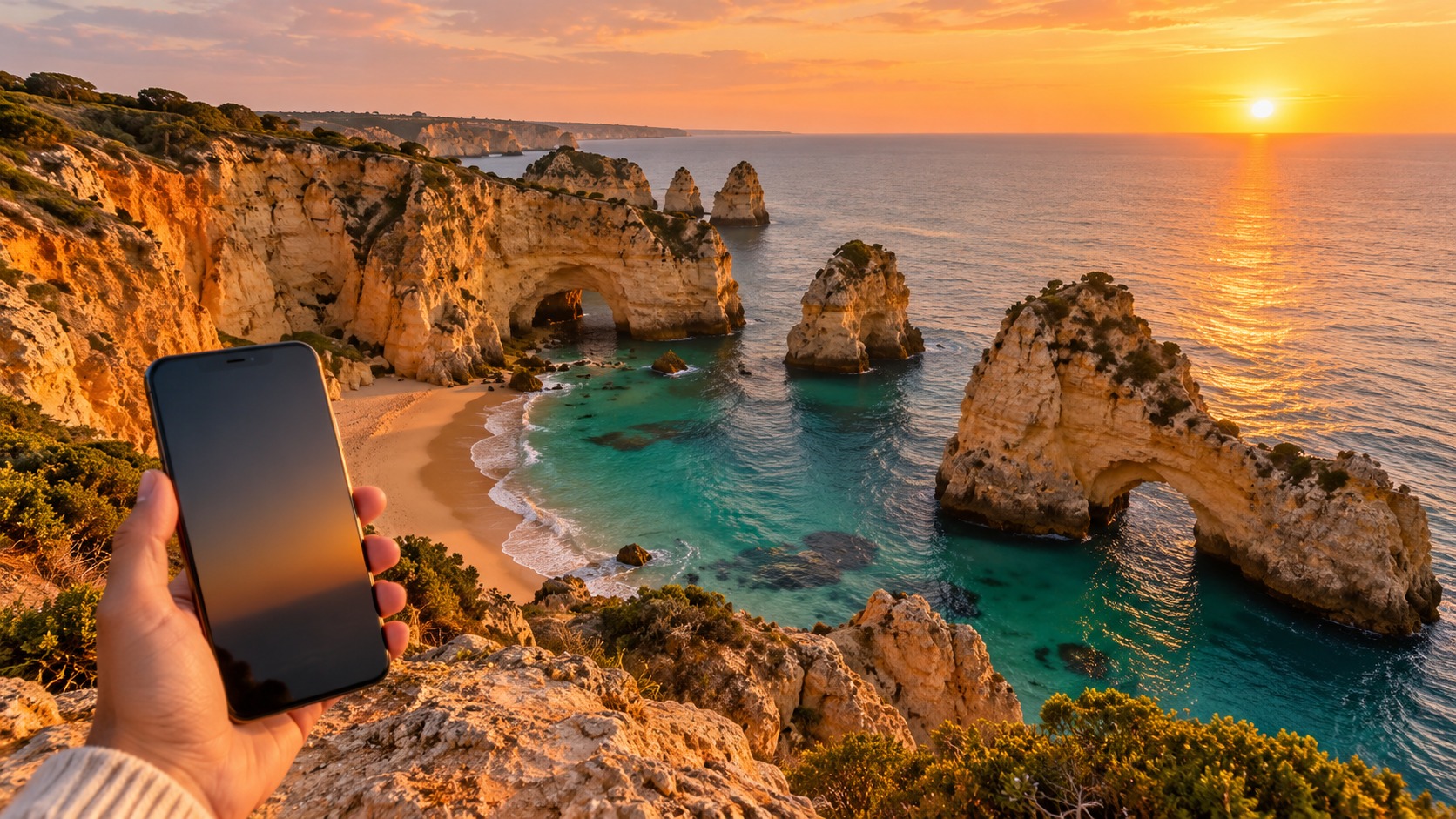
The primary culprit behind these connectivity gaps is not a lack of cell towers, but the Algarve’s distinctive geology. The region is defined by towering limestone cliffs and deep, narrow valleys. In 2026, while 5G coverage has expanded, the physical attenuation of radio waves by these massive rock faces remains a significant hurdle. When you are perched on a cliffside viewpoint to capture the perfect sunset, your phone is often in a "shadow zone" where the direct line of sight to the nearest base station is blocked by the very landscape you are admiring.
This creates a specific technical issue known as signal attenuation. Traditional single-carrier SIM cards rely on a direct, unobstructed link to one specific network provider. If that provider’s tower is on the opposite side of a ridge, or if their signal struggles to penetrate the dense limestone, your connection drops. This is particularly frustrating for content creators and photographers. Trying to upload a 40-megapixel RAW file or stream a live video of the sunset while your signal fluctuates between 2G and 4G can result in corrupted files or dropped calls. Furthermore, GPS accuracy suffers in these areas. Without a stable data connection to assist with A-GPS (Assisted GPS), your navigation apps may struggle to pinpoint your exact location on winding, unmarked roads, leading to the dreaded "connectivity anxiety"—the low-level stress of wondering if you’ll be able to call for help, check the tide times, or find the next fuel station.
Why Multi-Carrier eSIMs Outperform Local SIMs
This is where the best eSIM for Portugal Algarve becomes a superior tool compared to a standard local SIM. A high-quality eSIM, such as those offered by MollySIM, utilizes a multi-carrier aggregation strategy. Instead of locking you into a single network (like Vodafone, MEO, or NOS), a robust eSIM profile can dynamically switch between multiple carriers to find the strongest available signal. If MEO’s signal is weak behind a cliff face, your device can seamlessly handover to Vodafone’s 4G/5G band, which might have a tower positioned differently. This redundancy is the key to maintaining stability in the Algarve’s rugged terrain.
Moreover, the speed of data transfer matters as much as the availability of the signal. Many budget eSIM providers impose a Fair Use Policy (FUP) speed limit, often capping data at 128kbps after a certain threshold. At 128kbps, loading Google Maps or processing Apple Pay transactions can feel sluggish, and video calls may buffer. In contrast, MollySIM’s FUP limit is 384kbps, which is 3x faster than the industry standard. This higher ceiling ensures that even when you are on a secondary carrier with slightly lower priority, your essential apps—maps, messaging, and payment systems—remain responsive. For a traveler navigating the remote stretches between Carvoeiro and Odeceixe, this difference in latency and throughput is the distinction between a smooth journey and a frustrating stop-and-go experience.
The 2026 Connectivity Landscape: A Practical Comparison
To understand why a specialized eSIM is necessary, consider the following comparison of connectivity experiences in typical Algarve scenarios:
| Scenario | Traditional Local SIM | Single-Carrier eSIM | Multi-Carrier eSIM (e.g., MollySIM) |
|---|---|---|---|
| Urban Center (Albufeira) | Excellent (5G, >1 Gbps) | Excellent (5G, >1 Gbps) | Excellent (5G, >1 Gbps) |
| Cliffside Viewpoint | Unstable (Drops to 2G/3G) | Unstable (Dependent on one tower) | Stable (Auto-switches to strongest carrier) |
| Remote Beach Access | Poor (High latency, slow loads) | Poor (High latency, slow loads) | Good (384kbps FUP ensures smooth maps/pay) |
| Handover Reliability | Low (Manual or slow auto-switch) | Low (Limited carrier options) | High (Dynamic carrier aggregation) |
By understanding these technical realities, you can see that the choice of connectivity provider is not trivial. It is the backbone of your digital presence in one of Europe’s most visually stunning yet geographically complex regions. As we move forward, we will explore how to leverage this technology to maximize your time at the sunset spots, ensuring that your connection is as reliable as the sun itself. For those looking to secure this level of performance, exploring the specific Portugal eSIM plans available for 2026 is the first step toward a worry-free journey.
Carrier Wars: MEO, NOS, and Vodafone PT Coverage Comparison for Tourist Spots
🇵🇹 Portugal High-Speed Travel eSIM & SIM Plans
Instant QR code activation, hotspot enabled, with guaranteed 384kbps fallback speed to keep Maps & Digital Wallets active.
Navigating the MEO NOS Vodafone Portugal coverage landscape is less about finding the "best" carrier and more about identifying which network aligns with your specific geographic trajectory. In the Algarve, these three giants do not compete on equal footing across all terrain; their infrastructure investments reflect distinct historical priorities. For a traveler relying on a Portugal eSIM Algarve connection, understanding these nuances is critical. A single-carrier strategy often forces you to compromise between urban speed and rural reliability, a trade-off that can ruin a perfectly planned sunset session if your signal drops at the most critical moment.
MEO: The Urban Powerhouse with Cliffside Gaps
MEO has aggressively invested in 5G infrastructure, particularly in the urban centers of the central Algarve. In Albufeira and Portimão, MEO consistently delivers some of the highest peak download speeds in the region, often exceeding 1 Gbps in dense 5G zones. If your itinerary is strictly city-based, MEO is a formidable choice. However, the network’s strength in the urban core often masks weaknesses in the rugged western cliffs.
Travelers heading to the Ponta da Piedade or the secluded coves near Praia da Marinha frequently report signal degradation. MEO’s macro-cell towers are optimized for line-of-sight coverage in flatter, developed areas. When the terrain becomes vertical and rocky, the signal can weaken significantly, dropping users to 3G or even 2G. This is a critical risk for those attempting to upload high-resolution video or use real-time navigation apps while perched on a cliffside viewpoint. If you are using a single-carrier eSIM locked to MEO, you may find yourself hunting for a signal in a spot where the view is spectacular but the connectivity is frustratingly intermittent.
NOS: Rural Reach and the Summer Throttling Trap
NOS takes a different approach, prioritizing extensive 4G LTE coverage across the rural inland areas and the more dispersed communities of the eastern Algarve. Their network is often more robust in the Silves hinterland and the agricultural zones between major towns. For travelers who venture away from the coastal strip, NOS offers a reliable backbone.
However, NOS has a well-documented tendency to implement speed throttling during peak summer hours. In high-density tourist zones, the network may cap data speeds to manage load, a practice that can be disorienting if you are expecting the consistent high speeds advertised in their marketing. While this ensures basic connectivity, it can hinder bandwidth-intensive tasks like live streaming or large file transfers. For a cheap eSIM Portugal tourists option, NOS is often competitively priced, but the potential for dynamic speed adjustments means you are never quite sure what performance level you will receive at 7:00 PM on a Friday.
Vodafone PT: Eastern Strength and Coastal Congestion
Vodafone PT holds a strong presence in the eastern Algarve, particularly around Lagos and Carvoeiro. Their infrastructure is well-suited to the dense residential and tourist infrastructure of these areas. In Lagos, Vodafone often outperforms its competitors in terms of stability and low latency, making it a solid choice for digital nomads working from the city center.
The downside emerges in the crowded beach towns during high season. Vodafone’s network can suffer from congestion issues when thousands of tourists converge on the same few square kilometers of coastline. This is particularly noticeable in Praia da Rocha and Praia do Camilo, where the sheer volume of devices can saturate the local base stations. If you are relying on a single Vodafone SIM, you may experience packet loss or increased latency precisely when you need to process a payment or check a map.
The Multi-Carrier Solution: Why Single-SIM Strategies Fail
The risk of choosing a single local SIM becomes evident when your itinerary moves between these distinct coverage zones. Imagine starting your day in Albufeira (where MEO excels), driving to the Benagil Cave area (where NOS or Vodafone might have better cliffside penetration), and ending the day in Lagos (where Vodafone is strongest). A single-carrier eSIM forces you to accept the weaknesses of one network in the other two zones.
This is where a multi-carrier eSIM provider like MollySIM changes the equation. By aggregating signals from multiple Portuguese carriers, MollySIM dynamically switches to the strongest available network in real-time. This ensures that whether you are in the 5G-rich streets of Albufeira or the signal-challenged cliffs of the west, you are always connected to the optimal tower.
Furthermore, MollySIM’s 384kbps Fair Use Policy speed limit is a significant advantage over competitors who often cap speeds at 128kbps. This 3x faster limit ensures that critical applications like Google Maps and Apple Pay continue to function smoothly even when you are on the edge of a data plan or in a lower-tier coverage zone. For those seeking the best balance of performance and cost, exploring the specific Portugal eSIM plans available for 2026 is the most effective way to secure this level of dynamic, multi-carrier reliability without the hassle of managing multiple physical SIMs or worrying about which carrier owns the best signal in your current location.
MollySIM’s 384kbps FUP Advantage: Why Background Updates Matter for Sunset Hunters
When evaluating a Portugal eSIM Algarve solution, the most common marketing trap is the word "unlimited." While this term promises endless connectivity, the technical reality of mobile data networks in 2026 reveals a more nuanced picture. Most "unlimited" plans are actually "high-speed" plans with a hidden throttle. Once you exceed a specific data threshold—often between 5GB and 15GB depending on the provider—your connection speed drops dramatically. For many budget eSIM competitors, this drop-off point is a hard floor of 128kbps or 256kbps. While these speeds are sufficient for reading text-based emails, they are notoriously frustrating for the modern traveler who relies on real-time mapping, cloud syncing, and social media updates.
This is where the technical architecture of MollySIM provides a tangible, measurable advantage. MollySIM utilizes a 384kbps Fair Use Policy (FUP) fallback speed. To understand why this matters, consider the physics of data transfer. A speed of 384kbps is 3x faster than the standard 128kbps throttle used by many rivals. In practical terms, this difference is the distinction between a usable connection and a broken one. At 128kbps, loading a single high-resolution map tile in Google Maps can take several seconds, causing the blue dot to jump erratically or the interface to freeze. At 384kbps, the same map tile loads almost instantly, allowing for smooth panning and zooming even when you are off the main highway.
The "Buffering Circle" vs. Seamless Connectivity
Imagine a specific scenario common among Algarve visitors: You have spent the day at the Benagil Cave or the cliffs of Praia da Marinha. You have captured hours of 4K video and hundreds of high-resolution photos. You have likely consumed 8GB to 10GB of high-speed data during the day, uploading backups to the cloud and streaming music. As the sun begins to set, you need to navigate back to your accommodation in Lagos or Albufeira.
If you are using a standard competitor eSIM with a 128kbps cap, your connection is now in "throttle mode."
- Navigation: Google Maps may struggle to fetch real-time traffic data.
- Social Media: Posting a sunset video to Instagram or TikTok will result in a spinning "buffering circle" that lasts minutes.
- Payments: Contactless payments via Apple Pay or Samsung Pay may time out if the network handshake is slow.
With MollySIM’s 384kbps FUP, the experience remains fluid. The speed is high enough to maintain a stable TCP connection for background updates. Your email client continues to sync new messages without manual intervention. Your phone’s location services remain precise, ensuring your ride-share driver finds you exactly where you are standing. You can still upload a compressed version of your sunset video to social media without the anxiety of a failed upload. This is the difference between a data plan that supports your workflow and one that interrupts it.
Comparison: eSIM FUP vs. Pocket Wi-Fi Hard Caps
It is also crucial to contrast this eSIM flexibility with traditional Pocket Wi-Fi devices. Many physical Wi-Fi routers rented at airports or local shops operate on a "hard cap" model. If you use 10GB, the device often disconnects entirely or requires a manual reset to purchase more data. There is no graceful degradation. You go from full speed to zero speed.
In the Algarve, where signal strength can fluctuate rapidly due to the rugged terrain, a hard cut-off is risky. If your Pocket Wi-Fi disconnects while you are in a remote cove with no cell signal, you are offline until you return to a coverage zone. An eSIM with a 384kbps FUP, however, maintains a live connection. Even if the signal is weak, the lower bandwidth requirement of a 384kbps stream is more likely to hold than a high-bandwidth 10Mbps stream. This resilience is vital for travelers who need to stay connected for safety, navigation, and sharing their experiences in real-time.
Why This Matters for the 2026 Traveler
As we look toward 2026, the expectation for a Portugal travel data plan is no longer just about having "enough" data; it is about having reliable data. Travelers are increasingly using their phones as their primary camera, map, and communication hub. The spike in data usage during photo-heavy activities—such as capturing the golden hour in the Algarve—means that the "post-peak" performance of your plan is just as important as the initial high-speed allowance.
By choosing a provider that prioritizes a higher FUP speed, you are investing in a smoother user experience. You avoid the frustration of waiting for a map to load while your Uber is waiting for you. You ensure that your cloud backups complete without error. You maintain the ability to communicate effectively even when your data budget is exhausted.
For those seeking the best balance of performance and cost, exploring the specific Portugal eSIM plans available for 2026 is the most effective way to secure this level of dynamic, multi-carrier reliability. MollySIM’s approach ensures that your connection remains functional and fast enough for critical tasks, regardless of how much data you have consumed. This is not just a technical spec; it is a practical advantage that enhances the entire travel experience, allowing you to focus on the sunset rather than your signal strength.
Step-by-Step Activation: Setting Up Your Portugal eSIM on iOS and Android
Once you have secured your Portugal eSIM plans and received the QR code via email or the MollySIM app, the transition from digital file to active connection is straightforward. However, understanding the specific nuances of your operating system ensures a seamless start to your Algarve adventure. Before you begin, perform a critical pre-requisite check: verify that your device is eSIM-compatible and carrier-unlocked. For iOS, this typically means iPhone XR or newer. For Android, most flagship devices from 2018 onward (such as the Samsung Galaxy S series, Google Pixel 3 and later, and OnePlus 6 and later) support this technology. If your phone is locked to a specific carrier, you must unlock it before installing the MollySIM profile.
iOS Activation: Precision and Reliability
For iPhone users, the process is integrated directly into the system settings, ensuring a clean and error-free installation.
- Open the QR Code: Launch the email containing your activation details or open the MollySIM app. Tap the QR code to expand it.
- Navigate to Settings: Go to Settings > Cellular (or Mobile Data).
- Add eSIM: Tap Add eSIM. Your camera will activate automatically.
- Scan the Code: Position the QR code within the frame. The system will detect the profile and prompt you to confirm.
- Configure the Profile: You will be asked to name the line (e.g., "MollySIM Portugal") and choose whether to make it the Default Data Line. Select "Yes" if you want all data to route through the eSIM, or "No" if you prefer to manually switch.
- Confirm Installation: Tap Add eSIM again to finalize.
Troubleshooting iOS Errors:
- 'eSIM Already in Use': This occurs if the QR code was scanned previously but the installation failed. Go to Settings > Cellular > eSIM and delete the existing profile before scanning again.
- 'Network Not Available': Ensure your device is not in Airplane Mode. If the issue persists, toggle Airplane Mode on for 10 seconds, then off. This forces the device to re-register with the local network.
Android Activation: Brand-Specific Nuances
Android devices vary slightly in their interface, but the core logic remains consistent.
- Access Settings: Go to Settings > Network & Internet > Mobile Network (or SIMs and Network on Samsung).
- Add eSIM: Tap Add eSIM. On Samsung devices, this may be labeled Add Mobile Plan.
- Scan or Enter Manually: Use the camera to scan the QR code. If the camera app does not recognize it, select Enter details manually and input the activation code provided in your email.
- Label the SIM: Name the profile "MollySIM" for easy identification.
- Set as Default: Choose to set this as the Default Data SIM. This is crucial for ensuring your data usage routes through the high-speed MollySIM network rather than a potentially limited home SIM.
Brand-Specific Tips:
- Samsung: The interface is highly visual. If the "Add eSIM" option is missing, ensure your software is updated to the latest One UI version.
- Pixel: The process is streamlined. If the QR code fails, use the Google Play Store to download the "eSIM" app, which offers a more robust scanning tool.
- Other Brands: If you encounter a blank screen, restart your device and try again. Some older Android versions require you to disable "Data Roaming" on the primary physical SIM before adding the eSIM.
Leveraging Dual eSIM Functionality
One of the most significant advantages of the 2026 travel landscape is Dual eSIM functionality. This allows you to keep your home SIM active for voice calls and SMS (receiving OTPs) while using the MollySIM eSIM exclusively for data. This is particularly useful in the Algarve, where you may need to receive a bank alert or a WhatsApp message from home while navigating via Google Maps.
- iOS: Go to Settings > Cellular > Default Voice Line and select your home SIM. Set Default Data Line to MollySIM.
- Android: Go to Settings > Network & Internet > SIMs > Default for Mobile Data and select MollySIM.
Verification Checklist
Before you head out to capture the sunset, run this final diagnostic to ensure your connection is robust:
- Check the Data Icon: Ensure the top of your screen displays a 4G, 5G, or LTE icon associated with the MollySIM profile.
- Test Web Load: Open a browser and load a heavy site (like YouTube or a news portal). It should load instantly.
- Verify APN Settings: While MollySIM usually configures the Access Point Name (APN) automatically, check your settings to ensure it is set to
mollysim(or as specified in your email). Incorrect APN settings are the leading cause of "connected but no internet" issues. - Test Speed: Run a quick speed test. If you are near the end of your data allowance, remember that MollySIM’s Fair Use Policy maintains a speed of 384kbps—three times faster than the industry standard of 128kbps. This ensures that even after your high-speed data is exhausted, Google Maps and Apple Pay will continue to function smoothly, preventing the frustrating lag that plagues other providers.
By following these steps, you secure a reliable, high-performance connection that supports your entire itinerary, from the bustling streets of Faro to the secluded coves of the Algarve.
Comparative Analysis: eSIM vs. Pocket Wi-Fi vs. Local SIM in the Algarve
Choosing the right connectivity method is often the most overlooked aspect of trip planning, yet it dictates the fluidity of your entire experience. In the Algarve, where the landscape shifts rapidly from dense urban centers in Faro to the rugged, signal-sparse cliffs of the west coast, the technology you choose must be as adaptive as the terrain. While all three options—eSIM, Pocket Wi-Fi, and Local Physical SIMs—provide internet access, they operate on fundamentally different logistical and technical frameworks. The following table breaks down the critical performance metrics that matter most when you are trying to capture the perfect sunset or navigate a narrow coastal road.
| Feature | MollySIM eSIM | Pocket Wi-Fi Device | Local Physical SIM |
|---|---|---|---|
| Connectivity Reliability in Dead Zones | Superior. Utilizes multi-carrier switching technology. If one network (e.g., Vodafone) drops, it seamlessly hands off to another (e.g., MEO or NOS) without user intervention. | Moderate to Low. Typically locked to a single carrier’s network. In remote coves or underground parking, the device may struggle to find a signal, leaving all connected devices offline. | Low to Moderate. Limited to the specific carrier’s coverage map. If you are in a "dead zone" for that specific provider, you have no fallback. |
| Data Speed (5G/4G) | High. Accesses 5G in urban areas. Crucially, features a 384kbps Fair Use Policy after high-speed data exhaustion, which is 3x faster than the industry standard of 128kbps, ensuring smooth map navigation. | High. Offers full 5G/4G speeds while data lasts. However, once the daily cap is hit, speeds often throttle to 128kbps or lower, causing significant lag. | High. Full speeds available. Post-cap speeds vary by carrier but often drop to 128kbps, which can make video calls or real-time translation apps stutter. |
| Cost per GB | Transparent & Low. Pay-per-day or per-GB models with no hidden fees. No upfront hardware cost. | High Upfront Cost. Rental fees (€5–€10/day) + deposit. Often includes a "free" data cap that is lower than advertised. | Variable. Cheap upfront (€10–€20), but requires a phone number activation. Can be expensive if you need to buy top-ups frequently. |
| Convenience (Activation/Setup) | Zero Setup. Download, install, and go. No physical swapping. Works instantly upon landing. | High Friction. Must pick up from airport (often before flight), return at end of trip. Risk of losing the device. | Medium Friction. Requires visiting a shop or kiosk, providing ID, and physically swapping SIM cards. Activation can take 15–30 minutes. |
| Battery Impact | Minimal. Uses your phone’s existing battery. No extra device to charge. | Significant. The Pocket Wi-Fi unit drains its own battery (4–6 hours) and drains your phone’s battery faster due to constant Wi-Fi scanning. | Minimal. Uses your phone’s existing battery. |
| Ideal Use Case | Solo travelers, couples, and short-to-medium trips (3–14 days). Ideal for dynamic itineraries and remote exploration. | Large groups (4+ people) sharing one device. Less ideal for solo travelers due to extra weight and battery management. | Long-term stays (1+ month) or digital nomads who need a local phone number for calls and banking. |
The Obsolescence of Pocket Wi-Fi for Modern Travelers
For the solo traveler or couple exploring the Algarve, the Pocket Wi-Fi device is rapidly becoming a relic of the past. The primary drawback is logistical friction. You are forced to carry an additional brick-like device, a charging cable, and a power bank to keep it alive. More critically, the battery drain is a hidden cost; your smartphone’s battery depletes faster when connected to a Pocket Wi-Fi hotspot than when using cellular data directly, because the phone is constantly scanning for the strongest Wi-Fi signal while the device itself is consuming power to maintain the cellular connection.
Furthermore, Pocket Wi-Fi devices are often tethered to a single carrier’s network. In the Algarve’s western coastline, where cliffs block signals, this single-point-of-failure can be disastrous. If the device loses signal, every phone, tablet, and laptop connected to it goes offline simultaneously. In contrast, an eSIM like MollySIM allows your phone to intelligently switch between carriers. If you are standing on a cliff in Lagos and the primary network weakens, the eSIM can hop to a secondary carrier with better line-of-sight, keeping your connection alive. This multi-carrier switching capability is a technical advantage that hardware-based hotspots simply cannot replicate without complex, expensive hardware.
Why Local SIMs Fall Short for Short Trips
Local physical SIMs remain a viable option for long-term residents or digital nomads who need a local Portuguese phone number for banking or frequent voice calls. However, for the typical tourist visiting for 5–10 days, they present several inefficiencies. The activation delay is the first hurdle; you must visit a physical store, present your passport, and wait for the SIM to be provisioned. This process can take anywhere from 15 minutes to an hour, eating into your precious vacation time.
The second issue is carrier lock-in. Once you insert a local SIM, you are bound to that specific carrier’s coverage map. If you move to a region where their signal is weak, you are stuck. You cannot easily switch to a competitor without buying a new SIM, swapping cards, and re-entering your APN settings. This lack of flexibility is particularly problematic in the Algarve, where coverage can vary significantly from kilometer to kilometer. An eSIM, by contrast, abstracts this complexity away, allowing you to leverage the best available network at any given moment.
The Optimal Choice for Dynamic Algarve Travel
The Algarve is a region of contrasts: bustling marinas, quiet fishing villages, and rugged natural parks. Your connectivity solution must be equally dynamic. The eSIM represents the optimal balance of cost, convenience, and reliability. It eliminates the need to manage extra hardware, avoids the hassle of physical swaps, and provides the technical resilience needed for remote areas.
If your plans extend beyond Portugal, the flexibility of an eSIM becomes even more apparent. You can seamlessly transition to other European networks without changing your setup. For those looking to expand their travel scope, exploring global eSIM options ensures that your connectivity strategy remains robust across borders, maintaining the same high-speed, low-friction experience whether you are in Lisbon or the next destination on your list.
Maximizing Your Algarve Experience: Data-Saving Tips and Final Recommendations
Having established why an eSIM is the superior technical foundation for your 2026 Algarve trip, the next critical step is optimizing how you consume that data. Even with the most robust coverage, inefficient data usage can lead to unexpected throttling or the need to purchase additional top-ups. By adopting a strategic approach to connectivity, you can stretch your Portugal eSIM Algarve plan significantly further, ensuring you remain online during those crucial sunset moments without worrying about bandwidth caps.
Strategic Data Management for the Algarve
The Algarve’s digital landscape is unique. While urban centers like Faro and Lagos offer robust 4G/5G signals, the rugged coastline and interior valleys can experience fluctuating speeds. To navigate this, you must treat your data plan as a finite resource that requires active management.
1. Tame the Auto-Play Beast Social media platforms are the primary drivers of uncontrolled data consumption. By default, apps like Instagram, TikTok, and YouTube will auto-play videos when you open them. In a high-traffic area like the marina in Portimão, this is manageable. However, in quieter spots where you might be relying on a weaker signal, these background streams can rapidly deplete your high-speed allowance.
- Action: Navigate to the settings of every social app before your trip. Disable "Auto-play on Wi-Fi" if you are conserving, but more importantly, disable "Auto-play on Cellular/Mobile Data." This single change can save up to 30% of your daily data usage.
2. Leverage the 384kbps Fair Use Policy (FUP) One of the most significant advantages of choosing a provider like MollySIM is the 384kbps Fair Use Policy speed limit. This is 3x faster than the standard 128kbps limit offered by many competitors. Why does this matter?
- Standard 128kbps: Often too slow for real-time navigation, causing Google Maps to lag, and making Apple Pay or digital banking apps feel sluggish.
- MollySIM 384kbps: This speed is sufficient for smooth map navigation, quick email checks, and even light web browsing. If you exhaust your high-speed data cap, you are not left stranded with a nearly unusable connection. You can still navigate to your next sunset spot, check flight times, or make a contactless payment without the frustration of buffering.
3. The "Morning Upload, Evening Browse" Strategy Network congestion in the Algarve follows a predictable daily rhythm.
- High-Speed Window (08:00 – 11:00 AM): This is the optimal time for data-heavy tasks. Use this window to upload high-resolution photos from your camera roll to the cloud, sync large video files, or download offline maps for the day’s hiking routes. The network is less congested, allowing your eSIM to operate at its peak throughput.
- Low-Speed Window (18:00 – 21:00 PM): As the sun sets and tourists gather in popular spots like Benagil Cave or Praia da Marinha, network load increases. During these hours, prioritize low-bandwidth activities: checking messages, using voice calls, or browsing text-heavy news sites. Avoid streaming 4K video or downloading large software updates during this peak congestion period.
Choosing the Right Plan Tier for Your Travel Style
Not all travelers consume data in the same way. Selecting the wrong tier can lead to either paying for unused data or running out at the worst possible moment. Here is a breakdown of the ideal plan profiles for 2026:
| User Profile | Typical Behavior | Recommended Strategy |
|---|---|---|
| Light User | Relies heavily on hotel/restaurant Wi-Fi. Uses mobile data for navigation, maps, and occasional email. | Basic Tier. Focus on coverage reliability over raw speed. The 384kbps FUP is more than sufficient for your needs. |
| Moderate User | Streams music, occasional video calls, and social media on the go. Uses mobile data as a primary connection source. | Standard Tier. Balances cost and capacity. Ideal for those who want to stay connected without constantly hunting for Wi-Fi. |
| Heavy User | Content creators, digital nomads, or families sharing one connection. Streams video, uploads large files, and uses video conferencing. | Premium Tier. Maximizes high-speed data caps. Essential for maintaining productivity and creative workflows without interruption. |
Final Recommendation and Call to Action
Your connectivity solution is the invisible backbone of your Algarve adventure. It determines whether you can share the perfect sunset photo instantly, navigate to a hidden cove without getting lost, or stay in touch with loved ones back home. By choosing a Portugal eSIM Algarve plan that prioritizes coverage reliability and smart data management, you eliminate one of the biggest sources of travel stress.
MollySIM stands out as the expert choice for 2026 travelers. With no roaming fees, instant activation directly on your device, and superior coverage across the region, you are equipped to explore the Algarve with confidence. The 384kbps FUP ensures that even if you hit your cap, you remain functional and connected, a detail that makes a tangible difference in remote areas.
Do not leave your connectivity to chance. Secure your Portugal eSIM plans before your trip to avoid last-minute stress and ensure you are ready to capture every moment of your 2026 Algarve adventure. Your perfect trip starts with the right connection.
Frequently Asked Questions about Portugal eSIM Algarve
Which carrier has the best 5G coverage in the Algarve for tourists?
Vodafone PT and MEO generally offer the strongest 5G and 4G coverage along the Algarve coast. Check local maps before arrival.
Can I use a Portugal eSIM in Lisbon and Porto too?
Yes, most national eSIMs work across all of mainland Portugal. Ensure your plan includes data for both regions.
How much data do I need for a 7-day trip to Portugal?
For typical tourism including maps, social media, and streaming, 10-20GB is sufficient. Heavy streamers may need 30GB+.
SEO Score: 11/11
🇵🇹 Portugal High-Speed Travel eSIM & SIM Plans
Instant QR code activation, hotspot enabled, with guaranteed 384kbps fallback speed to keep Maps & Digital Wallets active.