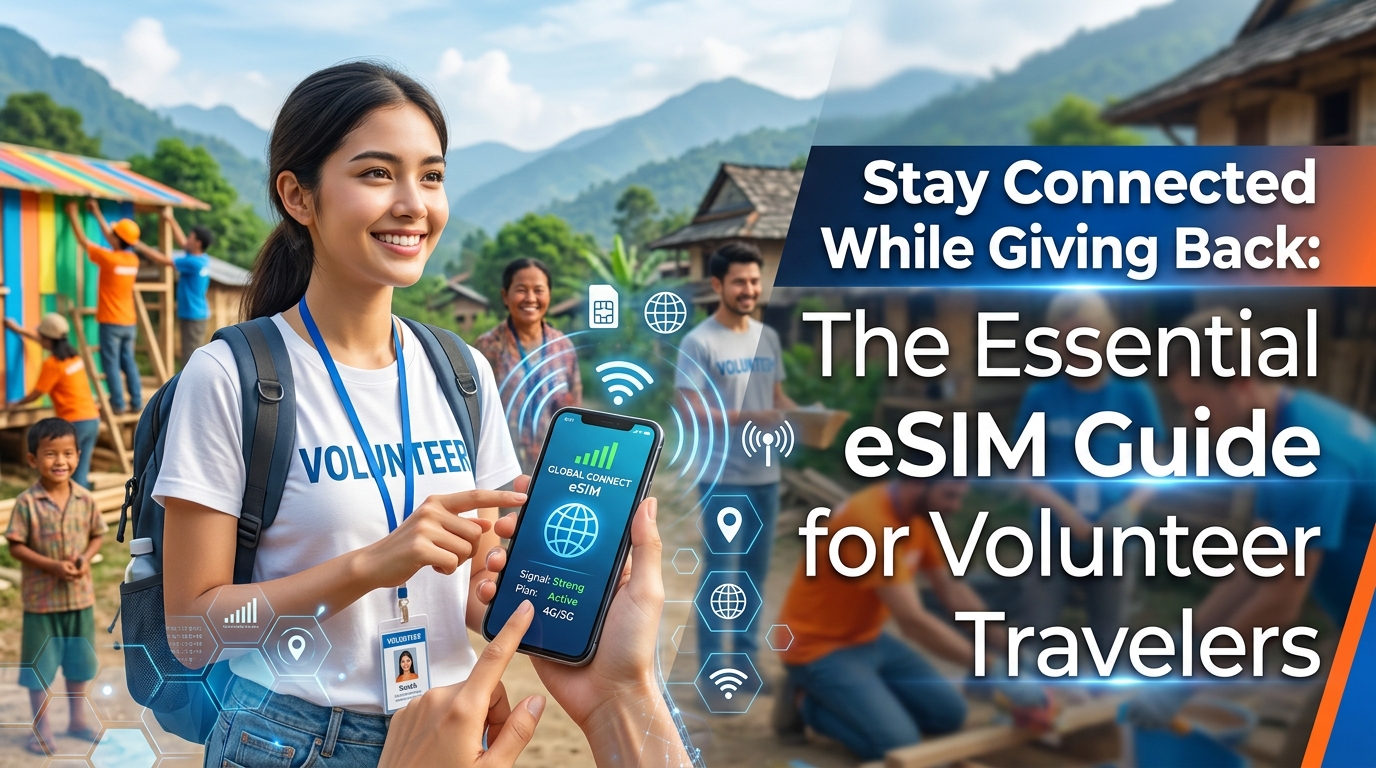
Mantente conectado mientras ayudas: la guía esencial de eSIM para viajeros voluntarios
El salvavidas invisible: por qué la conectividad es imprescindible para los viajeros voluntarios
Embarking on a volunteer mission abroad is a profound commitment, often leading individuals to the heart of communities in need, which are frequently situated in remote, underserved, or crisis-affected regions. Unlike a typical tourist seeking leisure, the volunteer traveler operates with a distinct set of priorities and, consequently, unique connectivity requirements. In these challenging environments, reliable communication isn't a convenience; it's the unseen lifeline that underpins mission effectiveness, personal safety, and overall well-being.
Critical Pillars of Volunteer Connectivity
Reliable internet access and communication tools serve several indispensable functions for those dedicating their time and skills to humanitarian efforts:
1. Seamless Logistics and Project Coordination
Volunteer work demands constant adaptability and real-time information exchange. Whether it's a medical team coordinating a mobile clinic, an environmental group tracking conservation efforts, or a disaster relief unit managing resource distribution, precise communication is paramount. Volunteers need to:
- Receive real-time updates on project schedules, location changes, or emerging needs from local teams and project leaders.
- Coordinate transportation, supply runs, and volunteer assignments efficiently.
- Communicate with local community leaders, beneficiaries, and fellow volunteers, often across vast distances or in dynamic situations.
- Access and share critical data, reports, and operational plans securely and instantly.
2. Ensuring Personal Safety and Emergency Communication
The safety of volunteers is a paramount concern, especially in unfamiliar or potentially volatile regions. A dependable connection provides a crucial layer of security:
- Emergency contact: The ability to immediately reach project coordinators, local emergency services, or embassy contacts in case of an accident, illness, or security incident.
- Location sharing: Transmitting GPS coordinates for rescue or assistance if lost or in distress.
- Staying informed: Receiving critical safety alerts, political stability updates, or natural disaster warnings specific to their operational area.
- Peace of mind: Both for the volunteer on the ground and their support networks back home, knowing that communication is possible in an emergency.
3. Accessing Vital Information and Resources
Beyond direct communication, volunteers rely heavily on internet access for essential information that guides their work and daily life:
- Navigation: Accurately navigating unfamiliar towns, rural paths, or complex project sites is non-negotiable. This is where the quality of your internet connection truly matters. Unlike many competitors that throttle speeds to a sluggish 128kbps, MollySIM's 384kbps Fair Use Policy speed limit is three times faster. This isn't just a number; it's the difference between a smoothly loading Google Maps guiding you to a remote village and a frustratingly slow, pixelated screen that leaves you lost. It also ensures essential services like Apple Pay or other digital transactions work without a hitch, crucial when you're far from traditional banking infrastructure.
- Cultural and health advisories: Accessing local customs, language translation tools, health advisories, vaccination requirements, and information on local disease outbreaks.
- Research and learning: Quickly looking up best practices, technical specifications, or educational materials relevant to their volunteer tasks.
4. Maintaining Morale and Support Networks
Volunteer work, while rewarding, can be emotionally and physically demanding. The ability to connect with family and friends back home is vital for mental health and resilience:
- Alleviating homesickness: Regular contact provides comfort and a sense of normalcy, combating feelings of isolation.
- Emotional support: Sharing experiences, successes, and challenges with a trusted support network helps process difficult situations and reduce stress.
- Recharging: Brief moments of connection can offer a much-needed break from the intensity of the mission, helping volunteers stay motivated and engaged.
The Frustrations of Traditional Connectivity in Volunteer Contexts
While the need for connectivity is clear, traditional methods often fall short, creating more obstacles than solutions for volunteer travelers:
- Exorbitant International Roaming: Relying on home network roaming is a financial black hole. The costs for data, calls, and texts can quickly deplete personal funds or project budgets, diverting resources from the mission itself. Speeds are often throttled, and data caps are restrictive.
- Unreliable Public Wi-Fi: In many volunteer destinations, especially remote ones, public Wi-Fi is either non-existent, incredibly slow, or intermittently available. Even when accessible, these open networks pose significant security risks, making volunteers vulnerable to cyber threats, data theft, and privacy breaches, which is particularly concerning when handling sensitive project information or personal data.
- Bureaucratic Local Physical SIM Cards: Acquiring a local physical SIM card in a foreign country can be a time-consuming and frustrating ordeal. It often involves navigating language barriers, finding authorized vendors, completing extensive paperwork, providing local identification or addresses, and enduring registration delays. This process can consume valuable time that should be dedicated to the volunteer mission, adding unnecessary stress and logistical hurdles.
- Inconvenience of Physical SIM Swapping: For volunteers moving between regions or countries, constantly swapping physical SIM cards is cumbersome, risking loss or damage, and leading to temporary communication blackouts.
For the volunteer traveler, connectivity transcends mere convenience; it is a fundamental operational tool, a safety net, and a crucial component of personal well-being. The limitations of conventional methods highlight the urgent need for a superior, more efficient, and secure solution that aligns with the unique demands of humanitarian work.
Beyond the Physical: Demystifying eSIM Technology for the Modern Aid Worker
🌐 Global Travel High-Speed Travel eSIM & SIM Plans
Instant QR code activation, hotspot enabled, with guaranteed 384kbps fallback speed to keep Maps & Digital Wallets active.
The challenges posed by traditional connectivity methods for volunteer travelers are clear. Fortunately, a revolutionary technology has emerged that directly addresses these pain points: the eSIM. Moving beyond the limitations of physical plastic, eSIM technology represents a significant leap forward in mobile connectivity, offering unparalleled flexibility, convenience, and reliability, especially for those working in dynamic and often remote environments.
What is an eSIM? The Digital Evolution of SIM Cards
At its core, an eSIM (embedded Subscriber Identity Module) is a digital version of the traditional physical SIM card. Instead of a removable plastic chip, an eSIM is a small, rewritable chip permanently embedded directly into your device's motherboard during manufacturing. This means there's no physical card to insert, swap, or lose. It functions identically to a physical SIM, storing your subscriber profile, allowing your device to connect to a mobile network, make calls, send texts, and access data. The key difference lies in its digital nature, enabling remote provisioning and management.
How eSIMs Function: A Seamless Digital Connection
The magic of an eSIM lies in its ability to be remotely provisioned. Instead of buying a physical card, you simply download a "profile" onto your device's embedded eSIM chip. This profile contains all the necessary network information, much like the data on a physical SIM. The process is typically initiated by scanning a QR code provided by an eSIM carrier or by following instructions within a carrier's mobile application. Once downloaded, your device instantly connects to the chosen network, often within minutes. This digital approach eliminates the need for physical interaction with network providers or their products, streamlining the entire setup process.
Key Advantages of eSIMs for International Travel
The fundamental differences between eSIMs and traditional SIMs translate into a host of powerful advantages, making them a game-changer for anyone traveling internationally, and particularly for aid workers.
- Instant Activation & Setup: Forget about searching for local stores, navigating language barriers, or filling out paperwork. With an eSIM, activation is nearly instantaneous. You can purchase a plan online before you even depart, or upon arrival, and activate it with a simple QR code scan or app download. This saves invaluable time and reduces pre-departure stress.
- Multiple Profiles on a Single Device: One of the most compelling features of eSIMs is the ability to store multiple network profiles on a single device. Most modern smartphones can store anywhere from 5 to 20 eSIM profiles simultaneously. This means you can have your home country's plan, a plan for your current volunteer destination, and even plans for future destinations, all ready to activate with a few taps. You can easily switch between these profiles as needed, without ever touching a physical card.
- No Physical SIM Swapping: The days of fumbling with tiny SIM trays, risking loss or damage to your precious physical SIM, are over. eSIMs eliminate the need for physical card swaps, ensuring continuous connectivity as you move between regions or countries. This is particularly beneficial for volunteers who might be deployed to multiple locations within a single mission.
- Elimination of Local SIM Procurement Hassles: As previously highlighted, acquiring a local physical SIM can be a bureaucratic nightmare. eSIMs bypass all these hurdles, offering a direct, digital pathway to connectivity without the need for local identification, addresses, or lengthy registration processes.
- Simplified Data Plan Management: Managing your data usage, checking balances, and topping up your plan becomes incredibly straightforward with eSIMs. Most eSIM providers offer intuitive mobile applications that allow you to monitor your data consumption in real-time, purchase additional data bundles, or switch to a different plan, all from the convenience of your smartphone.
Practical Benefits for Volunteer Travelers
For the modern aid worker, these general advantages translate into tangible, mission-critical benefits:
- Uninterrupted Focus on the Mission: By removing the logistical burden of obtaining and managing physical SIM cards, volunteers can dedicate their full attention and energy to their humanitarian work. Less time spent on connectivity means more time impacting lives.
- Seamless Cross-Border Transitions: Whether moving between project sites in different provinces or crossing international borders, volunteers can maintain continuous communication. The ability to switch between pre-loaded eSIM profiles ensures that critical communication lines remain open, facilitating coordination and safety.
- Reliable Connectivity for Essential Tools: For volunteers often relying on navigation, communication apps, and even mobile payment solutions, a consistent and robust connection is non-negotiable. This is where providers like MollySIM stand out. Their Fair Use Policy, for instance, offers a speed limit of 384kbps – a significant advantage over competitors' typical 128kbps. This 3x faster speed ensures that essential applications like Google Maps and Apple Pay function smoothly, even after exceeding initial high-speed data allowances, providing critical support for volunteers navigating unfamiliar territories or making necessary purchases on the go.
- Enhanced Security and Privacy: While not exclusive to eSIMs, the digital nature often means less exposure to potentially compromised public Wi-Fi networks, as volunteers can rely on their secure cellular data connection.
Device Compatibility
Most flagship smartphones released in the last few years, including models from Apple (iPhone XS and newer), Samsung (Galaxy S20 and newer), Google Pixel (Pixel 3 and newer), and many other manufacturers, are eSIM compatible. It's always advisable to check your specific device's specifications, but the trend is clear: eSIM support is now a standard feature in modern mobile technology.
In essence, eSIM technology empowers volunteer travelers with unparalleled connectivity freedom, allowing them to remain connected, safe, and efficient, ultimately amplifying their impact where it matters most.
MollySIM's Edge: Powering Your Purpose with Reliable, Budget-Friendly Data
For volunteer travelers, connectivity isn't a luxury; it's a fundamental tool for safety, coordination, and impact. While the general benefits of eSIMs are clear, MollySIM (https://mollysim.com) distinguishes itself with features specifically engineered to meet the unique demands of those dedicating their time to service. Their offerings are not just about staying online; they're about empowering your purpose with reliable, budget-friendly, and consistently functional data.
Seamless Connectivity Across Borders: Multi-Country and Regional Options
Volunteer assignments often span dynamic geographies, from multi-country initiatives in a specific continent to extensive projects within a large nation. Traditional physical SIM cards present a logistical nightmare in such scenarios, requiring volunteers to purchase and swap local SIMs in each new territory, often leading to activation delays, language barriers, and wasted time.
MollySIM addresses this challenge head-on with its comprehensive multi-country and regional eSIM plans. Instead of juggling multiple SIMs or facing exorbitant roaming charges, volunteers can activate a single MollySIM eSIM that provides coverage across numerous destinations. This means a volunteer moving between, say, Kenya, Uganda, and Tanzania for a conservation project, or across different states in India for a public health initiative, can maintain uninterrupted connectivity without any physical intervention. This flexibility ensures seamless transitions, reduces administrative burden, and allows volunteers to focus entirely on their mission, knowing their communication lifeline remains constant.
Transparent Pricing: Budget Predictability for Purpose-Driven Travel
Volunteers frequently operate on tight budgets, where every dollar saved can be reallocated to project resources or personal essentials. The last thing a volunteer needs is the uncertainty of hidden fees, unexpected charges, or complex billing structures often associated with traditional international roaming or even some local SIM providers.
MollySIM champions transparent pricing, offering clear, upfront costs with no hidden fees or surprise surcharges. What you see is what you pay. This commitment to clarity is invaluable for budget-conscious volunteer travelers, enabling them to accurately plan their expenses and avoid financial stress. By providing predictable costs, MollySIM empowers volunteers to manage their finances effectively, ensuring that their connectivity solution remains affordable and aligns with their altruistic goals.
The Reliable 384kbps FUP: Uninterrupted Functionality, Unwavering Peace of Mind
Perhaps MollySIM's most significant differentiator for volunteer travelers is its Fair Usage Policy (FUP), which guarantees a speed limit of 384kbps even after the initial high-speed data allowance is consumed. This isn't just a number; it's a commitment to continuous, practical functionality, setting MollySIM apart from competitors whose FUP often drops to a barely usable 128kbps or cuts off data entirely.
To truly understand the impact of 384kbps, consider these critical use cases for a volunteer:
- Essential Communication: Sending and receiving text-based emails, even with small attachments, remains perfectly functional. Crucially, messaging apps like WhatsApp, Signal, and Telegram continue to work smoothly for text messages, voice notes, and even low-quality voice calls, ensuring constant coordination with team members and vital check-ins with family back home.
- Navigation and Mobility: As highlighted previously, MollySIM's 384kbps FUP speed is 3x faster than the typical 128kbps offered by competitors. This significant speed advantage ensures that essential applications like Google Maps and Apple Pay function smoothly. Volunteers can confidently load maps, get turn-by-turn directions, and make necessary mobile payments, even after exceeding their high-speed data, providing critical support for navigating unfamiliar territories or making purchases on the go.
- Critical Information Access: Light web browsing for essential information – checking local emergency numbers, accessing project-specific updates, or reviewing weather forecasts – remains entirely feasible.
- VoIP Calls: Making voice-over-IP calls (e.g., WhatsApp calls) to team leaders, local contacts, or family members is still possible, albeit with slightly reduced quality compared to high-speed connections. This ensures that a voice connection is always available when needed most.
- Cloud Document Access: Viewing and even making light edits to shared project documents stored in cloud services like Google Docs or Dropbox remains within reach, facilitating ongoing collaboration.
In contrast, typical roaming plans often cut off data entirely once an allowance is depleted, or charge exorbitant per-MB rates. Even other eSIM providers with FUP speeds of 128kbps often render many of these critical applications frustratingly slow or completely unusable. MollySIM's 384kbps ensures that volunteers are never truly disconnected. This continuous, albeit slower, access for critical tasks and personal communication provides immense peace of mind, especially in remote or challenging environments where every bit of connectivity counts. It means that even if a volunteer runs out of high-speed data in a remote village, they can still communicate, navigate, and access vital information, ensuring their safety and the continuity of their mission.
Choosing Your Connection: A Comparative Look at Volunteer Connectivity Solutions
For volunteer travelers, staying connected isn't just about convenience; it's about safety, efficiency, and the ability to effectively contribute to their mission. The choice of international connectivity can significantly impact a volunteer's experience, from managing daily logistics to handling emergencies. Below, we present a detailed comparison of common connectivity solutions, highlighting why eSIMs, particularly MollySIM, stand out as the optimal choice for those dedicating their time to service abroad.
| Feature | eSIM (MollySIM) | Local Physical SIM | International Roaming (Home Carrier) | Pocket Wi-Fi Device | Public Wi-Fi Hotspots |
|---|---|---|---|---|---|
| Cost | Transparent, often budget-friendly, no hidden fees | Variable, can be cheap locally, but setup cost/time | Very expensive, unpredictable, bill shock risk | Upfront device cost + rental/data fees, charging | Free (but often unreliable and insecure) |
| Convenience | Instant activation, no physical swap, digital management | Requires purchase, registration, physical swapping | Automatic, but costly, no setup hassle | Extra device to carry, charge, manage | Widely available, but limited access, often slow |
| Reliability | High, uses local networks, 384kbps FUP ensures continuous basic data | High (dependent on local network quality) | High (dependent on home carrier agreements) | Dependent on device & local network, battery life | Highly variable, often poor, intermittent |
| Security | High (private connection, less vulnerable than public Wi-Fi) | High (private connection) | High (private connection) | Moderate (can be secure if privately managed) | Very low (vulnerable to cyber attacks, data theft) |
| Flexibility | Easy to switch plans, multi-country/regional options | Single country, limited flexibility, bureaucratic | Tied to home plan, limited options, often rigid | Single device, can be shared, often country-locked | Location-dependent, no plan flexibility |
| Setup Difficulty | Easy (QR code/app, minutes to activate) | Moderate (finding store, registration, language barrier) | None (automatic, but requires plan activation) | Moderate (device setup, charging, troubleshooting) | None (just connect, but often requires login) |
| Remote Suitability | Excellent (if local network exists, FUP for critical tasks) | Excellent (if local network exists) | Good (if home carrier has agreements in remote areas) | Good (if local network exists, but device dependent) | Poor (rarely found in remote areas, unreliable) |
| Multi-Country Use | Ideal (regional/global plans, seamless transition) | Poor (requires new SIM per country, hassle) | Good (but very expensive, often with limitations) | Poor (device often country-locked or expensive roaming) | Poor (different hotspots per country, inconsistent) |
| Data Speed/Consistency | High-speed initially, then reliable 384kbps FUP for essential tasks | High-speed (dependent on local network) | High-speed (but often capped/throttled after small usage) | High-speed (dependent on device and network) | Variable, often slow, inconsistent bandwidth |
In-Depth Analysis of Connectivity Solutions for Volunteers
The table above provides a snapshot, but a deeper dive into each metric reveals why eSIMs, and specifically MollySIM, are increasingly becoming the preferred solution for volunteer travelers.
Cost-Effectiveness and Transparency
International Roaming from a home carrier is almost universally the most expensive option, notorious for leading to "bill shock" upon return. While convenient, the unpredictable costs make it unsuitable for budget-conscious volunteers. Local Physical SIMs can be cheap at the point of purchase, but the hidden costs of time spent finding a store, navigating language barriers for registration, and potential overcharges can add up. Pocket Wi-Fi devices involve an upfront device cost, rental fees, and data plans, making them less economical for individual use. Public Wi-Fi is free but comes with significant trade-offs in reliability and security.
eSIMs like MollySIM offer unparalleled cost transparency. Plans are purchased upfront, with clear data allowances and durations, eliminating hidden fees. Volunteers can select plans tailored to their specific travel duration and data needs, ensuring they only pay for what they use. This predictability is crucial for managing a volunteer budget effectively.
Unmatched Convenience
The convenience factor of eSIMs is a game-changer. Activation is instant, typically via a QR code or app, eliminating the need to find a local store, register with ID, or physically swap SIM cards. This means volunteers can land in a new country and be connected within minutes, a critical advantage when time is limited and immediate communication is often necessary. MollySIM streamlines this process, allowing digital management of multiple plans. In contrast, Local Physical SIMs demand time and effort for acquisition and setup. International Roaming is convenient in terms of automatic connection but comes at a prohibitive cost. Pocket Wi-Fi devices add another gadget to carry, charge, and manage, while Public Wi-Fi requires constant searching and connecting.
Reliability and Continuous Connectivity
Reliability is paramount for volunteers who often operate in unfamiliar or remote areas. While all options (except public Wi-Fi) rely on local network infrastructure, eSIMs leverage these networks directly, offering robust service. A key differentiator for MollySIM is its 384kbps Fair Use Policy (FUP) speed limit. This speed, which is three times faster than the 128kbps offered by many competitors, ensures that even after high-speed data is depleted, critical applications remain functional. Volunteers can still use Google Maps for navigation, access essential project documents, check local emergency numbers, and even process payments via Apple Pay or similar services. This continuous, albeit slower, access provides immense peace of mind and ensures volunteers are never truly disconnected, a stark contrast to roaming plans that often cut off data entirely or public Wi-Fi that is inherently intermittent.
Enhanced Security
For volunteers handling sensitive information or simply personal data, security is a major concern. eSIMs, Local Physical SIMs, and International Roaming all provide private, encrypted connections, making them inherently more secure than Public Wi-Fi hotspots. Public Wi-Fi is notoriously vulnerable to cyberattacks, data theft, and malware, posing a significant risk to personal and project-related information. While Pocket Wi-Fi devices can be secure if privately managed, they still represent an additional device that could be compromised. MollySIM ensures a secure, private connection, safeguarding a volunteer's digital footprint.
Superior Flexibility
eSIMs offer unparalleled flexibility. Volunteers can easily switch between plans, activate regional or global packages for multi-country trips, and manage their data usage digitally. This adaptability is crucial for dynamic volunteer schedules. MollySIM allows volunteers to seamlessly transition between countries without the hassle of acquiring new physical SIMs. Local Physical SIMs are typically country-specific and require a new purchase for each border crossing. International Roaming is tied to a rigid home plan, and Pocket Wi-Fi devices are often country-locked or have expensive roaming options.
Simplified Setup
The ease of setup for eSIMs is a significant advantage. A simple QR code scan or app-based activation takes mere minutes. This contrasts sharply with the Moderate difficulty of acquiring a Local Physical SIM, which can involve navigating unfamiliar stores, language barriers, and bureaucratic registration processes. Pocket Wi-Fi devices require initial setup, charging, and potential troubleshooting. While International Roaming is automatic, its cost negates this convenience.
Suitability for Remote Environments
Volunteers often find themselves in remote or underserved areas where connectivity is sparse. In such scenarios, the presence of any local network is key. eSIMs and Local Physical SIMs are excellent if a local network exists. However, MollySIM's 384kbps FUP becomes particularly vital here. Even if high-speed data is limited, the guaranteed basic connectivity ensures volunteers can still access critical information, communicate in emergencies, and navigate, enhancing both their safety and mission continuity. Public Wi-Fi is rarely found in remote locations, making it an unreliable option.
Seamless Multi-Country Use
For volunteers on regional projects or those traveling across multiple borders, eSIMs are the ideal solution. Regional or global plans allow for seamless transitions between countries without the need for new physical SIMs or plan changes. This eliminates the logistical headache associated with Local Physical SIMs, which require a new purchase in each country. While International Roaming can offer multi-country coverage, its exorbitant cost makes it impractical.
Consistent Data Speed and Reliability
While initial high-speed data is common across most reliable options, MollySIM's commitment to a reliable 384kbps FUP after high-speed data is exhausted sets it apart. This ensures that essential tasks like navigation, messaging, and light browsing remain consistently functional, unlike roaming plans that often throttle heavily or cut off data, or public Wi-Fi which is inherently inconsistent. This consistent baseline connectivity is invaluable for volunteers who cannot afford to be completely cut off.
From Coordination to Comfort: Real-World Scenarios for Volunteer Connectivity
For volunteer travelers, reliable connectivity isn't a luxury; it's a fundamental tool that underpins safety, mission effectiveness, and personal well-being. MollySIM's robust eSIM solutions, particularly its industry-leading 384kbps Fair Use Policy (FUP) speed, empower volunteers with consistent access, even in challenging environments. Here’s how MollySIM translates into tangible benefits across various real-world scenarios:
Logistics & Coordination
Effective project execution hinges on seamless communication and precise logistics. MollySIM ensures volunteers remain connected to their teams and local resources.
- Team Communication & Scheduling: Volunteers can use messaging apps like WhatsApp or Signal to communicate instantly with team leaders, local partners, and fellow volunteers. This facilitates real-time updates on project progress, changes in schedules, or urgent requests for supplies. Accessing shared calendars (e.g., Google Calendar) for daily tasks, meeting times, and volunteer rotations is effortless, even when operating on MollySIM's 384kbps FUP, which is perfectly adequate for text-based communication and light data syncs.
- Mapping & Navigation: Navigating unfamiliar terrain to reach remote project sites, local clinics, or supply depots is critical. With MollySIM, volunteers can confidently use Google Maps or Apple Maps for turn-by-turn directions. The consistent 384kbps FUP speed ensures maps load smoothly, location services remain accurate, and routes can be recalculated without frustrating delays, a significant advantage over competitors' slower FUPs.
- Emergency Contacts & Updates: Quick access to digital lists of local emergency numbers, embassy contacts, and project manager details is paramount. MollySIM's reliable connection ensures these resources are always at hand. Furthermore, volunteers can receive urgent updates regarding project changes, weather warnings, or security advisories directly to their devices, enabling swift response and adaptation.
Information Access & Research
Staying informed is crucial for cultural integration, health awareness, and project success. MollySIM provides the gateway to essential information.
- Local Customs & Health Advisories: Before engaging with local communities, volunteers can quickly research cultural etiquette, essential phrases via translation apps, or specific local customs to ensure respectful interaction. They can also check official health advisories from organizations like the WHO or local health ministries for updates on disease outbreaks or vaccination requirements.
- Weather Updates & Translation Apps: Planning outdoor activities or travel requires up-to-date weather forecasts, which MollySIM delivers reliably. For bridging language barriers, translation apps like Google Translate or DeepL function effectively on the 384kbps FUP, facilitating communication with local residents and beneficiaries.
- Project Documents & Local News: Accessing cloud-stored project documents, volunteer handbooks, or data collection forms from platforms like Google Drive or Dropbox is seamless. Volunteers can also stay informed about local news, political developments, or community events that might directly impact their mission or require a change in approach.
Safety & Security
Consistent connectivity is a cornerstone of volunteer safety, offering peace of mind and critical support in emergencies.
- GPS Tracking & Emergency Calls: For volunteers working in remote or unfamiliar areas, the ability to share their live location with team leaders or trusted contacts via GPS tracking apps is invaluable. In an emergency, MollySIM's reliable connection allows for immediate contact. Even after high-speed data is exhausted, the 384kbps FUP supports clear VoIP calls via apps like WhatsApp or Signal, ensuring communication lines remain open when traditional calls might be expensive or unavailable.
- Local Alerts & Peace of Mind: Receiving real-time security alerts or local advisories from authorities or project security teams can be life-saving. MollySIM ensures these critical notifications are delivered promptly. Furthermore, consistent connectivity provides immense peace of mind for volunteers and their families, allowing for regular check-ins and updates on their well-being and travel status.
- "Find My Device" Functionality: In the unfortunate event of a lost or stolen phone, MollySIM's active connection enables "Find My Device" features, which can be crucial for locating the device and protecting sensitive project data.
Personal Well-being & Connection
Beyond the mission, volunteers need to maintain personal connections and access resources for their well-being.
- Family & Friends Connection: Staying in touch with loved ones back home is vital for morale. MollySIM facilitates regular messaging via WhatsApp, Telegram, or other platforms. The 384kbps FUP also comfortably supports voice calls via VoIP apps, allowing volunteers to hear familiar voices and share their experiences without incurring exorbitant roaming charges.
- Mental Health Resources: Volunteer work can be demanding. Accessing online mental health resources, mindfulness apps, or connecting with support groups can be crucial for maintaining emotional well-being. MollySIM's consistent data ensures these resources are always available.
- Relaxation & Personal Finances: After a long day, volunteers can unwind by streaming light audio (podcasts, music) or low-resolution video content within the FUP limits. Managing personal finances, checking bank accounts, or making secure payments via Apple Pay or Google Pay (which function smoothly on MollySIM's 384kbps FUP) are also essential for daily life and travel arrangements.
Your Practical MollySIM How-To Guide for Volunteers
To maximize your connectivity and ensure a smooth experience, follow these steps:
1. Purchasing a MollySIM Plan
- Visit MollySIM.com: Navigate to the official MollySIM website (https://mollysim.com).
- Select Your Destination: Browse the available eSIM plans, specifically looking for regional or multi-country plans that cover all the countries you plan to volunteer in. Examples might include "Africa Explorer" or "Asia Nomad" plans.
- Choose Data & Duration: Consider the duration of your trip and your estimated data needs. Remember that even after high-speed data is exhausted, MollySIM's 384kbps FUP provides robust baseline connectivity, making it a reliable safety net.
- Complete Purchase: Follow the secure online checkout process to finalize your purchase. You will typically receive your eSIM activation details via email.
2. Activation
- Receive QR Code: After purchase, you'll receive an email containing a QR code or manual activation details.
- Add eSIM to Your Device:
- iPhone: Go to
Settings > Cellular(orMobile Data)> Add eSIM. - Android: Go to
Settings > Network & internet > SIMs > Add eSIM(or similar path depending on your device). - Scan or Enter: Use your phone's camera to scan the provided QR code. If scanning isn't possible, you can usually enter the details manually.
- Follow Prompts: Your phone will guide you through the remaining steps. Ensure you label your new eSIM profile clearly (e.g., "MollySIM Volunteer") and set it as your primary data line. Crucially, ensure Data Roaming is turned ON for your MollySIM eSIM profile to ensure connectivity across borders.
3. Managing Data
- Monitor Usage: Regularly check your data usage through your phone's settings (
Settings > CellularorMobile Data) or, if available, via the MollySIM app. This helps you track how much high-speed data you have remaining. - Understand the FUP: Be aware of your plan's high-speed data limit. Once this limit is reached, your data speed will transition to the 384kbps Fair Use Policy. This speed is significantly faster than many competitors' 128kbps FUPs, making a real difference. At 384kbps, you can still comfortably use Google Maps for navigation, send and receive messages, check emails, browse light websites, and even make clear VoIP calls.
4. Maximizing Data Efficiency
- Activate Data Saver Modes: Enable data saver features on your phone and within individual apps (e.g., WhatsApp, Instagram, YouTube) to reduce background data consumption.
- Download Offline Content: Before heading to remote areas or when you have access to Wi-Fi, download maps (Google Maps allows offline area downloads), project documents, e-books, or podcasts. This saves your MollySIM data for essential tasks.
- Prioritize Essential Apps: Restrict background data usage for non-critical apps. Only allow essential communication, navigation, and work-related apps to use mobile data actively.
- Utilize Wi-Fi When Available: Whenever public or private Wi-Fi is accessible, use it for heavy downloads, software updates, or streaming to conserve your eSIM data.
- Disable Auto-Updates: Configure your phone and apps to only update over Wi-Fi, preventing large data downloads over your mobile connection.
Empowering Your Mission: The Future of Connected Volunteerism with eSIMs
As volunteer travelers embark on missions to make a tangible difference across the globe, the tools they carry are as crucial as their dedication. In this evolving landscape, eSIM technology stands out not merely as a convenience but as a fundamental enabler, transforming how volunteers connect, operate, and thrive in often challenging environments. The journey through this guide has illuminated the profound advantages of embracing eSIMs, culminating in a vision where seamless connectivity directly amplifies humanitarian impact.
The Unifying Power of Reliable Connectivity
At its core, volunteerism is about connection – connecting with communities, connecting with fellow volunteers, and connecting with the mission's objectives. eSIMs provide the bedrock for this, offering unparalleled reliability, cost-effectiveness, and flexibility. Gone are the days of hunting for local SIM cards, navigating language barriers in phone shops, or enduring exorbitant roaming charges. With an eSIM, volunteers can activate a data plan before they even depart, ensuring they land with immediate access to essential services. This proactive approach minimizes stress and maximizes precious time, allowing volunteers to dedicate their energy entirely to the cause at hand, rather than logistical hurdles.
The economic benefits are equally compelling. eSIM plans, particularly those offered by providers like MollySIM, are designed for the international traveler, offering transparent, competitive rates that drastically undercut traditional roaming fees. This cost-efficiency means more resources can be directed towards the volunteer project itself, enhancing its reach and effectiveness.
eSIMs: An Essential Tool for Modern Volunteerism
eSIMs are far more than a travel gadget; they are an essential operational tool for the modern volunteer. Their impact ripples through several critical aspects of a mission:
- Enhanced Operational Efficiency: From coordinating logistics with team members in remote locations to submitting progress reports, accessing critical project documents, or even managing inventory, reliable data connectivity is paramount. eSIMs ensure volunteers can communicate instantly, share vital information, and adapt to unforeseen circumstances with agility, thereby boosting the overall efficiency of their humanitarian efforts.
- Improved Safety and Well-being: For volunteers often working in unfamiliar or underserved regions, personal safety is a primary concern. An active data connection facilitates emergency communication, allows for real-time navigation using apps like Google Maps, and enables quick access to local emergency services. Even when high-speed data limits are reached, MollySIM's generous 384kbps Fair Use Policy (FUP) speed ensures that essential functions remain operational. This speed, which is three times faster than many competitors' 128kbps FUPs, is critical. It means volunteers can still comfortably use Google Maps for navigation, send and receive messages, check emails, and even make clear VoIP calls – a crucial safety net that provides immense peace of mind. Staying connected with loved ones back home also plays a vital role in maintaining mental well-being and reducing feelings of isolation.
- Reduced Stress and Increased Focus: The ability to stay connected without constant worry about finding Wi-Fi or incurring unexpected costs significantly reduces psychological burden. This allows volunteers to fully immerse themselves in their work, fostering deeper engagement and ultimately leading to more impactful contributions.
The Bright Future of Connected Giving Back
The trajectory of eSIM technology points towards increasing global adoption and accessibility. As more devices integrate eSIM capabilities and more providers offer diverse, region-specific plans, the process of staying connected abroad will become even more seamless. This future promises to further simplify international travel for those dedicated to giving back, making volunteerism more accessible and less daunting for a broader spectrum of individuals. Imagine a world where connectivity is a given, allowing every volunteer to focus solely on their mission, unhindered by technological barriers.
Your Mission, Amplified by MollySIM
For every prospective and current volunteer traveler, the choice of how you stay connected is a critical decision that directly impacts your ability to make a difference. We strongly encourage you to consider MollySIM for your next mission. With its robust global coverage, transparent pricing, and industry-leading 384kbps FUP speed that keeps essential apps like Google Maps and Apple Pay functioning even after high-speed data is depleted, MollySIM is engineered to support your humanitarian goals.
By choosing a smart, reliable, and cost-effective connectivity solution like MollySIM, you're not just buying data; you're investing in the success of your mission, your personal safety, and your peace of mind. Empower your journey, amplify your impact, and stay connected while giving back. Visit https://mollysim.com today to explore plans that will keep you connected, no matter where your compassion takes you.
🌐 Global Travel High-Speed Travel eSIM & SIM Plans
Instant QR code activation, hotspot enabled, with guaranteed 384kbps fallback speed to keep Maps & Digital Wallets active.