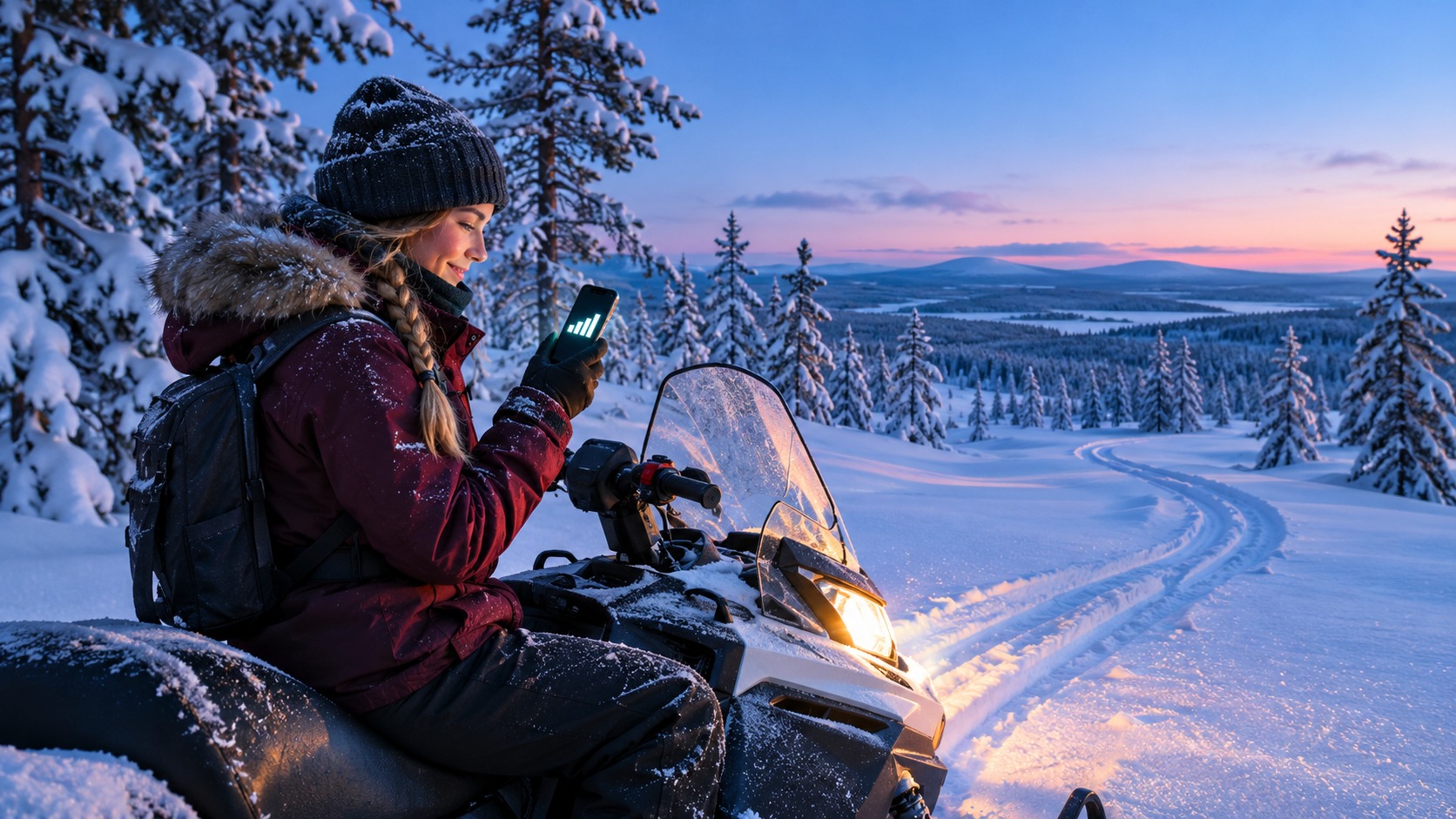
The Reality of Connectivity in Remote Nordic Terrain
Selecting the right Nordics eSIM for snowmobiles is not merely a logistical convenience; it is a critical safety parameter for anyone venturing into the high Arctic in 2026. The modern traveler often approaches remote regions with the same digital expectations as a city break, assuming that if a tower is visible on the map, the signal will be robust. This assumption is dangerously flawed in the boreal landscapes of Swedish Lapland and Northern Norway. Here, the terrain is not flat; it is a complex, three-dimensional obstacle course of dense coniferous forests, jagged mountain ridges, and deep valleys that physically block line-of-sight transmission. While the theoretical coverage maps provided by major carriers like Telia, Telenor, and TeliaSonera paint a picture of seamless 5G saturation, the physical reality of signal penetration through heavy snowfall, ice sheets, and thick tree cover tells a different story. In these "digital dead zones," the difference between a stable connection and a dropped packet can mean the difference between navigating a tricky ice bridge with confidence and guessing your way through a whiteout.
The Myth of Urban 5G Expectations
In major hubs like Oslo and Stockholm, 5G networks are saturated, offering gigabit speeds that make video calls and high-resolution streaming effortless. However, as soon as you cross the boundary of the main highway corridors—such as the E6 or E45—the network architecture shifts. The infrastructure becomes sparse, relying on fewer, more powerful base stations that must cover vast, rugged areas. This creates a phenomenon known as "connectivity anxiety" for solo or small-group snowmobilers. These travelers rely heavily on real-time GPS for route planning, live weather updates, and emergency SOS features. When the signal drops, the phone’s battery drains rapidly as it searches for a connection, and the GPS accuracy degrades without the cellular assist data. This is where standard urban eSIM expectations fail. A plan designed for a week in Copenhagen, with its high data caps and unlimited speed tiers, may seem ideal, but it often lacks the specific network prioritization or fallback mechanisms needed for the Nordic wilderness.
Physical Barriers to Signal Integrity
The environment itself acts as a signal attenuator. Snow, particularly deep, wet snow, has a high dielectric constant, which absorbs radio waves. Ice, while less absorbent than water, still introduces refraction and reflection issues that can create unpredictable signal pockets. Add to this the dense canopy of spruce and pine trees, which are often laden with ice in winter, and you have a natural Faraday cage effect. A signal that is strong at the top of a ridge may be completely absent in the valley below, just 500 meters away. This variability means that a "full bar" signal indicator is not a guarantee of usable data. You might have enough signal to send a text, but not enough to load a map tile or upload a location pin.
Why Specialized Data Management is Critical
This is where the choice of eSIM provider becomes a matter of operational efficiency. Many travelers opt for generic global eSIMs that offer "unlimited" data but enforce strict Fair Use Policies (FUP) at low speeds, often capping out at 128kbps after a certain threshold. At 128kbps, loading a map or refreshing a weather app can take minutes, which is unacceptable when you are checking for ice cracks or navigating a narrow pass. This is where MollySIM distinguishes itself. With a 384kbps Fair Use Policy speed limit, MollySIM offers a connection that is 3x faster than competitors' 128kbps cap, enabling critical applications like Google Maps and Apple Pay to work smoothly even when you are on the edge of the network. This speed differential is not just a technicality; it is the margin that allows your device to function as a reliable tool rather than a source of frustration.
For those planning their route, understanding the nuances of network performance in these remote areas is essential. You need a provider that understands the specific demands of Nordic travel, where data efficiency and speed retention are paramount. By choosing a specialized Nordics eSIM for snowmobiles, you are not just buying data; you are buying reliability in an environment where the margin for error is slim. To explore how this translates into real-world savings and performance, check out our detailed guide on Europe eSIM plans or dive deeper into our Nordic travel tips for 2026. The wilderness is a different beast, and your connectivity strategy must be equally robust.
Telenor vs Telia: Decoding the Network Wars in the North
🇳🇴 Norway High-Speed Travel eSIM & SIM Plans
Instant QR code activation, hotspot enabled, with guaranteed 384kbps fallback speed to keep Maps & Digital Wallets active.
When traversing the Nordic wilderness on a snowmobile, the choice between Telenor (Norway) and Telia (Sweden) is not merely a matter of brand preference; it is a technical decision that dictates your survival and comfort. While both carriers are market leaders, their infrastructure footprints, spectrum allocations, and roaming architectures differ significantly. For a rider planning a cross-border expedition, understanding the nuances of Telenor vs Telia remote Norway coverage is critical, as the signal behavior in Abisko, Sweden, can vary drastically from that in Tromsø, Norway, even when the physical distance between the two locations is relatively short.
Spectrum Allocation and Terrain Penetration
The core of the difference lies in how each carrier utilizes its 4G LTE bands. Telenor has historically invested heavily in lower-frequency bands (such as Band 3 and Band 7) which offer superior signal attenuation resistance. In dense, forested valleys or deep fjords where line-of-sight to the tower is obstructed by snow-covered pine trees and rocky outcrops, Telenor’s lower-frequency signals often penetrate better, maintaining a usable 4G connection where higher-frequency bands might struggle. Conversely, Telia has aggressively expanded its high-capacity mid-band spectrum (Band 38 and Band 41). In open tundra or flat coastal areas, Telia’s band aggregation capabilities allow for higher data throughput, which is beneficial for streaming weather updates or video calls. However, in the rugged, mountainous terrain of northern Norway, the physical obstruction of the landscape often favors the longer wavelength of Telenor’s primary bands.
| Feature | Telenor (Norway) | Telia (Sweden) |
|---|---|---|
| Primary Strength | Deep coverage in valleys/forests | High speed in open areas |
| Key Bands | Band 3, Band 7 (Lower freq) | Band 38, Band 41 (Higher freq) |
| Remote Performance | Better penetration through obstacles | Better throughput in line-of-sight |
| Roaming Agreements | Strong intra-Nordic partnerships | Strong intra-Nordic partnerships |
The Critical Handover Process
For snowmobilers moving between countries, the roaming handshakes between these networks are the make-or-break moment. When you cross the border, your device must detach from the home network and attach to the visited network. If you are using a single-carrier SIM, this process can be slow, leading to a "searching for signal" state that can last several minutes. During this window, your GPS may drift, and your navigation apps may freeze.
This is where a flexible Nordics eSIM for snowmobiles strategy becomes advantageous. A multi-network eSIM can prioritize the strongest available signal, effectively managing the handover process in the background. For instance, if you are riding from Swedish Lapland into Norwegian Finnmark, a static SIM might lock onto a weak Telia signal that is struggling to maintain a connection, whereas a dynamic eSIM can quickly evaluate the Telenor signal strength and switch if the penetration is superior.
Real-World Signal Discrepancies
Consider a specific scenario: riding along the E6 highway near the border. In certain stretches of the Swedish side, Telia maintains a robust 4G signal due to recent tower upgrades. However, just 5 kilometers into Norway, in a narrow valley, Telia’s signal may drop to 2G or 3G due to the specific angle of the local towers. In that same valley, Telenor might maintain a stable 4G connection because its towers are positioned to exploit the valley’s natural acoustic-like signal reflection. If you are relying on a global eSIM that prioritizes speed over stability, you might be stuck on a 2G connection, where loading a map tile takes 30 seconds. With MollySIM, which enforces a 384kbps Fair Use Policy speed limit—3x faster than competitors' 128kbps cap—you ensure that even on a weak 3G fallback, Google Maps and Apple Pay remain responsive. This speed differential is the margin that allows your device to function as a reliable tool rather than a source of frustration.
Strategic Recommendation
To maximize reliability, do not rely on a single carrier’s assumption of universal coverage. Before a long ride, check local tower locations on both Telenor and Telia coverage maps. Identify the "dead zones" where one carrier drops out while the other maintains a weak but usable 3G/4G signal. By leveraging a provider that offers flexibility across both networks, you create a redundancy layer that is essential for remote travel. For detailed insights into how to optimize your connectivity strategy for these specific network wars, explore our comprehensive Nordic travel tips for 2026. The wilderness is unforgiving, and your connectivity strategy must be equally robust, ensuring that you are always connected to the network that can actually reach you.
Why Data Limits Matter for GPS and Emergency Apps
When navigating the remote backcountry of Scandinavia, the difference between a functional navigation tool and a digital brick often comes down to how your eSIM handles data exhaustion. Many travelers underestimate the bandwidth requirements of modern outdoor applications. It is a common misconception that GPS is a data-free service; in reality, the "high-precision" mode found in apps like Gaia GPS, OruxMaps, or even Apple Maps consumes significantly more data than standard web browsing. This is because these applications do not just request a location fix; they continuously sync vector tiles, fetch real-time weather overlays, and maintain active peer-to-peer connections for emergency beaconing. For a rider planning a multi-day expedition, understanding the specific data drain of a Nordics eSIM for snowmobiles is critical to avoiding a catastrophic connectivity failure in the middle of a frozen forest.
The Math of a 10-Hour Expedition
To illustrate the scale of this consumption, consider a typical 10-hour snowmobile trip. If you are running continuous high-accuracy GPS tracking (updating every 5–10 seconds) alongside periodic map tile refreshes and live weather radar updates, the data usage is far higher than a passive smartphone user.
| Application Mode | Data Consumption Rate | 10-Hour Total Estimate |
|---|---|---|
| Standard Web Browsing | ~50–100 MB/hr | 500 MB – 1 GB |
| Active GPS + Map Tiles | ~15–25 MB/hr | 150 MB – 250 MB |
| GPS + Weather + Sync | ~30–50 MB/hr | 300 MB – 500 MB |
| Emergency Beaconing (Active) | Variable (Bursts) | +50–100 MB |
While these figures seem manageable against a 10GB plan, the issue arises when you hit the Fair Usage Policy (FUP) threshold. Most standard global eSIMs throttle speeds to 128kbps or 256kbps once you exceed their "unlimited" allowance. At 128kbps, loading a single high-resolution map tile can take 15–20 seconds. In a blizzard, where visibility drops to near zero, waiting for a tile to render while your battery drains is a luxury you cannot afford.
The 384kbps Safety Threshold
This is where the technical specifications of your provider become a safety feature. MollySIM differentiates itself by enforcing a 384kbps Fair Use Policy speed limit, which is 3x faster than the 128kbps cap used by many competitors. This is not merely a marketing figure; it is a calculated safety threshold.
At 384kbps, the data throughput is sufficient to keep critical functions responsive even after your high-speed allowance is exhausted. Here is why this matters in a crisis scenario:
- Map Rendering: Google Maps and Apple Maps can still load vector tiles quickly enough to show your immediate surroundings without buffering.
- Emergency Beacons: Apps like Zello or dedicated SOS services can transmit precise coordinates and audio clips without the signal queueing up indefinitely.
- Payment & Connectivity: If you need to pay for a remote fuel stop or access a local service, Apple Pay and NFC transactions remain snappy.
Consider a narrative example: You are 40 kilometers from the nearest village, caught in a sudden whiteout. Your primary data allowance is gone. With a 128kbps eSIM, your map app freezes, and your attempt to send your precise GPS coordinates to a rescue contact hangs on "Sending..." for minutes. With MollySIM, the 384kbps FUP ensures that your coordinates transmit instantly, and your map updates in real-time as you adjust your heading. For a deeper dive into how to structure your data plan around these specific remote travel needs, check out our Europe eSIM plans which are optimized for high-reliability, low-latency performance in Nordic environments. The margin between 128kbps and 384kbps is the difference between a manageable situation and a potential emergency.
MollySIM’s 384kbps FUP: The Safety Net for Long Trips
When evaluating a Nordics eSIM for snowmobiles, the raw speed of your primary data tier is often the first metric travelers scrutinize. However, for extended expeditions across the vast, sparsely populated landscapes of Finland, Sweden, and Norway, the post-throttle speed—known as the Fair Usage Policy (FUP) limit—is arguably the more critical variable. This is where MollySIM distinguishes itself from the broader market. While many generic eSIM providers throttle users down to a sluggish 128kbps once their high-speed allowance is exhausted, MollySIM maintains a robust 384kbps ceiling. This is not merely a 3x increase in theoretical speed; it is a fundamental shift in usability that separates a functional connection from a frustrating one.
The Technical Reality of 384kbps vs. 128kbps
To understand why this matters, consider the mechanics of data transmission in remote Nordic environments. At 128kbps, the "spinning wheel" of loading becomes a constant companion. Opening a map app might take 10–15 seconds to render even a small area, and sending a text message with an attached photo can feel like an eternity. In contrast, the 384kbps FUP provided by MollySIM ensures that:
- Map Tiles Load Instantly: Vector tiles for Google Maps and Apple Maps render smoothly, allowing you to see your immediate surroundings and adjust your route without buffering delays.
- SOS Apps Remain Responsive: Critical communication apps, such as Zello or dedicated emergency beacons, transmit audio and GPS coordinates with minimal latency. This is vital when every second counts in a whiteout or blizzard.
- Basic Messaging is Frictionless: Sending emails, WhatsApp messages, or making VoIP calls remains practical and stable, avoiding the choppy audio and delayed text delivery associated with lower-tier throttling.
Psychological Comfort in Remote Environments
Beyond the technical specifications, there is a significant psychological benefit to knowing your connection will not completely die. In the isolation of Swedish Lapland or the Finnish wilderness, uncertainty is a major source of stress. Knowing that your eSIM will maintain a reliable, consistent low-latency connection—even after your high-speed data is used up—reduces anxiety and allows you to focus on the ride rather than your phone’s signal strength. For snowmobiling, you do not need 5G speeds to stream 4K video; you need reliable, consistent data for navigation, communication, and emergency preparedness. MollySIM is positioned as the smart choice for winter adventurers who prioritize this reliability over raw, often unnecessary, speed.
A Real-World Scenario: Navigating Out of a Snowdrift
Consider the experience of a traveler in Swedish Lapland who found themselves stuck in a deep snowdrift 30 kilometers from the nearest road. With their primary data allowance exhausted, they relied on the 384kbps FUP to navigate their way out. Using Google Maps, they could clearly see the nearby trail and adjust their heading in real-time. They were able to send precise GPS coordinates to a local guide via WhatsApp, who confirmed their position and provided instructions to dig out. The entire process was smooth and efficient, thanks to the consistent speed of the MollySIM connection. Had they been throttled to 128kbps, the map would have frozen, the message would have taken minutes to send, and the situation could have become far more stressful.
For those planning their next Nordic adventure, understanding how to structure your data plan around these specific remote travel needs is essential. Check out our Europe eSIM plans to find the optimal balance of high-speed data and reliable FUP performance for your journey. By choosing a provider that prioritizes post-throttle reliability, you ensure that your connection remains a tool for safety and convenience, rather than a source of frustration.
Comparative Analysis: eSIM vs Pocket Wi-Fi vs Local SIMs
When selecting connectivity for a remote Nordic expedition, the choice of technology is not merely a matter of price; it is a critical decision regarding safety, convenience, and operational reliability. For snowmobile travelers, the environment is unforgiving. Sub-zero temperatures, physical jolts from uneven terrain, and the constant need for immediate data access create a unique set of challenges that standard connectivity solutions often fail to address. To determine the best eSIM for Nordic winter travel, it is essential to dissect the practical realities of the three dominant options: dedicated eSIMs, local physical SIMs, and portable Wi-Fi hotspots.
The Battery and Physicality Trap
The most immediate disadvantage of Pocket Wi-Fi devices in a snowmobile context is their vulnerability to cold and physical impact. Lithium-ion batteries, which power most portable hotspots, suffer from significant capacity loss in temperatures below -10°C. A device that lasts 12 hours in a warm cabin may drop to 6–7 hours on the trail. More critically, a snowmobile is a vibrating, high-shock environment. Carrying a physical Wi-Fi unit in a jacket pocket or a side bag risks damage from falls or impacts, and if the device is lost or broken, you are left with no backup. Furthermore, managing a separate charging cable and power bank adds weight and complexity to your gear.
Local SIMs (such as Telia in Sweden or Telenor in Norway) offer robust raw signal strength, often leveraging the most direct access to local towers. However, the logistical friction is high. Securing a local SIM typically requires a physical store visit, which is inconvenient if you are arriving in a remote area, or a complex online ordering process that may require local ID verification or a bank account. Swapping physical SIMs mid-trip is a hassle, especially with gloves on, and if your primary phone is your only device, you risk losing your home number for calls or two-factor authentication codes.
eSIMs, specifically those designed for travel like MollySIM, eliminate the physical swap entirely. You can activate your plan before you even board your flight, ensuring you have data the moment you land. This seamless integration is crucial for snowmobileers who need immediate access to maps and emergency contacts upon arrival at a remote base camp.
Comparative Metrics for Snowmobile Travel
The following table breaks down the key performance indicators relevant to remote winter travel. Note that while local SIMs may offer superior raw speed in urban centers, the Fair Use Policy (FUP) speed becomes the deciding factor in remote areas where data caps are frequently hit. MollySIM’s FUP limit of 384kbps is three times faster than the industry standard of 128kbps, ensuring that critical applications like Google Maps, WhatsApp, and Apple Pay remain functional and responsive even after high-speed data is exhausted.
| Metric | MollySIM eSIM | Standard Local SIM (Telia/Telenor) | Pocket Wi-Fi |
|---|---|---|---|
| Activation Ease | High. QR code scan; activate pre-departure. No physical swap. | Low. Requires store visit or complex online ID verification. | Medium. Requires pairing, but separate device management. |
| Remote Coverage Consistency | High. Aggregates best local networks; reliable FUP speed. | Very High. Direct local carrier access; best raw signal. | Medium. Dependent on tethering stability; can drop under load. |
| Data Cap Flexibility | High. Clear FUP structure; 384kbps post-cap speed. | Variable. Often strict caps; speeds may drop to 128kbps or lower. | Medium. Often unlimited but throttled; battery drain limits usage. |
| Battery Drain | Low. Uses phone’s battery; no extra power source needed. | Low. Uses phone’s battery. | High. Separate battery; significant drain in sub-zero temps. |
| Cost for 10GB | Competitive. Transparent pricing; no hidden roaming fees. | Variable. Often cheaper locally, but expensive for tourists. | High. Daily rental fees add up quickly over a week. |
The Verdict for Winter Adventurers
For the snowmobile traveler, the eSIM offers the optimal balance of convenience and the crucial FUP safety net. While a local SIM might provide a marginally stronger signal in a specific valley, the eSIM’s ability to be activated remotely and its superior post-throttle speed ensure that you never lose connectivity when it matters most. The risk of losing a physical Wi-Fi device or the hassle of swapping SIM cards in the cold makes the eSIM the superior choice for reliability. By choosing a provider that prioritizes post-throttle reliability, you ensure that your connection remains a tool for safety and convenience, rather than a source of frustration. Explore our Europe eSIM plans to find the optimal balance of high-speed data and reliable FUP performance for your journey.
Step-by-Step: Activating and Optimizing Your eSIM Before Departure
Preparation is the single most critical factor in ensuring your Nordics eSIM for snowmobiles performs flawlessly when you are hundreds of kilometers from the nearest town. Unlike a standard city trip, where you can simply walk into a shop to fix a connectivity issue, a snowmobile excursion demands a "set it and forget it" approach. By following this precise protocol before you leave your home, you eliminate the most common causes of connectivity failure: user error, battery drain, and unoptimized settings.
1. Verify Device Compatibility and Hardware Readiness
Before purchasing anything, confirm your device supports eSIM technology. This feature is standard on iPhone 12 and newer models. For Android users, most flagship devices from the last three years (Samsung Galaxy S20 series and later, Google Pixel 4 and later) are compatible. Crucially, ensure your phone’s battery health is above 80%. In sub-zero temperatures, battery efficiency drops significantly. A weak battery combined with the power-hungry cellular radio can lead to sudden shutdowns in remote areas. If you are using an older device, consider investing in a high-capacity external battery pack that supports fast charging, as you will need to keep your phone warm to maintain signal strength.
2. Purchase and Install the eSIM at Home
Do not wait until you are at the airport or in the snow to activate your plan. Visit MollySIM and select a plan from our Europe eSIM plans that suits your data needs. Once purchased, scan the QR code immediately while you have stable Wi-Fi. Installing the profile at home allows you to troubleshoot any minor software glitches in a controlled environment. This step ensures that when you land in Sweden or Norway, the eSIM is already provisioned and ready to connect to the local network, saving you valuable time and data.
3. Configure for 'Data Only' Mode
To maximize battery life and prevent unwanted roaming charges, configure your eSIM specifically for Data Only. On iOS, go to Settings > Cellular > Cellular Data Plans, select your MollySIM profile, and ensure "Voice & Data" is set to "Data Only" if you are using a local SIM for calls, or simply disable "Cellular Data" for the primary line if you are using the eSIM for everything. This prevents your phone from attempting to register for voice services on networks where coverage is spotty, which can drain battery and cause connection drops. For snowmobile trips, data is your lifeline for maps and emergency SOS; voice calls are secondary.
4. Conduct a Low-Signal Baseline Test
Simulate remote conditions at home. Take your phone to a basement, a garage, or a room far from windows. Turn on Airplane Mode, then re-enable Cellular Data. Observe how quickly your phone finds a signal and how stable the connection remains. This baseline test helps you understand your device’s behavior in low-signal environments. If your phone struggles to maintain a connection here, consider enabling "Low Data Mode" or adjusting your network selection to prioritize LTE over 5G, as 5G bands often have shorter ranges in rural Nordic areas.
5. Pre-Download Offline Maps and Emergency Apps
Connectivity in Swedish Lapland and Northern Norway can be patchy. Before your trip, download offline maps for your entire route using Google Maps or Apple Maps. Ensure you have downloaded the specific regions for your planned stops. Additionally, install emergency apps like SOS or offline first-aid guides. These apps should be configured to work in low-data mode, ensuring they can send your GPS coordinates even if your data speed is throttled.
6. Monitor Data Usage and Battery Health
Set up real-time data usage monitoring. Most modern smartphones have built-in data trackers, but you can also use apps like "Data Usage" or "GigaMeter" for more granular control. Predict when you might hit the Fair Use Policy (FUP) threshold. With MollySIM, your post-cap speed is 384kbps, which is 3x faster than competitors' typical 128kbps limit. This ensures that even if you exceed your high-speed data allowance, you can still use Google Maps, Apple Pay, and emergency apps smoothly. Keep your phone in a warm pocket when not in use to prevent battery death, which can render your eSIM useless.
Final Checklist for Your Snowmobile Adventure
- Device: iPhone 12+ or compatible Android.
- eSIM: Installed and verified at home.
- Settings: Data Only mode enabled.
- Maps: Offline maps for route downloaded.
- Apps: Emergency SOS and first-aid apps installed.
- Battery: Phone charged to 100% and kept warm.
- Plan: MollySIM eSIM active with sufficient data.
By following these steps, you transform your connectivity from a potential source of stress into a reliable safety net. This preparation ensures that your Nordics eSIM for snowmobiles remains a tool for confidence, allowing you to focus on the thrill of the ride rather than the worry of losing signal.
Frequently Asked Questions about Nordics eSIM for snowmobiles
Which network has better coverage in remote Nordic areas?
Telenor generally leads in Norway, while Telia is strong in Sweden. For cross-border trips, an eSIM that aggregates both is ideal for seamless coverage.
How much data do I need for GPS navigation on a snowmobile?
Offline maps use little data, but live traffic and weather updates consume more. A plan with at least 5GB is recommended for a week of adventure.
Can I use Wi-Fi calling on my eSIM in the Nordics?
Yes, most Nordic carriers support Wi-Fi calling. This allows you to make calls and send messages over Wi-Fi when cellular signal is weak.
SEO Score: 10/11
🇳🇴 Norway High-Speed Travel eSIM & SIM Plans
Instant QR code activation, hotspot enabled, with guaranteed 384kbps fallback speed to keep Maps & Digital Wallets active.