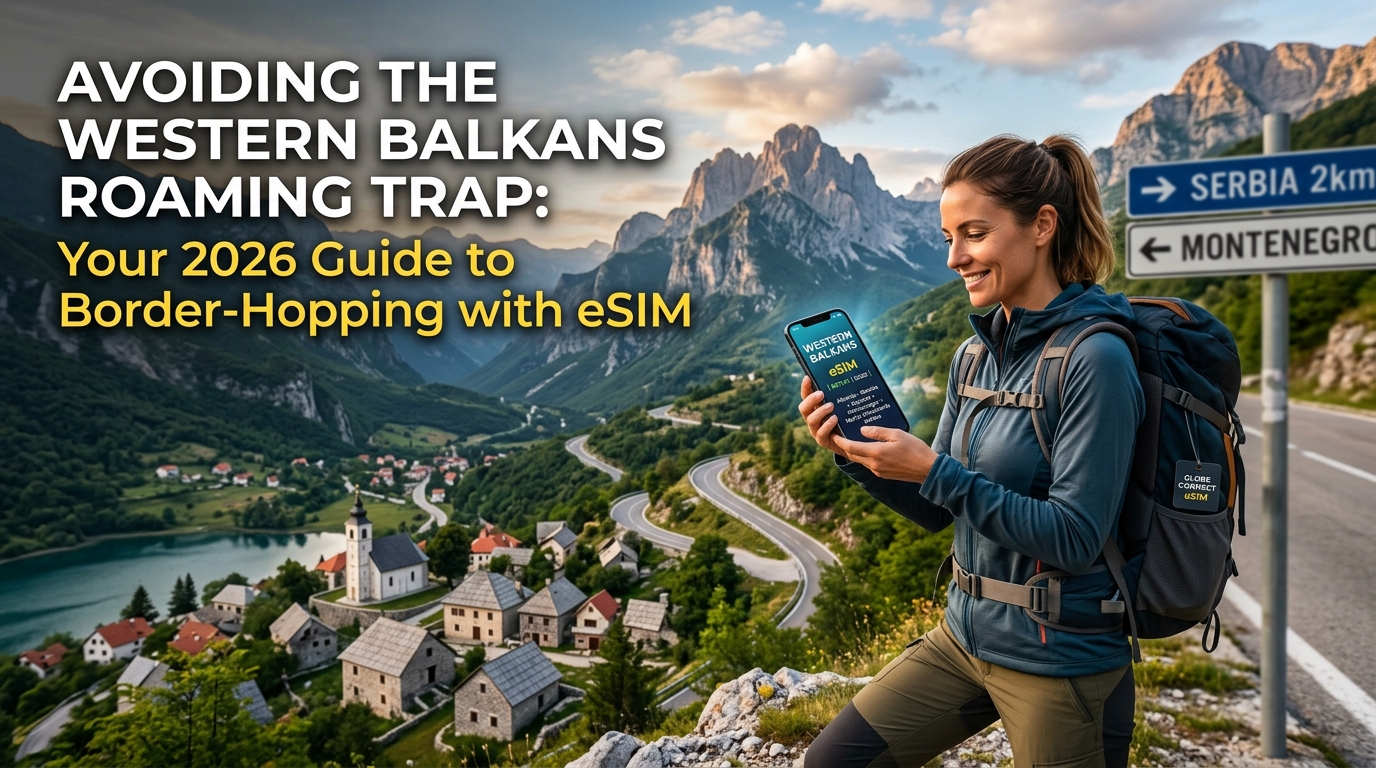
Avoiding the Western Balkans Roaming Trap: Your 2026 Guide to Border-Hopping with eSIM
The Non-EU Border Cliff: Why 'Roam Like at Home' Dies at the Balkan Frontier
For travelers crossing mainland Europe, the European Union's landmark "Roam Like at Home" (RLAH) regulation (EU Regulation 2026/612) creates the illusion of a borderless digital continent. You can stream high-definition video in Paris, navigate the autobahns of Germany, and upload photos from the beaches of Split, Croatia—all while drawing directly from your domestic mobile data allowance at zero surcharge.
However, the moment you drive south from Croatia into Bosnia & Herzegovina or Montenegro, or cross north from Greece into Albania or North Macedonia, you hit an invisible, economically devastating regulatory wall: The Non-EU Border Cliff.
The Anatomy of the Pay-Per-Megabyte Extortion
The Western Balkan Six (WB6)—Albania, Bosnia and Herzegovina, Kosovo, Montenegro, North Macedonia, and Serbia—eliminated roaming charges among themselves under the Regional Roaming Agreement. Crucially, this treaty does not apply to SIM cards issued outside the WB6 bloc.
Because these nations sit outside the EEA single market, bilateral wholesale interconnect tariffs between EU/US carriers and Balkan operators (such as BH Telecom, m:tel, Crnogorski Telekom, and One Montenegro) remain completely unregulated. Without statutory wholesale price caps, tier-1 home providers pass legacy tier-4 roaming charges directly onto consumers.
| Destination / Territory | Regulatory Status | Typical Home Carrier Roaming Rate | Cost of 100 MB Background Sync |
|---|---|---|---|
| Croatia (Dubrovnik) | EU / RLAH Enforced | $0.00 (Draws from domestic plan) | $0.00 |
| Bosnia & Herzegovina | Non-EU / Third Country | $12.00 – $20.48 per MB | $1,200 – $2,048 |
| Montenegro (Kotor) | Non-EU / Third Country | $10.00 – $15.36 per MB | $1,000 – $1,536 |
| Albania | Non-EU / Third Country | $10.00 – $18.00 per MB | $1,000 – $1,800 |
| Serbia | Non-EU / Third Country | $12.00 – $22.00 per MB | $1,200 – $2,200 |
The Border Bleed: Mountain Antennas and the Neum Corridor Trap
The physical geography of the Balkans turns cross-border transit into a technical ambush. High-gain cellular base transceiver stations (BTS) mounted on mountain ridges broadcast directional RF signals deep into neighboring territories. Your smartphone constantly scans for the strongest signal (RSRP/RSRQ metrics) rather than the most cost-effective network.
- The Dubrovnik-to-Kotor Transit (Debeli Brijeg): As you navigate the coastal highway south of Cavtat, Montenegrin cellular antennas perched on Mount Lovćen and surrounding ridgelines punch signals across the Croatian border. Your device often latches onto a Montenegrin network (such as m:tel 297-03) while you are physically still queueing at the Croatian exit checkpoint.
- The Neum Corridor: Although the Pelješac Bridge now bypasses the physical drive through Bosnia's coastal strip, maritime travelers and coastal drivers still encounter cellular spillover. Signals from Bosnian telecom towers bleed across the narrow channel, forcing baseband processors to switch MCC/MNC network IDs without warning.
The Invisible Background Drain
The catastrophe occurs before you even unlock your screen. Modern operating systems prioritize data throughput immediately upon establishing an LTE/5G handshake:
- Cloud Photo Synchronization: An iPhone queuing 4k HDR photos or a Google Pixel syncing camera bursts will attempt multi-threaded uploads instantly.
- App Store Background Updates & App Refresh: Background updates bypass user visibility unless specifically restricted to Wi-Fi.
- Email & Push Notification Daemons: Exchange servers, WhatsApp media auto-downloads, and system diagnostics consume hundreds of megabytes in seconds.
At a conservative roaming penalty of $15 per megabyte, an unmonitored 50 MB background update will run up a $750 charge in under three minutes.
Neutralizing the Cliff with Seamless Cross-Border eSIMs
Preventing accidental handshakes requires moving away from domestic carrier roaming entirely. Using a multi-network Balkan data profile from MollySIM completely eliminates pay-per-megabyte billing traps.
Because MollySIM secures regional wholesale agreements that span both EU members and non-EU Balkan states on a single profile, your connection transitions across borders with local routing profiles. Even if high data usage exhausts your high-speed tier mid-transit, MollySIM’s built-in 384kbps Fair Use Policy (FUP) speed limit—three times faster than the standard 128kbps throttle offered by legacy providers—ensures mission-critical tools like Apple Pay, WhatsApp, and Google Maps turn-by-turn navigation remain completely functional without generating a single cent of unexpected overage fees.
Balkan Network Topography: Local Operators, Mountain Passes, and Signal Dynamics
🇪🇺 Europe 33 Countries High-Speed Travel eSIM & SIM Plans
Instant QR code activation, hotspot enabled, with guaranteed 384kbps fallback speed to keep Maps & Digital Wallets active.
Traversing the Western Balkans exposes mobile hardware to some of the most challenging radio frequency (RF) propagation environments in Europe. The telecom landscape is heavily fractured along national and administrative borders, serviced by distinct Tier-1 mobile network operators (MNOs) with varying regional spectrum allocations and tower infrastructure.
The Fragmented Tier-1 Operator Landscape
Unlike consolidated single-market territories, each Western Balkan nation relies on domestic operators with infrastructure deployments optimized primarily for urban centers and their respective administrative territories:
| Country | Tier-1 Network Operators | Primary Spectrum Bands | Regional Infrastructure Strengths |
|---|---|---|---|
| Bosnia & Herzegovina | • BH Telecom<br>• m:tel (Telekom Srpske)<br>• HT Eronet | B3 (1800MHz)<br>B8 (900MHz)<br>B20 (800MHz) | BH Telecom: Strongest in Sarajevo & Federation cantons.<br>m:tel: Dominant in Republika Srpska & northern corridors.<br>HT Eronet: Optimized across Herzegovina & southern routes. |
| Montenegro | • Crnogorski Telekom<br>• ONE Crna Gora<br>• M:TEL Montenegro | B3 (1800MHz)<br>B7 (2600MHz)<br>B20 (800MHz)<br>n78 (3500MHz) | Telekom: Broadest coastal & highway 5G/LTE-A coverage.<br>ONE: High-density urban capacity.<br>M:TEL: Resilient rural micro-towers along interior transits. |
| Serbia | • MTS (Telekom Srbija)<br>• Yettel Srbija<br>• A1 Srbija | B1 (2100MHz)<br>B3 (1800MHz)<br>B20 (800MHz) | MTS: Extensive national backhaul and border outpost coverage.<br>Yettel: High-speed trunk lines along E70/E75 motorways.<br>A1: Dense urban/suburban capacity. |
Mountain Canyons and RF Signal Degradation
The geological profile of the Western Balkans—dominated by the Dinaric Alps, the Durmitor Massif, and the sheer limestone walls of the Tara River Canyon—creates severe wireless propagation bottlenecks.
High-frequency LTE (B3/B7) and mid-band 5G signals rely on direct Line of Sight (LoS). When driving through serpentine corridors such as the E762 transit between Sarajevo and Podgorica, or climbing over the Sedlo Pass (1,907m) in Montenegro, signals suffer from:
- Multipath Fading & Knife-Edge Diffraction: Sheer karst cliffs block direct tower links, forcing devices to rely on scattered, weak signal reflections that dramatically increase battery drain and drop packets.
- Administrative Blind Spots: In Bosnia & Herzegovina, telecom coverage shifts abruptly between cantons. A SIM locked to BH Telecom often drops to zero signal in rural regions where only m:tel or HT Eronet operates localized transmission towers.
- Border Canyon Isolation: Remote border checkpoints—such as Šćepan Polje (BiH/Montenegro) or Dobrakovo (Montenegro/Serbia)—are situated in deep river gorges where cellular reach from a single domestic carrier is virtually non-existent.
The Single-Network Trap vs. Multi-Carrier eSIM Redundancy
Relying on a local physical SIM purchased at a kiosk forces your phone to connect exclusively to that single provider's proprietary cell towers. If you purchase an HT Eronet SIM in Mostar and drive north toward Banja Luka, your connectivity will severely degrade as you enter m:tel-dominated territory.
A cross-border regional eSIM eliminates these dead zones through dynamic multi-network switching:
- Autonomous Tower Handshakes: If an MTS signal drops behind a ridge in western Serbia, a multi-network profile like MollySIM automatically negotiates a connection with the strongest visible cell tower—instantly latching onto Yettel or A1 without requiring user intervention.
- Sub-Second Border Transitions: Instead of suffering a total signal blackout at remote mountain crossings, the eSIM negotiates authentication handshakes with the neighboring country's partner network while you are still queued in the customs lane.
- Resilient Data Continuity: In deeply recessed valleys where high-speed LTE-A carrier aggregation is physically impossible, MollySIM maintains continuous packet routing. Even under heavy network congestion or fallback speeds, its 384kbps Fair Use Policy (FUP) limit provides three times the throughput of the standard 128kbps cap enforced by older roaming services—keeping critical GPS vector maps, mountain weather telemetry, and secure payment protocols fully operational.
Balkan Connectivity Matrix: Home Roaming vs. Local Kiosk SIMs vs. MollySIM Regional eSIM
Navigating the non-EU digital landscape of the Western Balkans requires balancing budget, bureaucratic overhead, and coverage reliability. Below is an architectural breakdown of how the four most common connectivity strategies perform across a typical multi-country itinerary (e.g., traversing Serbia, Bosnia and Herzegovina, Montenegro, and Albania).
| Feature / Metric | Standard Home Carrier Roaming | EU Carrier "Balkan Add-On" | Fragmented Local Plastic SIMs | MollySIM Regional Balkans eSIM |
|---|---|---|---|---|
| Cost per GB (4+ Borders) | Extreme ($10–$15/MB or $10–$12/day pass) | High (€5–€10 per 500MB daily pack) | Moderate (€3–€8 per SIM card + top-ups) | Ultra-Low (~€1.20–€2.50/GB unified across all territories) |
| KYC & Registration | None (pre-existing account) | None (pre-existing account) | Mandatory physical passport scan & paper registration at kiosks/shops | Zero KYC friction (Instant digital installation via QR code/app) |
| Cross-Border Continuity | Unreliable; frequent lockouts requiring device reboot | Manual network search often required at boundaries | Zero continuity (Total blackout until a new physical card is bought) | Automated sub-second handshakes via pre-configured roaming agreements |
| Bill Shock Risk | Critical (Background app refresh can cost hundreds of dollars) | Moderate (Overages revert to standard international rates) | Zero (Prepaid balance hard cap) | Zero (Prepaid data model with transparent limits) |
| Tethering / Hotspot | Often carrier-restricted or throttled | Varies by network tier | Supported, but tied to single-network coverage | Full unrestricted tethering for GPS head units, tablets, and passengers |
| Out-of-Data Fallback | Hard cut-off or exorbitant per-MB tiering | Complete data termination | Complete data termination until physical/online cash top-up | 384kbps continuous FUP (3x faster than standard 128kbps fallbacks) |
The Hidden Costs of Fragmented Plastic SIMs
While purchasing individual prepaid SIM cards at roadside fuel stations or tobacco kiosks (trafika) might appear economical on paper, the physical workflow introduces severe operational friction on a multi-border Balkan road trip:
- Mandatory Real-Name KYC Friction: Telecommunications regulations across Serbia (RATEL), Montenegro (EKIP), and Albania require mandatory identity verification and physical passport scans for all prepaid SIM registrations. Waiting in kiosk queues and handing physical passports to retail clerks creates unnecessary delays and exposure of sensitive personal data.
- Micro-Billing Losses and Currency Traps: Each physical SIM requires buying local airtime in separate non-Euro currencies—Serbian Dinar (RSD), Bosnian Convertible Mark (BAM), and Albanian Lek (ALL). Travelers routinely abandon €5 to €15 in unspent balances on each plastic SIM card upon crossing the next border checkpoint, compounding total trip costs.
- Physical Hardware Vulnerability: Constantly swapping nano-SIM trays in vehicles or outdoors risks losing your primary home SIM card, misplacing ejector tools, and disabling your home number's two-factor SMS authentication (2FA) for banking and travel services.
Technical Architecture: Why Unified Regional Routing Wins
In contrast to single-network physical SIM cards that lock your modem to one local carrier's infrastructure, a unified profile from MollySIM provisions multi-IMSI and dynamic profile capabilities directly to your device's eUICC chip.
- Multi-Carrier Redundancy: In mountainous border terrain, if a specific local carrier lacks tower density along a canyon route, MollySIM allows your handset to negotiate a link with alternative domestic operators (such as jumping between Yettel and A1 in Serbia, or m:tel and HT Eronet in Bosnia) without buying new profiles.
- The 384kbps Operational Safety Net: Standard travel SIMs and legacy international roaming plans impose a punitive 64kbps or 128kbps throttle—or cut data entirely—once a high-speed allowance is consumed. MollySIM enforces a 384kbps Fair Use Policy (FUP) baseline. This increased floor ensures sufficient throughput to render Google Maps/Apple Maps dynamic vector tiles, maintain VoIP audio telemetry, and clear TLS handshakes for mobile payment gateways (Apple Pay and Google Wallet) without stalling.
The Navigation Lifeline: Preventing Navigation Dropouts with MollySIM's 384kbps Safety Net
Driving through the Western Balkans exposes travelers to some of Europe’s most dramatic topography, from navigating the hairpins of the P14 Sedlo Pass through Durmitor National Park in Montenegro to traversing the remote, sheer rock faces along the M20 corridor through Sutjeska National Park in Bosnia and Herzegovina. In these isolated mountain corridors, cellular connectivity is not merely a convenience for social updates—it is an active safety system.
A sudden loss of data while descending an unlit canyon road can cripple your route guidance precisely when rockfalls, severe alpine weather fronts, or unmarked fork junctions require real-time decisions.
The Data Mechanics of Modern Alpine Navigation
Modern navigation tools—including Google Maps, Apple Maps, and Waze—have long abandoned simple static route caching in favor of continuous client-server telemetry. When navigating complex Balkan terrain, your handset processes multiple concurrent data streams:
- Dynamic Vector Tile Streaming: Rather than flat raster images, map engines download compressed protocol-buffer vector tiles (averaging 25KB to 60KB per bounding box) to dynamically render road geometry, 3D contours, and elevation profiles.
- Continuous Rerouting & Hazard Algorithms: Traffic density, road closures, border queue delays, and sudden flash-flood warnings require constant bi-directional packet exchanges.
- Cryptographic Token Verification: Digital wallet authentication (Apple Pay, Google Wallet) at remote fuel pumps and toll plazas requires swift TLS/SSL handshakes that time out if latency spikes or bandwidth drops below basic operational thresholds.
The 64kbps Trap vs. MollySIM’s 384kbps Operational Baseline
Most standard travel eSIMs impose a severe penalty once your high-speed quota is reached: they either cut off data completely or throttle transmission down to 64kbps or 128kbps. Under a 64kbps constraint, packet loss surges. Operating systems prioritize background operating system syncs, causing navigation apps to throw network timeout errors, leaving drivers staring at blank grey grids in the middle of a switchback.
MollySIM solves this operational hazard by enforcing a 384kbps Fair Use Policy (FUP) baseline across its regional profiles. By delivering triple the bandwidth of traditional throttles, MollySIM ensures that critical telemetry remains fully operational even if your primary high-speed allocation is exhausted midway through a remote pass.
| Mobile Service / Application | Bandwidth Required | Performance at 64–128kbps (Standard eSIM) | Performance at 384kbps (MollySIM Safety Net) |
|---|---|---|---|
| Vector Map Rendering (Google/Apple) | 30–50 kbps | Failed / Indefinite Tile Loading | Smooth Dynamic Rendering (<1.2s per tile) |
| Turn-by-Turn Voice Navigation | 10–20 kbps | Audio Stutters / Sync Lag | Uninterrupted Real-Time Guidance |
| VoIP Emergency Calling (WhatsApp/Viber) | 24–40 kbps (Opus) | Frequent Packet Drops / Robotic Audio | Clear, Low-Latency Voice Telephony |
| Live GPS Coordinate Sharing (Find My) | 5–10 kbps | Timed Out / Periodic Dropouts | Instant Real-Time Location Beaconing |
| Mobile Wallet TLS Authentication | 15–30 kbps bursts | Gateway Timeout / Transaction Error | Instant Settlement at Tolls & Fuel Stations |
Redundancy Where It Counts
At 384kbps (approximately 48 KB/s of clean throughput), your device retains enough headroom to stream compressed vector geometry, resolve live GPS coordinate updates on WhatsApp or Apple Find My, and maintain clear VoIP audio via the Opus codec simultaneously.
By eliminating hard cutoffs, MollySIM acts as a persistent digital safety tether, ensuring that navigating blind mountain gaps, sudden border detours, and rural fuel stops across the Western Balkans remains predictable, stable, and secure.
Step-by-Step 2026 Setup: Configuring Dual-SIM Routing for Seamless Cross-Border Travel
To enjoy zero-interruption navigation and avoid accidental tier-one roaming fees from your domestic carrier, your smartphone must be configured with a clear separation between your identity tier (domestic voice/SMS) and your transit data pipeline.
Follow this blueprint before reaching your first non-EU border crossing:
Step 1: Pre-Departure Provisioning (Home Wi-Fi or Airport Transit)
Install your eSIM while connected to a stable Wi-Fi connection—never attempt activation while idling in a border queue where cell towers are congested.
- iOS: Navigate to
Settings>Cellular>Add eSIM> Scan the QR code delivered by MollySIM. Once downloaded, label the label field as "Balkans Data" and your domestic carrier as "Home". - Android: Navigate to
Settings>Network & internet>SIMs>Add SIM(or+) >Download a SIM instead> Scan the QR code. Rename the profile to "Balkans Data".
Step 2: Channel Partitioning (Isolating 2FA from Data)
To receive bank verification SMS messages, transaction alerts, and emergency calls without paying data surcharges, separate your device channels:
- Set Default Voice Line to "Home".
- Set Cellular / Mobile Data to "Balkans Data" (MollySIM).
- Disable "Allow Cellular Data Switching" (iOS) / "Switch data automatically" (Android): This is critical. If left toggled on, your device will silently switch data routing to your home carrier whenever your local signal dips momentarily in a mountain pass, triggering immediate day-pass charges.
Step 3: Hard-Locking Roaming Parameters
┌──────────────────────────────┬──────────────────────────────┐
│       HOME SIM PROFILE       │     MOLLYSIM eSIM PROFILE    │
├──────────────────────────────┼──────────────────────────────┤
│ Mobile Data: Disabled        │ Mobile Data: Primary         │
│ Data Roaming: OFF (Hard-Lock)│ Data Roaming: ON (Enabled)   │
│ Network Selection: Automatic │ Network Selection: Automatic │
└──────────────────────────────┴──────────────────────────────┘- Select your Home SIM profile: Scroll to Data Roaming and toggle it OFF. This hard-blocks domestic background data synchronization (iCloud, Google Photos, background app refresh) while keeping the cellular receiver active for free inbound SMS.
- Select the Balkans Data profile: Toggle Data Roaming to ON. Because MollySIM is a specialized multi-carrier regional profile, roaming flags must be enabled to allow handoffs between disparate host carriers (e.g., A1, One, Telekom, Yettel).
Step 4: Network Selection & Cross-Border Tower Handshakes
Keep Network Selection set to Automatic across both profiles.
When you cross bottleneck checkpoints—such as GP Karasovići / Debeli Brijeg (Croatia into Montenegro) or GP Doljani (Croatia into Bosnia & Herzegovina)—your device automatically drops EU carrier bands and latches onto the strongest partner infrastructure (e.g., MTEL or One CG) within 30 to 90 seconds.
Because MollySIM features an integrated 384kbps continuous FUP safety net (triple the industry standard 128kbps), your active navigation routes on Apple Maps or Google Maps and your mobile wallet token authentications will continue streaming without dropping connection during transition delays.
Troubleshooting Vehicle Infotainment & Tethering Conflicts
Older built-in vehicle head units and wireless Apple CarPlay / Android Auto setups can drop routing data or misroute traffic through vehicle Wi-Fi bridges. If you experience map freezes after crossing borders:
- Wi-Fi Bridge Override: Wireless CarPlay and Android Auto utilize an ad-hoc 5GHz Wi-Fi bridge between your phone and car dashboard. Ensure your phone is not attempting to source cellular internet from the car’s dormant native infotainment hotspot. In your phone's Wi-Fi settings, tap the car network and toggle Auto-Join OFF while preserving Bluetooth pairing.
- APN Re-verification: If data drops entirely upon switching countries, navigate to
Mobile Data Network/Access Point Names (APN)on the MollySIM profile. Ensure the APN matches the value provided in your activation voucher (typically set toglobaldataor assigned automatically via carrier payload). - Resetting Network Stack: If local cell towers fail to register after an extended border queue, toggle Airplane Mode ON for 10 seconds and turn it back OFF to force an instant baseband transceiver search.
Balkan Road-Tripper FAQ & Edge Cases: Maritime Ferry Nodes to Dual-SIM 2FA Management
Navigating the cross-border corridors of the Western Balkans involves unique infrastructural and regulatory friction points. Below are practical protocols for managing the most common technical and operational edge cases you will encounter along these routes in 2026.
1. The Adriatic Ferry Trap: Avoiding Satellite Roaming Nodes
Cruising along the Dalmatian coast or taking vehicle ferries between Split, Dubrovnik, the Bay of Kotor (Lepetane–Kamenari), or international routes across to Italy (Bari/Ancona) exposes devices to high-cost maritime cellular networks.
       [ Coastal Terrestrial Cell Towers ]  <-- Covered by MollySIM
                       | (2-5 Nautical Miles Range)
~~~~~~~~~~~~~~~~~~~~~~~v~~~~~~~~~~~~~~~~~~~~~~~~~~~~~~~~~~~~~~~~~
       [ Open Water: Satellite Transceivers ] <-- EXCLUDED (Up to $10/MB)
(e.g., Telenor Maritime, MCP, AT&T Maritime)- The Mechanism: When a ferry moves beyond 3 to 5 nautical miles from the mainland, your device loses terrestrial 4G/5G signals and may automatically latch onto onboard maritime satellite transponders (such as Telenor Maritime or Telecom Italia Sparkle).
- The Cost Exposure: Maritime satellite data is not covered by standard European or Western Balkan terrestrial data plans and can cost upwards of $10.00 to $15.00 per megabyte on standard home carriers.
- The Fix: While traversing open water, manually select your network operator in your device settings instead of leaving it on Automatic, or toggle Airplane Mode until the ship approaches port infrastructure. MollySIM profiles operate exclusively on licensed terrestrial carrier networks, shielding you from accidental satellite billing if you use your eSIM for data while keeping your domestic SIM locked.
2. Dual-SIM Banking 2FA Management Without Domestic Roaming Charges
Maintaining access to home banking apps, mobile verification codes, and SMS two-factor authentication (2FA) across non-EU borders requires a strict Dual-SIM setup.
| Setting Parameter | Configuration | Operational Purpose |
|---|---|---|
| Default Voice Line | Primary (Home Carrier) | Receives incoming carrier SMS/2FA texts |
| Mobile Data Line | Secondary (MollySIM) | Routes all application and web traffic through local low-latency routing |
| Data Roaming (Home Line) | OFF (Crucial) | Blocks home carrier pay-per-megabyte data gouging (often $10–$15/MB) |
| Data Roaming (MollySIM) | ON | Allows dynamic multi-network carrier handshakes across Western Balkan borders |
| Allow Cellular Data Switching | OFF | Prevents the OS from switching to your home line when Balkan signals fluctuate |
Note: Inbound SMS messages are globally free on nearly all mobile networks. Keeping your primary physical SIM or home eSIM active for voice/SMS while setting MollySIM as your sole data conduit allows banking OTPs to land seamlessly without incurring a single roaming fee.
3. Long Border Queue Delays & Family Tethering Protocols
Crossing from Croatia (EU/Schengen) into Bosnia (Neum Corridor or Gradiška) or from Serbia into North Macedonia (Preševo) can involve queues ranging from 30 minutes to over 4 hours during peak summer transit windows.
- Managing Multi-Device Drain: Setting up a personal hotspot for passenger tablets and secondary smartphones accelerates data consumption through background app updates, social streaming, and cloud syncs.
- Bandwidth Preservation: Configure shared passenger devices to Low Data Mode to restrict background refreshes.
- The FUP Safety Net: If your high-speed data allocation runs out while idling in a multi-kilometer border queue, MollySIM’s built-in 384kbps continuous FUP safety net (unlike the restrictive 128kbps baseline common among generic providers) keeps critical logistics online. Passengers can continue sending WhatsApp messages, processing mobile transactions, and streaming live navigation telemetry without the connection freezing entirely.
4. Regulatory Realities: Albania and North Macedonia in Regional Packages
Travelers frequently misunderstand the regulatory framework governing the southern Balkans:
- The WB6 Agreement vs. The EU: The Western Balkans 6 "Roam Like at Home" agreement (covering Albania, Bosnia and Herzegovina, Kosovo, Montenegro, North Macedonia, and Serbia) eliminated intra-regional roaming fees among themselves. However, this agreement does not include EU member states like Croatia or Greece.
- The Cross-Border Gap: Moving from Sarandë (Albania) across the border to Igoumenitsa (Greece), or from Ohrid (North Macedonia) to Florina (Greece), instantly switches your regulatory territory from WB6 non-EU to EU Roaming Regulation jurisdiction.
- The Solution: A unified regional cross-border eSIM from MollySIM covers both EU member nations and non-EU Western Balkan candidates on a single profile, eliminating the need to swap physical cards or buy disparate country-specific plans at the roadside.
5. Emergency Services (112) Across Remote Balkan Corridors
When traversing isolated mountain regions—such as the Accursed Mountains (Prokletije) between Montenegro and Albania, the Tara River Canyon, or the Pindus passes:
- Universal 112 Routing: By international telecommunication mandates, dialing 112 from any mobile handset will route to the nearest local emergency dispatch center over any available cellular frequency, regardless of whether your eSIM has an active data bucket or is natively partnered with that specific mast.
- Offline Fallbacks: Emergency calls bypass network security locks and standard SIM IMSI verifications. Even in deep mountain gorges with no data coverage on your active profile, your transceiver will seize any operational 2G, 3G, or 4G carrier channel (e.g., One Crna Gora, Telekom Srbija, or A1) to complete the distress call.
🇪🇺 Europe 33 Countries High-Speed Travel eSIM & SIM Plans
Instant QR code activation, hotspot enabled, with guaranteed 384kbps fallback speed to keep Maps & Digital Wallets active.