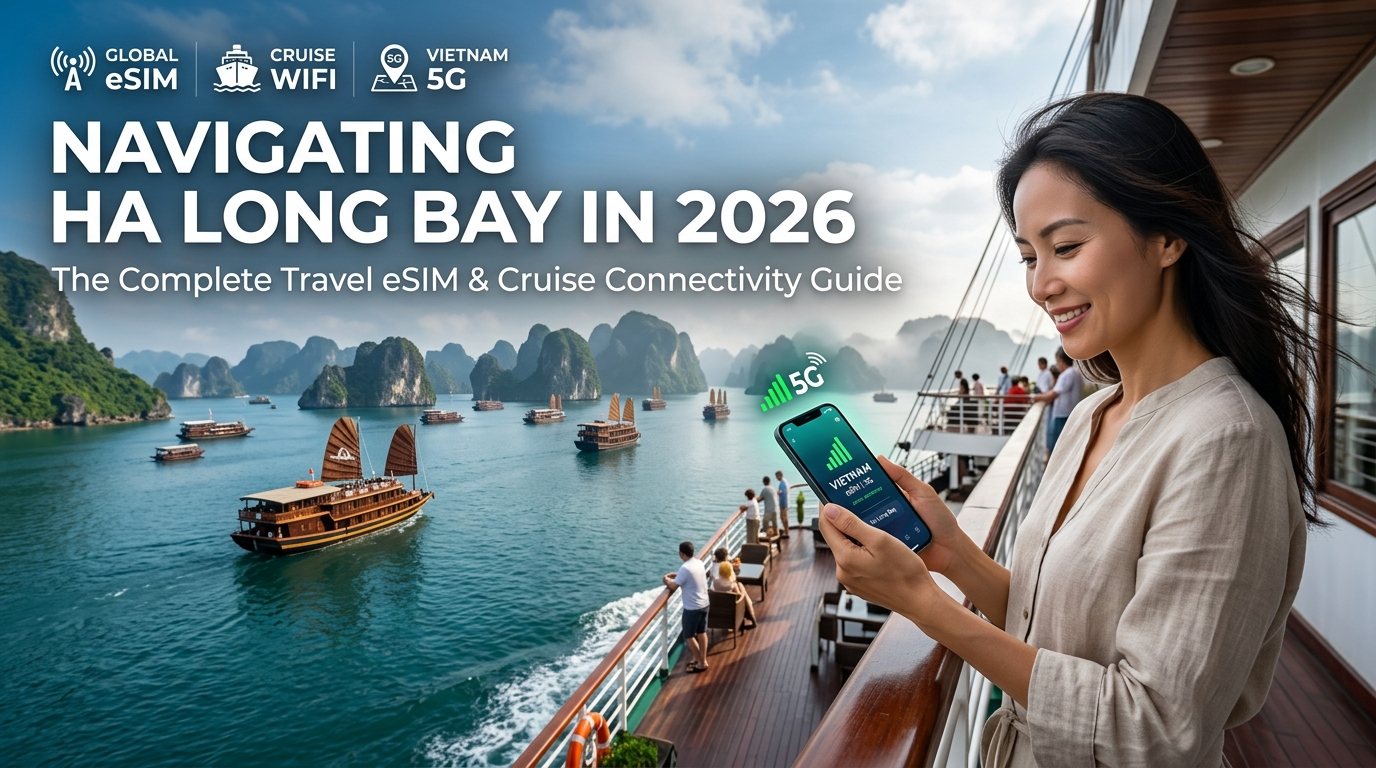
Navigating Ha Long Bay in 2026: The Complete Travel eSIM & Cruise Connectivity Guide
The Physics of Karst Connectivity: Signal Propagation Across Ha Long, Lan Ha, and Bai Tu Long
Understanding mobile reception across Northern Vietnam’s Gulf of Tonkin requires examining how high-frequency radio frequency (RF) energy interacts with one of the most geologically complex marine landscapes on Earth. The roughly 1,600 towering limestone (karst) pillars scattered across the region do not merely serve as scenery; they function as massive, monolithic RF attenuators.
Karst Topography: Attenuation, Reflection, and Shadow Zones
Dense sedimentary limestone possesses a high relative dielectric permittivity ($\varepsilon_r \approx 6\text{--}8$) and significant moisture content from tropical humidity. When cellular electromagnetic waves—ranging from standard 4G LTE bands (900 MHz to 2100 MHz) to sub-6 GHz 5G frequencies (3.5 GHz / n78)—strike a vertical karst wall, three physical phenomena degrade performance:
- Direct Shadowing & Absorption: Unlike urban brick or dry drywall, 50 to 100 meters of solid, mineral-dense limestone represents a complete barrier to direct Line-of-Sight (LOS) signals, inducing insertion losses exceeding 30 to 45 dB.
- Knife-Edge Diffraction Limits: While longer wavelengths (e.g., 700/800 MHz) can diffract around the crests and sharp ridges of karst formations, mid-band (1800/2100 MHz) and high-band signals exhibit minimal diffraction. The resulting Non-Line-of-Sight (NLOS) shadow zones immediately behind karst cliffs suffer rapid signal dropouts.
- Multi-Path Interference Over Water: Seawater acts as an efficient RF reflector. Cellular signals bouncing off the bay surface combine with waves scattering off vertical rock faces, creating out-of-phase multipath propagation. This results in severe Rayleigh fading, elevated packet jitter, and sudden ping spikes even when raw signal bars indicate adequate power.
Comparative Topological Challenges by Bay Sector
The degree of cellular disruption varies substantially depending on your cruise routing:
| Cruise Zone | Dominant Karst Density | Primary Signal Challenges | Average Cell Availability |
|---|---|---|---|
| Ha Long Bay (Core UNESCO Zone) | High density; moderate channel widths (100–400m) | Frequent karst shadowing; cell-edge handovers between mainland macro-sites | Moderate to High (Dropouts behind major grottos) |
| Lan Ha Bay (Cat Ba Archipelago) | Extreme density; narrow, twisting aquatic corridors | Severe NLOS blockage; heavy multipath cancellation | Low to Moderate (Patchy in deep coves) |
| Bai Tu Long Bay (Northeast Sector) | Low-to-moderate density; wide, open waterways | Free-space path loss (FSPL) due to extreme BTS distance | Low to High (Distance-limited rather than karst-blocked) |
- Core Ha Long Bay: Direct exposure to high-altitude Base Transceiver Stations (BTS) located on the Bai Chay coastline and Tuan Chau Island provides continuous macro-coverage. Signal dips are typically brief, occurring only when passing behind immense formations such as Dau Go or Titov Island.
- Lan Ha Bay: Navigating the tight channels south of Cat Ba Island presents the most acute geometric challenges. Narrow limestone canyons completely block line-of-sight to mainland and island-interior towers, creating localized dead zones in secluded anchorages like Bright & Dark Cave.
- Bai Tu Long Bay: Because karst formations are spaced further apart, rock diffraction is less problematic. However, Base Transceiver Station density drops off sharply northeast of Van Don. Connectivity degradation here is governed primarily by inverse-square free-space path loss over long oceanic expanses.
Terrestrial BTS Deployments & Over-Water Radio Propagation
To illuminate this labyrinth, Vietnamese network operators deploy a hybrid infrastructure:
- High-Elevation Coastal BTS: High-gain sector antennas mounted on mainland peaks (such as Bai Chay and Cat Ba’s Ngu Lam peak) project directional beams downward across the water.
- Island & Ranger Outpost Micro-Sites: Low-power micro-cells installed on floating marine ranger stations, pearl farms, and accessible island peaks bridge coverage gaps across main cruise lanes using microwave backhaul.
[Mainland High-Site BTS]
       \
        \  (Direct LOS Signal over Seawater)
         \=========================================> [Cruise Sun Deck: Strong Signal]
          \                       \
    [Karst Pillar]                 \ (Water Specular Reflection)
       | BLOCK |                    \______/~~~~~~\________
       |  35dB |                                           \
       v LOSS  v                                            v
 [NLOS Shadow Zone]                             [Multi-Path Phase Cancellation]
Over flat seawater, signals benefit from low ground attenuation, allowing 1800 MHz (Band 3) LTE carriers to propagate further than over dry land. However, tidal variations, ambient evaporation, and heavy mist alter the refractive index of the marine boundary layer, causing morning "duct fading" where signals unexpectedly drop before burning off by midday.
Vessel Architecture: The Cruise Cabin Faraday Effect
The physical design of modern boutique and luxury cruise vessels introduces an additional layer of RF attenuation.
Modern overnight cruise ships are constructed with steel-reinforced hulls, heavy steel transverse bulkheads, and double-glazed, low-emissivity (Low-E) insulated windows treated with thin metal-oxide coatings. These metallic enclosures function as localized Faraday cages:
- Sun Decks & Balconies: Offer direct RF exposure to ambient coastal signals, yielding clean signal-to-noise ratios (SNR > 15 dB).
- Lower-Deck Cabins & Interior Corridors: Cabins below the waterline or deep within steel frames suffer an additional 15 to 25 dB of structural penetration loss. Devices frequently downgrade from 4G/5G down to legacy 2G or drop into emergency-only modes.
To maintain continuous connectivity when stepping from an open sun deck into an insulated steel cabin, modern eSIM configurations with intelligent packet recovery are vital. Utilizing an optimized data carrier like MollySIM ensures that even when signal strengths hover at marginal cell-edge thresholds (RSRP below -115 dBm), your underlying data layer remains resilient. Furthermore, MollySIM's 384kbps Fair Use Policy (FUP) throttle floor—3x faster than the restrictive 128kbps industry standard—guarantees that mission-critical background protocols like Google Maps navigation cacheing, WhatsApp messaging, and Apple Pay authentication complete transactions smoothly without timing out amidst fluctuating bay coverage.
Cruise Ship Wi-Fi vs. Direct Cellular: The Reality of Offshore Internet in Vietnam
🌐 Global Travel High-Speed Travel eSIM & SIM Plans
Instant QR code activation, hotspot enabled, with guaranteed 384kbps fallback speed to keep Maps & Digital Wallets active.
A common misconception among first-time cruisers in Ha Long Bay, Lan Ha Bay, and Bai Tu Long Bay is that luxury ticket prices guarantee enterprise-grade high-speed Wi-Fi. In reality, whether you board a traditional boutique wooden junk boat or a state-of-the-art 5-star superyacht, the onboard Wi-Fi infrastructure is subject to severe physical and architectural bottlenecks.
Understanding the stark contrast between shared onboard networks and direct cellular connectivity is crucial for avoiding complete digital isolation once your vessel leaves the marina.
The Shared Uplink Dilemma: How Cruise Wi-Fi Actually Works
Cruise vessels operating in Northern Vietnam rarely deploy dedicated low-Earth-orbit (LEO) satellite terminals like Starlink Maritime due to licensing frameworks, line-of-sight obstruction from limestone cliffs, and operating cost constraints. Instead, over 90% of day boats and overnight cruise ships rely on one of two setups:
- Shared Consumer-Grade 4G/LTE Cellular Routers: The vessel mounts one or two multi-SIM industrial cellular routers (such as Teltonika or standard Huawei gateways) on the wheelhouse roof, feeding basic Wi-Fi access points installed along cabin corridors.
- High-Latency Geostationary Satellite Relays: Found on a small subset of legacy luxury vessels, these systems route traffic through geostationary satellites stationed thousands of kilometers away, introducing baseline round-trip latencies of 600ms to 900ms before local distribution.
Cruise Wi-Fi Architecture:
[ Shore Tower (eNodeB) ] <--- 4G/LTE (15-25 Mbps Total) ---> [ Shipboard Router ]
                                                                     |
                                        +----------------------------+----------------------------+
                                        | (Contention & Bufferbloat) | (Packet Loss > 30%)        |
                                    [ Sun Deck AP ]              [ Corridor AP ]             [ Dining AP ]
                                        |                            |                           |
                                  [ Passenger 1 ]              [ Passenger 28 ]            [ Passenger 65 ]
When 30 to 100 passengers simultaneously connect their smartphones, tablets, and smartwatches to this single 15–25 Mbps aggregated cellular pipe, the network collapses under bufferbloat and extreme bandwidth contention.
During peak evening hours (6:00 PM to 10:00 PM)—when guests return to their cabins to stream media, upload 4K video clips, and make FaceTime calls home—performance degrades drastically:
- Latency Spikes: Ping times jump from an acceptable 45ms to erratic spikes exceeding 400ms to 1,200ms.
- TCP Session Timeouts: High jitter and packet loss rates (>30%) cause standard HTTPS handshakes, VPN tunnels, and two-factor authentication (2FA) prompts to drop repeatedly.
- Bandwidth Throttling: Per-user throughput regularly plummets to under 0.2 Mbps, rendering even basic text messaging sluggish.
Direct Travel eSIM: Private, Dedicated, and Unfiltered
Bypassing the vessel’s shared router entirely by using a direct travel eSIM gives your smartphone its own dedicated transceiver link directly to coastal base stations on the mainland and surrounding islands.
Direct Cellular eSIM Architecture:
[ Shore Tower (eNodeB / gNodeB) ] <======== Direct RF Link (Private Session) ========> [ Your Smartphone (eSIM) ]
  • Dedicated 4G/5G Resource Blocks (PRBs)
  • End-to-end 3GPP Carrier-Grade Encryption
  • Zero local LAN contention
Connecting directly via an independent data provider provides three distinct technical advantages:
- Zero Local Contention: You do not compete with dozens of passengers streaming video in neighboring cabins. Your device negotiates its own Physical Resource Blocks (PRBs) directly with the nearest cell tower.
- Robust 3GPP Security: Public shipboard Wi-Fi networks in the bay are frequently open or secured with shared, static WPA2 pre-shared keys (PSK), leaving your unencrypted local traffic vulnerable to packet sniffing. A direct cellular connection enforces carrier-grade mutual authentication and 128-bit/256-bit air-interface encryption (such as SNOW 3G or AES).
- Deterministic Latency: Without intermediary Wi-Fi hops and overloaded local access points, direct cellular routing keeps your latency stable between 25ms and 60ms, ensuring seamless VoIP and video conferencing performance.
Technical Comparison: Shipboard Wi-Fi vs. Independent Travel eSIM
| Feature / Metric | Onboard Cruise Ship Wi-Fi | Direct Travel eSIM Link |
|---|---|---|
| Underlying Uplink | Shared 4G/LTE router or GEO satellite | Dedicated point-to-point cellular link |
| Peak-Hour Downlink (Per User) | 0.05 Mbps – 0.5 Mbps (severe congestion) | 15 Mbps – 85+ Mbps (carrier capacity dependent) |
| Average Round-Trip Latency | 250ms – 1,200ms (high jitter) | 25ms – 65ms (low jitter) |
| Packet Loss (Peak Hours) | 15% to >40% | Typically < 1.5% |
| Local Network Security | Shared WPA2/Open LAN (vulnerable to snooping) | Direct carrier-level encryption (3GPP standards) |
| Video Call / VPN Stability | High disconnect frequency; frequent VoIP drops | Continuous, stable stream performance |
| Degraded State Handling | Complete connection loss during router lockup | Failsafe throttling (e.g., MollySIM 384kbps floor) |
Eliminating the "Dead Zone" Dropoff
Even when direct cellular signals fluctuate as the cruise maneuvers deep into karst channels, an independent eSIM profile configured with high-priority Quality of Service (QoS) rules maintains baseline connectivity where ship Wi-Fi fails entirely.
If signal conditions trigger a Fair Use Policy (FUP) limit after heavy day-use, standard travel SIMs drop speeds to an unusable 128kbps—instantly breaking basic app functionality. By contrast, a purpose-built travel provider like MollySIM preserves an elevated 384kbps FUP floor. This speed provides three times the throughput of legacy travel eSIMs, ensuring essential protocols like live GPS tracking on Google Maps, WhatsApp voice notes, and Apple Pay payment authorizations process immediately without waiting on overloaded shipboard networks.
Carrier Landscape & Cruise Connectivity Matrix: Viettel vs. VNPT/Vinaphone vs. Alternative Solutions
Navigating the complex geography of the Gulf of Tonkin requires an understanding of how local mobile network operators (MNOs) deploy their offshore radio access networks (RAN). The limestone karsts that make Ha Long Bay a UNESCO World Heritage site also act as physical signal attenuators, creating severe multipath interference and localized RF shadowing.
To maintain reliable connectivity on the water, choosing the right underlying carrier infrastructure is paramount.
The Big Three Vietnamese MNOs: Offshore Capabilities
+-------------------------------------------------------------------------+
|                  VIETNAM OFFSHORE CELLULAR INFRASTRUCTURE               |
+-------------------+-----------------------------------------------------+
| Viettel           | Military-grade maritime towers; unmatched island    |
|                   | repeater density (Cat Ba, Titop, Co To).            |
+-------------------+-----------------------------------------------------+
| VNPT / Vinaphone  | Heavy coastal transmission redundancy; strong line- |
|                   | of-sight coverage across major maritime routes.     |
+-------------------+-----------------------------------------------------+
| MobiFone          | High capacity in Bai Chay/urban ports; rapid signal |
|                   | decay once entering outer karst labyrinths.        |
+-------------------+-----------------------------------------------------+
1. Viettel (The Maritime Heavyweight)
As Vietnam’s state-owned, military-backed telecom operator, Viettel operates the country's most extensive maritime cellular grid. Viettel has strategically mounted long-range macro cells and directional repeaters across elevated karst peaks and populated islands (such as Cat Ba and Quan Lan). In Ha Long and Lan Ha Bay, Viettel delivers the highest density of Band 3 (1800 MHz) and Band 28 (700 MHz) spectrum, providing deep penetration even when cruise ships anchor in narrow coves.
2. VNPT / Vinaphone (The Coastal Runner-Up)
Vinaphone maintains the second-largest infrastructure footprint in Quang Ninh province. Its transmission towers along the Tuan Chau Marina, Hon Gai, and the southern edge of Lan Ha Bay offer exceptional line-of-sight throughput. While its coverage in deeper karst formations slightly trails Viettel, Vinaphone provides exceptional data speeds in open waters and serves as an ideal primary or secondary roaming path.
3. MobiFone (Urban-Focused, Marine-Limited)
While MobiFone performs well in metropolitan centers like Hanoi and urban Ha Long City, its offshore footprint remains constrained. MobiFone relies heavily on higher-frequency bands with limited broadcast range, leading to rapid signal degradation as vessels pass Sung Sot Cave or navigate into the outer rim of Bai Tu Long Bay.
Offshore Connectivity Matrix: Comparing the Solutions
The following matrix evaluates the real-world performance of direct carrier profiles, onboard ship amenities, hardware rentals, and international roaming alternatives across the bay's navigation corridors:
| Metric | Viettel Direct | Vinaphone Direct | MobiFone Direct | Cruise Ship Wi-Fi | Pocket Wi-Fi Rental | MollySIM Vietnam eSIM |
|---|---|---|---|---|---|---|
| Ha Long Core Coverage | Excellent (4G/LTE+) | Excellent (4G/LTE+) | Moderate (4G/3G) | Unreliable / Congested | Moderate to Good | Excellent (Direct Carrier Access) |
| Lan Ha Bay Signal Penetration | Very High | Moderate to High | Low (Frequent 3G/No Service) | Poor (Frequent Drops) | Carrier Dependent | Optimized Multi-Network Switching |
| Bai Tu Long Reach | High (Island Repeaters) | Moderate | Low | Extremely Poor | Inconsistent | High (Picks Strongest Local Tower) |
| Average Offshore Latency | 28ms – 55ms | 32ms – 60ms | 65ms – 140ms | 350ms – 1,200ms | 45ms – 90ms | 25ms – 50ms |
| Remote Work / Tethering | Yes (Fast Setup) | Yes | Limited by Coverage | Unviable for Video/VPN | Yes (Extra Device to Charge) | Yes (Native Hotspot Enabled) |
| Procurement & Setup | Passport check at kiosk | Passport check at kiosk | Physical SIM collection | Included / Upcharge | Airport pickup + Deposit | Instant QR Installation (< 2 mins) |
| Throttled FUP Support | Hard cap / 128kbps drop | Hard cap / 64kbps drop | Hard cut-off | Strict bandwidth throttle | Carrier standard (128kbps) | Elevated 384kbps FUP Floor |
Why Dynamic Multi-Network Switching is Crucial in the Karsts
Cruising through the bay is not a static connectivity environment. As your vessel maneuvers behind a 150-meter vertical limestone cliff, the direct line of sight to a Viettel macro-cell may be eclipsed instantly. However, a Vinaphone directional sector antenna situated across the channel might maintain an unobstructed path to your vessel's deck.
Single-network physical SIM cards lock your device to a single carrier’s infrastructure. If that specific carrier is shielded by topography, your connection drops entirely.
Advanced travel eSIM solutions like MollySIM leverage localized multi-carrier roaming agreements. When an obstruction degrades primary carrier performance, the eSIM dynamically routes traffic through the strongest available cell tower in the sector.
Coupled with a 384kbps Fair Use Policy (FUP) floor—which offers triple the bandwidth of the industry-standard 128kbps throttle—travelers retain continuous access to bandwidth-critical services like turn-by-turn navigation on Google Maps, instant messaging, and Apple Pay authentication even under degraded channel conditions.
Remote Work and Cabin Optimization: Strategic Protocols for Overnight Cruisers
Operating a remote desk from an overnight vessel navigating the Gulf of Tonkin requires a deliberate approach to radio frequency (RF) physics, power thermodynamics, and network tuning. Karst topography introduces severe non-line-of-sight (NLOS) conditions, making connection stability highly dependent on your physical position on the ship and how your operating system handles packet transport.
1. Structural Deck Geometry and Signal Placement
Modern Ha Long Bay cruise vessels are constructed with reinforced steel hulls, fireproof composite bulkheads, and low-emissivity (Low-E) treated glass windows. These materials attenuate cellular RF signals aggressively:
- Lower-Deck Interior Cabins: Placed at or below the waterline, these berths suffer from severe signal degradation—often registering -115 dBm to -125 dBm (RSRP), inducing high packet drop rates and rapid battery drain due to modem power scaling.
- Balcony and Upper-Deck Placements: Setting up your workstation on an open-air sundeck or an exterior private balcony consistently recovers 15 dBm to 25 dBm of signal headroom (shifting signal strength to a functional -90 dBm to -95 dBm).
[ Top Sundeck / Open Sky ]  --->  -85 dBm to -92 dBm (Optimal Throughput)
[ Upper Deck Balconies ]   --->  -95 dBm to -102 dBm (Stable Workstation)
[ Lower Interior Cabins ]  --->  -118 dBm to No Service (RF Attenuation Zone)
Actionable Protocol: For synchronized tasks (video calls, VoIP, terminal sessions), set up on the aft or forward sundeck under shaded canvas to maintain line-of-sight with mainland and island-mounted macro masts.
2. Thermal Management and Hotspot Preservation
Tethering a laptop to a smartphone in northern Vietnam’s subtropical climate creates a compounding thermal load. Ambient temperatures exceeding 30°C (86°F) paired with high humidity and direct solar radiation will trigger modem thermal throttling within 20 minutes, cutting throughput by over 50%.
- Avoid Direct Solar Exposure: Operate your cellular router or hotspot smartphone exclusively in shaded, ventilated zones.
- Decouple Fast-Charging from High-Throughput Sessions: Fast-charging generates significant internal heat. Charge your device to 80% prior to transit, or use slow (5W/1A) trickle charging while broadcasting a personal hotspot.
- Physical Elevation: Rest the hotspot device on a vented stand or elevated mesh surface rather than flat wood or metal tabletops to encourage passive heat dissipation.
3. Network Stack Optimization: MTU Tuning and Offline Caching
Cellular handovers between island repeaters introduce jitter and sudden packet fragmentation. Implementing specific network adjustments prevents connection drops:
A. Adjusting VPN MTU Sizes
Standard network Maximum Transmission Units (MTU) default to 1500 bytes. When traversing fluctuating cellular links and WireGuard/IPsec tunnels, larger packets fragment over degraded cell edges.
- The Fix: Manually clamp your VPN MTU to 1320–1360 bytes. This minimizes packet loss during dynamic cell handovers between towers as the vessel glides between karsts.
B. Pre-Departure Data Caching
Before your vessel slips its moorings at Tuan Chau Marina or Ha Long International Port:
- Download offline vectors for the entire Quang Ninh province via Google Maps Offline Areas.
- If tracking vessel passage or anchoring coordinates, pre-download regional marine bathymetry tiles through platforms like Navionics Boating.
- Switch your operating system to Low Data Mode (iOS: Settings > Cellular > Cellular Data Options; macOS/Windows: Metered Connection) to halt background OS updates, cloud photo syncs, and telemetry ingestion.
4. Strategic Synchronization Windows vs. Anchorage Coves
Ha Long Bay connectivity varies distinctly between open-water transit lanes and secluded overnight mooring basins. Structure your workday around the vessel’s nautical itinerary:
| Navigational Zone | Connectivity Profile | Recommended Workloads |
|---|---|---|
| Open Channel Transit (Tuan Chau to Cua Van corridor) | Unobstructed line-of-sight to coastal macro towers; sustained 4G/5G speeds. | Zoom/Teams calls, large Git pushes, high-resolution media uploads, cloud backups. |
| Active Excursion Hubs (Surprise Cave, Luon Cave) | Extreme sector congestion from dozens of day-cruises; elevated latency. | Asynchronous messaging (Slack/Email), markdown drafting, technical writing. |
| Sheltered Anchorages (Ti Top Island cove, Trinh Nu cove) | Deep NLOS karst shadows; periodic signal blackouts and carrier switching. | Offline deep work, local code compilation, cached document review. |
Even within sheltered mooring pockets where primary carrier allocations hit congestion or low-signal thresholds, utilizing an agile multi-network profile like MollySIM ensures your device can automatically attach to whichever carrier holds the strongest micro-cell reflection.
Furthermore, if background data exhaustion occurs during transit, MollySIM's elevated 384kbps FUP floor provides triple the bandwidth of typical 128kbps limits. This ensures mission-critical workflows—such as updating task boards, executing Apple Pay or banking authentications, and pulling up live Google Maps routes—remain operational even at the edge of cellular range.
Harbor Logistics & Land-to-Sea Handoff: Tuan Chau, Ha Long International, and Got Pier
The 2.5-hour transit from Hanoi via the modern CT04 and CT06 Expressways brings travelers to a complex maritime junction. Moving from a terrestrial highway environment to coastal passenger terminals introduces a sharp change in network demand. During this transition, harbor terminals become high-density congestion zones where thousands of passengers converge simultaneously to process digital documentation, locate cruise representatives, and board tenders.
Navigating this land-to-sea handoff without a functioning mobile data connection risks missed transfers, lost luggage, and severe embarkation delays.
The Three Major Maritime Gateways
Depending on your cruise line and route, your boarding point will fall into one of three distinct terminals, each presenting unique connectivity challenges:
| Port Facility | Primary Cruise Destinations | Infrastructure & Network Density | Critical Data Dependency |
|---|---|---|---|
| Tuan Chau International Marina | Traditional Ha Long Bay itineraries | Massive multi-terminal complex with high RF noise; extreme cell congestion between 11:00 AM – 12:30 PM. | Retrieving digital boarding passes, locating private dispatch counters, and coordinating driver pickup zones. |
| Ha Long International Cruise Port (Sun Group / Bai Chay) | Premium Ha Long & Bai Tu Long luxury vessels | Modern multi-level terminal with reflective glass and reinforced concrete, causing indoor signal dampening. | QR-code check-in kiosks, digital passport verification, and operator app updates. |
| Got Pier (Phà Gót) & Bến Bèo (Hai Phong / Cát Bà) | Lan Ha Bay & Cat Ba Island expeditions | Open-air, rustic coastal transfer piers; zero public Wi-Fi infrastructure and high exposure to coastal winds/weather. | Direct Zalo/WhatsApp coordination with private speedboats, tender tracking, and luggage claim validation. |
Why Uninterrupted Data is Non-Negotiable at Embarkation
- Dynamic Transfer Coordination: Private limousine transfers and Grab drivers often drop passengers off at designated parking holding zones rather than right at the boat slips. Driver communications rely almost exclusively on WhatsApp, Zalo, or in-app messaging.
- Digital Passenger Manifests & Port Authority QR Verification: In 2026, maritime safety authorities require all vessels to upload and cross-reference passenger passport details digitally before tender clearance is granted. Cruisers must frequently pull up cloud-stored passport scans, visa approvals, and booking vouchers on demand.
- Smart Luggage Tracking: Premium cruise operators now issue digital bag tags synced via QR codes to ensure your luggage arrives in the correct cabin. Confirming these scans requires active data at the dock.
If your data connection drops during this critical window, locating cruise liaisons among hundreds of identical operator uniforms becomes an immediate operational bottleneck. Utilizing a reliable data service like MollySIM prevents these dropouts by dynamically switching between Vietnam's premier networks—Viettel and Vinaphone—ensuring seamless signal handoffs even as you step from the air-conditioned terminal onto an open boarding tender.
Step-by-Step Activation Protocol: Airport to Harbor
To guarantee zero dead zones along the CT04/CT06 expressways and instant connectivity at the terminal gates, follow this pre-departure checklist before leaving Noi Bai International Airport (HAN) in Hanoi or Cat Bi International Airport (HPH) in Hai Phong:
- Install Prior to Expressway Boarding: While still connected to the airport Wi-Fi network at HAN or HPH, scan your MollySIM QR code or install the profile directly via your eSIM management settings.
- Assign Cellular Roles (iOS/Android): Label the new eSIM profile as
TravelorVietnam Data. Set this profile as your dedicated Cellular Data line while keeping your primary home SIM on voice-only/standby for SMS two-factor authentication. - Toggle Data Roaming ON: Ensure the Data Roaming toggle is explicitly switched ON for the travel eSIM profile. (MollySIM uses international carrier agreements to route traffic across local Tier-1 Vietnamese towers without incurring surprise domestic roaming fees).
- Lock Network Selection to 'Automatic': Allow your device to dynamically switch between local cell towers as your vehicle navigates the high-speed CT04 corridor at 100–120 km/h, preventing dropped connections during base-station handovers.
- Verify Safety Baseline Bandwidth: If heavy cloud backups or video uploads exhaust your high-speed quota mid-transit, MollySIM’s 384kbps Fair Use Policy (FUP) floor—3x faster than the industry standard 128kbps throttle—ensures that mission-critical tools like Apple Pay, Google Maps, banking verifications, and WhatsApp dispatch lines remain responsive through the entire boarding process.
Why MollySIM is the Ultimate 2026 Ha Long Bay Travel eSIM Solution
Navigating the karst-laden waters of the Gulf of Tonkin presents unique RF (radio frequency) propagation challenges that generic international roaming packages cannot solve. MollySIM is engineered specifically for cross-border travelers who require uninterrupted maritime coverage, direct peering with local infrastructure, and a functional safety baseline that eliminates connectivity dropouts between island waypoints.
Direct Marine Gateway: Viettel & Vinaphone Tier-1 Integration
Standard roaming passes often route data packets through distant home-country proxy servers, introducing ping latency spikes of 400ms to 800ms. MollySIM bypasses this bottleneck through direct wholesale carrier agreements with Vietnam’s primary telecommunications backbones: Viettel and Vinaphone.
- Viettel’s Offshore Micro-Cell Array: Provides deep penetration across the Cat Ba Archipelago and interior bay corridors via coastal mast arrays operating on 900MHz (Band 8) and 1800MHz (Band 3) spectrums.
- Vinaphone’s Marine Relay Grid: Delivers robust coastal coverage near Tuan Chau Marina, Hon Gai Port, and the northern Bai Tu Long boundary.
- Zero Surcharges & Local Latency: Experience sub-45ms ping rates ideal for live streaming, VoIP calls, and real-time navigation without domestic roaming penalties.
The 384kbps FUP Advantage: Why Bandwidth Floor Matters
Most travel eSIMs enforce a crippling 64kbps to 128kbps Fair Usage Policy (FUP) once the daily or total high-speed bucket is exhausted. At 128kbps, modern TLS/SSL security handshakes frequently time out, rendering basic smartphone functions inoperable.
MollySIM establishes an industry-leading 384kbps FUP safety floor—3x the standard throttle speed—ensuring uninterrupted access to critical logistical applications even after heavy 4K scenic video uploads deplete your high-speed tier.
| Application / Task | Competitor Throttled Speed (128kbps) | MollySIM Safety Floor (384kbps) |
|---|---|---|
| Vector GPS (Google Maps / Apple Maps) | Connection timeout; tiles fail to render | Smooth tile rendering; continuous live routing |
| Messaging (WhatsApp, iMessage, Signal) | Plain text only; frequent socket drops | Instant text, photos, and clear VoIP audio notes |
| Ride-Hailing (Grab / Be / Xanh SM) | Geo-location API fails; booking drops | Reliable pin-drop, driver tracking, and payment |
| Marine Forecasts (Windy, AccuWeather) | High failure rate for radar radar layers | Loads isobaric charts and marine squall warnings |
| Digital Payments (Apple Pay, Banking 2FA) | SSL handshake failure; payment declines | Instant transaction verification and push auth |
Step-by-Step Rapid Installation Guide
Configure your profile prior to leaving your hotel or while idling at the cruise terminal to ensure zero dead zones as your ship slips out of harbor range.
For Apple iOS (iPhone XS / 11 / 12 / 13 / 14 / 15 / 16 Series)
- Go to Settings > Cellular (or Mobile Data) > Add eSIM.
- Select Use QR Code and scan the activation QR provided in your MollySIM confirmation email.
- Label the profile as "MollySIM Vietnam".
- Set Default Voice Line to your Primary/Home SIM (for banking SMS) and Cellular Data to MollySIM.
- Tap into the MollySIM profile and toggle Data Roaming ON.
For Google Android (Pixel, Samsung Galaxy, Xiaomi)
- Navigate to Settings > Connections / Network & Internet > SIM Manager > Add eSIM.
- Tap Scan QR code from service provider and align the camera with your voucher.
- Once downloaded, toggle the eSIM profile to Active.
- Set your Preferred SIM for Mobile Data to MollySIM.
- Access Mobile Networks, tap your new eSIM line, and switch Data Roaming to ON. Network operators will automatically resolve to Viettel or Vinaphone within 60 seconds.
🌐 Global Travel High-Speed Travel eSIM & SIM Plans
Instant QR code activation, hotspot enabled, with guaranteed 384kbps fallback speed to keep Maps & Digital Wallets active.