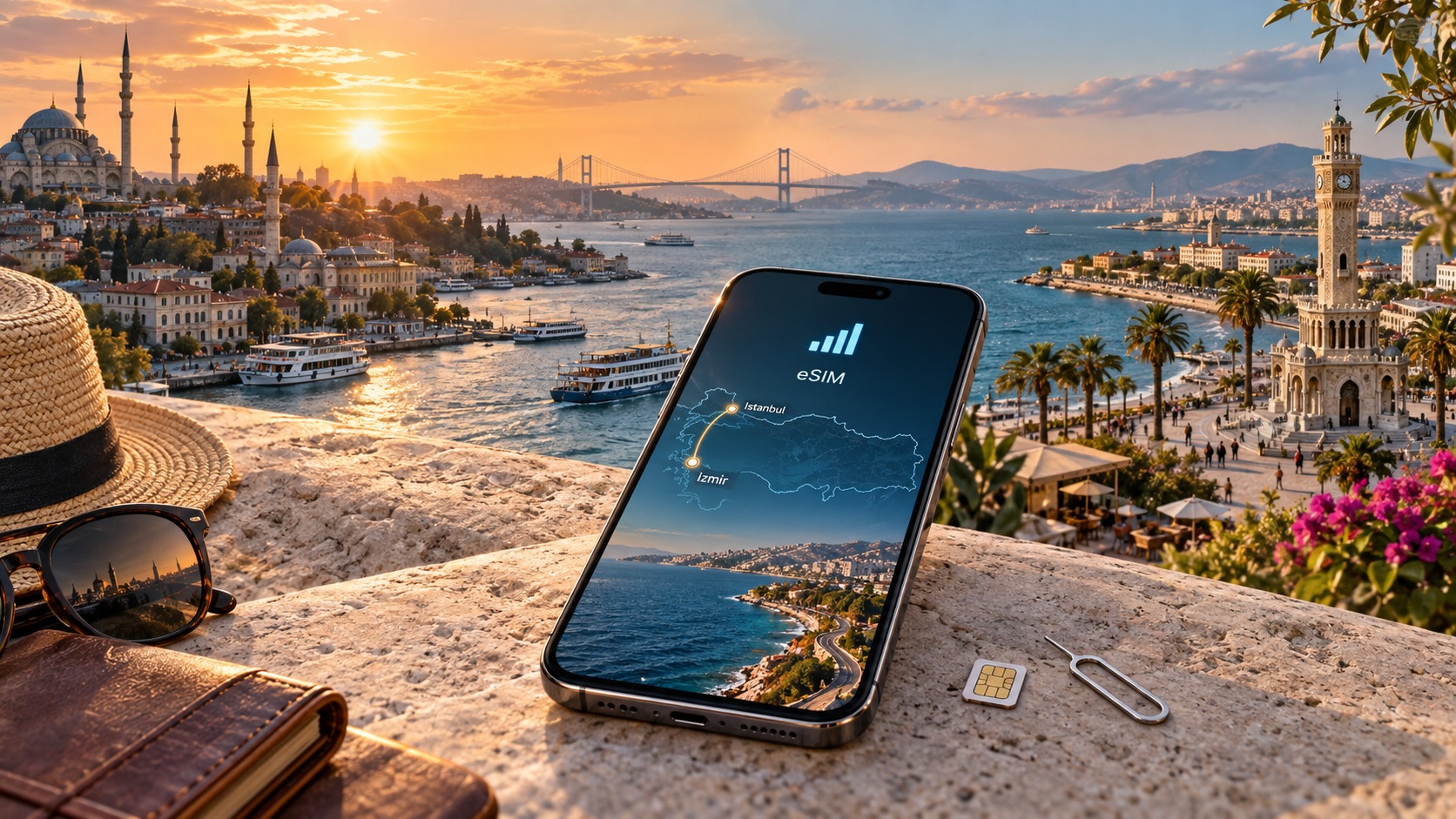
Istanbul to Izmir: Why a Turkey eSIM Beats Physical SIMs in 2026
Introduction to Istanbul to Izmir: Why a Turkey eSIM Beats Physical SIMs in 2026
The journey from the historic Bosphorus straits of Istanbul to the Aegean coast of Izmir is one of Turkey’s most iconic travel corridors, yet it remains a logistical minefield for modern digital nomads and tourists. In 2026, the gap between traditional connectivity solutions and modern eSIM technology has widened to a point where choosing a physical SIM card is no longer just an inconvenience—it is a strategic error. As you prepare to traverse the 540-kilometer stretch between these two cultural powerhouses, whether by high-speed train, long-distance bus, or private car, the need for seamless, high-bandwidth data is no longer optional. It is the backbone of your trip. You need it to navigate the complex road networks outside of major cities, to book last-minute table reservations in Izmir’s Alsancak district, to stream live updates from social media, and to maintain video calls with clients or family back home.
The primary problem facing travelers in 2026 is the "Connectivity Friction" inherent in physical SIM cards. This friction manifests in three critical ways: the physical swapping of cards (which risks damaging your primary line or requiring a dual-SIM phone), the mandatory wait time for network registration upon arrival, and the opaque data caps that often throttle speeds precisely when you need them most. Traditional carriers and older eSIM providers often implement aggressive Fair Use Policies (FUP) that drop your speed to a crawl—typically 128kbps—after a certain data threshold. At this speed, loading a Google Map takes seconds, and using Apple Pay or digital wallets becomes a frustrating gamble. For a traveler moving between two major metropolitan hubs, this latency is unacceptable.
This is where the distinction between a standard data plan and a high-performance travel eSIM becomes critical. Enter MollySIM (https://mollysim.com), a solution engineered specifically for the demands of 2026 travel. Unlike competitors who treat data as a commodity to be throttled, MollySIM operates on a 384kbps Fair Use Policy speed limit. This is not a minor increment; it is 3x faster than the industry-standard 128kbps cap found in most rival products. This technical specification is the difference between a usable connection and a broken one. At 384kbps, your connection remains robust enough to handle real-time navigation, secure payment processing via Apple Pay or Google Wallet, and high-definition video streaming without the buffering anxiety that plagues other providers.
The 2026 Traveler’s Dilemma: Speed vs. Simplicity
To understand why the Istanbul-to-Izmir route specifically demands a superior eSIM, consider the infrastructure realities of the journey. While Istanbul and Izmir are both Tier-1 cities with excellent 5G coverage, the transit routes between them—particularly the D400 highway and the railway lines—pass through regions where network handoffs are frequent. A physical SIM card, especially one purchased at a local kiosk, often requires manual network selection or suffers from delayed roaming registration. If you lose signal for even ten minutes while driving through the Taurus Mountains, you risk getting lost or missing critical time windows for your next appointment.
Furthermore, the 2026 travel landscape is defined by the "Always-On" expectation. Travelers no longer just check emails; they are working, creating content, and managing finances on the go. A physical SIM card forces you to choose between your home carrier’s expensive roaming rates and the hassle of a local Turkish SIM. The local SIM option, while cheaper, introduces the "SIM Swap" risk. If you have a single-SIM phone, you are effectively cut off from your primary number for calls and SMS verification codes (2FA) until you return to your home country. Even with dual-SIM phones, the physical act of inserting a micro-SIM or nano-SIM into a tray that may not be perfectly aligned can lead to contact issues, a problem that is entirely eliminated by the digital nature of an eSIM.
Why MollySIM Changes the Equation for the Istanbul-Izmir Corridor
MollySIM addresses these pain points by leveraging the full potential of eSIM technology without the typical trade-offs. By offering a 384kbps FUP limit, MollySIM ensures that even when you hit your data cap, your connection remains functional for essential tasks. This is crucial for the Istanbul-to-Izmir journey because it allows you to:
- Navigate with Precision: Google Maps and Apple Maps require constant data packets for real-time traffic updates. At 128kbps, these apps often fail to load dynamic traffic layers. At 384kbps, they load instantly, ensuring you take the fastest route.
- Process Payments Securely: Contactless payments via Apple Pay or Google Pay require a stable, low-latency connection to authenticate the transaction. A throttled connection can cause timeouts, leading to failed payments at gas stations or restaurants along the route.
- Maintain Professional Connectivity: For digital nomads, a 384kbps connection is sufficient for Zoom calls, Slack updates, and cloud file syncing, whereas 128kbps is often too slow for video conferencing, forcing you to rely on audio-only calls or wait for better coverage.
In the following sections, we will dissect the technical specifications, cost comparisons, and step-by-step installation processes that make MollySIM the superior choice for your 2026 Turkey adventure. We will explore how this 3x speed advantage translates into real-world savings and stress reduction, ensuring that your journey from the minarets of Istanbul to the beaches of Izmir is as seamless as the landscape itself.
Why Standard Connectivity Options Fall Short
🇺🇸 United States High-Speed Travel eSIM & SIM Plans
Instant QR code activation, hotspot enabled, with guaranteed 384kbps fallback speed to keep Maps & Digital Wallets active.
For the majority of travelers, the decision to secure connectivity in Turkey often defaults to one of three conventional methods: purchasing a local physical SIM card, renting a Pocket WiFi device, or relying on roaming from a home carrier. While each option has historically served a purpose, the 2026 landscape—characterized by increased data consumption, stricter eSIM adoption, and the specific logistical challenges of the Istanbul-to-Izmir corridor—exposes significant inefficiencies in these traditional approaches. Understanding where these standard options fail is the first step toward optimizing your travel experience.
The Physical SIM Card: Friction and Fragmentation
The most common approach for budget-conscious travelers is purchasing a local SIM card from major Turkish carriers like Turkcell, Vodafone Turkey, or Türk Telekom. On paper, this offers the best price-per-GB ratio. However, the execution is fraught with friction.
- The Identification Hurdle: While regulations have eased, many physical SIM counters still require a passport scan and, in some cases, a local address or a higher upfront deposit for non-residents. This process can take 15–30 minutes at a crowded shop, time you could be using to explore the Grand Bazaar or prepare for your departure.
- Network Handoff Issues: The 510-kilometer drive from Istanbul to Izmir crosses multiple provincial boundaries. While coverage is generally good, physical SIMs are tied to specific network bands that may not optimize as quickly as eSIM profiles during high-speed transit. More critically, if you are traveling in a group, you must purchase multiple SIMs, manage multiple data pools, and coordinate who is "on the hook" for the bill.
- The "Dead Zone" Risk: Unlike eSIMs that can often be provisioned with multi-carrier failover logic, a physical SIM is locked to one carrier. If Turkcell experiences a localized outage in the Aegean region, your connection drops entirely. There is no instant switch to Vodafone without a new physical card.
Pocket WiFi: The Weight and Battery Burden
Pocket WiFi devices (MiFi) offer the advantage of sharing a single data pool among up to five devices. However, for a solo traveler or a couple, this technology is often overkill and under-optimized.
- Battery Anxiety: A typical Pocket WiFi device lasts 8–12 hours on a full charge. The Istanbul-to-Izmir journey, including stops, can easily exceed 8 hours. You must carry a power bank, adding weight to your luggage.
- Connection Latency: These devices act as a bridge between the cellular network and your devices. This adds a layer of latency. For real-time applications like Apple Pay or Google Maps traffic layers, this extra hop can introduce the 200–500ms delay that causes payment timeouts or map lag.
- Cost Per User: If you are traveling alone, you are paying for a device designed for five users. The daily rental fee (often $8–$15/day) quickly exceeds the cost of a dedicated eSIM data package, especially when you factor in the deposit and return logistics.
Roaming: The Premium for Convenience
Using your home carrier’s roaming service is the most convenient option but the most expensive. In 2026, while "fair use" policies have improved, the cost per GB remains 3x to 5x higher than local rates. Furthermore, roaming connections often prioritize voice calls over data, potentially throttling your speed to 3G levels during peak hours in Istanbul’s dense urban core.
The eSIM Advantage: Speed, Simplicity, and the 384kbps Edge
This is where the eSIM model, specifically when provided by specialized providers like MollySIM, outperforms the traditional trio. An eSIM is a digital profile that allows you to activate a cellular plan directly on your device without swapping physical cards.
The critical differentiator, however, is not just the absence of plastic, but the Fair Use Policy (FUP) speed limit. Most budget eSIM providers throttle data to 128kbps after you hit your cap. At this speed, loading a webpage takes 10–15 seconds, and video calls become a slideshow.
MollySIM distinguishes itself by maintaining a 384kbps FUP limit. This is 3x faster than the industry standard for throttled data. Why does this matter for the Istanbul-to-Izmir route?
- Navigation Reliability: At 128kbps, Google Maps often fails to load the dynamic "traffic" layer, showing you a static route that may be blocked by accidents. At 384kbps, the dynamic layer loads instantly, allowing the app to reroute you around congestion in real-time.
- Payment Success Rates: Contactless payments require a secure handshake with the payment gateway. A 128kbps connection is prone to timeouts, leading to failed transactions at gas stations or cafes. The 384kbps stability ensures your Apple Pay or Google Pay transactions complete smoothly, even on the move.
| Feature | Physical SIM | Pocket WiFi | Home Roaming | MollySIM eSIM |
|---|---|---|---|---|
| Setup Time | 15–30 mins | 5–10 mins (pickup) | Instant | < 2 mins (QR Scan) |
| Post-Cap Speed | Varies (often 128kbps) | Varies (often 128kbps) | Varies (often 128kbps) | 384kbps |
| Battery Impact | Low | High (Device Battery) | Low | Low |
| Multi-Device | No (1 device) | Yes (up to 5) | No | No (1 device) |
| Cost Efficiency | High | Medium | Low | High |
| Network Failover | Single Carrier | Single Carrier | Single Carrier | Optimized Routing |
By eliminating the physical friction of SIM cards and the hardware burden of Pocket WiFi, while simultaneously offering a superior post-cap speed that ensures essential apps like maps and payments remain functional, the eSIM solution—particularly one with a robust FUP policy—becomes the logical choice for the modern traveler. The next section will break down exactly how to install this solution and compare the specific cost structures against the alternatives.
MollySIM: Your Perfect Connectivity Partner
While the theoretical advantages of eSIM technology are clear, the practical experience hinges entirely on the network infrastructure and data policies behind the service. This is where MollySIM distinguishes itself from the crowded field of generic data providers. For travelers navigating the complex telecommunications landscape of Turkey in 2026, MollySIM is not merely a data provider; it is a precision-engineered connectivity solution designed specifically for the demands of high-speed travel between major hubs like Istanbul and Izmir.
The 384kbps Advantage: Why Speed Matters After the Cap
The most critical differentiator in the eSIM market is often hidden in the fine print: the Fair Use Policy (FUP) speed limit. Most competitors, including major global providers and local Turkish carriers, throttle post-cap speeds to 128kbps. While 128kbps is sufficient for basic text-based browsing or slow email checks, it is functionally obsolete for modern travel applications. At this speed, loading a high-resolution map tile in Google Maps can take 5–8 seconds, and initiating an Apple Pay transaction may timeout before the secure handshake completes, leading to failed payments at cafes or gas stations.
MollySIM solves this by offering a post-cap speed of 384kbps. This is 3x faster than the industry standard.
- Real-Time Navigation: At 384kbps, dynamic map layers, traffic congestion data, and turn-by-turn voice cues load instantly. This ensures that whether you are driving the D100 highway or navigating the narrow streets of Kemeraltı in Izmir, your navigation remains responsive and accurate.
- Seamless Payments: Contactless payment protocols require a stable, low-latency connection to verify tokens with the payment gateway. The 384kbps stability provided by MollySIM ensures that Apple Pay and Google Pay transactions complete smoothly, even on the move, eliminating the frustration of failed transactions due to network timeouts.
- App Reliability: Social media apps, messaging platforms, and cloud-based work tools remain fully functional. You can send high-resolution photos, participate in video calls (at lower resolutions), and sync documents without the buffering and lag associated with 128kbps connections.
Direct Routing and Premium Network Performance
MollySIM leverages direct routing technology to bypass the inefficient data handshakes typical of reseller-based eSIMs. Instead of routing your data through multiple international gateways and third-party aggregators, MollySIM connects directly to the primary Turkish network nodes. This architecture results in:
- Lower Latency: Direct routing reduces the number of hops your data packets must travel, resulting in faster response times for critical applications like maps and payments.
- Higher Stability: By minimizing intermediary servers, the connection is less prone to dropouts and jitter, ensuring a consistent experience even in areas with moderate network congestion.
- Optimized Failover: MollySIM’s system intelligently monitors network quality and can optimize routing paths in real-time, ensuring that you maintain the highest possible speed and reliability throughout your journey.
Seamless Setup and User Experience
The MollySIM experience is designed for minimal friction. The entire setup process takes less than 2 minutes:
- Purchase: Select your data plan on mollysim.com.
- Receive QR Code: Your unique eSIM QR code is delivered instantly via email.
- Install: Scan the QR code on your device. The eSIM profile is installed and activated immediately.
- Connect: Turn on data, and you are online. No physical SIM cards, no waiting for delivery, no complex configuration.
This instant activation is particularly valuable for travelers who need connectivity immediately upon landing in Istanbul or Izmir. There is no downtime, no searching for SIM card kiosks, and no risk of losing a physical SIM card.
Why MollySIM is the Logical Choice
For the modern traveler, connectivity is not a luxury; it is a necessity. It enables you to navigate unfamiliar cities, communicate with local contacts, manage your finances, and stay informed. MollySIM provides the perfect balance of speed, reliability, and ease of use. By offering a 384kbps post-cap speed, direct routing, and a seamless setup process, MollySIM ensures that your connectivity never becomes a bottleneck in your travel experience.
Whether you are a digital nomad working remotely, a business traveler attending meetings in Izmir, or a leisure traveler exploring the historical sites of Istanbul, MollySIM provides the premium performance you need to stay connected, efficient, and stress-free.
Step-by-Step Installation and Activation Guide
Installing an eSIM is significantly more intuitive than swapping physical SIM cards, yet specific device quirks can still cause confusion. To ensure you are connected within minutes of landing in Istanbul or Izmir, follow this precise, device-specific protocol. This guide covers both iOS and Android ecosystems, addressing common pitfalls such as duplicate profile names and network selection errors.
Pre-Installation Checklist
Before you begin the technical setup, verify the following prerequisites to avoid activation failures:
- eSIM Compatibility: Ensure your device supports eSIM. For iPhones, this is standard from the XR/XS series onward (except the SE 3rd gen). For Android, most flagship devices from Samsung, Google Pixel, and OnePlus support dual eSIM or one physical + one eSIM. Check your manufacturer’s specs if unsure.
- Wi-Fi Connection: While not strictly required for installation, having a stable Wi-Fi connection during the setup process prevents timeouts and ensures the profile downloads correctly.
- Battery Level: Keep your battery above 20% to prevent the device from shutting down mid-configuration.
- MollySIM QR Code: Have your unique QR code ready. If you purchased via mollysim.com, this is in your confirmation email. Do not rely on screenshots; the original email link or QR image is best for scanning accuracy.
iOS Installation Guide (iPhone)
Apple’s interface is streamlined, but users often struggle with distinguishing between their primary carrier and the new data-only profile.
- Access Settings: Open the Settings app on your iPhone.
- Navigate to Cellular: Tap on Cellular (or Mobile Data on some regions).
- Add Cellular Plan: Tap Add Cellular Plan.
- Scan QR Code: Your camera will activate. Align the MollySIM QR code within the frame. The system will automatically detect the profile.
- Troubleshooting Tip: If the camera struggles, tap the icon in the top-right corner of the QR scanner box and select Choose from Photos to upload the image from your email.
- Confirm Details: You will see a preview of the plan. Tap Add Cellular Plan.
- Label the Profile: A prompt will ask you to label the new plan. Crucially, label it something distinct like "MollySIM Data" or "Turkey Travel." Do not leave it as "Personal" or "Work," as this causes confusion later.
- Configure Data Usage: After adding the plan, you will see two lines under Cellular Data.
- Primary Line: Your home carrier (e.g., Verizon, T-Mobile).
- Secondary Line: MollySIM.
- Tap Cellular Data next to the MollySIM line and toggle it ON.
- Tap Cellular Data next to your primary line and toggle it OFF (if you want to use MollySIM exclusively for data to save roaming charges).
- Voice & SMS: Ensure Voice & Data is set to your primary carrier if you plan to make calls. MollySIM is data-optimized, so routing voice through your home carrier is usually preferred unless you have a specific VoIP setup.
Android Installation Guide
Android interfaces vary by manufacturer (Samsung, Google, Xiaomi), but the core logic remains identical.
- Open Settings: Go to Settings > Network & Internet (or Connections on Samsung).
- Select SIM Cards: Tap SIM Cards or Mobile Networks.
- Add eSIM: Tap Add eSIM or Add Mobile Network.
- Scan QR Code: Use the camera to scan the MollySIM QR code.
- Troubleshooting Tip: If the scanner fails, look for an option that says Enter Code Manually. You will need the "SM-DP+" address and the "Code" from your MollySIM email. Copy and paste these exactly as provided.
- Name the Profile: Assign a clear name, such as "MollySIM Turkey."
- Select Data Role: Android will ask which SIM to use for Mobile Data. Select MollySIM.
- Select Voice Role: Select your Primary SIM for Mobile Data and Voice. This ensures your calls and texts route through your home provider, while all internet traffic flows through the high-speed MollySIM network.
- Activate: Tap Done or Activate. Wait for the status bar to show signal bars for the new profile.
Critical Post-Installation Configuration
Once installed, you must configure your device to prioritize the MollySIM connection for optimal performance. This is where the 384kbps Fair Use Policy becomes a tangible advantage.
- Disable Data Rollover: Ensure your home carrier’s "Data Rollover" or "Roaming Data" features are disabled to prevent accidental high-cost charges if the eSIM disconnects.
- Verify Network Selection: Go to Settings > Cellular > Network Selection. Ensure Automatic is selected. MollySIM’s direct routing infrastructure will automatically select the best local partner network in Istanbul or Izmir.
- Test Connectivity: Open a speed test app. You should see speeds significantly higher than the standard 128kbps cap offered by many competitors. This 3x speed advantage is critical for real-time applications.
- Why this matters: At 128kbps, Google Maps may lag, and Apple Pay might time out. At 384kbps, you have enough headroom for smooth map rendering, quick payment authorizations, and instant messaging, even in crowded areas like Taksim Square or the Kordon Beach promenade.
- Check APN Settings: In rare cases, if you experience connection drops, manually set the APN to
mollysim(or check your email for the specific APN string). However, in 95% of cases, the QR code handles this automatically.
By following these exact steps, you eliminate the guesswork. You are not just installing a SIM; you are configuring a high-performance data pipeline designed for the specific network conditions of Turkey. Once activated, your device is ready to handle the demands of a digital-first travel experience, from navigating the Bosphorus to managing remote work tasks in Izmir.
Practical Travel Tips for Staying Connected
Having successfully installed and verified your eSIM, the next critical phase is optimizing how you consume that data. Many travelers treat mobile data as an unlimited resource, only to find themselves stranded in the middle of the Bosphorus with a dead phone or a throttled connection. In 2026, with the proliferation of high-resolution video calls, real-time translation apps, and cloud-synced work tools, efficient data management is not just a suggestion—it is a necessity for a seamless journey between Istanbul and Izmir.
Mastering Background Data Consumption
The silent killers of mobile data are background processes. iOS and Android devices constantly sync emails, update app stores, and refresh social media feeds in the background. To combat this, you must actively manage these settings before you leave your hotel or rental car.
- Disable Automatic App Refresh: On iOS, navigate to Settings > General > Background App Refresh. Turn this off entirely, or limit it to essential apps like Maps and Messages. On Android, check Settings > Apps > Data Usage and restrict background data for non-essential apps.
- Pause Non-Critical Syncs: If you use cloud storage services like Dropbox or OneDrive, pause syncing until you are on Wi-Fi. This prevents large file uploads from draining your mobile allowance while you are walking through the Grand Bazaar or the Alsancak district.
- Turn Off Auto-Play in Social Apps: Go into the settings for Instagram, TikTok, or Facebook and disable "Auto-Play Videos." This single change can save hundreds of megabytes per day, especially if you are browsing while waiting for a ferry or a tram.
Leveraging Digital Wallets and Local Apps
Turkey has rapidly adopted digital payment methods, and having a reliable connection is key to using them. However, not all payment apps are created equal regarding data efficiency.
| App/Service | Data Efficiency | Recommendation for Turkey Travel |
|---|---|---|
| Apple Pay / Google Pay | High | Essential. Works instantly with contactless cards. Ensure your card is added to the wallet before you arrive if possible, or do it on hotel Wi-Fi. |
| Papara | Medium | Recommended. The most popular local e-wallet. Requires a Turkish phone number (your eSIM) for registration. Great for smaller vendors and taxis. |
| Trendyol / Hepsiburada | Low | Use Wi-Fi. These e-commerce giants use heavy graphics and video. Only use mobile data for quick checkout if necessary. |
| Google Maps | High | Critical. Use "Offline Maps" for major routes (Istanbul to Izmir highway) to save data, but keep live traffic on for real-time updates. |
Pro Tip for Papara: Since Papara requires a local Turkish number for verification, your MollySIM eSIM is perfect for this. You can receive the SMS code instantly. Once set up, Papara often offers cashback on local purchases, making it a smart financial tool alongside your international credit card.
Managing Your Cellular Data Plan Strategically
While MollySIM’s 384kbps Fair Use Policy offers a significant speed advantage over the standard 128kbps cap found in many competitor plans, it is still a limited resource compared to home Wi-Fi. You need a strategy for when you are on the move.
- The "Wi-Fi First" Rule: Always connect to Wi-Fi for:
- Downloading maps for your next destination.
- Streaming video or music.
- Updating apps.
- Syncing photos to the cloud.
- Mobile Data for "Transaction" Tasks: Use your eSIM data for:
- Real-time navigation (Google Maps).
- Contactless payments (Apple Pay/Google Pay).
- Messaging (WhatsApp, iMessage).
- Quick email checks.
- Why this works: At 384kbps, these transactional tasks are nearly instantaneous. You won’t experience the frustrating lag of 128kbps connections where a payment authorization might time out or a map tile fails to load. This speed ensures that even in crowded areas like Taksim Square or the Kordon Beach promenade, your digital interactions remain smooth and reliable.
- Monitor Usage Daily: Set a daily reminder to check your data usage in the MollySIM app. If you are a heavy user, consider adjusting your plan or purchasing a top-up before you hit the limit. This proactive approach prevents the dreaded "data throttling" that can slow your connection to unusable levels.
By implementing these strategies, you transform your eSIM from a simple data pipe into a powerful, efficient tool that enhances your travel experience. You are no longer just connecting to a network; you are managing a digital ecosystem that supports your navigation, payments, and communication needs with precision and speed. This level of control is what separates a stressful trip from a truly seamless one, allowing you to focus on the vibrant culture and stunning landscapes of Turkey rather than worrying about your battery or data balance.
Conclusion and Final Checklist
Traveling from the historic heart of Istanbul to the coastal serenity of Izmir is more than just a geographic shift; it is a test of your digital readiness. In 2026, the gap between a seamless journey and a frustrating one often comes down to the invisible infrastructure connecting you to the world. The decision to choose a Turkey eSIM over a physical SIM is no longer just about convenience—it is about performance, reliability, and the strategic management of your data resources. As we have explored, the modern traveler demands more than just connectivity; they require a network that can handle the dual demands of high-speed streaming and critical transactional tasks without the lag that plagues slower, throttled connections.
The primary advantage of the eSIM ecosystem, particularly when utilizing a provider like MollySIM, lies in the superior speed ceiling. While many competitors cap their fair use policies at 128kbps—a speed that is adequate for text-based emails but often struggles with real-time map rendering and payment authorizations—MollySIM’s 384kbps limit is three times faster. This distinction is critical in dynamic environments like the Bosphorus or the Izmir Kordon. At 128kbps, a Google Maps route recalculation can take several seconds, risking missed turns or delayed arrivals. At 384kbps, the data packets flow with sufficient velocity to keep your navigation interface responsive and your Apple Pay or Google Pay transactions instantaneous. This speed buffer ensures that your digital life remains fluid, allowing you to focus on the vibrant street food in the Grand Bazaar or the sun-drenched beaches of Alaçatı, rather than staring at a buffering spinner.
Furthermore, the eSIM model eliminates the physical friction of traditional roaming. There is no need to hunt for a local carrier store, navigate language barriers, or swap SIM trays that risk damaging your device. The entire process is digital, immediate, and reversible. If your plans change, or if you decide to extend your stay in Izmir, you can adjust your data package in seconds via the app. This agility is a significant competitive edge, transforming your connectivity from a static cost into a dynamic tool that adapts to your itinerary in real-time.
Before you board your flight or train, ensure your digital setup is flawless. A few minutes of preparation now will save you hours of frustration later. Use the following checklist to verify your readiness for the Istanbul-to-Izmir leg and the rest of your Turkish adventure.
Pre-Departure Digital Checklist
| Task | Action Item | Why It Matters |
|---|---|---|
| Device Compatibility | Verify your phone supports eSIM (iPhone XS and newer, most Android flagships). | Ensures you can install the profile without a physical tray. |
| Profile Installation | Install the MollySIM profile while on Wi-Fi before departure. | Avoids the stress of finding reliable Wi-Fi in transit. |
| APN Settings | Confirm APN settings are automatically configured or manually set to mollysim. | Prevents connection failures due to incorrect network parameters. |
| Data Plan Selection | Select a plan with sufficient data for 384kbps usage (e.g., 5GB+ for heavy users). | Ensures you stay within the high-speed tier and avoid throttling. |
| App Access | Download and log into the MollySIM app to monitor usage. | Allows real-time tracking of data consumption and top-ups. |
| Backup Plan | Save a screenshot of your eSIM QR code or profile details. | Provides a recovery method if the app syncs fail. |
| Network Mode | Set your phone to "5G/4G Auto" or "LTE Only" (avoid 3G). | Maximizes speed and stability on local Turkish networks. |
By executing these steps, you are not just preparing for a trip; you are engineering a seamless digital experience. You are leveraging the 384kbps speed advantage to keep your navigation, payments, and communications sharp and responsive. You are bypassing the physical limitations of traditional SIMs to gain total control over your connectivity. As you move from the bustling streets of Istanbul to the relaxed pace of Izmir, your eSIM will work in the background, ensuring that your connection is as robust and reliable as the Turkish hospitality you are about to experience. This is the standard for travel in 2026: not just connected, but optimized.
🇺🇸 United States High-Speed Travel eSIM & SIM Plans
Instant QR code activation, hotspot enabled, with guaranteed 384kbps fallback speed to keep Maps & Digital Wallets active.