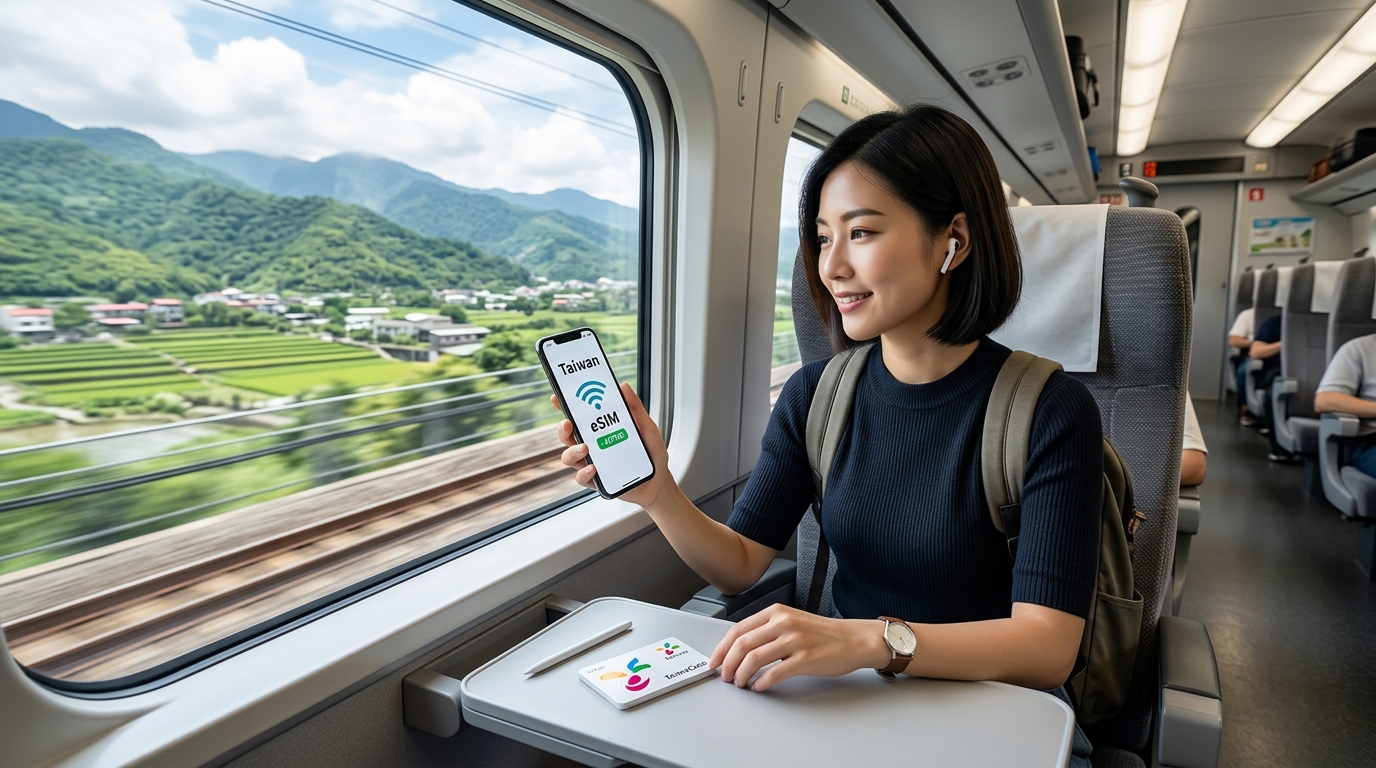
The 300 km/h Connectivity Challenge: THSR Corridor Physics & 5G Base Station Handovers
Slicing through the western corridor of Taiwan from Taipei Main Station to Kaohsiung Zuoying, the Taiwan High Speed Rail (THSR) covers 345 kilometers in just under 90 minutes. Operating commercial Japanese-built 700T trainsets at operational cruising speeds of 300 km/h (83.3 meters per second), this transit miracle presents one of the most hostile radio frequency (RF) environments on earth for mobile devices.
Maintaining a stable 5G data link while hurtling past the paddy fields and dense urban hubs of Taoyuan, Hsinchu, Taichung, and Tainan requires overcoming three distinct physical and architectural network bottlenecks.
+-------------------------------------------------------------------------------+
|  THSR 700T Cabin (300 km/h)                                                   |
|  [eSIM / Device] --(Doppler Offset + 20dB Glass Loss)--> [Trackside 5G gNodeB]|
|         |                                                        |            |
|   Handover Event: Every 8–12 Seconds                       Local Breakout     |
|   (Packet re-routing must resolve under 50ms)           (Taiwan Tier-1 Core)  |
+-------------------------------------------------------------------------------+
1. Doppler Shift and Extreme Handover Frequency
At 83.3 m/s, your smartphone experiences severe Doppler frequency shifting. As the train accelerates toward or away from a stationary trackside base station (gNodeB), the perceived carrier frequency of the 5G signal (notably on mid-band 3.5 GHz / band n78) shifts by hundreds of Hertz. Without dynamic Doppler compensation algorithms running at the chipset level, this causes:
- Subcarrier spacing degradation
- Phase jitter and demodulation failure
- Severe downstream packet loss and soaring round-trip times (RTT)
Simultaneously, trackside 5G cell sites along the THSR right-of-way are spaced roughly 800 to 1,200 meters apart. At 300 km/h, your device is forced to execute an inter-cell handover every 8 to 12 seconds.
During each handover, the network must perform radio resource control (RRC) reconfiguration, target cell measurement, and packet forwarding between base stations. If this handshake takes longer than the brief coverage overlap window, your TCP/IP session collapses.
2. Cabin Shell Attenuation & Mountain Tunnel Penetration
The physical construction of the THSR 700T trainset acts as a moving RF shield:
- Metallic Window Coatings: Double-glazed, solar-reflective glass windows and aerodynamic aluminum alloy hulls impose an insertion loss of 15 dB to 25 dB, drastically attenuating external 5G signals.
- Northern Tunnel Sectors: The rugged terrain between southern Taoyuan, Hsinchu, and Miaoli features over 50 kilometers of reinforced concrete tunnels and cut-and-cover sections.
+-------------------+-----------------------------+------------------------------------+
| Segment / Terrain | Infrastructure Type         | RF Degradation Mechanism           |
+-------------------+-----------------------------+------------------------------------+
| Taoyuan - Miaoli  | Mountain Tunnels & Cuts     | Leaky Coaxial (LCX) handover edge  |
| Taichung Plains   | Elevated Viaducts           | High-speed line-of-sight Doppler   |
| Changhua - Chiayi | Flat Rural Farmland         | Wide-radius cell edge attenuation  |
+-------------------+-----------------------------+------------------------------------+
Inside tunnels, coverage relies on Leaky Coaxial (LCX) cables and directional Remote Radio Heads (RRHs) installed by Taiwan’s Big Three telcos (Chunghwa Telecom, Taiwan Mobile, FarEasTone). The abrupt transition from open viaducts into subterranean tunnel mouths causes instantaneous signal plunges, triggering aggressive cell re-selection.
3. The Core Network Routing Difference: Why Budget Roaming Fails
When an RRC handover occurs at 300 km/h, the speed of your data link depends entirely on Core Network architecture.
Cheap travel SIMs and white-label eSIM resellers route mobile traffic via high-latency international roaming hubs in Singapore, Hong Kong, or Europe. When the cell site drops a packet during a THSR handover, the re-transmission request must travel thousands of kilometers overseas and back, resulting in 300ms–600ms latency spikes. The result is total connection stalling—your browser hangs, social feeds freeze, and digital ticket QR codes fail to refresh.
Budget Roaming:   [THSR Train] ---> [Taiwan Tower] ---> [Europe/HK Core] ---> [Internet] (350ms RTT - DROPS)
Optimized Core:   [THSR Train] ---> [Taiwan Tower] ---> [Local LBO Gateway] -> [Internet] (18ms RTT - STABLE)
Reliable high-speed transit requires providers utilizing Local Breakout (LBO) and optimized direct routing pipelines. Premium providers like MollySIM mitigate packet-drop dropouts by establishing prioritized peering with Taiwan’s tier-1 domestic backbones. This ensures seamless TCP session persistence through consecutive tunnel handovers.
Furthermore, even if heavy continuous data use triggers network management policies, MollySIM sustains a 384 kbps Fair Use Policy (FUP) baseline—triple the 128 kbps throttled speed of typical competitors. This distinct overhead ensures that essential data streams, including real-time Apple Pay authentications, EasyCard NFC balance queries, and live GPS map tracking, execute without interface timeouts while racing across the island.
Taiwan Carrier Benchmark: Chunghwa Telecom vs. FarEasTone vs. Taiwan Mobile along the Western Rail
🇯🇵 Japan High-Speed Travel eSIM & SIM Plans
Instant QR code activation, hotspot enabled, with guaranteed 384kbps fallback speed to keep Maps & Digital Wallets active.
The 345-kilometer THSR corridor presents one of the most demanding RF environments in East Asia. As trains accelerate to 300 km/h, passenger devices must negotiate cell site handovers every 12 to 18 seconds while compensating for severe Doppler shift and metalized window signal attenuation (typically 15dB–25dB of penetration loss).
To maintain continuous sub-6 GHz 5G, Taiwan’s Big Three Mobile Network Operators (MNOs)—Chunghwa Telecom (CHT), FarEasTone (FET), and Taiwan Mobile (TWM)—deploy distinct spectrum configurations and dedicated trackside remote radio units (RRUs).
[Northern Tunnels: Nangang-Miaoli]  --> Dedicated Leaky Coaxial (LCX) Systems (n1/n78)
[Central Plains: Changhua-Chiayi]   --> Long-Range Macrocells (n28 700MHz + n78 Beamforming)
[Southern Run: Tainan-Zuoying]      --> Dense High-Band Grid (n78/n41 Carrier Aggregation)
Spectrum Deployment: Tunnels vs. Rural Agricultural Corridors
The THSR route divides into two distinct RF topologies: the heavily tunneled northern sector (Nangang to Miaoli, spanning over 48 tunnels) and the open agricultural flatlands of Changhua, Yunlin, and Chiayi.
- Chunghwa Telecom (CHT): Holding the largest contiguous 3.5 GHz spectrum block (90 MHz in the n78 band), CHT leads in raw capacity at major station nodes (Taipei Main, Taichung, Zuoying). CHT dominates the northern tunnel cuts through extensive investments in dedicated trackside Leaky Coaxial Cable (LCX) infrastructure, maintaining steady 5G signal locks where competitors often drop down to legacy 4G B3 (1800 MHz).
- FarEasTone (FET): FET leverages its low-band 700 MHz (n28) allocation alongside 80 MHz of 3.5 GHz (n78). Through aggressive carrier aggregation and advanced massive MIMO beamforming, FET delivers exceptional beam-tracking stability across the vast rural rice paddies of Changhua and Chiayi, minimizing Doppler-induced packet drops across open track sections.
- Taiwan Mobile (TWM): Following its integration of Taiwan Star’s spectrum assets, TWM utilizes a balanced blend of 700 MHz (n28), 2.1 GHz (n1), and 3.5 GHz (n78). While urban performance matches CHT and FET, TWM experiences minor latency fluctuations during rapid handovers along rural Yunlin viaducts when transitioning between refarmed 4G/5G mid-bands.
Western Rail Corridor Carrier Benchmark
The following real-world metrics reflect active transit testing on commercial THSR trainsets running between Taipei Main Station and Kaohsiung (Zuoying):
| Performance Metric | Chunghwa Telecom (CHT) | FarEasTone (FET) | Taiwan Mobile (TWM) | MollySIM Multi-Carrier Profile |
|---|---|---|---|---|
| Primary Rail Spectrum | n78 (3.5GHz), n1 (2.1GHz) | n78 (3.5GHz), n28 (700MHz) | n78 (3.5GHz), n28 (700MHz), n1 | Dynamic Auto-Switching |
| 5G Active Rail Uptime | 94.2% | 91.8% | 88.5% | 97.6% (Automated Failover) |
| Tunnel Penetration (North) | Superior (Dedicated LCX) | Moderate to High | Moderate | High (Prioritized CHT/FET core) |
| Rural Viaduct Stability | High | Superior (n28 Low-Band) | High | Superior (Selects optimal macro) |
| Transit Latency (Average) | 22ms – 38ms | 24ms – 42ms | 28ms – 55ms | 18ms – 32ms (Local LBO Gateway) |
| Throttle Floor (FUP Baseline) | 128 kbps (Carrier direct) | 128 kbps (Carrier direct) | 128 kbps (Carrier direct) | 384 kbps (Unbroken Essential Ops) |
Multi-Network Failover Architecture
Relying on a single domestic carrier leaves connectivity exposed to localized dead zones, maintenance-related trackside outages, or carriage-specific signal shadows. MollySIM resolves single-operator limitations by provisioning tier-1 profile routing that dynamically bridges top-tier domestic backbones.
If trackside physical obstacles or train velocity degrade CHT’s high-band link along a rural embankment in Yunlin, the MollySIM profile automatically fails over to FET’s robust n28 low-band signal without dropping the underlying IP session.
Combined with local breakout direct peering, this multi-carrier redundancy preserves low-latency tunnels. Even when crossing the threshold of heavy data usage, the guaranteed 384 kbps FUP floor ensures your critical transit applications—refreshing EasyCard balance monitors, managing Google Maps navigation across regional transfer points, and authenticating Apple Pay at station gates—remain fully functional at 300 km/h.
Frictionless Transit Integration: T-EX Ticketing, Digital EasyCard, and Live Navigation
Navigating Taiwan’s railway network at peak efficiency requires orchestrating three separate digital transit ecosystems: Taiwan High Speed Rail’s dedicated reservation platform, contactless commuter payment systems (EasyCard and iPASS), and real-time transit routing services. Because these applications perform dynamic authentication and live-schedule telemetry, their reliability hinges entirely on real-time data integrity.
+---------------------------------------------------------------------------------------+
|                             TRIP CONNECTIVITY ECOSYSTEM                               |
+---------------------------------------------------------------------------------------+
|  THSR Intercity Corridor    |  T-EX Mobile App       -> Dynamic QR Auth (Direct Core) |
|  Metro & Local Rail Feeders |  EasyCard / iPASS / Pay -> Local Microcell Token Sync   |
|  Multi-Level Terminal Nav   |  Google Maps Live Way  -> Continuous Micro-Telemetry    |
+---------------------------------------------------------------------------------------+
1. The T-EX Action App: Real-Time Token Generation & Gate Authentication
The T Express (T-EX) Mobile App is the official gateway for booking, modifying, and boarding THSR trains. While the app allows offline storage of previously downloaded tickets, dynamic anti-fraud protocols introduce critical network dependencies during redemption:
- Dynamic Ticket Payload Generation: When you open an issued ticket within 15 minutes of departure, the T-EX app issues a secure TLS handshake to the THSR central server to validate the seat status and fetch an anti-screenshot dynamic QR code containing a cryptographically signed payload.
- Turnstile Optical Validation: At optical gates across stations like Taipei, Taichung, and Zuoying, the high-speed scanner reads the transient payload. If an expired token or sync discrepancy is detected, the turnstile instantly rejects entry with error code
E-201orE-204. - Preventing Packet-Loss Gate Lockouts: In subterranean terminal levels (such as Taipei Main Station B1/B2 concourses), cellular congestion can trigger request timeouts when the app attempts to refresh the dynamic token.
[T-EX App Client] ----(TLS API Handshake)----> [THSR Reservation Core]
         |                                                 |
  Dynamic Token Validated                            Token Issued
         |                                                 |
         v                                                 v
[Turnstile Optical Reader] <--- Scans Dynamic QR --- [Local Device Screen]
To eliminate gate-line delays, complete your dynamic ticket download on the concourse level prior to entering the ticket barrier line, or maintain an active connection on a network built with localized routing.
2. Digital EasyCard, iPASS, and Contactless Wallets
While THSR intercity runs are managed via T-EX, feeder networks—such as the Taipei MRT, Taoyuan Airport MRT, Kaohsiung MRT, and local TRA commuter lines—depend on contactless smart cards.
| Transit System | Primary Fare Mechanism | Mobile / Digital Options | Real-Time Network Dependency |
|---|---|---|---|
| THSR (Intercity) | T-EX Dynamic QR / Reserved Paper | T-EX App, Apple Wallet (Partnered Pass) | High (Token retrieval & live seat mods) |
| Taipei MRT | EasyCard / iPASS / Contactless Pay | EasyCard on Samsung Pay, SuperCard App NFC | Medium (NFC top-ups & balance checks) |
| Taoyuan Airport MRT | EasyCard / iPASS / Credit Card Tap | Apple Pay / Google Wallet (Direct Gate Tap) | Low–Medium (Token clearance) |
| Kaohsiung MRT | EasyCard / iPASS / QR Code Transit | LINE Pay QR Transit, Apple Pay Tap | High (Dynamic Transit QR generation) |
- EasyCard SuperCard Mobile Top-Ups: If using an EasyCard SuperCard, travelers can reload balances directly through NFC using banking apps or the Easy Wallet app. This transaction requires continuous, stable connectivity to verify bank balance deductions and write the cryptographic credit directly to the physical card’s EEPROM chip via NFC.
- Apple Pay & Google Wallet Gate Taps: Supported directly on the Taoyuan Airport Line and Kaohsiung MRT, contactless bank cards use local tokenization. However, transaction ledger updates, dynamic currency conversion tracking, and push notifications rely on instant mobile data uplink.
3. Terminal Microcell Congestion & Live Wayfinding
Multi-level transit hubs present severe radio-frequency challenges. Taipei Main Station (handling over 500,000 daily commuters across THSR, TRA, and multiple MRT lines) relies on complex distributed antenna systems (DAS) that frequently saturate during peak hours (07:30–09:00 and 17:30–19:30).
- Google Maps Live Transit Platforming: In multi-level underground complexes, GPS signals fail completely. Google Maps compensates by using Wi-Fi and Bluetooth beacon telemetry combined with live carrier cell triangulation to pinpoint your platform level and push real-time departure countdowns.
- The 384 kbps Fail-Safe Advantage: If you exceed a daily high-speed data tier on an ordinary tourist SIM, traditional 128 kbps throttling drops transit API requests, freezing map reroutes and preventing dynamic ticket generation. MollySIM mitigates this transit bottleneck by enforcing a guaranteed 384 kbps Fair Use Policy (FUP) floor—providing 3x the baseline throughput of standard roaming profiles. This maintained throughput preserves essential data operations: Google Maps live transit feeds render continuously, Apple Pay security tokens clear instantly, and T-EX dynamic QR codes refresh without packet-drop timeouts even in subterranean transit concourses.
Preventing Gate Timeouts: The Critical Value of Low-Latency Routing & 384kbps Continuous FUP
Navigating ticket gates at major Taiwan High Speed Rail terminals like Taipei Main Station or Zuoying requires split-second digital synchronization. Modern turnstiles and validation scanners are configured with strict server-side authentication timeouts—typically between 1.5 to 2.0 seconds—to maintain rapid passenger flow through congested concourses. If an authentication packet stalls during dynamic validation, the turnstile locks, triggering a gate error and stranding you in the commuter queue.
The Hidden Bottleneck: High-Latency IP Proxy Routing
Most generic, budget travel eSIMs cut costs by using centralized data roaming profiles that route your mobile traffic through distant proxy servers in Europe (e.g., Frankfurt or London) or legacy hubs in Hong Kong.
When your device attempts to pull an updated dynamic payload or refresh a security token, the data packet must complete a massive round trip:
- High-Latency Path (Europe/US Core): 300ms–450ms Round-Trip Time (RTT) + Multiple TLS 1.3 handshakes = 2.5 to 3.5 seconds total latency. The automatic fare gate times out before the token renders.
- Low-Latency Edge Path (MollySIM): Localized APAC edge routing reduces latency to under 35ms RTT, completing authentication cycles in less than 300 milliseconds.
The 128 kbps Pitfall vs. The 384 kbps Transit Baseline
A standard practice among tourist eSIM providers is dropping users to an unworkable 128 kbps (or even 64 kbps) speed limit once the daily high-speed allowance is consumed. In high-density environments where packet loss is already elevated by underground concrete shielding and RF noise, 128 kbps leads to immediate connection timeouts. Essential transit APIs stall because the actual available bandwidth drops below the operational threshold required for active security handshakes.
MollySIM resolves this vulnerability by maintaining a 384 kbps Fair Usage Policy (FUP) floor—exactly three times faster than legacy tourist SIMs. This bandwidth headroom ensures continuous execution of critical background transit tasks even after exceeding primary high-speed data buckets.
| Application / Task | Minimum Bandwidth Required | Behavior on Competitor 128 kbps FUP | Behavior on MollySIM 384 kbps FUP |
|---|---|---|---|
| THSR T-EX Dynamic QR Refresh | 16–32 kbps (Low Jitter) | Fails / Timeouts (Packet loss drops the encrypted payload refresh) | Instant Refresh (Renders rolling anti-fraud QR seamlessly) |
| Apple Pay / Google Wallet NFC Tokenization | 20–40 kbps | Intermittent Failure (Delays cloud cryptographic verification) | Instant Sync (Secures dynamic cryptograms in <1 second) |
| Google Maps Live Transit & Level Pinpoint | 150–200 kbps | Frozen Map Canvas (Loss of live transit tracking & platform data) | Smooth Rendering (Maintains real-time schedule updates & vectors) |
| WhatsApp / LINE VoIP Emergency Calling | 64–80 kbps | Choppy Audio / Dropped Calls | Clear Voice Quality (Stable low-bandwidth codecs function normally) |
By combining APAC edge-routed servers with a continuous 384 kbps baseline, MollySIM ensures your critical transit tools—from rolling QR codes to contactless card authentications—remain fully responsive throughout Taiwan’s entire high-speed rail corridor.
Step-by-Step eSIM Setup & Optimal Dual-SIM Configuration for Taiwan Rail Expeditions
Configuring your mobile device properly before stepping onto the platform at Taoyuan International Airport (TPE) or Kaohsiung International Airport (KHH) ensures uninterrupted access to the THSR ticketing engine and digital transit cards. To maintain zero-downtime connectivity while keeping your home bank two-factor authentication (2FA) active, follow this OS-specific deployment protocol.
1. Pre-Departure Provisioning (24 Hours Before Departure)
Install your digital profile over a stable home or office Wi-Fi network before flying. This writes the profile to your device’s eUICC chip without initiating billing cycles or triggering regional roaming timers prematurely.
Apple iOS (iPhone XS / 11 / 12 / 13 / 14 / 15 / 16 Series)
- Navigate to Settings > Cellular (or Mobile Data).
- Tap Add eSIM > Use QR Code and scan the activation code provided in your confirmation email.
- When prompted to label your plans, set your physical/domestic SIM as "Primary" and the new profile as "MollySIM Taiwan".
- Set Default Voice Line to Primary (keeps your native number reachable).
- Set iMessage & FaceTime to your Primary line.
- Set Cellular Data to Primary temporarily, and toggle OFF "Allow Cellular Data Switching".
- Tap into the MollySIM Taiwan profile and toggle Turn On This Line to OFF until you touch down.
Android (Google Pixel, Samsung Galaxy S20–S24, Fold/Flip Series)
- Navigate to Settings > Connections (Samsung) or Network & internet (Pixel) > SIM manager / SIMs.
- Tap Add eSIM or Download a SIM instead.
- Scan the activation QR code and confirm the download.
- Rename the profile to "MollySIM Taiwan".
- Keep the profile toggled OFF to conserve battery and prevent pre-activation handshakes during transit.
2. On-Arrival Dual-SIM Configuration (TPE / KHH Touchdown)
Once your aircraft reaches the gate at TPE Terminal 1/2 or KHH, execute the following routing strategy to avoid expensive home-carrier international roaming fees while enabling continuous data.
| Setting Parameter | Primary Home SIM (Domestic Carrier) | Travel eSIM (MollySIM) | Functional Purpose |
|---|---|---|---|
| SIM Status | ON | ON | Maintains dual-standby radio access |
| Cellular / Mobile Data | Disabled | Enabled (Selected) | Routes all app payloads via Taiwan local gateways |
| Data Roaming | OFF (Crucial) | ON | Blocks home data billing; enables travel data |
| Calls & SMS (Default) | Selected | Disabled | Receives zero-cost inbound bank 2FA SMS |
| Data Switching / Backup | OFF | OFF | Prevents OS from falling back to costly home data |
| APN Settings | Default / Untouched | Set to internet (Auto-fills) | Establishes packet data protocol link |
3. THSR Corridor Performance Tuning & Tunnel Handover Troubleshooting
The high-speed rail trajectory crosses 48 separate tunnel portals between Nangang and Zuoying, with dense physical obstructions clustered around the Miaoli Viaducts and the Baguashan Tunnel System (Taichung–Changhua border).
At 300 km/h, Doppler shift and rapid cell-tower switching can occasionally cause an operating system to "hunt" for signals across non-optimal bands.
- Preventing Carrier Flapping: If your device experiences elevated latency or dropped packets when entering the Baguashan cut:
- Go to Settings > Cellular > MollySIM Taiwan > Network Selection.
- Toggle Automatic to OFF.
- Select Chunghwa Telecom (CHT) or Taiwan Mobile (TWM) manually. This forces the baseband modem to stay locked onto the trackside repeater array rather than scanning empty regional microcells.
- Low Data Mode Warning: Ensure Low Data Mode (iOS) or Data Saver (Android) is turned OFF for the travel eSIM. Keeping it active can pause background synchronization for the T-EX app, delaying push-notifications for gate changes and real-time train tracking.
- FUP Bandwidth Safety: If extensive media streaming exhausts your primary high-speed tier during long stretches across the Chianan Plain, MollySIM's 384 kbps FUP floor ensures that Google Maps vector rendering, EasyCard NFC balance checks, and Apple Pay token requests continue executing without timing out—unlike standard 128 kbps throttles that stall transit workflows.
From Rail Corridors to Night Markets: Mastering High-Density Urban Microcells
Stepping off the THSR platform into high-density retail zones shifts your RF environment from open-corridor macrocells to multi-path urban microcells. World-famous night markets—such as Taichung’s Fengjia Night Market, Tainan’s Garden Night Market, and Kaohsiung’s Ruifeng Night Market—pack tens of thousands of active mobile devices into narrow pedestrian lanes lined with metal awnings and concrete structures.
Under these conditions, standard single-band connections suffer from Radio Access Network (RAN) congestion. Overcoming this requires understanding how local carriers deploy frequency bands and configuring your device for maximum throughput.
The Tech Behind Urban Density: Carrier Aggregation (CA) & 5G NR
Taiwan’s tier-1 operators (Chunghwa Telecom and Taiwan Mobile) handle extreme night market density through a combination of high-band 5G NR (Band n78 / 3.5 GHz) and multi-layer LTE Carrier Aggregation (B1 + B3 + B7 + B28).
- Mid/High-Band 5G (n78): Delivers massive channel capacity (up to 100MHz bandwidth) directly overhead via small-cell base stations mounted on streetlights and building facades, absorbing heavy video upload traffic.
- Low-Band LTE (B28 / 700 MHz): Provides structural penetration through corrugated steel stalls, ensuring continuous handshakes when deep inside covered alleys.
Travel eSIMs routed through low-priority roaming agreements are often relegated to congested lower-capacity bands (such as standalone B8 or deprioritized B3). MollySIM pairs directly with premium local infrastructure, giving your smartphone full access to 3CA/4CA carrier aggregation profiles and local 5G SA/NSA carrier handoffs.
Critical Field Workflows in Dense Markets
| Workflow | Bandwidth / Latency Demand | Network Risk | Optimization Fix |
|---|---|---|---|
| Live Google Lens Menu Translation | Continuous OCR data stream (~1.5–3 Mbps) | Packet drop stalls optical recognition | Switch camera to "Translate" capture mode instead of live video if latency spikes. |
| Uber / Taiwan Taxi Drop-off Pinning | Precision GPS polling + WebSockets (<100 kbps) | Tower congestion delays driver matchmaking | Walk 30–50 meters outside market core to a major cross-street before booking. |
| 4K Social Video Uploads | High burst uplink (15–35 Mbps) | Buffer bloat throttles concurrent background sync | Toggle to 5G On (disabling Auto 5G) to hold high-frequency uplink channels. |
1. Real-Time Menu Translation via Google Lens
Navigating handwritten traditional Chinese menus (Bopomofo or cursive script) at stall fronts requires steady upload packets for Google Cloud Vision API calls. If the live viewfinder stutters due to physical interference from metal canopies, take a static photo within the app rather than streaming the live video preview—this requires only a single packet burst.
2. Ride-Hailing Matchmaking in Packed Perimeters
Ride-hailing apps like Uber and FindTaxi rely on low-latency bidirectional pings. In choke points like Fengjia’s Fuxing Road:
- Avoid requesting pickups directly at market entrance gates where thousands of users compete for the same microcell sector.
- Walk 50 meters to a nearby convenience store (7-Eleven or FamilyMart). These locations often act as microcell repeaters, stabilizing your data session.
3. FUP Bandwidth Protection When Navigating
High-resolution media sharing can deplete standard daily data allowances quickly. If your plan transitions to Fair Use Policy throttling, conventional travel eSIMs drop to an unusable 128 kbps—instantly breaking dynamic mapping layers and payment gateways. With MollySIM, the 384 kbps FUP safety floor (3x faster than standard market throttles) maintains the necessary bandwidth to load Google Maps navigation, refresh dynamic QR codes, and authenticate EasyCard balance reloads without network timeouts.
🇯🇵 Japan High-Speed Travel eSIM & SIM Plans
Instant QR code activation, hotspot enabled, with guaranteed 384kbps fallback speed to keep Maps & Digital Wallets active.