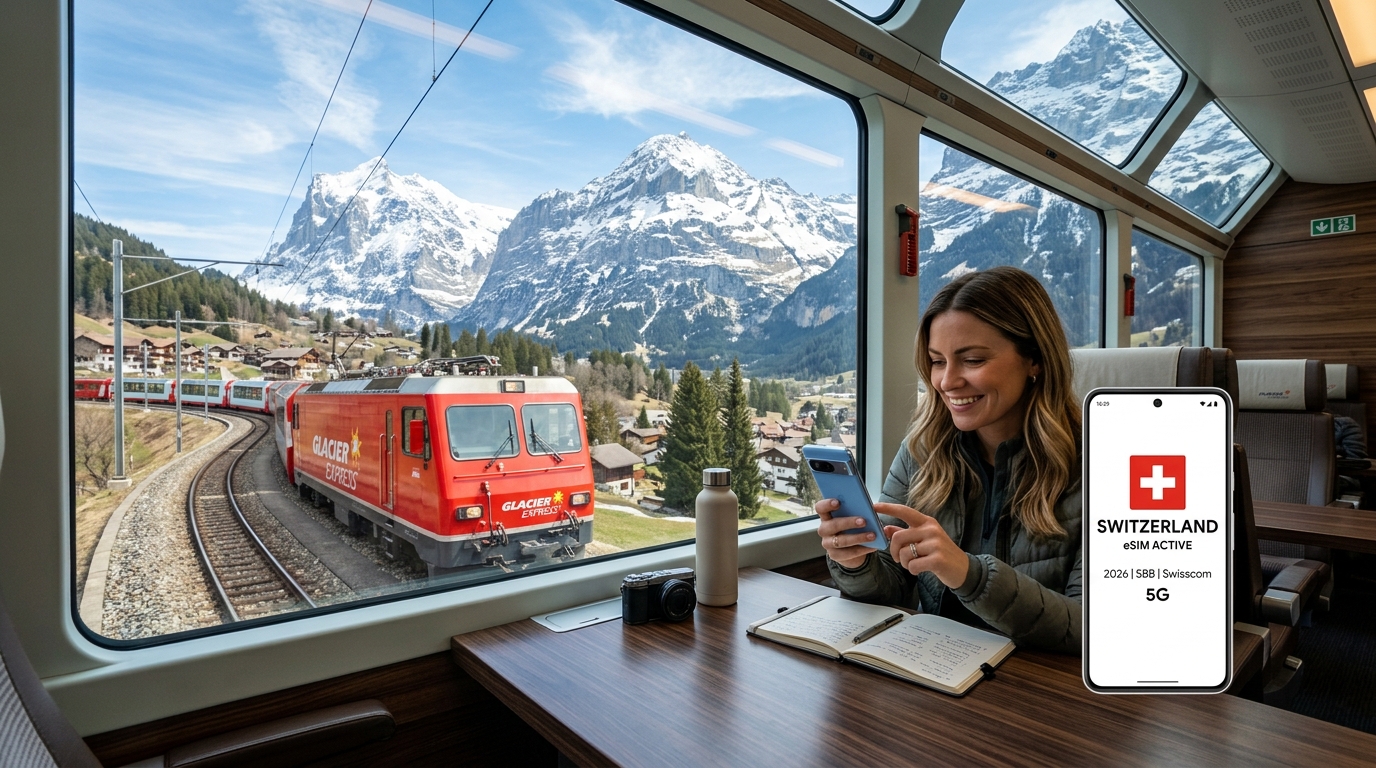
Glacier Express to Jungfraujoch: The 2026 Switzerland Scenic Train Travel eSIM Guide
The Alpine Connectivity Challenge: Why Swiss Train Routes Demand Advanced eSIM Technology in 2026
Traversing the Swiss Alps aboard legendary panoramic trains like the Glacier Express, Bernina Express, or the GoldenPass Express offers unparalleled views of snow-draped peaks, ancient glaciers, and vertical gorges. However, navigating these extreme topographies presents a severe technical challenge for mobile devices. Maintaining an uninterrupted cellular connection across mountain corridors requires understanding the dual hurdles of physical signal degradation and geopolitical telecommunications pricing.
1. The Physics of Panoramic Trains: Thermal Glass and Altitude Extremes
Scenic rail travel in Switzerland introduces an acoustic and electromagnetic environment unlike standard commuter routes. Two primary physical barriers degrade standard mobile reception:
- RF Signal Attenuation from Thermal-Insulated Glass: Panoramic railcars are engineered with double-glazed, heat-reflective windows treated with microscopic metallic oxide coatings. While this keeps cabins climate-controlled against sub-zero Alpine air and solar glare, it inadvertently creates a partial Faraday cage. This glass composition can attenuate high-frequency 4G LTE and 5G signals by as much as 15 to 30 dB, cutting typical smartphone reception down to a fraction of its open-air capability.
- Rapid Altitude Shifts & Signal Shadows: Over the course of an 8-hour journey on the Glacier Express, trains climb from Zermatt (1,608m) up to the Oberalp Pass summit at 2,044 meters, before plunging into deep valleys like the Rhine Gorge (Ruinaulta). Line-of-sight communication between your phone and valley-based cellular base stations breaks frequently as trains weave through helical tunnels, sheer granite cuts, and high-altitude switchbacks.
Signal Obstacles: [Tower in Valley] ---\ (Blocked by Granite Ridge)
                                       \---> [Thermal Glass Railcar] ---> [High Attenuation / Packet Loss]
2. The "Swiss Roaming Trap": Beware of Non-EEA Billing Surcharges
Many international travelers assume that because Switzerland sits at the geographic heart of Western Europe, it falls under the European Union’s "Roam Like at Home" (RLAH) regulations. It does not.
Because Switzerland is not a member of the European Union (EU) or the European Economic Area (EEA), standard European SIM cards and regional carrier passes frequently exclude Swiss networks from their inclusive roaming bundles.
| Roaming Type | Regulatory Protection | Cost Traps / Restrictions |
|---|---|---|
| EU "Roam Like at Home" | Capped by EU directives across 27 member states | Switzerland excluded by default on many budget EU SIMs |
| Domestic Carrier Daily Passes | None (Set by home carrier) | $10 – $15/day per device; throttles after low daily allotments |
| Pay-As-You-Go Data | Unregulated cross-border pricing | Can exceed $5.00 to $12.00 per MB, triggering instant bill shock |
| Next-Gen Travel eSIM (MollySIM) | Prepaid, transparent Alpine bundles | Multi-network 5G access, zero overages, automated local routing |
Stepping off a connecting train from Milan or Munich into Chiasso or Basel without a dedicated Swiss profile can trigger automatic background syncs, resulting in hundreds of dollars in roaming overages within minutes.
3. Solving Multi-Carrier Alpine Handovers with MollySIM
Navigating complex Swiss transit—such as tracking real-time platform changes on the SBB Mobile app, validating digital Swiss Travel Passes, or processing ticket upgrades via Apple Pay—demands dynamic multi-carrier network switching.
MollySIM resolves the Alpine connectivity problem by deploying prioritized roaming agreements across Switzerland’s top-tier infrastructure providers: Swisscom, Sunrise, and Salt. As the train winds around the Albula Line or through the Furka Base Tunnel, a multi-network eSIM dynamically hands off your data session to the strongest local mast, avoiding the persistent single-carrier dead zones typical of standard consumer roaming profiles.
The 384kbps Essential Safety Net
On scenic routes where high-resolution photo uploads and video streams can consume data allotments quickly, traditional travel SIMs throttle expired plans to an unusable 64kbps or 128kbps—effectively severing connection to modern navigation and security protocols.
MollySIM implements a robust 384kbps Fair Use Policy (FUP) baseline. At 3x the standard competitor speed, this bandwidth ensures essential travel utilities remain fully operational even if you exhaust your high-speed pool:
- SBB Mobile Live Tracking: Immediate timetable adjustments and delay tracking remain smooth.
- Google Maps & Apple Maps Navigation: Turn-by-turn vector routing and station walking directions load without timing out.
- Contactless Security & Authentication: Apple Pay, Google Wallet, and bank 2FA verification tokens complete transactions without packet-drop failures.
Route-by-Route Network Breakdown: Glacier Express, Bernina Express, and GoldenPass
🇪🇺 Europe 33 Countries High-Speed Travel eSIM & SIM Plans
Instant QR code activation, hotspot enabled, with guaranteed 384kbps fallback speed to keep Maps & Digital Wallets active.
Navigating the Swiss Alps by rail places unique demands on cellular transceivers. Metal-coated panoramic thermal glass, severe granite canyon attenuation, and sudden transitions into high-altitude tunnels cause single-network SIMs to drop signal frequently.
Below is an engineering-level breakdown of cellular performance across Switzerland’s premier scenic rail routes and how multi-carrier dynamic switching maintains continuous data throughput.
1. The Glacier Express: Zermatt to St. Moritz
- Distance: 291 km | Duration: ~8 hours | Key Terrains: Matter Valley, Oberalp Pass (2,044m), Rhine Gorge, Albula Line
[Zermatt] ---> [Oberalp Pass (2,044m)] ---> [Rhine Gorge] ---> [Landwasser Viaduct] ---> [St. Moritz]
Swisscom 5G Swisscom / Sunrise Salt / Swisscom Multi-Carrier 5G Swisscom 5G- Zermatt to Brig (Matter Valley): High-density Swisscom and Sunrise LTE-A/5G small cells cover the valley floor. Deep rock cuttings occasionally drop secondary carriers, but primary line-of-sight transmitters maintain 80–120 Mbps downlinks.
- Andermatt to the Oberalp Pass Summit (2,044m): Above the tree line, Swisscom commands the widest Band 20 (800MHz) and Band 28 (700MHz) low-frequency coverage, providing essential long-range signal propagation across snowfields.
- The Rhine Gorge ("Swiss Grand Canyon"): Towering 300-meter limestone walls block direct macro-tower signals. Salt and Sunrise alternate dominance through directional repeaters installed along the trackbed.
- The Albula Line & Landwasser Viaduct: Helical tunnels and curved viaducts demand continuous cell handovers. While locked-carrier SIMs buffer and stall 4K live streams, MollySIM swaps profiles in milliseconds to pull bandwidth from the nearest active mast.
2. The Bernina Express: Chur to Tirano (Italy)
- Distance: 144 km | Duration: 4.5 hours | Key Terrains: Ospizio Bernina (2,253m), Alp Grüm, Brusio Spiral Viaduct, Swiss-Italian Border
[Chur / St. Moritz] ---> [Ospizio Bernina (2,253m)] ---> [Alp Grüm] ---> [Brusio Viaduct] ---> [Tirano (Italy)]
Swiss 5G Bands High-Alpine Mast Coverage Micro-Cell 4G/5G Seamless Cross-Border Handover- Pontresina to Ospizio Bernina (2,253m): Glacial reflections and sheer altitude test signal integrity. Isolated high-alpine masts deployed by Swisscom handle high data volumes, allowing instant 4K uploads of the Morteratsch Glacier.
- Alp Grüm Switchbacks: The train descends 1,000 meters in tight curves toward Poschiavo. Tower line-of-sight rapidly shifts between valley antennas, requiring robust multi-band support (Band 1, 3, 7, 20).
- Campocologno to Tirano (Border Crossing): Approaching the Brusio Spiral Viaduct, Swiss domestic networks transition into Italian infrastructure (TIM / Vodafone Italy). Single-country SIM cards drop out completely here; MollySIM’s regional European roaming agreements initiate a background handover before the train pulls into Tirano Station.
3. GoldenPass Express: Montreux to Interlaken
- Distance: 115 km | Duration: 3 hours 15 mins | Key Terrains: Lake Geneva Riviera, Jaman Tunnel, Pays-d'Enhaut, Simmental
- Montreux Incline to Château-d'Oex: Climbing away from Lake Geneva, panoramic coaches face rapid elevation changes. Sunrise and Salt maintain dense urban-grade speeds (150+ Mbps) throughout the Riviera vineyards before yielding to rural Swisscom LTE corridors through the Jaman Tunnel.
- Zweisimmen Variable-Gauge Transition: The train mechanically adjusts its wheel bogies to switch track gauges. Strong multi-carrier 5G coverage around Zweisimmen and Spiez allows remote workers to hold continuous video conferences without jitter.
4. Jungfraubahn: Kleine Scheidegg to Jungfraujoch (3,454m)
- Distance: 9.3 km | Duration: 35 mins | Key Terrains: Eiger Glacier, Eigerwand Tunnel, Sphinx Observatory
The ascent through the internal rock structure of the Eiger and Mönch mountains relies on specialized in-tunnel leaky feeder cables and distributed antenna systems (DAS) engineered primarily by Swisscom:
- Eigergletscher to Eismeer (Inside the Rock): Dedicated micro-repeaters line the tunnel shaft, delivering steady 4G LTE data even through solid granite.
- Sphinx Observatory (3,454m): Outdoor viewing platforms receive high-capacity 5G from summit-mounted directional arrays. If heavy tourist congestion throttles peak bandwidth, MollySIM’s 384kbps safety baseline guarantees that your digital boarding passes, SBB seat reservations, and Apple Pay checkouts process without delay.
Swiss Alpine Rail Connectivity Matrix
| Route Sector | Primary Carrier Dominance | Typical Speed (Down/Up) | Signal Vulnerability | MollySIM Multi-Carrier Benefit |
|---|---|---|---|---|
| Oberalp Pass (Glacier Exp.) | Swisscom (B20/B28 4G/5G) | 45 / 15 Mbps | High-altitude weather attenuation | Connects to high-gain Alpine macro towers |
| Rhine Gorge (Glacier Exp.) | Salt / Sunrise | 30 / 10 Mbps | Steep granite canyon deflection | Auto-swaps away from blocked Swisscom line-of-sight |
| Brusio to Tirano (Bernina Exp.) | Cross-border (Swisscom $\to$ TIM) | 70 / 25 Mbps | International border tower handoffs | Zero-gap transition into Italian networks |
| GoldenPass (Gstaad Valley) | Sunrise / Swisscom 5G | 180 / 40 Mbps | Rolling topography shadow zones | Aggregates strongest localized band |
| Jungfraujoch Tunnel (3,454m) | Swisscom Leaky Feeder | 25 / 8 Mbps | Subterranean rock isolation | Retains 384kbps baseline for SBB/Apple Pay apps |
Connectivity Showdown: Local SIM vs. EU Roaming vs. Pocket Wi-Fi vs. MollySIM eSIM
Navigating the Swiss transit network requires split-second access to the SBB Mobile app for platform changes, real-time elevation telemetry, and seat reservations. However, international travelers frequently misunderstand Switzerland’s telecom landscape—most notably assuming that standard European Union roaming regulations apply here.
To determine the most resilient option for high-altitude rail expeditions, we evaluated five distinct connectivity methods across critical alpine performance benchmarks.
Comprehensive Swiss Transit Connectivity Comparison
| Connectivity Method | Cost Profile (7–10 Days) | Multi-Carrier Network Switching | KYC / Passport ID Mandate | SBB App & API Latency | Alpine Shadow Failover | Throttle / FUP Floor Speed |
|---|---|---|---|---|---|---|
| EU Carrier Roaming | Extreme ($10–$15/day or steep surcharges) | Single roaming partner (No dynamic swap) | Bound to home contract | High (Routes back to origin country) | Poor (Sticks to dead partner signal) | 64–128 kbps (Unusable for maps) |
| Swiss Airport Physical SIM (Swisscom / Sunrise) | Moderate–High (CHF 20–40 base) | Locked to single carrier (Swisscom or Sunrise) | Strict passport scan at kiosk (BÜPF law) | Low (<25ms local breakout) | Moderate (Dead in competitor-only valleys) | Hard stop or 128 kbps |
| Pocket Wi-Fi Device | High (CHF 6–10/day + deposit + returns) | Usually single SIM inside device | Identity verification at rental desk | Moderate (Wi-Fi hop introduces lag) | Moderate (Tied to one network provider) | 128 kbps after daily cap |
| Generic Roaming eSIM | Moderate ($15–$30) | Single localized profile (Often Salt only) | None to basic digital check | High (Routed via distant third-party servers) | Low (Drops signal in deep ravines) | 64–128 kbps (Apps timeout) |
| MollySIM Switzerland eSIM | Low–Budget ($5–$20 flexible tiers) | Dynamic switching (Swisscom + Sunrise + Salt) | Instant zero-KYC installation | Low (Optimized regional edge routing) | High (Auto-fails over to strongest mast) | 384 kbps (SBB, Apple Pay & Maps functional) |
Architectural Breakdown: Why Rail Tourists Need Multi-Carrier Redundancy
1. The "Switzerland Is Not the EU" Roaming Surcharge Trap
Because Switzerland is not an EU/EEA member state, it is excluded from the "Roam Like at Home" directive. Using an EU SIM card from France, Germany, or Italy often triggers exorbitant "Zone 2" roaming tariffs—sometimes exceeding $12 per megabyte—or throttles data to an unusable standstill the moment your train crosses the border into Basel or Chiasso.
2. The Swiss BÜPF Registration Barrier (Physical SIMs)
Under Switzerland’s Federal Act on the Surveillance of Post and Telecommunications (BÜPF), purchasing a local physical SIM card at Zurich (ZRH) or Geneva (GVA) airport requires an in-person passport scan, manual identity validation, and a mandatory activation queue. If your scenic train departs within an hour of your flight landing, waiting in terminal telecom queues introduces immediate schedule risk.
3. Hardware Vulnerabilities of Pocket Wi-Fi in Sub-Zero Terrain
Pocket Wi-Fi routers introduce unnecessary operational friction aboard panoramic trains:
- Lithium Battery Drain: Sub-zero ambient temperatures at Jungfraujoch (3,454m) and the Gornergrat ridge rapidly deplete external battery banks.
- Bulk & Returns: Traveling light between connecting trains becomes cumbersome when managing a charging brick, cables, and physical return drop-offs before departure.
4. Single-Carrier Lock-In vs. Dynamic Multi-Carrier Core
No single Swiss carrier provides 100% geographic dominance across the entire alpine rail network:
- Swisscom controls high-altitude open passes (like Oberalp Pass).
- Sunrise and Salt offer superior micro-cell density within narrow limestone gorges (such as the Ruinaulta / Rhine Gorge).
Generic eSIMs lock your device to a single regional provider. When that network loses line-of-sight behind a mountain ridge, your connection drops entirely. MollySIM utilizes an autonomous multi-carrier profile that constantly listens to neighboring eNodeB towers, switching seamlessly between Swisscom, Sunrise, and Salt to maintain unbroken data streams.
5. The 384kbps Fair Use Safety Baseline
Standard travel eSIMs throttle your speed to 64kbps or 128kbps once high-speed allocations are exhausted—rendering dynamic vector maps and payment gateways completely unresponsive.
MollySIM implements an industry-leading 384kbps safety baseline. Even if you consume your primary data allowance uploading 4K video clips from the Glacier Express, your connection maintains enough throughput to:
- Refresh dynamic QR validation codes inside the SBB Mobile app.
- Process instantaneous Apple Pay and Google Wallet NFC authentications.
- Load real-time GPS coordinate overlays in Google Maps or Apple Maps without timing out.
Powering the SBB Mobile App and Live Transit Tools Across High-Altitude Summits
Switzerland operates arguably the most precisely synchronized public transport ecosystem in the world (the Integraler Taktfahrplan). However, navigating this multi-modal network of panoramic trains, cogwheel railways, postbuses, and aerial cableways requires continuous, low-latency data access. Independent alpine transit is no longer managed with paper timetables; it relies entirely on a suite of mission-critical mobile applications running simultaneously in the background.
+------------------------+------------------------------------+---------------------------------------+
| App / Digital Tool     | Primary Function                   | Bandwidth & Latency Dependency        |
+------------------------+------------------------------------+---------------------------------------+
| SBB Mobile & EasyRide  | Real-time routing, dynamic QR pass | Low latency, continuous GPS sync      |
| MeteoSwiss             | Cloud cover, alpine precipitation  | Moderate data (high-res radar loops)  |
| Jungfrau Live Cams     | Peak visibility & summit wind speed| High throughput (HD/4K video streams) |
| Glacier Express Portal | Onboard infotainment & seat maps   | Instant browser-based local sync      |
+------------------------+------------------------------------+---------------------------------------+
1. Dynamic QR Authentication and Ticket Verification
Whether you carry a digital Swiss Travel Pass, a Point-to-Point ticket, or use SBB’s automated EasyRide check-in system, tickets are validated using dynamic, cryptographically rotating QR codes.
Train conductors on routes like the GoldenPass Express or the Rhaetian Railway carry mobile optical scanners that cross-reference your ticket against the central SBB transit database in real time. If your device loses connectivity inside a high-alpine pass and your app fails to regenerate its dynamic security token:
- EasyRide tracking can terminate prematurely, triggering an automated fare violation penalty.
- Stored digital passes in offline caches can fail cryptographic signature checks during spot audits.
- Seat reservation PDFs linked to third-party panoramic reservation portals fail to fetch live carriage layout updates.
2. High-Stakes Alpine Transfers: The 4-Minute Window
Alpine transit itineraries often hinge on razor-thin transfer windows at complex multi-level railway junctions. A brief connectivity outage at the wrong moment can derail an entire day's itinerary:
- Visp Station: The crucial 4-to-6 minute transfer hub between the high-speed SBB InterCity line (emerging from the 34.6 km Lötschberg Base Tunnel) and the narrow-gauge Matterhorn Gotthard Bahn heading to Zermatt. Real-time platform changes (Gleisänderungen) are pushed via SBB Mobile notifications minutes before arrival.
- Brig Bahnhof: A sprawling nexus where international EuroCity trains, regional Matterhorn Gotthard Bahn lines, and PostAuto alpine bus routes converge across separate terminal plazas.
- Kleine Scheidegg: The 2,061-meter transfer ledge where the Wengernalpbahn meets the Jungfraubahn cogwheel train. Missing your assigned boarding group (Reservation Group) due to an unrefreshed boarding pass delays your Jungfraujoch summit entry by up to two hours during peak season.
3. Live Alpine Telemetry and Peak Webcams
Mountain weather at 3,454 meters (Jungfraujoch) or 3,883 meters (Matterhorn Glacier Paradise) changes within minutes. Savvy travelers do not ascend blindly; they rely on live digital telemetry:
- MeteoSwiss High-Resolution Radar: Pinpointing localized cloud decks and thermal updrafts before purchasing expensive summit cogwheel supplements.
- Summit Webcams: Streaming real-time 360-degree panoramic feeds from the Sphinx Observatory to verify cloud-free visibility before boarding the Eiger Express tricable gondola at Grindelwald Terminal.
How MollySIM Secures the Alpine Transit Workflow
MollySIM provides direct routing to Tier-1 Swiss infrastructure with optimized IP routing paths, minimizing packet latency down to single-digit milliseconds. Even when navigating the deep cuts of the Landwasser Gorge or climbing the rack-rail sections toward Kleine Scheidegg, your connection does not freeze.
Furthermore, if your primary high-speed data tier is depleted while streaming summit webcams, MollySIM’s 384kbps safety baseline (triple the conventional 128kbps speed limit offered by generic travel eSIMs) ensures that SBB Mobile live platform updates, dynamic QR refresh tokens, and Apple Pay/Google Wallet authentications process instantly without network timeouts.
Zero Downtime Guaranteed: The Critical Value of MollySIM's 384kbps Baseline Safety Net
Traversing high-altitude passes like the Gornergrat ridge (3,089m), the sheer cliffside tracks of Mount Pilatus (2,132m), or the sub-zero tunnels of Jungfraujoch (3,454m) is not the place to experience an abrupt connectivity blackout. On standard tourist eSIMs, exhausting your daily or total high-speed data allowance triggers an instantaneous hard cutoff or throttles your speed down to a virtually unusable 64kbps to 128kbps.
At 128kbps, modern encrypted applications fail: TLS handshakes time out, dynamic transit apps crash, and mapping services refuse to render vector tiles.
MollySIM eliminates this operational hazard by establishing an unthrottled 384kbps safety baseline under its Fair Use Policy. Even after exhausting 100% of your high-speed quota, your connection does not drop off the network. This 3x speed advantage over standard generic providers preserves the exact bandwidth threshold required to execute critical travel logistics and emergency protocols in alpine terrain.
Functional Threshold Analysis: 128kbps Throttling vs. MollySIM 384kbps Baseline
| Critical Transit & Safety Function | Generic eSIM Throttling (64–128kbps) | MollySIM Safety Baseline (384kbps) | Real-World Impact in High Alpine Zones |
|---|---|---|---|
| SBB Mobile Live Timetable Query | ❌ Fails / Times Out (HTTP 504 Gateway) | ✅ Loads in < 2.5 seconds | Catch tight 3-minute mountain rail connections at Visp or Spiez. |
| Dynamic QR / Apple Wallet Refresh | ❌ Token Expiry Error | ✅ Instantaneous Refresh | Pass cogwheel turnstiles without manual agent intervention. |
| WhatsApp Voice Messaging & Calls | ❌ Heavy Packet Loss / Garbled Audio | ✅ Crystal Clear (Opus Codec) | Coordinate meetups at crowded summit viewing platforms. |
| Vector Map Rendering (Google / SwissTopo) | ❌ Blank Grey Tiles | ✅ Renders Routes & Caches Trails | Prevent getting disoriented along descent trails or station transfers. |
| Emergency Coordinate Sharing (GPS) | ❌ Fails on Latency Buffer | ✅ Sub-Second Transmission | Transmit exact WGS84 coordinates if separated during alpine treks. |
Mission-Critical Operations Maintained at 384kbps
1. Real-Time Dynamic Ticket Token Validation
Modern Swiss transport barcodes—especially the Swiss Travel Pass, Jungfrau Travel Pass, and SBB Point-to-Point dynamic tickets—employ rolling cryptographic tokens to prevent fraud. When conductor ticket scanners ping the central SBB backend, your device must acknowledge the dynamic certificate exchange. MollySIM’s 384kbps stream handles these lightweight API payloads seamlessly, preventing embarrassing ticket invalidation while standing in front of summit turnstiles.
2. Alpine GPS Navigation and Topographic Rendering
Unlike heavy raster satellite imagery, vector-based navigation engines like swisstopo and Google Maps require sustained downstream bandwidth of roughly 200–250kbps to stream terrain contours, platform footprints, and transit layers. With a 384kbps baseline:
- Station floor plans (e.g., navigating Zürich HB or Geneva Airport underground corridors) populate instantly.
- Real-time elevation tracking and trail-marker coordinates refresh without stalling.
3. Low-Bandwidth Emergency Communications
If bad weather forces an emergency service suspension on the Eiger Express or Gornergrat Bahn, communication infrastructure becomes congested. While high-bandwidth video streaming is restricted under baseline speeds, WhatsApp low-bandwidth voice calls (utilizing the 16kbps Opus codec) and compressed photo uploads remain fully operational. You can seamlessly notify hotels of late arrivals, submit rebooking requests, and access live emergency bulletins without hunting for unreliable public station Wi-Fi.
Step-by-Step Installation and Optimization Guide for Switzerland Rail Expeditions
Configuring mobile data for a multi-day Swiss rail itinerary requires careful setup before boarding panoramic trains. Rapid cell tower handoffs through mountain passes, frequent tunnel traverses, and the need for dual-SIM operation (keeping your domestic number live for bank 2FA while channeling data over local infrastructure) demand exact operating configurations.
Follow this deployment guide to configure your device before arrival and maximize battery longevity across panoramic routes like the Glacier Express and GoldenPass Express.
Phase 1: Pre-Departure eSIM Provisioning & Dual-SIM Architecture
Install your eSIM 24 to 48 hours before departing for Switzerland while connected to a stable home or office Wi-Fi network.
1. Profile Installation
- iOS: Navigate to
Settings>Cellular>Add eSIM>Use QR Code. Scan the activation code provided in your MollySIM confirmation email. - Android (Samsung/Google Pixel): Go to
Settings>Connections(orNetwork & internet) >SIM manager>Add eSIM>Scan QR code from service provider.
2. Line Labeling & Dual-SIM Routing
Proper labeling prevents accidental cross-billing and domestic carrier roaming fees:
- Label your home physical SIM/eSIM as "Primary" or "Home".
- Label your newly installed profile as "MollySIM" or "Swiss Rail Data".
By disabling "Allow Cellular Data Switching", you ensure that your domestic carrier cannot bill you $10–$15 per day for accidental background data syncs when Alpine signals fluctuate, while still receiving inbound two-factor authentication (2FA) SMS messages for credit card security verifications.
Phase 2: Arrival Verification at Zurich (ZRH) or Geneva (GVA)
Upon landing on Swiss soil and taking your phone off Airplane Mode, execute this 60-second verification routine:
| Checkpoint | Target Status | Troubleshooting Action |
|---|---|---|
| Carrier Lock | Swisscom 5G or Sunrise 5G | If displaying No Service, toggle Airplane Mode for 10 seconds. |
| APN Assignment | Automatic (globaldata or designated carrier APN) | If data drops, verify APN fields in Cellular Data Network match your activation voucher. |
| Baseline Speed Test | >50Mbps initial (or stable 384kbps if throttled) | Run a quick check on the SBB Mobile app to confirm timetable rendering and ticket validation. |
Because MollySIM maintains a 384kbps Fair Use Policy (FUP) speed limit—three times faster than standard 128kbps competitor throttles—vital rail applications such as live platform trackers, SBB dynamic QR generation, Apple Pay, and Google Maps vector layers will operate reliably even if your high-speed allowance runs low during the expedition.
Phase 3: Battery Preservation for 8-Hour Panoramic Transits
The full Glacier Express run from Zermatt to St. Moritz takes roughly 7.5 to 8 hours. The panoramic glass dome coaches act as natural greenhouse environments, magnifying thermal load on your smartphone while continuous tower-to-tower signal switching through deep V-shaped valleys accelerates battery drain.
Hardware & Settings Optimization Rules
- Manage Cell Search Spikes in the Furka Base Tunnel: During the 15.4 km passage through the Furka Tunnel (Oberwald to Realp), activate Airplane Mode temporarily if you are not tracking GPS to prevent the modem from broadcasting at maximum transmission power (23 dBm) in search of non-existent valley macrocells.
- Limit Background Cloud Photo Uploads: Apple Photos and Google Photos will continuously attempt to upload 48MP RAW landscape captures over cellular data, cooking the battery. Set Cloud Backups to "Wi-Fi Only".
- Power Bank Selection: While modern Glacier Express Excellence Class and refurbished First Class coaches feature 230V European Type J sockets or individual USB ports, Second Class coaches often feature shared plugs between seat pairs or none on older rolling stock. Carry a 10,000mAh to 20,000mAh Power Bank supporting Power Delivery (PD 3.0, minimum 20W output) to keep your camera, navigation, and ticketing operational through remote alpine passes.
🇪🇺 Europe 33 Countries High-Speed Travel eSIM & SIM Plans
Instant QR code activation, hotspot enabled, with guaranteed 384kbps fallback speed to keep Maps & Digital Wallets active.