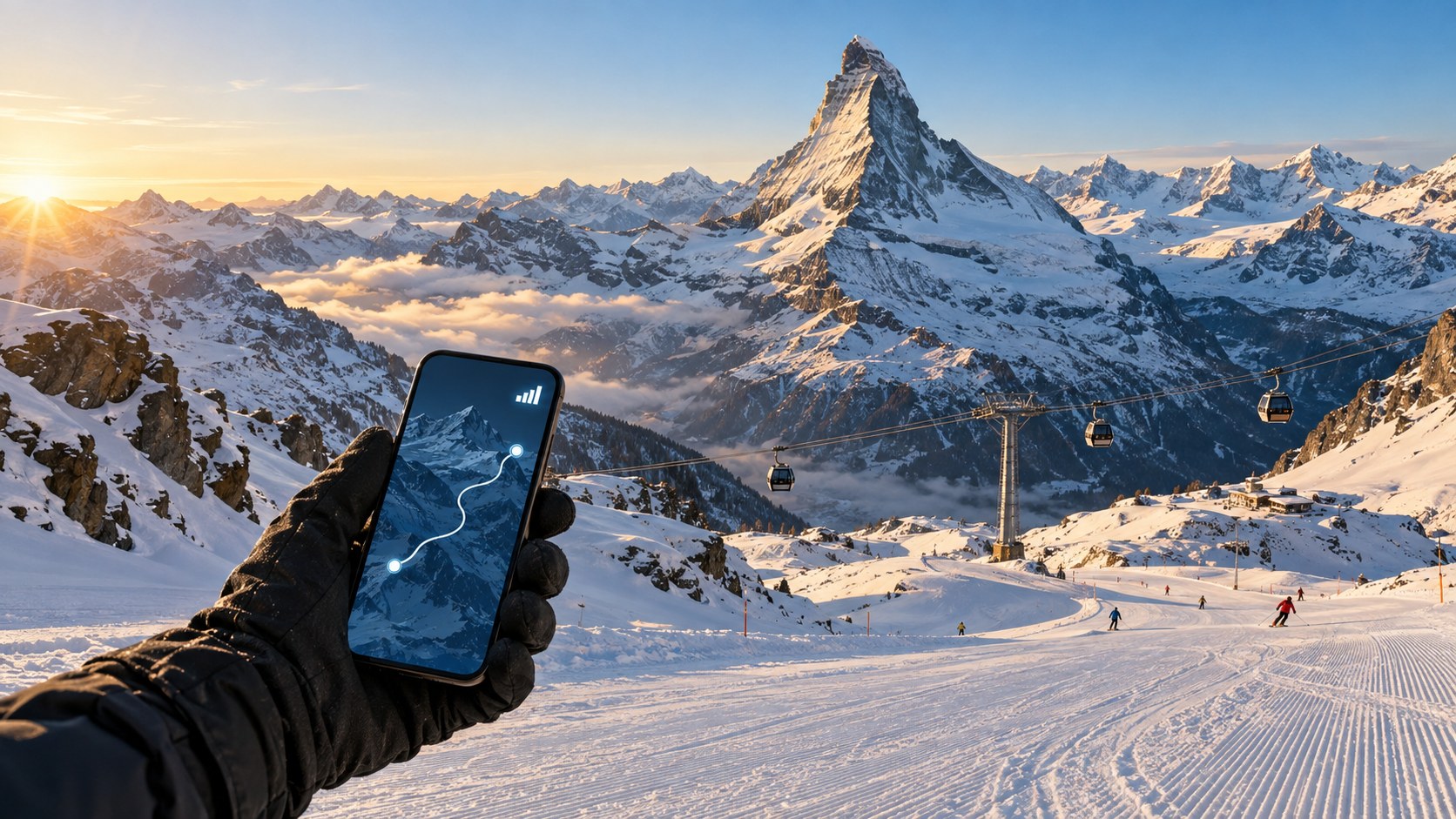
Crossing Borders on the Slopes: The 2026 eSIM Strategy for Zermatt & Cervinia
The Cross-Border Connectivity Paradox: Why Zermatt and Cervinia Are Different
The Matterhorn Ski Paradise is widely marketed as a single, unified alpine destination, a seamless expanse of powder and pistes that spans two nations. For the skier, the transition from the Swiss village of Zermatt to the Italian hamlet of Breuil-Cervinia is often treated as a minor logistical detail, a simple change in scenery rather than a fundamental shift in infrastructure. However, for the modern digital traveler, this geographical unity masks a profound technical fragmentation. While the ski lift infrastructure is meticulously synchronized to allow uninterrupted access to 360 kilometers of slopes, the mobile network infrastructure remains stubbornly divided by the political border. This creates what we term the Cross-Border Connectivity Paradox: the assumption that one ski area equals one network, when in reality, you are straddling two distinct, non-negotiable national telecom ecosystems.
The friction arises from a fundamental misunderstanding of how cellular networks operate across national boundaries. In 2026, as 5G coverage expands across the Alps, the expectation of seamless, high-bandwidth connectivity is higher than ever. Travelers rely on real-time data for GPS navigation in complex lift systems, instant social media sharing of high-resolution video, and critical emergency communication. Yet, the moment you cross the border at the Testa Grigia lift, you are no longer just changing mountains; you are changing regulatory jurisdictions, frequency bands, and, crucially, billing structures.
The Dual-SIM Dilemma and Roaming Anxiety
The traditional solution for this geographic split is often a physical dual-SIM setup or a reliance on expensive international roaming. This approach is fraught with anxiety and inefficiency. To maintain optimal signal strength and data speeds, a traveler might need to purchase a Swiss SIM (from providers like Swisscom or Sunrise) for the Zermatt side and a separate Italian SIM (from TIM or Vodafone) for the Cervinia side. This requires not only the physical management of two cards or eSIM profiles but also the mental overhead of knowing which network is active at any given moment.
The pain point intensifies when relying on roaming. If you use a Swiss SIM in Italy, you are subject to roaming charges, which can be exorbitant for data-heavy users. Conversely, using an Italian SIM in Switzerland can lead to similar penalties or, worse, a drop in network priority. The anxiety of crossing the border at Testa Grigia is palpable: will your phone switch networks automatically? Will the data speed plummet? Will you receive a surprise bill at the end of the week? This uncertainty disrupts the flow of the ski day, forcing travelers to constantly monitor their signal bars and data usage, detracting from the experience of the slopes.
The 2026 Technical Hurdle: The Digital Border
In the 2026 context, the "digital border" is more significant than ever. As 5G networks mature, the handover between networks becomes a critical technical hurdle. Traditional roaming protocols are often slow to negotiate a new connection, leading to dropped calls or stalled data streams precisely when you need them most—such as when navigating a complex lift junction or checking real-time snow reports. The expectation is that connectivity should be as seamless as the ski lifts themselves, but the reality is that national telecom ecosystems are designed to protect their domestic revenue, not to facilitate cross-border mobility.
This is where the concept of a unified data layer becomes essential. Instead of relying on the host network’s roaming agreements, a specialized eSIM provider can create a virtual network that ignores national boundaries. This is where MollySIM (https://mollysim.com) distinguishes itself from traditional roaming or dual-SIM setups. MollySIM’s architecture is designed specifically to address this cross-border friction point. By leveraging a global data pool that spans both Swiss and Italian networks, it provides a single, consistent data experience regardless of which side of the Matterhorn you are on.
Crucially, MollySIM’s Fair Use Policy sets a speed limit of 384kbps, which is 3x faster than competitors' typical 128kbps cap. This seemingly small difference is transformative for the cross-border skier. At 128kbps, applications like Google Maps or Apple Pay can become sluggish or unresponsive, particularly when switching between networks. At 384kbps, these critical services remain smooth and reliable, ensuring that your navigation doesn’t lag when you cross into Italy and your payments process instantly at the lift ticket machine. This unified, high-speed data layer eliminates the need for dual SIMs, reduces roaming anxiety, and ensures that your digital life remains as seamless as your ski run.
Technical Deep Dive: eSIM Roaming vs. Dual-Profile Switching Mechanics
🌐 Global Travel High-Speed Travel eSIM & SIM Plans
Instant QR code activation, hotspot enabled, with guaranteed 384kbps fallback speed to keep Maps & Digital Wallets active.
To understand why a specialized cross-border solution is superior for the Zermatt-Cervinia corridor, one must dissect the underlying network mechanics that govern connectivity. The debate often centers on eSIM roaming versus dual-profile switching, but the technical reality reveals a stark difference in latency, session stability, and user experience.
The Architecture of Standard eSIM Roaming
In a standard roaming scenario, your device maintains a primary logical connection with your Home Network (in this case, MollySIM). When you cross the border from Switzerland into Italy, your device does not "change" networks in the way a physical SIM might require manual intervention. Instead, it executes a Network Registration process.
- Signal Detection: The device’s radio continuously scans for available cells. Upon detecting a stronger signal from an Italian carrier (such as TIM or Vodafone Italia) than the Swiss carrier (Swisscom or Sunrise), it initiates a handover.
- Authentication Handshake: The device sends an authentication request to the visited network. The visited network then queries the Home Network (MollySIM) via the Diameter protocol to verify the subscriber’s identity and data allowance.
- Session Establishment: Once authenticated, the visited network grants access to its radio resources. Crucially, the IP address and APN (Access Point Name) remain consistent because the data traffic is tunneled back to the Home Network’s core.
This process is automated, transparent, and typically occurs within 1–3 seconds. The user’s device sees a single, unified data pool. Whether the signal originates from a tower in Zermatt or Cervinia, the logical path to the internet remains identical. This is the essence of the unified data layer: the device does not need to reconfigure its network stack, change APNs, or renegotiate data allowances. It simply rides the strongest available signal, with the Home Network managing the billing and routing in the background.
The Friction of Dual-Profile Switching
Contrast this with the dual-profile approach, where a user installs two separate eSIMs: one optimized for Swiss networks and one for Italian networks. This strategy relies on manual profile switching.
- Session Interruption: When you manually switch profiles, the device must detach from the current network and attach to the new one. This is not a seamless handover; it is a re-registration event. Any active data sessions—such as a live video call, a streaming podcast, or a map tile download—are often terminated or paused during this transition.
- APN Mismatch: Each profile may require different APN settings. If the Swiss profile uses
swisscom.chand the Italian profile usestim.it, the device must flush its DNS cache and re-establish the PDP context. This can introduce latency spikes of 5–10 seconds, during which your navigation app may freeze or your payment app may time out. - Data Allowance Fragmentation: You are now managing two separate data pools. If you exhaust your Swiss data before crossing the border, you are left with a dead connection until you manually switch. Conversely, if you switch too early, you may waste Swiss data on Italian towers where the roaming agreement is less favorable.
Why Handover Speed Matters on the Slopes
In a dynamic environment like the Matterhorn Ski Paradise, users are constantly moving between valleys, peaks, and border checkpoints. The 4G/5G handover process is critical here. A high-quality eSIM provider like MollySIM ensures that the Handover Request is processed with minimal delay.
| Feature | Standard eSIM Roaming (MollySIM) | Dual-Profile Switching |
|---|---|---|
| Network Registration | Automatic, <3 seconds | Manual, 5–15 seconds |
| Session Continuity | Maintained (seamless) | Often interrupted |
| APN Configuration | Single, consistent APN | Multiple APNs, requires reconfiguration |
| Data Management | Unified pool, single billing | Fragmented pools, complex tracking |
| Fair Use Speed | 384kbps (3x faster) | Varies by profile, often capped at 128kbps |
The 384kbps Fair Use Policy of MollySIM is not just a marketing figure; it is a technical safeguard. During the brief moments of handover or when signal strength fluctuates between Swiss and Italian towers, a higher speed cap ensures that critical applications like Google Maps and Apple Pay remain responsive. At 128kbps, the overhead of re-establishing a session can cause noticeable lag, but at 384kbps, the buffer is sufficient to maintain smooth operation.
The Role of High-Quality eSIM Providers
A local physical SIM often requires manual APN configuration and carrier-specific settings, which can fail if the user’s device does not support the specific band or protocol. In contrast, a high-quality eSIM provider like MollySIM pre-configures the optimal settings for both Swiss and Italian networks. This means that when your device registers with a local tower, it does so with the correct QoS (Quality of Service) parameters, ensuring that your data is prioritized over voice or SMS traffic.
This technical superiority is what makes the cross-border experience seamless. You do not need to think about which network you are on, which APN is active, or which data pool is being depleted. You simply ski, and your digital life follows, uninterrupted.
MollySIM’s Unified Data Layer: Eliminating the Manual Toggle
The most significant friction point for alpine travelers is not the physical act of crossing the border, but the cognitive load required to manage connectivity. Traditional dual-SIM setups or even dual-eSIM configurations force the user into a constant state of digital vigilance. You are no longer just a skier; you are a network engineer. You must mentally track which SIM is active, monitor two separate data balances, and constantly wonder if the current carrier’s coverage is sufficient for your location. This "manual toggle" mentality creates a background hum of anxiety that detracts from the experience. In contrast, MollySIM operates on a Unified Data Layer, a technical architecture designed to abstract away the complexity of multi-carrier roaming. The result is a true "set it and forget it" experience where the device handles the network selection, data pooling, and billing in the background, allowing the traveler to focus entirely on the slopes.
The Burden of Fragmented Connectivity
Consider the logistical nightmare of managing two physical SIMs or separate eSIM profiles in the Zermatt-Cervinia region. If you are on the Swiss side, you might be connected to Swisscom or Sunrise. If you cross into Italy, you need to switch to TIM or Vodafone. With a standard setup, this transition is rarely seamless. You may find yourself hunting for a Swisscom store in Zermatt to top up data, only to realize you need a TIM store in Breuil-Cervinia for the next day. Each carrier has its own data caps, its own pricing structures, and its own definition of "unlimited." This fragmentation means that your data pool is not a single reservoir but a series of disconnected buckets. If you deplete your Swiss data while still on the Swiss side, you are stranded until you can manually switch profiles or purchase a new top-up, often at a premium rate.
Network Aggregation and Intelligent Prioritization
MollySIM solves this by aggregating multiple local partner networks into a single, cohesive data stream. This is not merely about having access to more towers; it is about intelligent network prioritization. In alpine terrain, signal strength is highly variable. A valley that offers robust 5G coverage to one carrier might be a dead zone for another due to frequency band differences or tower placement.
MollySIM’s infrastructure continuously monitors signal quality and latency across its partner networks. If the primary partner, such as Sunrise, experiences weak signal in a specific shadowed area of the Matterhorn valley, the system can dynamically prioritize a partner with superior coverage, such as Swisscom, without any user intervention. This process, known as network flexibility, is critical in mountainous environments where "network stickiness"—the tendency of a device to latch onto a weak signal to avoid handover costs—can lead to frustratingly slow speeds or dropped connections. By decoupling the user from the specific carrier, MollySIM ensures that the device always connects to the strongest available signal, maintaining high throughput and low latency.
The Invisible Transition: A Real-World Scenario
The true test of this architecture is the cross-border moment. Imagine a skier taking the Matterhorn Glacier Paradise lift from Zermatt, Switzerland, to Cervinia, Italy. As the cable car ascends, the device is connected to the Swiss network. As it descends into the Italian side, the signal strength of the Swiss towers begins to fade, and Italian towers become visible.
In a traditional setup, this is the moment of potential failure. The device might struggle to hand over, or the user might need to manually switch profiles, causing a brief interruption in service. With MollySIM’s Unified Data Layer, this transition is invisible. The eSIM architecture seamlessly shifts the data traffic from the Swiss partner to the Italian partner. The data pool remains unified, so there is no concern about depleting one balance while the other remains untouched.
Consider a traveler who is in the middle of a high-quality video call with a client or streaming a podcast. As the lift crosses the border, the connection does not drop. The audio does not stutter. The video does not pixelate. This stability is a direct result of the 384kbps Fair Use Policy, which is three times faster than the typical 128kbps cap found in competitor offerings. This higher speed buffer ensures that even during the brief moments of handover or signal fluctuation, critical applications like Google Maps and Apple Pay remain responsive. The user continues their conversation or listens to their podcast, completely unaware that their data is now being routed through an Italian tower. This seamless continuity is the hallmark of a modern eSIM strategy, transforming a potential technical hurdle into a non-event.
Data Consumption Analysis: Live Ski Tracking, GPS, and Alpine Navigation
Understanding the true cost of connectivity in the Alps requires moving beyond abstract "unlimited" labels and examining the granular data demands of specific alpine activities. In the high-altitude environment of Zermatt and Cervinia, data is not merely a utility; it is a critical resource for safety, navigation, and real-time decision-making. A standard tourist itinerary often underestimates the bandwidth required by modern mobile applications, leading to unexpected throttling or service interruptions precisely when connectivity is most vital.
The Bandwidth Heavyweights: Live Ski Tracking and 3D Mapping
Applications such as PeakVisor and SkiDB are designed to provide immersive, real-time visualizations of slope conditions, lift status, and 3D terrain rendering. Unlike static web pages, these apps continuously stream vector data and high-resolution map tiles to maintain an accurate, dynamic representation of the mountain. When roaming across the Swiss-Italian border, this demand intensifies. The app must constantly re-fetch data to ensure that the lift status on the Matterhorn Glacier Paradise side matches the current operational reality, while simultaneously rendering the 3D topology of the Cervinia sector.
This continuous data handshake is particularly taxing on connections with low latency tolerance. If a user is relying on a standard roaming connection with a 128kbps speed cap, the 3D map may lag, causing the lift icons to freeze or the slope color-coding to update with a noticeable delay. With MollySIM’s 384kbps Fair Use Policy, which is three times faster than the typical competitor cap, the data throughput is sufficient to keep these complex visualizations fluid. This speed differential ensures that the "live" aspect of live tracking remains accurate, allowing skiers to make informed decisions about which runs to take based on real-time snow reports rather than stale data.
GPS Precision and the Myth of Satellite Independence
A common misconception is that GPS navigation is entirely independent of cellular data. While the positioning signal is indeed satellite-based, the map tiles, route optimization algorithms, and traffic condition overlays require a constant data feed. In remote alpine areas, such as the upper reaches of the Theodul Pass, signal strength can be intermittent. Continuous GPS usage in these zones forces the device to buffer data aggressively to maintain route integrity.
If the connection drops or slows significantly, the device may struggle to calculate the optimal route back to the base, potentially leading to inefficient travel or, in emergency scenarios, delayed location sharing. A robust data buffer is essential here. By maintaining a higher speed threshold, MollySIM ensures that the background data processes required for precise geolocation and route recalculations remain active, even when the user is moving at speed or in areas with fluctuating tower coverage.
The Social Media Surge: High-Resolution Media Uploads
The modern alpine experience is inextricably linked to documentation. Uploading high-resolution photos and 4K videos from the slopes places a significant load on the uplink channel. A single 4K video clip can easily consume 100MB to 200MB of data. If a skier captures a series of action shots during a morning session and attempts to upload them to social media platforms like Instagram or TikTok while still on the mountain, the data consumption spikes dramatically.
This is where limited daily caps on local physical SIMs become a risk. A user might exhaust their daily allowance by noon, leaving them without connectivity for the afternoon’s critical safety checks or navigation needs. A high-capacity eSIM strategy mitigates this by providing a larger data pool, allowing for the "burst" usage associated with media sharing without depleting the essential data required for navigation and communication.
Weather Intelligence and Avalanche Safety
Real-time weather apps are not optional; they are safety-critical. These applications pull in hyper-local meteorological data, including wind chill, visibility, and avalanche risk indices, which are updated frequently. In the volatile weather conditions of the high Alps, a delayed update can mean the difference between a safe descent and a hazardous one. The data requirement for these frequent, small-but-critical updates is consistent and non-negotiable.
Calculating the Daily Data Footprint
To illustrate the scale of this consumption, consider a typical day of skiing in Zermatt/Cervinia:
| Activity | Estimated Data Usage | Frequency |
|---|---|---|
| Live Ski Tracking (PeakVisor/SkiDB) | 150MB - 300MB | Continuous during lift rides |
| GPS Navigation & Map Tiles | 100MB - 200MB | Intermittent, high in dead zones |
| Photo/Video Uploads (50 items) | 500MB - 1GB | Post-session bursts |
| Weather & Safety Apps | 50MB - 100MB | Continuous background updates |
| General Web Browsing/Email | 200MB - 400MB | Variable |
| Total Estimated Daily Usage | 1.5GB - 2.5GB | Per person, per day |
This calculation reveals that a typical day consumes between 1.5GB and 2.5GB of data. This volume makes a local physical SIM with a limited daily cap (often 1GB or 2GB) a risky choice, as it leaves little to no buffer for unexpected needs or high-bandwidth activities.
Furthermore, this data volume highlights the importance of the offline mode preparation phase. Before entering known dead zones, such as the upper sections of the Matterhorn glacier, users must download high-resolution map tiles and offline guides. This initial download phase requires a reliable, high-speed connection. If the connection is weak or capped, the download may fail, leaving the user without critical offline resources. MollySIM’s architecture, with its unified data pool and higher speed thresholds, ensures that this critical preparation phase is completed successfully, providing a safety net for the rest of the day’s activities. By prioritizing a high-capacity, high-speed eSIM, travelers ensure that their digital tools remain as reliable as their physical equipment, turning data from a potential bottleneck into a seamless enabler of the alpine experience.
The 384kbps FUP Advantage: Reliability in Critical Moments
While high-speed 4G and 5G connections are ideal for streaming and heavy data transfers, the true measure of a travel eSIM’s quality often emerges when the network is under stress. This is where the technical specification of the Fair Usage Policy (FUP) becomes a critical differentiator, particularly in the complex cross-border environment of Zermatt and Cervinia. Many budget eSIM providers implement a "throttle" that reduces speeds to 128kbps once a user exceeds their high-speed data cap. While 128kbps is technically sufficient for sending a text message, it is functionally obsolete for modern travel needs. It forces web pages to load in slow, fragmented chunks, causes map tiles to render with significant lag, and, most critically, introduces high latency and packet loss into Voice-over-IP (VoIP) calls. In a remote alpine setting, a dropped WhatsApp call or a frozen navigation screen can be the difference between a minor inconvenience and a logistical crisis.
MollySIM distinguishes itself by setting its FUP threshold at 384kbps. This is not an arbitrary number; it is the standard speed ceiling for 3G and Edge networks. By maintaining this speed, MollySIM ensures that even after the high-speed data pool is exhausted, the connection remains robust enough to handle essential digital tasks with minimal friction. The technical implications of this 3x speed advantage over the 128kbps standard are profound for the Zermatt/Cervinia traveler:
- VoIP Stability: At 384kbps, applications like WhatsApp, FaceTime, and Zoom maintain a stable bitrate. This prevents the "robotic" audio distortion and call drops common at 128kbps, ensuring that coordination with ski guides, hotel staff, or emergency services remains clear and reliable.
- Real-Time Navigation: Google Maps and Apple Maps require continuous data streams to update location and route calculations. At 128kbps, the map may freeze or show a stale location. At 384kbps, the blue dot moves smoothly, and turn-by-turn directions remain responsive, which is vital when navigating the winding roads between the Swiss and Italian borders.
- Transaction Reliability: Digital payment methods like Apple Pay or contactless banking apps require a secure, low-latency handshake with the server. A 384kbps connection completes these handshakes quickly, whereas a 128kbps connection may time out, forcing a fallback to physical cards or cash.
Why This Matters in Cross-Border Roaming
The Zermatt-Cervinia corridor presents a unique networking challenge. Travelers are constantly crossing from Swiss networks (Swisscom, Sunrise) to Italian networks (TIM, Vodafone, Wind Tre). During this handover, or when roaming in the high-altitude dead zones of the Matterhorn glacier, network prioritization for roaming users is often lower than for local subscribers. This can lead to fluctuating speeds and increased latency.
If a provider throttles you to 128kbps during this period, any minor network congestion can cause the connection to become unusable. However, MollySIM’s architecture is designed to leverage the 384kbps floor as a safety net. Even if the primary 4G/5G signal is congested or weak, the 384kbps fallback provides a stable, low-latency channel that is resilient to packet loss. This is crucial for the "critical voice-over-IP" aspect of travel: in an emergency, or when coordinating a lift access pass, you need a connection that works, not just one that is fast. A stable 384kbps connection is infinitely more reliable than an unstable high-speed connection that drops packets intermittently.
The Reliability Gap
Local physical SIMs often suffer from aggressive throttling policies when roaming or when the network is saturated during peak ski season. They may drop speeds to 64kbps or introduce significant latency to manage load. In contrast, the 384kbps FUP ensures that the traveler’s digital lifeline remains intact. For the Zermatt/Cervinia traveler, this is not a limitation; it is a guarantee of continuity. It ensures that whether you are checking the weather app in a crowded bar in Cervinia or sending a location pin from the summit of the Klein Matterhorn, your data connection remains functional, responsive, and ready for the next critical task. This level of technical foresight transforms the eSIM from a simple data pipe into a reliable operational tool for the alpine experience.
Comparative Analysis: eSIM vs. Pocket Wi-Fi vs. Local Physical SIMs
Selecting the right connectivity solution for the 2026 season requires a granular understanding of how each technology performs under the specific stressors of alpine travel: cold temperatures, variable signal strength, and the unique logistical challenge of crossing the Swiss-Italian border. While all three options—eSIM, Pocket Wi-Fi, and local physical SIMs—provide internet access, they differ significantly in operational friction, cost structure, and reliability. The following analysis breaks down these differences to help you determine the optimal strategy for your ski holiday.
| Feature | MollySIM eSIM (Unified Roaming) | Local Physical SIMs (Swisscom + TIM) | Pocket Wi-Fi Device |
|---|---|---|---|
| Cross-Border Seamlessness | High. Automatic handover between Swiss and Italian networks. No manual intervention required. | Low. Requires physical swapping of SIM cards or reliance on expensive roaming agreements. | Medium. Device handles handover, but you must manage the device’s own connectivity settings. |
| Data Speed Reliability (384kbps FUP) | High. Guaranteed 384kbps floor ensures stable VoIP, Maps, and payments even in congestion. | Variable. Subject to aggressive throttling (often 64kbps) during peak load or roaming. | Variable. Speeds degrade significantly as more devices connect; no guaranteed individual floor. |
| Cost Efficiency for 7-Day Trip | High. Single flat rate covers both countries. No hidden roaming fees. | Low. Cost of two SIMs + potential roaming charges + cost of two phone plans if dual-SIM. | Medium. Rental fee + deposit. Cost-effective only if shared by 4+ people. |
| Device Compatibility | High. Works on any unlocked phone/iPad. No extra hardware needed. | Medium. Requires a dual-SIM phone or swapping cards. Physical slot limitations. | Low. Requires carrying an extra device. Limited to Bluetooth/Wi-Fi range. |
| Ease of Setup | High. Scan QR code before departure. Instant activation. | Low. Must buy SIMs in-store, configure APN settings, and manage two profiles. | Medium. Must rent, charge, and configure the device. Manage multiple device connections. |
The Local Physical SIM Dilemma
The traditional approach of purchasing local SIMs is increasingly inefficient for cross-border skiing. To cover both Zermatt and Cervinia, you typically need a Swisscom SIM for Switzerland and a TIM SIM for Italy. This dual-SIM strategy introduces significant friction. First, the cost is compounded: you are paying for two separate data plans, often with monthly minimums that exceed the cost of a single week’s travel data. Second, the physical act of swapping SIM cards is cumbersome in cold gloves, and if you use a dual-SIM phone, you must manually switch the active data line every time you cross the border. If you forget, you risk incurring high roaming charges or losing connectivity entirely. Furthermore, local carriers often implement aggressive throttling during peak ski season to manage network load, potentially dropping speeds to 64kbps, which can make loading maps or sending messages frustratingly slow.
Pocket Wi-Fi: The Shared Solution
Pocket Wi-Fi devices offer the advantage of sharing a single data pool among multiple users, making them attractive for large families or groups. However, they come with inherent drawbacks. You must carry an additional device, keep it charged, and manage its battery life, which can drain quickly in cold alpine environments. More critically, the speed is divided among all connected devices. If four people are streaming video or loading maps simultaneously, the individual speed per device drops significantly, leading to buffering and lag. There is no guaranteed minimum speed for any single user, meaning one person’s heavy data usage can degrade the experience for everyone else.
The MollySIM Advantage
MollySIM addresses these pain points by providing a unified, single-device solution. With a Switzerland Italy cross border skiing eSIM, you maintain one consistent data pool that works seamlessly across both countries. The 384kbps Fair Use Policy is a game-changer: it is 3x faster than the typical 128kbps limit found in many competitor eSIMs. This higher floor ensures that critical applications like Google Maps, Apple Pay, and VoIP calls remain smooth and responsive, even when the primary 4G/5G signal is congested. You do not need to swap cards, manage multiple plans, or worry about roaming fees. The setup is instantaneous via QR code, and the reliability is engineered for the alpine environment.
Recommendation by Traveler Type
- Solo Skiers: The eSIM is the superior choice. It offers the highest convenience, lowest cost, and best reliability for individual use.
- Families: Consider Pocket Wi-Fi if you have 4+ people sharing data, or opt for multiple eSIMs if you prefer individual control and guaranteed speeds per person.
- Tech-Savvy Users: The eSIM is ideal for its seamless integration, lack of physical hardware, and superior speed reliability.
For the 2026 season, the eSIM is the definitive solution for maintaining a single, reliable data connection across the Matterhorn border, ensuring you stay connected without the hassle of traditional connectivity methods.
🌐 Global Travel High-Speed Travel eSIM & SIM Plans
Instant QR code activation, hotspot enabled, with guaranteed 384kbps fallback speed to keep Maps & Digital Wallets active.