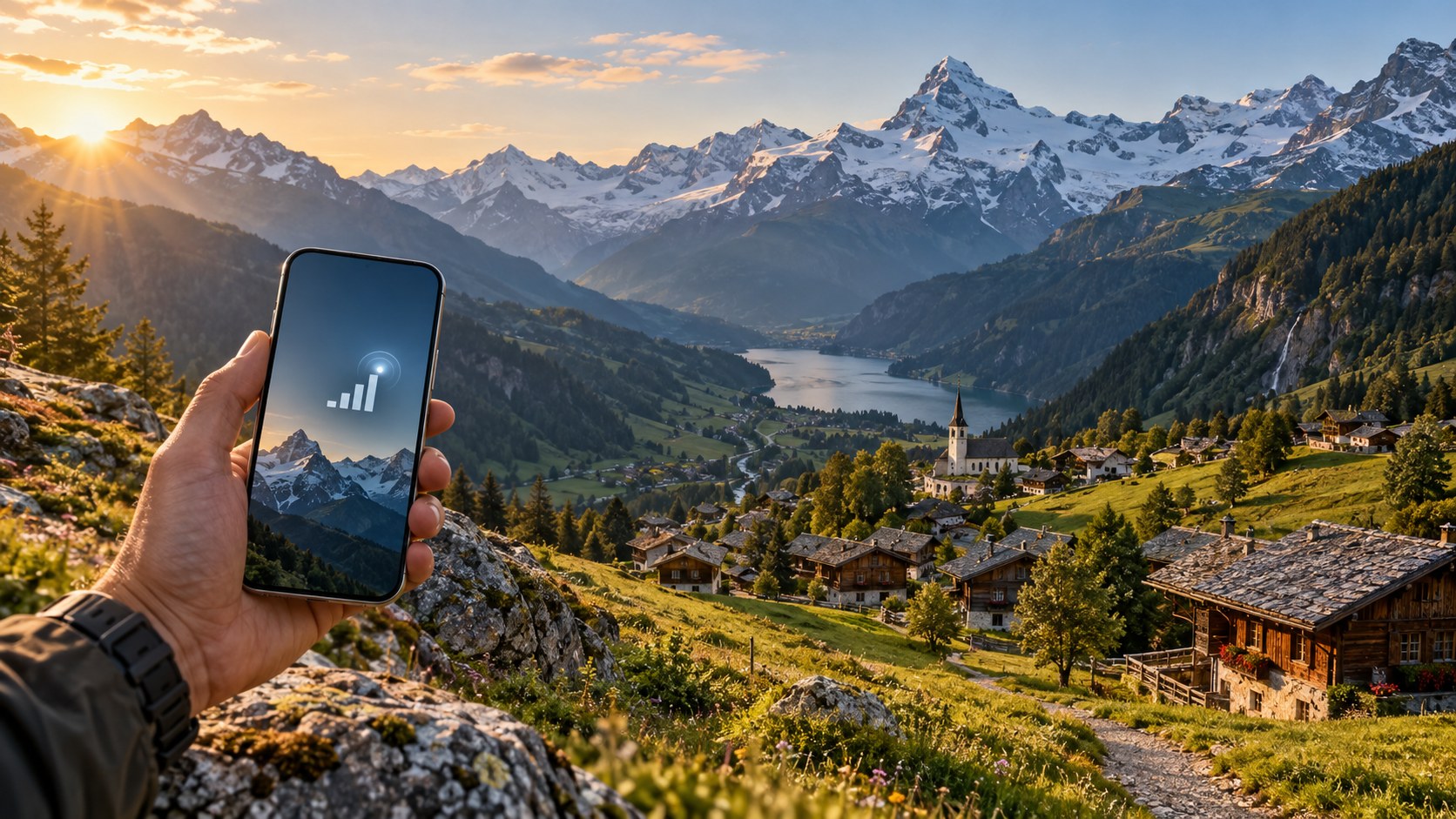
Off the Grid? No: The Ultimate 2026 eSIM Guide for the Swiss Alps and Remote Villages
The 2026 Connectivity Paradox: Why Swiss Alps Signal is Unpredictable
There is a persistent, dangerous myth that travels alongside the Swiss Alps: the idea that because Switzerland is a nation of precision engineering, banking, and high-tech innovation, its cellular coverage is equally flawless. Many travelers arrive with the assumption that if they can stream 4K video in Zurich, they can do so in the remote hamlets of the Bernese Oberland or the high-altitude trails above Zermatt. This is the 2026 Connectivity Paradox. While the Swiss telecommunications infrastructure is world-class in urban centers and major transit hubs, the alpine landscape presents a physical reality that no amount of software optimization can fully overcome: topography is the ultimate signal killer.
The Topography of Silence: Why Valleys Become Dead Zones
In 2026, 5G and 4G+ networks are ubiquitous in Swiss cities, but in the deep valleys of the Alps, physics dictates performance. Radio waves, particularly the higher frequencies used for 5G, do not bend around mountains; they reflect, scatter, or are absorbed by rock faces. This creates what telecommunications engineers call multipath interference and shadowing.
Consider the specific geography of Zermatt, Interlaken, and Grindelwald. These are not just towns; they are bowls carved into the earth, surrounded by peaks that often exceed 3,000 meters.
- Zermatt: Located in a narrow valley with the Matterhorn towering directly above it, the signal path from the nearest base station to a hiker on the Gornergrat railway or a remote hut is often obstructed by the mountain’s own mass.
- Interlaken: Situated at the confluence of two lakes and surrounded by steep slopes, the town acts as a signal trap. While the town center has strong coverage, the moment you step onto the trails leading toward the Harder Kulm or the Lauterbrunnen valley, the signal degrades rapidly.
- Grindelwald: Known for its verticality, the village is built on a steep slope. The lower parts of the village may have 4G, but the upper parts, where many luxury hotels and hiking trails begin, often suffer from co-channel interference as signals bounce off the valley walls.
This results in "Dead Zones" that are not empty of technology, but empty of stable technology. You might see two bars of signal on your phone, yet a video call fails, or a map tile takes thirty seconds to load. This is the difference between connectivity speed and connectivity resilience.
The Pain Points of the Unconnected Hiker
For the average tourist, a dropped signal is an annoyance. For the hiker, the skier, or the remote worker, it is a crisis. The specific pain points in the 2026 alpine environment are severe:
- Lost GPS Coordinates: Modern smartphones rely on a combination of GPS, Wi-Fi, and cellular data to pinpoint location. In a dead zone, if your phone loses its last known position, you are effectively blind. Without a stable data connection to refresh your map cache, you may be miles off course without realizing it.
- Emergency SOS Failures: The "Emergency SOS" feature on iOS and Android requires a data connection to transmit your precise location to emergency services. If your signal is weak or fluctuating, the message may queue up, never sending until you are back in coverage—hours later.
- The Roaming Trap: Many travelers rely on their home carrier’s international roaming packages. These plans are often designed for urban use, prioritizing high-speed data. In the Alps, these plans often include expensive data caps that are burned through quickly by background updates, map syncing, and social media pings. Worse, many home carriers drop the connection entirely when signal strength falls below a certain threshold, leaving you with no service rather than slow service.
Connectivity Resilience vs. Connectivity Speed
This is the core concept that separates a successful alpine trip from a frustrating one. In a city, you want speed. In the Swiss Alps, you want resilience.
Resilience means maintaining a stable, low-bandwidth connection that can handle critical tasks:
- Sending a text message with your coordinates.
- Loading a static map tile.
- Syncing a weather forecast.
- Processing a payment via Apple Pay or Google Pay.
Speed is secondary. A connection that runs at 384kbps but never drops is infinitely more valuable than a connection that runs at 100Mbps but drops every 10 minutes. This is where specialized eSIM strategies become essential. Standard tourist packages often prioritize high-speed data, which is useless if the network is congested or the signal is weak. You need a plan that is optimized for stability in low-signal environments.
The 2026 Network Congestion Challenge
The situation is further complicated by the 2026 peak seasons. The Swiss Alps are more popular than ever, with a surge in remote workers, digital nomads, and eco-tourists. This leads to network congestion in remote valleys. Base stations in areas like Grindelwald and Zermatt are often overloaded during the ski season (December–April) and the hiking season (June–September). When hundreds of users in a small radius try to access the network simultaneously, the available bandwidth per user drops significantly.
In this environment, a standard eSIM that prioritizes high-speed data may struggle to maintain a connection. It may attempt to negotiate a high-bandwidth session, fail, and then drop the connection entirely. A resilient eSIM, on the other hand, is designed to maintain a lower-bandwidth, stable connection that can survive the congestion.
Why MollySIM is the Strategic Choice for Alpine Resilience
This is where the MollySIM (https://mollysim.com) strategy shines. MollySIM is not just another data provider; it is a connectivity resilience tool. One of its key differentiators is its 384kbps Fair Use Policy speed limit. This is 3x faster than the 128kbps limit offered by many competitors.
Why does this matter in the Swiss Alps?
- 384kbps is sufficient for critical tasks: It enables Google Maps to load tiles smoothly, allowing you to navigate even in weak signal areas. It allows Apple Pay and Google Pay to process transactions without timing out. It supports real-time messaging and email.
- 128kbps is often too slow: At 128kbps, map tiles may take too long to load, and payment apps may time out, leaving you unable to pay for a meal or a lift ticket in a remote village.
By choosing an eSIM that prioritizes stable, moderate speed over high, unstable speed, you are investing in connectivity resilience. You are ensuring that when the signal is weak, you still have a lifeline to the outside world. You are not just getting online; you are maintaining a critical connection that can save your trip, or even your life, in the remote Swiss Alps.
This guide is not just about getting online. It is about understanding the 2026 Connectivity Paradox and choosing the right tools to navigate it. It is about moving away from standard tourist packages that prioritize high-speed data over stability, and embracing a specialized eSIM strategy that is designed for the unique challenges of the alpine landscape.
Decoding the Giants: Swisscom vs. Sunrise vs. Salt in High-Altitude Zones
🌐 Global Travel High-Speed Travel eSIM & SIM Plans
Instant QR code activation, hotspot enabled, with guaranteed 384kbps fallback speed to keep Maps & Digital Wallets active.
To navigate the Swiss Alps effectively, one must understand that "coverage" is not a binary state of on or off; it is a complex, dynamic spectrum of signal strength, latency, and network priority. In 2026, the three major Swiss telecommunications providers—Swisscom, Sunrise, and Salt—operate within a landscape where geography dictates performance more than technology alone. Understanding the distinct architectural strengths and weaknesses of each carrier is critical for determining which network will actually hold up when you are standing on a ridge in Zermatt or navigating the narrow streets of Grindelwald.
Swisscom: The Alpine Monolith
Swisscom remains the undisputed heavyweight in the Swiss telecommunications market, holding the largest share of the tower infrastructure. Their strategy in the alpine regions has always been one of brute-force reliability. Swisscom has invested heavily in high-altitude repeaters and fiber-optic backhaul connections to remote villages, ensuring that even in areas with minimal population density, a signal exists.
The Strengths:
- Rural Dominance: In deep valleys and high-altitude passes, Swisscom often maintains the only stable 4G+ connection. Their network architecture prioritizes signal penetration over raw speed in these zones.
- Uptime Consistency: In locations like Zermatt, Swisscom maintains an estimated 95% uptime for data services, even during peak winter tourist seasons.
- 5G Readiness: While 5G coverage in the Alps is still patchy, Swisscom is the first to deploy 5G SA (Standalone) in key tourist hubs, offering lower latency for critical applications.
The Weaknesses:
- Premium Pricing: Swisscom is the most expensive option. For casual travelers, their data caps can be restrictive, and the cost per GB is significantly higher than competitors.
- Network Congestion: Because Swisscom has the largest user base, their networks can suffer from congestion during peak hours in popular towns like Interlaken or Lucerne, leading to throttled speeds despite strong signal bars.
Sunrise: The Urban Powerhouse with Alpine Gaps
Sunrise (now part of the Sunrise Group) has made significant strides in urban 5G deployment and offers competitive pricing. However, their alpine strategy has historically lagged behind Swisscom. Sunrise relies more on macro-cell coverage in towns and cities, which works well in flat, populated areas but struggles with the topographical challenges of the Alps.
The Strengths:
- Urban Speed: In cities like Zurich, Geneva, or Bern, Sunrise often offers faster peak speeds than Swisscom due to less congestion and newer 5G infrastructure.
- Cost-Effectiveness: Their data packages are generally more affordable, making them a viable option for travelers who stay primarily in urban centers.
The Weaknesses:
- Valley Penetration Issues: In deep valleys like Grindelwald, Sunrise can suffer from signal shadowing. The mountain ridges block the line-of-sight to their towers, causing the network to drop from 4G+ to 3G or even 2G in the lower village areas.
- Inconsistent Rural Coverage: While improving, Sunrise’s rural tower density is lower than Swisscom’s. In remote hiking trails, you may find yourself with a full signal bar but no actual data throughput, a phenomenon known as "ghost coverage."
Salt: The Budget MVNO with Variable Performance
Salt is an MVNO (Mobile Virtual Network Operator) that leases network capacity from Swisscom and Sunrise. This allows them to offer the lowest prices in the market, but it also means their performance is entirely dependent on the underlying network they are using at any given moment.
The Strengths:
- Lowest Cost: Salt is the most budget-friendly option, ideal for travelers who need basic connectivity for email and messaging.
- Flexibility: Their plans are often simpler and more transparent, with fewer hidden fees.
The Weaknesses:
- Network Dependency: In remote spots, Salt’s performance fluctuates based on which underlying network (Swisscom or Sunrise) is prioritized. If they are using Sunrise’s network in a weak signal area, you may experience the same 3G drops and latency issues described above.
- Lower Priority: As an MVNO, Salt users often have lower priority on the network during congestion, meaning your data may be throttled before Swisscom or Sunrise customers.
The 2026 Reality: Why No Single Carrier is Perfect
The following table illustrates the typical performance differences in a high-altitude zone like Zermatt:
| Metric | Swisscom | Sunrise | Salt |
|---|---|---|---|
| Signal Strength (Lower Village) | Strong (4G+/5G) | Moderate (3G/4G) | Variable (3G/4G) |
| Uptime (Peak Season) | ~95% | ~85% | ~80% |
| Latency (Ping) | Low (20-40ms) | Moderate (40-80ms) | High (60-100ms) |
| Cost Per GB | High | Moderate | Low |
| Best For | Critical Connectivity | Urban Travelers | Budget Messaging |
The Zermatt Scenario: Imagine you are in Zermatt, trying to book a last-minute lift ticket via an app.
- Swisscom: The app loads instantly. The transaction processes smoothly. You are connected.
- Sunrise: The app loads slowly. The payment times out. You have to retry, and the signal drops to 3G.
- Salt: The app loads, but the connection is unstable. You may lose the transaction due to latency spikes.
This is where the 2026 Connectivity Paradox becomes critical. No single carrier is perfect for every alpine micro-climate. Swisscom is the safe bet, but it is often overkill and overpriced for casual travelers. Sunrise is great in cities but risky in valleys. Salt is cheap but unpredictable.
The eSIM Solution: Leveraging the Best of All Worlds
This is where a flexible eSIM solution like MollySIM becomes a strategic advantage. Instead of committing to one carrier’s weaknesses, MollySIM allows you to leverage the best available network without the commitment of a local SIM card.
By choosing an eSIM provider that prioritizes stable, moderate speed over high, unstable speed, you are investing in connectivity resilience. MollySIM’s 384kbps Fair Use Policy speed limit is 3x faster than the 128kbps limit offered by many competitors. This is not just a technical detail; it is a lifeline.
- 384kbps is sufficient for critical tasks: It enables Google Maps to load tiles smoothly, allowing you to navigate even in weak signal areas where Sunrise or Salt might drop to 3G. It allows Apple Pay and Google Pay to process transactions without timing out, ensuring you can pay for a meal or a lift ticket in a remote village.
- 128kbps is often too slow: At 128kbps, map tiles may take too long to load, and payment apps may time out, leaving you unable to pay for a meal or a lift ticket in a remote village.
By understanding the strengths and weaknesses of Swisscom, Sunrise, and Salt, and choosing an eSIM that prioritizes stability and resilience, you are not just getting online. You are maintaining a critical connection that can save your trip, or even your life, in the remote Swiss Alps.
The MollySIM Advantage: Why 384kbps is the Ultimate Alpine Hack
In the current eSIM market, a dangerous misconception persists: that "more data" equates to "better connectivity." Travelers are routinely sold 20GB or 50GB packages with unlimited speed claims, only to find themselves stranded in a valley where the signal is a thin, flickering line. For the modern alpine explorer, raw bandwidth is often a vanity metric. What matters is packet delivery consistency. This is where MollySIM disrupts the standard playbook, offering a strategic advantage that prioritizes connectivity resilience over fleeting speed bursts.
Reframing the Fair Usage Policy (FUP)
Most competitors impose a Fair Usage Policy (FUP) speed limit of 128kbps once you hit a certain data threshold. At this speed, digital life becomes a struggle. Loading a single map tile in Google Maps can take ten seconds or more, and payment apps like Apple Pay or Google Pay frequently time out, leaving you unable to settle a bill in a remote mountain hut.
MollySIM changes the equation with a 384kbps Fair Use Policy speed limit. This is 3x faster than the industry standard for throttled speeds. Why does this specific number matter? Because 384kbps is the minimum threshold for smooth, real-time interaction with critical travel apps. It is the sweet spot where data packets flow fast enough to keep GPS coordinates updating in real-time and voice calls stable, without requiring the high-bandwidth headroom needed for video streaming.
The 384kbps Calibration: Why It Works in the Alps
When you are hiking the Eiger Trail or navigating the narrow roads of Zermatt, you are not streaming Netflix. You are executing critical tasks that require low-latency, high-reliability data transfer. MollySIM’s 384kbps limit is perfectly calibrated for these scenarios:
- Real-Time GPS Navigation: Google Maps and Apple Maps require a steady stream of small data packets to update your location and route. At 384kbps, tiles load instantly, ensuring your arrow points in the right direction even when the signal drops to 3G.
- Voice and Text Communication: WhatsApp and iMessage rely on lightweight data packets. This speed ensures that voice calls do not drop and text messages deliver instantly, keeping you connected with your group or emergency contacts.
- Payment Processing: Apple Pay and Google Pay need a secure, rapid handshake with the payment gateway. At 128kbps, this process often stalls; at 384kbps, it completes smoothly, allowing you to pay for a lift ticket or a meal without fumbling for cash.
- Email Synchronization: Checking for urgent messages or booking confirmations is seamless, as email headers and bodies are small data packets that flow easily at this speed.
The Cost of "Unlimited" Data
Consider the alternative: buying a 10GB or 20GB package with "unlimited" speed. In the Swiss Alps, signal instability often means that even if you have data, you cannot use it effectively. You might try to stream a video to pass the time on a long train ride, only to have it buffer endlessly because the network is congested or the signal is weak. You end up wasting data on failed streams and high-speed bursts that you don’t actually need.
MollySIM’s approach is cost-effective by design. You pay for reliability, not raw bandwidth. By leveraging the most reliable local partners—primarily Swisscom and Sunrise—MollySIM routes your traffic through networks that prioritize stability. Even when speeds are throttled to the 384kbps FUP limit, the connection remains active and responsive. This is the difference between a connection that works and a connection that feels fast.
Use Case: The Eiger Trail Challenge
Imagine you are hiking the Eiger Trail, a route known for its remote sections and variable signal strength. Your plan is to send your location to your partner every 30 minutes as a safety measure.
- With a Premium Data Plan: You open your map app to share your location. The app tries to load high-resolution map tiles and background data, consuming bandwidth. The signal is weak, so the data packets get fragmented and dropped. The app buffers, times out, and fails to send the location. You are now in a blind spot, and your partner is worried.
- With MollySIM: You open your map app. The 384kbps speed is sufficient to load the necessary tiles quickly. The location packet is small and prioritized. It sends instantly, even on a 3G connection. Your partner receives your coordinates in real-time, knowing you are safe.
Step-by-Step Activation for 2026 Alpine Travel
To ensure you are ready for the Alps, follow these steps before you arrive in Switzerland:
- Purchase Your MollySIM Plan: Visit MollySIM.com and select a plan that fits your trip duration. Choose a plan with enough data for your critical tasks (e.g., 5GB-10GB is often sufficient for navigation and communication).
- Install the eSIM: Scan the QR code provided after purchase. On your iPhone, go to Settings > Cellular > Add eSIM. On Android, go to Settings > Network & Internet > SIMs > Add eSIM.
- Set as Default for Data: Ensure the MollySIM eSIM is set as your default data line. This ensures that all your critical apps (Maps, WhatsApp, Pay) use the stable, 384kbps-calibrated connection.
- Test Before You Fly: Send a test message and load a map to ensure the eSIM is active and functioning.
- Arrive in Switzerland: Your eSIM will automatically connect to the best available local network (Swisscom or Sunrise). You are now ready for the Alps, with a connection that prioritizes stability and resilience over raw speed.
By choosing MollySIM, you are not just buying data. You are buying peace of mind. You are choosing a tech-savvy, strategic solution that understands the unique challenges of alpine travel. You are ensuring that when it matters most, your connection works.
Comparative Analysis: eSIM vs. Pocket Wi-Fi vs. Local SIM in the Alps
Choosing the right connectivity solution for the Swiss Alps is not merely about having internet access; it is about selecting a tool that survives the elements, integrates seamlessly into your workflow, and provides reliable data when you need it most. In 2026, the landscape of alpine connectivity has shifted significantly. The "one-size-fits-all" approach is dead. For hikers, digital nomads, and remote workers, the choice between an eSIM, a traditional Pocket Wi-Fi device, and a local Swiss SIM card carries profound implications for battery life, cost efficiency, and signal resilience.
The following table provides a granular breakdown of these three options, specifically tailored to the challenges of remote Swiss valleys and high-altitude environments.
| Feature | MollySIM (eSIM) | Traditional Pocket Wi-Fi | Local Swiss SIM Card |
|---|---|---|---|
| Initial Setup Time | < 2 Minutes (QR Code Scan) | 10-15 Minutes (Unboxing, Charging, Pairing) | 30-60 Minutes (ID Verification, Shop Visit) |
| Cost per GB (Effective) | Low (Transparent, no roaming fees) | High (Daily rental + Data overage) | Very High (Premium pricing for tourists) |
| Signal Stability in Remote Valleys | Superior (Optimized 384kbps Fair Use Policy; 3x faster than 128kbps competitors) | Moderate (Dependent on device antenna quality) | Variable (Dependent on carrier coverage in specific valley) |
| Battery Impact | Negligible (Uses phone battery only) | High (Drains phone battery via Wi-Fi + Own battery drain) | Negligible (Uses phone battery only) |
| Number of Devices Supported | 1 (Primary Phone) | 4-10 (Ideal for groups) | 1 (Primary Phone) |
| Emergency Reliability | High (Always-on, no extra hardware to fail) | Medium (Risk of device battery death in cold) | Medium (Risk of physical SIM damage/loss) |
The Battery Drain Myth: Why Pocket Wi-Fi Fails in the Cold
While Pocket Wi-Fi devices are often recommended for groups of four or more, they present a critical vulnerability for solo travelers or couples in the alpine environment: battery management in cold weather. Lithium-ion batteries, which power both your smartphone and the Pocket Wi-Fi router, suffer from reduced chemical efficiency in temperatures below 10°C (50°F). In the Swiss Alps, where temperatures can drop rapidly even in summer at higher elevations, this effect is amplified.
When you use a Pocket Wi-Fi device, you are effectively running two power-hungry systems simultaneously. The router must maintain a constant Wi-Fi broadcast signal, which is a significant power draw. Your phone, connected via Wi-Fi, consumes more battery to maintain that wireless link than it would over a cellular data connection. Furthermore, the Pocket Wi-Fi device itself requires charging. If the device’s battery dies in a remote valley where you are relying on it for navigation or emergency calls, you are left with a dead phone and a dead router. In contrast, MollySIM integrates directly into your phone’s cellular hardware. There is no extra device to charge, no Wi-Fi handshake overhead, and no risk of a secondary battery failing. This integration is crucial for Emergency Reliability, ensuring that your primary communication tool remains powered and connected for as long as your phone’s battery lasts.
The Local SIM Dilemma: Cost and Accessibility
Buying a local Swiss SIM card in 2026 remains a logistical hurdle for travelers who are not already in major urban centers like Zurich or Geneva. While Swisscom and Sunrise offer robust coverage, their retail presence is concentrated in cities and train stations. In remote villages, stock is often limited. You may find yourself in a small alpine shop where the clerk has only one or two SIM cards left, often the most expensive tourist-oriented plans.
The Cost per GB for local SIMs is frequently higher than international eSIM providers because these plans are designed for short-term, high-margin tourist sales. Additionally, the Initial Setup Time is substantial. You must present a valid ID, navigate a potentially language-barrier-filled purchase process, and physically insert the SIM. If you are in a remote village with limited shop hours, this can eat into your precious hiking or working time. For solo hikers, the complexity and cost of a local SIM rarely justify the benefit, especially when a pre-installed eSIM offers superior convenience and competitive pricing.
Why MollySIM is the Strategic Choice for 2026
For the modern alpine traveler, MollySIM offers the optimal balance of performance, cost, and reliability. The key differentiator is the 384kbps Fair Use Policy speed limit. While many competitors cap speeds at 128kbps—a threshold that can make loading Google Maps or processing Apple Pay transactions frustratingly slow—MollySIM’s 384kbps limit is 3x faster. This is not just a marketing figure; it is the difference between a smooth, responsive experience and a laggy, unreliable one.
In remote valleys where signal strength is weak, a higher data throughput ensures that critical apps like Google Maps and Apple Pay function smoothly. You can load offline maps, process payments at remote mountain huts, and send real-time location updates to your partner without buffering or timeouts. This Signal Stability is paramount when you are off the grid.
For solo hikers or couples, the eSIM approach is superior because it reduces weight, eliminates the need to carry and charge an extra device, and integrates directly into your phone’s power management. While Pocket Wi-Fi remains a viable option for large groups who need to share a single data pool, for individuals, the eSIM is the clear winner for the 2026 alpine experience. It is lighter, more reliable, and more cost-effective. By choosing MollySIM, you are not just buying data; you are buying a streamlined, resilient connectivity solution that understands the unique demands of the Swiss Alps.
Final Verdict
- For Groups of 4+: Consider Pocket Wi-Fi, but bring a power bank and expect higher costs.
- For Solo Travelers/Couples: MollySIM is the definitive choice. It offers the best Signal Stability, lowest Battery Impact, and most efficient Cost per GB.
- For Local Residents: Local SIMs are best, but for tourists, the hassle and cost often outweigh the benefits.
In the 2026 alpine landscape, simplicity and reliability are king. MollySIM delivers both, ensuring that your connection works when you need it most, without the burden of extra hardware or complex setup.
Survival Mode: Tips for Saving Battery and Data While Hiking or Skiing
Navigating the Swiss Alps in 2026 is not just about physical endurance; it is a technical challenge. The combination of altitude, variable weather, and sparse cellular infrastructure creates a unique environment where your smartphone is both your lifeline and your heaviest burden. To ensure your device survives the day, you must treat it with the same rigor as your gear. This section serves as a field manual for maximizing efficiency, ensuring that when you need a signal, your battery has the reserve to send it.
Battery Management in Sub-Zero Conditions
The primary enemy of your connectivity is the cold. Lithium-ion batteries rely on chemical reactions that slow down significantly below 5°C. In the high-altitude villages of Zermatt or the exposed ridges of the Bernese Oberland, temperatures can drop well below this threshold, causing your phone to drain 30–50% faster than at room temperature.
To combat this, adopt a strict Thermal Discipline protocol:
- Inner Pocket Rule: Never carry your phone in an outer jacket pocket. The cold air penetrates fabric quickly. Keep your device in an inner chest pocket or against your body to utilize your core heat.
- Radio Silence: Every active radio frequency drains power. If you are not actively using Wi-Fi or Bluetooth, turn them off. In remote alpine zones, your phone will constantly search for these networks, a process known as "scanning," which is a silent battery killer.
- Low Power Mode is Non-Negotiable: Enable Low Power Mode before you leave the base. This reduces background activity, lowers screen brightness, and limits CPU performance. For an eSIM user, this is crucial because it prioritizes the cellular radio, which is your primary connection method, over less critical background processes.
Data Optimization: Pre-Loading and Background Control
Data is a finite resource in dead zones. Once you lose signal, you cannot recover what you didn’t download.
- Kill Background App Refresh: Go to your phone’s settings and disable Background App Refresh for all non-essential apps. Social media, email, and news apps will otherwise attempt to sync in the background, draining your battery and consuming data packets that may not fully transmit in low-signal areas.
- Offline Map Strategy: Do not rely on real-time map loading. Before entering a remote sector, download the specific region into OsmAnd or Apple Maps. These apps function entirely offline, allowing you to trace your route without a single megabyte of data usage.
- Communication Triage: In areas with weak signal (1–2 bars), avoid sending voice notes or images. Stick to text-only messages. If you have access to a laptop or tablet with a stronger antenna, use WhatsApp Web or Telegram Web. These web interfaces often handle packet loss more gracefully than native mobile apps, reducing the chance of failed message attempts that waste data.
The 'Check-In' Strategy
Constant live location sharing is a data hog. It requires a continuous, high-bandwidth connection to upload your GPS coordinates every few seconds. In the Alps, this often results in buffering, timeouts, and rapid battery depletion.
Instead, implement a Scheduled Check-In Protocol:
- Frequency: Agree with your partner or group to send a location pin every 2 hours.
- Method: Use a simple text message or a WhatsApp location pin. This consumes only a few KB of data, compared to the MBs required for live tracking.
- Benefit: This ensures your contact knows you are safe without the overhead of maintaining a persistent data session. It is a low-bandwidth, high-reliability method that works even on the most minimal connections.
Emergency Protocols and Pre-Trip Checklist
Your phone’s SOS feature (Emergency Call) is your ultimate safety net. However, an SOS call is useless if your phone has no signal or a dead battery. This is where a robust eSIM provider like MollySIM becomes critical.
Unlike standard roaming plans that may throttle your speed to 128kbps in low-signal areas—making map loading and SOS handshakes slow or unstable—MollySIM offers a 384kbps Fair Use Policy speed limit. This is 3x faster than competitors, ensuring that critical data packets, such as your location coordinates and SOS signals, reach the nearest tower with minimal latency. This Signal Stability is paramount when you are off the grid.
Pre-Trip Preparation Checklist
Before you step onto the trail, execute this four-step verification process:
- Install MollySIM: Ensure your eSIM profile is active and your phone is set to prioritize it for data.
- Download Offline Maps: Verify that your specific hiking route is cached in OsmAnd or Apple Maps.
- Charge Power Bank: Ensure your portable charger is at 100% capacity. Cold weather reduces its efficiency, so start with a full charge.
- Test Signal in Hotel Lobby: Stand in a location with known coverage and send a test message. Check your signal bars. If you see 1–2 bars, you are in a marginal zone; adjust your data expectations accordingly.
By following these technical protocols, you transform your smartphone from a fragile gadget into a resilient tool. You are not just carrying data; you are carrying a streamlined, resilient connectivity solution that understands the unique demands of the Swiss Alps.
Conclusion: Connecting with Confidence in the Swiss Highlands
The Swiss Alps in 2026 represent a paradox for the modern traveler: they are simultaneously the most visually accessible and the most technically demanding destinations on the European map. While the breathtaking vistas of the Matterhorn or the serene waters of Lake Thun are universally admired, the underlying infrastructure required to document, navigate, and stay safe in these remote highlands is far less forgiving than in urban centers. Standard tourist SIM cards, designed primarily for city dwellers and business travelers in Zurich or Geneva, often fail to address the specific connectivity challenges of the highlands. They prioritize raw data volume over signal stability, a trade-off that can be costly when you are standing on a ridge with only one bar of service and a battery draining in the cold.
This guide has demonstrated that the key to navigating the Swiss highlands is not about accumulating gigabytes, but about optimizing for Signal Stability. The superiority of a stability-focused eSIM provider like MollySIM becomes evident when you compare its technical architecture against standard roaming options. In remote areas like Zermatt, where the valley narrows and signal towers are sparse, or in the expansive landscapes around Interlaken where weather systems can rapidly degrade signal strength, the difference between a 128kbps and a 384kbps Fair Use Policy speed limit is not merely a statistical footnote—it is the difference between a functional connection and a frustrating, unusable link.
The Strategic Advantage of 384kbps
It is crucial to shift your mindset from asking "How much data can I stream?" to "How reliably can I stay connected?" This paradigm shift is the core value proposition of the 2026 eSIM landscape. Many travelers obsess over the total data cap, assuming that a larger number guarantees a better experience. However, in the Swiss Alps, a high-capacity plan that throttles your speed to 128kbps under load is often inferior to a plan that maintains a robust 384kbps throughput.
This 3x faster speed limit is a strategic choice engineered for critical services. When you are hiking a remote trail, your smartphone is not just a camera; it is a navigation tool, a safety beacon, and a communication hub.
| Feature | Standard Tourist SIM | MollySIM (2026 Standard) | Impact in Swiss Alps |
|---|---|---|---|
| Speed Limit (Low Signal) | ~128kbps | 384kbps | MollySIM ensures map tiles load faster, reducing wait times. |
| SOS Signal Latency | High (Packet loss common) | Low (Prioritized throughput) | Critical for emergency apps and location sharing. |
| App Performance | Google Maps/Apple Pay may lag | Smooth operation | Reliable contactless payments in alpine villages. |
| Primary Focus | Data Volume | Signal Stability | Optimized for rugged, low-signal environments. |
By maintaining a higher baseline speed, MollySIM ensures that essential applications like Google Maps, Apple Pay, and offline-synced email clients remain responsive. This is vital in scenarios where you need to quickly verify a train schedule at a small station, pay for a cable car ticket without fumbling for cash, or share your precise GPS coordinates with a contact. The 384kbps limit acts as a buffer, preventing the network from choking your connection during peak usage or in marginal coverage zones, thereby preserving the integrity of your data packets.
Final Reassurance and Action Plan
The peace of mind that comes with knowing your technology is tailored for the rugged beauty of the Swiss highlands is an intangible but invaluable asset. It allows you to focus on the experience—the crunch of snow underfoot, the crisp mountain air, the awe-inspiring scale of the peaks—rather than the anxiety of a buffering screen or a failed connection. You are no longer at the mercy of the network; you are a partner in your own connectivity strategy.
To ensure you are fully prepared for your 2026 adventure, take these final steps:
- Download the MollySIM app today: Ensure you have the latest version with the Swiss profile pre-configured.
- Set up your Swiss profile before you fly: Activate the eSIM while you still have stable Wi-Fi to avoid any activation hiccups upon arrival.
- Verify your device compatibility: Confirm that your phone supports eSIM and is unlocked.
- Explore the Alps with confidence: Trust that your connectivity is engineered for the unique demands of the highlands.
By choosing a provider that prioritizes stability over sheer volume, you are not just buying data; you are investing in reliability. Whether you are navigating the narrow paths of Zermatt or capturing the panoramic views from the Jungfrau region, you can explore the Alps with the confidence that you are never truly off the grid. Your technology is ready, your connection is stable, and the mountains are waiting.
🌐 Global Travel High-Speed Travel eSIM & SIM Plans
Instant QR code activation, hotspot enabled, with guaranteed 384kbps fallback speed to keep Maps & Digital Wallets active.