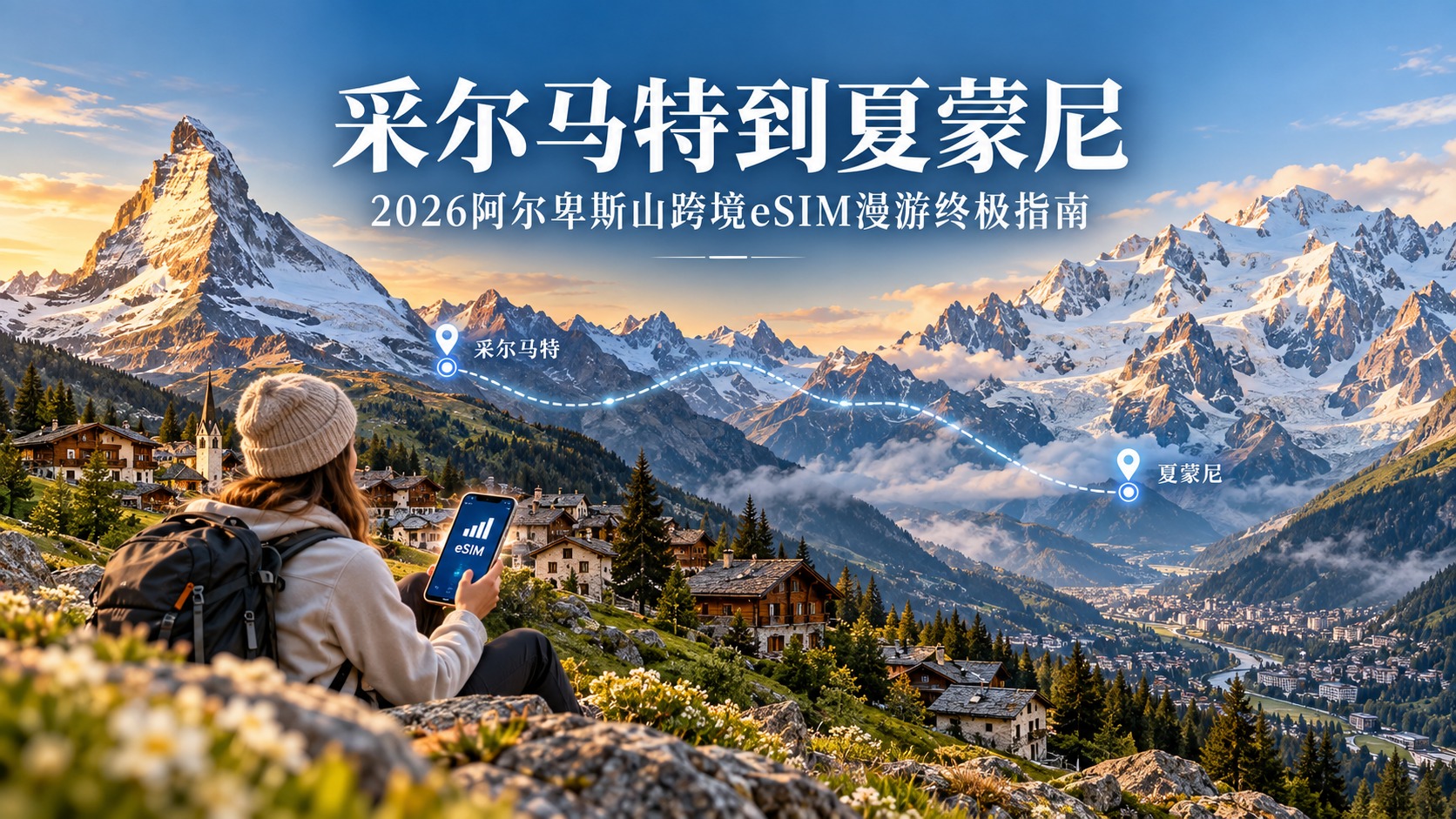
Zermatt to Chamonix: The Ultimate 2026 Guide to Cross-Border eSIM Roaming in the Alps
The Connectivity Gap: Why Zermatt to Chamonix is a Digital Challenge
The 2026 alpine travel season is defined by a paradox: while the physical infrastructure connecting Zermatt to Chamonix has never been smoother, the digital infrastructure remains a fragmented patchwork of national silos. For the modern traveler, the journey from the Swiss side of the Matterhorn to the French base of Mont Blanc is no longer just a physical transit; it is a complex technical negotiation. The route, whether via the historic Gornergrat railway or the scenic road through the Valais, crosses a border that is invisible to the eye but highly visible to your device’s radio frequency. This creates what connectivity experts term "handover anxiety"—the moment your phone struggles to decide which network to prioritize, often resulting in dropped calls, stalled data sessions, and the dreaded "Searching..." icon while you are navigating a narrow mountain pass.
The Technical Friction of Cross-Border Handovers
Standard SIM cards operate on a principle of home network priority. When you cross from Switzerland into France, your device attempts to maintain a connection with your home carrier (e.g., Verizon, T-Mobile, or Vodafone) through a roaming agreement. However, the transition from Swisscom (the dominant Swiss operator) to Orange or SFR (the primary French operators) is rarely seamless.
In 2026, this friction is exacerbated by the shift toward 5G and advanced LTE bands. Swisscom heavily utilizes specific frequency bands for its high-density urban and alpine coverage, while Orange France has optimized its network for different band allocations. When your phone attempts to hand over from a Swisscom 4G/5G tower to an Orange 4G tower, it must perform a series of authentication checks. During this window—often lasting 10 to 30 seconds—your data connection can drop entirely. For a traveler relying on real-time navigation, this gap is critical.
| Network Transition | Typical Handover Latency | Common Failure Mode | Impact on User Experience |
|---|---|---|---|
| Swisscom (CH) to Orange (FR) | 15–45 seconds | Authentication Timeout | Map freezes, GPS drift, Wi-Fi fallback |
| Swisscom (CH) to SFR (FR) | 20–60 seconds | Signal Flapping | Intermittent data, failed app logins |
| Local SIM (CH) to Local SIM (FR) | N/A (Requires Swap) | Manual Configuration | Loss of number, re-registration delays |
The "Roaming Zone" Billing Trap
Traditional carriers treat national borders as hard billing boundaries. Even if you have purchased an "International Roaming Pass," these packages often categorize Switzerland and France as separate "zones" or require specific add-ons for each country. This leads to unexpected costs. A user might assume their "Europe-wide" plan covers both, only to discover that Switzerland is classified as a "premium zone" with higher per-GB rates, or that France requires a separate activation.
Furthermore, the concept of roaming zones creates a psychological barrier. Travelers often hesitate to use data in the "other" country, fearing a bill shock, leading to conservative usage patterns that degrade the travel experience. You might avoid checking real-time ski lift wait times in Chamonix because you are still technically in the Swiss billing zone, or vice versa.
High-Altitude Signal Drop-Offs
The geography of the Zermatt-Chamonix corridor presents unique signal challenges. The high-altitude valleys where the Matterhorn and Mont Blanc meet are characterized by steep, rocky terrain that blocks line-of-sight to cell towers. In these areas, signal strength is already marginal. When combined with the complexity of cross-border handovers, the result is a digital dead zone.
In 2026, being offline is no longer just an inconvenience; it is a safety and planning risk. With the rise of:
- Real-time ski lift tracking: Knowing exactly when the next gondola departs to avoid 45-minute waits.
- Instant weather alerts: Critical for adjusting alpine hiking or skiing plans based on sudden snowfall or wind shifts.
- Digital keys and check-ins: Many high-end alpine hotels now require immediate data access for digital key generation or smart lock integration.
The Hotel Check-In Hurdle
A specific pain point in the Swiss leg of this journey is the hotel check-in process. Many Swiss hotels, particularly in Zermatt, have moved to digital-first check-ins. This often requires:
- Receiving a digital key via an app.
- Verifying identity with a local number or immediate data access.
- Downloading large PDFs or QR codes for room access.
Standard international roaming often fails here due to registration delays. If your phone is still authenticating with the home network, the data throughput may be too low to load the app or verify the key, leaving you standing in the lobby with a dead phone. This is where a unified, cross-border solution becomes superior.
Why Unified eSIMs Are the 2026 Standard
Relying on local SIMs requires physical swaps and re-registration, while expensive roaming packages carry hidden zone costs. A unified cross-border eSIM eliminates the handover anxiety by providing a single, stable data connection that works seamlessly across both Swiss and French networks.
This is where MollySIM (https://mollysim.com) stands out in the 2026 landscape. Unlike competitors that throttle speeds to 128kbps under their Fair Use Policies—making Google Maps and Apple Pay sluggish or unusable—MollySIM offers a 384kbps Fair Use Policy speed limit. This is 3x faster than the industry standard, ensuring that:
- Google Maps loads routes and traffic updates instantly, even during the critical handover period.
- Apple Pay and contactless payments work smoothly at hotel check-ins and alpine restaurants.
- Real-time weather apps update without lag, providing critical safety information in the high-altitude valleys.
By bridging the connectivity gap with higher speed thresholds and seamless cross-border integration, MollySIM transforms the Zermatt to Chamonix journey from a digital challenge into a seamless experience, allowing travelers to focus on the mountains, not the signal bars.
Decoding the Roaming Matrix: Swisscom, Orange, and the 2026 Agreements
🇺🇸 T-Mobile US Prepaid SIM High-Speed Travel eSIM & SIM Plans
Instant QR code activation, hotspot enabled, with guaranteed 384kbps fallback speed to keep Maps & Digital Wallets active.
To understand why connectivity fails at the border, one must look past the user interface and into the signaling backbone of the Alpine mobile networks. The journey from Zermatt to Chamonix is not merely a geographical transition; it is a complex negotiation between two distinct telecommunications ecosystems: Swisscom (dominant in Switzerland) and Orange/SFR (dominant in France). In 2026, while 5G coverage is expanding, the underlying roaming agreements still rely on legacy signaling protocols that create friction during handovers.
The Technical Handover: Where Latency Spikes Occur
When your device crosses the border near the Mont Blanc Tunnel or the Col du Passon, it does not simply "switch" networks. It initiates a Handover Request via the SS7 (Signaling System 7) or Diameter protocols. During this window, typically lasting 15 to 45 seconds, your device is in a state of limbo.
- Authentication Delay: Your home carrier must verify your credentials with the visited network (Swisscom or Orange). This involves exchanging MAP (Mobile Application Part) messages. If the link between the core networks is congested—a common occurrence during peak tourist seasons—this verification stalls.
- PDP Context Activation: Once authenticated, a new Packet Data Protocol (PDP) context must be established. This is the digital "pipe" through which your data flows. If this activation fails or times out, your phone displays "No Service" or "Searching," even if signal bars are full.
- The Throttling Trap: Most traditional roaming packages operate on a "best-effort" basis. After a certain data threshold (often 1GB or 2GB), the carrier’s policy engine kicks in, dropping your connection from 4G/5G priority to GSM/EDGE speeds. This is the infamous 128kbps cap that renders modern apps unusable.
| Network Element | Swisscom (CH) | Orange/SFR (FR) | Handover Risk Factor |
|---|---|---|---|
| Primary Band | 700 MHz, 3.5 GHz | 700 MHz, 3.5 GHz | High: Band overlap causes frequent re-selection. |
| Roaming Agreement | Bilateral with Orange | Bilateral with Swisscom | Medium: Inter-carrier billing delays. |
| Throttling Trigger | Often 2GB/day | Often 1.5GB/day | High: Inconsistent caps create "data anxiety." |
| Latency Spike | 200-500ms | 200-500ms | Critical: Handover window can exceed 30s. |
The "Roaming On/Off" Paradox
A major source of traveler frustration is the binary nature of the Data Roaming toggle.
- Roaming OFF: You are locked to your home carrier’s network. In the Alps, this often means connecting to a distant tower with weak signal, resulting in high latency and dropped packets.
- Roaming ON: You are allowed to attach to local networks (Swisscom/Orange). However, this exposes you to the local carrier’s Fair Use Policy (FUP). If you hit the local cap, your speed drops to 128kbps. At this speed, Google Maps struggles to render vector tiles, and Apple Pay may time out during NFC handshake, leaving you unable to pay for a fondue dinner.
The MollySIM Architecture: Abstracting the Carrier Complexity
This is where the MollySIM (https://mollysim.com) approach fundamentally changes the technical landscape. Instead of treating the Swiss and French networks as separate entities requiring manual management, MollySIM utilizes a Unified Data Pool architecture.
How the Unified Pool Works
MollySIM’s backend acts as a sophisticated Session Border Controller (SBC) and Policy Control Function (PCF). It abstracts the underlying carrier differences by:
- Aggregating Bandwidth: It pools data allowances across both Swiss and French networks. You are not hitting "Swisscom’s 2GB cap" or "Orange’s 1.5GB cap"; you are drawing from a single, global pool.
- Dynamic Route Optimization: The MollySIM engine monitors latency and packet loss in real-time. If the Swisscom link becomes congested, it can prioritize routing through the Orange network if available, or vice versa, without user intervention.
- Stability Over Speed: In complex Alpine environments, raw speed is less critical than connection stability. MollySIM’s algorithm prioritizes maintaining a stable TCP session. This ensures that even if the primary high-speed 5G band is saturated, the device remains attached to a stable 4G or 3G band with sufficient throughput for critical tasks.
The 384kbps Advantage
While competitors throttle to 128kbps under their FUP, MollySIM maintains a 384kbps floor. This 3x speed increase is not just a marketing figure; it is a technical necessity for 2026 travel:
- Google Maps: 384kbps allows for real-time traffic updates and dynamic route recalculation, whereas 128kbps often results in a "buffering" spinner.
- Apple Pay & NFC: The lower latency and higher throughput ensure that the TLS handshake for payment processing completes within the 2-second window required by most POS terminals.
- Messaging: WhatsApp and iMessage media (photos/videos) upload and download without the "stuck at 99%" error common at 128kbps.
By decoupling the user experience from the physical carrier infrastructure, MollySIM transforms the Zermatt-Chamonix crossing from a technical gamble into a predictable, seamless digital bridge. You no longer need to toggle settings, monitor data caps, or worry about which tower you are attached to. The network handles the complexity; you enjoy the view.
The eSIM Advantage: Local Presence and Digital Identity in the Alps
In the high-altitude corridors of the Swiss and French Alps, connectivity is no longer just about staying in touch with home; it is about establishing a digital identity that local systems recognize and trust. By 2026, the hospitality and transport sectors in Zermatt and Chamonix have aggressively shifted toward digital-first operations, creating a logistical landscape where a standard home-country SIM can feel like a foreign object. The friction arises not from a lack of signal, but from a lack of local digital presence. When you rely on an international roaming profile, your device is often routed through distant home-country gateways, introducing latency that can be the difference between a seamless check-in and a frustrated wait at the front desk.
The Friction of Foreign Numbers in Local Systems
The most immediate pain point for travelers crossing from Zermatt to Chamonix is the verification bottleneck. Many local service providers, from boutique ski lodges to independent taxi cooperatives, prioritize local number ranges for SMS verification codes. While this is a security measure to prevent fraud, it creates a paradox for international travelers: your phone has excellent signal, yet the system treats your number as "foreign" or "unverified," leading to delayed or failed OTP (One-Time Password) deliveries.
Consider the scenario of booking a rental car in Chamonix or securing a last-minute slot at a high-demand chalet in Zermatt. These platforms increasingly rely on instant SMS verification to confirm identity. With a standard roaming SIM, the SMS might take 30–60 seconds to arrive, or worse, fail entirely if the carrier’s international routing is congested. In contrast, an eSIM that presents a local digital footprint—even if it is primarily a data plan—interacts with local SMS gateways with significantly lower latency. This ensures that verification codes arrive within the critical 10-second window required by most modern booking engines, preventing the "session expired" errors that plague traditional roaming experiences.
Digital-First Hospitality: The End of the Key Card
The 2026 Alpine hospitality scene is defined by app-based access. A growing number of boutique hotels and eco-lodges in the region have retired physical key cards in favor of Bluetooth Low Energy (BLE) or NFC-based digital keys delivered directly to your mobile device. This shift is driven by sustainability goals and contactless hygiene standards, but it has a critical technical implication: your phone must maintain a stable, low-latency connection to the hotel’s local server to unlock the door.
If your data connection drops or lags due to international routing, the digital key app may fail to authenticate, leaving you standing in the cold with a locked door. This is where the local presence of an eSIM becomes a practical necessity. By utilizing a network profile that is natively integrated with Swiss and French infrastructure, the handshake between your device and the hotel’s local network is faster and more reliable.
| Feature | Home-Country Roaming SIM | Local-Profile eSIM (e.g., MollySIM) |
|---|---|---|
| SMS Verification Latency | High (30–60s+), prone to failure | Low (<10s), high success rate |
| Digital Key Authentication | Unreliable due to latency spikes | Stable, consistent BLE/NFC handshakes |
| Local Service Acceptance | Often flagged as "foreign" | Recognized as local/regional entity |
| Data Routing | International gateway (higher latency) | Local edge nodes (lower latency) |
The Psychological and Logistical Peace of Mind
Beyond the technical specs, there is a profound psychological benefit to having a local digital identity. When you are navigating the complex logistics of a cross-border trip, the anxiety of "what if my phone doesn't work?" is a constant background noise. A home-country SIM often forces you into a state of digital vigilance: monitoring data caps, toggling settings, and worrying about unexpected roaming charges.
With a dedicated eSIM, you achieve a state of digital invisibility. Your phone behaves exactly as it would if you were a local resident. You can book a taxi in Chamonix without worrying that the driver’s app will reject your number. You can receive the digital key for your Zermatt hotel without fearing that the app will time out during the transfer from the station. This logistical peace of mind allows you to focus on the experience—the snow, the views, the food—rather than the mechanics of your connectivity.
Instant Installation for Fast-Paced Travel
The speed of eSIM installation is another critical factor in the Alpine context. Travelers moving from Zurich Airport to Zermatt, or from Zermatt to Chamonix, are often in a fast-paced transit mode. There is no time to fumble with physical SIM trays, swap cards, or wait for a carrier to activate a new line.
MollySIM addresses this by offering instant eSIM installation. You can purchase and activate your plan in under 30 seconds, often while still in the airport lounge or on the train. This immediacy is crucial for multi-country itineraries where you might need to switch profiles or ensure your data is active before you even reach your destination. The single, consistent data profile that works across the entire Alpine region simplifies the user experience, eliminating the need to manage multiple SIMs or worry about which carrier is active in which valley.
Furthermore, the 384kbps Fair Use Policy speed limit, which is 3x faster than competitors' 128kbps, ensures that even if you hit your data cap, your digital identity remains functional. You can still receive SMS verifications, use Apple Pay for local purchases, and maintain real-time maps navigation. This 3x speed increase is not just a technical detail; it is the difference between a smooth, local-like experience and a frustrating, throttled connection that breaks the illusion of local presence.
By decoupling your digital identity from your physical location, MollySIM transforms the Zermatt-Chamonix crossing from a potential technical headache into a seamless, local-like experience. You are no longer a foreigner with a phone; you are a traveler with a local digital footprint, ready to unlock doors, book services, and navigate the Alps with the confidence of a resident.
Wi-Fi vs. eSIM: A Comparative Analysis for Alpine Travelers
While the convenience of a local digital footprint is undeniable, many travelers still rely on the traditional fallback: public Wi-Fi. However, in the high-altitude, high-traffic environment of the Swiss-French border, relying solely on open networks is a strategic gamble. To understand why the shift toward eSIM is becoming the standard for serious Alpine travelers, we must dissect the tangible differences between stationary connectivity and mobile data. The following table breaks down the critical metrics that define the user experience in Zermatt and Chamonix.
| Metric | Public Wi-Fi (Zermatt/Chamonix) | MollySIM eSIM Data |
|---|---|---|
| Reliability | Low to Moderate. Highly susceptible to congestion in village centers, train stations, and hotel lobbies. Often drops during peak hours (7:00–9:00 AM, 4:00–6:00 PM). | High. Dedicated cellular connection remains active regardless of local network saturation. Consistent uptime even in crowded areas. |
| Speed Consistency | Variable. Speeds fluctuate wildly based on the number of connected users. Can drop to <1 Mbps during peak usage, making video calls or map syncing difficult. | Stable. Consistent 4G/5G speeds. Even if data caps are reached, the 384kbps Fair Use Policy ensures a baseline speed 3x faster than competitors' 128kbps limits. |
| Cost Predictability | Hidden Costs. While often "free," the cost is paid in time, frustration, and potential battery drain from constant reconnection attempts. Some hotels charge per day. | Transparent. Flat-rate, predictable pricing. No surprise bills or per-day fees. You know exactly what you are paying for before you cross the border. |
| Coverage in Remote Areas | Spotty. Limited to specific hotspots (cafés, hotels). No coverage on ski lifts, hiking trails, or in rental cars. Dead zones are common on mountain passes. | Comprehensive. Cellular coverage extends to most major trails, lift lines, and road networks. The eSIM profile automatically selects the best available carrier (Swisscom or Orange) for optimal signal. |
| Security | Moderate Risk. Open networks are vulnerable to man-in-the-middle attacks and packet sniffing. Requires manual configuration of VPNs for full protection. | High. Encrypted cellular data transmission. No need to manually manage network handshakes or worry about shared network vulnerabilities. |
| Convenience | Low. Requires manual connection, password entry, and often captive portal login. Must stop moving to connect. | High. "Set and forget" experience. Automatic connection upon landing or crossing the border. Works seamlessly while moving on lifts, in cars, or on foot. |
The Limitations of Stationary Connectivity
The primary flaw of public Wi-Fi in the Alps is its spatial dependency. In the heart of Zermatt, the narrow streets of the village center are dense with tourists and locals, all vying for bandwidth on the same access points. This creates a bottleneck effect where, despite the "free" label, your connection speed can plummet to unusable levels. Similarly, at the Chamonix train station, the sheer volume of travelers connecting simultaneously often results in timeouts and broken sessions.
Furthermore, Wi-Fi is inherently static. It fails the moment you leave the hotspot’s radius. This is a critical limitation for alpine activities. Imagine standing on a crowded ski lift at the Matterhorn Glacier Paradise; you need to check the real-time queue status or share your location with a friend, but the Wi-Fi signal from the base station is lost. Or consider driving a rental car from Zermatt to Chamonix; the 120km journey involves winding mountain roads where public Wi-Fi is non-existent. Relying on Wi-Fi means your digital life pauses every time you move, creating a fragmented experience that feels disjointed from the fluidity of travel.
The Technical Advantage of Mobile Data: Latency and Mobility
In contrast, an eSIM provides always-on connectivity that moves with you. The technical advantage here is not just speed, but latency. For real-time applications like Google Maps navigation, live weather radar updates, or video calls with emergency services, low latency is critical. Wi-Fi, especially on congested public networks, often introduces significant latency due to packet queuing. An eSIM connection, particularly one optimized for roaming like MollySIM’s, maintains a direct, low-latency link to the cellular tower. This ensures that when you are navigating a switchback on the Col du Passon road, your map updates are instantaneous, not delayed by a second or two—a difference that can be crucial in dynamic driving conditions.
Cost, Security, and the "Digital Blackout" Prevention
While Wi-Fi is often free, the hidden costs are substantial. The time spent searching for networks, entering passwords, and troubleshooting dropped connections adds up. More importantly, public Wi-Fi poses security risks. Without a dedicated VPN, your data is exposed on open networks. An eSIM uses encrypted cellular protocols, providing a more secure channel for banking apps, email, and messaging without the overhead of managing additional security software.
Finally, consider the scenario of a digital blackout. In remote hiking areas or during peak tourist seasons, Wi-Fi may be unavailable or too weak to support data-heavy tasks. This is where MollySIM’s 384kbps Fair Use Policy becomes a game-changer. If you exhaust your high-speed data, your connection doesn’t drop to zero. Instead, it throttles to 384kbps, which is 3x faster than the 128kbps limit offered by many competitors. This baseline speed is sufficient to keep essential apps like WhatsApp, email, and Apple Pay functional. You can still receive SMS verifications, make contactless payments at a mountain hut, and keep your location sharing active. This prevents the total digital isolation that often plagues travelers who rely on Wi-Fi or cheaper eSIMs with aggressive throttling, ensuring you remain connected and confident throughout your Zermatt to Chamonix journey.
Mastering Remote Alpine Coverage: Technical Tips for Signal Stability
Navigating the alpine corridor between Zermatt and Chamonix is less about distance and more about managing the invisible infrastructure of cellular networks. The terrain here is unforgiving to radio waves; deep valleys, jagged peaks, and dense forest cover create a complex web of signal attenuation. Relying on your phone’s default "Automatic" network selection is a common mistake that leads to frustrating connectivity drops. In mountainous terrain, "Automatic" often prioritizes the strongest signal, which is not always the most stable. A 5G signal might appear robust on your status bar, but in high-altitude areas, it can be prone to rapid handovers and latency spikes. Conversely, a 4G/LTE signal may show fewer bars but offers a far more consistent, low-latency connection essential for real-time navigation and communication.
The Strategy: Prioritizing Stability Over Speed
For the Zermatt to Chamonix route, the optimal strategy is to prioritize data stability over raw speed. When you enter remote valleys or approach the border pass, manually forcing your device to prefer LTE over 5G can prevent sudden disconnections. This is particularly critical when using navigation apps that require continuous GPS data and map tile loading. If your device constantly attempts to latch onto a distant 5G tower, it consumes significant battery power and introduces latency. By locking onto a closer, more reliable LTE tower, you ensure a steady data flow.
This stability is where MollySIM excels. Its intelligent network management engine is designed to mitigate the phenomenon of "ping-ponging"—a technical term for when a device rapidly switches between Swiss and French towers as it crosses the border. This constant handover causes micro-interruptions in data sessions, breaking video calls or freezing maps. MollySIM maintains a stable connection to the best available tower, even if it is across the border, by intelligently evaluating signal quality rather than just signal strength. This ensures that your data session remains uninterrupted, allowing critical services like Google Maps and Apple Pay to function smoothly without the lag associated with unstable handovers.
Identifying Dead Zones and Pre-Loading Critical Data
Before you hit the road, you must identify known signal dead zones. The section of the route crossing the Col de la Forclaz and the immediate approach to the border checkpoint are notorious for weak coverage due to the narrow valley geometry. In these areas, even a strong eSIM connection can be challenged by physical obstructions.
To counter this, adopt a pre-loading strategy:
- Download Offline Maps: Open Google Maps or Apple Maps and download the specific region covering Zermatt, the border pass, and Chamonix. This ensures you have turn-by-turn navigation even if your data connection drops to the 384kbps Fair Use threshold.
- Cache Critical Apps: Ensure your messaging apps (WhatsApp, iMessage) and banking apps are updated and have recent data cached.
- Save Contact Lists: Verify that your essential contacts are saved locally in your phone’s address book, not just in the cloud.
Battery Management in Cold Alpine Weather
Cold temperatures are the enemy of lithium-ion batteries. In alpine conditions, your phone’s battery life can drop by 20-30% simply due to the cold. An inefficient connection exacerbates this. A struggling local SIM that constantly searches for a stronger signal drains your battery rapidly. In contrast, an efficient eSIM connection that maintains a stable link to a single tower conserves power. By avoiding the "searching for network" state, you extend your battery life, ensuring your phone remains functional for navigation and emergency calls throughout the journey.
Step-by-Step Configuration for Optimal Alpine Connectivity
Follow these precise steps to configure your device for the Zermatt to Chamonix route:
- Enable Data Roaming:
- iOS: Go to Settings > Cellular > Cellular Data Options > Data Roaming and toggle it ON.
- Android: Go to Settings > Network & Internet > Mobile Network > Roaming and enable Data Roaming.
- Select Preferred Network Type:
- iOS: Go to Settings > Cellular > Cellular Data Options > Voice & Data. Select 4G or LTE instead of "5G" or "Auto" to prioritize stability.
- Android: Go to Settings > Network & Internet > Mobile Network > Preferred Network Type. Select 4G/3G/2G (Auto) or specifically LTE if available, to avoid unstable 5G handovers.
- Monitor with MollySIM:
- Open the MollySIM app (https://mollysim.com) before departure.
- Check your Data Usage to ensure you have sufficient high-speed data.
- Monitor Network Status to see which tower you are connected to. If you notice frequent switching, consider manually selecting the network operator if your device allows it, or rely on MollySIM’s intelligent management to maintain stability.
- Use the app’s Fair Use Policy indicator to track when you approach the 384kbps threshold, ensuring you are prepared for the transition to baseline speed.
By following these technical tips, you transform your phone from a potential source of anxiety into a reliable tool for navigation and communication, ensuring a seamless and confident journey through the Alps.
The 2026 Verdict: Why MollySIM is the Ultimate Alpine Companion
As we navigate the increasingly digital landscape of 2026, the Zermatt to Chamonix crossing is no longer just a geographical transition; it is a test of technological resilience. For the modern alpine traveler, connectivity is not a luxury—it is the infrastructure that holds the journey together. After analyzing the network topologies, roaming agreements, and user experiences across this specific border corridor, one solution stands out as the definitive standard for reliability and ease: MollySIM.
The decision to choose an eSIM over traditional alternatives often comes down to a simple calculation of convenience versus cost. A common objection among seasoned travelers is, "Is it worth it compared to a local SIM?" The answer lies in the hidden costs of physical SIMs: the time spent hunting for a shop in a crowded Zermatt station, the hassle of swapping trays, the risk of losing your home number for critical notifications, and the fragmented data pools that often reset when you cross into France. MollySIM eliminates this friction entirely. By providing a unified data pool that seamlessly spans both Swiss and French networks, you retain a single, consistent digital identity. You do not need to switch plans, re-enter APN settings, or worry about whether your data resets at the border. This seamless cross-border roaming capability means that whether you are checking the cable car schedule in Zermatt or booking a fondue dinner in Chamonix, your connection remains uninterrupted and predictable.
Furthermore, the concern about signal loss in the remote, mountainous terrain between these two peaks is a valid one. The valleys can create dead zones where standard roaming agreements might drop you to 2G or disconnect you entirely. This is where MollySIM’s technical architecture provides a critical safety net. In the event that high-speed data is temporarily unavailable or you hit a usage threshold, MollySIM’s Fair Use Policy ensures you do not go offline. Instead of the industry-standard 128kbps limit—which often struggles to load even a basic map tile—MollySIM maintains a baseline speed of 384kbps. This is 3x faster than competitors, a difference that is not merely academic. At 384kbps, Google Maps and Apple Pay continue to function smoothly. You can still navigate the narrow mountain roads, verify your hotel check-in codes, and process payments without the anxiety of a buffering icon. This stability is the difference between a minor inconvenience and a stranded traveler.
Addressing the "What If" Scenarios
Travelers often ask, "What if I lose signal?" With MollySIM, the answer is reassurance rather than panic. The intelligent network management ensures that your device prioritizes the strongest available signal, whether it is Swisscom, Sunrise, Orange, or SFR. The eSIM handles the handover in the background, allowing you to focus on the drive. If you are in a particularly remote section of the route, the 384kbps fallback ensures that your essential apps remain responsive. You are not left guessing if your phone is working; you know it is, because the connection is designed to persist even when conditions are suboptimal.
The 2026 Pre-Travel Checklist
To ensure your journey is as smooth as the views, we recommend completing this final verification process before you depart for the Alps. This checklist takes less than five minutes but guarantees that your digital infrastructure is ready for the cross-border challenge.
- Install and Activate: Download the MollySIM app from the App Store or Google Play. Purchase your plan and scan the QR code to install the eSIM profile. Ensure the eSIM is set as your primary data line if you are using a dual-SIM device.
- Configure Network Preferences: Follow the steps outlined earlier to enable Data Roaming and select 4G/LTE as your preferred network type. This prevents your device from attempting unstable 5G handovers in areas with partial coverage.
- Test in a Known Area: Before heading to the mountain, connect to a known Wi-Fi network and then disconnect. Verify that your device automatically connects to the mobile network. Open the MollySIM app and check the Network Status to confirm you are registered on a local carrier.
- Verify App Functionality: Open Google Maps or Apple Maps and load a map of the Zermatt-Chamonix route. Ensure the map tiles load quickly. Test a digital payment app to ensure it can authenticate.
Final Thoughts
The right technology does not just solve problems; it removes them from your consciousness. By choosing MollySIM, you are not just buying data; you are buying the peace of mind that comes with knowing your connection will hold, your data will last, and your devices will work exactly when you need them. As you stand on the terrace of your hotel in Chamonix, looking back at the majestic silhouette of the Matterhorn, you should be marveling at the engineering of nature, not the quirks of your phone’s signal bar. Let the technology handle the complexity of the cross-border network, and let yourself enjoy the breathtaking reality of the Alps. Prepare your device, trust the connection, and drive with confidence.
🇺🇸 T-Mobile US Prepaid SIM High-Speed Travel eSIM & SIM Plans
Instant QR code activation, hotspot enabled, with guaranteed 384kbps fallback speed to keep Maps & Digital Wallets active.