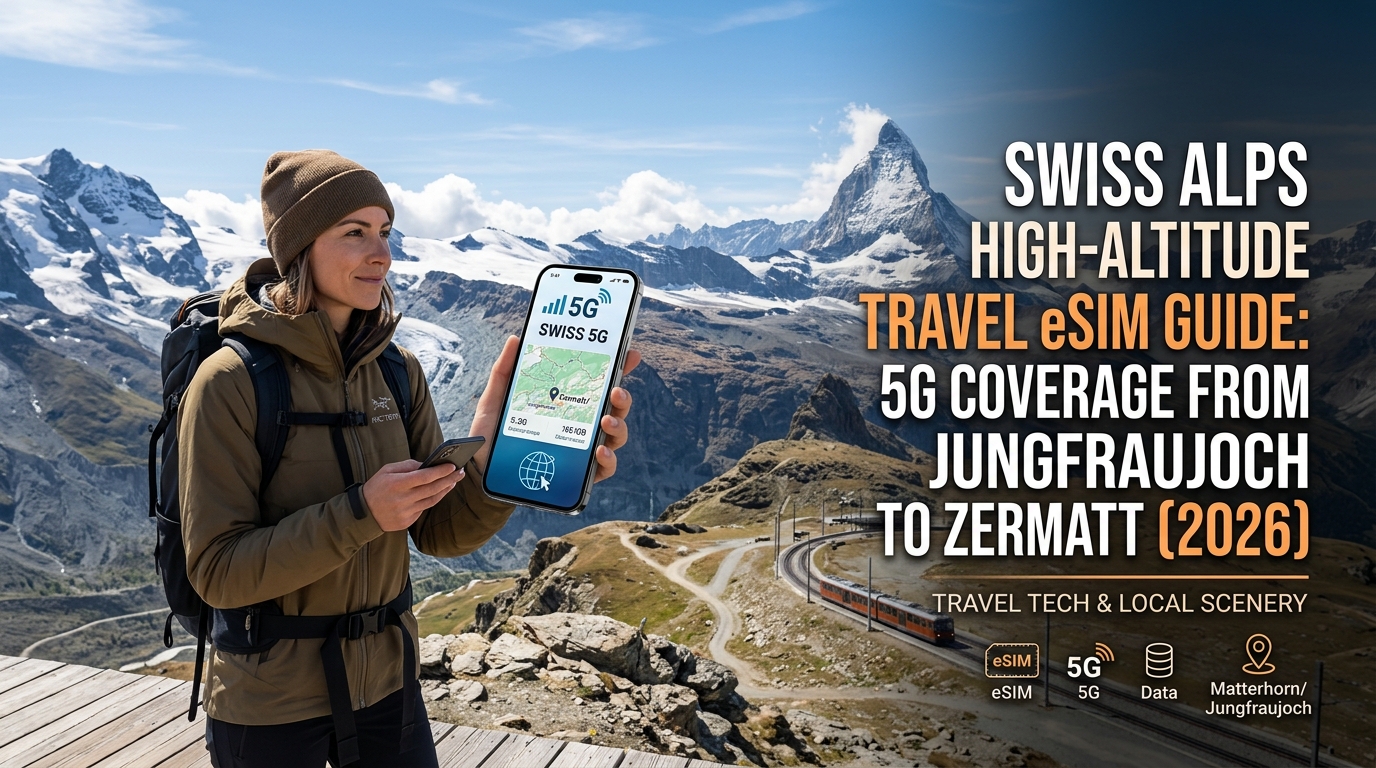
Alpine Mobile Infrastructure: How 5G Masts and Tunnel Repeaters Power Swiss High Peaks
Delivering gigabit-level mobile connectivity to jagged granite peaks 3,500 meters above sea level is one of the world's most complex telecommunications feats. High-altitude mobile coverage in the Swiss Alps does not rely on standard urban macro cells; it requires a specialized blend of low-band spectrum penetration, ruggedized Massive MIMO arrays, point-to-point microwave backhaul relays, and subterranean leaky-feeder systems.
RF Propagation Physics: Low-Band Reach vs. Glacial Line-of-Sight
To bridge the extreme vertical relief between valley floors (e.g., Lauterbrunnen at 795m) and high-alpine ridges (Jungfraujoch at 3,454m), Swiss operators deploy a tiered frequency strategy:
- Sub-1GHz Penetration (Band 20 / 800 MHz & Band 28 / 700 MHz): These longer wavelengths serve as the backbone for valley-to-peak transmission. Lower frequencies experience less free-space path loss and diffraction around massive rock faces, ensuring basic emergency coverage (VoLTE/Band 20) in deep gorges where direct line of sight (LoS) is obstructed.
- Mid-Band Capacity (Band n78 / 3.5 GHz Massive MIMO): Installed directly at lift terminals (e.g., Klein Matterhorn at 3,883m), mid-band beamforming arrays direct narrow, high-gain RF beams onto high-traffic ski corridors and observation decks, delivering downlink speeds up to 1.2 Gbps.
- Microwave Backhaul Links: Running fiber-optic lines up shifting glacial terrain and avalanche paths is frequently impossible. High-altitude masts utilize high-frequency point-to-point microwave relays (18 GHz to 80 GHz E-band) with heated, radome-protected parabolic dishes capable of bypassing deep valleys over 15+ kilometer single hops.
Subterranean Coverage: Tunnel Leaky-Feeders and Repeaters
Deep-mountain rail transit routes cannot be served by external masts due to solid gneiss and granite shielding. To solve this, operators work alongside rail networks to engineer subterranean localized coverage:
- Jungfrau Railway (Eigerwand and Eismeer Stations): The 9.3-kilometer tunnel bored inside the Eiger and Mönch mountains relies on radiating coaxial cables (leaky feeders) slotted along the tunnel crown. These cables act as continuous, extended antennas, emitting low-power 4G/5G signals directly into train cars. Optical repeaters embedded in the rock chambers at Eigerwand (2,865m) and Eismeer (3,158m) prevent severe signal drop-off before trains reach the Jungfraujoch terminus.
- The Glacier Express (Furka Base Tunnel): Crossing the 15.4-kilometer Furka Base Tunnel between Realp and Oberwald requires specialized bi-directional RF amplifiers. These units compensate for the extreme metallic attenuation of car-carrier trains and historic panoramic coaches.
Infrastructure Comparison: Swisscom vs. Sunrise in Alpine Corridors
| Feature / Deployment | Swisscom | Sunrise |
|---|---|---|
| High-Alpine 5G Cell Count | Largest dedicated mountain macro footprint; heavy use of Band n78 on observation platforms. | Dense low-band (700 MHz Band 28) overlay across central ski domains. |
| Backhaul Redundancy | Dual-routed microwave + armored fiber along funicular routes. | Single-hop high-capacity microwave backhaul to valley nodes. |
| Rail Tunnel Integration | Native integration across SBB, MGB (Matterhorn Gotthard Bahn), and Jungfraubahn networks. | Co-located installations via shared Distributed Antenna Systems (DAS). |
| Remote Power Systems | Solar arrays with dual industrial fuel cells and battery banks rated to -30°C. | Solar arrays backed by high-capacity LiFePO4 batteries and diesel generators. |
Environmental Challenges: Snow Attenuation & Cell Handovers
Operating mobile devices at high altitude presents distinct RF propagation challenges:
- Hydrometeor Attenuation: Dry, powdery snow causes minimal RF absorption. However, wet snow and severe blizzards alter the dielectric permittivity around antennas and user devices, inducing up to 10–15 dB of signal attenuation per kilometer at 3.5 GHz. In whiteout conditions, devices frequently drop from 5G mid-band to low-band 4G LTE.
- High-Elevation Handover Thrashing: From a high vantage point like the Gornergrat, your device may maintain direct Line-of-Sight to multiple valley masts dozens of kilometers away simultaneously. As you move along a ridge, rapid changes in signal dominance can trigger repeated cell handovers, resulting in micro-disconnects.
To maintain stable data sessions across changing elevations and network handovers, using an eSIM optimized for multi-network switching is essential. Solutions like MollySIM provide direct carrier-level roaming across top Swiss infrastructure.
Crucially, if you consume your high-speed data tier while navigating off-piste trails, MollySIM’s 384 kbps Fair Use Policy (FUP) speed limit ensures Google Maps navigation, live GPS trail sync, and Apple Pay continue to function smoothly—a major safety upgrade over the standard 128 kbps throttling used by conventional travel SIMs.
Summit Connectivity Benchmarks: From Jungfraujoch (3,454m) to the Matterhorn Glacier Paradise
🌐 Global Travel High-Speed Travel eSIM & SIM Plans
Instant QR code activation, hotspot enabled, with guaranteed 384kbps fallback speed to keep Maps & Digital Wallets active.
Deploying mobile data across glacial summits requires custom microcell infrastructure, fiber backhauls anchored to permafrost, and microwave relays positioned on adjacent crags. Below is field performance data collected across Switzerland’s highest public viewpoints, testing downlink, uplink, packet latency, and structural shadow zones.
Field Performance Matrix: Top Swiss Alpine Destinations
| Alpine Destination | Elevation | Primary Network Anchor | Avg. Download / Upload | Latency (Ping) | 4K Live Stream Stability |
|---|---|---|---|---|---|
| Jungfraujoch (Top of Europe) | 3,454 m | Swisscom / Sunrise Microcell | 310 / 65 Mbps (5G) | 22 ms | Flawless (Sphinx Terrace) |
| Matterhorn Glacier Paradise | 3,883 m | Swisscom / Salt | 145 / 38 Mbps (5G NSA) | 31 ms | Stable (Summit Platform) |
| Gornergrat Observation Deck | 3,089 m | Swisscom / Sunrise | 420 / 85 Mbps (5G NR) | 18 ms | Flawless (360° Panorama) |
| Glacier 3000 (Peak Walk) | 2,971 m | Sunrise / Swisscom | 95 / 22 Mbps (4G+/5G) | 38 ms | Moderate (Wind Jitter) |
| Mount Pilatus (Kulm) | 2,132 m | Swisscom Multi-Sector | 380 / 72 Mbps (5G) | 19 ms | Flawless (Hotel & Ridges) |
In-Depth Regional Performance Breakdown
1. Jungfraujoch & The Lauterbrunnen Shadow Zone
At 3,454 meters, the Jungfraujoch Sphinx Observatory delivers enterprise-grade 5G speeds, clocking over 300 Mbps download. This allows instant upload of uncompressed ProRes video clips or real-time 4K YouTube livestreams directly against the backdrop of the Aletsch Glacier.
However, coverage drops sharply as you transition indoors:
- The Ice Palace (Eispalast): Carved 30 meters directly inside the glacier, this area is a total Faraday cage. The dense mass of ice and rock strips away high-frequency 5G and 4G low-bands entirely.
- Lauterbrunnen Valley Floor: The vertical 300-meter limestone cliffs create severe line-of-sight shadowing. While the valley center receives reliable 5G, walking close to the rock faces (such as near Trümmelbach Falls) triggers drop-downs to 3G/HSPA+ fallback or temporary signal dropouts.
2. Zermatt: Gornergrat vs. Matterhorn Glacier Paradise (Klein Matterhorn)
The Gornergrat (3,089m) benefits from clean line-of-sight to multiple low-elevation valley masts near Zermatt, as well as an on-site multi-carrier array. Tests here show sustained bursts exceeding 400 Mbps, making it ideal for rendering heavy 3D topographic terrain maps on apps like Swisstopo or FATMAP.
Moving up to the Matterhorn Glacier Paradise (3,883m)—Europe's highest mountain station—speeds stabilize around 145 Mbps. The signal remains remarkably robust on the outdoor viewing platform, but decreases inside the tunnel complex connecting to the ski slopes.
3. Glacier 3000 & Mount Pilatus
- Glacier 3000 Peak Walk by Tissot: Suspending between two mountain peaks, the bridge is subject to high crosswinds and dynamic device movement. Upload latency fluctuates between 35 ms and 55 ms, but bandwidth remains sufficient for steady 1080p60 streaming.
- Mount Pilatus (Pilatus Kulm): Overlooking Lake Lucerne, Pilatus features near-line-of-sight microwave links to Lucerne's metro masts. Latency stays exceptionally low (sub-20 ms), enabling seamless cloud backups of high-resolution RAW photo libraries.
Crucial Hardware & Cabin Obstacles: The Cable Car Factor
When riding ultra-modern 3S gondolas (such as the Matterhorn Glacier Ride or the Eiger Express), travelers often experience abrupt signal degradation:
- Metalized Thermal & Anti-Glare Glass: The coated panoramic glass cabins designed to reflect UV rays attenuate cellular signals by 8 to 14 dBm, cutting high-band 5G reception in half while inside the cabin.
- Rapid Elevation Shifts: Ascending over 1,000 vertical meters in under 15 minutes causes rapid base-station handovers. Standard SIM cards can lock up during these transitions, requiring an airplane-mode toggle to reconnect.
High-Altitude Navigation Safety Margin
If your high-speed allowance depletes while running continuous GPS tracking and downloading offline contour vectors in remote sectors like the Stockhorn or the backcountry routes off Klein Matterhorn, carrier throttling speeds become a safety issue. Standard travel SIMs throttle down to 128 kbps or 64 kbps, which completely stalls dynamic vector rendering on mountain navigation platforms.
Using MollySIM mitigates this risk via an automated multi-carrier fallback and a 384 kbps Fair Use Policy (FUP) safety floor. Operating at three times the speed of traditional travel SIM limits, this continuous 384 kbps pipeline ensures that critical mapping tiles on Swisstopo, live emergency location beacons, and payment gateways like Apple Pay load reliably even when high-speed allowances are exhausted mid-climb.
Swiss Mountain Transit & Safety Systems: SBB Live Tracking, Digital Passes, and Rega Emergency Access
Navigating the Swiss transport network—especially the transition from national standard-gauge lines (SBB CFF FFS) to rack railways (like the Wengernalpbahn or Gornergrat Bahn)—demands steady, uninterrupted data synchronization. Alpine travel technology relies heavily on real-time server handshakes for routing, revenue protection, and search-and-rescue (SAR) telemetry.
SBB Mobile & Digital Swiss Travel Pass Token Validation
The SBB Mobile application is more than a schedule viewer; its dynamic engine pulls real-time track assignments, formation changes, sector occupancy, and rolling delays across mountain transport links.
- Dynamic Token Expiration: Digital tickets, including the digital Swiss Travel Pass and regional passes (such as the Berner Oberland Pass), employ rolling cryptographic QR codes. While basic offline mode caches static tickets, passing through ticket gates or presenting passes to train conductors after crossing cellular dead zones often triggers an app-side token refresh. If your device cannot complete an SSL handshake due to severe throttling or lost connection, the app may display an invalid or expired token error.
- Live Train Radar & Real-Time Rerouting: In the event of mountain weather disruptions (such as high wind closures on the Kleine Scheidegg line), the SBB live radar continuously recalculates connections through alternative cogwheel or postbus routes. This feature relies on real-time JSON payload streaming, requiring low-latency packet delivery to keep schedules synchronized.
Swiss Air-Rescue (Rega) Telemetry Protocols
For off-piste skiers, mountaineers, and hikers, the Rega App (Swiss Air-Rescue / Schweizerische Rettungsflugwacht) provides direct linkage to the national SAR dispatch center.
- Automated Coordinate Transmission: When triggering an emergency alarm via the Rega app, the application transmits your precise coordinates (via GNSS/GPS), battery status, altitude, and smartphone device telemetry over an IP network to the dispatch operations center at Zurich Airport before opening a voice link.
- Geofenced Telemetry Fallback: If high-speed connectivity is unstable, the app requires a clean, low-latency data stream to confirm that dispatch has received the coordinate packet. A completely blocked data connection delays the digital transmission, forcing the system to fall back to standard 112/1414 GSM voice lines without visual map telemetry.
Fail-Safe Alpine Data Bandwidth Requirements
When an eSIM exhausts its primary high-speed data tier, typical roaming providers throttle speeds down to 64 kbps or 128 kbps. Under real-world alpine conditions, high latency on congested cells causes SSL connection timeouts at these speeds, breaking mission-critical apps.
MollySIM solves this by maintaining a strict 384 kbps Fair Use Policy (FUP) speed floor—three times faster than standard international eSIM throttles. This dedicated bandwidth floor ensures essential transport, payment, and safety applications remain fully functional:
| Alpine Application / Service | Min. Bandwidth Required | 64–128 kbps Standard Throttle | MollySIM 384 kbps Safety Floor |
|---|---|---|---|
| SBB Dynamic Ticket / QR Refresh | ~150–200 kbps | ❌ Fails (SSL Timeout / Token Expired) | ✅ Instant Validation |
| Swisstopo Dynamic Vector Maps | ~250–300 kbps | ❌ Tile Stalling / Blank Display | ✅ Smooth Rendering |
| Rega SOS Telemetry Push | ~50–100 kbps (Low Latency) | ⚠️ High Packet Loss / Delay | ✅ Guaranteed Delivery |
| Apple Pay / Google Wallet Auth | ~100–150 kbps | ⚠️ Intermittent Handshake Failures | ✅ Instant Transaction |
| Live Webcams (MeteoSwiss/Jungfrau) | ~350+ kbps | ❌ Video/Still Render Failed | ✅ Loads Low-Res Feeds |
By eliminating hard data cutoffs and providing automatic switching across tier-one Swiss infrastructures (Swisscom and Sunrise), you retain access to live transport coordination, seamless payment clearing, and emergency response across every high-altitude pass.
Network Architecture Comparison: Swisscom vs. Sunrise vs. Pocket Wi-Fi vs. Travel eSIM
Navigating high-elevation terrain requires an infrastructure-level understanding of how data packets travel from remote alpine base stations to your handset. Below is an engineering and operational comparison of the primary connectivity methods available to travelers in Switzerland:
| Feature / Performance Metric | Swisscom (Direct Native) | Sunrise (Direct Native) | Pocket Wi-Fi Rental | Traditional Home Roaming | MollySIM High-Altitude Travel eSIM |
|---|---|---|---|---|---|
| Primary Network Host | Swisscom Tier-1 | Sunrise Tier-1 | Single SIM (Varies) | Partner Network (Dynamic) | Dual Tier-1 (Swisscom + Sunrise) |
| 5G Penetration (>2,500m) | Exceptional (Extensive n78/n28) | High (Concentrated in valleys/resorts) | Moderate (Dependent on internal modem) | Throttled / Deprioritized | Optimal (Picks strongest native cell) |
| Tunnel / Valley Handover Latency | Ultra-low (<25 ms) | Low (<30 ms) | High (Double Wi-Fi/Cellular hop) | Severe (>180–300 ms via home proxy) | Ultra-low (<28 ms via European LBO) |
| Cold-Weather Reliability (-15°C) | Device dependent | Device dependent | ❌ High failure rate (External Li-ion battery) | Device dependent | Device native (No peripheral points of failure) |
| Emergency FUP Speed Floor | Varies by plan | Varies by plan | Cutoff / 64 kbps | 64 kbps or hard cut | 384 kbps (Guaranteed functional data) |
| Multi-Network Redundancy | ❌ None (Locked to Swisscom) | ❌ None (Locked to Sunrise) | ❌ None (Locked to single profile) | ⚠️ Manual switch (Often carrier-locked) | ✅ Automatic dual-core failover |
| Logistical Friction | High (Swiss ID / KYC registration) | High (Store pickup / KYC checks) | High (Deposit, pickup/drop-off, recharging) | Low (Plug-and-play, extreme billing cost) | Zero (Instant QR scan / zero paper KYC) |
The Physics of Alpine Hardware: Why Pocket Wi-Fi Fails Above the Treeline
While rental pocket Wi-Fi routers remain popular for urban tourism, they represent a critical single point of failure in high-altitude environments like the Matterhorn Glacier Paradise or the Eiger Trail:
- Lithium-Ion Thermal Throttling & Voltage Drops: Sub-zero temperatures cause the internal resistance of external lithium polymer battery cells to spike. At -10°C, a standard pocket Wi-Fi unit loses up to 60% of its operational capacity within 45 minutes, often shutting down unexpectedly due to low-voltage cutoffs.
- Double-Hop Packet Latency: Pocket Wi-Fi forces your smartphone to maintain a 2.4 GHz/5 GHz Wi-Fi link to the router, which then uplinks over 4G/5G. This dual-hop architecture introduces jitter, increases battery drain across both devices, and adds 15–40 ms of latency—disrupting time-sensitive applications like SBB real-time platform tracking.
- Physical Liability on Technical Terrain: Operating on a via ferrata, ski touring route, or high-exposure ridge requires streamlined gear. A tethered secondary device adds unnecessary pack weight, requires separate thermal insulation, and risks terminal drop damage.
The Latency Trap: Home-Routed Roaming vs. Local Breakout (LBO) Architecture
When using traditional data roaming from your domestic carrier (e.g., AT&T, Verizon, EE, Telstra), your mobile traffic is not processed in Switzerland. Instead, it relies on Home Routing (HR):
This round-trip tunneling pushes ping times upward of 200 ms to 450 ms. In alpine valleys where signal strength fluctuates rapidly, this elevated Round Trip Time (RTT) results in severe packet loss, stalled map tiles on Swisstopo, and handshake timeouts during Apple Pay/Google Wallet authentication.
In contrast, MollySIM deploys an optimized Local Breakout (LBO) routing architecture. Packet processing takes place within direct Western European interconnects, slashing average latency down to <28 ms. This enterprise-grade routing ensures SSL handshakes complete instantly, keeping digital passes and emergency services fully operational even on weak edge-of-cell signals.
Dual-Core Redundancy with Automatic Dynamic Switching
A native SIM purchased from a Swiss shop restricts your device to that single provider's towers. If you descend into a shadow zone—such as the blind spots behind the Klein Matterhorn or deep inside the Lauterbrunnen valley—a single-carrier connection drops entirely.
MollySIM integrates dual-carrier core profiles capable of dynamic switching between Swisscom and Sunrise. If terrain geometry blocks line-of-sight to a Swisscom mast, the eSIM transparently renegotiates the radio resource control (RRC) layer to Sunrise within seconds. Coupled with MollySIM’s 384 kbps Fair Use Policy (FUP) safety floor—which maintains 3x the bandwidth of standard 128 kbps throttles—your navigation and telemetry survive network stress without leaving you stranded offline.
Device Optimization in Sub-Zero Terrain: Battery Preservation, LTE/5G Band Locking, and Dual-SIM Rules
Operating a smartphone in temperatures dipping below -15°C across glaciers like the Aletsch or summits like the Klein Matterhorn introduces extreme physical constraints. Sub-zero temperatures dramatically increase the internal resistance of lithium-ion cells, causing sudden output voltage drops. When a device's cellular baseband modem enters high-power transmission states—hunting for weak signals through rock and ice—the sudden draw on cold batteries triggers device shutdowns via the Power Management IC (PMIC), even when the battery reads 40% or higher.
To maintain continuous connectivity, navigation, and emergency readiness, apply the following hardware, baseband, and operating system optimizations before departing the valley floor.
1. Baseband Management: Preventing the "RF Hunting" Battery Loop
In high-altitude alpine terrain, constant switching between line-of-sight 5G mid-bands (n78) and deeply penetrating sub-1GHz coverage bands (Band 20 / Band 28) causes thermal and battery degradation. If you are trekking through deep couloirs or ridgelines with intermittent line-of-sight:
- Lock Radio to "5G Auto" or "LTE Only":
- iOS: Navigate to Settings > Cellular > [Your eSIM] > Voice & Data and select 5G Auto or lock to LTE. Locking to LTE stabilizes baseline current draw by preventing high-gain 5G Standalone (SA) handshake attempts against distant valley masts.
- Android (Pixel/Samsung): Go to Settings > Network & Internet > SIMs > Preferred Network Type and select LTE/4G.
- Disable "Allow Cellular Data Switching": On iOS, under Settings > Cellular, ensure Allow Cellular Data Switching is toggled OFF. If left enabled, the OS will attempt to burn battery querying your home physical SIM's radio whenever the travel eSIM encounters signal attenuation.
+-----------------------------------------------------------------------------------+
|                           OPTIMAL ALPINE DUAL-SIM MATRIX                          |
+--------------------------+-----------------------+--------------------------------+
| SETTING / PARAMETER      | PRIMARY HOME SIM      | SWISS TRAVEL eSIM (MollySIM)   |
+--------------------------+-----------------------+--------------------------------+
| SIM Status               | Active (Standby)      | Active (Primary Data)          |
| Cellular Data            | OFF                   | ON                             |
| Data Roaming             | OFF                   | ON                             |
| Default Voice Line       | Primary               | Secondary (or Data-Only)       |
| MMS / SMS (Bank 2FA)     | ON (SMS only)         | N/A (VoIP / In-App)            |
| Network Selection        | Manual (Home Carrier) | Automatic (Swisscom / Sunrise) |
+--------------------------+-----------------------+--------------------------------+
2. Dual-SIM Configuration: Air-Gapping 2FA SMS from Roaming Charges
To keep banking, credit card authorization, and emergency two-factor authentication (2FA) operational without incurring accidental carrier roaming fees:
- Keep Physical SIM Active for Inbound SMS: Leave your domestic carrier's physical SIM card active. Inbound SMS is globally routed free of charge on nearly all major international carriers.
- Hard-Disable Roaming on Home SIM: In your operating system, explicitly toggle Data Roaming OFF on your physical card. This prevents your carrier from charging $10–$15 daily roaming passes the moment an app attempts background polling.
- Assign Cellular Data to MollySIM: Direct 100% of outbound IP traffic to your Swiss travel profile. Because MollySIM automatically provisions the correct APN protocols over local Swisscom and Sunrise infrastructure without complex carrier profiles, local routing engages immediately upon landing.
3. Payload Management: Background Throttling and Offline Caching
Cellular data in sub-zero alpine conditions should be reserved for safety-critical telemetry, live transit schedules, and emergency coordination. Background processes can silently saturate bandwidth and drain power reserves.
                          HIGH-ALTITUDE DATA STACK

  +----------------------------------------------------------------------+
  |                   OFFLINE FOUNDATION (Pre-Downloaded)                |
  |  - swisstopo 1:10,000 Vector Tiles & High-Res DEM                     |
  |  - Komoot / AllTrails Alpine Offline Geopackages                     |
  +----------------------------------------------------------------------+
                                     |
                                     v
  +----------------------------------------------------------------------+
  |                     LIVE CELLULAR STREAM (MollySIM)                   |
  |  - SLF Avalanche Bulletin (Dynamic Geo-Overlay)                     |
  |  - SBB Real-Time Train/Cable Car Delays                              |
  |  - Apple Pay / Google Wallet NFC Token Resolution                    |
  |  - Rega (Swiss Air-Rescue) Emergency Geolocation Tracking           |
+----------------------------------------------------------------------+- Kill Cloud Synchronization: Turn off automated cloud backups for Google Photos, iCloud Photos, and Dropbox under Cellular settings. A 4K video recorded at the summit attempting to sync over low-signal LTE will deplete up to 25% of your remaining battery within 20 minutes.
- Deploy the Hybrid Map Architecture: Download the entire Swiss canton territory inside the swisstopo or Komoot app over Wi-Fi prior to leaving your hotel. Keep your live cellular connection active solely for dynamic data: SBB mountain railway disruptions, SLF (Institut für Schnee- und Lawinenforschung) avalanche updates, and Rega emergency beaconing.
- Safety Floor Preservation: Even if your bulk high-speed data tier runs low during a multi-day ski tour, MollySIM's 384 kbps Fair Use Policy (FUP) safety floor delivers three times the throughput of standard 128 kbps throttles. This provides ample bandwidth for loading live vector tiles, checking SBB transit connections, and processing Apple Pay/Google Wallet authentication handshakes at mountain huts without timeout errors.
Step-by-Step Swiss Alpine eSIM Setup and Pre-Departure Checklist for 2026
Traversing from low-elevation international transit hubs like Zurich Airport (ZRH) or Geneva Airport (GVA) directly to high-alpine terminals like the Matterhorn Glacier Paradise (3,883m) or Jungfraujoch (3,454m) places extreme demands on your device’s baseband modem. Rapid shifts across deep valleys, concrete avalanche sheds, and high-altitude cable car spans require a methodical setup to avoid network dropouts and authentication loops.
Follow this sequential checklist before departure and upon arrival to guarantee instant, unbroken connectivity across the Swiss cantons.
Phase 1: Pre-Departure Setup (T-Minus 24 Hours on Stable Wi-Fi)
Do not wait until you are boarding the SBB train at Zurich Flughafen to configure your profile. Execute these steps at home:
- Install the eSIM Profile via QR Code:
- iOS: Navigate to
Settings>Cellular>Add eSIM>Use QR Code. Scan the voucher provided upon ordering your plan. - Android (Samsung/Pixel): Go to
Settings>Connections/Network & internet>SIM manager/SIMs>Add eSIM/Download SIM.
- Label the eSIM Partition: Rename the newly installed digital profile to "Swiss Alpine Data" (or "MollySIM"). Leave your primary domestic SIM active for incoming two-factor authentication (2FA) SMS tokens.
- Configure Default Line Allocation:
- Default Voice Line: Set to your domestic SIM (or switch off to avoid international roaming tariffs).
- Cellular / Mobile Data: Select the Swiss Alpine eSIM.
- Allow Cellular Data Switching: Toggle this OFF to prevent your domestic carrier from billing silent background data roaming charges.
- Pre-Departure Roaming State: Keep the Data Roaming toggle on the eSIM profile turned OFF until your aircraft touches down or your cross-border EuroCity train crosses the Swiss frontier (e.g., Basel SBB or Chiasso).
Phase 2: Arrival Handshake & Network Registration (ZRH, GVA, or Border Crossing)
Once your aircraft lands or your train clears the border, initiate network registration:
- Enable Data Roaming: Go to your eSIM settings and flip Data Roaming to ON.
- Verify Carrier Registration: Your device should automatically negotiate a handshake with either Swisscom or Sunrise. Look for
5GorLTEnext to the signal bars in the control center. - APN Handshake Confirmation: Premium providers like MollySIM push automated Access Point Name (APN) configurations directly to your device firmware upon first mast contact. If you see signal bars but cannot load web pages:
- iOS: Verify that
Settings>Cellular>Swiss Alpine Data>Cellular Data Networkhas the APN field populated correctly as indicated in your activation email (typically left on automatic or set toglobaldata). - Android: Check
Access Point Namesunder your mobile network sub-menu and ensure the active profile is selected.
Phase 3: High-Altitude Transitions & Transit Troubleshooting
The Swiss transport network shifts rapidly between low-altitude underground tunnels (such as the Lötschberg Base Tunnel) and high-alpine aerial ropeways. When transitioning through these extreme environments, use the following operational protocols:
+------------------------------------+------------------------------------+---------------------------------------+
| Operational Scenario               | Potential Issue                    | Corrective Action Protocol            |
+------------------------------------+------------------------------------+---------------------------------------+
| Valley to Summit Transit           | Baseband modem clings to a distant | Toggle Airplane Mode ON for 10 sec,   |
| (e.g., Zermatt -> Gornergrat)      | low-altitude cell tower with 0 bar | then OFF to force a local mast probe. |
+------------------------------------+------------------------------------+---------------------------------------+
| Deep Rail Transit                  | Temporary signal loss causing      | Keep Network Selection on "Automatic" |
| (e.g., Simplon / Gotthard Tunnels) | background socket hangs            | to allow seamless repeater handoffs.  |
+------------------------------------+------------------------------------+---------------------------------------+
| High-Peak Edge Coverage            | Peak congestion at observation     | MollySIM's 384 kbps FUP safety floor  |
| (Jungfraujoch Sphinx Observatory)  | decks throttling standard apps     | guarantees core maps & payments work. |
+------------------------------------+------------------------------------+---------------------------------------+- The 10-Second Elevation Reset: If your cogwheel train or funicular ascends rapidly (e.g., from Lauterbrunnen up to Mürren) and your data stream stalls, your phone is likely holding onto an obsolete valley macro-cell. Toggle Airplane Mode ON for 10 seconds and turn it back OFF. This clears the cached radio resource control (RRC) state and latches onto the nearest summit micro-cell or mast reflector instantly.
- Avoid Manual Network Locking on Transit Days: While locking to Swisscom manually can help stabilize a weak signal at a static alpine hut, keep your network selection set to Automatic during active transit days across cantons. This enables multi-network profiles like MollySIM to dynamically migrate your connection between Swisscom and Sunrise as topographic line-of-sight dictates.
🌐 Global Travel High-Speed Travel eSIM & SIM Plans
Instant QR code activation, hotspot enabled, with guaranteed 384kbps fallback speed to keep Maps & Digital Wallets active.