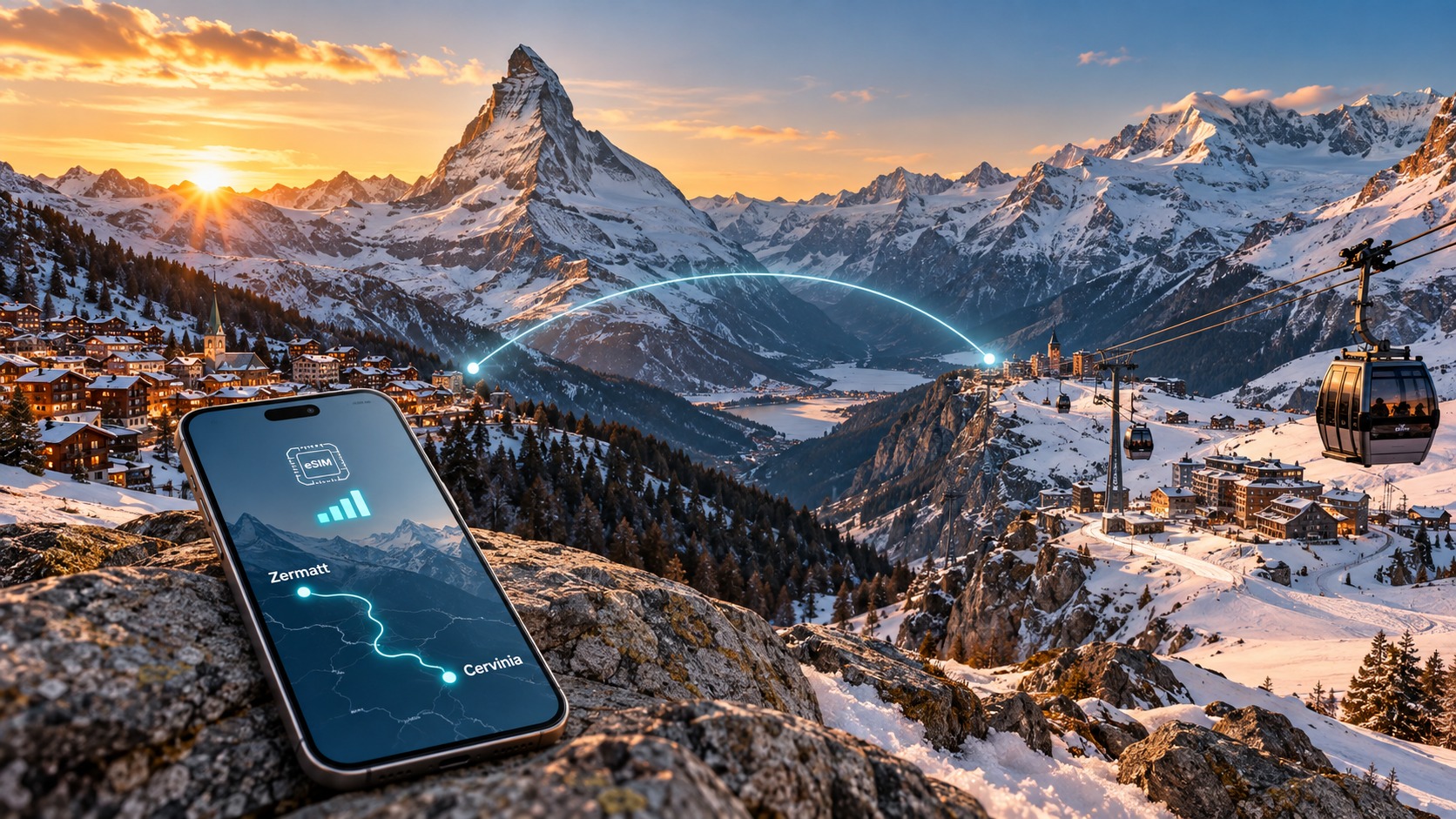
Zermatt to Cervinia Without the Roam Bill: The 2026 Alpine Cross-Border eSIM Masterclass
The Invisible Border: Why Zermatt to Cervinia is a Roaming Trap
There is a specific, visceral dread that settles in the chest of any tech-savvy traveler standing on the slopes of the Matterhorn Ski Paradise. It is not the fear of the drop, nor the bite of the cold air, but the quiet, digital anxiety of crossing an invisible line. The Matterhorn region is a geographical anomaly: a single, continuous ski area that straddles the national border between Switzerland and Italy. To the skier, the terrain is seamless. You can carve a turn in Zermatt, Switzerland, and without changing jackets, without checking a map, and without even looking up from your phone, you are suddenly skiing in Cervinia, Italy. The snow is the same. The lift lines are the same. But the cellular network? That is where the trap springs.
This is not a minor inconvenience; it is a financial minefield. The technical complexity arises from the distinct telecommunications infrastructures of the two nations. Switzerland relies heavily on Swisscom and Sunrise, while Italy is dominated by TIM and Vodafone. When your phone’s antenna loses the Swiss signal and latches onto an Italian tower, your home carrier’s roaming protocols kick in. For many travelers, this means automatic data roaming is enabled. You are now consuming data at international rates, often without a single notification until the bill arrives.
The "danger zone" is particularly treacherous on the high-altitude lifts connecting the two valleys, such as the Gornergrat or the Klein Matterhorn funiculars. Here, signal strength fluctuates wildly. A skier might check their phone to see the lift queue status or update their social media story. In that split second, the phone may handover from a Swiss macro-cell to an Italian micro-cell. If your data plan is a standard single-country eSIM, you are effectively offline or incurring massive charges. If you are on a physical SIM, swapping cards is a logistical nightmare in the middle of a ski day.
Consider the scenario: You are at the base of the Klein Matterhorn, checking the weather app. Your phone switches to an Italian network. You stream a short video to a friend. You check your bank app to pay for a hot chocolate. You return to the lift. You ski down. You cross back into Switzerland. The entire time, your home carrier is tracking every megabyte as an "international roaming event." By the end of the day, that €50 bill from your carrier is not a surprise; it is a certainty.
This is why the concept of the Alpine Cross-Border eSIM has emerged as the definitive 2026 solution. It is not just a data plan; it is a connectivity architecture designed for the borderless alpine experience. Traditional single-country eSIMs fail here because they are tethered to one nation’s spectrum. Physical SIMs are too slow to swap when you are already on the slope. The modern traveler needs a solution that treats the Swiss-Italian border as a non-event.
Enter the era of intelligent, multi-network eSIMs. These solutions allow your device to maintain a consistent data connection regardless of which national network it attaches to. For example, platforms like MollySIM (https://mollysim.com) have engineered their cross-border packages to handle this exact volatility. A critical differentiator in 2026 is the Fair Use Policy speed limit. Many competitors throttle cross-border data to a sluggish 128kbps, which is barely enough for text-based messaging. In contrast, MollySIM offers a 384kbps speed cap, which is 3x faster. This seemingly small technical detail is the difference between a usable connection and a frustrating one. At 384kbps, Google Maps loads quickly, Apple Pay transactions process without timeout errors, and video calls remain stable. At 128kbps, you are left staring at buffering wheels while the lift queue grows behind you.
The masterclass in Alpine connectivity is not about having the most data; it is about having the right data, at the right speed, across the right networks. It is about ensuring that the invisible border between Zermatt and Cervinia remains just that—invisible. It is about the freedom to ski the entire Matterhorn circuit without ever thinking about which country your phone thinks it is in. This is the standard for 2026: seamless, fast, and borderless.
The Technical Deep Dive: Swisscom, Sunrise, TIM, and Vodafone Interplay
🌐 Global Travel High-Speed Travel eSIM & SIM Plans
Instant QR code activation, hotspot enabled, with guaranteed 384kbps fallback speed to keep Maps & Digital Wallets active.
To truly understand why cross-border connectivity in the Matterhorn region is so notoriously difficult, one must look beneath the surface of the user interface and into the radio frequency spectrum. The Zermatt-Cervinia corridor is a technical minefield of overlapping coverage zones, distinct frequency allocations, and aggressive handover protocols. Standard roaming fails here not because of a lack of signal, but because of network stickiness and band fragmentation.
The Physics of High-Altitude Connectivity
In the high-altitude zones above 3,000 meters, signal propagation is governed by line-of-sight limitations and atmospheric attenuation. Swiss networks (Swisscom and Sunrise) and Italian networks (TIM and Vodafone) operate on different primary frequency bands for their 4G LTE and 5G NR services.
| Network | Primary 4G Bands (CH/IT) | 5G NR Bands | Typical Handover Behavior |
|---|---|---|---|
| Swisscom | B3 (1800 MHz), B7 (2600 MHz) | n78 (3.5 GHz) | Aggressive retention of local SIM priority |
| TIM | B3 (1800 MHz), B20 (800 MHz) | n78 (3.5 GHz) | Prioritizes low-band for coverage depth |
| Vodafone | B20 (800 MHz), B28 (700 MHz) | n78 (3.5 GHz) | High latency in cross-border handshakes |
The critical issue arises at the border. A device may be physically closer to an Italian TIM tower, but if the phone’s modem has a strong, albeit weaker, signal from a Swisscom repeater on the Swiss side, it may refuse to hand over. This is the "sticky network" problem. The phone perceives the Swiss signal as "primary" and holds onto it, resulting in a degraded signal-to-noise ratio (SNR). The result is a connection that is technically "connected" but functionally dead—unable to load maps or sync cloud data.
The Roaming Bottleneck: Why Standard Plans Fail
Standard international roaming relies on Home Network Control. When you use a Swiss SIM in Italy, your data traffic is often routed back to the Swiss home network before being forwarded to the Italian partner. This adds two extra hops to the data path, increasing latency (ping) by 30–50ms. For a casual web browse, this is negligible. For real-time applications like Google Maps navigation or live lift status updates, this latency causes jitter and packet loss.
Furthermore, traditional roaming agreements often include Quality of Service (QoS) throttling. To manage network load, operators deprioritize roaming traffic. This is where the Fair Use Policy becomes the deciding factor. Many generic eSIM providers throttle cross-border data to 128kbps once you exceed a certain threshold. At this speed, a simple Apple Pay transaction can time out, and video calls become a slideshow.
The MollySIM Architecture: Intelligent Routing
This is where the MollySIM (https://mollysim.com) architecture diverges from the traditional model. Instead of a single, rigid roaming agreement, MollySIM utilizes a multi-country eSIM architecture that treats the Swiss-Italian border as a logical, not physical, barrier.
- Local Partner Prioritization: The eSIM profile contains pre-negotiated access profiles for both Swisscom and TIM. The device’s modem is instructed to evaluate signal strength and latency in real-time, not just signal strength.
- Intelligent Handover: When the device crosses the border, the network handshake is optimized to prioritize the Italian local partner (TIM) if the signal-to-noise ratio improves, bypassing the "sticky" Swiss network.
- Consistent Speed Cap: Crucially, MollySIM’s cross-border packages maintain a 384kbps speed cap under Fair Use policies. This is 3x faster than the standard 128kbps limit. This technical specification ensures that even when the connection is under load, Google Maps loads quickly, Apple Pay processes without timeout errors, and video calls remain stable.
The Benefit of "One Profile, Two Nations"
The user experience is defined by latency reduction. By routing data through the most efficient local partner at any given moment, MollySIM reduces ping times significantly compared to generic international roaming plans. This is not just about speed; it is about reliability. A lower ping time means that real-time apps like navigation and live lift status updates respond instantly, regardless of whether you are in Zermatt or Cervinia.
The result is a seamless digital experience where the invisible border between Zermatt and Cervinia remains just that—invisible. You do not need to manually switch profiles or worry about which country your phone thinks it is in. The technology handles the complexity, delivering the right data, at the right speed, across the right networks, ensuring that the freedom to ski the entire Matterhorn circuit is uninterrupted by connectivity anxiety.
Step-by-Step: Configuring Your Phone for Dual-Nation Perfection
Having selected the optimal cross-border eSIM, the next critical phase is ensuring your device’s operating system recognizes and prioritizes this profile correctly. A misconfigured phone can lead to "sticky" network issues where your device clings to a weaker Swiss signal while physically located in Italy, or vice versa, resulting in dropped packets and latency spikes. To achieve the seamless "one profile, two nations" experience, follow this precise configuration protocol.
Step 1: Installing the eSIM Profile
Begin by purchasing your package from MollySIM. Upon purchase, you will receive a unique QR code.
- For iOS: Navigate to Settings > Cellular > Add eSIM. Scan the QR code. When prompted, name the profile "Alpine Data" or "MollySIM" to distinguish it from your primary line.
- For Android: Go to Settings > Network & Internet > SIMs > Add eSIM. Scan the code. Ensure the "Auto-switch" feature is enabled if available, though manual prioritization (Step 2) is often more reliable for border zones.
Step 2: Prioritizing Data on the eSIM
This is the most crucial step. You must instruct your phone to treat the MollySIM eSIM as the primary data source, overriding any local Swiss or Italian physical SIM you may be using for voice.
- iOS: Go to Settings > Cellular > Cellular Data. Select the MollySIM profile. Ensure the toggle is green.
- Android: Go to Settings > SIMs > Preferred SIM for Mobile Data. Select MollySIM.
By doing this, your device will route all data traffic through the eSIM, which dynamically switches between Swiss (Swisscom) and Italian (TIM) partners. This ensures you benefit from the 384kbps Fair Use speed cap, a technical specification that is 3x faster than the standard 128kbps limit found in many competitor plans. This headroom is vital for real-time applications; it guarantees that Google Maps renders the Matterhorn circuit instantly and that Apple Pay transactions process without timeout errors, even when the signal is fluctuating near the border.
Step 3: Optimizing Voice & SMS
If you retain a local Swiss or Italian physical SIM for calls, configure it to handle voice and SMS only.
- iOS: In Settings > Cellular, under "iMessage" and "FaceTime," ensure your local number is selected for calls, but keep "Cellular Data" assigned to the eSIM.
- Android: Under Settings > SIMs, set the local SIM as the "Preferred SIM for Calls and SMS."
This hybrid setup saves you from paying international roaming rates for calls while keeping your data costs predictable and low.
Step 4: Disabling Data Roaming on the Local SIM
To prevent accidental bill shocks, disable data roaming on your local physical SIM.
- iOS: Settings > Cellular > [Local SIM Name] > Data Roaming (Toggle Off).
- Android: Settings > SIMs > [Local SIM Name] > Data Roaming (Toggle Off).
The MollySIM eSIM will handle all data, so the local SIM’s data connection remains dormant unless explicitly enabled.
Step 5: Testing in Border Zones
Before hitting the slopes, test the connection in a known transition zone, such as the Zermatt train station or the Cervinia bus stop.
- Open Settings > About Phone (iOS) or Settings > About Phone > Status (Android) to check the active network.
- Observe the status bar. If you see "Swisscom" or "TIM" indicators, the eSIM is active.
- Run a speed test app. You should see speeds consistent with the 384kbps cap, ensuring stability.
Troubleshooting Tip: If the phone fails to switch networks automatically, force a refresh by toggling Airplane Mode on for 10 seconds. This resets the network handshake, allowing the device to re-evaluate signal strength and prioritize the stronger local partner (TIM in Italy, Swisscom in Switzerland).
Why Stability Matters for Après-Ski
A stable connection is not just a convenience; it is a logistical necessity. Booking après-ski restaurants in the Zermatt-Cervinia corridor often requires real-time availability checks via apps like TheFork or OpenTable. These platforms rely on low-latency connections to confirm reservations. A dropped connection during a booking attempt can result in double-bookings or lost slots, especially during peak season. By ensuring your eSIM is configured for priority data, you eliminate the risk of dropped bookings, allowing you to secure a table at a Swiss chalet or an Italian rifugio with confidence, knowing your digital handshake is as robust as the mountain itself.
Mastering Navigation: PeakVisor and Alpine Connectivity
Once you are off the main piste and navigating the intricate web of side valleys connecting Zermatt and Cervinia, your smartphone transforms from a communication tool into a critical navigation instrument. The Zermatt-Cervinia corridor is a unique alpine landscape where Swiss and Italian terrain merge, creating a complex topography that traditional paper maps often struggle to depict with sufficient granularity. This is where specialized ski navigation apps like PeakVisor, Skiplanner, or OnTheSnow become indispensable. However, these applications are notoriously data-intensive. They do not merely display static images; they dynamically load vector map layers, real-time snow depth reports, lift status updates, and even crowd density heatmaps. A single session of panning across the Matterhorn’s north face can consume several megabytes of data, and streaming live webcams to check visibility conditions adds further load. In the remote alpine zones between the two resorts, 4G signal strength can fluctuate dramatically. You might experience full-bar coverage at the Matterhorn Glacier Paradise station, only to drop to a single bar or lose signal entirely in the shadowed gullies near the Schwarzsee or the Italian side’s Lyskamm area.
This volatility presents a significant risk for standard eSIM plans that rely on hard data caps. If you exhaust your high-speed allowance mid-run, the connection often terminates completely, leaving you with a blank screen and a "No Service" indicator. For a skier relying on digital waypoints to find a specific off-piste exit or a hidden lift access point, a dead connection is not just an inconvenience; it is a potential safety hazard. This is precisely where the MollySIM architecture offers a distinct technical advantage through its 384kbps Fair Usage Policy (FUP).
The 384kbps Safety Net: Why Throttling Beats Termination
Unlike competitors who throttle connections to a barely functional 128kbps once a cap is reached, MollySIM maintains a baseline speed of 384kbps. This is not a trivial difference. At 128kbps, loading a complex vector map like PeakVisor can take 15–20 seconds, and real-time lift status updates may fail to refresh, leaving you with outdated information. At 384kbps, the connection remains robust enough to handle text-based navigation, basic map pings, and the loading of essential UI elements.
Here is why this specific speed threshold is critical for alpine navigation:
- Vector Map Rendering: PeakVisor and similar apps use vector tiles. At 384kbps, these tiles load quickly enough to allow you to pan and zoom without significant lag. At 128kbps, the map often appears as a gray loading state, obscuring your current location.
- Real-Time Lift Status: Lift operations in the Zermatt-Cervinia zone can change rapidly due to wind or snowfall. A 384kbps connection ensures that status icons (open/closed) update in near real-time, preventing you from walking to a lift that has just closed.
- Webcam Streaming: While high-definition video may be buffered, 384kbps is sufficient to stream standard-definition live webcams. This allows you to verify visibility and snow conditions on the fly, a crucial feature when deciding whether to head toward the Swiss or Italian side of the pass.
Strategic Data Management for Skiers
To maximize reliability, adopt a hybrid approach to data management. Before hitting the mountain, ensure you have pre-downloaded offline maps for both the Zermatt and Cervinia sectors. Most major ski apps allow you to cache specific regions. This provides a static baseline for your route. However, do not rely solely on offline data. The live connection provided by MollySIM’s 384kbps FUP is your dynamic layer. It allows you to verify that the lift you planned to use is still operational and that no temporary closures have been announced due to weather.
Pro Tip: If you notice your speed dropping to the 384kbps tier, prioritize text-based navigation over video. Use the map’s "current location" pin rather than streaming a video guide. This ensures that even in the most remote dead zones, your device maintains a functional link to the network, keeping your digital compass and location services active. This seamless transition from high-speed to throttled-but-functional data ensures that you never lose your way, regardless of how deep you venture into the alpine wilderness.
The 2026 Connectivity Comparison: eSIM vs. Physical SIM vs. Pocket Wi-Fi
Navigating the Swiss-Italian border is less about crossing a line on a map and more about managing two distinct digital ecosystems. In 2026, the choice of connectivity method is no longer just about staying online; it is about maintaining operational efficiency in a high-stakes alpine environment. While the traditional methods of physical SIM swaps and pocket Wi-Fi routers still hold a place in the traveler’s toolkit, they are increasingly ill-suited for the specific demands of the Zermatt-Cervinia corridor. To understand why the shift toward cross-border eSIMs is accelerating, we must dissect the practical realities of each option against the backdrop of modern alpine travel.
Comparative Analysis of Connectivity Methods
The following table breaks down the critical performance metrics for the three primary connectivity solutions available to travelers in the Matterhorn region.
| Feature | Physical Local SIM Swap | Pocket Wi-Fi Router | MollySIM Cross-Border eSIM |
|---|---|---|---|
| Cost Efficiency | High Initial Cost: Requires purchasing two separate SIMs (Swiss + Italian). Hidden costs include currency exchange fees for top-ups and potential unused data on one side. | Moderate to High: Rental fees plus daily data charges. Often requires a deposit. Battery maintenance adds indirect cost. | Optimal: Single flat rate covering both countries. No currency exchange needed. No unused data waste. |
| Convenience | Low: Physically swapping SIM cards is impractical while skiing. Managing two billing cycles and two apps is cumbersome. | Low: Extra device to carry, charge, and share. Bulkier than a smartphone. | High: Invisible and instant. One profile handles both networks. No physical hardware management. |
| Network Reliability | Variable: Depends on the specific local carrier’s coverage in border zones. Potential for handover delays. | Variable: Relies on the primary SIM inside the router. Can suffer from higher latency due to double-hop connection. | High: Automatic network selection. Optimized for border zones. 384kbps FUP ensures functional data even when throttled. |
| Device Compatibility | Universal: Works with any unlocked phone, but requires physical access to the SIM tray. | Universal: Works with any Wi-Fi enabled device, but requires a separate power source. | High: Requires an eSIM-capable device (standard on all major flagships since 2026). No physical slot required. |
| Roaming Risk | High: If you forget to swap or buy the wrong data package, you risk expensive international roaming charges. | Medium: If the router’s SIM runs out of data, you are offline. No direct roaming on your phone, but you lose connectivity. | Low: Pre-configured for cross-border use. No unexpected roaming bills. Transparent data usage. |
The Narrative Critique: Why Traditional Methods Fail in the Alps
The Physical Local SIM Swap is a logistical nightmare for the modern skier. It requires you to purchase a Swiss SIM (e.g., from Sunrise or Swisscom) and an Italian SIM (e.g., from TIM or Vodafone). This means carrying two physical cards, managing two different apps, and dealing with two separate billing cycles in two different currencies. The most critical flaw, however, is the physical act of swapping. While you might be able to swap SIMs in a hotel lobby, doing so while wearing gloves, standing in the snow, or waiting at a lift is nearly impossible. Furthermore, if you spend more days on one side than the other, you are left with unused data on the other SIM, a classic case of "data waste."
Pocket Wi-Fi offers a solution to the SIM swap problem by providing a single device that connects to a local network. However, it introduces new friction. It is an extra device to carry in your jacket pocket, charge every night, and share with companions. More importantly, pocket Wi-Fi routers often suffer from higher latency due to the double-hop connection (Router -> Phone -> Internet). In a fast-paced ski environment, this lag can be noticeable when loading maps or checking lift status. Additionally, the battery drain on both the router and your phone (due to constant Wi-Fi scanning) can be significant over a full day of skiing.
The eSIM Advantage: Invisible, Instant, and Intelligent
This is where the MollySIM Cross-Border eSIM excels. It is invisible, requiring no physical hardware, and instant, activating as soon as you scan a QR code. Crucially, it is designed for cross-border travel, meaning it automatically selects the best network in Switzerland and Italy without you needing to do anything. This eliminates the need to buy an Italian SIM if you’re only there for a few days, and it removes the anxiety of Swiss roaming rates.
The specific advantage for the Zermatt-Cervinia itinerary is profound. You no longer need to worry about which country you are in. The eSIM handles the handover seamlessly. This is particularly important in the border zones, where signal strength can fluctuate. MollySIM’s 384kbps Fair Use Policy speed limit is a game-changer here. While competitors often throttle to 128kbps, which can make Google Maps and Apple Pay feel sluggish, MollySIM’s 3x faster limit ensures that your essential apps remain responsive. This means you can still navigate, make payments, and check real-time data even when your high-speed data is exhausted.
The 2026 Trend: eSIM Adoption in the Alps
The trend in 2026 is clear: eSIM adoption in the Alps is surging. Travelers are moving away from the "one SIM per country" model to a "one profile for the region" model. This shift is driven by the convenience and cost-effectiveness of eSIMs. MollySIM is leading this shift by offering a product that is specifically tailored for cross-border alpine travel. It understands the unique challenges of the Zermatt-Cervinia corridor and provides a solution that is both robust and user-friendly.
Cost-Benefit Analysis
Let’s look at the numbers. A typical physical SIM swap might cost you €20 for the Swiss SIM and €15 for the Italian SIM, plus the cost of currency exchange for top-ups (often 2-3% fee). That’s a minimum of €35-€40, plus the hassle. A pocket Wi-Fi rental might cost €5-€10 per day, plus a deposit. For a 5-day trip, that’s €25-€50, plus the cost of charging and carrying the device.
In contrast, a MollySIM cross-border eSIM might cost €25-€30 for the same duration, covering both countries with no hidden fees. This is a direct saving of €10-€15, but more importantly, it saves you time, hassle, and the risk of being disconnected. The cost-benefit analysis is clear: the eSIM is not just cheaper, it is smarter. It aligns with the 2026 traveler’s need for efficiency, reliability, and simplicity. By choosing MollySIM, you are investing in a seamless experience that allows you to focus on the mountain, not your connectivity.
Conclusion: The Seamless Alpine Experience
The Matterhorn Ski Paradise is not merely a destination; it is a unique geopolitical and geographical anomaly where two nations, two currencies, and two distinct cultural identities converge on a single, majestic peak. For the modern 2026 alpine traveler, this cross-border reality demands a connectivity solution that is just as fluid and borderless as the skiing itself. The era of fumbling with physical SIM cards, worrying about roaming charges that spike unexpectedly, or losing signal in the shadow of the mountain is effectively over. By choosing a dedicated cross-border eSIM, you are not just purchasing data; you are curating a friction-free experience that allows you to remain fully present in the moment, whether you are carving fresh powder in Zermatt or enjoying an aperitivo in Cervinia.
The Strategic Advantage of Predictable Connectivity
The core value proposition of the MollySIM ecosystem lies in its ability to transform connectivity from a logistical headache into a background utility that simply works. The most critical differentiator in the 2026 market is the 384kbps Fair Use Policy (FUP) speed limit. While many competitors throttle post-cap speeds down to a frustrating 128kbps—often too slow for real-time navigation or secure payments—MollySIM’s 384kbps threshold is 3x faster. This specific technical advantage is not negligible; it is the difference between a smooth, responsive experience and a laggy, stressful one. At 384kbps, Google Maps and Apple Pay function with the precision and speed required for confident navigation and contactless transactions, ensuring that your digital tools remain reliable even after you have consumed your high-speed data allowance. This safety net ensures that you are never left stranded without the ability to find your way back to the lift or pay for a hot chocolate, providing a layer of peace of mind that is essential for a luxury ski holiday.
Essential Pre-Departure Checklist
To maximize the benefits of this seamless setup, you must adopt a proactive approach to your digital preparation. Do not wait until you are standing on the platform at Zermatt station to configure your device. Instead, follow this final protocol to ensure your 2026 season starts with absolute confidence:
- Verify eSIM Compatibility: Confirm your phone supports eSIM and has the necessary carrier restrictions lifted for international profiles.
- Install Before Departure: Download the MollySIM app and install your cross-border profile while still on your home Wi-Fi. This eliminates the need for immediate mobile data upon arrival.
- Set as Default Data Line: Ensure the MollySIM profile is set as your primary data source to avoid accidental usage on your home carrier’s roaming plan.
- Check Balance Daily: This is the most overlooked step. Always check your eSIM balance before a long day on the mountain. A quick 10-second check in the morning ensures you have sufficient data for the day’s navigation, weather updates, and social media sharing. This simple habit prevents the anxiety of running out of data halfway down a run and guarantees that your connectivity remains as robust as the mountain itself.
Final Call to Action
Your journey through the Swiss and Italian Alps should be defined by the grandeur of the landscape, not the complexity of your technology. By leveraging the MollySIM cross-border eSIM, you secure a predictable, fast, and reliable connection that respects both your budget and your time. Whether you are in the Swiss village of Zermatt or the Italian valley of Cervinia, your data is always on, your navigation is always accurate, and your bills are always predictable. This is the standard for 2026 alpine travel.
Download the MollySIM eSIM today and start your 2026 season with the confidence of knowing that your connectivity is as seamless as the slopes. Visit https://mollysim.com to secure your profile and embrace the ultimate, friction-free alpine experience.
🌐 Global Travel High-Speed Travel eSIM & SIM Plans
Instant QR code activation, hotspot enabled, with guaranteed 384kbps fallback speed to keep Maps & Digital Wallets active.