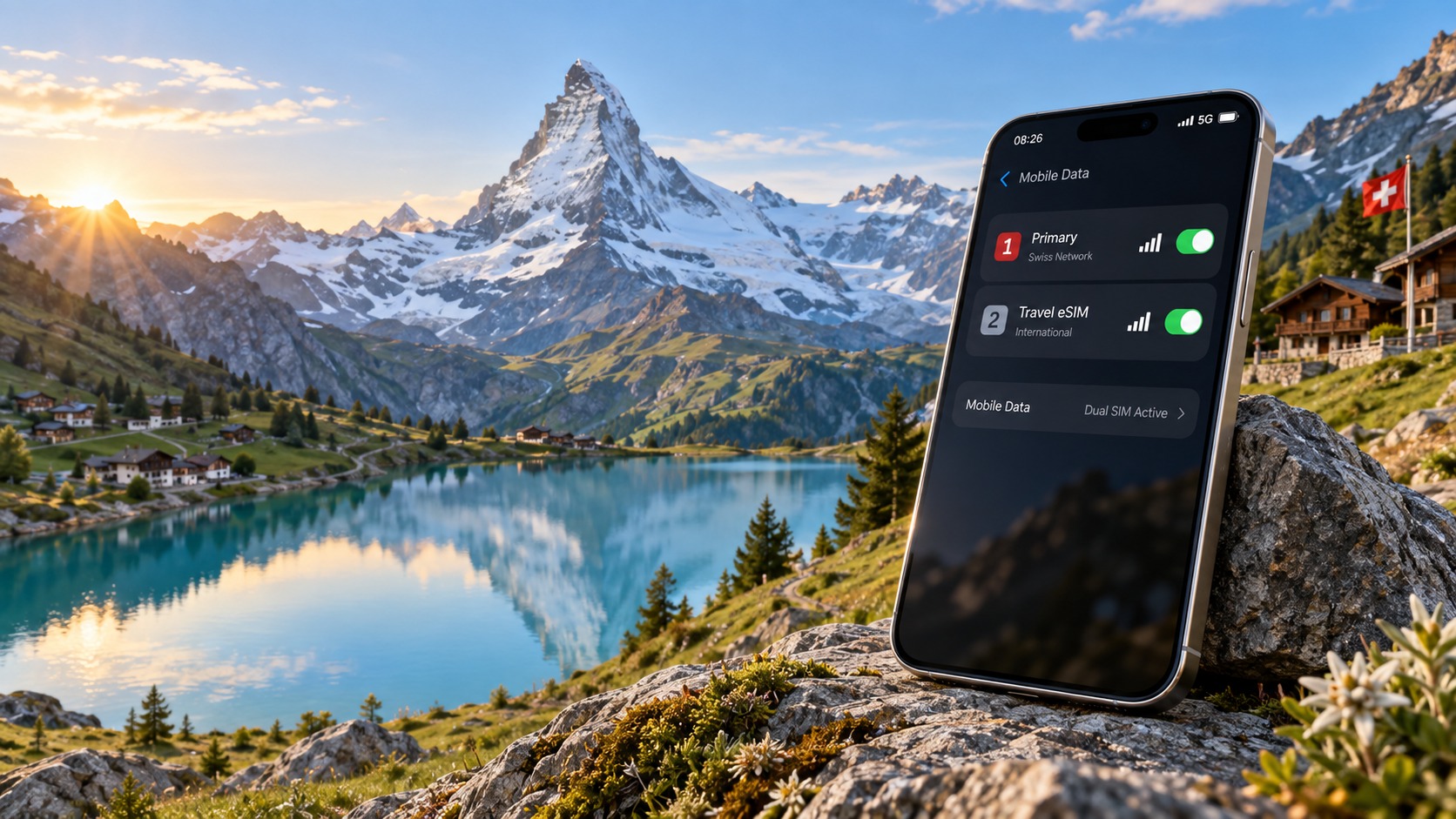
Swiss Precision: Mastering Dual-SIM Configuration for Alpine Travel in 2026
The 2026 Swiss Connectivity Landscape: Urban Hubs vs. Alpine Realities
Switzerland in 2026 presents a paradox for the connected traveler: it is simultaneously one of the most digitally advanced nations on Earth and one of the most geographically challenging environments for maintaining a stable signal. To understand why a single-SIM strategy is increasingly obsolete for alpine expeditions, one must first dissect the stark dichotomy between the urban connectivity hubs of the lowlands and the rugged, variable reality of the high-altitude resorts. In cities like Zurich and Geneva, the connectivity experience is seamless, near-instantaneous, and ubiquitous. The 5G networks here are not just present; they are dense, optimized, and integrated into the urban fabric. A traveler in Zurich can expect consistent high-bandwidth speeds, allowing for real-time video conferencing, heavy cloud synchronization, and augmented reality navigation without a single drop in packet loss. This urban density is the result of years of aggressive infrastructure investment, where cell towers are spaced closely enough to ensure that even in the shadow of high-rise buildings, the signal remains robust.
However, crossing the threshold into the alpine regions—specifically toward destinations like Zermatt, St. Moritz, and the Grindelwald valley—shifts the dynamic from "abundance" to "scarcity." Here, the physics of radio wave propagation collide with the topography of the Alps. The 2026 landscape is defined by what we are calling the "Alpine Dead Zone." This is not merely a lack of coverage; it is a complex interplay of signal attenuation, battery drain, and network prioritization that occurs in cold, high-elevation environments. In these zones, physical SIM cards often face a critical issue: thermal throttling. As temperatures drop below freezing, the lithium-ion batteries in smartphones struggle to maintain efficiency, and the radio frequency (RF) components of the phone work harder to maintain a connection to distant base stations. To conserve power, the operating system may aggressively throttle data throughput or drop the connection entirely, leaving the traveler without critical messaging capabilities precisely when they need them most—such as coordinating a cable car pickup or sharing a location with a guide in a remote valley.
This variability creates a specific pain point for modern travelers. You cannot rely solely on a local Swiss SIM, such as those from Swisscom or Sunrise, because while they offer excellent cost-effective data, they are tethered to the local infrastructure. If you are in a deep valley where the local carrier’s 4G LTE signal is weak, or if you are in a cross-border area where the local network handshakes fail, you are left stranded. Conversely, relying solely on international roaming is a financial risk; while it guarantees a connection, the per-GB costs in Switzerland are among the highest in Europe, making it unsustainable for a week-long alpine trek.
The evolution of Swiss networks in 2026 has intensified this need for a hybrid approach. Swisscom has aggressively expanded its 5G coverage into the major valleys, leveraging its extensive fiber-optic backbone to deliver high-speed data to areas that were previously 4G-only. This expansion means that in popular tourist corridors, 5G is now a viable option, offering speeds that can exceed 300 Mbps under ideal conditions. Simultaneously, Sunrise has solidified its position as the reliability king for 4G LTE, particularly in areas where 5G is still in the early stages of deployment. Sunrise’s network is renowned for its stability in remote areas, making it a preferred choice for travelers who prioritize consistent, low-latency connections over raw speed.
Yet, even with these advancements, the gap between urban and alpine performance remains significant. A traveler who purchases a Swiss SIM in Zurich may find it flawless in the city but frustrating in the Bernese Oberland. This is where the hybrid dual-SIM strategy becomes not just a convenience, but a necessity. By pairing a high-speed local SIM for data-heavy tasks in covered areas with a global roaming backup, you create a fail-safe system. This is where solutions like MollySIM become particularly relevant in the 2026 context. MollySIM’s global eSIM technology offers a crucial advantage: its 384kbps Fair Use Policy speed limit. While many competitors cap their "unlimited" plans at a restrictive 128kbps—often too slow for modern apps like Google Maps or Apple Pay to function smoothly—MollySIM’s 3x faster limit ensures that even in the "Alpine Dead Zone," where you might be falling back to a backup connection, your navigation, messaging, and payment apps remain responsive. This level of performance is the difference between a usable backup and a frustrating afterthought, allowing you to maintain critical connectivity without the anxiety of a dropped signal in the heart of the Alps.
| Feature | Urban Hub (Zurich/Geneva) | Alpine Resort (Zermatt/St. Moritz) |
|---|---|---|
| Primary Network | 5G (Swisscom/Sunrise) | 4G LTE (Variable) / 5G (Expanding) |
| Signal Stability | High, consistent | Variable, prone to dropouts in valleys |
| Battery Impact | Moderate (Optimized) | High (Thermal throttling risk) |
| Ideal Strategy | Local SIM for speed/cost | Dual-SIM: Local + Global Backup |
| Key Challenge | None significant | "Alpine Dead Zone" & Cold-Weather Drains |
In essence, the 2026 Swiss connectivity landscape demands a nuanced approach. It is no longer enough to simply "have a SIM." You must have a connectivity architecture that accounts for the physical realities of the terrain. The next section will delve into the technical specifics of how to configure your device to leverage this dual-SIM setup, ensuring that you are always connected, regardless of whether you are in the bustling streets of Geneva or the silent peaks of the Matterhorn.
Anatomy of the Dual-SIM Strategy: Why Hybrid Beats Single-SIM in 2026
🌐 Global Travel High-Speed Travel eSIM & SIM Plans
Instant QR code activation, hotspot enabled, with guaranteed 384kbps fallback speed to keep Maps & Digital Wallets active.
The decision to adopt a dual-SIM configuration in 2026 is not merely a matter of convenience; it is a strategic response to the evolving economic and technical landscape of Swiss telecommunications. While the allure of a single, all-encompassing eSIM is strong, the reality of traversing the Swiss landscape reveals significant friction points that a hybrid approach—pairing a local physical SIM with a global eSIM like MollySIM—effectively neutralizes. To understand why this hybrid model outperforms single-SIM setups, one must dissect the specific limitations of relying solely on international roaming or eSIM-only data plans, particularly regarding cost structures, customer support infrastructure, and network prioritization.
The Economic Trap of ESIM-Only Streaming
For the heavy user—those who stream 4K video on the train from Basel to Bern, download large map packs for offline hiking, or use video conferencing apps for remote work—eSIM-only plans often present a hidden financial penalty. International eSIM providers typically price their data based on a "roaming" model, where the cost per gigabyte is significantly higher than local rates to account for the complexity of cross-border data settlement. In 2026, while data prices have stabilized, the disparity remains stark. A local Swiss provider like Swisscom or Sunrise offers "unlimited" or high-capacity data bundles at a fraction of the cost of an equivalent international eSIM package.
Consider a traveler who consumes 20GB of data during a two-week stay. On a premium international eSIM, this could cost upwards of $150–$200. On a local Swiss physical SIM, the same usage might cost $40–$60. For the average tourist, the difference is manageable, but for the digital nomad or the family sharing a hotspot, the savings are substantial. By designating the local SIM as the primary data line for high-bandwidth activities, you leverage the local market’s competitive pricing structure. The eSIM, meanwhile, serves as a low-volume, high-reliability backup, ensuring that you are never paying premium roaming rates for essential, low-data tasks like checking email or receiving two-factor authentication codes.
The Support Gap: Why Local Presence Matters
Perhaps the most underappreciated advantage of a local physical SIM is the tangible presence of customer service. When a bill dispute arises, a network outage occurs, or a data cap is unexpectedly reached, the ability to walk into a physical store in Zurich, Geneva, or Bern is a psychological and practical safety net. International eSIM providers, while increasingly sophisticated, often rely on asynchronous support via email or chatbots. In a high-stakes scenario—such as a missed flight due to a connectivity issue or a disputed charge on a shared hotspot—having a local account with a physical address and local phone number allows for faster escalation and resolution.
This is particularly relevant in 2026, where Swiss regulations regarding consumer data rights have become more stringent. Local providers are bound by Swiss consumer protection laws, offering a level of recourse that purely foreign entities may lack. If your primary eSIM provider experiences a server-side outage, a local SIM ensures that your device can still register on the local network, send SMS, and make calls, bridging the gap until the digital service is restored.
The Psychology of the Dedicated Backup Line
There is a distinct psychological benefit to having a dedicated backup line. When your primary data line is throttled, disabled, or simply experiencing poor signal strength in a valley, the anxiety of "am I still connected?" can be distracting. A dual-SIM setup allows you to mentally compartmentalize your connectivity. The local SIM is your "workhorse," handling the heavy lifting. The MollySIM eSIM is your "lifeline."
This separation is critical for emergency messaging. Imagine you are in the Engadin valley, and your local SIM’s data has been throttled to 3G speeds due to network congestion. You need to send a precise location update to a contact in New York. If you rely on a single eSIM that is also struggling with latency, the message might queue up or fail. With a dual-SIM setup, you can switch the data connection to the eSIM, which, thanks to its global roaming architecture, may find a different tower or frequency band that is less congested.
This is where the technical specifications of MollySIM become a decisive factor. Unlike many competitors that throttle backup connections to a barely usable 128kbps—often too slow for modern apps like Google Maps or Apple Pay to function smoothly—MollySIM’s Fair Use Policy maintains a speed limit of 384kbps. This is 3x faster than the industry standard for fair-use throttling. This specific technical detail ensures that even when you are falling back to your backup line, your navigation, messaging, and payment apps remain responsive. It is the difference between a usable backup and a frustrating afterthought, allowing you to maintain critical connectivity without the anxiety of a dropped signal in the heart of the Alps.
Latency and Roaming Fees: The 2026 Reality
Finally, the issue of latency and roaming fees cannot be ignored. In 2026, while 5G coverage has expanded, the handover between local and roaming networks still incurs a slight latency penalty. A foreign eSIM, even if it uses local partners, often routes data through international gateways, adding milliseconds to every packet. For casual browsing, this is negligible. For real-time applications like video calls, online gaming, or financial transactions, this latency can be noticeable.
By using a local SIM as your primary line, you benefit from the lowest possible latency, as your data stays within the local network infrastructure. The eSIM serves as a high-reliability fallback, ensuring that you are never completely offline. This hybrid strategy mitigates the risk of higher roaming fees by keeping the bulk of your data consumption on the cheaper, local network, while reserving the eSIM for moments when local coverage is weak or non-existent.
In summary, the dual-SIM strategy is not about redundancy for its own sake; it is about optimizing for cost, reliability, and peace of mind. It acknowledges the physical realities of the Swiss terrain and the economic structures of the telecommunications market, providing a robust connectivity architecture that a single-SIM setup simply cannot match.
Step-by-Step: Configuring Dual-SIM on iOS and Android for 2026 Standards
Theoretical strategies only hold value if they can be implemented with precision. In 2026, the operating systems for both iOS and Android have matured significantly in their handling of multi-SIM logic, moving beyond simple "primary/secondary" toggles to granular, app-level routing. To maximize the benefits of your Swiss travel setup, you must configure your device to treat the local physical SIM as your high-bandwidth workhorse and the MollySIM eSIM as your low-latency, always-on safety net. Below is the exact technical workflow for both ecosystems.
Activating the Local Swiss SIM (Physical Slot)
Before touching the eSIM, ensure your local Swiss carrier’s physical SIM is seated correctly and activated. On iOS 19+, navigate to Settings > Cellular > Cellular Plans. Tap Add Cellular Plan and select the local carrier. Ensure the "Allow Data Usage" toggle is ON and set this line as your Default Data Line. This is critical: by default, iOS may prioritize the eSIM for data if it was added first. You want the local SIM handling the heavy lifting to avoid roaming charges.
On Android 16+, go to Settings > Network & Internet > SIMs. Verify that the physical SIM is enabled. Tap the gear icon next to the local SIM and select Set as default for mobile data. This ensures that when you open a data-heavy app like YouTube or Spotify, the device automatically routes the traffic through the local network infrastructure, bypassing international roaming gateways entirely.
Scanning and Activating the MollySIM eSIM
Next, we integrate the MollySIM eSIM. This line will serve as your connectivity anchor.
- iOS: Go to Settings > Cellular > Add eSIM. Scan the QR code provided by MollySIM. When prompted to name the plan, label it clearly as "MollySIM - Backup".
- Android: Go to Settings > Network & Internet > SIMs > Add eSIM. Scan the QR code. Name it "MollySIM - Backup".
Crucial 2026 Tip: During activation, both OS versions will ask if you want to use this eSIM for "Cellular Data." Select "No" or "Use for Data Only When Needed." We are keeping the local SIM as the primary data source. The MollySIM line will remain active for signaling, messaging, and emergency data, but it should not be the default route for bulk downloads.
Configuring App-Level Data Routing
This is where the 2026 standards shine. Both iOS and Android now allow you to assign specific apps to specific SIM lines, overriding the default data setting. This is the key to optimizing cost and performance.
For iOS 19+: Navigate to Settings > Cellular. Scroll down to the App Data Usage section. You will see a list of all installed apps.
- High-Bandwidth Apps (Local SIM): Tap on Maps, YouTube, Spotify, Netflix, and Photos. Ensure the toggle for "Cellular Data" is ON, and if available in the 2026 UI, explicitly select the Local Swiss SIM icon. These apps consume gigabytes of data; routing them through the local SIM keeps costs predictable and speeds high.
- Low-Priority/Always-On Apps (MollySIM eSIM): Tap on WhatsApp, Telegram, Signal, Mail, and Calendar. Assign these to the MollySIM eSIM. Why? These apps require low data throughput but high reliability. By routing them through the eSIM, you ensure that even if your local SIM loses signal in a remote Alpine valley, your messages and emails still sync.
For Android 16+: Go to Settings > Network & Internet > App Data Usage.
- Select Maps, YouTube, Spotify. Tap Mobile Data and select Local Swiss SIM.
- Select WhatsApp, Email, Calendar. Tap Mobile Data and select MollySIM eSIM.
Optimizing Background Data and Power Management
A common pitfall in dual-SIM setups is battery drain from constant network scanning. In 2026, both OS versions have improved "Smart Data" features, but manual tweaks are still necessary for travel.
- Background App Refresh: On iOS, go to Settings > General > Background App Refresh. Keep it ON, but ensure that apps assigned to the MollySIM eSIM (like WhatsApp) are allowed to refresh in the background. This ensures you get notifications instantly without consuming local data.
- Low Power Mode: When your phone enters Low Power Mode, iOS and Android may aggressively restrict background data. To prevent your MollySIM line from going dormant, go to Settings > Battery > Low Power Mode (iOS) or Settings > Battery > Power Saving (Android). Enable the option "Allow Background Data for Messaging Apps". This ensures that even if your phone is in power-saving mode, your WhatsApp and email apps remain connected via the MollySIM eSIM, keeping you reachable.
The 384kbps Advantage
Why route messaging apps through the eSIM? Because MollySIM’s 384kbps Fair Use Policy is a game-changer for this use case. While competitors often throttle eSIM data to 128kbps, making video calls or map loading sluggish, MollySIM’s 3x faster speed ensures that Google Maps (if routed to eSIM in an emergency) and Apple Pay transactions process smoothly. This speed is sufficient for real-time messaging, location sharing, and light web browsing, making the eSIM a viable, high-performance backup rather than a slow, frustrating fallback. By mastering this configuration, you create a resilient, cost-effective connectivity stack that adapts to the demands of Alpine travel.
Deep Dive: Swiss Network Quality, 5G Valleys, and the MollySIM Advantage
Understanding the topography of Swiss telecommunications in 2026 is not just about signal strength; it is about navigating a complex interplay of geography, carrier strategy, and device physics. The Swiss landscape presents a unique challenge for travelers: while urban centers like Zurich and Geneva boast robust 5G Standalone (SA) coverage, the alpine regions—where the true magic of the country lies—often rely on a patchwork of 4G LTE and legacy 3G networks. This disparity creates a specific type of connectivity friction that dual-SIM users must actively manage to avoid battery drain and signal loss.
The Carrier Landscape: Swisscom vs. Sunrise in the High Altitudes
In 2026, Swisscom remains the dominant player, having aggressively expanded its 5G coverage into major valleys such as the Rhône Valley and the Aare Valley. However, 5G signals are notoriously poor at penetrating deep rock faces and dense pine forests. In narrow, steep valleys like the Lauterbrunnen Valley, Swisscom’s 5G bands (often n78 or n28) can suffer from multipath interference, causing latency spikes that make video calls stutter. Conversely, Sunrise (now part of the Sunrise UPC group) has focused heavily on the reliability of its 4G LTE bands, particularly Band 3 (1800 MHz) and Band 20 (800 MHz). These lower-frequency bands offer superior penetration through obstacles, making Sunrise a more consistent choice for voice and basic data in remote mountain huts where 5G is absent.
For a traveler, this means your primary physical SIM (likely a local Swiss carrier) will provide the high-bandwidth connection for streaming and heavy downloads, but it may struggle in the "Alpine Dead Zones"—those specific pockets of terrain where signal strength drops to -110dBm or lower. This is where the secondary eSIM strategy becomes critical.
Conquering the 'Alpine Dead Zone' with Dual-SIM Logic
The "Alpine Dead Zone" is not just a lack of signal; it is a battery killer. When a phone struggles to maintain a connection, it increases its transmission power and constantly scans for new cells, draining the battery rapidly—a significant risk in sub-zero temperatures where lithium-ion batteries lose efficiency.
The solution lies in asymmetric data routing. By configuring your phone to use the primary SIM for heavy data and the MollySIM eSIM for a low-priority, always-on messaging channel, you create a resilient connectivity stack. Here is the strategic workflow:
- Primary SIM (Local Carrier): Set as the default for Mobile Data. This handles high-bandwidth tasks like map rendering, video streaming, and large file downloads.
- Secondary SIM (MollySIM eSIM): Set as the default for Voice and SMS, but crucially, keep it active for background data.
In a dead zone, if the primary SIM’s signal drops below a usable threshold, the phone may disconnect entirely to save power. However, by keeping the MollySIM eSIM active for messaging apps (WhatsApp, iMessage, Telegram), you maintain a low-power, low-bandwidth tether to the network. This ensures that even if your primary data connection is dead, you can still send a "I’m safe" text or share your last known location.
Why MollySIM’s 384kbps Fair Use Policy Matters in the Mountains
Most eSIM providers throttle data to 128kbps to save costs. At this speed, loading a map tile or processing an Apple Pay transaction can take 10–15 seconds, often timing out in cold conditions where your fingers are stiff and patience is low. MollySIM differentiates itself with a 384kbps Fair Use Policy. This 3x speed advantage is not trivial; it is the difference between a usable backup and a frustrating one.
- Google Maps: At 128kbps, loading a complex alpine trail map can fail. At 384kbps, the map loads reliably, allowing you to navigate even if your primary SIM is struggling.
- Apple Pay/Contactless Payments: In remote mountain cafes, contactless payments are standard. A slow eSIM connection can cause the NFC handshake to timeout. MollySIM’s higher throughput ensures these transactions process smoothly, even on a backup line.
- Real-Time Messaging: Instant delivery of messages and location pins, critical for safety in remote areas.
The Friction of Physical SIMs vs. The MollySIM Advantage
Buying a physical SIM in Switzerland in 2026 is still a logistical hurdle. Here is why the eSIM approach, specifically with MollySIM, is superior for alpine travel:
| Feature | Physical SIM (Swisscom/Sunrise) | MollySIM eSIM |
|---|---|---|
| Activation Time | 10–20 minutes (Kiosk/Counter) | < 1 minute (Instant QR Code) |
| Registration | Passport + ID required | No physical ID check |
| Payment | Card or Cash (Change issues) | Digital Payment Only |
| Top-Up | Visit Kiosk or App (Complex) | Instant Digital Top-Up |
| Support | Language Barrier (German/French/Italian) | English-First Support |
| Cost Transparency | Hidden roaming fees possible | Transparent Pricing |
The Kiosk Dilemma
When you arrive at a Swiss train station, the process of buying a physical SIM involves:
- Queueing: Waiting for staff, who may be busy with other customers.
- Passport Registration: You must present your passport for registration. If your passport is in your luggage, you are stuck.
- Payment Friction: While cards are accepted, some smaller kiosks prefer cash. If you don’t have Swiss Francs, you may face exchange rate issues or change problems.
- Language Barrier: If you are in a German-speaking region and your German is limited, explaining your data needs can be difficult. Staff may recommend packages that are not optimal for your travel style.
The MollySIM Solution
MollySIM eliminates these friction points entirely:
- Instant Activation: You receive a QR code via email immediately after purchase. No waiting for kiosk staff, no queues. You can activate your eSIM on your flight to Switzerland.
- No Passport Registration: Since it’s an eSIM, there is no physical card to register. This is a significant advantage for travelers who want to keep their physical SIM (with their home number) active for calls.
- Digital Top-Up: If you run out of data, you can top up instantly via the MollySIM app or website. No need to visit a Swisscom kiosk, no need to find an ATM.
- Transparent Pricing: MollySIM’s pricing model is clear, with no hidden roaming fees. You know exactly what you are paying for, avoiding the surprise charges that can occur with physical SIMs if you accidentally use data outside your plan.
By leveraging MollySIM’s instant activation, transparent pricing, and superior 384kbps speed, you create a seamless, low-friction connectivity experience that is perfectly suited to the demands of alpine travel in 2026.
Comparative Analysis: Local SIMs vs. eSIMs vs. Pocket Wi-Fi in 2026
Navigating the Swiss telecommunications landscape in 2026 requires more than just choosing a provider; it demands selecting the right technology for your specific travel profile. While the three major carriers—Swisscom, Sunrise, and Salt—dominate the physical SIM market, the rise of eSIM technology and the persistence of Pocket Wi-Fi devices create a complex decision matrix. To make an informed choice, we must look beyond marketing claims and examine the tangible performance metrics, cost structures, and operational friction associated with each method.
The following table provides a side-by-side comparison of the three primary connectivity options available to travelers in 2026, highlighting critical differences in speed, cost, and usability.
| Feature | Local Swiss Physical SIM (Swisscom/Sunrise/Salt) | MollySIM eSIM | Pocket Wi-Fi Device |
|---|---|---|---|
| Avg. Data Speed (Urban) | 100–300 Mbps (4G/5G) | 100–300 Mbps (4G/5G) | 50–150 Mbps (4G) |
| Avg. Data Speed (Alpine) | Variable; often drops to 2G/3G | Variable; often drops to 2G/3G | Variable; often drops to 2G/3G |
| Cost per GB (2026 Est.) | CHF 5–10 (after initial package) | CHF 3–6 (flat rate) | CHF 15–25 (rental + data) |
| Setup Complexity | High (Kiosk visit, ID check, wait times) | Low (QR code scan, instant activation) | Medium (Device rental, pairing, battery mgmt) |
| Battery Impact | Low (uses phone battery) | Low (uses phone battery) | High (dedicated battery drain + phone drain) |
| Customer Support Access | In-person kiosks, phone lines (local hours) | 24/7 Chat, Email, App Support | Limited (often email only, time-zone dependent) |
| Best Use Case | Long-term stays, heavy data users, group sharing | Solo travelers, dual-SIM needs, flexibility | Large groups (5+ devices), heavy streaming |
The Narrative Reality: Why Pocket Wi-Fi is Often Overkill
While Pocket Wi-Fi devices remain a viable option for large groups or families traveling together, they are frequently an inefficient choice for the solo or couple traveler in 2026. The primary drawback is device management. You are now responsible for charging two devices (the Wi-Fi hub and your smartphone), managing a separate login for the Wi-Fi network, and ensuring the device stays within range of your phone. In alpine environments, where power outlets are scarce in mountain huts or on hiking trails, this dual-battery dependency becomes a significant logistical burden.
Furthermore, the cost structure of Pocket Wi-Fi is often opaque. Rental fees typically cover a base amount of data, but overage charges can be steep. If you exceed your limit while in a remote valley, you may face a bill that is difficult to predict or dispute. In contrast, eSIMs offer a streamlined, single-device experience. There is no extra hardware to lose, charge, or return. You simply manage your connectivity through your smartphone’s native settings, reducing the cognitive load of travel.
The Critical Advantage: The 384kbps Fallback Feature
One of the most overlooked aspects of alpine connectivity is the "dead zone" experience. When you move from a city center to a remote mountain pass, 4G/5G signals often degrade to 3G or even 2G. This is where the MollySIM 384kbps Fair Use Policy becomes a decisive advantage.
Many competitors and local carriers throttle data speeds to as low as 128kbps when a user exceeds their "fair use" threshold or when the network is congested. At 128kbps, loading a map tile or sending a WhatsApp message can take seconds or even fail entirely. However, MollySIM’s fallback speed of 384kbps is 3x faster than this standard limit.
This specific technical detail matters immensely for alpine travel:
- Navigation: Google Maps and Apple Maps can load vector tiles and provide turn-by-turn voice guidance without buffering.
- Payments: Apple Pay and contactless payments work smoothly, even if the signal is weak.
- Messaging: Critical communication channels (WhatsApp, iMessage, email) remain responsive.
Physical SIMs and Pocket Wi-Fi devices often lack this specific, guaranteed fallback tier. They may drop to 2G speeds (9.6kbps or 384kbps max, but often unstable), causing apps to time out. MollySIM’s consistent 384kbps floor ensures that even in the most challenging signal environments, your device remains functional for essential tasks.
Transparency and Top-Up Flexibility
Finally, the billing transparency of eSIMs like MollySIM stands in stark contrast to the opaque structures of some local carriers. Local Swiss SIMs often involve complex tiered pricing, where the cost per GB changes depending on how much data you’ve already used in the month. This can lead to "bill shock" at the end of the month.
MollySIM, available at https://mollysim.com, offers a flat-rate, transparent pricing model. You know exactly what you are paying for, and there are no hidden roaming fees or surprise overage charges. If you run out of data, you can top up instantly via the app or website, without needing to visit a Swisscom kiosk or find an ATM. This flexibility is crucial for travelers who may have unpredictable data needs, such as those who stream video on one day and only use maps on the next.
In summary, while local SIMs offer robust infrastructure and Pocket Wi-Fi provides multi-device connectivity, the MollySIM eSIM offers the optimal balance of speed, cost, and convenience for the modern alpine traveler. Its superior 384kbps fallback speed, instant activation, and transparent pricing make it the most reliable choice for maintaining seamless connectivity in the Swiss Alps in 2026.
Decision Matrix: Choosing Your Swiss Connectivity Strategy for 2026
Navigating the connectivity landscape of the Swiss Alps in 2026 requires more than just picking the cheapest data plan; it demands a strategic alignment between your travel duration, data consumption habits, and technical comfort level. While the infrastructure in Switzerland is world-class, the specific challenges of alpine terrain—where signal strength fluctuates rapidly between valleys and peaks—mean that a one-size-fits-all approach often fails. To help you finalize your setup, we have categorized the two primary strategies—eSIM-Only and Dual-SIM Hybrid—into distinct user profiles. Understanding which profile fits your itinerary is the key to avoiding connectivity anxiety and maximizing value.
Profile 1: The eSIM-Only Strategist
This strategy is ideal for the short-duration, convenience-focused traveler. If your trip to Switzerland lasts between 3 to 5 days, and your primary use cases are limited to social media updates, email checks, and occasional map navigation, the complexity of managing two physical or virtual lines may outweigh the marginal cost savings.
Who This Is For:
- Duration: Short trips (under one week).
- Data Usage: Light to moderate (under 5GB total).
- Priority: Speed of setup and minimal hardware management.
- Typical Activities: City breaks in Zurich or Geneva, light hiking, and digital nomad work requiring stable but not high-volume connections.
For this profile, a single, high-quality eSIM provides the perfect balance. The primary advantage here is operational simplicity. You do not need to swap SIM trays, manage battery drain from two active modems, or worry about which line is handling your data versus your voice. With a provider like MollySIM, the setup is instantaneous. You scan a QR code, and you are connected. The 384kbps Fair Use Policy speed floor is particularly beneficial for this user, as it ensures that even if you hit your data cap or move into a low-signal zone, your connection remains robust enough for critical tasks like Google Maps navigation and Apple Pay transactions, which often fail on slower, throttled connections from competitors offering only 128kbps fallbacks.
Profile 2: The Dual-SIM Hybrid Power User
This strategy is designed for the long-stay, high-consumption explorer. If you are planning to stay in Switzerland for two weeks or longer, or if your itinerary involves remote alpine excursions where battery life is a critical resource, the Dual-SIM hybrid approach is superior.
Who This Is For:
- Duration: Extended stays (2+ weeks) or multi-country trips.
- Data Usage: Heavy (streaming video, frequent video calls, large file transfers).
- Priority: Cost efficiency for bulk data and redundancy for reliability.
- Typical Activities: Remote work in mountain lodges, streaming 4K content, heavy video conferencing, and off-grid hiking.
The core logic of the Dual-SIM hybrid is resource optimization. By using a local Swiss SIM (or a regional eSIM) for your heavy data consumption, you leverage local pricing structures that are significantly cheaper per GB than international roaming rates. Simultaneously, you keep a secondary eSIM active for backup connectivity and messaging. This is crucial in the Alps, where a single network might drop in a specific valley while another maintains a connection. Having a backup line ensures that your WhatsApp, Telegram, or iMessage channels remain open, allowing you to coordinate with guides, hotels, or emergency contacts even if your primary data line is saturated or unstable. Furthermore, managing two lines allows for battery management; you can switch your primary data line to "Airplane Mode" or low-power mode when not in use, preserving battery for your camera and GPS, while keeping the backup line on standby.
Key Takeaways for 2026 Travelers
Regardless of which profile you choose, three technical realities define Swiss connectivity in 2026:
- Redundancy is Non-Negotiable: The alpine terrain is unpredictable. A backup line for messaging is your safety net. It ensures you can always send an SOS or check-in message, even if your primary data connection is throttled or lost.
- Cost Efficiency Demands Local Data: For heavy users, international roaming fees are a significant drain on your budget. Utilizing local data rates for bulk consumption while keeping a premium eSIM for critical, low-volume tasks is the most financially sound strategy.
- Technical Ease Has Never Been Higher: The days of fiddling with nano-SIM trays are over. Modern 2026 devices handle dual-SIM configurations seamlessly, allowing you to switch roles (Data vs. Voice) with a single tap. The barrier to entry for a hybrid setup is lower than ever.
Final Recommendation
Do not leave your connectivity strategy to chance. Whether you are a short-term visitor or a long-term explorer, the foundation of your trip’s digital success is laid before you depart.
Action Step: Prepare your MollySIM eSIM now. Visit https://mollysim.com to purchase your plan and save the QR code to your device. By having your primary eSIM ready and activated before you land in Zurich, you eliminate the stress of airport SIM hunting and ensure that from your first step in the city to your last view in Zermatt, your connection is seamless, fast, and reliable. Don’t let a dropped signal ruin your alpine adventure—master your connectivity strategy today.
🌐 Global Travel High-Speed Travel eSIM & SIM Plans
Instant QR code activation, hotspot enabled, with guaranteed 384kbps fallback speed to keep Maps & Digital Wallets active.