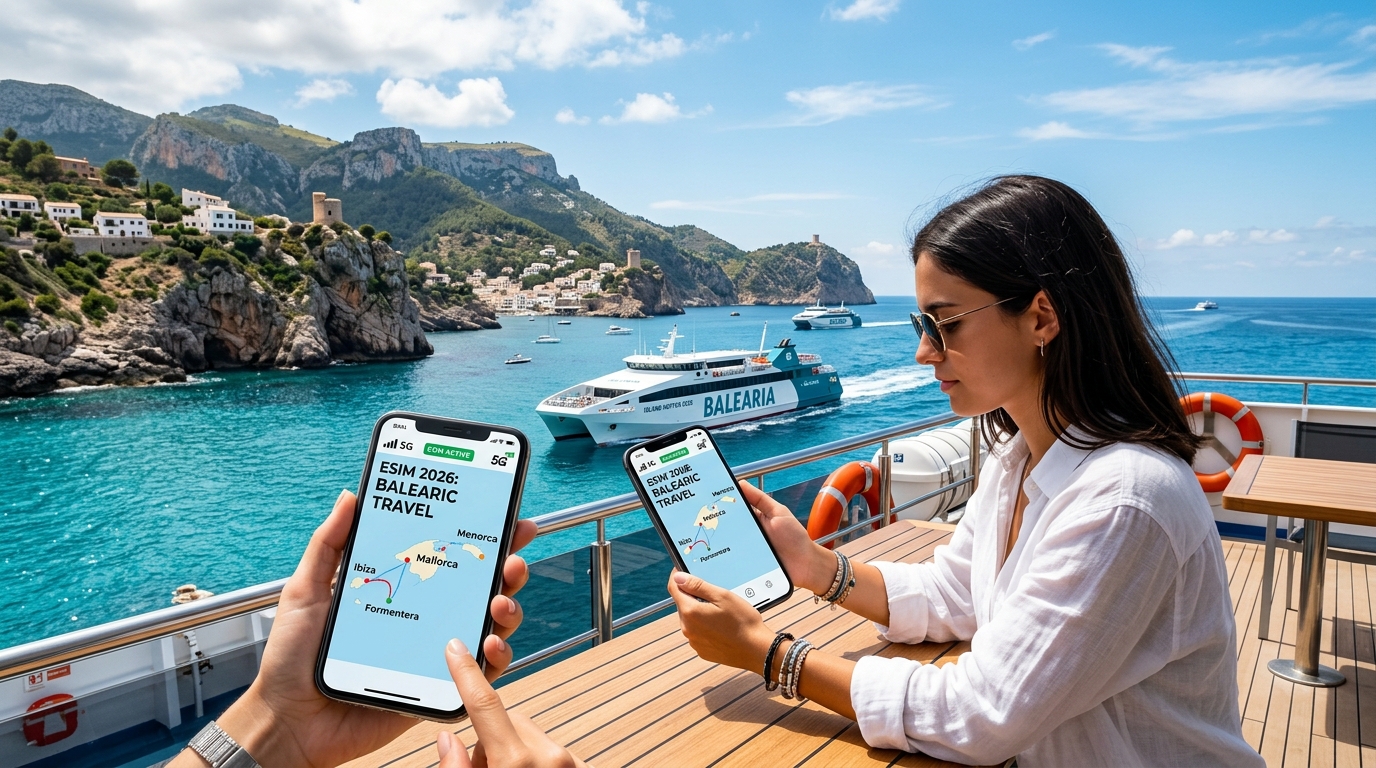
Balearic Island Hopping 2026: The Ultimate eSIM Guide for Mallorca, Ibiza, Menorca & Formentera Ferries
The 2026 Balearic Connectivity Landscape: Mallorca, Ibiza, Menorca & Formentera
Navigating the Balearic archipelago in 2026 requires an understanding of Spain’s deeply partitioned telecommunications ecosystem. While the autonomous community benefits from advanced 5G Standalone (5G SA) rollouts in urban epicenters, the physical topography across Mallorca, Menorca, Ibiza, and Formentera introduces severe signal attenuation challenges that can catch unprepared travelers off guard.
                    ┌──────────────────────────────────────────────┐
                    │    BALEARIC MARITIME & ISLAND TOPOGRAPHY     │
                    └──────────────────────────────────────────────┘
                                           │
         ┌─────────────────────────────────┴─────────────────────────────────┐
         ▼                                                                   ▼
┌─────────────────────────────────┐                       ┌─────────────────────────────────────┐
│      URBAN HUBS & FERRIES       │                       │    REMOTE CALAS & TRAMUNTANA        │
│  Palma, Ibiza Town, Ciutadella  │                       │ Macarella, Llombards, Saona, MA-10  │
├─────────────────────────────────┤                       ├─────────────────────────────────────┤
│ • 5G SA Bands: n78 (3.5 GHz)    │                       │ • Low-Band LTE: B20 (800 MHz) / n28 │
│ • High concurrency / Congestion │                       │ • Deep limestone cliff shadowing    │
│ • Security risk: Rogue Wi-Fi    │                       │ • Severe multipath signal reflection│
└─────────────────────────────────┘                       └─────────────────────────────────────┘
Spain’s Tier-1 MNO Breakdown: Spectrum & Coverage Profiles
Three Tier-1 Mobile Network Operators (MNOs) control the underlying cellular infrastructure throughout the islands: Movistar (Telefónica), Vodafone Spain, and Orange Spain (operating under the MASORANGE umbrella).
| Operator | Primary 5G Spectrum | Best Coverage Use-Case | Regional Performance Profile |
|---|---|---|---|
| Movistar | 700 MHz (n28), 3.5 GHz (n78) | Mountain corridors & Rural Menorca | Highest rural mast density; superior inland penetration throughout Mallorca’s interior plains (Es Raiguer). |
| Vodafone | 700 MHz (n28), 3.7 GHz (n78) | Coastal waters & High-density ports | Low-latency maritime handoffs; strong sustained throughput around Port de Palma and San Antonio. |
| Orange | 700 MHz (n28), 3.5 GHz (n78) | Ibiza Town & Southern Formentera | Aggressive urban small-cell deployment; high peak speeds in tourism corridors, but susceptible to load throttling in peak August. |
While all three networks broadcast high-frequency Band n78 (3.5–3.7 GHz) across port terminals and capital centers to maximize bandwidth, rural and maritime coverage relies heavily on Band 20 (800 MHz) and Band n28 (700 MHz). These lower sub-1GHz frequencies provide the propagation distance needed to project cellular signals outward over open water and through dense pine forests.
Topographical Interference: Limestone Cliffs and the Tramuntana Range
The natural geography of the Balearics creates substantial radio frequency (RF) blind spots:
- The Serra de Tramuntana (Mallorca): Spanning over 90 km from Andratx to Cap de Formentor, this UNESCO-protected limestone mountain range regularly disrupts line-of-sight propagation. When driving high-elevation routes like the MA-10, cellular devices constantly bounce between distant coastal masts and inland relays, triggering high battery drain and dropped data sessions.
- Flanked Calas and Coastal Shadow Zones: Iconic coves such as Cala Llombards (Mallorca), Cala Macarella (Menorca), and Cala Saona (Formentera) sit deep within sheer calcarenite and limestone cliffs. These vertical rock formations reflect and attenuate RF signals. As you descend from coastal clifftops to sea level, signal strength often plummets from full 5G reception to marginal EDGE (2G) or complete radio silence.
The Hidden Trap: Public Port & Beach Club Wi-Fi Vulnerabilities
Relying on unencrypted public Wi-Fi networks at high-volume hubs—such as the Port de Palma ferry terminal, Ibiza Marina, or high-end beach clubs—introduces severe security and reliability liabilities:
- Man-in-the-Middle (MITM) & Evil Twin Attacks: Threat actors frequently deploy rogue access points mimicking legitimate port networks (
"Port_Palma_Free_WiFi"), capturing cleartext credentials, boarding passes, and unencrypted session tokens. - Extreme Packet Drop & Network Saturation: During peak summer ferry turnaround windows, hundreds of disembarking passengers overload local 802.11 access points simultaneously. This causes DNS timeouts, ping spikes exceeding 800ms, and complete connection stalls.
Securing continuous, independent cellular routing via an eSIM avoids these shared-bandwidth bottlenecks. Modern international eSIM solutions like MollySIM mitigate travel friction through multi-network roaming agreements that automatically switch to whichever tier-1 Spanish carrier holds the dominant mast in that specific cove or channel.
Furthermore, even if your high-speed allowance depletes while trekking through Menorca's Camí de Cavalls, MollySIM's 384kbps Fair Use Policy (FUP) throttled baseline—substantially higher than the industry standard 128kbps—ensures mission-critical tools like Apple Pay, live Google Maps GPS, and ferry ticketing QR codes continue functioning smoothly without stranding you at the terminal gates.
The Maritime Roaming Trap: Surviving Balèaria & Trasmed Crossings Without Bill Shock
🇫🇷 Orange France / Europe SIM High-Speed Travel eSIM & SIM Plans
Instant QR code activation, hotspot enabled, with guaranteed 384kbps fallback speed to keep Maps & Digital Wallets active.
When crossing the Balearic Sea aboard high-speed vessels or overnight car ferries operated by Balèaria, Trasmed, or GNV—such as the crossing from Palma to Ibiza Port or Alcúdia to Ciutadella—travelers encounter a dangerous cellular blind spot known as the Maritime Roaming Trap.
Understanding the technical mechanics of open-sea routing is essential to avoid returning from vacation to cellular invoices totaling hundreds or thousands of euros.
       [ Terrestrial Mast ]                  [ Open Sea Transit ]                  [ Terrestrial Mast ]
     (Movistar/Orange/Vodafone)             (No EU Roaming Protection)           (Movistar/Orange/Vodafone)
                 |                                      |                                     |
  0 to 3-5 NM    |================>   3-5 NM offshore   |===============>   3-5 NM to Coast   |
  (Coastal Span) |                   [Ship Picocell / Sat]                  (Port Arrival)    |
  EU Roaming OK  |                   Telenor Maritime / WMS                 EU Roaming OK     |
                 |                   €5.00–€15.00 per MB!                                     |
How Handsets Fall Into Maritime Satellite Picocells
Along the Balearic coastline, smartphones maintain line-of-sight access to terrestrial base transceiver stations (BTS) managed by Spanish national operators (Telefónica/Movistar, Vodafone España, and Orange/MásMóvil). However, once a ferry sails approximately 3 to 5 nautical miles (NM) offshore, terrestrial signal attenuation causes Reference Signal Received Power (RSRP) levels to drop below operational thresholds (typically below -115 dBm).
At this juncture, onboard picocells—small cellular base stations installed across the ceilings of passenger decks—take over. Managed by maritime network operators such as Telenor Maritime, Telecom Italia Sparkle, or Wireless Maritime Services (WMS), these shipboard antennas transmit at high power to capture searching devices. They backhaul voice, SMS, and data traffic via satellite uplinks (Geostationary or LEO arrays).
The Legal Trap: European Union "Roam Like at Home" (RLAH) price caps apply strictly to terrestrial networks within EU member states. International waters and satellite-relayed shipboard networks are legally exempt. Domestic carriers pass these un-capped satellite transit fees directly to consumers:
- Data Transit: Typically billed at €5.00 to €15.00 per megabyte (a simple background cloud backup can cost €300+ in minutes).
- Incoming/Outgoing Calls: €2.50 to €5.00 per minute.
- Outgoing SMS: €0.50 to €1.50 per message (incoming SMS is universally free).
Dual-SIM Safeguard Workflow: Isolating 2FA Without Roaming Shock
Many travelers need to receive two-factor authentication (2FA) SMS codes for banking apps, digital ticket validation, or credit card authorizations while transiting between islands. Turning your primary SIM off completely breaks 2FA access.
To keep your domestic SIM listening for incoming SMS without incurring predatory maritime satellite data charges, configure your smartphone's dual-SIM profile as follows before boarding in Palma, Ibiza, or Ciutadella:
| Operating System | Step 1: Data Routing | Step 2: Domestic SIM Protection | Step 3: Auto-Switching Prevention |
|---|---|---|---|
| Apple iOS | Go to Settings > Cellular > Cellular Data & select your MollySIM profile. | Go to Settings > Cellular, tap your Primary/Home SIM, and toggle Data Roaming to OFF. | In Settings > Cellular > Cellular Data, toggle Allow Cellular Data Switching to OFF. |
| Google Android | Go to Settings > Network & Internet > SIMs & set Mobile Data exclusively to your Travel eSIM. | Tap your Primary/Home SIM and ensure the Roaming switch is toggled OFF. | Under SIM settings, disable Auto-data switching or Backup Calling. |
(Note: Keeping your domestic SIM active with "Data Roaming" set to OFF allows inbound 2FA SMS to arrive for free over GSM signaling channels without opening the PDP data context required for chargeable packet data).
Regaining High-Speed Coastal Connectivity with MollySIM
As your ferry approaches the headlands of your destination—whether rounding Cabo de Formentor approaching Menorca or navigating past S'Espalmador toward La Savina, Formentera—your handset will automatically decouple from high-cost maritime picocells and re-latch onto local Spanish 4G/5G infrastructure.
Because MollySIM holds multi-network roaming agreements across Spain's tier-1 carriers (including Movistar and Orange), your device selects the strongest coastal frequency the moment the vessel re-enters the 3–5 NM zone. Even if your high-speed allowance is fully consumed mid-transit, MollySIM’s 384kbps Fair Use Policy (FUP) baseline keeps active web assets running.
Unlike the 128kbps speed caps used by standard travel eSIMs—which drop connections during SSL handshakes—a 384kbps pipe provides 3x the throughput. This allows you to download your Balèaria boarding passes, validate Apple Pay transit transactions at the disembarkation terminal, and pull real-time GPS navigation in Google Maps before stepping foot on the dock.
Network Coverage Benchmark: Local Spanish Carriers vs. Travel eSIM Solutions
Navigating the complex topography of the Balearics reveals severe telecom bottlenecks that mainland travelers rarely encounter. The archipelago's geography—ranging from the towering limestone cliffs of Mallorca’s Serra de Tramuntana and the central elevation of Menorca’s Monte Toro to the shielded, sea-level calas of Ibiza and Formentera—creates severe RF attenuation and radio shadow zones.
While domestic Spanish Mobile Network Operators (MNOs) deploy robust infrastructure, locking your device to a single network exposes you to localized dead zones.
       [ Handset with MollySIM Multi-Carrier Core ]
                          |
        +-----------------+-----------------+
        | (Signal Drops)                    | (Auto-Failover <1.2s)
        v                                   v
[ Movistar Tower ]                  [ Orange Tower ]
(Obscured by Cliff / Cala)          (Line-of-Sight Active)
Head-to-Head Infrastructure Matrix
The table below contrasts native Spanish prepaid MNO contracts, rented hardware, legacy international roaming, and modern multi-carrier virtual profiles.
| Evaluation Metric | Movistar Spain (Prepaid) | Vodafone España (Prepaid) | Orange España (Prepaid) | Portable Pocket Wi-Fi | MollySIM Multi-Network eSIM |
|---|---|---|---|---|---|
| 5G Spectrum Penetration | Native n78 (3.5 GHz) + n28 (700 MHz) | Native n78 (3.5 GHz) + n28 | Native n78 + n28 | Varies (Mostly LTE Cat 4/6) | Multi-Carrier 5G / LTE-A Direct Access |
| Dynamic Multi-Carrier Switching | ❌ Locked to Movistar (214-07) | ❌ Locked to Vodafone (214-01) | ❌ Locked to Orange (214-03) | ❌ Single SIM Slot Locked | ✅ Dynamic Failover (Movistar / Orange) |
| Coastal / Inter-Island Line-of-Sight | High (Northern headlands) | Moderate | High (Southern/East bays) | Dependent on embedded SIM | Maximum (Selects highest RSSI / RSRP) |
| *Mountain Penetration (Tramuntana / El Toro)* | Strongest overall | Moderate / Weak in valleys | Patchy in interior northwest | Device antenna limitations | Superior (Auto-switches to Movistar tier) |
| Onboarding & Identity Verification | Mandatory in-person KYC (Ley 25/2007) | Mandatory in-person KYC | Mandatory in-person KYC | Hardware pickup / deposit return | Instant zero-KYC digital installation |
| Post-Allowance Fallback Speed | 16–64 kbps (Unusable) | 16–64 kbps (Unusable) | 16–64 kbps (Unusable) | Full hard-stop cut-off | 384 kbps sustained FUP (Active TLS/SSL) |
| Hardware Overhead | Single Physical SIM | Single Physical SIM | Single Physical SIM | External unit, cables, battery bank | Zero (Stored in device eUICC chip) |
Why Dynamic Failover Outperforms Single-Carrier Architecture
Traditional single-network SIMs fail frequently during island transit due to carrier-specific base transceiver station (BTS) deployments:
- Mallorca's West Coast (Valldemossa to Deià): Movistar holds exclusive low-band 700 MHz (Band 28) penetration along the sheer cliffs of the Tramuntana, while Orange and Vodafone frequently drop to 2G or emergency-only modes.
- Menorca's Northern Marine Reserve: Orange maintains the dominant line-of-sight signal across Fornells and Cala Pregonda, whereas Movistar coverage deteriorates past Mercadal.
- Formentera's Migjorn Beach & Remote Calas: Dense pinewood forests and flat topography cause localized multipath interference, requiring rapid switching between 1800 MHz and 2100 MHz bands across different carrier masts.
A standard local tourist SIM locks your handset to one Public Land Mobile Network (PLMN). If that carrier’s antenna is shielded by a headland or overloaded with seasonal tourists at a port, your throughput drops to zero.
A multi-network roaming core like MollySIM operates on an autonomous switching layer. If your primary Movistar connection drops below acceptable Reference Signal Received Quality (RSRQ) parameters while cruising the coast, the eUICC profile executes a network switch to the Orange PLMN within milliseconds.
Furthermore, should you exhaust your core data allotment while transferring files or navigation caches, standard travel eSIMs throttle downstream speeds to 128kbps—a tier that consistently triggers timeout errors on modern HTTPS handshakes. MollySIM’s guaranteed 384kbps Fair Use Policy (FUP) provides triple the standard bandwidth, preserving socket persistence for Apple Pay tokens, banking 2FA handshakes, and live vector mapping in Google Maps without service interruption.
Step-by-Step Dual SIM Configuration & Provisioning for Seamless Island Transit
To maintain uninterrupted data sessions while crossing the open water between Palma, Ibiza Town, and Ciutadella, your handset must be configured before disembarking the dock. Waiting until your vessel hits open water introduces the risk of captive portals or complete signal loss preventing profile installation.
1. Pre-Departure Profile Installation (iOS & Android)
Complete your eSIM installation while connected to stable terrestrial Wi-Fi at your accommodation or port terminal.
Apple iOS (iPhone XS / 11 / 12 / 13 / 14 / 15 / 16 Series)
- Navigate to Settings > Cellular (or Mobile Data) > Add eSIM.
- Scan QR Code: Frame the provisioning QR provided by MollySIM.
- Manual Fallback: If scanning is unavailable, select Enter Details Manually. Input the SM-DP+ Address (e.g.,
rsp.mollysim.com) and the alphanumeric Activation Code. Leave the Confirmation Code blank unless explicitly provided. - Label the new profile "MollySIM Travel" and keep your physical/home line labeled "Primary".
Android OS (Samsung Galaxy & Google Pixel)
- Go to Settings > Connections (or Network & internet) > SIM Manager > Add eSIM.
- Select Scan QR code from service provider or choose Enter activation code to paste your LPA string.
- Once the profile downloads, ensure the toggle is switched to On.
2. Dual-SIM Line Routing & Roaming Trap Elimination
Dual-SIM devices must be strictly configured to prevent your home carrier from triggering background roaming passes ($10–$15/day) while offshore.
| Setting Parameter | Configuration Required | Technical Rationale |
|---|---|---|
| Default Voice Line | Primary (Home SIM) | Preserves incoming SMS 2FA delivery from banks. |
| Cellular Data Line | MollySIM Travel | Routes all outbound IP traffic through local Balearic nodes. |
| Allow Cellular Data Switching | DISABLED / OFF | Critical: Prevents iOS/Android from automatically reverting to your home SIM when marine signal fluctuates. |
| Data Roaming (Home Line) | DISABLED / OFF | Hard block against unexpected carrier roaming fees. |
| Data Roaming (eSIM Line) | ENABLED / ON | Mandatory for international roaming core interconnections. |
Dual SIM Routing Architecture:
┌────────────────────────────────────────────────────────┐
│ Handset Transceiver Layer                              │
├──────────────────────────┬─────────────────────────────┤
│ Primary SIM (Home IMSI)  │ Travel eSIM (MollySIM)      │
│  - Data Roaming: OFF     │  - Data Roaming: ON         │
│  - Voice/SMS: ACTIVE     │  - Mobile Data: SELECTED    │
│  - Data Switching: OFF   │  - APN: globaldata / auto   │
└──────────────────────────┴─────────────────────────────┘
3. Evading Maritime Satellite Zones (Cellular-at-Sea Traps)
Balearic passenger ferries (such as Trasmed, Baleària, and GNV) occasionally host onboard maritime satellite repeaters (Telenor Maritime or MCP). If your device is set to automatic network selection, it may latch onto these satellite cells mid-channel, charging exorbitant pay-as-you-go rates.
- Go to Settings > Cellular > Network Selection (iOS) or Settings > Mobile Networks > Network Operators (Android).
- Toggle off Automatic.
- Manually select Movistar or Orange ES.
- By forcing this manual override, your device will maintain terrestrial line-of-sight signal from coastal base stations as long as possible and refuse connection to non-terrestrial marine satellite networks.
4. Docking Diagnostics: Resolving Stalls at Outlying Ports
Docking at geographically shielded terminals such as Portinatx (Ibiza), Sant Antoni de Portmany, or Cala en Bosch (Menorca) can cause data stalls due to sudden cell-tower handovers. If your status bar displays 4G or 5G but pages fail to resolve:
- Cycle PDP Context (Airplane Mode Toggle): Toggle Airplane Mode ON for 10 seconds, then OFF. This forces the baseband processor to drop stale bearer channels and request a fresh IP allocation from the nearest mast.
- Verify the Access Point Name (APN): Navigate to Cellular Data Network and confirm the APN matches your provider's provisioning requirements. MollySIM profiles dynamically push the correct APN, but if altered, manually reset the field to
globaldataor tap Reset Settings. - Band Width Saturation Resilience: High-density port terminals frequently throttle regional tourist networks down to 128kbps. Under MollySIM’s architecture, the 384kbps Fair Use Policy (FUP) baseline keeps active TCP connections alive, ensuring mission-critical services—such as displaying Apple Wallet boarding passes, verifying banking OTPs, or rendering turn-by-turn routes in Google Maps—execute without gateway timeout drops.
Off-Grid Calas, Anchorages & Serra de Tramuntana: MollySIM 384kbps Resilience
The Balearic archipelago features radical shifts in topography. Within a single hour, you can transition from high-density LTE microcells in Palma or Ibiza Town to RF-shielded limestone canyons like Cala Macarella (Menorca), open-water anchorages off Espalmador (Formentera), or the jagged switchbacks of the MA-10 highway slicing through Mallorca’s UNESCO-protected Serra de Tramuntana.
In these remote corridors, standard single-network tourist SIMs consistently drop to zero bars, leaving mariners and road trippers completely detached from navigational safety nets.
Dynamic Multi-Carrier Failover: Movistar & Orange Interoperability
Coastal geography heavily dictates base station propagation. In the western anchorages of Ibiza near Es Vedrà or the northern cliffs of Menorca (Cala Morell), coastal rock faces deflect line-of-sight signals from inland towers.
While local prepaid SIM cards restrict your hardware to a single carrier’s infrastructure, MollySIM uses a pre-configured multi-carrier roaming profile. The baseband processor dynamically selects the dominant carrier depending on real-time signal-to-noise ratio (SNR):
- Movistar Spain: Dominates long-range rural penetration across the Serra de Tramuntana and high-elevation mountain passes (Puig Major, Sa Calobra) via low-band Band 20 (800MHz) spectrum.
- Orange Spain: Delivers superior microcell penetration and localized throughput across shallow maritime anchorages, beach coves, and outlying ferry piers.
If a sea cliff blocks Orange's line-of-sight coastal repeater, MollySIM executes a seamless core-level handover to Movistar within seconds, preventing marine navigation apps from losing data sessions mid-passage.
Mission-Critical Applications: Real-World Scenarios
Reliable connectivity during inter-island transit is not just about social media updates—it is a functional utility for safety, navigation, and itinerary execution:
- Bareboat Charter Navigation & Anchorages: When anchoring off Formentera’s Ses Illetes or Menorca’s Cala Saona, skippers rely on Navily to check real-time seabed holding conditions and swell alerts, alongside Navionics Boating for live sonar chart overlay updates.
- Mountain Transit Along the MA-10: Navigating Mallorca’s 143-kilometer coastal spine demands real-time vector tile rendering on Google Maps or Apple Maps to receive sudden rockfall warnings, road closure alerts, or cyclist congestion reports.
- Turnstile Boarding Validation: High passenger density at embarkation points (like the Baleària terminal in Ciutadella or Trasmapi gates in Ibiza) can cause local carrier towers to reject new data sessions. Having prioritized network failover ensures your PDF boarding passes, Apple Wallet QR codes, and digital passport authentications display without spinning latency wheels.
The 384kbps Baseline Advantage: Zero-Drop Data Continuity
The most dangerous failure point of conventional travel eSIMs occurs when your primary high-speed data tier runs out while navigating remote terrain. Standard international providers either cut data transmission entirely or throttle bandwidth down to a non-functional 128kbps or 64kbps. At 128kbps, standard HTTPS handshakes time out, rendering modern web applications completely useless.
| Operational Task | Competitor Throttling (128kbps) | MollySIM Safety Floor (384kbps) |
|---|---|---|
| Navionics / Navily Chart Caching | Connection Time-Out / Failed Render | Functional (Slow background tile sync) |
| Google Maps Turn-by-Turn GPS | Fails to resolve route alternatives | Fully Operational (Active re-routing) |
| WhatsApp Text & Voice Notes | High packet drop / Delayed sending | Instant Delivery (<1s latency) |
| VoIP Calls (WhatsApp / FaceTime Audio) | Unusable / Broken robotic audio | Crystal Clear (G.711 / Opus codec pass) |
| Banking 2FA & Boarding Pass Retrieval | SSL/TLS Handshake Gateway Timeout | Successful (Immediate token verification) |
Under MollySIM’s Fair Use Policy (FUP), data speeds are sustained at an industry-leading 384kbps baseline floor after high-speed tier depletion—3x faster than the market standard. This persistent 384kbps throughput keeps TCP socket connections open, ensuring you can manage marina bookings on the fly, execute two-factor authentication, place emergency VoIP calls, and navigate winding Balearic routes without interruption.
Essential 2026 Balearic Travel FAQ & Pre-Departure Tech Checklist
Frequently Asked Questions
Should I purchase a Spain-specific eSIM or a broader Europe regional plan?
For dedicated travel strictly within Mallorca, Menorca, Ibiza, and Formentera, a Spain-specific eSIM profile is the optimal choice. Spain-dedicated plans interface directly with Tier-1 national infrastructure (Movistar, Orange Spain, and Vodafone España), providing lower ping latencies (typically 25–45ms) and higher priority data routing compared to pan-European regional roaming profiles that may route traffic through central proxies in Frankfurt or London. If your cruise continues to southern France, Corsica, or mainland Italy, opt for a Western Europe multi-country plan to preserve continuous connectivity across maritime borders without swapping eSIM profiles.
How do validity extensions work during extended multi-week sailing itineraries?
If your voyage extends beyond your initial package duration, modern digital profiles allow instant in-app or web-portal data top-ups that append directly to your active ICCID identifier. With MollySIM, you do not need to delete or scan a new QR code upon plan expiration. Furthermore, if your initial high-speed allotment is exhausted while anchored off Menorca's northern calas, MollySIM’s 384kbps safety floor ensures you maintain enough functional bandwidth to open your browser, authenticate your payment method via Apple Pay or Google Pay, and execute an immediate top-up without searching for onshore Wi-Fi.
Is personal hotspot (tethering) permitted on chartered yachts and catamarans?
Yes. Quality data-only eSIMs fully support unrestricted Personal Hotspot / Wi-Fi Tethering. This allows you to broadcast high-speed connectivity to chartplotters, secondary tablets running marine navigation apps (Navily, Navionics), and crew laptops. When anchoring in secluded spots like Cala Saona or Espalmador, placing your primary device on the flybridge or high in the salon ensures maximum line-of-sight reception to mainland cell towers while broadcasting stable Wi-Fi throughout the vessel.
How do I handle emergency calls (112) without an assigned Spanish voice number?
Under Spanish telecommunications law and European 3GPP standards, emergency services (dialing 112) operate on an open-spectrum override basis. Your smartphone can place a 112 emergency call over any detectable cellular tower within radio reach—even on a data-only eSIM profile or without an active cellular subscription. For non-emergency voice communications (such as contacting marina dockmasters on VHF standby or booking beach clubs), use VoIP protocols such as WhatsApp, FaceTime Audio, or Skype over your high-speed data connection.
Chronological 6-Point Pre-Departure Tech Checklist
Execute these technical steps before boarding your flight or ferry to ensure seamless, uninterrupted connectivity across the Balearic archipelago:
[ ] 1. Carrier Unlock Verification   -> Settings > General > About > "No SIM restrictions"
[ ] 2. QR Code Installation         -> Install eSIM profile 24h prior while on home Wi-Fi
[ ] 3. Primary Line Configuration   -> Toggle "Data Roaming" OFF on home carrier to avoid PPU fees
[ ] 4. Offline Map Caching          -> Pre-download Balearic regional maps in Google Maps & Navily
[ ] 5. Cellular Data Routing        -> Set Cellular Data default to MollySIM; toggle Data Roaming ON
[ ] 6. Marine Power Management -> Configure 5G Auto / LTE fallback to prevent offshore battery drain- Verify Factory Carrier Unlock Status: Navigate to
Settings > General > About > Carrier Lockon iOS (orSettings > Connections > Mobile Networkson Android) and confirm the device displays "No SIM restrictions". Carrier-locked handsets will reject foreign digital profiles upon scanning. - Install the eSIM Profile 24 Hours Prior to Departure: Scan your MollySIM QR code while still connected to a stable home or office Wi-Fi network. Label the newly added plan as "Balearics Travel" to distinguish it cleanly from your primary domestic line.
- Lock Down Domestic SIM Roaming Settings: To prevent your home carrier from charging accidental daily international roaming rates ($10–$15/day), go to your physical/primary SIM settings and toggle Data Roaming to OFF. Keep the voice line active only if you require SMS-based two-factor authentication from domestic financial institutions.
- Pre-Cache High-Density Offline Navigation Maps: Open Google Maps and download offline map zones covering Mallorca, Menorca, Ibiza, and Formentera. If bareboating or chartering, open Navionics Boating or Navily and pre-download the Balearic maritime hydrographic chart layers while connected to high-speed broadband.
- Assign Active Data Line Upon Arrival: Upon entering Spanish airspace or docking at Palma/Ibiza port, set your Default Cellular Data line to your travel eSIM and switch Data Roaming to ON under the travel profile settings. Verify APN defaults populate automatically (e.g.,
globaldataor auto-detection). - Implement Marine Power Preservation for Offshore Excursions: During full-day boat crossings near high-radiation cliffs (e.g., Es Vedrà or the southern cliffs of Cabrera), low signal conditions cause cellular modems to broadcast at maximum wattage, accelerating battery drain. Lock your network mode to LTE / 4G (disabling battery-intensive 5G hunting) and pack a minimum 10,000mAh PD-rated power bank to sustain navigation throughout open-water transits.
🇫🇷 Orange France / Europe SIM High-Speed Travel eSIM & SIM Plans
Instant QR code activation, hotspot enabled, with guaranteed 384kbps fallback speed to keep Maps & Digital Wallets active.