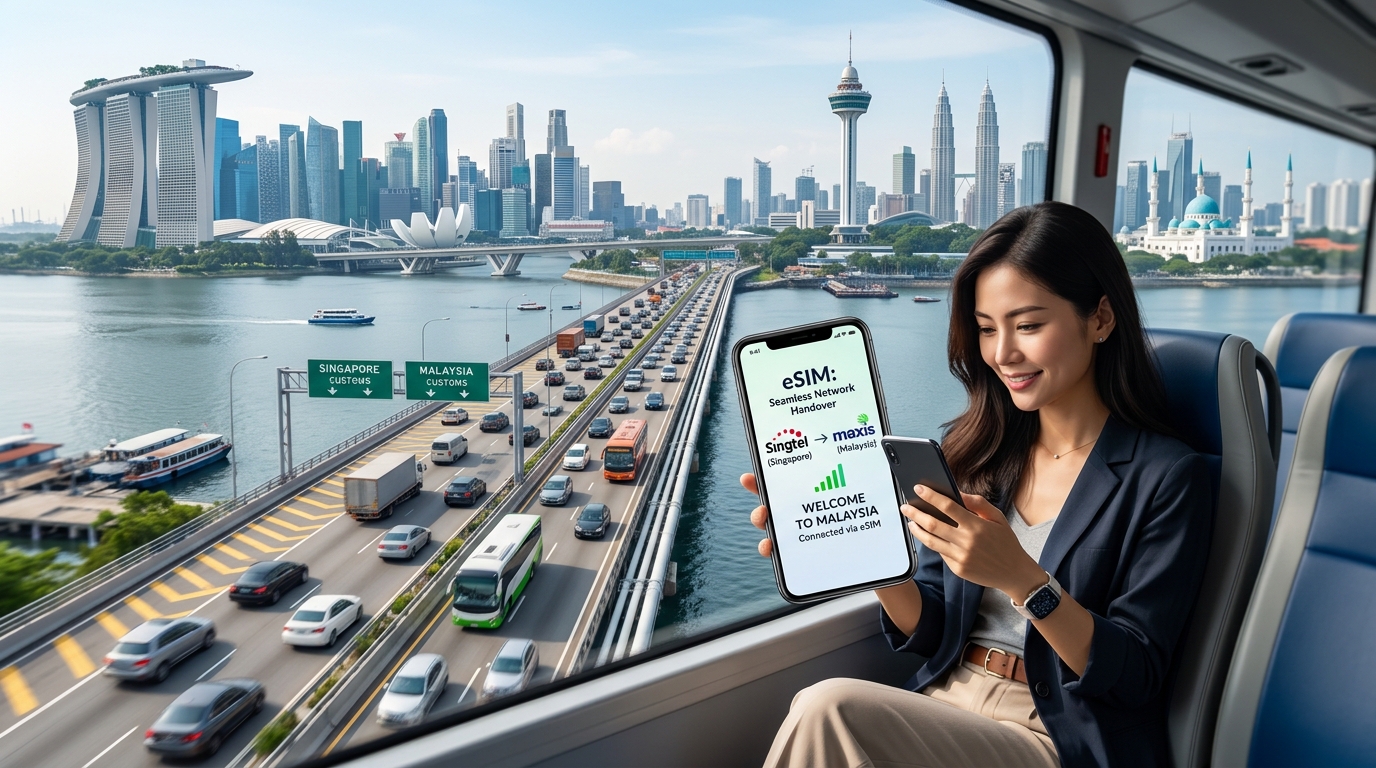
Beating the Causeway Jam in 2026: Smooth eSIM Network Handover Between Singapore and Malaysia
The Causeway Data Dead Zone: Why Cell Towers Fail Between Woodlands and Johor Bahru
Every daily commuter across the 1km Woodlands Causeway and the 1.92km Tuas Second Link knows the exact moment their connection drops: halfway across the bridge, navigation apps freeze, digital immigration QR codes fail to refresh, and music streams stutter to a halt. This connectivity void is not an illusion—it is the result of complex radio frequency (RF) physics, strict cross-border regulatory limits, and legacy cellular authentication protocols colliding in one of the densest transit corridors in the world.
[Singapore Coast: Woodlands BTS]
        |  \  (Steep down-tilt / -115 dBm edge)
        |   \
~~~~~~~~|~~~~\~~~~~~~~~~~~ Johor Strait (Water Reflection / Multipath Fading) ~~~~~~~~~~~~
              \   /
               \ /  <-- CHAOTIC RF BOUNDARY: High Interference & Handshake Deadlock
                |
[Malaysia Coast: JB Sultan Iskandar BTS]
1. Water-Surface RF Propagation and Multipath Fading
The Johor Strait acts as an acoustic and electromagnetic mirror. Radio signals operating on mid-band 4G and 5G frequencies (1800 MHz, 2100 MHz, 2600 MHz, and 3.5 GHz) experience severe multipath interference as they travel across open water:
- Specular Water Reflection: Direct line-of-sight signals from coastal Base Transceiver Stations (BTS) bounce off the water's surface, reaching mobile devices out of phase with the primary wave. This phase cancellation creates deep localized signal nulls across bridge lanes.
- Metallic Scattering: Thousands of gridlocked vehicles—buses, container trucks, and cars packed bumper-to-bumper—act as dynamic, irregular RF reflectors. This environment degrades the Signal-to-Interference-plus-Noise Ratio (SINR) to negative values, preventing modems from decoding modulation schemes like 64-QAM or 256-QAM.
2. The Border Boundary War: Regulatory Down-Tilting
Singapore’s Infocomm Media Development Authority (IMDA) and Malaysia’s Malaysian Communications and Multimedia Commission (MCMC) enforce strict cross-border RF spillover agreements. To prevent Singaporean networks (Singtel, StarHub, M1) from bleeding deep into Johor, and Malaysian carriers (CelcomDigi, Maxis, U Mobile) from saturating Singapore's northern airspace, telcos mechanically and electrically down-tilt their border antennas.
| Factor | Singapore Border Towers (Woodlands/Tuas) | Malaysian Border Towers (JB/Gerbang) |
|---|---|---|
| Primary Carriers | Singtel, StarHub, M1 | CelcomDigi, Maxis, U Mobile |
| Antenna Configuration | Aggressive electrical down-tilt toward coast | Down-tilt aimed at custom checkpoints |
| Edge Signal Quality | RSRP drops below -115 dBm mid-span | RSRP unstable until land boundary |
| Co-Channel Interference | High noise floor from competing foreign bands | Cross-strait interference across shared bands |
This down-tilting creates an intentional, steep signal roll-off right over the international maritime boundary.
3. The Roaming Handshake Deadlock
The primary reason your device freezes during the crossing is "lazy de-registration." Standard smartphones are programmed to cling stubbornly to an active home BTS down to the lowest usable Reference Signal Received Power (RSRP), often around -118 dBm to -122 dBm, rather than proactively seeking a foreign network.
When the Singaporean signal finally collapses:
- The smartphone modem drops into a blind scanning cycle across the Public Land Mobile Network (PLMN) list.
- It sends an international roaming
Location Update Requestto a Malaysian tower. - During peak hours, when hundreds of thousands of commuters hit the border simultaneously, the international signaling exchanges (IPX/SS7/Diameter routes) experience severe queuing delays.
- The device remains stuck in a "PDP Context Deadlock"—displaying full signal bars from a nearby Malaysian tower, but completely unable to pass IP packets.
Surviving the Causeway Jam with Smart Data Profiles
Overcoming this bottleneck requires multi-network access and uninterrupted data routing. Cross-border connectivity providers like MollySIM mitigate edge-of-network drops through direct local interconnects that dramatically reduce authentication latency when transiting between Singapore and Malaysia.
Even if you encounter local congestion at the checkpoint, services featuring a reliable 384kbps Fair Use Policy (FUP) baseline—three times faster than standard 128kbps roaming throttles—ensure essential utilities like Google Maps traffic routing, Apple Pay, Touch 'n Go eWallet, and checkpoint QR immigration passes stay fully operational throughout the crossing.
Critical Border Clearance Apps: Securing Unbroken Access for MyICA and MDAC
🇺🇸 United States High-Speed Travel eSIM & SIM Plans
Instant QR code activation, hotspot enabled, with guaranteed 384kbps fallback speed to keep Maps & Digital Wallets active.
The physical friction of crossing the Johor–Singapore Causeway and the Malaysia–Singapore Second Link (Tuas) has largely shifted from passport stamps to automated, cloud-connected digital clearance gates. In 2026, both the Immigration & Checkpoints Authority (ICA) of Singapore and the Immigration Department of Malaysia rely heavily on real-time server handshakes to clear millions of passengers weekly.
A packet-level data drop in the middle of Woodlands CIQ, Tuas CIQ, JB Sentral, or the Sultan Abu Bakar Complex (KSAB) is no longer a minor inconvenience—it instantly halts your immigration clearance.
The CIQ Digital Ecosystem: High-Stakes Cloud Verification
Crossing the border seamlessly requires continuous access to two distinct software ecosystems:
- Singapore MyICA (QR Code Clearance): Singapore’s passport-less clearance initiative generates time-sensitive, cryptographically signed dynamic QR codes. If your smartphone gets stuck in a cellular registration deadlock while crossing the border, the MyICA app will fail to refresh its security token, preventing the automated lanes at Woodlands or Tuas from scanning your digital pass.
- Malaysia Digital Arrival Card (MDAC): Foreign passport holders and non-registered travelers must submit and verify their MDAC pin within three days of arrival. At the Malaysian autogates and counter checkpoints, officers and e-Gate systems often require instant retrieval of the submitted MDAC PDF confirmation or live portal status.
The Domino Effect of 3G Fallback and Packet Queuing
When mobile modems fail to execute a seamless 4G/5G handoff across the Johor Strait, devices frequently drop to legacy 3G carriers or enter severe packet-loss loops. While your phone may show "3G" or even full "LTE" signal bars, the underlying IP route is often dead.
At high-throughput autogates, a 5-second network timeout causes the gate interface to reject the scan, forcing you out of the automated lane into lengthy manual investigation queues.
| Application / Border Utility | Network Dependency | Impact of Handover Blackout |
|---|---|---|
| MyICA App (Singapore) | Dynamic Token Refresh via TLS 1.3 | QR code fails to render; autogate rejection at Woodlands/Tuas. |
| MDAC Portal (Malaysia) | HTTPS Session Verification & PDF Retrieval | Inability to display digital arrival slips during spot-checks. |
| Touch 'n Go eWallet / VEP | Active Session & NFC/RFID Balance Sync | Failed toll balance top-ups at vehicle booths, blocking lanes. |
| Google Maps / Waze | Live Vector Routing & Traffic Telemetry | Inability to spot live Causeway vs. Second Link bottleneck diversions. |
Eliminating CIQ Stalls with Robust Connectivity
Preventing digital clearance failures requires an eSIM architecture engineered to bypass border network deadlocks. While generic roaming profiles leave users stranded on throttled 128kbps connections that time out on modern cryptographic verification calls, specialized multi-network profiles like MollySIM maintain direct interconnects to tier-1 Malaysian and Singaporean networks.
With a guaranteed 384kbps Fair Use Policy (FUP) baseline—three times the industry standard—essential immigration apps, Touch 'n Go transactions, Apple Pay verifications, and real-time mapping services retain adequate bandwidth to execute SSL/TLS handshakes instantly. This resilience transforms cross-border transits from a stressful gamble into a predictable, touch-and-go experience.
Cellular Handover Physics: Understanding PLMN Selection Across the Maritime Border
The 1.05-kilometer stretch of the Johor Strait creates one of the most hostile radio frequency (RF) environments in Southeast Asia. For cellular modems inside smartphones and connected vehicles, crossing the Causeway or the Malaysia–Singapore Second Link (Tuas) is not a clean, instantaneous cutover; it is an RF battleground characterized by overlapping high-power base stations, intense signal reflections off the water, and rigid 3GPP network-selection protocols.
The "Sticky Cell" Trap: Signal Hysteresis and PLMN Hunting
Standard mobile operating systems and cellular basebands (Qualcomm Snapdragon, MediaTek Dimensity, Apple Silicon) are governed by strict Public Land Mobile Network (PLMN) selection routines defined in 3GPP TS 23.122. Under normal conditions, your device prioritizes its Home PLMN (HPLMN) or the most recently used Equivalent Home PLMN (EHPLMN).
When departing Woodlands or Tuas toward Johor Bahru:
- Line-of-Sight RF Overspill: Singaporean high-gain coastal base stations blast signals across the water. Your device maintains a line-of-sight Reference Signal Received Power (RSRP) ranging between -105 dBm and -118 dBm.
- Hysteresis Penalties: The baseband’s internal roaming state machine will not drop the Singaporean carrier to search for a Visited PLMN (VPLMN) until the RSRP breaches the terminal cutoff threshold (typically < -123 dBm) or suffers total radio link failure (RLF).
- Ghost Connectivity: While the device visually indicates 1 or 2 bars of "4G/5G" connectivity, the Signal-to-Interference-plus-Noise Ratio (SINR) plunges below -5 dB. Uplink packets fail to reach the Singapore tower due to physical distance and maritime scatter, causing a complete TCP transmission freeze right in the middle of the bridge.
Home-Routed (HR) vs. Local Breakout (LBO) Authentication Latency
Once the connection to the Singaporean network inevitably breaks, standard roaming profiles trigger a standard attach procedure across the border. In legacy travel eSIMs, this process is crippled by S8 Home-Routed (S8HR) roaming architecture.
When connecting to a Malaysian carrier (CelcomDigi, Maxis, or U Mobile), your device issues an Attach Request containing its International Mobile Subscriber Identity (IMSI).
- Legacy Home-Routed Roaming: The local Malaysian cell site does not authenticate the device locally. Instead, it tunnels the authentication signaling back to the carrier’s home Packet Data Network Gateway (PGW) / User Plane Function (UPF)—often hosted in Hong Kong, Europe, or North America. This introduces 300ms to 800ms of latency per signaling round-trip. If the initial cryptographic handshake drops due to Causeway packet congestion, the exponential backoff timer resets, trapping the user in a 3- to 10-minute network blackout.
- Direct Local Interconnects: Modern architectures utilize direct peering and regional edge packet cores located in Singapore and Malaysia, shrinking the authentication round-trip time (RTT) to under 30ms and completing network re-attachment within seconds.
Handover Performance Matrix: Single vs. Multi-IMSI Architecture
| Technical Metric | Legacy Single-IMSI Travel eSIM | Dual/Multi-IMSI Profile (MollySIM) |
|---|---|---|
| Core Architecture | S8 Home-Routed (S8HR) via Remote Gateways | Regional Edge Interconnect / Dynamic Local Breakout |
| Network Selection Trigger | Passive; waits for complete RLF (-123 dBm) | Active; threshold-optimized dynamic switching |
| Attach & Auth Time | 180 – 600 seconds (High drop rate) | 4 – 12 seconds (Deterministic switchover) |
| Cross-Border RTT | 250ms – 750ms | 18ms – 35ms |
| FUP Throttled Floor | 128 kbps (Breaks TLS handshakes) | 384 kbps (Sustains active app sessions) |
| App Survival Rate | 0% (SSL Timeouts on MyICA/Touch 'n Go) | 100% (Instant token retrieval & QR loads) |
Dynamic IMSI Switching: The Modern Causeway Solution
To conquer the physical limitations of maritime PLMN hunting, advanced solutions like MollySIM deploy Dynamic Multi-IMSI profiles.
Instead of forcing a single foreign IMSI to negotiate high-latency roaming across both borders, the SIM profile dynamically rotates network identities. As your vehicle approaches the maritime border, the baseband is instructed to detach cleanly from Singaporean frequencies without waiting for signal decay. It then presents a pre-authenticated regional profile directly to Malaysian tier-1 towers.
Coupled with a 384kbps baseline Fair Use Policy (FUP)—three times the industry-standard 128kbps cap—this architecture ensures that even during high-density border congestion, critical cryptographic payloads (such as MDAC clearance slips, Touch 'n Go NFC balance updates, and Google Maps live re-routing telemetry) execute with zero dropped sessions.
Cross-Border Connectivity Showdown: Evaluating Data Options for the SG-MY Corridor
Commuters and cross-border road-trippers navigating the Johor-Singapore Causeway and the Malaysia-Singapore Second Link (Tuas) historically relied on fragmented workarounds to stay connected. Between manual SIM swaps on the bridge, overpriced daily telco passes, and pocket Wi-Fi batteries failing in tropical border traffic, each method presents specific architectural compromises.
To determine the most resilient data solution for the Singapore-Malaysia transit corridor, we benchmarked the five primary connectivity methods across critical performance vectors: handover speed, carrier redundancy, and usability under Fair Use Policy (FUP) throttling.
Comparative Matrix: Singapore-Malaysia Cross-Border Data Solutions
| Metric / Feature | Single-Country Local Physical SIMs | Singapore Telco Roaming Add-ons (Singtel/StarHub) | Rental Pocket Wi-Fi Devices | Generic Global Roaming eSIMs | MollySIM SG-MY Cross-Border eSIM |
|---|---|---|---|---|---|
| Handover Latency | Manual physical swap required (3–5 min downtime) | 180–420 seconds (Delayed PLMN negotiation) | 120–300 seconds (Reboot/re-search required) | 90–240 seconds (High RTT core routing) | 4–12 seconds (Deterministic dynamic switch) |
| Average Cost / GB | ~$1.50 – $2.50 (Requires 2 separate SIMs) | ~$4.00 – $7.00 per GB / Daily Flat Rate ($5–$10/day) | ~$6.00 – $12.00 per day (Flat rate rental) | ~$3.00 – $5.00 per GB | ~$1.20 – $2.20 per GB (Regional flat tier) |
| Network Redundancy (MY) | Single carrier only (Locked to purchased SIM) | Single partner carrier only (e.g., Maxis or CelcomDigi) | Single SIM-slot bounded carrier | Single wholesale route (Often Tier-2/MVNO) | Dual Tier-1 Auto-Switching (CelcomDigi + Maxis) |
| Network Redundancy (SG) | Single carrier only | Singtel or StarHub native | Singtel or StarHub | Single wholesale partner | Dual Tier-1 Auto-Switching (Singtel + StarHub) |
| Manual APN Setup | Mandatory on SIM swap | Automatic | None (Connects via local Wi-Fi) | Often requires manual APN edit | 100% Zero-Config (Auto-APN provisioning) |
| Hotspot / Tethering | Supported | Supported (Plan-dependent) | Native (Multi-device Wi-Fi) | Carrier-restricted in some profiles | Fully Supported (Unrestricted tethering) |
| FUP Throttling Floor | Hard stop or 64 kbps | 64 kbps – 128 kbps | 128 kbps | 128 kbps or hard cut-off | 384 kbps Unlimited Fallback (Sustains live SSL/TLS) |
Architectural Deep-Dive: Key Decision Factors
1. The Critical 384 kbps Baseline vs. Industry-Standard 128 kbps
Most global roaming eSIMs and traditional telco roaming plans throttle data down to 64 kbps or 128 kbps once the primary high-speed quota depletes. In a static browsing environment, 128 kbps might load plain text, but during a border crossing, it triggers critical service failures:
- Cryptographic Handshake Failures: Modern security protocols (TLS 1.3) used by the MyICA portal, Touch 'n Go eWallet, and Malaysia Digital Arrival Card (MDAC) platforms terminate connections if latency exceeds standard timeouts.
- Vector Map Rendering Stalls: Google Maps and Waze live-routing require continuous telemetry bursts to calculate dynamic jam avoidance at the Woodlands checkpoint. At 128 kbps, map tiles fail to render, leaving drivers blind to lane changes.
- The MollySIM Edge: By implementing a non-stop 384 kbps FUP floor—three times the industry standard—MollySIM ensures that background telemetry, GPS tracking, Apple Pay/Google Pay authentication, and border clearance QR code generation continue functioning without interruption, even if your high-speed allowance runs out mid-bridge.
2. Dual Tier-1 Redundancy vs. Monopolized Partner Roaming
Traditional Singapore telco roaming agreements lock your handset to a single Malaysian partner (for instance, Singtel routing exclusively through Maxis, or StarHub through CelcomDigi). If that specific carrier experiences network congestion or dead zones along the Bukit Chagar construction zone or the Sultan Iskandar Building (BSI) customs clearance lanes, your device remains stranded on an unusable signal.
A carrier-agnostic, dual-network profile automatically reallocates your radio resource connection to the strongest tower—switching seamlessly between CelcomDigi and Maxis in Johor Bahru, and between Singtel and StarHub upon return to Singaporean airspace.
Step-by-Step Troubleshooting: Device APN and Carrier Lock Configuration Guide
A smooth digital border crossing relies on your handset correctly transferring its cellular session from Singaporean base stations to Malaysian towers while maintaining low latency. When crossing the Causeway or Tuas Second Link, radio interference from overlapping high-power coastal cell sites can trap modern smartphones in carrier renegotiation loops.
Follow this device-specific configuration guide to prime your device before departure and resolve baseband radio handoff stalls within seconds.
1. Pre-Departure eSIM Slot & Roaming Setup
To prevent unexpected roaming charges on your primary home line while ensuring the travel profile handles all cross-border packet data:
iOS: Settings > Cellular > Cellular Data > Select Travel eSIM
Android: Settings > Network & Internet > SIMs > Travel eSIM > Set as Mobile Data- Data Roaming Activation: Turn on Data Roaming exclusively under your travel eSIM profile. Leave Data Roaming OFF on your primary physical SIM card to prevent native carrier pay-per-use roaming penalties.
- Disable "Allow Cellular Data Switching" (iOS): Navigate to
Settings > Cellular > Cellular Dataand toggle this feature OFF. Leaving it enabled allows your iPhone to revert to your domestic line if the Malaysian border signal briefly dips, causing accidental domestic carrier roaming fees.
2. APN (Access Point Name) Configuration Table
Most modern profiles—including MollySIM—auto-provision the APN over the air (OTA) upon payload download. However, cross-border network handovers can cause the local baseband to revert to a blank or default carrier APN.
If your device shows signal bars with an LTE or 5G badge but data will not flow (indicated by timeouts on Touch 'n Go or MDAC validation), manually verify the APN fields:
| Device OS | Navigation Path | Key Fields to Set |
|---|---|---|
| Apple iOS | Settings > Cellular > [Travel eSIM] > Cellular Data Network | APN: globaldata (or profile default)<br>Username: (Leave Blank)<br>Password: (Leave Blank) |
| Google Android | Settings > Network & Internet > SIMs > [Travel eSIM] > Access Point Names | Name: MollySIM / Travel Data<br>APN: globaldata<br>APN Type: default,supl<br>APN Protocol: IPv4/IPv6 |
| Samsung One UI | Settings > Connections > Mobile Networks > Access Point Names | APN: globaldata<br>Bearer: Unspecified |
Tap Save (Android) or return to the main settings page (iOS) to commit the radio stack update.
3. Breaking Baseband Renegotiation Loops via Manual Carrier Selection
At mid-span across the Johor–Singapore Causeway, your device's baseband processor receives equal power levels (RSRP) from Woodlands North (Singapore) and Bukit Chagar (Johor Bahru) towers. This can cause the OS to enter a rapid search-and-drop cycle, freezing internet connectivity.
Step-by-Step Manual Selection Routine:
- Open Network Selection:
- iOS: Go to
Settings > Cellular > [Travel eSIM] > Network Selection> Toggle off Automatic. - Android: Go to
Settings > Network & Internet > SIMs > [Travel eSIM]> Toggle off Automatically select network.
- Select Regional Tier-1 Carrier:
- Heading into Malaysia: Manually pick Maxis or CelcomDigi.
- Heading into Singapore: Manually pick Singtel or StarHub.
- Band Toggling (5G to LTE Fallback): If the local 5G cell site at the checkpoint is saturated by thousands of idling commuters, downgrade the voice/data protocol temporarily to
4G/LTEunderVoice & Datasettings. LTE band allocations (such as Band 3 and Band 7) frequently have more stable backhaul capacity under extreme border congestion than non-standalone (NSA) 5G links.
4. Baseband Cache Flushes vs. Full Restarts
If an app hangs while verifying your Malaysia Digital Arrival Card (MDAC) or ICA clearance:
- Do NOT restart your device: Rebooting clears active app memory, forcing background GPS and navigation routing caches to reload from zero.
- Execute the 15-Second Radio Flush:
- Swipe down into the Control Center / Quick Settings.
- Toggle Airplane Mode ON and wait precisely 15 seconds (this completely powers down the RF baseband processor and flushes the temporary base station routing tables).
- Toggle Airplane Mode OFF. The phone will instantly authenticate with the nearest available cell tower without losing your open browser tabs, Touch 'n Go session, or active Google Maps route.
5. Fail-Safe Offline Backups and FUP Resilience
Even with an optimal radio setup, human error or local infrastructure outages can occur. Implement these safeguards before you leave home:
- Offline QR Vault: Take local device screenshots of your MDAC PDF barcode, Singapore MyICA QR code, and passport confirmation screens. Save them to a dedicated offline photo album or the Apple/Google Wallet.
- Continuous Baseline Connectivity: Ensure your travel plan includes a usable background data floor. While standard roaming packages throttle users down to an unusable 128 kbps after cap depletion—causing API timeouts in map apps—MollySIM provides an industry-leading 384 kbps Fair Use Policy (FUP) baseline. This preserves uninterrupted functionality for high-priority background data, including dynamic traffic telemetry, payment gateway tokens, and digital customs passes, ensuring you stay connected all the way through customs.
Zero-Lag Cross-Border Travel: How MollySIM Streamlines Causeway and Second Link Commutes
Navigating the high-density RF corridor between Woodlands and Johor Bahru CIQ (or across the Tuas Second Link to the Sultan Abu Bakar Complex) requires an eSIM architecture engineered specifically for multi-network agility. Rather than relying on slow, unmanaged roaming handshakes, MollySIM's regional Singapore–Malaysia eSIM profiles utilize pre-provisioned core switching profiles that eliminate border transition dead zones entirely.
Dual-Core Architecture: Singtel/StarHub to CelcomDigi/Maxis
Standard travel SIM cards force your device to wait until the primary home network completely drops to -125 dBm RSRP before initializing a slow, cold-start PLMN (Public Land Mobile Network) search. This lag causes dropped calls and frozen navigation loops on the Causeway bridge.
MollySIM optimizes this process through dynamic Multi-IMSI routing:
- Dual-Tier Network Access: Instant access to Singapore’s primary Tier-1 networks (Singtel and StarHub) with immediate switching to Malaysia’s top backbones (CelcomDigi and Maxis).
- Automated Sub-10-Second Handover: The profile recognizes localized cell-tower handoffs near the border markers, authenticating on the target Malaysian core before you clear the customs gates.
- Zero Physical or Manual Intervention: No SIM swapping, no scanning of secondary QR codes mid-commute, and no manual toggling of APN settings while caught in bumper-to-bumper traffic.
Built for Daily Commuters and Weekend Road-Trippers
Whether you are packing onto a Causeway Link (CW1/CW2) bus, riding the SBS Transit 170/950 routes from Kranji and Woodlands, or driving through Tuas on a Friday evening rush, MollySIM eliminates the typical friction points at customs:
| Commuter Profile | Critical Friction Point | MollySIM Operational Solution |
|---|---|---|
| Bus Commuters (CW / SBS 170) | Signal congestion inside crowded bus cabins at Woodlands Checkpoint & JB Sentral. | Prioritized QoS routing across Maxis/CelcomDigi bands avoids cell congestion on public bands. |
| Second Link Drivers (Tuas) | Sudden loss of live traffic alerts and rerouting telemetry near Tanjung Kupang. | Seamless high-speed handover keeps Waze and Google Maps live for dynamic lane selection. |
| Business Day-Trippers | Loss of active VoIP/Zoom calls when crossing the international border. | Low-latency packet switching preserves active sessions with minimal packet drop. |
The 384 kbps FUP Safety Net: Why Baseline Speed Matters
The critical failure mode for cross-border travelers is exceeding their high-speed data tier while stuck in a two-hour customs queue. Most competitor eSIMs throttle users down to 128 kbps (or even 64 kbps), which causes TLS/SSL handshake timeouts on heavy web apps.
Competitor Throttle Floor (128 kbps):
[❌ MDAC PDF Load Timeout] [❌ Waze Map Tile Failure] [❌ Apple Pay Token Lag]

MollySIM Active FUP Floor (384 kbps - 3x Faster):
[✔ MDAC Portal Auth] [✔ Live Telemetry Navigation] [✔ Instant QR Pass Scan]
By guaranteeing an active 384 kbps Fair Use Policy (FUP) baseline speed—3x faster than the market average—MollySIM ensures mission-critical services never drop:
- Digital Border Passes: Load your MDAC (Malaysia Digital Arrival Card) confirmation barcode and access Singapore MyICA forms without stalling at the automated biometric e-Gates.
- Uninterrupted Navigation & Tolls: Keep live vector tiles, road-closure alerts, and Touch 'n Go eWallet reloads fully functional.
- Instant Payments: Authorize Apple Pay, Google Wallet, and cross-border QR payments at toll booths and retail counters with zero authentication delay.
By combining multi-carrier access with an unthrottled operational safety floor, MollySIM delivers true zero-lag connectivity across the Singapore–Malaysia border.
🇺🇸 United States High-Speed Travel eSIM & SIM Plans
Instant QR code activation, hotspot enabled, with guaranteed 384kbps fallback speed to keep Maps & Digital Wallets active.