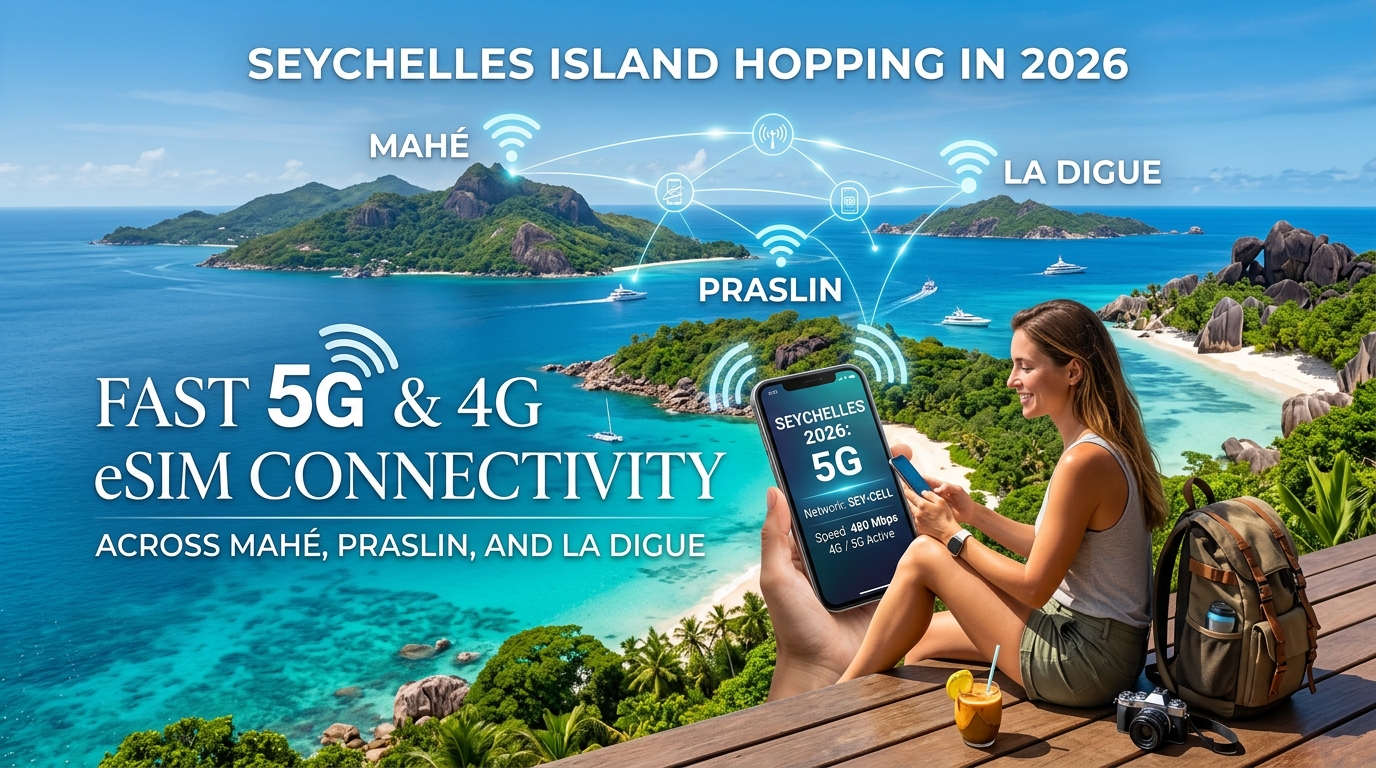
Seychelles Island Hopping in 2026: Fast 5G & 4G eSIM Connectivity Across Mahé, Praslin, and La Digue
The 2026 Seychelles Connectivity Landscape: Island Geography Meets 5G & 4G Networks
The Republic of Seychelles presents one of the most distinctive telecommunications environments in the Indian Ocean. Unlike coral atoll nations that are entirely flat, the primary inner islands—Mahé, Praslin, and La Digue—are the exposed peaks of the submerged Mascarene Plateau, formed from ancient, dense granite.
While this dramatic geology creates the archipelago’s world-famous vistas, it introduces severe physical obstacles for wireless signal propagation. Towering granitic massifs (such as Morne Seychellois, rising 905 meters above sea level), dense tropical cloud forests, and sheer rock faces routinely cause signal shadowing. Radio frequencies struggle to penetrate these interior granite barriers, meaning that while coastal ring roads enjoy strong line-of-sight cellular coverage, signal strength can drop abruptly as you ascend winding mountain passes or round isolated headlands.
The 5G vs. 4G Deployment Reality in 2026
Telecommunications modernization across the islands has accelerated rapidly, yet network architecture remains stratified based on local population density and tourist traffic:
- Mahé (Urban & Commercial Nodes): High-speed 5G connectivity is concentrated throughout the capital of Victoria, the residential marina enclave of Eden Island, Seychelles International Airport (SEZ) at Pointe Larue, and along the luxury resort belts of Beau Vallon. These pockets deliver gigabit-class low latency, perfect for streaming and remote operations.
- Mahé (Mountain Interiors & South Coast): Along roads like the Sans Souci Pass or near secluded southern bays (Anse Intendance, Police Bay), mobile radios drop back to robust 4G/LTE-Advanced carrier aggregation.
- Praslin & La Digue: 4G LTE is the operational standard across both islands. Cell towers clustered around Baie Sainte Anne, Grand Anse, and La Passe blanket the primary settlements and low-lying coastal paths. On La Digue—where transport is primarily bicycles and electric carts—cellular micro-sites hidden within palm canopies maintain uninterrupted 4G data along the western and northern coasts, though coverage tapers off around the remote southeastern coves (Anse Cocos).
- Maritime Transit Corridors: Fast ferries (Cat Cocos) and chartered catamarans traversing the 44-kilometer crossing between Mahé and Praslin retain coastal cellular signals for the first 15–20 minutes out of port before transitioning into intermittent offshore dead zones until approaching the opposite island.
| Island / Region | Primary Network Band | Real-World Speeds | Topography Challenge |
|---|---|---|---|
| Victoria & Eden Island (Mahé) | 5G (Sub-6GHz) | 350 – 850 Mbps | Urban multi-path reflection |
| Beau Vallon & Coastal Mahé | 4G LTE-A / 5G Pockets | 80 – 220 Mbps | Direct coastal line-of-sight |
| Morne Seychellois Interior | 4G LTE / 3G Fallback | 10 – 45 Mbps | Heavy jungle canopy & granite cliffs |
| Praslin (Grand Anse / Côte d'Or) | 4G LTE | 40 – 110 Mbps | Moderate low-elevation granite hills |
| La Digue (La Passe / Anse Source d'Argent) | 4G LTE | 30 – 85 Mbps | Dispersed micro-cells; dense flora |
| Open Water Ferry Corridors | 4G LTE (Fringe) / No Service | 0 – 15 Mbps | Curvature & open marine distances |
Real-Time Traveler Demands: Why Reliable Data Is Crucial
Navigating the Seychelles in 2026 demands continuous, dependable mobile connectivity. Modern travelers rely on cellular data far beyond basic social media posting:
- Precision Navigation: Winding single-track coastal routes and hairpin switchbacks across the mountainous interiors require live turn-by-turn GPS navigation to avoid hazardous mountain passes during sudden equatorial squalls.
- Maritime & Ferry Coordination: Real-time yacht tracking, mooring reservations, and monitoring schedule updates for inter-island catamarans rely on constant data pings.
- VIP Transfers & Excursions: High-end travel coordination—from booking private helicopter hops with Zil Air to organizing catamaran charters or messaging villa concierges via WhatsApp—happens dynamically on the move.
Because heavy media syncing, offline map caching, and video calls can exhaust high-speed data allowances unexpectedly, network continuity is non-negotiable. Travel eSIMs like MollySIM mitigate this risk with a 384kbps Fair Use Policy (FUP) fallback speed—three times the industry-standard 128kbps throttle. Even if you exceed your daily or total high-speed bucket while hiking the Copolia Trail or sailing between Praslin and Curieuse Island, critical services like Apple Pay, Google Maps route recalculations, and WhatsApp messaging continue to operate smoothly without leaving you stranded.
Carrier Showdown: Cable & Wireless Seychelles vs. Airtel Seychelles
🌐 Global Travel High-Speed Travel eSIM & SIM Plans
Instant QR code activation, hotspot enabled, with guaranteed 384kbps fallback speed to keep Maps & Digital Wallets active.
The telecommunications infrastructure of the Seychelles is operated primarily by two national mobile network operators (MNOs): Cable & Wireless Seychelles (CWS) and Airtel Seychelles. While both carriers have invested heavily in expanding 4G LTE-Advanced and mid-band 5G footprints, their deployment strategies, spectrum allocations, and physical base station placements lead to distinctly different field performance across the islands.
+--------------------------+------------------------------------------+------------------------------------------+
| Metric / Feature         | Cable & Wireless Seychelles (CWS)        | Airtel Seychelles                        |
+--------------------------+------------------------------------------+------------------------------------------+
| 5G Frequency Bands       | Band n78 (3.5 GHz), Band n28 (700 MHz)   | Band n78 (3.5 GHz)                       |
| 4G LTE Bands             | Band 3 (1800 MHz), Band 20 (800 MHz)     | Band 1 (2100 MHz), Band 3, Band 8 (900)  |
| Backhaul Infrastructure  | Subsea cable landing owner (SeyS/PEACE)  | Leased fiber backhaul & microwave links  |
| Peak Urban Speeds (5G)   | 450 – 750 Mbps (Victoria / Eden Island)  | 300 – 550 Mbps (Victoria / Beau Vallon)  |
| Outer Island Reach       | Silhouette, Bird Island, Denis Island    | Selected boutique resort coverage only   |
+--------------------------+------------------------------------------+------------------------------------------+
Spectrum Holdings and Tropical Foliage Penetration
The granitic islands of Mahé, Praslin, and La Digue present a challenging RF environment: vertical granite massifs draped in dense, high-humidity tropical rainforest.
- Cable & Wireless (CWS) maintains an advantage in sheer backhaul capacity and low-band deployment. By utilizing Band 20 (800 MHz) alongside its Band n28 (700 MHz) sub-GHz allocations, CWS signals penetrate through thick palm canopies and granite cliff faces more reliably than high-band alternatives. Their direct ownership of the subsea fiber landing stations guarantees lower latency to European and African servers.
- Airtel Seychelles relies heavily on dense microcell sites operating on Band 3 (1800 MHz) and Band 8 (900 MHz). In high-density coastal strips—such as Beau Vallon and the resort corridors of south Mahé—Airtel delivers symmetrical, low-jitter connections ideal for live streaming and video calls. However, as you travel up into the mist forests, Airtel's 1800 MHz mid-band suffers greater signal attenuation compared to CWS's sub-GHz layers.
Maritime Performance: Cat Cocos Inter-Island Ferry Routes
Offshore performance is a critical factor for travelers island-hopping across the archipelago:
- Mahé to Praslin (approx. 45 km crossing):
High-gain base stations situated on northern Mahé (Signal Hill) and southern Praslin (Mont Plaisir) provide clean line-of-sight (LOS) 4G coverage for the first 12 km out of Victoria and the last 15 km approaching Baie Sainte Anne. However, during the open-water mid-crossing—especially north of the Sainte Anne Marine National Park—both networks drop to edge/3G levels or experience periodic 10–15 minute signal voids.
- Praslin to La Digue (approx. 6 km crossing):
This short transfer between Baie Sainte Anne and La Passe offers near-continuous LTE coverage. Cell towers positioned on the slopes of Praslin easily illuminate the shallow channel, ensuring uninterrupted data for processing tickets, booking transfers, or messaging accommodation hosts.
Dead Zones and Granite Topography Gaps
Despite extensive coastal coverage, several geographic blind spots persist across the inner islands:
- Morne Seychellois National Park (Mahé): The rugged interior trails—including the lower ravines of the Mare aux Cochons and the deep valleys below Trois Frères—experience heavy signal degradation where high granite walls block line-of-sight transmission.
- Anse Major (Mahé): Tucked beneath sheer granite cliffs on the northwest coast, this secluded beach is a well-known dead zone where cellular signals often drop completely until you hike back up onto the ridge trail.
- Anse Georgette (Praslin): While nearby resorts maintain private DAS (Distributed Antenna Systems), the public access trail around the western headlands frequently drops cellular links.
- Anse Marron (La Digue): Shielded by massive boulder formations along the island's southern tip, this isolated bay has negligible cellular reception.
Because local physical SIM cards restrict you to a single carrier's footprint, falling into a carrier-specific dead zone can halt communications entirely. Travel eSIM solutions like MollySIM bypass this single-carrier vulnerability by roaming across top infrastructure routes. Furthermore, if you exhaust your primary data pool while navigating off-grid trails, MollySIM's 384kbps Fair Use Policy (FUP) speed limit ensures that mission-critical apps like Google Maps and Apple Pay remain fully operational—avoiding the complete connection lockouts typical of standard 128kbps throttles.
The Seychelles International Airport (SEZ) Reality Check: Physical Tourist SIMs vs. Instant eSIM Activation
Touching down at Seychelles International Airport (SEZ) on Mahé immediately introduces travelers to the islands' laid-back pace—a charm that quickly becomes a logistical hurdle inside the compact arrivals concourse at Pointe Larue. When wide-body long-haul flights from hubs like Dubai, Doha, or Addis Ababa land simultaneously, hundreds of passengers funnel into a non-air-conditioned or semi-open terminal corridor. For those relying on buying a local physical SIM card upon landing, this setup creates an immediate connectivity bottleneck.
The Inefficiencies of Airport Kiosks
Purchasing a physical prepaid tourist SIM card at SEZ involves several friction points that can derail your arrival schedule:
- Strict KYC Identity Registration: Under Seychellois telecommunications regulations, every SIM card must be registered against an official identity document. Kiosk attendants must manually photograph or scan your physical passport, input your personal data into a carrier portal, and submit the profile for network provisioning. During peak arrival banks, this administrative processing leads to queues exceeding 30 to 45 minutes.
- Delayed Network Activation: Even after completing the paperwork and paying at the counter, physical tourist SIM cards are rarely active immediately. Provisioning over the local cellular core network can take anywhere from 20 minutes to several hours, leaving you without navigation or communication while trying to coordinate taxi transfers or find your private villa driver.
- Airport Retail Markups and Currency Exchange Gouging: Kiosks at SEZ primarily market marked-up "Tourist Packs." Paying in foreign currencies (EUR or USD) results in unfavorable exchange rates, while paying by credit card often incurs foreign transaction surcharges or minimum spend thresholds.
- Hardware Fragility in Humid Conditions: Swapping out a nano-SIM tray on the go—often while balancing luggage in 85% relative humidity—creates a real risk of dropping, bending, or permanently losing your primary domestic SIM card.
Physical Tourist SIM vs. Digital eSIM at SEZ
| Feature / Metric | Physical Airport Tourist SIM (Airtel / C&W) | MollySIM Travel eSIM |
|---|---|---|
| Activation Point | Post-customs arrival kiosk counter | In-air / Instant on runway touchdown |
| Identity Verification (KYC) | Mandatory manual passport scan at counter | 100% digital pre-clearance |
| Queue Time | 20–45 minutes during flight banks | 0 minutes |
| Hardware Requirement | Physical nano-SIM swap & tray ejector tool | Software profile installed via QR code |
| Dual SIM / 2FA SMS Access | Disables primary line (single-SIM trays) | Keeps home number active for banking OTPs |
| Post-Data Throttle Speed | Hard cut-off or throttled to 64–128kbps | 384kbps Fair Use Policy (FUP) |
The Seamless Arrival: Pre-Configured Digital Connectivity
Opting for an eSIM completely eliminates airport terminal friction. By purchasing and installing your MollySIM digital eSIM profile before boarding your flight, your phone automatically handshakes with local cellular towers the moment the landing gear touches the SEZ runway.
┌────────────────────────────────────────────────────────┐
│  MollySIM 384kbps Fair Use Policy (FUP) Performance    │
├─────────────────────────┬──────────────────────────────┤
│ Google Maps Navigation  │  OPERATIONAL (Smooth vector) │
│ Apple Pay / Google Pay  │  OPERATIONAL (Instant token) │
│ WhatsApp Text Messaging │  OPERATIONAL (Real-time)     │
│ Standard 128kbps Cap    │  FREQUENT TIMEOUTS / FAILS   │
└─────────────────────────┴──────────────────────────────┘
Because your domestic physical SIM remains undisturbed in its slot, your phone functions in true Dual SIM, Dual Standby (DSDS) mode. This ensures you continue receiving essential two-factor authentication (2FA) SMS codes from your banking and credit card apps on your primary number, while all cellular data routes through your local eSIM profile.
Furthermore, if unexpected island-hopping data usage depletes your high-speed allowance before you can top up, MollySIM’s built-in 384kbps Fair Use Policy (FUP) speed limit provides a safety net that is three times faster than typical 128kbps throttles. This guarantees that turn-by-turn navigation on Google Maps, contactless Apple Pay/Google Pay authentications, and instant messaging stay operational without leaving you stranded at the terminal exit.
Comprehensive Connectivity Breakdown: Travel eSIM vs. Local Tourist SIMs vs. Pocket Wi-Fi vs. International Roaming
Navigating the granitic and coralline islands of the Seychelles archipelago requires a robust communication strategy. Between inter-island ferry transits, remote coastal trails, and fluctuating cell coverage between Mahé, Praslin, and La Digue, choosing the wrong connectivity channel can lead to dropped signals, dead hardware, or exorbitant billing.
The following comparative breakdown evaluates the four primary data methods across critical performance and logistical metrics:
| Evaluation Parameter | MollySIM Travel eSIM | Local Tourist Physical SIM (Airtel / CWS) | Pocket Wi-Fi Router Rental | Home Carrier International Roaming |
|---|---|---|---|---|
| Average Cost per GB | Low ($2.50 – $4.50 / GB) | Moderate ($4.00 – $7.00 / GB) | Very High ($9.00 – $15.00 / day base) | Extreme ($10.00 – $20.00 / MB or $15/day) |
| Deployment Time | Instant (Pre-install via QR / In-App) | 20–45 mins (Airport kiosk queues) | 15–30 mins (Pickup & return logistics) | Instant (Requires manual network toggle) |
| KYC / Passport ID Mandate | None (Fully digital onboarding) | Mandatory (Physical passport scan + photo) | Mandatory (Credit card deposit + ID) | None (Tied to home account) |
| Multi-Island Dynamic Handshake | Automatic (Multi-network tier integration) | Locked to single carrier network | Single SIM slot (Carrier locked) | Network dependent (Often throttled 3G tier) |
| Personal Hotspot / Tethering | Fully Supported (No throttle) | Supported (Plan dependent) | Native function (Multi-device) | Carrier-restricted or extra surcharge |
| Zero-Data Safety Net | 384kbps Uncapped FUP (Active maps/pay) | Hard cut-off at 0 MB | Hard cut-off or shut down on battery drain | Hard cut-off or 64–128kbps throttle |
| Hardware Portability | Zero footprint (Embedded chip) | Physical swap (Tray ejector required) | Heavy puck + external power bank | Zero footprint |
The Hardware Dilemma: Why Pocket Wi-Fi Fails on La Digue and Praslin
While portable Wi-Fi pucks are popular across East Asia, they introduce severe operational friction in the Indian Ocean. La Digue is virtually devoid of cars; transportation relies almost entirely on bicycles traversing uneven, unpaved sand paths near Grand Anse and Anse Source d'Argent.
- Thermal Stress & Battery Degradation: Ambient temperatures in the Seychelles regularly hover between 29°C and 32°C with humidity exceeding 80%. Pocket Wi-Fi units running concurrent LTE radios and Wi-Fi transceivers generate substantial internal heat. In tropical conditions, their lithium-ion cells degrade rapidly, often dropping from an advertised 10-hour battery life to under 3.5 hours.
- Mechanical Ingress & Physical Burden: Carrying an additional 200g hardware puck alongside dedicated charging cables and power banks increases clutter in beach dry-bags. Exposure to abrasive silica sand and salt spray frequently fouls USB-C charging ports and power switches.
With a digital profile from MollySIM, your connectivity engine resides directly within your device’s internal logic board, drawing nominal power from your phone's battery without mechanical failure points.
International Roaming Traps: Maritime Handshakes and Tier-4 Surcharges
Relying on standard roaming from domestic carriers (such as AT&T, Verizon, Vodafone, or EE) in the Seychelles is fraught with economic risk:
- Tier-4 Country Categorization: Major Western carriers classify the Seychelles in their highest international tariff tiers. "Daily Pass" options frequently limit high-speed allocation to 500MB per 24-hour cycle before dropping users to an unusable 64kbps or 128kbps connection.
- Accidental Maritime Tower Latching: During the 60-minute Cat Cocos ferry crossing between Victoria Harbor (Mahé) and Baie Sainte Anne (Praslin), handsets searching for terrestrial towers can inadvertently latch onto satellite-based maritime cells operating on marine vessels. Unregulated maritime data rates regularly exceed $12.00 to $20.00 per megabyte, resulting in hundreds of dollars in automated background overages before docking.
- The 384kbps Advantage vs. Roaming Throttles: If a local data balance runs dry during an excursion to Curieuse Island, traditional roaming drops to a degraded 128kbps state that causes TLS handshake timeouts on banking apps. In contrast, MollySIM’s built-in 384kbps Fair Use Policy (FUP) maintains a reliable downstream pipe, ensuring vector map tiles load without latency and NFC payment tokens clear terminal handshakes instantly.
Local Physical SIMs: The Bureaucratic Bottleneck at SEZ
Purchasing an Airtel or Cable & Wireless Seychelles (CWS) plastic tourist card at Seychelles International Airport (SEZ) presents its own challenges. Long international flight banks (Emirates, Qatar Airways, Ethiopian Airlines) arriving simultaneously produce massive queues at the small arrivals concourse kiosks.
Under local Department of Information Communications Technology (DICT) regulations, foreign nationals must undergo mandatory Know-Your-Customer (KYC) registration, requiring manual passport scans, physical visa validation, and live paperwork entry. If your flight arrives outside standard retail operating hours or during weekend public holidays, these kiosks are frequently unstaffed, leaving travelers without connectivity for the initial taxi transit to their resort.
Island-by-Island Field Guide: Signal Performance from Mahé's Coast to La Digue's Granite Coves
The granitic inner islands of Seychelles present a unique radio frequency (RF) challenge. Massive granite massifs, dense rainforest canopies, and narrow coastal strips create significant signal shadowing. Understanding where coverage peaks—and where terrain attenuation degrades performance—is critical for smooth navigation and remote work.
+------------------+-----------------------+---------------------+-------------------------+
| Island / Region  | Target Area           | Expected Tech / Gen | Typical Download Speed  |
+------------------+-----------------------+---------------------+-------------------------+
| Mahé (North)     | Victoria, Beau Vallon | 5G / LTE-Advanced   | 85 – 220 Mbps           |
| Mahé (South)     | Anse Intendance       | 4G LTE (1-2 Bars)   | 8 – 25 Mbps             |
| Praslin          | Côte d'Or, Grand Anse | 4G LTE              | 35 – 75 Mbps            |
| Praslin (Canopy) | Vallée de Mai         | 3G / Low-band LTE   | 2 – 10 Mbps             |
| La Digue (West)  | La Passe, Source d'Ag | 4G LTE              | 25 – 60 Mbps            |
| La Digue (South) | Anse Marron (Trail)   | Intermittent / None | 0 – 5 Mbps (Shadowed)   |
+------------------+-----------------------+---------------------+-------------------------+
Mahé: Urban Speeds vs. Deep South Granite Shadowing
- Victoria & Eden Island Marina: As the administrative and commercial hub, Victoria features dense microcell deployment. Eden Island delivers persistent 5G and high-capacity LTE-Advanced (averaging 120–210 Mbps down). This makes it the ideal anchorage for clearing digital work queues, backing up RAW photography to the cloud, or conducting high-definition video calls before heading out to sea.
- Beau Vallon & Northern Peninsula: The resort strip along Beau Vallon enjoys uninterrupted, high-band line-of-sight from transmission towers along the northern ridge, delivering consistent 70–110 Mbps throughput right up to the tide line.
- The Southern Coves (Anse Intendance, Police Bay, Baie Lazare): Moving south past Anse Royale, the terrain shifts abruptly. The colossal granite bluffs flanking Anse Intendance and Police Bay block direct inland line-of-sight. While ridge-mounted cell towers push low-band 4G into these pockets, signal strength frequently hovers around 1 to 2 bars. At sea level, transmission speeds drop to 8–18 Mbps.
Praslin: Beach Corridors vs. Dense Forest Canopy
- Côte d’Or (Anse Volbert) & Grand Anse: Praslin’s primary tourism strips benefit from unobstructed coastal cell propagation. Both beachfronts offer dependable 40–80 Mbps LTE connectivity, allowing easy spot-booking of boat transfers and instant restaurant payments.
- Vallée de Mai UNESCO World Heritage Site: The multi-layered canopy of giant endemic Coco de Mer palms creates extreme RF path loss and signal absorption. Expect your device to step down from 4G LTE to low-band 3G or single-bar LTE along the deeper central trails. Vector-based navigation cached in advance is essential here, as downloading map assets under the dense foliage will suffer high latency.
La Digue: Flat Bicycle Tracks to the Isolated Coves of Anse Marron
- La Passe to Anse Source d’Argent: Navigating the flat western coastal path via bicycle offers unbroken line-of-sight to the main tower infrastructure near the La Passe helipad and L'Union Estate. Throughput remains steady at 30–60 Mbps, providing plenty of bandwidth for live 4K social streams among the famous coastal boulders.
- The Wild East (Grand Anse, Petite Anse, Anse Cocos): Once you cross the central ridge toward the eastern littoral, signal penetration drops quickly. While Grand Anse receives bounced coastal coverage (15–30 Mbps), Anse Cocos sits in a partial signal shadow where handoffs between towers can cause brief connection drops.
- The Anse Marron Bouldering Route: Navigating the technical boulder maze around the southern tip to Anse Marron involves deep granite fissures that completely sever RF line-of-sight. Your smartphone will spend extended stretches searching for signal.
Islet Day Charters: Curieuse, Cousin, and St. Pierre
When taking day catamarans out to Curieuse Island, Cousin Nature Reserve, or snorkeling off St. Pierre islet, you remain within coastal line-of-sight of Praslin’s northern and western sector antennas:
- Curieuse Island (Baie Laraie & Anse José): Excellent 4G propagation across the narrow channel from Anse Volbert provides 25–50 Mbps coverage, even while walking among the free-roaming giant tortoises.
- St. Pierre Islet: Clean line-of-sight to Côte d'Or antennas delivers stable coverage directly onto your boat deck.
- Cousin Island: Strict eco-reserve rules prohibit land towers, but incoming signals across the water from Grand Anse keep basic messaging and data pipelines fully operational.
To avoid expensive maritime network overrides while cruising these channels, locking your cellular profile to a land-based data provider is critical. Using a travel-optimized eSIM from MollySIM prevents maritime roaming charges while keeping offshore connections intact.
Furthermore, if your primary high-speed data tier runs out while anchored off Curieuse, MollySIM’s built-in 384kbps Fair Use Policy (FUP) speed limit keeps you connected. Unlike the standard 128kbps throttling enforced by conventional carriers—which stalls map loading and causes TLS timeouts on payment processors—a 384kbps throughput keeps Apple Pay, Google Maps vector routing, and instant messaging running without interruption.
Optimizing Your Seychelles eSIM: Setup, Dual-SIM Management, and MollySIM's 384kbps Fallback Advantage
Transitioning smoothly between remote anchorages in the Sainte Anne Marine National Park and the mountainous interior of Mahé requires a properly configured device. Modern smartphones handle dual-SIM setups with ease, but minor misconfigurations can lead to accidental domestic roaming charges or dropped authentication tokens.
Here is how to configure your hardware for flawless connectivity across the archipelago.
Step-by-Step Installation: Pre-Departure vs. Arrival
To ensure immediate data access when touching down at Seychelles International Airport (SEZ), complete the provisioning process before boarding your international flight.
On Apple iOS (iPhone XS and newer):
- At Home (via Wi-Fi): Navigate to
Settings>Cellular(orMobile Service) >Add eSIM. - Select Use QR Code and scan the digital voucher provided by MollySIM.
- Assign a custom label to the new profile (e.g., MollySIM Seychelles).
- Set your domestic SIM as the default line for voice and SMS, but do not turn on data roaming yet.
- Upon Landing at SEZ: Open
Settings>Cellular>Cellular Dataand select MollySIM. Toggle Data Roaming to ON under the MollySIM profile.
On Google Android (Samsung Galaxy, Google Pixel, etc.):
- At Home (via Wi-Fi): Go to
Settings>Connections(orNetwork & Internet) >SIM manager>Add eSIM. - Scan your activation QR code and confirm the download.
- Label the profile MollySIM.
- Upon Landing at SEZ: Set Primary SIM for Mobile Data to MollySIM. Navigate to
Mobile Networksand ensure Data Roaming is enabled for the eSIM slot while keeping roaming disabled on your primary domestic physical SIM.
Dual-SIM Architecture: Keeping 2FA Active Without Incurring Roaming Fees
Island hopping often involves online payments for catamaran charters, national park entrance permits, and ferry tickets—all of which trigger two-factor authentication (2FA) SMS codes from your bank.
To receive incoming verification texts without paying exorbitant international data rates to your home carrier, organize your dual-SIM settings as follows:
| Setting Category | Recommended Configuration | Operational Purpose |
|---|---|---|
| Cellular Data Line | MollySIM | Routes 100% of web traffic, maps, and apps through local high-speed infrastructure. |
| Default Voice/SMS Line | Primary Domestic SIM | Receives inbound 2FA SMS and banking security prompts (typically free to receive globally). |
| Allow Cellular Data Switching | DISABLED / OFF | Prevents your phone from silently using domestic data if island topography momentarily drops local signal. |
| WhatsApp Account | Keep Existing Number | Keeps your contact identity intact without re-registering on local networks. |
Critical iPhone Setting: Always verify that
Allow Cellular Data Switchingis toggled OFF. If left enabled, your device will automatically fail over to your domestic carrier’s roaming pipeline whenever an island headland momentarily blocks line-of-sight to the nearest tower, triggering unexpected carrier day-passes.
The Safety Net: Why MollySIM’s 384kbps Fallback Outperforms Conventional Roaming
Most prepaid travel eSIMs enforce a hard disconnect or throttle bandwidth to 64kbps–128kbps once your high-speed quota depletes. In real-world travel scenarios, a 128kbps pipe is practically unusable: transport-layer security (TLS) handshakes time out, banking portals crash during checkout, and vector map tiles fail to render.
Standard Travel eSIM (128kbps Throttling)
├── Google Maps: ❌ Tile Load Timeouts
├── Banking / Apple Pay: ❌ TLS Handshake Failures
└── WhatsApp: ⚠️ Text Only (Media/Voice Calls Fail)

MollySIM Unlimited Fallback (384kbps Fair Use Policy)
├── Google Maps: ✅ Smooth Vector Routing & GPS Caching
├── Banking / Apple Pay: ✅ Rapid Token Handshake
└── WhatsApp: ✅ Crystal-Clear VoIP Voice Calls & Text
MollySIM’s 384kbps Fair Use Policy (FUP) provides 3x the baseline throughput of standard competitors. This ensures essential digital utilities remain active even if you exceed your allocated high-speed data while trekking the Morne Blanc trail or sailing past Anse Source d'Argent:
- Uninterrupted Navigation: Google Maps and Apple Maps can stream turn-by-turn vector data, calculate reroutes, and update traffic telemetry without connection resets.
- Resilient Financial Transactions: TLS/SSL encryption certificates for banking apps and contactless mobile payments complete their handshake within regular timeout limits.
- Essential Communications: WhatsApp, Signal, and iMessage sustain reliable text delivery, image compression downloads, and clear low-bitrate VoIP voice calls.
By combining local high-speed 5G/4G connectivity with a guaranteed 384kbps floor, MollySIM guarantees that no matter where you drop anchor in the Seychelles, you are never stranded without a working data link.
🌐 Global Travel High-Speed Travel eSIM & SIM Plans
Instant QR code activation, hotspot enabled, with guaranteed 384kbps fallback speed to keep Maps & Digital Wallets active.