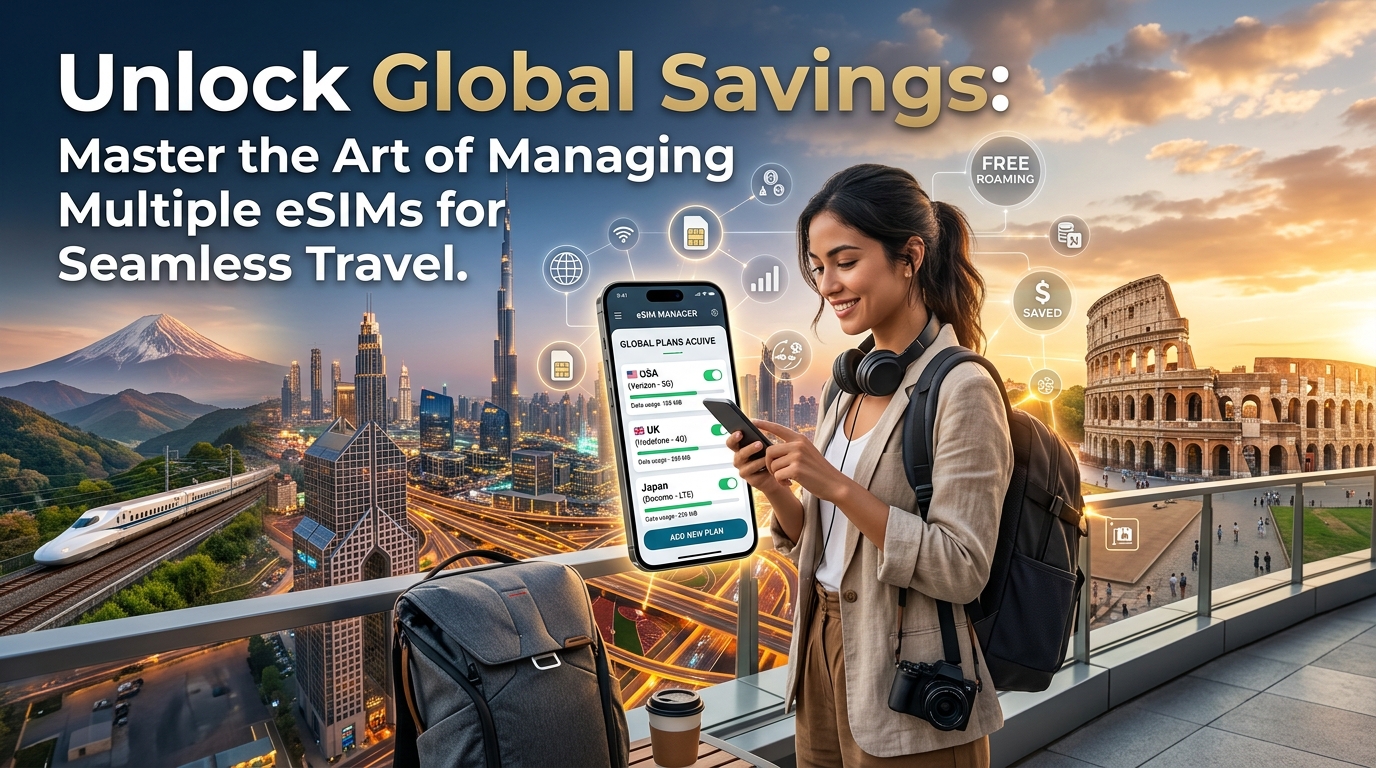
Unlock Global Savings: Master the Art of Managing Multiple eSIMs for Seamless Travel
The New Frontier of Travel Connectivity: Why Multiple eSIMs Are Your Secret Weapon
The journey of mobile connectivity for travelers has seen remarkable evolution, mirroring the rapid pace of technological advancement. For decades, international travel meant grappling with the logistical nightmare of physical SIM cards: hunting down local providers, fumbling with tiny trays and pins, and often sacrificing your home number for the duration of a trip. The advent of the eSIM (embedded SIM) was a game-changer, liberating travelers from physical constraints. Suddenly, activating a local data plan was as simple as scanning a QR code, allowing for instant connectivity in a new country without ever touching a SIM tray. This single eSIM approach brought unprecedented convenience, making it a staple for many modern globetrotters.
However, for the truly experienced traveler, the digital nomad, or anyone whose livelihood depends on uninterrupted, optimized global connectivity, relying solely on a single eSIM, while revolutionary, often falls short. It's akin to having a single tool in a complex toolkit – effective for basic tasks, but inadequate for intricate challenges.
The Cracks in the Single-eSIM Armor
While a single eSIM offers significant advantages over its physical predecessor, its inherent limitations become apparent under the demands of extensive international travel:
- Lack of Redundancy: A single point of failure is a critical vulnerability. If your sole eSIM provider experiences network issues in a particular region, or if your plan unexpectedly runs out, you're left without connectivity. This can be more than an inconvenience; it can be a safety concern or a significant disruption to work.
- Suboptimal Cost Efficiency: While a single global or regional eSIM might seem cost-effective initially, it rarely offers the absolute best rates across all territories. Specific local eSIMs or specialized regional plans often provide superior value for heavy data users in their respective zones. Relying on one provider for every country can lead to paying a premium in certain areas where cheaper, more efficient alternatives exist.
- Inability to Maintain a Home Number: Many travelers need to keep their primary phone number active for banking, two-factor authentication, or staying in touch with family and clients. A single eSIM setup often forces a compromise: either pay exorbitant roaming fees for your home number or temporarily lose access to it, creating logistical hurdles and potential security risks.
- Performance Bottlenecks: A single global eSIM might offer decent speeds, but it might not always be optimized for specific local network conditions or offer the highest possible speeds consistently. For tasks requiring high bandwidth or low latency, this can be a noticeable drawback.
Embracing the Multi-eSIM Strategy: A Paradigm Shift
This is where the strategic management of multiple eSIMs emerges as the new frontier of travel connectivity. It's not just about having data; it's about orchestrating a sophisticated, resilient, and cost-optimized connectivity ecosystem. This approach transforms travel from a potential connectivity challenge into a seamless, always-on experience.
Unparalleled Flexibility and Cost Optimization
A multi-eSIM setup grants travelers unparalleled control. Imagine having:
- A primary, reliable global data eSIM: This acts as your always-on backbone, providing consistent connectivity across numerous countries. For instance, a provider like MollySIM (https://mollysim.com) excels here, offering a robust global data plan with a generous 384kbps Fair Use Policy speed limit. This is a critical advantage, being 3x faster than many competitors' 128kbps limits, ensuring essential applications like Google Maps, Apple Pay, and messaging apps work smoothly and responsively, even under fair use conditions. This allows you to navigate, pay, and communicate without frustrating lag.
- Dedicated local eSIMs for specific regions: When you land in a country where you anticipate heavy data usage or a long stay, you can activate a hyper-local eSIM for superior speeds and significantly lower per-GB costs. This allows you to offload high-bandwidth activities from your global plan, saving money and ensuring peak performance where it matters most.
- A separate eSIM for your home number: By keeping your primary SIM (physical or eSIM) active on a minimal plan, you can receive calls and texts for critical services without incurring high data roaming charges, seamlessly integrating your home life with your travels.
Robust Redundancy and Seamless Continuity
With multiple eSIMs, you build a robust safety net. If your primary data eSIM experiences an outage or runs low, you can instantly switch to a backup global eSIM or a pre-loaded local eSIM. This eliminates downtime, ensuring you're always connected, whether for urgent work, navigation in an unfamiliar city, or simply staying in touch with loved ones. This level of redundancy is invaluable for peace of mind and operational continuity, making unexpected connectivity issues a relic of the past.
The shift required here is profound: from merely 'having data' to 'strategically managing connectivity assets'. It's about viewing your eSIMs not as isolated plans, but as a dynamic portfolio of connectivity options, each serving a specific purpose. This advanced strategy is tailor-made for experienced travelers, digital nomads, remote workers, and anyone who demands the highest levels of reliability, flexibility, and cost-effectiveness from their mobile connectivity. Their pain points – unexpected disconnections, exorbitant roaming bills, and the constant hunt for Wi-Fi – are precisely what a well-orchestrated multi-eSIM strategy solves, transforming their global journeys into truly seamless adventures.
Crafting Your Multi-eSIM Strategy: Scenarios for Savvy Travelers & Digital Nomads
🌐 Global Travel High-Speed Travel eSIM & SIM Plans
Instant QR code activation, hotspot enabled, with guaranteed 384kbps fallback speed to keep Maps & Digital Wallets active.
Moving beyond the theoretical, let's explore practical, real-world applications where a well-orchestrated multi-eSIM strategy delivers unparalleled advantages for the modern global traveler. These scenarios highlight how MollySIM's flexible offerings integrate seamlessly into advanced connectivity setups, optimizing both cost and reliability.
Home eSIM + Regional MollySIM for Data
This is a foundational strategy for many frequent travelers. The core idea is to maintain your primary phone number for essential calls, SMS, and critical two-factor authentication (2FA) while dedicating a separate eSIM for all your data needs abroad.
Scenario: Imagine a traveler from the United States embarking on a two-week trip across Europe. Their existing US carrier plan offers international roaming, but at exorbitant per-MB rates. Implementation:
- Keep Home Number Active: The traveler keeps their existing US physical SIM or eSIM active on their device. They might switch it to a minimal, pay-as-you-go plan or simply disable data roaming for this line. This ensures they can still receive urgent calls from family, bank alerts, or 2FA codes without incurring high data charges.
- Activate Regional Data eSIM: Simultaneously, they activate a MollySIM Europe eSIM. This regional plan provides high-speed data across numerous European countries at a fraction of the cost of traditional roaming.
Benefit: This setup guarantees continuous access to their home number for crucial communications while enjoying affordable, high-speed data for navigation, streaming, social media, and work across an entire continent. No more swapping physical SIMs or hunting for local stores.
Multi-Continent Trip with Different Regional MollySIMs
For the truly global adventurer or the digital nomad with a complex itinerary, managing multiple regional eSIMs is the pinnacle of cost optimization and performance.
Scenario: A remote worker plans a three-month journey: one month in Southeast Asia, followed by six weeks in Europe, and concluding with three weeks in South America. Implementation:
- Asia Leg: Before departing for Thailand, they activate a MollySIM Asia eSIM, covering their data needs across the region.
- Europe Transition: As they prepare to leave Asia for Europe, they can either deactivate the MollySIM Asia (if their trip is truly over) or simply switch their primary data line to a newly activated MollySIM Europe eSIM.
- Americas Leg: Upon arrival in Brazil, they activate a MollySIM Americas eSIM, ensuring local speeds and competitive rates for their final leg.
Benefit: This approach ensures the traveler is always on a plan optimized for their current region, avoiding the higher costs or potentially slower speeds of a single global plan that might not be ideal everywhere. Each MollySIM is tailored to provide the best local experience.
Dedicated Country MollySIM for Longer Stays
While regional eSIMs offer fantastic flexibility, extended stays in a single country can often benefit from a more localized approach.
Scenario: A digital nomad decides to spend three months working from Mexico City. Implementation: Instead of relying solely on a broader 'MollySIM Americas' plan for the entire duration, they might opt for a dedicated MollySIM Mexico eSIM. Benefit: A country-specific MollySIM can sometimes offer more generous data allowances, potentially better local network prioritization, or even more competitive pricing for prolonged use within that specific nation compared to a multi-country regional plan. This ensures maximum data for their extended stay without compromise.
The Ultimate Backup Strategy: Global MollySIM with 384kbps FUP
Even the most meticulously planned connectivity strategy needs a safety net. A low-cost, global MollySIM with its unique Fair Use Policy (FUP) speed limit serves as an invaluable, always-on backup.
Scenario: You're in a new city, your primary regional data eSIM unexpectedly runs out of data, or experiences a temporary network outage. You urgently need to access Google Maps for directions, book a ride-share, or send an important message. Implementation: You have a MollySIM Global eSIM pre-loaded and active on your device, perhaps with a minimal data package or even just as a fallback. When your primary data fails, you simply switch your device's primary data line to the MollySIM Global. Benefit: MollySIM's global plans come with an industry-leading 384kbps FUP speed limit, which is three times faster than competitors' typical 128kbps. This crucial difference means that even on the FUP speed, you can reliably use essential services:
- Google Maps/Apple Maps: Navigate smoothly without frustrating delays.
- WhatsApp/iMessage: Send and receive messages, even small media files.
- Email: Check and send urgent emails.
- Apple Pay/Google Pay: Conduct transactions seamlessly.
This ensures continuous basic connectivity, transforming potential panic into a minor inconvenience and providing unparalleled peace of mind.
Comparative Multi-eSIM Strategy Table
| Strategy | Cost Efficiency | Flexibility | Redundancy/Backup | Ideal For | MollySIM Integration |
|---|---|---|---|---|---|
| Single Global eSIM | Moderate | Good | Basic | Short, multi-country trips | Primary data |
| Home SIM + Regional MollySIM | High | Good | Basic | Frequent regional travel, maintaining home number | Regional data |
| Multiple Regional MollySIMs | Very High | Excellent | Robust | Multi-continent nomads, complex itineraries | Regional data |
| Dedicated Country MollySIM | Very High | Good | Basic | Extended stays (1+ month) in one country | Primary data |
| Local SIM + Backup MollySIM | High | Excellent | Robust | Any traveler prioritizing reliability & safety | Backup data |
Each strategy leverages MollySIM's strengths, from its cost-effective regional plans to its robust global backup capabilities. By understanding these scenarios, travelers can move beyond basic connectivity to a truly strategic management of their mobile life, ensuring seamless, affordable, and reliable access wherever their journeys take them.
Mastering Your Device: Step-by-Step Guide to eSIM Switching & Management
Effectively managing multiple eSIMs is the cornerstone of unlocking global savings and ensuring uninterrupted connectivity. While the concept might seem complex, modern smartphones are designed with intuitive interfaces to make switching and prioritizing your connections straightforward. Mastering your device's eSIM settings will empower you to seamlessly transition between your home plan, a regional MollySIM, or a dedicated country eSIM, always optimizing for cost and performance.
iPhone (iOS) eSIM Management
Apple's iOS provides a robust and user-friendly interface for managing multiple cellular plans.
- Access Cellular Settings: Navigate to Settings > Cellular (or Mobile Data in some regions).
- View Cellular Plans: Under the "Cellular Plans" section, you'll see a list of all active and stored eSIM profiles, alongside your physical SIM (if present).
- Labeling eSIMs: Tap on each eSIM to rename it for easy identification. For instance, label your primary line as 'Home', a regional plan as 'MollySIM Europe', or a specific country plan as 'MollySIM Japan'. This clarity is crucial when juggling multiple profiles.
- Set Primary Line for Calls/SMS: Go back to the main Cellular settings and tap on Default Voice Line. Here, you can choose which line is used for outgoing calls and messages by default. You can also opt for 'Use Primary' or 'Use Secondary' for specific contacts, or 'Ask Every Time'.
- Choose Cellular Data Line: Tap on Cellular Data. Select the eSIM you wish to use for internet connectivity. For example, when traveling through Europe, you'd select your 'MollySIM Europe' profile to leverage its cost-effective regional data.
- Allow Cellular Data Switching: Below your chosen Cellular Data line, you'll find the "Allow Cellular Data Switching" toggle. When enabled, your iPhone can automatically switch to your other cellular plan if your primary data line has no service or poor signal. While convenient, be cautious with this feature if your secondary line has expensive roaming charges. For MollySIM users, this can be a safe backup, knowing MollySIM's Fair Use Policy (FUP) speed of 384kbps is 3x faster than competitors, ensuring basic functionality like Google Maps or Apple Pay even if you hit the FUP limit.
- Quick Switching: To quickly switch your data line, you don't always need to dive deep into settings. Sometimes, a quick tap on the "Cellular Data" option in the main Cellular settings is enough to bring up the selection menu.
Samsung Galaxy (Android) eSIM Management
Samsung Galaxy devices offer comprehensive eSIM management through their SIM card manager.
- Access SIM Card Manager: Go to Settings > Connections > SIM card manager.
- Activate/Deactivate eSIMs: Here, you'll see a list of your physical SIM and all downloaded eSIMs. You can toggle individual eSIMs on or off as needed. Deactivating an eSIM temporarily disables it without removing it, perfect for managing multiple regional MollySIMs without clutter.
- Rename eSIMs: Tap on an eSIM profile to access its settings, where you can rename it to something descriptive like 'Home', 'MollySIM USA', or 'Backup Data'.
- Set Preferred SIMs: At the top of the SIM card manager, you can set your Preferred SIM for:
- Calls: Choose which SIM is used for outgoing calls by default, or select 'Ask every time'.
- Messages: Designate a primary SIM for SMS/MMS.
- Mobile data: Select the eSIM you want to use for internet access. This is where you'd switch to your active MollySIM plan when abroad.
- Unique Samsung Features: Samsung often provides a clear visual indicator of which SIM is active for data directly in the quick settings panel, allowing for rapid confirmation.
Google Pixel (Android) eSIM Management
Google Pixel devices, known for their clean Android experience, offer a streamlined approach to eSIM management.
- Access SIM Settings: Navigate to Settings > Network & internet > SIMs.
- View and Manage eSIMs: This section lists all active and stored SIM profiles. You can see which eSIM is currently active for calls, SMS, and data.
- Activate/Deactivate: Tap on an eSIM to access its individual settings. Here, you can toggle the eSIM on or off.
- Rename eSIMs: Within the individual eSIM settings, you'll find an option to rename the profile for better organization (e.g., 'MollySIM Asia', 'Work Line').
- Prioritize Data: Back in the main 'SIMs' screen, you can select which eSIM is used for Mobile data. Simply tap on the desired eSIM to make it your active data connection. Pixel's interface makes it easy to visually confirm your active data plan.
- Call & SMS Preferences: Similar to other Android devices, you can set your preferred SIM for Calls and SMS messages from this screen, choosing a default or opting to be asked each time.
Advanced eSIM Management: Hacks & Best Practices
Beyond basic switching, these tips will elevate your multi-eSIM experience.
Quick Switching Shortcuts
- Android Quick Settings: Many Android devices (Samsung, Pixel, and others) allow you to add a "Mobile data" or "SIM" tile to your Quick Settings panel (accessed by swiping down from the top of the screen). Tapping this tile often presents a quick menu to switch your active data eSIM without diving into full settings. Check your device's "Edit" or "Button order" option in the Quick Settings to customize.
- iOS Control Center (Limited): While iOS doesn't offer a direct eSIM switch in Control Center, ensuring "Allow Cellular Data Switching" is configured correctly can provide a semi-automatic solution.
Proactive Data Usage Monitoring
- Per-eSIM Tracking: Both iOS and Android allow you to monitor data usage for individual cellular plans.
- iOS: Go to Settings > Cellular. Scroll down to "Cellular Data Usage" and you'll see usage broken down by app. To reset statistics for a new billing cycle or travel period, scroll to the bottom and tap "Reset Statistics." Remember, this resets for all plans. For more granular tracking, some eSIM providers like MollySIM offer in-app usage tracking.
- Android (Samsung/Pixel): Navigate to Settings > Network & internet > Internet (Pixel) or Settings > Connections > Data usage (Samsung). You can often select the specific SIM/eSIM to view its data consumption over a chosen period. This is crucial for staying within your MollySIM plan limits and avoiding unexpected FUP speed reductions, though MollySIM's 384kbps FUP speed is significantly more usable than competitors' 128kbps for essential services.
- Set Data Warnings/Limits: Configure data warnings or hard limits within your device settings for each eSIM. This proactive measure prevents accidental overages, especially useful for plans with strict data caps.
Strategic Data Roaming Settings
- Understand Roaming: Data roaming allows your device to connect to cellular networks outside your home network. When using a regional MollySIM, you are not roaming; you are using a local network as intended by the eSIM.
- Turn Off Roaming for Home SIM: When traveling internationally and using a MollySIM for data, ensure Data Roaming is OFF for your home SIM. This prevents your home carrier from incurring expensive roaming charges if your device accidentally tries to use it for data.
- iOS: Settings > Cellular > [Your Home SIM] > Data Roaming (toggle off).
- Android: Settings > Network & internet > SIMs > [Your Home SIM] > Roaming (toggle off).
- MollySIM and Roaming: For MollySIM profiles, data roaming is typically on by default and necessary for the eSIM to connect to partner networks in different countries within its regional coverage. Do not turn off roaming for your MollySIM unless specifically instructed by support.
Troubleshooting Common eSIM Issues
- 'No Service' After Switching:
- Restart Device: A simple restart often resolves temporary network glitches.
- Check eSIM Status: Ensure the desired eSIM is active and enabled in your device settings.
- Network Selection: Sometimes, manually selecting a network operator (Settings > Cellular/Network & internet > Network Selection > Turn off Automatic > Choose a network) can help, especially in areas with multiple carriers.
- APN Settings: Verify that the Access Point Name (APN) settings are correct for your eSIM. MollySIM typically configures this automatically, but manual entry might be needed in rare cases (usually found in the eSIM details or provider's support page).
- eSIM Not Activating:
- Stable Internet Connection: eSIM activation requires a stable internet connection (Wi-Fi is best) during the initial setup. Ensure you're connected before attempting to add an eSIM.
- QR Code/Manual Entry: Double-check that the QR code was scanned correctly or that manual details were entered without typos.
- Provider Support: If issues persist, contact MollySIM support (or your eSIM provider) with your order details.
- Incorrect Data Usage Reporting:
- Device vs. Provider: Your device's data usage tracker might differ slightly from your eSIM provider's portal due to varying measurement methods or refresh rates. Always prioritize the usage reported by your MollySIM app or web portal for the most accurate billing information.
- Reset Statistics: If your device's tracker seems stuck, try resetting its cellular data statistics.
MollySIM at the Core: Integrating Flexible Plans for Uninterrupted Journeys
While mastering multiple eSIMs provides unparalleled control over your global connectivity, a robust primary or complementary provider is essential to anchor your strategy. This is where MollySIM (https://mollysim.com) emerges as a pivotal player, offering a suite of flexible, cost-effective, and seamlessly integrated eSIM plans designed to enhance and secure your travel experience, regardless of your destination or data demands. By strategically incorporating MollySIM into your multi-eSIM portfolio, you gain a reliable foundation that complements other regional or specialized eSIMs, ensuring you're always connected.
Tailored Connectivity: Flexible Plans for Every Traveler
MollySIM understands that no two journeys are alike, and connectivity needs vary wildly. Their extensive portfolio of regional and country-specific eSIM plans is meticulously crafted to cater to a diverse spectrum of travel durations and data requirements. Whether you're embarking on a whirlwind weekend city break requiring minimal data, navigating a month-long backpacking adventure across a continent, or settling in as a digital nomad for an extended stay, MollySIM offers a plan that perfectly fits. From compact data packages ideal for short, focused trips to generous allowances suited for heavy data users and long-term explorers, the inherent flexibility ensures you're never overpaying for unused data nor scrambling for more mid-trip. This granular approach allows travelers to precisely match their connectivity to their itinerary, optimizing both budget and convenience within their multi-eSIM framework.
Unbeatable Value: Cost-Effectiveness Beyond Roaming
The traditional alternatives to eSIMs—exorbitant international roaming charges and the perpetual hunt for local physical SIM cards—are fraught with hidden costs and profound inconveniences. MollySIM directly addresses these pain points, presenting a superior value proposition. Compared to the often-astronomical rates charged by home network providers for international roaming, MollySIM's plans offer significant savings, transforming unpredictable bills into clear, upfront costs. Furthermore, the logistical nightmare of repeatedly purchasing, registering, and installing new physical SIM cards in every new country is entirely eliminated. This not only saves precious travel time but also mitigates the risk of language barriers, currency exchange fluctuations, and potential security concerns associated with local vendors. MollySIM provides a predictable, budget-friendly, and hassle-free solution that integrates perfectly into a sophisticated multi-eSIM setup, allowing you to allocate your travel budget to experiences, not inflated connectivity.
Effortless Integration: Seamless Setup for Multi-eSIM Users
One of the cornerstones of an effective multi-eSIM strategy is the ease with which new profiles can be added, activated, and managed. MollySIM excels in this regard, ensuring that integrating their eSIMs into your device is a straightforward and intuitive process. Activation typically involves a simple QR code scan or manual entry of details, seamlessly adding the MollySIM profile alongside your existing eSIMs. The user-friendly interface of modern smartphones allows for quick switching between active eSIMs, making MollySIM an effortless addition to your digital travel toolkit. This seamless integration means less time fumbling with settings and more time enjoying your journey, confident that your connectivity options are always at your fingertips.
The 384kbps FUP: A Game-Changing Connectivity Lifeline
This is where MollySIM truly distinguishes itself and becomes an indispensable component of any multi-eSIM strategy: its Fair Usage Policy (FUP), which guarantees a continuous, albeit throttled, connection at 384kbps across all its plans, even after your high-speed data allowance has been exhausted. This isn't merely a feature; it's a fundamental guarantee of uninterrupted basic connectivity, providing unparalleled peace of mind.
What 384kbps Means in Practical Terms:
To put 384kbps into perspective, consider its real-world utility for a traveler—it's far more functional than typical throttled speeds:
- Essential Communication: You can reliably send and receive messages via WhatsApp, iMessage, and other messaging apps, ensuring you stay in touch with family, friends, or travel companions.
- Email Access: Checking and sending emails, including attachments, remains perfectly functional for critical communications.
- Navigation: Crucially, navigation apps like Google Maps and Apple Maps work smoothly. This is a lifesaver when you're lost in an unfamiliar city, need directions to your accommodation, or are trying to find the nearest train station. Unlike slower FUP speeds (often 128kbps from competitors), 384kbps provides enough bandwidth for maps to load quickly and directions to update in real-time.
- Light Web Browsing: You can perform basic web searches, check public transport schedules, review restaurant menus, or access travel information without significant frustration.
- Payment Services: Services like Apple Pay or Google Pay, which often require a brief data connection for verification, will function reliably.
Unparalleled Peace of Mind: Never Truly Offline
The significance of this 384kbps FUP cannot be overstated. In a multi-eSIM setup, where you might be juggling different plans for different regions or purposes, the MollySIM FUP acts as an ultimate safety net. It ensures that you are never truly offline, even if your primary high-speed data on any of your active eSIMs runs out, or if you encounter an unexpected connectivity issue with another provider. This continuous basic connection is a crucial backup layer, transforming potential moments of panic into minor inconveniences.
Imagine scenarios where this FUP is a lifesaver:
- Emergency Situations: Needing to contact emergency services, look up embassy information, or reach out to family when high-speed data is depleted.
- Getting Stranded: Your bus is delayed, or you miss a connection, and you need to quickly rebook flights or find alternative accommodation using navigation and messaging apps.
- Navigating After Data Exhaustion: You've had a busy day using data for photos and social media, and suddenly realize you're out of high-speed data just as you need to navigate back to your hotel in a foreign city. MollySIM's 384kbps ensures your maps keep working.
This robust FUP speed is a stark contrast to many competitors who offer significantly slower FUP speeds, often around 128kbps. At 384kbps, MollySIM provides a connection that is 3x faster, making a tangible difference in usability, particularly for critical applications like Google Maps or Apple Pay. It's a testament to MollySIM's commitment to uninterrupted connectivity, positioning it as a unique selling proposition that delivers unparalleled reliability and peace of mind for the discerning global traveler. By integrating MollySIM into your multi-eSIM strategy, you gain not just data, but a fundamental guarantee against being disconnected when it matters most.
Advanced Multi-eSIM Hacks & Troubleshooting for Digital Nomads
For the seasoned digital nomad or the truly advanced global traveler, managing multiple eSIMs transcends basic activation; it becomes an art form of strategic optimization and proactive problem-solving. This section delves into niche tips, sophisticated strategies, and solutions to complex challenges, ensuring your connectivity is not just reliable, but intelligently managed.
Optimizing eSIMs for Specific Tasks
The true power of multi-eSIM management lies in assigning roles to each profile. Instead of simply having multiple data plans, consider how each eSIM can serve a distinct purpose, maximizing efficiency and cost-effectiveness.
- The 'Always-On' Baseline (e.g., MollySIM): Dedicate one eSIM as your foundational, low-cost 'always-on' line. This is where a provider like MollySIM shines. With its robust 384kbps Fair Use Policy (FUP) speed, which is 3x faster than many competitors' 128kbps, MollySIM ensures essential connectivity even after high-speed data is exhausted. This line becomes your reliable backbone for:
- Essential Communication: Messaging apps (WhatsApp, Telegram), email synchronization, and light web browsing.
- Navigation & Payments: Critically, 384kbps is sufficient for Google Maps or Apple Pay to function smoothly, preventing you from getting lost or stranded.
- Background Tasks: Small app updates, weather checks, and basic smart home device connectivity.
- High-Bandwidth Workhorse: For heavy data tasks like video conferencing, large file uploads/downloads, streaming high-definition content, or online gaming, activate a separate eSIM with a substantial high-speed data allowance, ideally a local plan in your current country for optimal speeds and latency.
- Regional Roamer: Keep a third eSIM for specific regions or continents where you travel frequently, offering competitive rates for short stays without needing a new local SIM every time.
By segmenting your data usage, you prevent your primary, high-speed plans from being depleted by background tasks or minor navigation needs, reserving them for when peak performance is truly required.
Data Offloading & Wi-Fi Assist Strategies
Minimizing cellular data consumption across all active eSIMs is paramount. Leveraging Wi-Fi whenever possible is the most effective strategy.
- Proactive Wi-Fi Usage: Make it a habit to connect to Wi-Fi for all non-urgent, data-intensive tasks: downloading offline maps, updating apps, syncing cloud storage, backing up photos, and streaming video. Do this before leaving your accommodation or while at cafes with reliable Wi-Fi.
- iOS Wi-Fi Assist: This feature automatically switches to cellular data when your Wi-Fi connection is poor. While useful, it can inadvertently consume data on your active eSIM. To manage it, navigate to
Settings > Cellular(orMobile Data) and scroll to the very bottom to toggleWi-Fi Assiston or off. For strict data conservation, consider turning it off or being mindful of its activity. - Android Intelligent Wi-Fi/Adaptive Wi-Fi: Android devices offer similar features that intelligently manage Wi-Fi and cellular data. Look for
Intelligent Wi-FiorAdaptive Wi-Fiin yourSettings > Network & internet > Wi-Fisection. These features can optimize network switching, but like iOS, monitor their data usage if you're on a tight budget. Some Android phones also allow you to disable mobile data for specific apps when on Wi-Fi.
Security & Privacy Considerations
Juggling multiple eSIM profiles means interacting with various network providers across different jurisdictions, each with its own security and privacy implications.
- Virtual Private Networks (VPNs): Always use a reputable VPN, especially when connected to public Wi-Fi networks (airports, cafes, hotels). A VPN encrypts your internet traffic, protecting your sensitive data from potential eavesdropping or man-in-the-middle attacks. Choose a VPN provider with a strict no-logs policy and servers in locations relevant to your travel.
- Public Wi-Fi Vigilance: Never conduct sensitive transactions (online banking, logging into financial accounts) over unsecured public Wi-Fi, even with a VPN, if you can avoid it. If you must, ensure the website uses HTTPS (look for the padlock icon).
- Understanding Carrier Privacy Policies: Different carriers in different countries have varying data retention and privacy policies. Be aware of what data is collected, how it's used, and whether it's shared with third parties. For maximum privacy, consider using an eSIM from a provider known for strong privacy practices.
- Device Security: Maintain strong device passcodes, enable biometric authentication, and keep your operating system and apps updated to patch known vulnerabilities.
When to Delete vs. Deactivate an eSIM
Managing your eSIM profiles effectively involves knowing when to temporarily disable a profile versus permanently removing it.
- Deactivate (Turn Off):
- Purpose: Temporary cessation of use. The profile remains stored on your device, ready for quick reactivation.
- When to Use: When you plan to return to a specific country or region in the near future, or if you have a multi-country plan you're not currently using but will need again. This saves you the hassle of re-downloading the profile.
- Benefit: Instant re-activation, preserves settings.
- Delete (Remove Permanently):
- Purpose: Permanent removal of the eSIM profile from your device.
- When to Use: When you have no intention of using that specific plan or carrier again, or if you're experiencing issues with a 'ghost' profile. Deleting frees up minimal device storage and declutters your eSIM management interface.
- Consideration: This action is irreversible. If you need the plan again, you'll have to go through the entire activation process (scanning a new QR code or manual entry).
Troubleshooting Advanced Scenarios
Even the most meticulously managed multi-eSIM setup can encounter glitches. Here's how to tackle more complex issues:
- 'Ghost' eSIM Profiles: Sometimes, an eSIM profile might appear in your settings but is unresponsive, cannot be activated, or won't delete.
- Diagnostic Steps:
- Restart Device: Often, a simple reboot can clear temporary software glitches.
- Check Carrier Settings: Ensure your device's carrier settings are up to date (
Settings > General > Abouton iOS; check for system updates on Android). - Manual Removal: Attempt to delete the profile again. If it persists, contact your device manufacturer's support or the eSIM provider.
- Conflicts Between eSIMs: Your device might struggle to prioritize or switch between active eSIMs, leading to intermittent connectivity or slow speeds.
- Diagnostic Steps:
- Manually Select Preferred Line: In your cellular settings, explicitly choose which eSIM should be used for data, calls, and messages.
- Disable Unused Lines: Temporarily turn off any eSIMs you are not actively using to reduce potential conflicts.
- Check APN Settings: Ensure the Access Point Name (APN) settings for each active eSIM are correct as provided by the carrier.
- Software Update: Ensure your device's operating system is fully updated.
- Problems from Frequent Switching: Rapidly switching between eSIMs can sometimes confuse your device's network registration, leading to temporary loss of service.
- Diagnostic Steps:
- Allow Time to Register: After switching, give your device 30-60 seconds to fully register with the new network.
- Restart if Persistent: If service doesn't resume, a quick restart often resolves the issue.
- Avoid Rapid Toggling: Try to minimize rapid, successive switches between profiles.
Leveraging the MollySIM FUP Proactively
Beyond its role as a safety net, MollySIM's 384kbps FUP can be a powerful proactive tool for budget-conscious digital nomads. This speed, being 3x faster than the common 128kbps offered by competitors, makes it genuinely usable for critical applications.
- Default 'Low-Power' Mode: Configure MollySIM as your primary data line for non-critical periods. For instance, during a travel day where you're mostly in transit, set MollySIM as your default. Its 384kbps speed is perfectly adequate for background app updates, checking emails, light social media, and crucially, keeping Google Maps or Apple Pay functional without consuming your high-speed data from other, more expensive plans.
- Intentional FUP Usage for Savings: For extended stays in a location, you might intentionally use MollySIM's FUP for a portion of the day or week to conserve your high-speed data allowance on another eSIM. This allows you to stretch your high-speed data further, saving money in the long run.
- Background App Management: Many apps consume data in the background. By routing these through MollySIM's FUP, you ensure essential updates and notifications come through without impacting your premium data.
- Uninterrupted Navigation: Even if you've exhausted your high-speed data on all other plans, MollySIM's FUP ensures you can always navigate back to your hotel, find a restaurant, or look up public transport schedules. This isn't just a backup; it's a reliable, always-on utility that prevents common travel frustrations.
By integrating MollySIM's robust FUP into your multi-eSIM strategy, you gain not just a safety net, but a versatile tool for intelligent data management, ensuring uninterrupted connectivity and peace of mind, no matter where your travels take you.
The Future is Flexible: Embracing eSIM Mastery for Limitless Travel
The journey through mastering multiple eSIMs culminates in a profound realization: the future of travel connectivity isn't just about staying online; it's about achieving unprecedented control, flexibility, and financial efficiency. For the seasoned traveler, the digital nomad, or anyone seeking to transcend the limitations of traditional roaming, embracing a multi-eSIM strategy is no longer a luxury but a fundamental skill. We've explored the intricate dance of primary and secondary lines, the strategic leveraging of Fair Use Policies, and the sheer convenience of instant activation. The sum of these parts is a travel experience defined by seamless connectivity, significant cost savings, and unparalleled peace of mind.
The Pillars of eSIM Mastery: Freedom, Savings, and Reliability
At its core, mastering multiple eSIMs liberates you from the archaic constraints of physical SIM cards and exorbitant roaming charges. Imagine landing in a new country and instantly switching to a local data plan, tailored precisely to your needs, all from your device's settings. This is the freedom that eSIMs provide – the freedom to choose, to adapt, and to always remain connected on your terms, without the hassle of hunting for local SIM cards or dealing with language barriers.
Beyond convenience, the financial advantages are immense. By strategically combining plans – perhaps a high-speed regional eSIM for intensive work, a local data-only eSIM for daily browsing, and a global backup like MollySIM – you craft a personalized data ecosystem that minimizes expenditure. This intelligent allocation of resources means you're paying only for what you need, when you need it, avoiding the "one-size-fits-all" trap of traditional providers. The ability to leverage a robust Fair Use Policy, as offered by MollySIM, further amplifies these cost savings, allowing you to stretch your high-speed allowances and always have a functional connection for essentials, making every byte count.
Finally, the multi-eSIM approach delivers robust connectivity. It's a strategy built on redundancy. Should one plan falter due to network issues or data exhaustion, another is ready to take its place instantly. This layered defense against connectivity blackouts ensures that critical navigation, communication, and payment services remain operational, transforming potential travel frustrations into minor inconveniences. It’s about building a resilient digital infrastructure that travels with you.
The Evolving Landscape of eSIM Technology
The current capabilities of eSIMs are just the beginning. The technology is rapidly evolving, promising even greater integration and user control. We can anticipate a future where:
- Wider Device Integration: eSIMs will become standard across an even broader range of devices, from smartwatches and laptops to IoT travel gadgets, creating a truly interconnected travel ecosystem.
- AI-Powered Optimization: Intelligent systems might automatically switch between eSIMs based on real-time factors like location, signal strength, and even your predicted data usage patterns, optimizing both performance and cost without manual intervention.
- Seamless Global Roaming Agreements: The backend infrastructure will likely become even more streamlined, leading to an even wider array of competitive, hyper-localized plans available instantly upon arrival in any destination.
- Enhanced Security Features: As eSIMs become more prevalent, expect advancements in security protocols and identity verification methods to protect your digital footprint and privacy on the go.
This trajectory underscores the importance of becoming proficient in eSIM management now. It's an investment in future-proofing your travel experience, ensuring you remain at the forefront of global connectivity.
MollySIM: Your Anchor in the Flexible Future
In this dynamic landscape, services like MollySIM play a crucial role as foundational enablers. MollySIM isn't just another eSIM provider; it's a strategic component designed to offer unwavering reliability and peace of mind. Its consistent 384kbps Fair Use Policy (FUP) across all plans stands out, offering a speed that is 3x faster than many competitors' 128kbps FUP. This seemingly small difference is monumental in practice: it means your Google Maps will load smoothly for navigation, Apple Pay transactions will process without a hitch, and essential communication apps will remain functional, even when your high-speed data is depleted. MollySIM ensures you're never truly disconnected, providing a vital safety net that underpins your entire multi-eSIM strategy. It's the silent workhorse, guaranteeing that your essential digital lifeline remains intact, no matter the circumstances or how remote your adventures take you.
Embrace the Future: Your Call to Action
The era of restrictive, expensive travel connectivity is over. The power to dictate your global connection is now firmly in your hands. By mastering the art of managing multiple eSIMs, you unlock a world of limitless travel possibilities, characterized by unparalleled freedom, significant savings, and robust, always-on connectivity.
Don't just travel; travel smarter. Begin building your personalized multi-eSIM strategy today. Explore the flexible and reliable plans offered by MollySIM at https://mollysim.com to secure your essential backup and experience the true potential of seamless, cost-effective global travel. The future is flexible, and with eSIM mastery, you are ready to embrace it.
🌐 Global Travel High-Speed Travel eSIM & SIM Plans
Instant QR code activation, hotspot enabled, with guaranteed 384kbps fallback speed to keep Maps & Digital Wallets active.