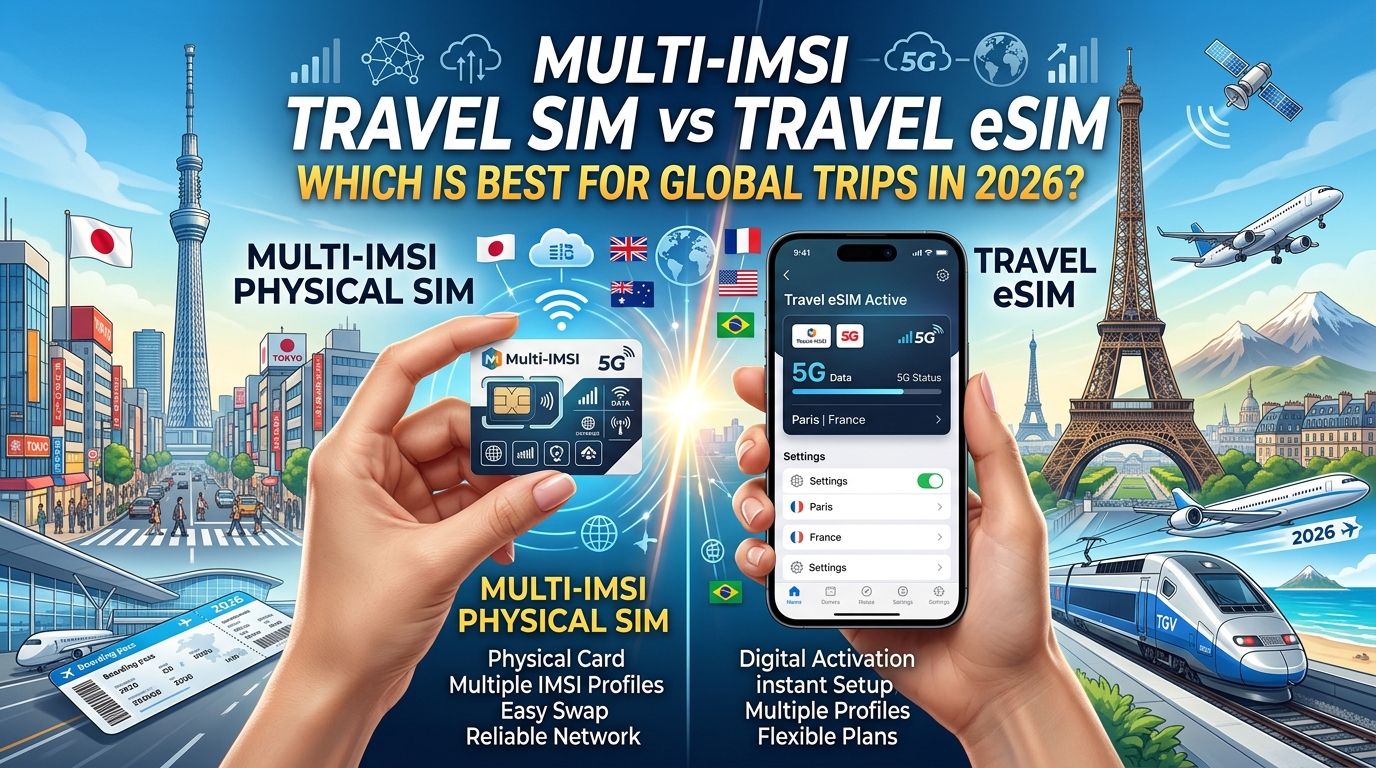
Multi-IMSI Physical Travel SIM vs Travel eSIM: Which Is Best for Global Trips in 2026?
Architectural Breakdown: Multi-IMSI Physical SIMs vs. GSMA Remote SIM Provisioning (RSP)
To understand why international roaming technology has shifted dramatically, one must examine the underlying hardware protocols and baseband interactions governing how mobile devices authenticate across borders. Both Multi-IMSI physical cards and modern travel eSIMs solve the same fundamental problem—avoiding exorbitant legacy roaming fees—but their mechanical and cryptographic architectures are fundamentally distinct.
The Legacy Approach: Multi-IMSI Physical SIMs and STK Scripting
A traditional physical travel SIM uses standard Universal Integrated Circuit Card (UICC) hardware combined with an onboard SIM Toolkit (STK) software applet.
Every cellular subscriber is identified globally by an International Mobile Subscriber Identity (IMSI), a 15-digit number mapped to a specific Mobile Country Code (MCC) and Mobile Network Code (MNC). Standard carrier SIMs contain a single, hardcoded IMSI. Multi-IMSI cards, by contrast, store a library of multiple IMSIs inside the card’s non-volatile EEPROM (Electrically Erasable Programmable Read-Only Memory).
How the Switching Logic Works:
- Network Location Trigger: When you land in a new destination, the device scans local broadcast channels for available Public Land Mobile Networks (PLMNs).
- STK Interception: Because the primary IMSI fails to authenticate cheaply or lacks a direct roaming agreement, the onboard STK applet intercepts the baseband modem’s registration handshake.
- IMSI Swapping: The STK forces the baseband to reload its network parameters using an alternate IMSI from its EEPROM table (e.g., swapping a US-based IMSI for a local European or UK-brokered identity).
- Baseband Re-attach: The modem executes a warm restart against the local tower, presenting the new IMSI to trick the local PLMN into routing authentication through an intermediary partner core network.
Technical Failure Modes:
- EEPROM Space Constraints: Physical card microcontrollers typically offer only 64 KB to 256 KB of memory, capping the stored IMSI capacity to between 4 and 16 partner identities.
- Baseband Desynchronization: Modern 5G Standalone (SA) and advanced LTE baseband processors often reject forced AT-command resets triggered by legacy STK applets, leading to persistent "No Service" state loops.
- Mechanical Degradation: Repeated physical insertions, microscopic surface oxidation, and thermal degradation inside mobile handsets lead to I/O read errors over time.
The Modern Paradigm: GSMA Remote SIM Provisioning (SGP.22 / SGP.32)
Modern travel connectivity relies entirely on Remote SIM Provisioning (RSP) governed by the GSMA SGP.22 (Consumer) and SGP.32 (IoT/eIM) specifications. Instead of mechanical cards and applet hacks, the architecture operates at the silicon level via a dedicated, tamper-proof eUICC (Embedded UICC) chip surface-mounted directly to the device's logic board.
The RSP Cryptographic Pipeline:
- Profile Generation & Encryption: A Subscription Manager Data Preparation (SM-DP+) server compiles an Operator Profile containing the carrier’s network authentication credentials, proprietary keys ($K_i$), and cryptographic algorithms (such as Milenage or TUAK).
- Local Profile Assistant (LPA) Handshake: The device’s operating system executes the LPA module, establishing an end-to-end encrypted TLS session with the SM-DP+ server using GSMA-certified X.509 root certificates.
- Hardware-Isolated Installation: The inbound profile is decrypted and written inside an Issuer Security Domain Profile (ISD-P) on the eUICC chip.
- Native Baseband Routing: Profile switching occurs purely via software state flags within the eUICC's operating system. The baseband processor accesses the active profile over the internal physical peripheral bus without needing custom applets or simulated physical reconnections.
Technical Comparison: Physical Multi-IMSI vs. GSMA eSIM
| Feature / Architecture | Multi-IMSI Physical SIM | GSMA Remote SIM Provisioning (eSIM) |
|---|---|---|
| Hardware Core | External removable card (UICC) with EEPROM | Integrated surface-mount silicon (eUICC) |
| Profile Capacity | Limited by flash memory (typically 4–16 IMSIs) | Virtually unlimited (storage dependent, 20+ profiles) |
| Switching Mechanism | SIM Toolkit (STK) applet AT-command forcing | Native OS / LPA hardware-level bus switching |
| Network Standards | Proprietary multi-IMSI vendor routing | GSMA SGP.22 / SGP.32 standardized specifications |
| 5G Standalone (SA) Support | Inconsistent; prone to handshake dropouts | Native; direct integration with 5G Core (5GC) |
| Security Architecture | Single security domain on card | Isolated Security Domains (ISD-P) with PKI crypto |
| Failure Vectors | Contact wear, applet crash, baseband lock | Server-side provisioning errors (recoverable via push) |
Why Direct Baseband Integration Changes the Travel Experience
By eliminating the intermediary STK translation layer, modern RSP infrastructure avoids baseband race conditions, cuts latency during cross-border tower handoffs, and unlocks deterministic quality of service.
Data Flow Comparison:

Legacy Multi-IMSI:
[Tower] <-> [Baseband] <-> [STK Intercept Layer] <-> [EEPROM] (High Handshake Latency)

Modern GSMA RSP:
[Tower] <-> [Baseband] <-> [eUICC Silicon] (Zero-Latency Native Bus)
Forward-looking travel platforms leverage these silicon-level advantages to eliminate restrictive local performance penalties. For example, MollySIM provisions direct, high-tier GSMA-compliant profiles that prevent mid-journey connection drops caused by legacy STK timeouts. Furthermore, modern architecture allows for more intelligent traffic management: while standard physical travel SIMs enforce severe 128kbps throttling once high-speed caps are reached, MollySIM maintains an industry-leading 384kbps Fair Use Policy (FUP) limit. This 3x speed advantage ensures critical data streams—such as live Google Maps navigation, biometric transit gates, and Apple Pay terminal handshakes—continue processing without timing out.
The Real-World Pitfalls of Multi-IMSI Cards: Latch Delays, STK Crashes, and Transit Blindspots
🌐 Global Travel High-Speed Travel eSIM & SIM Plans
Instant QR code activation, hotspot enabled, with guaranteed 384kbps fallback speed to keep Maps & Digital Wallets active.
While multi-IMSI technology was a revolutionary workaround for roaming monopolies a decade ago, deploying it across modern cellular infrastructure introduces profound edge-case vulnerabilities. In practice, travelers encounter software-level execution failures and hardware degradation that simply do not occur on native eSIM profiles.
1. The 15-to-45-Minute "Latch Delay" and Exponential Search Loops
The most common failure mode occurs when crossing borders by rail, road, or air. When your phone enters a new territory, the baseband detects a foreign Mobile Country Code (MCC). Instead of instantly routing through a native localized profile, the legacy multi-IMSI sequence initiates a high-friction negotiation:
- The device attempts to register on the foreign tower using the active IMSI.
- The local network rejects the registration (e.g., Cause #11: PLMN Not Allowed).
- The baseband informs the SIM card's SIM Application Toolkit (STK) applet of the rejection.
- The STK applet cycles its internal lookup table and writes a new IMSI to the baseband.
- The baseband resets the radio interface to attempt re-authentication.
If the timing between the baseband’s network scanning interval and the STK's internal read/write cycle falls out of sync by even a few hundred milliseconds, the modem enters an exponential backoff loop. The device ceases scanning to conserve battery, stranding the traveler with "No Service" for anywhere from 15 to 45 minutes upon arrival.
2. STK Applet Freezes and APN Conflicts
Because the Java Card applet inside a physical multi-IMSI chip runs on extremely low-power microcontroller logic, it is prone to silent memory leaks and crashes:
- Applet Lockups: If an IMSI swap is interrupted by an incoming cellular probe or a premature device unlock, the STK menu freezes. The phone displays active signal bars, but all TCP/UDP packets are dropped at the packet gateway. Resolving this requires a cold hardware reboot or navigating buried submenus (Settings > Cellular > SIM Applications) to manually toggle country profiles.
- APN Misconfigurations: Many multi-IMSI cards rely on distinct Access Point Names (APNs) for each IMSI profile. When the card swaps IMSIs, the operating system does not always automatically update the cellular data APN, breaking mobile tethering and MMS routing until manual APN strings are entered.
3. Physical Wear, Moisture, and Tray Degradation
Modern flagship smartphones are engineered around tightly sealed enclosures with high IP68 water-resistance ratings. Repeatedly ejecting the SIM tray under field conditions—such as crowded airport terminals, ferry docks, or dusty transit hubs—introduces significant mechanical liabilities:
| Failure Vector | Mechanism | Real-World Impact |
|---|---|---|
| Contact Pad Oxidation | Exposure to tropical humidity and salt air | High-resistance contacts cause sudden SIM drops |
| Tray Gasket Tearing | Mechanical friction during frequent swapping | Compromises device IP68 water resistance |
| Physical Card Loss | Handling 12.3mm × 8.8mm nano-SIMs on the go | Loss of primary home SIM (and 2FA SMS access) |
| Micro-fractures | Flexing thin plastic substrates in cold weather | Permanent chip read failure (SIM Not Detected) |
The Frictionless Modern Standard
Native digital architectures bypass these mechanical and logic layers entirely. Solutions like MollySIM route connectivity through hardware-isolated GSMA-compliant eSIM profiles, completely eliminating STK lookup latency and physical tray manipulation. Because localized routing is provisioned directly to the modem via encrypted Remote SIM Provisioning (RSP), devices latch onto target partner networks within seconds of touchdown. Furthermore, if network density drops or data caps are reached, MollySIM’s built-in 384kbps FUP fallback—triple the legacy 128kbps standard—ensures navigation apps and digital payment gateways stay fully responsive without triggering baseband authentication timeouts.
Comprehensive Technical Benchmark: Multi-IMSI Travel SIM vs. MollySIM Travel eSIM
To understand why international roaming is undergoing an architectural shift, we evaluated legacy Multi-IMSI physical hardware directly against native eUICC digital profiles. The matrix below benchmarks both technologies across core baseband performance, usability, and hardware reliability metrics.
| Technical Parameter | Legacy Multi-IMSI Physical SIM | MollySIM Travel eSIM Architecture |
|---|---|---|
| Provisioning Speed | 3–7 business days (postal dispatch) or physical retail pickup | < 60 seconds via instant SM-DP+ QR delivery or direct in-app push |
| Cross-Border Handshake Latency | 3 to 12+ minutes (STK script execution, PLMN fallback retries, baseband reboots) | 15 to 45 seconds (direct eUICC network attach via local steering profiles) |
| Carrier Switching Redundancy | Limited to hardcoded IMSIs burned to ROM (often 2–4 sponsor networks) | Dynamic software-defined roaming via multi-tier Tier-1 roaming agreements |
| STK Applet Dependency | Critical; requires SIM Toolkit software layer running on baseband OS | Zero; native GSMA-compliant Remote SIM Provisioning (RSP) integration |
| FUP Throttling Floor | Hard cut-off or throttled to legacy 64kbps–128kbps (packet drops) | 384kbps optimized FUP floor (maintains critical app payloads & APIs) |
| Hardware Compatibility | Incompatible with eSIM-only flagship models (US iPhone 14/15/16/17, select iPads) | Universal compatibility with all unlocked GSMA eUICC-compliant smartphones |
| Multi-Country Profile Storage | 1 physical card slot occupied; fixed routing tables | 8 to 20 digital profiles stored concurrently on modern basebands |
| Security & Theft Exposure | High; physical extraction grants access to IMSI, ICCID, and cellular intercepts | Maximum; hardware-isolated eUICC chip locked by device biometric security |
| Physical Wear & Environmental Risk | High; contact erosion, tray pin damage, oxidation, humidity failures | Zero; solid-state eUICC embedded directly onto device logic board |
| Remote Diagnostic Support | None; defective SIMs require physical replacement and international reshipping | Real-time; remote OTA profile resets and instant APN payload re-provisioning |
Architectural Metric Deep Dive
1. Cross-Border Handshake Mechanics & STK Latency
Traditional Multi-IMSI SIMs do not switch networks natively. When your device loses connection at an international border, the SIM Toolkit (STK) applet must execute a timeout counter, force a baseband soft reset, cycle to the next burned IMSI, and initiate a blind Public Land Mobile Network (PLMN) search. If the local tower rejects the secondary sponsor identity, the cycle restarts.
In contrast, MollySIM leverages native GSMA Remote SIM Provisioning (RSP). When your phone enters a new territory, the modem updates its location registry through direct carrier routing profiles without baseband restarts, collapsing cross-border attach times from over ten minutes to under 45 seconds.
2. Fair Use Policy (FUP) Floors: 384kbps vs. 128kbps
Most legacy roaming providers enforce extreme throttling once high-speed data buckets deplete, reducing speeds to 64kbps or 128kbps. While marketed as "unlimited basic data," these bitrates break modern application handshakes:
- TCP Handshake Timeouts: Modern HTTPS/TLS 1.3 certificate exchanges and API token validations routinely drop connections on 128kbps lines.
- Payload Starvation: Modern map rendering (Google Maps, Apple Maps) requires vector tile streaming and dynamic traffic polling that stall completely below 200kbps.
MollySIM establishes a baseline 384kbps Fair Use Policy (FUP) floor—triple the legacy 128kbps threshold. This dedicated throughput keeps critical real-time micro-transactions functional:
3. Structural Hardware Compatibility in Modern Flagships
The transition away from physical SIM trays is accelerating globally. Following Apple's removal of physical SIM trays from North American models, high-tier Android manufacturers are increasingly transitioning to eSIM-only or dual-eSIM motherboards to reclaim internal real estate for larger thermal vapor chambers and battery cells.
Relying on a physical Multi-IMSI travel SIM introduces an insurmountable hardware bottleneck on modern flagship hardware. With MollySIM, users maintain their primary domestic line on dual-standby mode for two-factor authentication (2FA) SMS security while dedicating data traffic to high-speed local roaming routes, completely eliminating device chassis wear and SIM tray degradation.
2026 Smartphone Trends: Physical SIM Slot Extinction and Dual-eSIM Dominance
The global smartphone market has reached a critical architectural inflection point. What began as an experimental, region-specific move when Apple omitted physical SIM trays on North American iPhone models has now evolved into an international industry standard. In 2026, flagship and upper-midrange devices from Apple, Samsung, and Google have systematically deprecated the mechanical nano-SIM slot in favor of integrated eUICC (Embedded Universal Integrated Circuit Card) arrays and MEP (Multiple Enabled Profiles) technology.
Internal Volumetrics: Why Hardware Engineers Killed the Tray
The removal of the physical SIM tray is driven by internal volumetric real estate. As modern 5G-Advanced and AI-driven system-on-chips (SoCs) demand advanced cooling solutions and higher power budgets, micro-engineering within the smartphone chassis faces extreme spatial constraints:
- Ingress Protection (IP68 & IP69 Certification): The mechanical SIM card tray requires a perimeter rubber gasket and an ejector pinhole—historically the single most common failure point for liquid and dust ingress. Eliminating this aperture hardens devices against extreme environmental exposure and water immersion.
- Thermal Dissipation and Battery Density: A traditional nano-SIM socket, ejector bracket, and reader assembly occupy between 85 mm³ and 120 mm³ of critical internal space. Reclaiming this perimeter allows hardware engineers to expand copper vapor chambers and integrate higher-capacity lithium-silicon battery cells.
- Structural Rigidity: Unibody aluminum and titanium frames without side-rail cutouts display significantly higher torsional rigidity, reducing flex and board-level micro-fractures under stress.
The Obsolescence of Multi-IMSI Plastic Cards in the DSDA Era
This engineering evolution creates an insurmountable barrier for legacy physical Multi-IMSI SIMs. Travelers purchasing modern flagships worldwide are finding that physical travel SIM cards cannot be inserted into their devices at all.
| Device Tier (2026 Landscape) | SIM Configuration | Multi-IMSI Plastic SIM Support | Modern Travel eSIM Support |
|---|---|---|---|
| Apple Flagships (Global Models) | Dual-Active eSIM (DSDA) | ❌ Incompatible (No Tray) | Native Provisioning via QR / In-App |
| Samsung Galaxy S-Series Flagships | eSIM-Only / Hybrid Single nano | ⚠️ Deprecated / Phased Out | Full MEP Support (Up to 10 Profiles) |
| Google Pixel Flagships | Dual-eSIM Dedicated | ❌ Incompatible (No Tray) | Instant Dual-Standby Activation |
Modern smartphones leverage Dual SIM Dual Active (DSDA) protocols powered by software-provisioned eSIMs. This setup allows travelers to keep their domestic primary number active for bank-grade two-factor authentication (2FA) SMS tokens while running digital travel networks on a secondary virtual slot.
Cloud-native solutions like MollySIM interface directly with this architecture. Because profiles are provisioned over-the-air via GSMA-certified remote provisioning servers, users bypass physical logistics entirely. Furthermore, while physical multi-IMSI cards often throttle data to unworkable 128kbps baselines once high-speed caps are reached, MollySIM enforces a 384kbps Fair Use Policy (FUP) floor—a speed 3x faster that ensures vital endpoints like Apple Pay tokenization, Google Maps navigation, and ride-hailing geolocations never fail on the road.
The MollySIM Connectivity Engine: Dynamic Multi-Network Roaming and Uninterrupted 384kbps Continuity
Legacy multi-IMSI cards rely on rigid, hardware-level SIM Application Toolkit (STK) commands to swap profile identities. When crossing a border or entering an area with degraded signal, this mechanical fallback triggers a full baseband reset, frequently causing 180 to 300 seconds of dead-zone latency while the device attempts re-authentication.
MollySIM engineers out this bottleneck entirely by deploying an automated, cloud-native roaming core backed by direct Tier-1 carrier agreements across 150+ countries.
Zero-Latency Automated Network Hopping
Instead of forcing your handset through manual network-selection menus or ungraceful STK applet reboots, MollySIM leverages automated carrier steering at the core network level. Your phone dynamically binds to the strongest local radio access network (RAN) based on real-time Reference Signal Received Power (RSRP) and quality metrics:
- United States: Seamless failover between AT&T and T-Mobile 5G/LTE bands without dropped data sessions.
- Japan: Continuous coverage through automated handover between NTT Docomo and SoftBank, critical when navigating high-speed Shinkansen corridors.
- United Kingdom & Europe: Multi-operator redundancy across EE, Vodafone, and Orange backhauls, eliminating localized coverage drops in rural transit zones.
Because this multi-network logic executes over native eSIM provisioning protocols, baseband radios maintain active IP routing, ensuring continuous data transfer even during cross-carrier transitions.
The 384kbps FUP Safety Net: Engineering True Travel Continuity
Most travel SIM vendors advertise "unlimited" packages with an asterisk: once your high-speed bucket depletes, downstream speeds are throttled to 128kbps or 64kbps. In the modern web ecosystem, 128kbps is functionally equivalent to total disconnection—modern TLS 1.3 cryptographic handshakes, dynamic vector mapping tiles, and API authentication payloads routinely time out under such narrow pipes.
MollySIM replaces this obsolete standard with an unthrottled 384kbps Fair Usage Policy (FUP) safety floor, offering 3x the throughput of legacy travel cards. This 384kbps baseline provides enough sustained bandwidth (~48 KB/s) to keep critical real-time travel services fully functional.
| Application / Use Case | Required Bandwidth | Legacy 128kbps Throttling | MollySIM 384kbps FUP Floor |
|---|---|---|---|
| VoIP Calls (WhatsApp, FaceTime Audio, Zoom) | 24–64 kbps (Opus codec) | ❌ Heavy packet loss & dropped audio | ✅ Crystal-clear voice calls |
| Vector GPS Navigation (Google Maps, Apple Maps) | 50–150 kbps (burst tiles) | ❌ Map fails to render; route recalculation fails | ✅ Fluid turn-by-turn navigation |
| Ride-Hailing Telemetry (Uber, Grab, Bolt) | 30–80 kbps | ❌ Driver tracking freezes; API timeout errors | ✅ Instant ride requests & real-time GPS tracking |
| Two-Factor Auth & Pay (Apple Pay, Google Wallet) | Minimal (requires fast TLS) | ❌ SSL/TLS handshakes timeout | ✅ Instant tokenization & verification |
| Messaging & Location Sharing (Telegram, Signal) | 10–30 kbps | ⚠️ Text works; location pins & images stall | ✅ Real-time live location sharing |
By pairing multi-network Tier-1 redundancy with a resilient 384kbps operational floor, MollySIM guarantees that travelers never face total digital isolation, regardless of daily consumption spikes or regional carrier anomalies.
The 2026 Global Traveler's Decision Matrix and Step-by-Step eSIM Deployment Guide
Selecting the right connectivity profile depends on your hardware architecture, travel frequency, and workflow dependencies. Use the decision matrix below to identify the optimal connectivity architecture for your upcoming itinerary.
| Traveler Persona | Primary Needs & Constraints | Recommended Strategy | Strategic Architecture & Rationale |
|---|---|---|---|
| High-Frequency Business Executive | Zero downtime, instant cross-border switching, reliable bank 2FA receipt | Travel eSIM (MollySIM) | Dual-SIM standby maintains home carrier for banking SMS while routing data via MollySIM's Tier-1 carrier agreements. |
| Cross-Continental Digital Nomad | Sustained remote connectivity, high data volume, multi-country hops | Global / Regional eSIM | Avoids swapping physical plastic. Uncapped 384kbps FUP ensures team collaboration tools (Slack, VoIP) stay alive during data overages. |
| Budget Leisure Traveler | Cost efficiency, single-country vacation (1–2 weeks) | Destination eSIM Profile | Cheaper than domestic roaming packages; eliminates local airport SIM kiosk queues and identity verification friction. |
| Legacy Hardware / Locked Device User | Devices manufactured pre-2019 or carrier-locked smartphones | Multi-IMSI Physical SIM | Only viable path until upgrading to an unlocked, eSIM-enabled handset. |
Step-by-Step MollySIM Installation & Activation Architecture
Deploying a MollySIM profile takes less than two minutes. While installation can be completed over airport Wi-Fi, configuring your profile prior to departure ensures instant network latching upon touchdown.
+-------------------------------------------------------------------------+
|                  PRE-DEPARTURE SETUP (Home Wi-Fi)                       |
|  1. Purchase Plan -> 2. Receive SM-DP+ Details -> 3. Install eSIM       |
+-------------------------------------------------------------------------+
                                     │
                                     ▼
+-------------------------------------------------------------------------+
|                     UPON ARRIVAL AT DESTINATION                         |
|  4. Assign Cellular Data to MollySIM -> 5. Enable Roaming -> 6. Connect |
+-------------------------------------------------------------------------+
Step 1: Profile Provisioning & Installation
- Method A (QR Code Scan): Navigate to Settings > Cellular (or Mobile Data) > Add eSIM. Frame the QR code delivered in your MollySIM confirmation email using your device camera.
- Method B (Manual SM-DP+ Input): If scanning from the same screen, select Enter Details Manually. Input the provided SM-DP+ Address (e.g.,
rsp.mollysim.com) and unique Activation Code. - Label the new profile "MollySIM Data" to distinguish it from your primary line.
Step 2: APN Configuration (Access Point Name)
Most modern iOS and Android operating systems automatically populate the APN via OTA (Over-The-Air) carrier bundles. If manual input is prompted:
- APN: Enter the exact APN string listed in your MollySIM activation dashboard (typically
globaldataorinternet). - Username & Password: Leave blank.
- APN Protocol: Set to
IPv4/IPv6.
Step 3: Activating Mobile Data & Roaming
Upon landing at your destination:
- Go to Settings > Cellular > Cellular Data and select MollySIM Data.
- Tap on the MollySIM Data profile and toggle Data Roaming to ON. (Note: This does not incur extra charges on prepaid travel eSIMs).
- Keep Data Roaming OFF on your primary home carrier line to block accidental carrier-level roaming fees.
Best Practices for Dual-SIM Standby (Zero Roaming Shock)
Operating dual SIMs simultaneously allows you to maintain continuous access to two-factor authentication (2FA) SMS codes from your home bank while drawing pure mobile data from MollySIM.
+------------------------------------------------------------------------+
|                     OPTIMAL DUAL-SIM CONFIGURATION                     |
+------------------------------------------------------------------------+
|  PRIMARY SIM (Home Carrier)      │  SECONDARY eSIM (MollySIM)          |
|  • Calls / SMS: ON (Default)     │  • Mobile Data: SELECTED            |
|  • Data Roaming: OFF             │  • Data Roaming: ON                 |
|  • Wi-Fi Calling: ENABLED        │  • FUP Floor: 384kbps ACTIVE        |
+------------------------------------------------------------------------+- Disable "Allow Cellular Data Switching": Ensure this iOS/Android setting is toggled OFF. If left on, your phone may silently fall back to your primary home carrier's expensive roaming pipeline during local cell handshakes.
- Leverage IMS over Cellular (Backup Calling): On supported devices, your primary carrier can route calls and SMS over the MollySIM data connection using Wi-Fi Calling protocols, completely bypassing legacy voice roaming tariffs.
- Rely on the 384kbps FUP Safety Net: If your high-speed quota depletes in transit, MollySIM's built-in 384kbps baseline keeps turn-by-turn routing in Google Maps, Apple Pay token exchanges, and WhatsApp messaging fully responsive—eliminating the emergency of finding a physical retail kiosk mid-trip.
🌐 Global Travel High-Speed Travel eSIM & SIM Plans
Instant QR code activation, hotspot enabled, with guaranteed 384kbps fallback speed to keep Maps & Digital Wallets active.