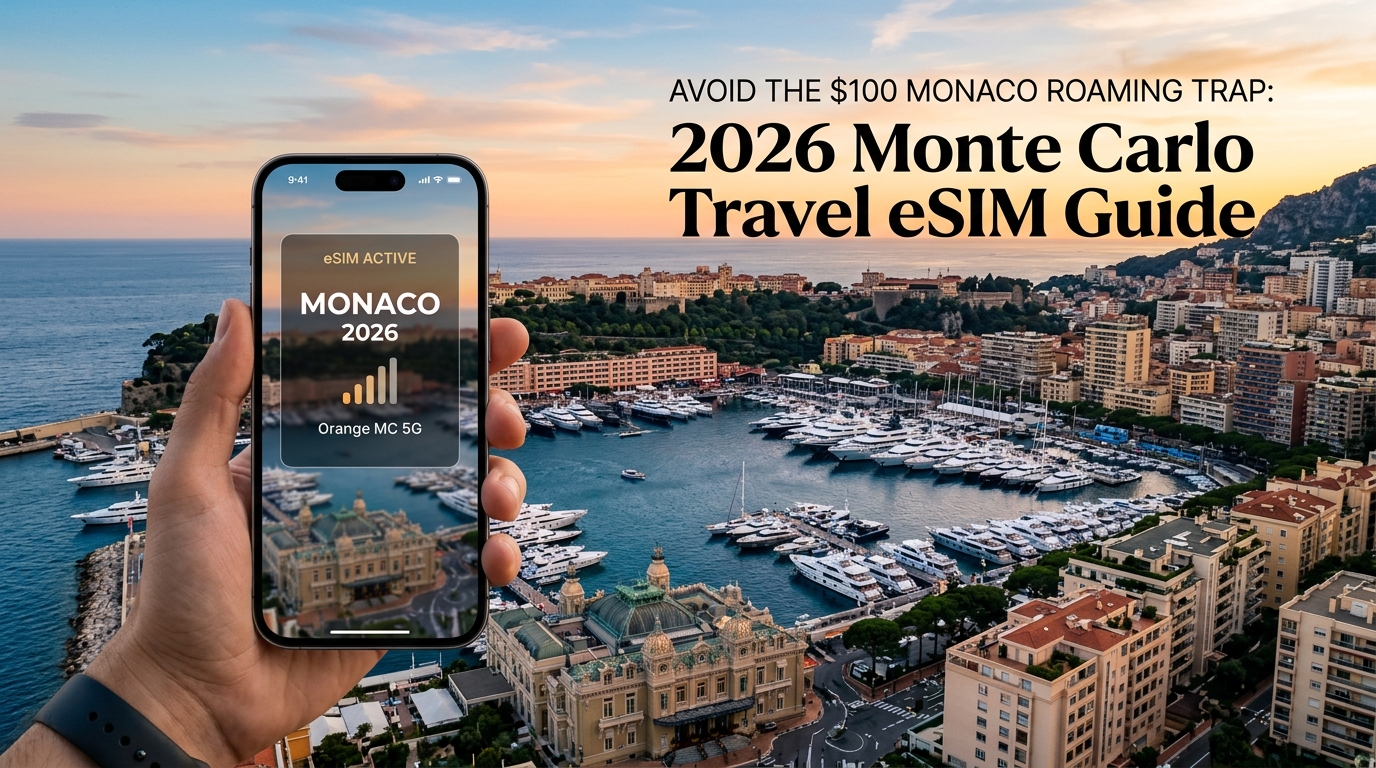
Avoid the $100 Monaco Roaming Trap: 2026 Monte Carlo Travel eSIM Guide
The $100 Monaco Roaming Trap: Why EU 'Roam Like at Home' Fails in Monte Carlo
It is one of the most expensive assumptions a traveler can make on the French Riviera: assuming that your European data plan treats Monaco the same as France.
While the Principality of Monaco is completely encircled by the French department of Alpes-Maritimes and sits just a short ride from Nice, it is a sovereign microstate. Crucially, Monaco is neither a member of the European Union (EU) nor part of the European Economic Area (EEA).
Because of this specific legal distinction, the landmark EU Regulation 2026/612—widely known as "Roam Like at Home" (RLAH)—does not apply to Monaco’s domestic network infrastructure, operated by Monaco Telecom. The moment your smartphone drops its connection to French towers (Orange, SFR, or Bouygues) and handshakes with Monaco Telecom, your domestic EU roaming protections vanish instantly.
The 20-Minute Commute Shock: From Nice Ville to Rest-of-World Rates
The vast majority of Monaco roaming bill shock cases happen during routine day trips. Hundreds of thousands of tourists, Grand Prix attendees, and superyacht crews board the local SNCF TER train from Nice Ville or Cannes bound for Ventimiglia, passing directly through Monaco.
As the train pulls into the underground Gare de Monaco-Monte-Carlo, the physical topography forces your device to switch networks. Within seconds:
- Your handset disconnects from French domestic relay towers.
- It latches onto Monaco Telecom (Network Code: 212 10 / MC).
- Your domestic carrier reclassifies your location from "EU / Zone 1" to "Zone 2", "Zone 3", or "Rest of World".
- Background data services—such as Apple iCloud photo syncing, Instagram feed refreshes, email fetching, and background app updates—immediately consume data at non-regulated, pay-as-you-go (PAYG) rates.
Typical Carrier Out-of-Bundle Pricing in Monaco
When roaming on Monaco Telecom without an explicitly bundled microstate plan, international mobile network operators (MNOs) bill astronomical out-of-bundle tariffs:
| Carrier Origin / Region | Average Standard Roaming Rate in Monaco | Time to Trigger $60–$100 Safety Cap |
|---|---|---|
| UK Carriers (EE, Vodafone, O2) | £3.00 – £6.00 per MB | ~2 to 4 minutes of background data (15–20 MB) |
| US Carriers (Verizon, AT&T, T-Mobile PAYG) | $2.05 – $15.00 per MB | Under 90 seconds (often hitting daily pass locks) |
| EU Domestic Operators (Germany, Spain, Italy) | €6.00 – €12.00 per MB | ~3 to 5 minutes of basic app syncing |
| Canadian Carriers (Rogers, Bell, Telus) | $12.00 – $16.00 per MB | Instant exhaustion of default $50 roaming cap |
Most international carriers enforce a hard financial roaming cap (typically set around €50, $60, or £45) to prevent accidental multi-thousand-dollar invoices. In Monte Carlo, background network syncs burn through this safety cap within minutes of walking through Casino Square or along Port Hercule. Once the limit is reached, your cellular data is completely severed, leaving you stranded without digital navigation, messaging, or rideshare access unless you manually authorize additional uncapped billing.
Why Regional "Europe" SIM Cards Still Get Caught
Many off-the-shelf "Europe 30-Country" travel SIMs and generic regional packages exclude microstates to minimize operator wholesale settlement costs. They advertise seamless connectivity across the continent, yet leave Monaco, Andorra, and the Channel Islands in high-tariff exclusion zones.
Avoiding this roaming trap requires an international eSIM solution configured to cover Monaco natively alongside France and the broader Mediterranean coastline. Modern travel eSIM providers like MollySIM eliminate these dead zones by bundling Monaco directly into their multi-destination European routing profiles. Furthermore, unlike legacy roaming providers that cut off service entirely or throttle speeds to an unusable 128kbps once high-speed allocations are hit, MollySIM features an optimized 384kbps Fair Use Policy (FUP) speed limit. This 3x throughput advantage ensures that even during speed throttles, essential mission-critical tools—such as Google Maps live routing, Apple Pay authentications, and WhatsApp messaging—continue to operate uninterrupted across the Principality.
Cellular Bleed & Border Handover: The RF Mechanics Between France and Monaco
🇫🇷 Orange France / Europe SIM High-Speed Travel eSIM & SIM Plans
Instant QR code activation, hotspot enabled, with guaranteed 384kbps fallback speed to keep Maps & Digital Wallets active.
The geography of the Principality of Monaco creates one of the most complex radio frequency (RF) environments in modern telecommunications. Spanning roughly 2.08 square kilometers, Monaco is wedged into a natural coastal amphitheater completely surrounded by French communes: Cap d'Ail to the west, Beausoleil to the north, and Roquebrune-Cap-Martin to the east.
Because terrestrial cellular boundaries cannot follow razor-thin municipal borders, macro cell towers operated by French Mobile Network Operators (MNOs)—Orange (MCC 208, MNC 01), SFR (208-10), Bouygues Telecom (208-20), and Free Mobile (208-15)—inevitably project RF energy deep into Monégasque territory. Simultaneously, Monaco Telecom (212-01) operates an ultra-dense, localized network of microcells and distributed antenna systems (DAS) optimized to blanket the dense urban grid.
The result is a volatile RF overlapping zone where your smartphone constantly battles between competing base stations.
       [ French MNO Towers (Beausoleil / Mont Agel) ]
                         \         /
                          \  RF   /
                           \ Bleed /
                            v     v
+-------------------------------------------------------------+
|               BORDER OVERLAP / INTERFERENCE ZONE            |
|  - RSRP Fluctuations (-85 dBm to -120 dBm)                  |
|  - Rapid Handshake Re-authentications                       |
|  - Ping-Pong Handover Loop (French MNO <-> Monaco Telecom)   |
+-------------------------------------------------------------+
                            ^     ^
                           / Monaco\
                          / Telecom \
                         /   DAS     \
     [ Port Hercule / Casino Square Microcells ]
The "Ping-Pong" Handover Effect
When you walk along the border—such as the Boulevard de Suisse or the steps descending from Beausoleil into Monte Carlo—your device enters a continuous handover loop known in RF engineering as the ping-pong effect.
- Signal Degradation: As you move lower into Monaco, line-of-sight to the French macro towers on the cliffs above degrades. The Reference Signal Received Power (RSRP) from your French carrier plummets from a stable –85 dBm to a fringe –115 dBm or worse.
- Network Negotiation: Your smartphone's Baseband Processor detects the high-power, dominant carrier wave of Monaco Telecom’s localized nodes.
- Carrier Switching & Re-Authentication: The device drops the French cell and initiates a location update request with Monaco Telecom.
- Roaming Trigger: If your domestic carrier treats Monaco as an out-of-plan zone, this single millisecond handshake triggers an automated international roaming pass or uncapped per-megabyte billing event.
- Reverse Oscillation: A slight shift in orientation or turning a street corner briefly restores line-of-sight to a French tower, prompting the device to disconnect from Monaco Telecom and re-authenticate back to France.
+-----------------------------------------------------------------------------------+
|                     RF Ping-Pong Network Impact Matrix                            |
+----------------------+-----------------------------+------------------------------+
| Metric               | French Bleed Lock (Fringe)  | Native Cross-Border Profile  |
+----------------------+-----------------------------+------------------------------+
| RSRP Signal Strength | -112 dBm to -125 dBm (Poor) | -72 dBm to -88 dBm (Optimal) |
| Device Battery Drain | Severe (Max Tx Amplification)| Normal (Power Efficient)     |
| Packet Loss Rate     | 18% – 42% (High Jitter)     | < 0.5%                       |
| Out-of-Plan Risk     | Extreme ($10–$15/MB Spikes) | Zero (Unified Billing)       |
+----------------------+-----------------------------+------------------------------+
This cycle repeats dozens of times per hour. Beyond the extreme financial risk, the continuous switching and signal hunting forces your phone’s RF power amplifier to run at maximum wattage (up to +23 dBm / 200 mW), rapidly draining your battery and causing severe packet loss that freezes live map navigation and web browsing.
Microclimate Traps: Tunnels, Topography, and Ports
Monaco's dramatic verticality exacerbates this cellular instability in three distinct zones:
- Underground Railway Descent (Gare de Monaco-Monte-Carlo): Carved directly into the subterranean rock of Mont Agel, the train station relies on dedicated in-station leaky feeder cables and internal DAS. The moment your train enters the tunnel from Nice or Menton, all external French macro signals are instantly severed. Your device immediately locks onto subterranean Monaco Telecom infrastructure.
- Urban Concrete Canyons (Casino Square & Larvotto): Towering luxury high-rises create severe multipath interference. French signals bounce erratically off glass facades and reinforced concrete, creating localized dead zones where only Monaco Telecom’s small cells can establish a stable connection.
- Superyacht Berths (Port Hercule & Fontvieille): Down at sea level, the high cliffs completely shadow French inland cell towers. While you may catch occasional RF reflections off the water, data throughput on French connections drops to near-zero, forcing the device to switch to Monaco’s maritime and harbor cells.
Why Attempting to "Force French Networks" Fails
Many travelers attempt to bypass roaming fees by disabling automatic network selection in their smartphone settings and manually locking their device to Orange France or SFR.
While this prevents accidental connections to Monaco Telecom, it creates a compromised user experience:
- Dead Zones: You will suffer complete cellular blackouts the moment you enter shops, restaurants, hotel lobbies, parking structures, or lower-tier harbor walks where French macro signals cannot penetrate.
- High Latency and Timeouts: Even when your phone displays 1 or 2 bars of "locked" French 4G/5G, the uplink budget is heavily asymmetrical. Your phone lacks the transmission power to send data packets back up the mountain to the French tower, resulting in silent connection timeouts, failed rideshare requests, and stalled payment processing.
The only technically sound solution is using a multi-IMSI or cross-border travel eSIM like MollySIM, which carries pre-negotiated, native routing agreements with both top-tier French MNOs and Monaco Telecom. When your phone transitions between Cap d'Ail and Monte Carlo, the handover occurs cleanly across unified data pools without surprise connection cutoffs or extortionate roaming penalties.
Even if you exhaust a high-speed bucket while streaming heavy media along the marina, MollySIM’s built-in 384kbps Fair Use Policy (FUP) speed limit maintains a throughput 3x higher than legacy 128kbps throttles. This guarantees that your dynamic border-crossing data sessions keep Apple Pay tokens, live GPS tracking, and VoIP messaging fully responsive, regardless of which side of the cell tower boundary you stand on.
Monaco Connectivity Breakdown: Carrier Roaming vs. Local SIMs vs. MollySIM eSIM
Navigating cellular connectivity along the Côte d'Azur requires understanding the stark technical and commercial divide between standard EU regulated zones and the sovereign territory of Monaco. Because Monaco Telecom operates an independent, non-EU cellular core, international travelers must choose between four distinctly different connection methods, each carrying severe trade-offs in billing, administrative friction, and network performance.
The matrix below provides an engineering-level and cost comparison across the primary options available for modern smartphones.
Comprehensive Monaco Connectivity Comparison
| Evaluation Metric | Home Carrier Roaming (US/UK/AU) | Monaco Telecom Local Prepaid SIM | Generic "Europe 30+ Countries" eSIM | MollySIM Regional Europe eSIM |
|---|---|---|---|---|
| Average Cost per GB | $10.00 – $25.00+ (or $15/day passes) | €10.00 – €15.00 / GB (+ physical SIM fees) | $4.00 – $7.00 / GB (Fails in Monaco) | $1.50 – $3.50 / GB |
| Native Carrier Partner | Variable (often throttled 3G/4G) | Monaco Telecom (Tier 1 Direct) | French bleed-only (Orange/SFR from border) | Monaco Telecom + Orange France (Multi-IMSI) |
| 5G NR Access | Rarely negotiated / Restricted | Yes (Native 5G Sub-6) | No (Dropouts / Edge-only) | Yes (High-speed 5G/4G LTE) |
| French Riviera Cross-Border Handover | Seamless, but triggers immediate rate changes | Fails outside Monaco without pricey add-ons | High packet loss & persistent cell drops | Seamless zero-drop transition (Nice ⇄ Monaco) |
| FUP Throttling Floor | Hard cut-off or 64–128 kbps | Hard cut-off (Must top-up) | Disconnected upon entering 212-10 MCC | 384 kbps Unlimited Fallback |
| Deployment & Setup Friction | Instant, but high-risk automated billing | High: Physical store visit & KYC passport check | Digital QR, but dead upon crossing border | Zero friction: Instant digital eSIM activation |
| Bill Shock Risk | Extreme ($100–$500+ accidental overages) | None (Prepaid balance) | Low (Service simply cuts out) | Zero (Prepaid data balance with zero hidden fees) |
In-Depth Option Analysis
1. Home Carrier Pay-As-You-Go Roaming (The Trap)
Major carriers—including AT&T, Verizon, T-Mobile US, O2 UK, and Telstra—frequently exclude Monaco from their standard $10/day international day passes or treat it as a Tier-3 destination. Once your device registers on Monaco Telecom's MCC/MNC (212-10), background app refreshes and cloud photo synchronizations are metered at standard international PAYG tariffs, often reaching $2.05 to $15.00 per megabyte. A single 500MB software update can trigger a catastrophic $1,000+ billing event before carrier fraud alerts activate.
2. Monaco Telecom Local Prepaid SIM (The Bureaucratic Bottleneck)
Purchasing a native prepaid SIM directly from Monaco Telecom delivers uncompromised local throughput, but introduces major physical and administrative hurdles:
- Mandatory KYC Verification: Under Monegasque law, purchasing a local SIM card requires in-person identity verification. You must locate a Monaco Telecom boutique (such as the branch on Rue Grimaldi or inside the Fontvieille Shopping Centre), present a valid physical passport, and await manual document clearance.
- Restricted Cross-Border Utility: These cards are optimized for domestic usage. The moment you take a day trip to Èze, Saint-Jean-Cap-Ferrat, or Nice, standard French roaming rates apply, forcing you to manage multiple disconnected balances.
3. Generic "Europe 33-Country" Travel eSIMs (The Blindspot)
Most commodity travel eSIMs sold online lump European destinations under the European Union Roaming Regulation (Regulation EU 2026/612). Because Monaco is not an EU member state, these providers silently omit network agreements with Monaco Telecom.
When your train pulls into Gare de Monaco-Monte-Carlo, your device loses connectivity entirely or clings to degraded, unusable micro-signals broadcasted from French transmitters on the cliffs of Beausoleil.
4. MollySIM Regional Europe Architecture (The Turnkey Solution)
MollySIM solves the microstate dilemma by deploying an advanced regional eSIM configuration with native bilateral roaming agreements across both French tier-one carriers (Orange, SFR) and Monaco Telecom.
[ Cap d'Ail (France) ]  ---> [ Monaco Border ] ---> [ Monte Carlo (Monaco) ]
    Orange 5G Core       --- Seamless Handover --->    Monaco Telecom 5G
         |                                                    |
         +=========== Unified MollySIM Multi-IMSI Pool ========+
Rather than cutting off or charging punitive out-of-bundle rates when data pools are depleted, MollySIM implements an industry-leading 384 kbps Fair Use Policy (FUP) floor. Compared to the legacy 64 kbps or 128 kbps throttles used by traditional roaming providers—which render smartphones completely non-functional—a 384 kbps connection retains enough bandwidth to process encrypted Apple Pay/Google Wallet tokens, stream live turn-by-turn navigation in Google Maps, and handle uninterrupted two-way WhatsApp voice communication. This ensures zero downtime whether you are boarding a yacht in Port Hercule or transiting back to Nice Côte d'Azur Airport.
Technical Hardening: Dual-SIM Roaming Kill-Switches for iOS and Android
Preventing silent background leakage to your home carrier requires more than simply turning on an eSIM profile. Modern smartphone operating systems are engineered to prioritize network continuity over cost avoidance, frequently falling back to a secondary SIM if the primary data carrier experiences latency spikes.
To ensure zero bill shock when transiting between the French Riviera and the Principality, execute these hardening protocols before boarding the TER train or crossing the border on the Moyenne Corniche.
Step-by-Step iOS Hardening (iPhone 12 through iPhone 16 Pro)
Apple’s default dual-SIM setup can expose you to accidental domestic carrier roaming via its automated network failover. Follow these exact settings:
[ Primary Home SIM ] ---> Turn OFF "Data Roaming"
[ Cellular Data Selection ] ---> Set explicitly to [ MollySIM ]
[ Allow Cellular Data Switching ] ---> TOGGLE OFF (CRITICAL)
[ MollySIM Profile ] ---> Turn ON "Data Roaming" & "Low Data Mode"- Disable Domestic Roaming: Go to Settings > Cellular (or Mobile Data). Tap your Primary/Home SIM line and toggle Data Roaming to OFF.
- Lock the Data Path: Return to the main Cellular menu, tap Cellular Data, and explicitly select your MollySIM profile.
- Disarm Automatic Failover: Immediately below the data selection list, toggle Allow Cellular Data Switching to OFF. If left enabled, iOS will automatically route data through your primary carrier if the Monaco Telecom signal fluctuates inside tunnels or dense marble lobbies, triggering home-carrier pay-as-you-go rates instantly.
- Engage Data Conservation: Tap your MollySIM profile line, turn Data Roaming to ON, and enable Low Data Mode. This halts non-essential iCloud photo backups, background app refreshes, and automatic iOS firmware downloads while keeping live traffic on Google Maps and messaging protocols active.
Step-by-Step Android Hardening (Samsung One UI & Google Pixel)
Android distributes roaming controls between the SIM Manager and individual connection sub-menus.
| Setting | Samsung Galaxy (One UI 6+) | Google Pixel (Stock Android 14/15) |
|---|---|---|
| Data Line Assignment | Settings > Connections > SIM manager > Mobile data → Select MollySIM | Settings > Network & internet > SIMs > MollySIM → Toggle Use SIM for data |
| Auto-Switching Kill | Disable Auto data switching | Disable Backup calling / Switch data automatically |
| Primary SIM Data Roam | Settings > Connections > Mobile networks → Primary SIM Data roaming → OFF | Settings > SIMs > Primary SIM → Roaming → OFF |
| eSIM Data Roaming | Settings > Connections > Mobile networks → MollySIM Data roaming → ON | Settings > SIMs > MollySIM → Roaming → ON |
Pro-Tip for Android Users: Navigate to Settings > Apps > Special App Access > Background Data and restrict large-volume synchronization engines (e.g., Google Photos, OneDrive, and high-bitrate social video feeds).
Even if you exhaust your high-speed allowance during heavy day-use, MollySIM's 384 kbps Fair Use Policy (FUP) baseline ensures that critical transactions—such as Google Pay token validation, Uber ride requests, and WhatsApp voice calls—continue executing without failure, running at three times the speed of traditional 128 kbps throttles.
Underground Triage: Fixing the Gare de Monaco "SOS Only" Loop
The Gare de Monaco-Monte-Carlo is bored deep into the coastal limestone cliffs. This subterranean environment frequently causes baseband modems to lock onto a vanishing French cell tower (Orange/SFR) rather than handshaking with the internal Monaco Telecom distributed antenna system (DAS), trapping your handset in a persistent "No Service" or "SOS Only" state.
       [ Deep Underground Limestone ]
               |
     +---------+---------+
     |                   |
[ French Border Signal ] [ Monaco Telecom DAS ]
(Unusable fringe wave)   (Direct 5G trackside)
     |                   |
     X <-- Modem Stuck    ==> Force Manual Network Search
If your phone fails to acquire service within 90 seconds of pulling into the station:
- Cycle the Baseband: Toggle Airplane Mode ON, wait 10 seconds, then toggle it OFF.
- Force Manual Network Selection:
- iOS: Go to Settings > Cellular > MollySIM > Network Selection. Toggle off Automatic and manually pick Monaco Telecom from the scan list.
- Android: Go to Settings > Network & internet > SIMs > MollySIM > Automatically select network. Turn the toggle off and select Monaco Telecom (212-01).
- Verify APN String Integrity: Ensure the Access Point Name (APN) on the MollySIM profile matches the default installation profile (
globaldataor auto-provisioned string) without trailing whitespaces.
Once you surface toward Sainte-Dévote or the Port Hercule exits, the manual lock will instantly latch onto the outdoor Monaco Telecom 5G millimeter-wave and sub-6GHz grids.
The MollySIM 2026 Advantage: True 5G Coverage & the 384kbps Never-Stranded Safety Net
Standard travel eSIMs treat Monaco as an expensive afterthought, routing traffic through distant cloud packet cores with high latency or completely dropping service the second you cross the threshold from Cap d'Ail into Fontvieille. MollySIM re-engineers cross-border Mediterranean connectivity from the core network level up, combining direct local carrier agreements with an uncompromising safety protocol designed for high-density, cross-border transit.
+-------------------------------------------------------------------------+
|                       MOLLYSIM REGIONAL IP CORE                         |
+-------------------------------------------------------------------------+
       |                                                 |
[ Direct Peering ]                                [ Direct Peering ]
       v                                                 v
Monaco Telecom 5G (PLMN 212-01)                 Orange / SFR France (PLMN 208)
       |                                                 |
       +-------> Seamless Layer-2 Border Handover <------+
              (Zero Packet Loss on TER & Corniche)
Dual Tier-1 Peering: Zero-Interruption Handover on the Riviera
The primary point of failure for international roaming between Nice and Ventimiglia is the physical border interface. As the train snakes through the coastal tunnels or your car winds along the Moyenne Corniche, standard SIM cards trigger a sluggish inter-PLMN roaming search that causes dropped calls, disconnected GPS routes, and stalled ride-hailing apps.
MollySIM resolves this with multi-network core provisioning:
- Dual-Core Carrier Peering: MollySIM holds direct interconnects with Monaco Telecom (PLMN 212-01) and France’s tier-1 operators (Orange and SFR).
- Instant Layer-2 Handshakes: As radio frequency signals shift across national boundary lines, network attachment handovers execute in milliseconds rather than minutes.
- True 5G Standalone & Non-Standalone Speeds: MollySIM profiles automatically unlock full-rate 5G access across the Monte Carlo and Larvotto micro-cells without artificial bandwidth caps or aggressive throttling on active data buckets.
The 384kbps Fair Usage Protocol: A Mission-Critical Safety Net
Most generic eSIM providers market "unlimited data" with a catastrophic hidden flaw: once your high-speed quota is reached, your connection throttles down to 64kbps or 128kbps. At 64kbps, modern smartphone operating systems experience connection timeouts: HTTPS handshakes fail, Apple Pay cannot re-authenticate security tokens, and map tiles fail to load.
MollySIM integrates a guaranteed 384kbps Fair Usage Policy (FUP) baseline speed across all 2026 plans. Running at 3x to 6x the speed of competitor fallbacks, 384kbps is the engineered threshold required to keep modern travel telemetry functional:
| Essential Travel Function | Competitor FUP (64kbps – 128kbps) | MollySIM FUP (384kbps Guaranteed) |
|---|---|---|
| Apple Maps & Google Maps | ❌ Tile timeout; GPS map blanking | ✅ Full vector map loading & turn-by-turn routing |
| WhatsApp / Signal / iMessage | ⚠️ Text-only delay; media fails | ✅ Instant text delivery + clean, uninterrupted VoIP voice calls |
| Uber & Taxi Monaco Dispatch | ❌ Connection drop during fare lock | ✅ Dynamic dispatching & real-time driver tracking |
| Mobile Banking / Apple Wallet | ❌ 2FA timeout & security drop | ✅ Instant TLS security handshake & tokenization |
| Web Browsing & Boarding Passes | ❌ Safari / Chrome network error | ✅ Lightweight mobile site rendering & pass downloads |
Even if you exhaust your premium 5G data bucket while capturing 4K video along Port Hercule, MollySIM’s unthrottled 384kbps data stream ensures you will never be digitally stranded in the Principality.
Step-by-Step Monte Carlo Itinerary Connectivity Guide: From Nice Airport to Port Hercule
Navigating the transition between France and Monaco requires a continuous data connection capable of handling automatic network handovers across international borders. Below is the exact technical deployment strategy for landing at Nice Côte d'Azur Airport (NCE) and transiting smoothly to the heart of Monte Carlo.
Checkpoint 1: Pre-Departure Installation
- Timing: 12–24 hours before your flight departure.
- Action: Purchase your plan on MollySIM and scan the provided installation QR code via your phone's cellular settings (
Settings > Cellular / Mobile Service > Add eSIM). - Configuration:
- Label the new line "MollySIM Monaco".
- Keep Data Roaming toggled ON for this profile.
- Keep your domestic carrier designated for default voice/SMS calls, but turn off cellular data switching to prevent accidental roaming charges.
Checkpoint 2: Touchdown at Nice Côte d'Azur Airport (NCE)
- Timing: As the aircraft taxis to the gate at Terminal 1 or Terminal 2.
- Action: Turn off Airplane Mode and select the MollySIM profile as your primary Cellular Data line.
- Network Registration: Your device instantly registers on local French Tier-1 partner networks (such as Orange or SFR 5G), allowing you to bypass congested airport Wi-Fi captive portals and immediately load ground transport itineraries or coordinate VIP airport transfers.
Checkpoint 3: The French Riviera Cross-Border Transit
Whether you transfer via the coastal TER SNCF train, hire a private car along the winding cliffs of the Moyenne Corniche, or take a 7-minute Monacair helicopter transfer to Fontvieille Heliport, your device will cross international borders at high velocity.
- The Border Switch: Conventional single-country SIM cards drop signal when passing through the railway tunnels near Gare de Monaco-Monte-Carlo or approaching the Cap d'Ail border.
- Seamless Handover: MollySIM plans engineered for the French Riviera provide automatic roaming handover between France and Monaco networks with zero session drops, ensuring navigation apps maintain live GPS telemetry and real-time traffic updates without interruption.
Checkpoint 4: Port Hercule, Larvotto Beach, and Casino Square
- Superyacht Hubs & Crowded Promenades: During high-density events such as the Monaco Yacht Show or Grand Prix, cellular towers on Boulevard Albert 1er face massive congestion.
- Uninterrupted Access: With MollySIM's priority routing and 384kbps guaranteed Fair Usage Policy (FUP) baseline, mission-critical transactions stay online even under heavy local network load:
- Re-authenticating Apple Pay / Google Wallet at luxury retail boutiques around Place du Casino.
- Requesting rides via local dispatch services near Larvotto Beach.
- Streaming high-resolution route previews without hunting for unsecured hotel or café public Wi-Fi networks.
Frequently Asked Questions: Monaco eSIM & Data Connectivity
Will my smartphone support a Monaco travel eSIM?
Any carrier-unlocked smartphone with native eSIM hardware supports MollySIM. This includes:
- Apple: iPhone XS, XR, iPhone 11 through iPhone 16 Pro Max.
- Samsung: Galaxy S20 through S24/S25 series, Z Fold/Flip models.
- Google: Pixel 3a through Pixel 9 Pro.
- Check compatibility by dialing
*#06#on your phone dialer; if an EID barcode appears, your device is eSIM-ready.
Can I use personal hotspot/tethering on my laptop or yacht?
Yes. Personal Hotspot / Mobile Tethering is fully supported at native speeds across all MollySIM Monaco profiles. You can share your high-speed 5G/4G data connection with laptops, tablets, or companion devices while anchored in Port Hercule or working remotely from hotel suites.
How do I keep my domestic WhatsApp and iMessage active while using MollySIM?
When your phone asks if you want to update your WhatsApp account to a new number after switching data lines, tap "Keep Existing Number" / "Don't Change". WhatsApp and iMessage will continue to use your primary home phone number for all chats, calls, and security 2FA prompts, while routing all underlying internet traffic over MollySIM’s cost-effective cellular data line.
🇫🇷 Orange France / Europe SIM High-Speed Travel eSIM & SIM Plans
Instant QR code activation, hotspot enabled, with guaranteed 384kbps fallback speed to keep Maps & Digital Wallets active.