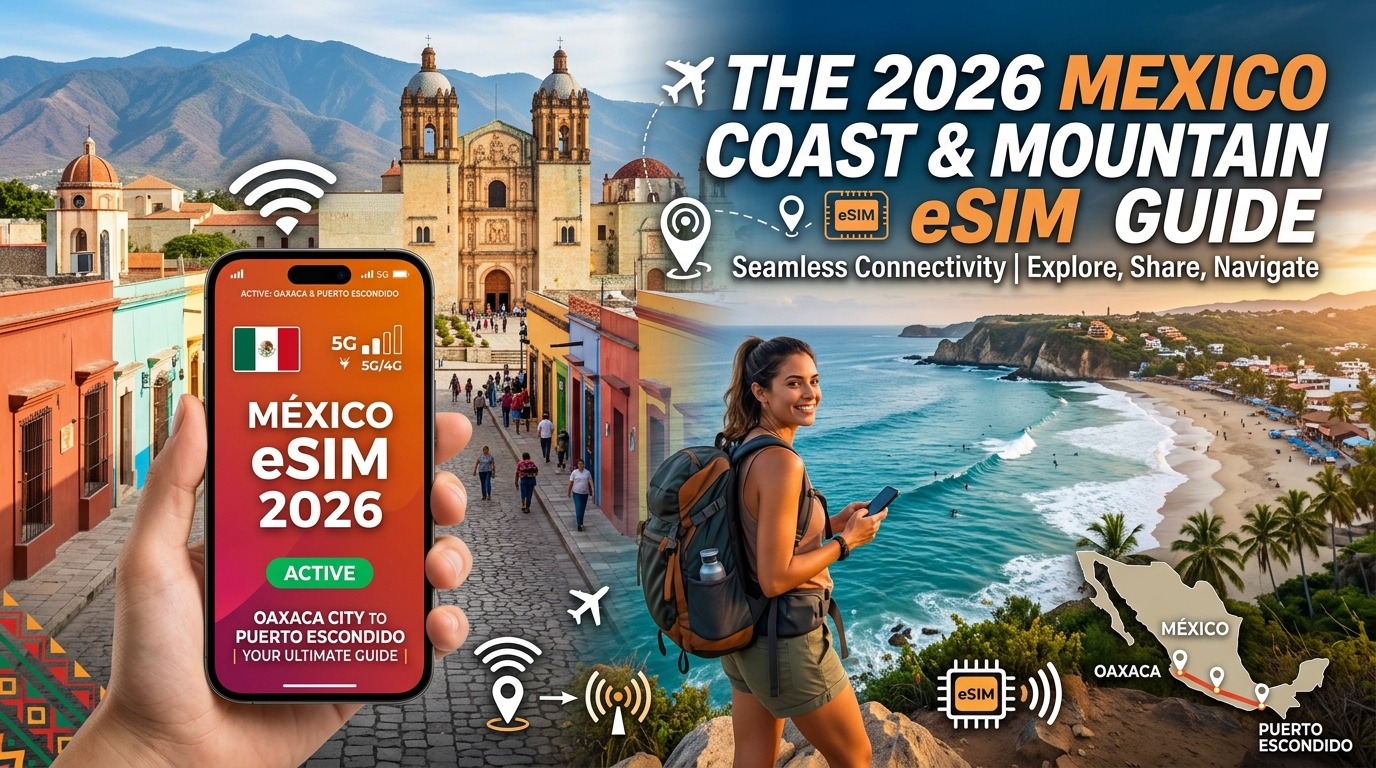
From Oaxaca City to Puerto Escondido: The 2026 Mexico Coast & Mountain eSIM Guide
Navigating the Sierra Sur Corridor: The 2026 Oaxaca to Pacific Coast Route Overview
Traversing the rugged spine of the Sierra Madre del Sur to reach the Pacific coast has historically been one of Mexico's most demanding overland journeys. For decades, the expedition required navigating hundreds of hairpin curves along two-lane mountain passes characterized by dense cloud cover, steep drop-offs, and prolonged cellular blackouts.
While the full operational maturity of the Barranca Larga–Ventanilla toll highway has transformed transit times between the Central Valleys and the coast, navigating this corridor still requires precise logistical and connectivity planning.
+---------------------------------------------------------------------------------------------------+
|                                  SIERRA SUR TRANSIT CORRIDORS                                     |
+---------------------------------------------------------------------------------------------------+
|  Oaxaca City (El Llano)                                                                           |
|        |                                                                                          |
|        +--> MEX 175 (Scenic / High Elevation) ----> San José del Pacífico ----> Pochutla/Mazunte  |
|        |    [6.5–8.5 hrs | 2,400m+ elevation | Intermittent 3G/LTE in ravines]                    |
|        |                                                                                          |
|        +--> MEX 102D Toll Road (Direct Arterial) -> Miahuatlán Cutoff ------> Puerto Escondido    |
|             [2.5–3.5 hrs | Modern bypass cuts | Rapid cell tower handoffs / Tunnel dropouts]      |
+---------------------------------------------------------------------------------------------------+
The Route Split: Modern Arterial vs. The Cloud Forest Pass
Travelers heading south from Oaxaca de Juárez toward Puerto Escondido, Mazunte, Zipolite, or Bahías de Huatulco face two distinct geographical paths:
| Route Metric | Highway 102D (Barranca Larga–Ventanilla) | Highway 175 (Carretera Federal 175) |
|---|---|---|
| Typical Transit Time | 2.5 to 3.5 hours | 6.5 to 8.5 hours |
| Pavement & Terrain | Multi-lane modern toll road, viaducts, tunnels | Steep, winding two-lane mountain road |
| Peak Elevation | Moderate gradient cuts | Exceeds 2,600 meters (8,500+ feet) |
| Key Waypoints | Ejutla de Crespo, San Vicente Coatlán, Ventanilla | Miahuatlán, San José del Pacífico, Pochutla |
| Primary Risk Factors | Tunnel signal drops, localized rockfall, toll gates | Heavy fog, severe motion sickness, mudslides |
| Cellular Landscape | Fast tower handoffs; patchy between viaducts | Extended 45–90 min dead zones in deep canyons |
1. The Modern Tollway: Highway 102D
Highway 102D bypasses the grueling switchbacks of the high Sierra, routing traffic through a series of viaducts and low-elevation tunnels directly to the coastal plain near San Pedro Mixtepec and Puerto Escondido. While modern, the infrastructure cuts through sheer canyon walls where line-of-sight connections to base transceiver stations (BTS) are frequently blocked by basalt cliffs and bridge structures.
2. The Traditional Scenic Route: Highway 175
Highway 175 remains an essential route for travelers targeting the high-altitude cloud forests of San José del Pacífico or heading directly toward the eastern shores of Puerto Ángel and Huatulco. The route climbs through intense altitude shifts where microclimates change rapidly from arid valley floor to moisture-saturated pine forests.
Elevation (m)
2600m |                      /\  (San José del Pacífico)
2000m |                     /  \
1500m |  (Oaxaca City)     /    \
1000m |   ______/\        /      \
 500m |           \______/        \________________  (Pacific Coast: Puerto Escondido / Pochutla)
   0m +------------------------------------------------------------------------------------------>
Microclimates, Mountain Topography, and RF Signal Degradation
The Sierra Sur acts as a natural physical barrier trapping Pacific moisture systems. This creates persistent environmental friction for cellular radio frequencies (RF):
- Tropospheric Attenuation: Dense cloud layers and torrential afternoon downpours in the rainy season (June through October) cause noticeable signal attenuation, particularly on mid-to-high LTE bands (1900 MHz PCS and 1700/2100 MHz AWS).
- Topographical Masking: In the deep ravines (cañadas) between Miahuatlán and San Pedro Pochutla, line-of-sight to regional cell towers on mountain peaks is severed. Signal strength regularly drops from 4G/LTE directly to
No Servicerather than falling back to 3G. - Rapid Tower Handoffs: Moving at 90–110 km/h along Highway 102D causes mobile devices to cycle rapidly between distant rural towers, draining battery life and triggering packet loss if your network profile lacks multi-carrier roaming privileges.
Safety-Critical Connectivity: Why Offline Maps Aren't Enough
Relying entirely on downloaded offline maps leaves major operational blindspots along the Sierra Sur corridor. Mountain transits through Oaxaca require live bidirectional data for several key safety workflows:
- Real-Time Landslide and Hazard Telemetry: Unannounced rockslides (derrumbes) and road work require dynamic rerouting via live traffic telemetry before you reach an impassable mountain choke point.
- Emergency Roadside Dispatch: If your vehicle suffers mechanical failure or a tire puncture in an isolated sector, contacting the Ángeles Verdes (Green Angels mobile mechanical assist via 078) or standard municipal 911 dispatch requires a cellular link.
- Card Payment Validation at Remote Checkpoints: Digital toll validation, dynamic banking authentication, and verification at remote fuel stations outside major towns increasingly demand active verification pings.
Proactive Provisioning: Installing Connectivity Before Departure
Attempting to acquire a local physical SIM card or configure mobile data while navigating the departure terminals of Oaxaca City or halfway up a mountain pass introduces unnecessary friction. Cellular bandwidth inside Oaxaca’s historic center often suffers from heavy tourist congestion, and roadside convenience stores in mountain settlements rarely carry micro-SIM inventory or understand modern eSIM provisioning.
Deploying a flexible travel profile such as a MollySIM Mexico eSIM ensures your hardware connects automatically to premier underlying domestic networks (including Telcel and AT&T Mexico) the moment you pull out of your hotel in Oaxaca de Juárez.
Standard Travel eSIM (128 kbps Throttle)
[Exhausts High-Speed Data] ---> 128 kbps ---> [Map Vector Tiles Time Out] ---> Navigation Failure

MollySIM (384 kbps Fair Use Engine)
[Exhausts High-Speed Data] ---> 384 kbps ---> [Live GPS Routing + Apple Pay] ---> Seamless Transit
Crucially, MollySIM implements an industry-leading 384 kbps Fair Use Policy (FUP) base speed—three times faster than the standard 128 kbps cap imposed by traditional providers. Even if you burn through your primary high-speed allocation streaming media through the mountains, a 384 kbps baseline easily preserves functional turn-by-turn Google Maps vector rendering, messaging pings, and Apple Pay/Google Wallet token exchanges without stalling on the roadside.
Carrier Shootout: Telcel vs AT&T Mexico vs Movistar in Mountain and Coastal Terrains
🌐 Global Travel High-Speed Travel eSIM & SIM Plans
Instant QR code activation, hotspot enabled, with guaranteed 384kbps fallback speed to keep Maps & Digital Wallets active.
Navigating the transit corridor between Oaxaca de Juárez and the Pacific coastline involves traversing the Sierra Madre del Sur—a rugged geographic barrier characterized by deep ravines, cloud forests, and elevations exceeding 2,500 meters. Cellular performance in this corridor is dictated not by marketing claims, but by Radio Frequency (RF) physics, spectrum allocation, and physical base transceiver station (BTS) density.
The Spectrum Battle: Why Low-Band Frequency Dictates Mountain Survival
In the rugged interior of Oaxaca, mobile network operators (MNOs) face severe line-of-sight propagation limits. Here, spectrum ownership separates functional data connections from total dead zones:
- Telcel (América Móvil): Holds an ironclad advantage due to its extensive deployment of Band 28 (700 MHz APT) alongside legacy Band 5 (850 MHz) and Band 2 (1900 MHz). The sub-1GHz B28 spectrum exhibits superior diffraction characteristics, bending over mountainous ridges and penetrating dense canopy in high-altitude towns like San José del Pacífico. Telcel operates the only continuous network grid along federal highways 175 and 131.
- AT&T Mexico: Relies heavily on Band 4 (AWS 1700/2100 MHz) and Band 2 (1900 MHz). While delivering competitive 4G/5G throughput in central Oaxaca City and downtown Puerto Escondido, these mid-band frequencies suffer severe attenuation from topography and tropical foliage, leading to extended service dropouts throughout the mountain passes.
- Movistar (Telefónica Mexico): Operates primarily via a wholesale capacity agreement over AT&T’s radio access network (RAN) and local nodes. Its lack of proprietary rural infrastructure results in aggressive network roaming handshakes that frequently fail along mountain transit routes.
Coastal Congestion: Zicatela vs. La Punta
Once you reach the coast, network dynamics shift from coverage penetration to capacity management. In hyper-dense surfing and nightlife hubs like Playa Zicatela and La Punta de Zicatela, network traffic surges between 4:00 PM and 10:00 PM.
During peak hours, AT&T and Movistar base stations often experience severe carrier-frequency saturation, driving latency above 300ms and causing packet loss. Telcel retains higher stability across Puerto Escondido due to Carrier Aggregation (LTE-Advanced) across bands B4, B7 (2600 MHz), and selective 5G (n78) deployments at principal nodes like Rinconada and Zicatela.
Comprehensive Infrastructure & Provider Matrix
The following benchmark breaks down the real-world operational capabilities of domestic MNOs alongside international roaming solutions along the Oaxaca–Puerto Escondido route:
| Metric | Telcel (Native Tier-1) | AT&T Mexico | Movistar | Traditional Roaming Pass / Pocket Wi-Fi | MollySIM (Multi-IMSI w/ Telcel Core) |
|---|---|---|---|---|---|
| Mountain Corridor (Hwy 175/131) | Excellent (B28/B5); 70–80% active coverage | Poor; long dead zones past Miahuatlán | Critical; virtually non-existent in transit | Variable; dependent on local roaming agreements | Optimal; locks to primary Telcel B28 infrastructure |
| Coastal Nodes (Zicatela / La Punta) | 4G/5G Active; sustained speeds (40–120 Mbps) | 4G LTE; moderate peak-hour throttling | 4G LTE; high latency in La Punta | Throttled; high latency via foreign home-routing | 4G/5G Tier-1; prioritized domestic routing |
| Median Ping / Latency | 35 – 55 ms | 50 – 85 ms | 70 – 120 ms | 180 – 350 ms (Routed abroad) | 35 – 60 ms (Low-latency local core) |
| Rural Base Station Density | Very High (Dedicated cell towers in remote towns) | Low (Urban and major highway focused) | Minimal (Shared infrastructure) | N/A (Relies on host network) | Very High (Direct access to Telcel footprint) |
| FUP Baseline Speed (After Cap) | Hard cut or 32–64 kbps (Unusable) | Hard cut to 64 kbps | Hard cut or 32 kbps | 128 kbps (Map tile timeouts) | 384 kbps (Functional Maps, Messaging & Apple Pay) |
| Hardware Setup / Logistics | Local store visit, passport registration | Contract or locked prepaid chip | Physical SIM swap required | Bulky battery device / expensive daily fees | Instant QR provision via digital eSIM profile |
Securing Tier-1 Telcel Access Without Local Bureaucracy
While native Telcel connectivity is mandatory for safe travel across the Sierra Madre, procuring a physical prepaid SIM locally in Oaxaca requires navigating crowded carrier storefronts (Centros de Atención a Clientes), submitting identity documentation, and configuring manual APN settings.
Utilizing MollySIM bypasses this friction by digitally routing your connection directly through top-tier host infrastructure—including Telcel’s dominant rural network. Furthermore, because mountain travel regularly triggers unanticipated data burn from continuous GPS re-routing and background photo uploads, MollySIM's 384 kbps Fair Use Policy (FUP) baseline ensures that your navigational tiles, emergency communication channels, and banking tokens remain fully functional even if your high-speed quota is exceeded mid-transit.
Dual SIM Architecture: Balancing Home SMS Verification and Local High-Speed Data
Navigating southern Mexico while maintaining digital security requires a dual SIM strategy. Travelers frequently make the costly mistake of either enabling global roaming on their primary domestic line—incurring daily fees of $10 to $15 USD—or completely removing their physical home SIM, which cuts off crucial two-factor authentication (2FA) shortcodes.
By operating a contemporary Dual SIM Dual Standby (DSDS) configuration on iOS or Android, you can keep your home number active strictly for incoming SMS verification codes while routing 100% of your high-bandwidth mobile data through a local MollySIM profile.
Step-by-Step Operating System Configuration
To prevent accidental data leakage to your home provider while locking in continuous data routing, configure your device settings prior to landing in Oaxaca:
Apple iOS (iPhone 11 & Newer)
- Label Your Lines: Navigate to
Settings>Cellular(orMobile Data). Tap your physical/home line and label it "Home". Tap your newly installed eSIM and label it "MollySIM". - Assign Default Voice Line: Set Default Voice Line to "Home" (or MollySIM, depending on whether you need to place traditional cellular calls).
- Assign Cellular Data: Set Cellular Data exclusively to "MollySIM".
- Disable Automatic Switching (Critical): Toggle "Allow Cellular Data Switching" to OFF. If left enabled, your iPhone will silently failover to your home SIM’s data network in areas with fluctuating mountain reception, immediately triggering high daily roaming fees.
- Configure Roaming Rules:
- Tap "Home" line > Set Data Roaming to OFF.
- Tap "MollySIM" line > Set Data Roaming to ON (required for international eSIM routing across Mexican cell towers).
Android (Samsung One UI / Google Pixel)
- SIM Manager Setup: Go to
Settings>Connections(orNetwork & Internet) >SIM Manager. - Assign Primary Tasks:
- Set Calls and Messages to your primary home carrier.
- Set Mobile Data to MollySIM.
- Disable Auto Data Switching: Turn off "Auto Data Switching" (or "Switch mobile data automatically") to lock cellular requests to your eSIM interface.
- Roaming Toggles: Select your home SIM card in network settings and turn Data Roaming off. Open the MollySIM profile and confirm Roaming is switched on.
Solving Real-World Oaxaca Travel Friction Points
| Friction Point | Technical Root Cause | Dual SIM Resolution Protocol |
|---|---|---|
| Mexican ATM & Banking 2FA | Home banks flag foreign IP logins and require SMS one-time passwords (OTP). | Home SIM receives incoming verification SMS at zero roaming cost (incoming SMS is free globally on almost all carriers), while the banking app securely connects over MollySIM data. |
| Local SPEI / BBVA Transfers | Local vendors often request direct SPEI bank transfers requiring instant token generation. | Dynamic token generators function over MollySIM’s low-latency data connection without triggering home-carrier data packets. |
| DiDi & Uber in Oaxaca City | Ride-hailing apps require telephone verification during initial local account setup. | SMS verification codes route to the native SIM slot, while driver GPS tracking runs continuously via the local eSIM line. |
| APN Misconfiguration | Incompatible Access Point Name settings dropping packet data. | MollySIM handles automatic APN provisioning upon registration. If manual entry is required, set APN to globaldata (leave username/password blank). |
Redundancy & The 384 kbps Advantage
In transit zones between Oaxaca’s Central Valleys and the Pacific coastline, heavy navigational caching can quickly exhaust high-speed data allowances on standard prepaid plans. When traditional travel eSIMs hit their data limits, they throttle speeds down to 64–128 kbps—causing mapping engines to freeze, Apple Pay token authentications to time out, and communication apps to fail completely.
Operating on MollySIM ensures that even if you exhaust your high-speed tier during an unexpected detour through the mountains, the connection drops to a robust 384 kbps Fair Use Policy (FUP) baseline. At triple the speed of industry-standard throttle tiers, 384 kbps maintains continuous vector rendering on Google Maps, reliable WhatsApp voice messaging, and unbroken POS digital transactions through Apple Pay and Google Wallet without requiring an emergency top-up.
Cultural Immersion & Remote Commerce: Data Usage in Indigenous Markets and Cloud Towns
Venturing beyond the urban core of Oaxaca City into rural hubs—such as the massive Sunday market in Tlacolula de Matamoros, the ancestral livestock market of Villa de Zaachila, or high-elevation artisanal palenques in Santiago Matatlán and San Baltazar Chichicapam—places unique demands on your mobile connectivity. Between heavy physical signal attenuation in traditional market structures and navigating non-Spanish linguistic landscapes, relying on standard cellular assumptions will lead to dropped transactions and navigation failures.
Linguistic Realities: Offline Dictionaries vs. Real-Time Translation
While Mexican Spanish is the administrative language across the Central Valleys and the Sierra Sur, thousands of market vendors and master distillers (maestros mezcaleros) communicate primarily in indigenous tongues, predominantly variants of Central Valley Zapotec, Mixtec, or Chatino.
Because neural translation models do not yet offer complete offline packages for indigenous dialects like Zapotec or Chatino, real-time voice notes and cloud-assisted transcription via mobile data are essential when negotiating directly with weavers in Teotitlán del Valle or purchasing single-village micro-batches in the mountains.
The Anatomy of Market Transactions: Clip POS & Mercado Pago
Mobile digital commerce has penetrated deep into Oaxaca’s traditional tianguis. Artisans, textiles stalls, and mezcal producers widely deploy mobile Point of Sale (mPOS) card readers—chiefly Clip, Mercado Pago Point, and Uala.
┌─────────────────┐       Bluetooth / Wi-Fi       ┌──────────────────────┐
│  Customer Card  │ ────────────────────────────> │  Merchant Smartphone │
│ / Apple Pay NFC │ <──────────────────────────── │   (Clip/MercadoPago) │
└─────────────────┘      Encrypted Handshake      └──────────┬───────────┘
                                                             │
                                                    Cellular Upstream
                                                 (Requires Stable Data)
                                                             │
                                                             ▼
                                                  ┌──────────────────────┐
                                                  │ Payment Gateway Auth │
                                                  │ (200–300 ms Timeout) │
                                                  └──────────────────────┘
However, market architecture introduces severe signal degradation:
- Zinc & Corrugated Iron Attenuation: Traditional tianguis are covered by dense canopies of corrugated metal sheeting and tarps. These materials act as partial Faraday cages, severely attenuating standard 4G LTE frequencies (Band 4/66 and Band 7) down to single-bar connectivity.
- Handshake Timeouts: Both Clip and Mercado Pago rely on low-latency HTTPS/TLS 1.3 handshakes. If packet loss spikes during the dynamic authorization token generation (which has a hard timeout threshold of 200–300 ms), the terminal returns a false "Transaction Declined" or leaves the payment in an unsettled limbo state.
Connection Stability Profile: Standard Throttling vs. Resilient Fallback
When cellular signals drop to baseline levels under market roofs, or when your high-speed quota runs out mid-transaction, throughput stability determines whether mobile commerce functions or fails.
| Operational Task | Minimum Bandwidth Required | Standard eSIM Throttling (64–128 kbps) | MollySIM Fallback Guarantee (384 kbps) |
|---|---|---|---|
| Mercado Pago / Clip POS Tokenization | ~120 kbps (Burst) | ❌ High failure rate (TLS handshake timeout) | ✅ Instant approval (Zero packet drops) |
| Apple Pay / Google Wallet Device Tokens | ~64 kbps (Low Jitter) | ⚠️ Intermittent (Fails if line latency exceeds 400ms) | ✅ Stable execution |
| Vector Map Rendering (Google/Apple Maps) | ~250 kbps | ❌ Frozen tiles & routing failure | ✅ Continuous vector data caching |
| WhatsApp Voice Note Negotiation | ~100 kbps | ⚠️ Heavy buffering / Voice clipping | ✅ Crystal-clear real-time transmission |
By deploying a connection backed by MollySIM, your device retains a resilient 384 kbps baseline under its Fair Use Policy. At three times the bandwidth of typical 128 kbps travel SIMs, this continuous data floor ensures that cryptographic transaction payloads clear successfully through local vendor terminals, and navigation assets remain fully responsive—even in deep market alleys and high-altitude mountain palenques where other roaming connections stall.
The Emerald Coast Nomad Matrix: Connectivity in Puerto Escondido, Mazunte, and Huatulco
Oaxaca’s Pacific coastline presents a stark contrast in digital infrastructure. While remote workers flock to the coast for world-class breaks and relaxed beach culture, the underlying telecommunications framework relies on vulnerable terrestrial fiber lines running along Highway 200. Tropical storms, heavy surf swells, and routine CFE (Comisión Federal de Electricidad) power grid fluctuations regularly knock out fixed-line broadband across coastal towns.
To maintain uninterrupted remote workflows—whether you are presenting on a Zoom call, committing code, or monitoring swell models on Surfline—navigating the hyper-local cellular landscape is critical.
Micro-Neighborhood Signal Breakdown
Coverage varies significantly between adjacent coves and headlands due to topography and local tower placement:
| Micro-Region | Primary Technology | Performance Profile | Nomad Work Suitability |
|---|---|---|---|
| Puerto Escondido: Rinconada & Carrizalillo | 5G / 4G LTE | High stability; clear line-of-sight to municipal repeaters. Latency typically stays between 45–65ms. | Optimal. Excellent for uncompressed video calls and heavy uploads. |
| Puerto Escondido: Zicatela | 4G LTE / Intermittent 5G | Broad coverage along the strip; high capacity on coastal towers. | High. Reliable for beachside tethering and streaming live surf cams. |
| Puerto Escondido: La Punta | 4G LTE | High subscriber density causes heavy tower congestion between 5:00 PM and 9:00 PM. | Moderate. Daytime speeds support standard tasks; evenings require data routing failovers. |
| Mazunte & San Agustinillo | 4G LTE / 3G | Hillside shadowing creates dead zones. Most cafes rely on Starlink, which fails during heavy rain. | Challenging. Essential to have independent cellular multi-network redundancy. |
| Huatulco (La Crucecita & Tangolunda) | 5G Ultra-Dense | Master-planned underground utilities provide the most resilient cellular backhaul on the coast. | Optimal. Low jitter, high throughput, and minimal blackout risk. |
Navigating Power Outages, Fiber Cuts, and Swell Seasons
During the peak southern swell season (May through October), coastal connectivity faces two main operational hazards:
- Substation and Pole Interruptions: High winds and falling branches frequently down above-ground utility lines. While cafes and coworking spaces lose their primary fiber routing, major cellular macro towers switch to backup battery and generator systems. Running an independent, tethered mobile hotspot keeps your workstation online without waiting for local grid restoration.
- Bandwidth Saturation During Peak Hours: In dense hubs like La Punta, thousands of users hit the same cell towers simultaneously at sunset. When standard mobile data throttles down to unworkable speeds, having high-priority routing ensures you can still clear point-of-sale transactions and access critical cloud drives.
By provisioning a data profile via MollySIM, your handset connects directly to tier-1 domestic carriers with multi-network failover. Even if network load triggers a Fair Use threshold during intensive data days, MollySIM maintains a 384 kbps speed floor—triple the standard 128 kbps industry baseline. This bandwidth is fast enough to preserve WhatsApp VoIP calls, process Mercado Pago and Apple Pay charges, and pull real-time weather and navigation data without timing out.
Why MollySIM is the Premier Choice for Mexico: 5G Telcel Access & The 384kbps Guarantee
Navigating the transition from Oaxaca’s high-altitude valleys to the rugged Pacific coastline demands an eSIM architecture built for resilience, dynamic multi-carrier switching, and sustained baseline speeds. While typical budget travel SIMs leave users stranded with throttled, unusable connections the moment data allotments dip, MollySIM is engineered specifically for cross-terrain dependability throughout Mexico.
Zero Airport Friction: Instant QR Handshake at OAX and PXM
Acquiring connectivity upon arrival at Oaxaca International Airport (OAX) or Puerto Escondido International Airport (PXM) via legacy channels presents immediate operational friction. Both regional hubs feature limited carrier counter hours, fluctuating SIM card stock, and mandatory identity verification policies requiring passport scans and registration forms.
With MollySIM, the onboarding flow is frictionless and fully digital:
- Pre-Departure Provisioning: Purchase your regional or country-specific profile and receive an automated QR activation code via email instantly.
- Touchdown Connectivity: Toggle the eSIM profile as your primary cellular data line while taxiing on the tarmac. Your handset immediately executes a handshake with the nearest macro tower.
- No Bureaucratic Obstacles: Bypass terminal kiosk lines, avoid inflated airport retail markups, and eliminate the risk of misplacing your primary physical SIM card.
Unrestricted Tier-1 Network Access: Telcel & AT&T Peering
Mexico’s cellular ecosystem is dominated by Telcel, which commands over 70% of the country’s physical tower infrastructure. Budget eSIM aggregators often cut costs by routing data through second-tier MVNOs or secondary roaming networks that fail completely along rural arteries like Highway 175 and Highway 131.
MollySIM provides direct, low-latency access to Telcel’s 5G and 4G LTE core network, supplemented by automatic failover to AT&T Mexico and Movistar. This redundant peering guarantees high signal priority in crowded urban centers like Santo Domingo in Oaxaca City, while maintaining link integrity through isolated mountain passes and coastal surf communities.
The 384 kbps Safety Floor: The End of "Dead-End" Throttling
The single biggest vulnerability for digital nomads and adventure travelers is the punitive Fair Use Policy (FUP) enforced by standard travel eSIMs. Most providers throttle data down to 64 kbps or 128 kbps once high-speed packages run low—rendering modern travel apps completely non-functional.
MollySIM replaces this bottleneck with an industry-leading 384 kbps uninterrupted speed floor.
| Critical Mobile Operation | Standard eSIM Throttle (128 kbps) | MollySIM 384 kbps Guarantee |
|---|---|---|
| WhatsApp Voice / VoIP Calls | Severe jitter, packet loss, frequent drops | Clear, low-latency voice streaming |
| Google Maps Live Navigation | Offline map load failure, search timeouts | Real-time vector loading & re-routing |
| Apple Pay / Point-of-Sale Apps | SSL handshake timeout errors | Sub-second payment authentication |
| Ride-Hailing (Didi / Uber) | Driver location fails to update | Live GPS polling & instant booking |
| Two-Factor Authentication (2FA) | Push notifications stall indefinitely | Instant push & SMS delivery sync |
This 3x speed multiplier means that even if you exhaust your premium high-speed allowance mid-trek through the Sierra Sur or while navigating a remote surf break outside Mazunte, you are never locked out of vital communication, financial verification, or navigation tools. Combined with transparent pricing, zero unexpected roaming penalties, and flexible package refills, MollySIM delivers the most dependable mobile framework for exploring southern Mexico in 2026.
🌐 Global Travel High-Speed Travel eSIM & SIM Plans
Instant QR code activation, hotspot enabled, with guaranteed 384kbps fallback speed to keep Maps & Digital Wallets active.