Tulum, Cozumel & Cenotes: Ultimate 2026 Riviera Maya Travel eSIM Guide
The 2026 Riviera Maya Network Landscape: Telcel vs. AT&T Mexico vs. Movistar
Navigating the digital landscape of the Mexican Caribbean requires an understanding of how local geography impacts cellular architecture. While the high-density urban corridors of Cancun’s Hotel Zone and downtown Playa del Carmen are blanketed with high-capacity multi-carrier 5G nodes, the connectivity story changes dramatically once you venture south along Federal Highway 307 or inland into the dense tropical foliage of Quintana Roo.
       CARRIER FOOTPRINT: RIVIERA MAYA (2026)
┌──────────────────┬──────────────────┬──────────────────┐
│     TELCEL       │   AT&T MEXICO    │     MOVISTAR     │
│  ■■■■■■■■■■ 92%  │  ■■■■■■□□□□ 58%  │  ■■■■□□□□□□ 44%  │
│  Highway 307     │  Urban Hubs Only │  AT&T Shared RAN │
│  + Deep Jungle   │  Fails in Jungle │  High Latency    │
└──────────────────┴──────────────────┴──────────────────┘
The Yucatán Peninsula’s unique limestone topography and dense jungle canopy act as natural signal attenuators. High-frequency bands struggle to penetrate the foliage surrounding secluded eco-resorts, cenote clusters, and Mayan heritage sites. Consequently, your on-the-ground experience depends entirely on which physical masts your device connects to.
Carrier Infrastructure Breakdown
1. Telcel (América Móvil): The Undisputed Regional Standard
Telcel controls over 85% of physical telecommunications infrastructure across Quintana Roo and Yucatán. Operating on Band 4 (AWS 1700/2100 MHz), Band 7 (2600 MHz), Band 28 (APT 700 MHz), and expanding Band n78 (3.5 GHz 5G), Telcel possesses the low-frequency spectrum necessary to punch through thick jungle canopies along the Tulum Beach Road (Boca Paila) and deep into the Ruta de los Cenotes near Puerto Morelos. Along the entire 130-kilometer stretch of Highway 307 from Cancun Airport to Tulum Pueblo, Telcel maintains uninterrupted LTE-Advanced and mid-band 5G coverage.
2. AT&T Mexico: Urban Viability, Rural Dropouts
AT&T Mexico delivers fast, reliable data in planned municipalities like Cancun, central Playa del Carmen, and San Miguel de Cozumel. However, their rural tower density remains sparse. Once you travel 3 to 5 kilometers west of Highway 307 toward inland cenote locations (such as Cenote Dos Ojos or Gran Cenote), AT&T devices routinely drop from LTE down to 3G or enter an emergency-only "No Service" state.
3. Movistar (Telefónica): Wholesale Reliance
Following Telefónica’s return of its national radio spectrum, Movistar operates across Mexico as an MVNO-style entity utilizing AT&T’s Radio Access Network (RAN). This means Movistar shares AT&T’s rural coverage limitations while routing data through separate gateway nodes, frequently resulting in higher latency (ping times exceeding 90–120ms) and reduced throughput during peak resort hours.
2026 Carrier Performance by Sub-Region
| Geographic Zone | Telcel | AT&T Mexico | Movistar |
|---|---|---|---|
| Cancun Hotel Zone & Downtown | 5G / 150–350 Mbps | 5G / 100–250 Mbps | 4G LTE / 40–90 Mbps |
| Playa del Carmen (Centro & Playacar) | 5G / 120–300 Mbps | 5G / 80–180 Mbps | 4G LTE / 30–75 Mbps |
| Highway 307 (Cancun to Tulum Transit) | 4G LTE / 5G Seamless | Intermittent 4G / 3G | Frequent Drops |
| Tulum Pueblo & La Veleta | 5G / 80–200 Mbps | 4G LTE / 20–50 Mbps | 4G LTE / 15–30 Mbps |
| Tulum Beach Road (Boca Paila / Jungle) | 4G LTE (Band 28 Penetration) | Edge / No Service | No Service |
| Cozumel (West Coast & Ferry Route) | 5G / 100–220 Mbps | 4G LTE / 40–80 Mbps | 4G LTE / 20–50 Mbps |
| Inland Cenote Corridors & Cobá | Solid 4G LTE | No Service / Edge | No Service |
The Roaming Trap: Why Direct Tier-1 Access Matters
A common misconception among international travelers is that an eSIM or global roaming plan connects uniformly to all available networks. In practice, many budget eSIM aggregators establish wholesale roaming agreements with secondary carriers (primarily Movistar or lower-priority AT&T pipelines) to reduce data acquisition costs.
When your vehicle pulls into a remote beach club south of Tulum or an isolated cenote deep off the main highway, these budget profiles drop off the grid entirely—leaving you unable to load navigation routes, call ride-shares, or access two-factor authentication tokens.
To eliminate regional dead zones, modern travel profiles must leverage intelligent Tier-1 network switching. MollySIM solves this architectural hurdle by prioritizing direct, low-latency handshakes with Mexico's primary Tier-1 infrastructure—predominantly Telcel. This ensures your phone retains continuous high-speed data while transiting between isolated boutique villas, coastal ferries, and off-grid archaeological zones.
Furthermore, unlike conventional roaming passes that throttle users to an unusable 128kbps crawl once high-speed caps are reached, MollySIM enforces an industry-leading 384kbps Fair Use Policy (FUP). Operating at triple the throughput of legacy providers, this 384kbps baseline ensures mission-critical apps like Google Maps vector rendering, WhatsApp audio messaging, and Apple Pay authentication continue running smoothly even in bandwidth-constrained jungle environments.
Connectivity Breakdown: MollySIM Mexico Travel eSIM vs. Local SIMs vs. Pocket Wi-Fi
🌐 Global Travel High-Speed Travel eSIM & SIM Plans
Instant QR code activation, hotspot enabled, with guaranteed 384kbps fallback speed to keep Maps & Digital Wallets active.
Navigating the connectivity ecosystem across Quintana Roo requires balancing convenience, real-world cellular coverage, and cost. While travelers historically relied on hunting down physical plastic SIM cards upon arrival or paying exorbitant daily rates for pocket Wi-Fi routers, embedded SIM (eSIM) architecture has fundamentally restructured how mobile data is provisioned across Mexico.
The comparative matrix below outlines how MollySIM stacks up against conventional local options across critical operational metrics:
| Metric | MollySIM Mexico eSIM | CUN/TQO Airport SIM Kiosks | OXXO / Convenience Store SIM | Pocket Wi-Fi Rental |
|---|---|---|---|---|
| Setup Friction | Zero: Pre-install via QR/App before boarding; connects instantly on touchdown | High: Wait in arrival lines; manual passport registration; card tray swap | Moderate to High: Must locate store, communicate in Spanish, register via SMS | High: Device pickup/drop-off queues; daily battery recharging cycles |
| Average Cost per GB | Cost-Effective & Transparent: Predictable tier-based pricing | Predatory: $40.00–$60.00 USD for 2GB–4GB starter packs | Low: ~$5.00–$10.00 USD base (requires cash recharges/paquetes) | Very High: $8.00–$15.00 USD/day + large security deposits |
| Network Backbone | Telcel Tier-1 Direct Routing (Low Latency) | Variable / Reseller profiles (often throttled Movistar/AT&T) | Telcel Amigo (Native prepaid, low network priority) | Shared virtual SIM pools (high latency) |
| Dual-SIM & 2FA Continuity | Seamless: Primary home SIM remains active for SMS bank verification | Broken: Home SIM physically removed; SMS 2FA inaccessible | Broken: Home SIM physically removed; SMS 2FA inaccessible | Partial: Keeps home SIM active, but requires carrying an external hotspot |
| Airport Scam Vulnerability | None: Direct digital provisioning | Severe: 400%–600% markup over Mexican retail prices | Low: Fixed retail price (if you manage to find an open shop) | Moderate: Hidden fees for scratches, lost cables, or late returns |
| Post-Cap Fallback Speed | 384kbps Fair Use Policy (FUP) (Maintains Maps & Apple Pay) | Hard data cut-off or severe throttle to 64kbps | Hard data cut-off (balance drains instantly to zero) | Throttled to 128kbps (fails on dynamic mapping) |
The CUN and TQO Airport Kiosk Trap: Debunking the "Cheap Local SIM" Myth
A pervasive myth among travelers landing at Cancun International Airport (CUN) or the newly inaugurated Felipe Carrillo Puerto Tulum International Airport (TQO) is that buying a physical SIM card at terminal arrivals is the most economical strategy. In reality, international arrivals terminals in Quintana Roo operate aggressive retail concessions.
Third-party arrival kiosks regularly charge arriving tourists between $40 and $60 USD for rudimentary physical SIM packs that deliver a mere 2GB to 4GB of data. Beyond the inflated initial price tag:
- The Registration Bottleneck: Mexican telecommunications law requires SIM card identification, forcing you to surrender your physical passport to terminal kiosk staff after an exhausting flight.
- Physical Tray Swapping Risks: Ejecting your domestic carrier's nano-SIM on a busy terminal concourse creates an immediate risk of losing or damaging your primary card.
- Compromised Security & Banking 2FA: The moment your home carrier's physical SIM is removed from your device, you lose access to vital SMS-based two-factor authentication (2FA). This causes instant lockouts when verifying international fraud alerts with banks, confirming rideshare booking codes, or logging into airline management platforms.
PHYSICAL SIM SWAP (Legacy Method)
Eject Domestic SIM ──> Lose 2FA SMS Access ──> Pay $50 Airport Markup ──> Manual Activation Delays

MOLLYSIM DUAL-SIM (Digital Profile)
Retain Domestic SIM (Active for 2FA) + MollySIM (Routing 5G Data via Telcel) ──> Instant Landing Connectivity
Streamlined Dual-SIM Architecture and True Fallback Resilience
While purchasing an Amigo chip at an off-airport convenience store (such as OXXO) is cheaper than airport kiosks, it introduces significant logistical friction: dealing with activation delays, cash-only top-up systems (recargas), and navigating Spanish-only automated menu options.
MollySIM completely bypasses these operational pain points by allowing you to install a high-performance Mexican digital data profile directly onto your smartphone's secure eSIM module prior to departure. Your device's cellular settings handle dual-SIM standby seamlessly: your domestic number remains active to receive silent banking tokens and critical family texts, while high-throughput mobile data routes uninterrupted over Telcel's robust local 4G/5G infrastructure.
Crucially, MollySIM provides a built-in safety net with its 384kbps Fair Use Policy (FUP). Competitor eSIMs and roaming bundles routinely throttle overage speeds to a debilitating 64kbps or 128kbps—latencies at which vector tile rendering on Google Maps fails and financial transactions timeout. At 384kbps (3x the industry standard), MollySIM ensures that even if you exhaust your core high-speed data tier while exploring deep in the jungle, critical digital infrastructure like Apple Pay token handshakes, WhatsApp emergency voice routing, and GPS navigation remain operational.
Dead Zones & Jungle Corridors: Staying Connected in Tulum Eco-Resorts & Remote Cenotes
Navigating the Riviera Maya beyond all-inclusive resort gates introduces distinct telecommunication hurdles. The region’s unique mix of off-grid eco-architecture, dense sub-tropical jungle canopies, and subterranean limestone formations creates severe radio frequency (RF) attenuation that regularly trips up unprepared travelers.
The Boca Paila Micro-Grid Reality (Tulum Hotel Zone)
Tulum’s South Beach Road (Carretera Tulum-Boca Paila) operates almost entirely off the municipal municipal power grid. Boutique eco-resorts rely on hybrid systems combining solar arrays, industrial battery banks, and diesel generators.
While many properties advertise Starlink satellite Wi-Fi, localized service experiences intense latency spikes and packet loss between 7:00 PM and 11:00 PM as hundreds of guests return from beach clubs simultaneously. Furthermore, power-saving shutdowns late at night cut property Wi-Fi routers entirely. Maintaining an independent cellular data link via an eSIM is the only reliable way to guarantee continuous connectivity for emergency comms or remote work deliverables.
RF Attenuation in Inland Jungle Corridors & Cenotes
Venturing inland toward the archaeological ruins of Cobá or exploring subterranean sinkholes—such as Cenote Dos Ojos, Gran Cenote, Cenote Calavera, and Cenote Suytun—presents natural physical barriers to cellular signals:
- Sub-Tropical Canopy Absorption: High-moisture foliage aggressively dampens higher-frequency cellular bands (such as 2.5 GHz and mmWave 5G), forcing devices into power-hungry signal-hunting loops.
- Limestone Cavern Shielding: Stepping down into semi-open or closed cave cenotes naturally encases your device in mineral-dense rock, creating immediate dead zones within the water basins.
- *Unpaved Brechas (Access Roads):* Secondary dirt roads leading to private cenotes lack micro-towers, relying entirely on macro-cellular towers positioned along Highway 307 or Highway 109.
Jungle Optimization Protocol: Mobile Configuration
To prevent premature battery drain and dropped connections when traveling through inland jungle corridors, execute this configuration checklist before leaving your resort:
| Step | Setting / Action | Technical Benefit |
|---|---|---|
| 1. Force LTE / 4G | Settings > Cellular > Voice & Data > Select LTE (disable "5G On" / "5G Auto") | Prevents the phone transceiver from burning battery trying to maintain unstable 5G handshakes through dense tree cover. |
| 2. Cache Offline Maps | Download regional vector tiles in Google Maps / Maps.me for the entire Quintana Roo & Yucatán Peninsula zone | Ensures navigation functions instantaneously even when dropping into deep sinkhole valleys or unmapped dirt trails. |
| 3. Restrict Background Refresh | Disable Background App Refresh for cloud-syncing apps (Google Photos, iCloud, Dropbox) | Preserves high-speed data allocation exclusively for navigation, WhatsApp, and operational queries. |
| 4. Pre-Load Driver Contacts | Pin local WhatsApp driver/shuttle dispatch threads | Coordinates smooth return pickups without relying on real-time search engine queries in remote staging areas. |
Critical Driver Logistics & The MollySIM Safety Advantage
Public transit between remote cenotes is non-existent, and rideshare platforms face strict operational restrictions across Tulum and the wider Riviera Maya corridor. Arranging private transport depends heavily on real-time WhatsApp messaging with trusted local drivers (taxistas) or specialized eco-tour shuttles.
When your pickup is scheduled at an unmarked access point along the Tulum-Cobá corridor, losing connectivity can leave you stranded.
Equipped with a MollySIM eSIM profile, your phone locks directly into Telcel’s dominant low-band spectrum—the gold standard for rural Mexican cellular reach. Even if you push past your primary high-speed data allowance while streaming video at a beach club, MollySIM’s 384kbps Fair Use Policy (FUP) keeps your data flowing at triple the speed of traditional roaming packages (which throttle to an unusable 64kbps or 128kbps).
At 384kbps, your device maintains sufficient bandwidth to transmit live WhatsApp GPS pins, initiate clear VoIP emergency calls, and execute Apple Pay or digital banking authorizations without timing out on jungle access roads.
From Playa del Carmen to Cozumel: Channel Ferries, Reef Expeditions & East Coast Transit
Crossing the Cozumel Channel to Mexico’s premier scuba diving and eco-adventure hub introduces a distinct set of connectivity hurdles. Whether you are hopping between the mainland and San Miguel de Cozumel for a day trip or embarking on a week-long reef expedition, staying tethered to high-speed data dictates how smoothly you navigate ferry schedules, port logistics, and remote coastal highways.
The 45-Minute Ferry Crossing: Managing Cellular Handover
Transit between the Playa del Carmen Maritime Terminal and the San Miguel Pier is serviced by high-speed catamarans operated by Ultramar and Winjet. As your vessel departs the mainland:
- 0 to 15 Minutes: Your device maintains a solid connection with mainland cell towers situated along Playa del Carmen’s shoreline.
- 15 to 30 Minutes (Mid-Channel Drop Zone): Approximately 8 to 12 kilometers offshore, signal attenuation over open water causes coverage to dip to 1 bar of 3G/LTE or enter intermittent "Searching" states as line-of-sight distance stretches the limits of shoreline macro-cells.
- 30 to 45 Minutes (Island Approach): Approaching the Cozumel coastline, high-bandwidth LTE/5G bands re-engage automatically.
[Playa Terminal] ===(Solid LTE)====> [Mid-Channel Gap] ====(Re-attach)====> [San Miguel Pier]Using a MollySIM travel eSIM ensures near-instantaneous network re-registration upon entering San Miguel’s harbor basin, bypassing the prolonged network negotiation delays typical of third-party roaming providers.
Immediate Dockside Logistics: Scuba Charters & Scooter Pickups
Reliable mobile data immediately upon disembarkation is non-negotiable for two critical reasons:
- *Harbor Master (Capitanía de Puerto) Port Alerts & Dive Charters: Marine weather can alter port status on short notice. Scuba dive operators servicing Palancar Reef, Columbia Wall, and Punta Sur frequently update departure locations (e.g., shifting pick-ups between downtown docks and Marina Fonatur*) via WhatsApp while you are on the ferry.
- Independent Vehicle Rentals: Renting a scooter, jeep, or beach buggy typically requires coordinating off-strip meetups with independent rental agencies to bypass aggressive pier-side tourist markups.
Cozumel Connectivity Breakdown: Downtown vs. The Wild East Coast
Cozumel is divided into two radically distinct operational environments:
| Island Zone | Coverage Profile | Critical Logistics |
|---|---|---|
| San Miguel & West Coast | Dense 5G/LTE coverage via multi-carrier infrastructure. | WhatsApp dispatch, restaurant reservations, Marina Fonatur coordination. |
| Marine National Park | Moderate LTE fading to 3G near outer reef drop-offs. | Live GPS tracking for private boat charters and surface marker signaling. |
| East Coast ("The Other Side") (Chen Rio, El Mirador, Punta Sur) | Low-band rural LTE coverage; Zero public Wi-Fi at off-grid beach shacks. | Live turn-by-turn map caching, digital card payments, emergency roadside assistance. |
        =============================================
        COZUMEL COVERAGE PROFILE
        =============================================
        [West Coast / San Miguel]  ██████████ 5G/4G
        [Marine Park / Reefs]      ██████░░░░ 4G/3G
        [Wild East Coast]          █████░░░░░ 4G (Low-Band)
        [East Coast Shacks]        ░░░░░░░░░░ NO WI-FI
        =============================================
Surviving the Off-Grid East Coast Highway
Unlike the populated western shoreline, Cozumel’s eastern perimeter—stretching along the Carretera Costera Oriental past spots like Playa Chen Rio, El Mirador, and the Punta Sur Eco Beach Park—is completely off-grid. The rustic open-air beach clubs (chiringuitos) here run exclusively on generators or small solar arrays, offering virtually no functional public Wi-Fi.
If you blow a tire on a rental scooter or misjudge fuel consumption between remote stretches, calling for assistance requires an active mobile data pipeline.
MollySIM connects directly to Mexico’s dominant low-band 700MHz/850MHz spectrum, delivering long-range signal penetration around the island's coastal curve. Moreover, should you exhaust your primary high-speed data tier while uploading high-resolution reef photos, MollySIM’s built-in 384kbps Fair Use Policy (FUP) keeps Google Maps navigation active, WhatsApp location pings operational, and Apple Pay checkouts responsive—well above the unusable 64kbps to 128kbps throttling limits imposed by standard roaming providers.
Step-by-Step Installation: Activating Your MollySIM Before Landing at CUN or TQO
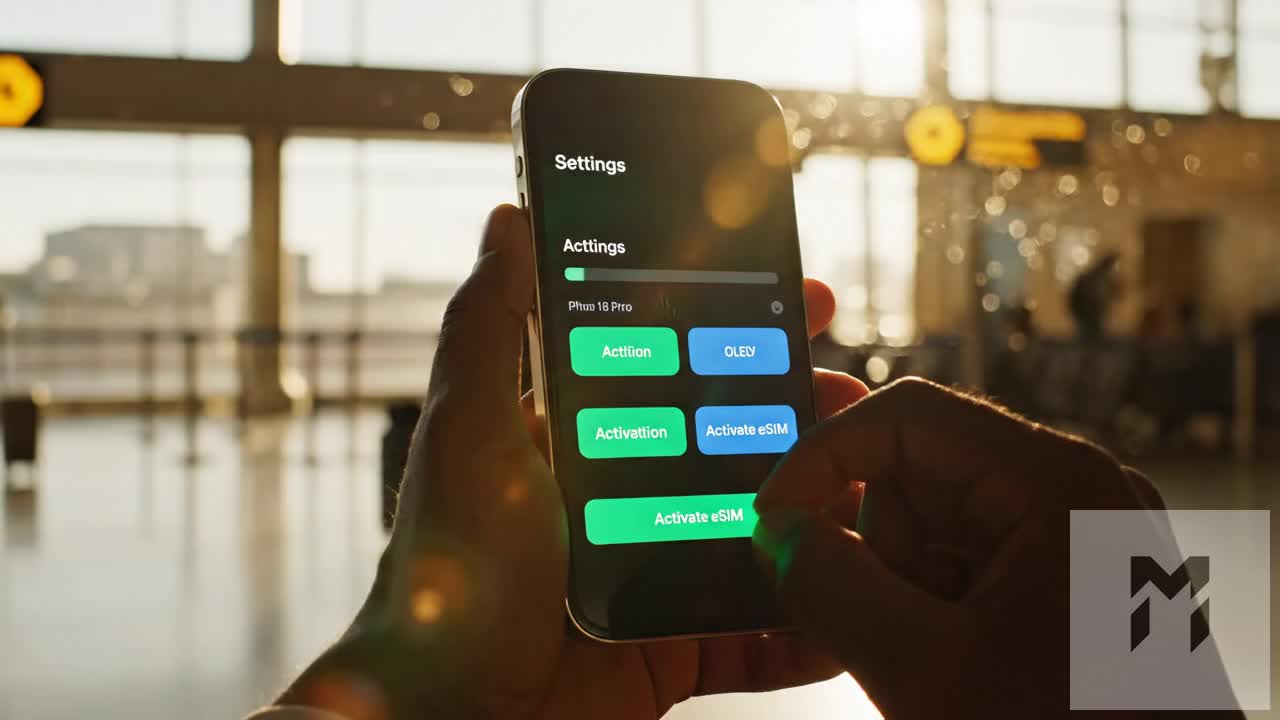
Setting up your digital data pipeline before boarding your flight ensures you avoid international roaming shocks, expensive airport telecom markups, and connectivity blackouts upon arrival.
Installing MollySIM requires an active Wi-Fi connection. Complete the setup at home or in your departure lounge so your device is primed to latch onto Mexican cell towers the second your plane touches the tarmac at Cancun International (CUN) or Tulum Felipe Carrillo Puerto Airport (TQO).
Pre-Flight Installation: iOS & Android Walkthrough
Most travelers purchase their eSIM on the same smartphone they plan to use. If you do not have a secondary screen or printed printout to scan the QR code, use the direct single-device methods below.
Apple iOS (iPhone XR, 11, 12, 13, 14, 15, 16 & Newer)
- Option A (Single-Device Image Scan): Save the QR code from your MollySIM confirmation email to your Photos app. Open the image, tap and hold the QR code directly, and select Add eSIM.
- Option B (Manual LPA Entry): Navigate to Settings > Cellular > Add eSIM > Use QR Code > tap Enter Details Manually at the bottom. Copy and paste the SM-DP+ Address and Activation Code provided in your confirmation email.
- Label Your Plans: Set your physical/primary carrier as Primary (for receiving 2FA bank texts) and label the new eSIM as MollySIM or Travel.
- Configure Cellular Data Routing:
- Default Voice Line: Set to Primary (keep your home carrier active for emergency calls, but check your home carrier’s roaming charges).
- Cellular Data: Set to MollySIM.
- Allow Cellular Data Switching: Toggle this OFF to prevent your home carrier from silently charging you domestic roaming fees if signal fluctuates.
- Enable Data Roaming: Tap on the MollySIM cellular profile and toggle Data Roaming ON. (Note: MollySIM uses regional roaming agreements across Mexico; roaming must be active for the profile to function.)
Android (Samsung Galaxy, Google Pixel, Xiaomi)
- Navigate to Settings > Network & Internet (or Connections) > SIMs / SIM Manager.
- Tap Add eSIM (or Download a SIM).
- If installing manually without a second device: Tap Need help? or Enter activation code manually, then paste the LPA string.
- Set Preferred SIM for Mobile Data to MollySIM.
- Tap the MollySIM profile, enter its settings, and switch Mobile Data and Data Roaming to ON.
| Setup Parameter | Recommended Configuration | Purpose / Impact |
|---|---|---|
| Mobile Data Line | MollySIM | Directs all data traffic through high-speed local routes |
| Default Voice Line | Primary (Home SIM) | Keeps WhatsApp/iMessage and bank SMS verification live |
| Cellular Data Switching | OFF | Blocks home carrier from triggering $10–$15/day pass fees |
| Data Roaming (eSIM) | ON | Mandatory for authenticating on local Mexican networks |
| APN Settings | Automatic | Auto-configures; no manual proxy/port entry required |
Airport Arrival Playbook: Bypassing the "Shark Tank" at CUN & TQO
Arriving at Cancun International (specifically Terminals 2, 3, and 4) drops travelers directly into the infamous arrivals corridor colloquially known as the "Shark Tank"—a dense gauntlet of aggressive timeshare sales reps, unofficial taxi touts, and overpriced airport retail kiosks.
Airport telecom booths in both CUN and the newly opened TQO airport routinely charge between $40 and $60 USD for low-tier, 2GB–3GB physical tourist SIM cards that require physical passport registration and long activation wait times.
With MollySIM pre-installed, your arrival routine changes completely:
- Instant On-Tarmac Connectivity: The moment the aircraft touches down, switch Airplane Mode OFF. Your phone will lock onto the local partner towers within 30 to 45 seconds.
- Pre-Book Ground Transit on the Taxiway: By the time you reach the jet bridge, open the official ADO Móvil app to book your express coach ticket to Playa del Carmen or Tulum Centro at standard local rates ($12–$18 USD) instead of negotiating inflated terminal counter rates.
- Hail App-Based Rides with Confidence: Rideshare regulations around CUN require Ubers to pick up passengers at specific outer terminal roadways. Real-time data lets you coordinate pickup points, track driver license plates, and avoid unauthorized "pirate" cabs charging upwards of $120 USD for short transfers.
- Coordinate Shuttles via WhatsApp: Instantly message your private transfer dispatcher or Airbnb host to confirm your exit gate while clearing customs, completely bypassing the terminal sales desks.
Even if you consume excessive high-speed data streaming videos during a flight delay, MollySIM’s baseline 384kbps Fair Use Policy (FUP) keeps your WhatsApp messages, ride-hail tracking, Google Translate phrases, and Apple Pay authentication functioning smoothly without stranding you at the gate.
Zero-Downtime Guarantee: The Strategic Advantage of MollySIM’s 384kbps Unlimited Fallback
Running out of high-speed data on an isolated stretch of Highway 307 between Playa del Carmen and Tulum—or deep on the jungle access road to Cenote Sac Actun—is not merely an inconvenience; it is an immediate safety and logistical risk. Traditional tourist SIMs and standard travel eSIM providers handle data plan exhaustion with one of two user-hostile policies: an abrupt hard cutoff (0 kbps) that strands you without warning, or aggressive throttling down to 64 kbps or 128 kbps.
At 64–128 kbps, modern HTTPS security handshakes consistently time out. App interfaces freeze on infinite loading spinners, rendering navigation and communication completely non-functional.
MollySIM eliminates connection anxiety by engineering a 384 kbps unlimited baseline Fair Use Policy (FUP) into every plan. By maintaining throughput at three times the speed of conventional throttled tiers, your device retains the continuous bandwidth required to execute critical travel operations without requiring an immediate Wi-Fi network to recover.
┌─────────────────────────────────────────────────────────────────────────┐
│              FALLBACK SPEED BENCHMARK: 384 KBPS VS 128 KBPS             │
├────────────────────────────┬───────────────────┬────────────────────────┤
│ Application / Travel Task  │ Standard (128k)   │ MollySIM FUP (384k)    │
├────────────────────────────┼───────────────────┼────────────────────────┤
│ Google Maps Vector Routing │ Connection Timeout│ Smooth (1.5s refresh)  │
│ WhatsApp Voice Notes       │ Packet Loss / Fail│ Crisp Opus Playback    │
│ Uber / DiDi Ride Requests  │ SSL Handshake Fail│ Active GPS & Dispatch  │
│ Google Translate Live Text │ Failed API Fetch  │ Instant Results        │
│ Apple Pay / Banking 2FA    │ Auth Timeout Error│ Instant Token Sync     │
└────────────────────────────┴───────────────────┴────────────────────────┘
Real-Time Mission-Critical Performance at 384kbps
Even after your allocated premium gigabytes reach zero, a 384 kbps data stream reliably sustains critical travel workflows:
- Turn-by-Turn GPS Navigation: While satellite mapping overlays require high bandwidth, dynamic vector rendering in Google Maps, Apple Maps, and Waze consumes roughly 40–80 kbps. Turn warnings, dynamic rerouting around construction on the Federal 307, and highway hazard alerts stream continuously.
- WhatsApp Communication with Local Operators: WhatsApp audio messages encoded via the Opus codec require only 12–24 kbps. You can exchange real-time voice notes and text coordinates with Cozumel dive boats, Tulum private shuttle drivers, or Airbnb hosts without buffering or failed outbound packets.
- On-Demand Ride Hailing: The Uber and DiDi applications require steady telemetry to transmit your GPS coordinates and fetch driver match metadata. MollySIM’s 384 kbps connection successfully clears the back-and-forth authentication loops that fail under lower throttled speeds.
- Cloud Translation & Security Tokenization: Instant translation queries through Google Translate, two-factor authentication (2FA) SMS syncs, and digital wallet security token generation (Apple Pay / Google Wallet) authenticate seamlessly at regional checkout counters.
Practical Tips for Data Management & Zero-Interruption Top-Ups
To maintain peak LTE/5G speeds while exploring the Mexican Caribbean, pair your fallback protection with proactive usage habits:
- Pre-Download Offline Geographic Regions: Before leaving your resort Wi-Fi, cache offline map zones covering Cancun down to Punta Allen, including the entirety of Cozumel. This frees your cellular connection entirely for live traffic and background messaging.
- Engage Low Data Mode: In iOS (Settings > Cellular > Cellular Data Options) or Android (Settings > Network & internet > Data Saver), toggle Low Data Mode on. This halts automatic cloud photo backups, background app refreshes, and app store updates from burning through your primary high-speed allocation.
- Frictionless In-App Top-Ups: If you hit your high-speed limit while island-hopping or deep in the jungle, you do not need to search for local physical kiosks or install new eSIM profiles. Access your account dashboard directly over the 384 kbps connection and add an instant data top-up with zero service interruption.
🌐 Global Travel High-Speed Travel eSIM & SIM Plans
Instant QR code activation, hotspot enabled, with guaranteed 384kbps fallback speed to keep Maps & Digital Wallets active.