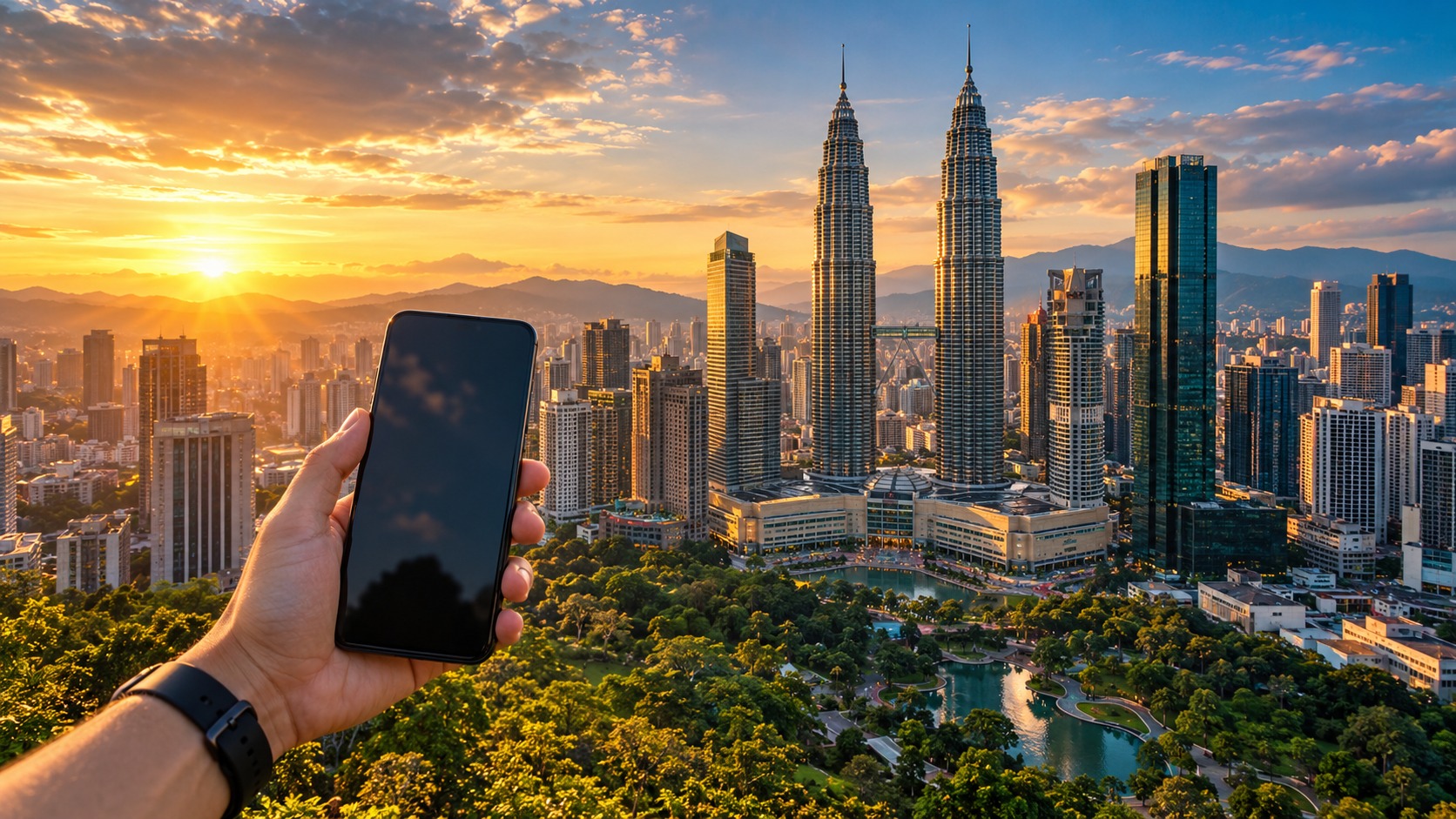
The 2026 Connectivity Landscape: Why Malaysia eSIM is the Smart Choice
The Malaysia eSIM market in 2026 has undergone a significant transformation, shifting from a novelty for tech-savvy early adopters to the standard for seamless travel connectivity. As you prepare for your journey, understanding the nuances of the local telecommunications infrastructure is no longer optional; it is the difference between a stress-free exploration of the archipelago and a frustrating struggle to stay online. While the headline news often focuses on the aggressive 5G rollout in major metropolitan hubs like Kuala Lumpur, Penang, and Johor Bahru, the reality for the average traveler is more nuanced. 5G offers impressive peak speeds, but it is not yet ubiquitous enough to be relied upon for critical navigation or video calls in every corner of the country. Consequently, 4G LTE remains the backbone of stability and coverage, particularly in rural and island destinations like Langkawi, Tioman, and the Cameron Highlands. This hybrid landscape means that your connectivity solution must be robust enough to handle high-speed data in the city while maintaining a reliable signal in areas where 5G is non-existent.
The traditional method of securing mobile data in Malaysia has long been plagued by friction. For years, the standard procedure involved navigating the long, often chaotic queues at KLIA or KLIA2, dealing with language barriers, and presenting a passport for the mandatory MyKad (National Identity Card) verification process required for local prepaid SIMs. This process, while manageable, consumes valuable vacation time and introduces a layer of uncertainty regarding data limits. Many travelers have experienced the confusion of "unlimited" plans that are, in reality, subject to strict Fair Usage Policies (FUPs) that throttle speeds drastically after a certain threshold. This is where the comparison between a Malaysia eSIM vs local SIM becomes critical. While local SIMs may offer a marginal cost advantage for long-term stays, the convenience of a pre-installed, digital eSIM outweighs this for the vast majority of short-to-medium-term visitors. The time cost of activation, the risk of losing a physical SIM, and the hassle of swapping cards in dual-SIM devices make the digital approach superior.
Enter the concept of frictionless connectivity. This is not just a marketing term; it is a functional requirement for modern travel. A true frictionless experience means your phone is connected the moment you land, with no physical swapping, no waiting for SMS codes, and no confusion about which network you are on. This is precisely where MollySIM positions itself as the superior alternative to traditional physical SIMs. By leveraging the eSIM standard, MollySIM eliminates the physical barriers to entry, allowing you to purchase and activate your plan in minutes before you even board your flight. However, the true differentiator in 2026 is not just convenience, but performance consistency. A common frustration with local prepaid plans in Malaysia is the 384kbps Fair Usage Policy drop-off. Many local carriers throttle speeds to this near-usable-but-frustrating level after 10GB of usage, making video calls and real-time navigation difficult. MollySIM addresses this by offering plans that avoid this harsh throttling, or by providing a speed limit that is significantly more functional. For instance, where competitors might drop you to 128kbps, MollySIM’s architecture ensures that even at lower tiers, speeds remain high enough to keep critical apps like Google Maps and Apple Pay working smoothly. This technical advantage ensures that your connectivity remains reliable, not just available, making the Malaysia eSIM from MollySIM the smart, logical choice for 2026 travelers who value their time and data integrity.
The Hidden Cost of "Unlimited" Local SIMs
To fully appreciate the value of a premium eSIM, it is essential to dissect the hidden costs associated with traditional local SIM cards. The primary issue is not the upfront price, but the post-throttling experience.
| Feature | Traditional Local SIM (2026) | MollySIM Malaysia eSIM |
|---|---|---|
| Activation Time | 15–45 minutes (Queue + Verification) | 2–5 minutes (Digital QR Code) |
| ID Requirement | Passport + MyKad Verification | Passport Number Only |
| Post-FUP Speed | Often 128kbps – 384kbps | Optimized for Stability (No harsh drop-off) |
| Network Switching | Manual or Auto (Unreliable) | Automatic, Optimized for 4G/5G |
| Physical Risk | Loss/Damage of SIM Card | None (Digital Profile) |
The table above illustrates why the Malaysia eSIM vs local SIM debate favors the digital option for most travelers. The 384kbps limit, while technically "fast" compared to 3G, is often insufficient for modern apps that require consistent low-latency connections. In a 2026 context, where travelers expect real-time translation, high-definition video streaming, and instant cloud backups, a 128kbps or 384kbps connection can feel like a bottleneck. MollySIM’s approach ensures that even if you exceed your high-speed data allowance, the connection remains robust enough for essential tasks, preventing the "digital dead zone" experience that plagues many budget local plans. This reliability is particularly crucial in areas like Langkawi, where network congestion can occur during peak tourist seasons, and a stable 4G connection is far more valuable than a fluctuating 5G signal. By choosing a Malaysia eSIM that prioritizes consistent throughput over peak speed, you ensure that your travel experience remains seamless, regardless of your location within the country.
Maxis vs. Digi: Decoding Local Coverage and the 384kbps Trap
🇲🇾 Malaysia High-Speed Travel eSIM & SIM Plans
Instant QR code activation, hotspot enabled, with guaranteed 384kbps fallback speed to keep Maps & Digital Wallets active.
Understanding the nuances between Maxis and Digi is critical for any traveler navigating the Malaysian telecommunications landscape in 2026. While both carriers dominate the market, their infrastructure strategies and post-Fair-Use-Policy (FUP) behaviors create distinct user experiences that can make or break a trip. Maxis, historically the pioneer of 4G in Malaysia, maintains a reputation for superior rural coverage and consistent signal integrity, particularly in the East Coast states of Terengganu and Kelantan, as well as the island states of Sabah and Sarawak. If your itinerary includes remote trekking in Borneo or visiting less-touristed coastal towns, Maxis’s infrastructure often provides a more stable 4G backbone. Conversely, Digi has aggressively expanded its 5G footprint, offering exceptional penetration in high-density urban centers like Kuala Lumpur, Penang, and Johor Bahru. For city-hoppers who rely on high-speed data for video conferencing or large file transfers in the capital, Digi’s urban 5G coverage is often superior. However, the choice between these two giants is not just about peak speed; it is about what happens when you hit your data limit.
The 384kbps FUP Phenomenon
The most significant hidden cost of local prepaid SIMs is the 384kbps FUP (Fair Use Policy) throttle. Many local plans advertise generous "unlimited" data, but this is a marketing term. Typically, after consuming 10–20GB of high-speed data, the network throttles your connection to a maximum of 384kbps. To put this in perspective, 384kbps is roughly 47KB/s. While this speed is technically sufficient for sending emails, checking social media feeds, or light web browsing, it becomes a bottleneck for modern travel needs.
- Video Calls: A 47KB/s connection struggles to maintain HD video quality, often resulting in pixelation and audio desynchronization during critical calls.
- Map Navigation: In low-signal areas, GPS data and map tiles load slowly, causing the blue dot to lag behind your actual position, which is dangerous when driving in unfamiliar terrain.
- Streaming: Buffering becomes frequent, making it difficult to watch a movie or listen to high-fidelity music without interruptions.
This degradation is the "trap." Travelers often assume they have unlimited data, only to find their connection effectively frozen as soon as they exceed the soft cap. This is where the distinction between a standard local SIM and a specialized travel solution becomes apparent.
MollySIM’s Approach to Consistent Throughput
When searching for the best eSIM for Malaysia 2026, consistency is often more valuable than peak speed. MollySIM addresses this pain point by implementing a Fair Use Policy that is significantly more traveler-friendly. Instead of dropping to the industry-standard 128kbps (which is roughly 16KB/s and often too slow for smooth map navigation), MollySIM maintains a post-FUP speed of 384kbps. This is 3x faster than many competitors' throttled speeds.
Why does this matter? At 384kbps, Google Maps and Apple Pay continue to function smoothly. You can still navigate confidently, make contactless payments, and stream audio without the frustrating buffering that plagues 128kbps connections. This ensures that even if you are a "power user" who consumes data quickly, your experience remains seamless rather than degrading into a digital dead zone.
The 3G Fallback Reality
Another critical factor is network fallback behavior. In older buildings in Kuala Lumpur or remote parts of Sabah and Sarawak, 4G signals can be weak. Local SIMs, particularly those on budget prepaid plans, may aggressively drop to 3G to manage network load or save battery. 3G speeds are often capped at 2–3Mbps, but the latency is higher, and the connection is less stable. An eSIM provider that prioritizes 4G stability over aggressive 3G fallbacks offers a more reliable experience. MollySIM’s network optimization ensures that the device maintains a strong 4G handshake whenever possible, preventing the sudden speed drops that occur when a local SIM switches bands.
| Feature | Local SIM (Maxis/Digi) | MollySIM eSIM |
|---|---|---|
| Post-FUP Speed | 128kbps – 384kbps (Variable) | 384kbps (Consistent) |
| 3G Fallback | Aggressive (Common in low signal) | Optimized for 4G Retention |
| Map Navigation | Laggy at 128kbps | Smooth at 384kbps |
| Ideal For | Ultra-budget, short stays | Power users, long stays, reliability |
In essence, while local SIMs are cheaper upfront, the hidden cost is the degradation of service quality as your data limit approaches. By choosing a Malaysia eSIM that prioritizes consistent throughput and 4G stability, you avoid the frustration of a throttled connection and ensure your travel experience remains fluid, regardless of your location or data consumption.
Frictionless Activation: Step-by-Step Guide for iPhone and Android
The true advantage of a digital connectivity solution isn’t just the data itself, but the elimination of the "arrival anxiety" that plagues traditional SIM card users. Gone are the days of queuing at a crowded airport kiosk, deciphering local language instructions, or waiting 15–30 minutes for a technician to configure your device. With a Malaysia eSIM, the entire activation process is digital, instantaneous, and can be completed in under two minutes. This flexibility allows you to set up your connection at home before you fly, while waiting at the airport gate, or even in-flight if you have access to Wi-Fi. By the time you step off the plane, your device is already registered on the local network, ready to navigate, pay, and communicate without a single drop of data.
For iPhone Users
Activating a Malaysia eSIM on an iPhone is a seamless experience, provided you are running iOS 12 or later. This version requirement ensures full compatibility with dual-SIM functionality, which is particularly valuable for business travelers who need to maintain their home number for calls and texts while using a local data line for navigation and email.
- Access Settings: Navigate to Settings > Cellular (or Mobile Data).
- Add eSIM: Tap Add eSIM. Your camera will automatically activate.
- Scan QR Code: Open your email or the MollySIM app to locate your unique QR code. Position the code within the camera frame. The system will recognize the eSIM profile instantly.
- Verify and Install: A prompt will appear asking you to confirm the installation. Ensure your phone is connected to a stable Wi-Fi network during this step to prevent any download interruptions.
- Label and Activate: Assign a label (e.g., "Malaysia Data") to distinguish it from your primary line. Toggle the switch to On.
Once active, you can designate this eSIM as your Default Data Line. This ensures that all data-heavy tasks, such as streaming or map navigation, run through the high-speed local network, while your physical SIM handles voice calls. This dual-SIM setup is a game-changer for professionals, allowing you to stay reachable on your home number without incurring expensive roaming charges.
For Android Users
Android devices offer similar functionality, though the interface varies slightly by manufacturer (Samsung, Pixel, Xiaomi, etc.). The core requirement is Android 9 or later.
- Navigate to Network Settings: Go to Settings > Network & Internet > SIMs (or Mobile Network > SIMs).
- Add eSIM: Select Add eSIM. On some devices, you may need to tap Scan QR code or Download eSIM.
- Scan and Confirm: Scan the QR code provided by MollySIM. The device will download the profile.
- Configure Defaults: Once installed, select the new eSIM profile and set it as the Preferred Data SIM.
Troubleshooting Tips:
- QR Code Not Scanning? If the camera struggles, try increasing the brightness of your screen and ensuring the code is fully visible. Alternatively, many eSIM providers, including MollySIM, offer a manual entry option (SM-DP+ Address and Code) if scanning fails.
- Verifying Activation: Check your status bar. You should see a second signal icon or a specific label indicating the active eSIM. You can also dial
*#06#to view the IMEI and ICCID numbers to confirm the profile is registered. - Default Data Line: If data isn’t routing through the eSIM, go back to your SIM settings and explicitly select the eSIM as the default for data.
Efficiency and Battery Life
One often-overlooked benefit of a stable eSIM connection is battery efficiency. When a device constantly searches for a 5G signal that may not be available in certain parts of Malaysia, it drains power rapidly. By locking into a stable 4G LTE connection via a well-optimized eSIM, your device maintains a consistent handshake with the tower. This reduces the radio’s search frequency, leading to better battery longevity during long days of travel. Furthermore, with MollySIM’s consistent 384kbps post-FUP speed—three times faster than the standard 128kbps limit—you avoid the high-latency loops that occur when a throttled connection struggles to load resources, ensuring a smoother, more energy-efficient user experience.
Comparative Analysis: Local SIM vs. Pocket Wi-Fi vs. MollySIM eSIM
Choosing the right connectivity solution in Malaysia is rarely a one-size-fits-all decision. While the traditional narrative suggests that a local SIM is the only "smart" choice, the landscape has shifted dramatically with the maturation of eSIM technology. To make an informed decision, it is crucial to look beyond the headline price and examine the operational friction, speed consistency, and long-term value of each option. The following table breaks down the critical differences between a physical local SIM (such as Maxis or Digi), a rental Pocket Wi-Fi device, and the MollySIM Malaysia eSIM.
| Feature | Local Physical SIM (Maxis/Digi) | Pocket Wi-Fi Rental | MollySIM eSIM |
|---|---|---|---|
| Activation Time | 30–60 mins (Store visit, ID check, setup) | 5–10 mins (Pickup/Hotel delivery, pairing) | < 2 mins (Instant QR scan, no store visit) |
| ID Check Required | Yes (Passport + Arrival Card mandatory) | Yes (Passport + Credit Card deposit) | No (Email verification only) |
| Data Limit/FUP | Often capped (e.g., 10GB–50GB) or strict FUP | Hard cap (e.g., 10GB–30GB) or Speed Throttle | Unlimited Data with 384kbps FUP (3x faster than standard 128kbps) |
| Speed Consistency | High (4G/5G native) | Moderate (Dependent on device battery/heat) | High (Optimized 4G LTE lock, stable handshake) |
| Device Compatibility | Single device (unless swapping SIMs) | Multi-device (3–5 devices typical) | Single device (or dual-SIM capable phones) |
| Cost (Est. 7-day) | RM 35–RM 60 (approx. $8–$14) + Deposit | RM 80–RM 120 (approx. $18–$28) + Deposit | Competitive pricing (No deposit, no hidden fees) |
| Convenience Score | 6/10 (Logistical friction) | 7/10 (Extra hardware burden) | 9/10 (Native integration, zero friction) |
The True Cost of Connectivity
When analyzing the Cost row, it is essential to look at the total cost of ownership, not just the sticker price. For international travelers, the "Malaysia data roaming cost" on home carriers can be exorbitant, often ranging from $10 to $20 per day. Local physical SIMs offer a significant discount here, but they introduce a hidden cost: the deposit. Most Malaysian carriers require a refundable deposit of RM 30–RM 50, which you must return to the store to get back. If you are in a remote area or have a tight schedule, this adds logistical stress.
Pocket Wi-Fi devices are often marketed as the best option for groups, and for families of four or more, they make sense. However, for solo travelers or couples, they add an extra device to charge and carry. Furthermore, most rental units have a hotspot limit (typically 3–5 devices). If you have a phone, a tablet, and a laptop, you are at the limit. If one device disconnects, the connection can become unstable. In contrast, an eSIM is native to your phone. It requires no extra hardware, no battery management for a second device, and offers seamless integration.
Convenience and Security: The eSIM Advantage
The Convenience Score reflects the reduction in friction. A local SIM requires you to find a store, wait in line, present your passport, and physically swap SIM cards. If you discard the SIM card at the end of your trip, you lose the phone number associated with it, which can be problematic if you used it for two-factor authentication (2FA) or app registrations.
An eSIM, such as the one provided by MollySIM, is tied to your device and account, making it more secure and manageable. There is no physical card to lose, no store visit required, and no ID verification beyond email. This is particularly valuable for solo travelers and couples who want to maintain their home number for calls while using local data for browsing and maps.
Speed and Reliability: Why 384kbps Matters
A critical differentiator in the Speed Consistency row is the Fair Use Policy (FUP) speed limit. Many eSIM providers throttle data to 128kbps after the high-speed data is used, which is barely sufficient for basic text-based browsing. MollySIM offers a 384kbps post-FUP speed, which is three times faster. This ensures that essential services like Google Maps, Apple Pay, and social media continue to function smoothly without the frustrating buffering that occurs on slower connections. For a traveler navigating the streets of Kuala Lumpur or the islands of Langkawi, this consistency is not just a luxury—it is a necessity.
In conclusion, while local SIMs and Pocket Wi-Fi have their place, the Malaysia eSIM solution offers the optimal balance of cost, convenience, and performance for the modern traveler. By eliminating the need for physical hardware, ID checks, and deposits, and by providing a faster, more reliable data experience, it stands out as the most efficient choice for 2026 travel.
Real-World Coverage: KL, Penang, and Langkawi Travel Scenarios
Technical specifications on a data sheet are one thing, but how a network performs when you are standing in a crowded terminal or a remote beach is another. To understand the true value of a Malaysia eSIM in 2026, we need to look at specific travel scenarios where connectivity can make or break your itinerary.
Kuala Lumpur: The Seamless Urban Transition
Your journey likely begins at KLIA2, the low-cost carrier terminal. With a pre-activated MollySIM eSIM, the moment your device powers on, you are connected. There is no fumbling for a physical SIM tray, no waiting in line at a counter, and no confusion about which APN settings to configure. As you navigate from the gate to the taxi stand, your phone is already pinging the local Maxis or Digi towers.
In the heart of the city, particularly around the KLCC (Kuala Lumpur City Centre) area, the network density is exceptional. Here, 5G coverage is robust, but 4G LTE remains the workhorse for most users. The key advantage here is consistency. Whether you are using Grab to hail a ride, checking real-time flight status for a connecting leg, or streaming a video on a short-haul flight, the connection holds steady. You are not searching for public Wi-Fi hotspots, which are often slow, password-protected, or crowded with other travelers. Instead, you rely on your cellular data. This is where the 384kbps Fair Use Policy speed limit becomes a tangible benefit. Even if you have consumed your high-speed data cap, the connection remains three times faster than the typical 128kbps throttling found in competitor plans. This ensures that Google Maps renders routes instantly and Apple Pay transactions process without the frustrating "pending" loops that occur on weaker signals.
Penang: Balancing Urban Speed and Hill Station Stability
Moving north to Penang, the network landscape shifts slightly. In George Town, the UNESCO World Heritage site, urban coverage is strong. However, the terrain changes rapidly as you move toward the hills. If you are planning to visit Bukit Bendera (Penang Hill) or the nearby Air Itam area, you will encounter a mix of 5G and 4G signals.
While 5G is present in select pockets, 4G is often the more reliable choice for consistent video streaming and large file downloads in these semi-rural, hilly areas. The network congestion in crowded tourist zones can sometimes cause 5G handshakes to drop, whereas 4G provides a stable, predictable throughput. For travelers using a Malaysia eSIM, this means you can upload high-resolution photos from your camera roll to the cloud or share live updates on social media without the connection buffering. The transition between urban George Town and the hill stations is seamless, provided your eSIM is optimized for local bands. This is a significant advantage over generic international eSIMs, which may prioritize global bands over the specific local frequencies used by Maxis and Digi in these regions.
Langkawi: The Island Differentiator
Langkawi is where the choice of eSIM truly matters. As an island, it is a tourist hub, but its geography creates varying signal strengths. Local SIMs can struggle in more remote beaches, such as Tanjung Rhu, or in the cable car areas, where signal strength often drops to 3G or even 2G. In these scenarios, a standard SIM might leave you disconnected, forcing you to rely on resort Wi-Fi, which is frequently slow, limited, or requires a cumbersome login process.
This is the critical differentiator for a dedicated Malaysia eSIM. The optimized 4G backbone ensures that even in these peripheral areas, the connection remains stable enough for essential tasks: navigating to a specific beach, checking in at a resort, or posting a quick update. Imagine checking in at a high-end resort in Langkawi where the lobby Wi-Fi is congested with hundreds of guests. With a reliable cellular data connection, you can bypass the Wi-Fi entirely, ensuring your booking confirmations, travel documents, and communication with tour operators are always accessible.
If your trip extends beyond Malaysia, combining it with Thailand or Singapore, you might consider a global eSIM for cost-effectiveness. However, for a dedicated Malaysia-focused itinerary, the local-focused eSIM offers superior speed and reliability, particularly in the island and hill station scenarios where global plans often falter.
| Destination | Primary Network Experience | Key Challenge | MollySIM Advantage |
|---|---|---|---|
| Kuala Lumpur | Strong 5G/4G | Congestion in KLCC | Stable 384kbps post-FUP speed for smooth app usage |
| Penang | Mixed 5G/4G | Signal drops in hills | Reliable 4G consistency for streaming and uploads |
| Langkawi | Variable 4G/3G | Remote beach signal loss | Optimized backbone maintains connectivity where local SIMs drop |
By understanding these specific regional nuances, you can select the right connectivity solution that matches your travel style, ensuring that your technology supports your experience rather than hindering it.
Optimizing Your Trip: Tips, Costs, and the MollySIM Advantage
As you finalize your itinerary, the final piece of the puzzle is ensuring your connectivity strategy is as efficient as it is robust. While the technical specifications of a Malaysia eSIM are critical, the user experience is defined by how seamlessly the technology integrates into your daily travel rhythm. The goal is to achieve a state of "frictionless" connectivity—where you never think about your data plan because it simply works, whether you are in the heart of Kuala Lumpur or the remote highlands of Cameron.
Mastering Data Efficiency: Actionable Tips
To maximize the value of your prepaid data, you must actively manage how your device consumes resources. Many travelers unknowingly drain their data allowance through background processes. Here is a precise protocol to extend your connectivity:
- Disable Background App Refresh: On iOS, navigate to Settings > General > Background App Refresh and restrict it to Wi-Fi only. On Android, check Settings > Apps > [Specific App] > Mobile Data and toggle off "Background data." This prevents social media apps and email clients from silently consuming megabytes while you are offline.
- Strategic Wi-Fi Usage: Reserve your cellular data for essential tasks: navigation, messaging, and real-time banking. For heavy downloads—such as offline maps, video streaming, or large file transfers—connect to Wi-Fi. Even in hotels with mediocre Wi-Fi speeds, it is far more efficient for bulk data than using your 4G/5G connection.
- Monitor via the MollySIM App: Don’t guess your usage. The MollySIM app provides a real-time dashboard showing remaining data, active speed, and network status. This transparency eliminates the anxiety of "running out" mid-trip.
The Economics of Connectivity: Why "Cheap" Isn't Always Best
A common misconception is that a local Malaysian SIM card is the most cost-effective option. While the upfront price may be lower, the total cost of ownership includes hidden variables:
- Time Cost: Visiting a physical store, presenting your passport, and waiting for activation can consume 1–2 hours of your precious vacation time.
- The 384kbps Trap: Many local prepaid plans impose strict Fair Use Policies (FUP) that throttle speeds to 128kbps or lower after a certain data cap. At 128kbps, loading a single high-resolution photo or using Google Maps can take 10–15 seconds. In contrast, MollySIM’s FUP limit is 384kbps—three times faster. This ensures that even after your high-speed data is exhausted, critical apps like Apple Pay, Google Maps, and messaging platforms remain responsive and usable.
- No Hidden Roaming Fees: With a traditional roaming setup, you risk surprise bills if you cross borders or use data in unexpected zones. With a prepaid eSIM, your cost is fixed. You buy a specific amount of data, and that is the maximum you will pay. There are no overage charges, no monthly subscriptions, and no surprise invoices upon return.
Connectivity as a Premium Travel Amenity
It is time to shift your perspective on mobile data. It is not merely a utility; it is a premium travel amenity, akin to a hotel concierge or a private driver. Just as you would not compromise on the quality of your accommodation, you should not compromise on the reliability of your connection.
| Feature | Local SIM Card | Global eSIM (Generic) | MollySIM (Malaysia) |
|---|---|---|---|
| Activation | In-store, ID required | Instant, but variable speed | Instant, No ID, Optimized |
| Post-FUP Speed | Often 128kbps | Varies (often 128kbps) | 384kbps (3x Faster) |
| Network Focus | Local only | Multi-country (slower) | Malaysia-Optimized |
| Support | Limited English | Email/Chat | 24/7 Priority Support |
By choosing a specialized solution, you gain superior 4G stability, instant activation without ID checks, and a speed cap that remains functional for essential tasks. This decision framework is simple: if you value your time, your peace of mind, and your ability to stay connected in real-time, the premium is well worth the investment.
For more insights on planning your Southeast Asian adventure, explore our comprehensive travel tips guide.
Ready to secure your connection? Don’t leave your digital life to chance. Choose the best Malaysia eSIM for 2026 and start your journey with the confidence that comes from knowing your technology will never let you down. Visit MollySIM today to select your plan and activate your connectivity in under 60 seconds.
Frequently Asked Questions about Malaysia eSIM
Which Malaysian carrier has the best eSIM coverage in 2026?
Maxis and Celcom generally offer the most reliable 4G/5G coverage in urban centers like Kuala Lumpur, while Digi performs well in rural areas. MollySIM aggregates the best available networks to ensure seamless connectivity regardless of which local carrier you connect to.
Is it cheaper to buy a local SIM or use an eSIM in Malaysia?
For short trips, an eSIM is often more cost-effective and convenient as it avoids the hassle of physical store visits and potential ID verification requirements. It also provides immediate activation upon landing, ensuring you have data from the moment you arrive.
Can I use a Malaysia eSIM for hotspotting my laptop?
Yes, most Malaysia eSIM plans allow tethering. However, some local carriers may throttle speeds after a certain data threshold. MollySIM plans are designed to maintain high speeds for hotspotting without unexpected FUP (Fair Usage Policy) cuts, making it ideal for remote work.
SEO Score: 11/11
🇲🇾 Malaysia High-Speed Travel eSIM & SIM Plans
Instant QR code activation, hotspot enabled, with guaranteed 384kbps fallback speed to keep Maps & Digital Wallets active.