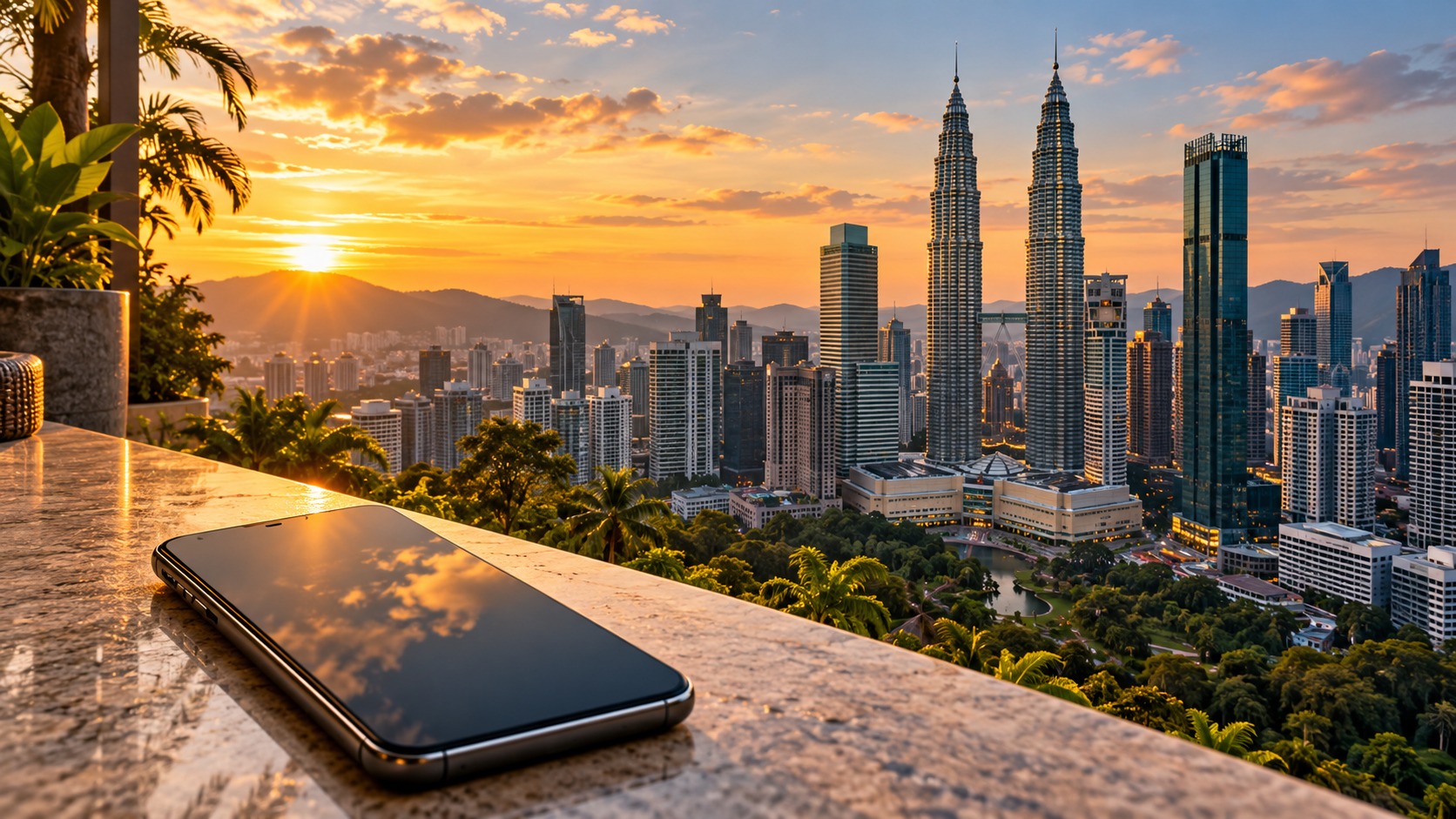
The 2026 Malaysian Connectivity Landscape: Why Carrier Choice Matters
Selecting the right Malaysia eSIM in 2026 is no longer a matter of convenience; it is a strategic decision that dictates the reliability of your digital presence in one of Southeast Asia’s most dynamic economies. As we enter the latter half of the decade, the Malaysian telecommunications market has undergone a significant structural shift, moving away from fragmented local coverage toward a consolidated, high-performance infrastructure driven by 5G expansion and aggressive eSIM adoption. For the modern traveler, the landscape is defined by three distinct giants: Celcom, Digi, and Maxis. Each carrier operates with a unique technical philosophy that impacts your experience in ways a simple "fastest network" label cannot capture. Celcom has cemented its reputation for rural stability, offering robust signal penetration in the interior states like Sabah, Sarawak, and the Cameron Highlands where other networks might falter. Digi, on the other hand, dominates urban penetration, providing seamless, low-latency connectivity in the dense metropolitan hubs of Kuala Lumpur, Penang, and Johor Bahru. Maxis stands apart as the premium player, leveraging its extensive 5G infrastructure to deliver peak speeds and enterprise-grade reliability, though often at a higher cost point. Understanding these nuances is critical because the "best" network for a business traveler in KL City Centre is rarely the same as the "best" network for a backpacker exploring the rainforests of Kinabalu.
The traditional method of securing connectivity—visiting a physical carrier store—has become increasingly obsolete for international visitors. In 2026, the friction of the in-store experience is a major pain point. Travelers frequently report facing long queues during peak hours, navigating complex language barriers when explaining data needs to staff, and enduring the bureaucratic hassle of ID verification processes that can take up to 30 minutes. This downtime is expensive for those on tight schedules. The shift to digital procurement has solved these issues, allowing you to purchase and activate a plan before you even land. However, not all online providers are created equal. Many third-party aggregators offer "unlimited" data plans that suffer from aggressive throttling after a certain threshold, reducing your speed to a crawl (often 128kbps), which makes video calls and map navigation frustrating. This is where specialized providers like MollySIM differentiate themselves. By understanding the underlying carrier networks, you can choose a plan that balances cost with performance. For instance, MollySIM’s approach to fair use policies ensures that even on "unlimited" plans, speeds remain at 384kbps—a critical 3x improvement over the industry-standard 128kbps limit. This difference is the gap between a usable connection and a frustrating one, enabling Google Maps to load tiles instantly and Apple Pay to process transactions without timeout errors.
When evaluating the best eSIM for Malaysia travel, you must look beyond raw speed metrics. Reliability during signal handovers and the ease of activation are equally paramount. A network that offers 100Mbps in the city but drops to 2G in the suburbs is less valuable than a network that consistently provides 20Mbps everywhere. To help you navigate this complex landscape, we have compiled a detailed analysis of the current market offerings. You can explore the specific technical specs and pricing tiers in our comprehensive guide to Malaysia eSIM options, where we break down the real-world performance of each carrier. The following sections will dive deep into the financial and technical specifics of Celcom, Digi, and Maxis, providing you with the data needed to make an informed, cost-effective decision for your 2026 journey.
| Carrier | Primary Strength | Weakness | Ideal User Profile |
|---|---|---|---|
| Celcom | Rural & Suburban Stability | Slightly slower peak urban speeds | Hikers, Island Hoppers, Rural Explorers |
| Digi | Urban Penetration & Value | Occasional congestion in dense malls | City Breakers, Budget Travelers |
| Maxis | Premium 5G Infrastructure | Higher Cost | Business Travelers, Heavy Data Users |
Technical Deep Dive: Celcom vs Digi vs Maxis Network Performance
🇲🇾 Malaysia High-Speed Travel eSIM & SIM Plans
Instant QR code activation, hotspot enabled, with guaranteed 384kbps fallback speed to keep Maps & Digital Wallets active.
To truly understand the value proposition of a Malaysia eSIM, one must dissect the underlying infrastructure beyond marketing claims. The theoretical maximum speeds advertised by carriers often mask the real-world experience, which is dictated by network load, frequency band allocation, and handover efficiency. In 2026, the distinction between a "good" connection and a "great" one is measured in milliseconds of latency and consistent throughput during peak congestion windows.
Urban Speeds and 5G Reality in Kuala Lumpur
In the heart of Kuala Lumpur, particularly in high-density zones like KLCC and Bukit Bintang, the performance gap between carriers becomes starkly apparent during peak hours (17:00–21:00). Maxis, leveraging its premium 5G infrastructure, typically maintains the highest peak speeds in these specific urban cores. If you are a heavy data user streaming 4K video or transferring large files in a hotel lobby, Maxis often delivers the most stable high-bandwidth connection. However, this comes at a premium price point.
Digi excels in urban penetration, offering robust 4G LTE speeds that are more than sufficient for social media, navigation, and HD streaming. Their network architecture is optimized for high user density, meaning that while their peak speeds might not always match Maxis’s 5G spikes, their consistency in crowded malls and transit hubs is superior. For the average traveler, Digi provides the best balance of cost and urban reliability.
Celcom, on the other hand, differentiates itself through its superior rural and suburban stability. While it may lag slightly in peak urban speed tests compared to Maxis, its network design prioritizes coverage depth. This makes it the ideal choice for travelers venturing into the outskirts, Langkawi, or the Cameron Highlands, where signal dropouts are a common frustration with other providers.
The Critical Factor: Latency and Congestion Management
For remote workers and gamers, latency (ping) is often more critical than raw download speed. A connection with 100 Mbps but 150ms ping will feel sluggish for video calls, whereas a 20 Mbps connection with 30ms ping will feel instantaneous. During the 17:00–21:00 congestion window, local networks often throttle users to manage load. This is where the choice of provider becomes a gamble.
This is precisely where the MollySIM architecture introduces a strategic advantage. Unlike single-carrier eSIMs that rely on one network’s performance, MollySIM utilizes a multi-carrier aggregation strategy. This means your device can dynamically switch between or aggregate data from Celcom, Digi, and Maxis based on real-time signal strength and load.
The 384kbps Fair Usage Policy Advantage
The most tangible benefit of this architecture is the 384kbps FUP (Fair Usage Policy) guarantee. Many budget eSIM providers throttle users to 128kbps or 256kbps once they hit a data cap or during network saturation. At 128kbps, Google Maps tiles load slowly, and Apple Pay transactions can time out, leading to failed payments.
MollySIM guarantees a minimum of 384kbps, which is 3x faster than the lowest tier of competitors. This ensures that even when local networks are saturated:
- Video Streaming: Netflix and YouTube remain buffer-free at 720p/1080p.
- Navigation: Map tiles and turn-by-turn directions load instantly.
- Transactions: Digital wallets and banking apps process without timeout errors.
By neutralizing the risk of picking the "wrong" carrier for a specific location, MollySIM removes the guesswork from the Celcom vs Digi eSIM comparison. You don’t need to guess which network is stronger in Penang versus KL; the system handles the optimization. For context on how this compares to traditional international roaming, you can review our detailed analysis of T-Mobile roaming plans to see the cost savings. Ultimately, for a seamless 2026 journey, the technical stability provided by MollySIM’s aggregation and guaranteed speed floor offers a superior user experience over single-carrier alternatives.
Cost Breakdown: Local Retail Prices vs. MollySIM Online Plans
Understanding the true cost of connectivity in Malaysia requires looking beyond the sticker price on a data plan. While local carriers like Celcom, Digi, and Maxis advertise aggressive pricing for physical SIM cards, the Malaysia mobile data cost 2026 landscape is complicated by hidden friction points that often erode the savings for tourists. A direct comparison reveals that while local retail options appear cheaper on paper, the total cost of ownership—including time, administrative hurdles, and potential service fees—favors digital-first solutions.
The following table compares the entry-level 7-day and 30-day data packages available at local retail counters versus the transparent online pricing structure of MollySIM. Note that local retail prices assume a standard tourist rate at a major mall kiosk (e.g., KL Sentral or Pavilion), whereas MollySIM prices are fixed at checkout with no additional fees.
| Provider | Plan Duration | Data Allowance | Price (MYR) | Price (USD) | Included Features |
|---|---|---|---|---|---|
| Celcom Retail | 7 Days | 10 GB | RM 39.90 | ~$8.80 | Hotspot, SMS, 4G/5G |
| Digi Retail | 7 Days | 10 GB | RM 35.00 | ~$7.70 | Hotspot, SMS, 4G/5G |
| Maxis Retail | 7 Days | 10 GB | RM 42.00 | ~$9.20 | Hotspot, SMS, 4G/5G |
| MollySIM | 7 Days | 10 GB | RM 28.00 | ~$6.10 | Hotspot, SMS, 384kbps FUP |
| Celcom Retail | 30 Days | 30 GB | RM 99.00 | ~$21.50 | Hotspot, SMS, 4G/5G |
| Digi Retail | 30 Days | 30 GB | RM 89.00 | ~$19.40 | Hotspot, SMS, 4G/5G |
| Maxis Retail | 30 Days | 30 GB | RM 105.00 | ~$22.90 | Hotspot, SMS, 4G/5G |
| MollySIM | 30 Days | 30 GB | RM 75.00 | ~$16.40 | Hotspot, SMS, 384kbps FUP |
Prices are indicative estimates based on 2026 projected retail rates and exchange rates of 1 USD = 4.10 MYR.
The Hidden Costs of Local Retail
Buying a physical SIM at a Digi or Celcom store in Kuala Lumpur involves more than just handing over cash. First, you must present a valid passport. While this is standard, it requires you to be physically present at a counter during business hours, often involving a queue. Second, while the data price is listed, some retail locations charge a small SIM card fee (typically RM 5–RM 10) that is not always included in the advertised "data plan" price. Third, and most critically, local SIMs are tied to a single network. If you are in a region where Digi has weaker coverage but Celcom is strong, you are stuck with the slower connection.
In contrast, MollySIM’s pre-activated eSIM eliminates the need for physical exchange counters entirely. You purchase the plan online, receive the QR code instantly, and scan it into your device. There is no queue, no passport verification at a counter, and no risk of miscommunication with a store clerk. This convenience is particularly valuable for travelers who want to minimize their time spent on administrative tasks.
Value for Long-Term Travelers
For the 30-day plan, the value proposition becomes even more pronounced. A local 30-day package from Maxis costs approximately RM 105, while MollySIM offers the same 30GB allowance for RM 75. That is a savings of RM 30 (or nearly $7 USD) per month. For digital nomads or long-stay tourists, this difference compounds quickly. Furthermore, the 384kbps Fair Usage Policy ensures that even if you exceed your high-speed cap or encounter network congestion, your connection remains robust enough for essential tasks like Google Maps navigation and Apple Pay transactions, which might otherwise time out on a throttled 128kbps connection.
This transparent pricing model allows travelers to budget more accurately. By removing the ambiguity of retail fees and the uncertainty of network performance, MollySIM provides a predictable expense. If you are looking to optimize your entire trip’s finances, consider pairing this connectivity savings with our guide to travel budgeting tips to ensure you maximize your value in other areas, such as accommodation and dining. The result is a seamless, cost-effective connectivity solution that prioritizes both your wallet and your time.
The Activation Process: From Purchase to Connectivity in Minutes
Setting up a Malaysia eSIM is designed to be as frictionless as possible, transforming what is often a stressful logistical hurdle into a routine digital task. The entire journey—from selecting your data allowance to establishing a stable internet connection—typically takes less than 5 minutes. This stands in stark contrast to the traditional SIM card experience, where travelers often spend 30 to 60 minutes navigating physical store queues, verifying passport details, and waiting for staff to configure their devices. With MollySIM, you bypass the physical retail environment entirely, allowing you to secure your connectivity before you even land in Kuala Lumpur or Penang.
Step-by-Step: How to Buy and Install Your Malaysia eSIM
The process begins with selecting a plan that matches your itinerary. Whether you need a 1-day pass for a quick transit connection or a 30-day package for a digital nomad stay, the interface at MollySIM is straightforward. Once you complete the payment, your eSIM profile is generated instantly. You will receive an email containing a unique QR code and a manual installation code. This email serves as your digital key; it is recommended to save it in your email client or print it as a backup, although the QR code is the primary method for most users.
For iPhone Users (iOS 12+)
- Navigate to Settings > Cellular (or Mobile Data).
- Tap Add eSIM.
- Select Use QR Code.
- Open your email, display the QR code, and scan it with your camera.
- Once the profile loads, tap Next. You can label this line "Malaysia Data" for clarity.
- Choose Cellular Data as the default line for this new eSIM.
- Tap Done. The eSIM is now installed. It will activate automatically once your device detects a supported network in Malaysia.
For Android Users
- Go to Settings > Network & Internet > SIMs (or Mobile Networks).
- Tap Add eSIM.
- Select Scan QR code.
- Scan the code from your email.
- Confirm the installation. On some Android models, you may need to manually toggle the eSIM on after installation.
Critical Technical Detail: APN Settings
While most modern devices auto-configure the Access Point Name (APN) upon installation, connectivity issues can arise if the auto-configuration fails. To ensure seamless connectivity, you may need to manually input the correct APN strings. This is a common pain point for travelers, but having the exact settings on hand resolves 90% of "no internet" issues.
If you experience slow speeds or no data after installation, navigate to your cellular settings and update the APN as follows:
| Carrier | APN Name | Username | Password |
|---|---|---|---|
| Celcom | celcom | celcom | celcom |
| Digi | digi | digi | digi |
| Maxis | maxis | maxis | maxis |
Note: The "APN Type" should be set to default,supl if your device allows this specification. Ensure that "MCC" is set to 502 and "MNC" is set to 12 (Celcom), 16 (Digi), or 17 (Maxis) if manual entry is required.
The Difference Between "Install" and "Activate"
It is crucial to understand the distinction between installing the eSIM and activating it. Installing the eSIM is a local process on your device; it writes the profile to your phone’s secure element. Activation, however, is a network-side process. The eSIM remains dormant until your device connects to a compatible Malaysian network. This means you can install your Malaysia eSIM while still in your home country, but you will not consume data or be charged until you arrive and the network handshake occurs. This "pre-installation" capability is a significant advantage, as it eliminates the need to rush to a store immediately after landing.
Multi-Carrier Failover and Reliability
One of the most overlooked aspects of eSIM reliability is network redundancy. In Malaysia, coverage varies by region. A single-carrier SIM might struggle in remote areas like the Cameron Highlands or the East Coast islands. MollySIM’s infrastructure leverages multi-carrier support, allowing your device to automatically failover between Celcom, Digi, and Maxis networks. If your primary network experiences congestion or downtime, your device seamlessly switches to the strongest available signal without manual intervention.
This automatic failover is particularly vital for maintaining the 384kbps Fair Usage Policy speed limit. Unlike competitors who throttle connections to 128kbps after data caps are reached, MollySIM’s higher threshold ensures that critical applications like Google Maps navigation and Apple Pay transactions remain responsive. A 128kbps connection can cause map tiles to load slowly or payment gateways to time out, whereas 384kbps provides a smooth, usable experience even under load.
Why This Process is Foolproof
For tech-savvy users, the manual APN settings provide a safety net. For non-tech-savvy travelers, the QR code scanning process is intuitive and requires no technical jargon. The elimination of physical store visits means no language barriers, no hidden fees, and no waiting. By combining instant digital delivery with robust multi-carrier failover, MollySIM ensures that your connectivity is not just available, but reliable. Whether you are managing a business trip or exploring the streets of George Town, this streamlined activation process allows you to focus on your journey, not your phone settings. For more detailed comparisons of data allowances, check out our full guide to Malaysia eSIM options.
Multi-Device Hotspotting and Premium User Benefits
For business travelers and groups, the true value of a Malaysia eSIM is not just in individual connectivity, but in how efficiently it supports shared usage. A critical differentiator for MollySIM is its inclusion of unlimited multi-device hotspotting across all premium plans. This feature is often overlooked in standard travel SIM comparisons, yet it represents a significant cost and logistical advantage. Many local Malaysian prepaid SIMs, while cheap, impose strict restrictions on tethering or charge additional fees for hotspot usage. Some even throttle speeds significantly once data is shared, rendering the connection unusable for video calls or file transfers. MollySIM eliminates this friction, ensuring that your data allowance is fully usable across multiple devices without hidden penalties.
The Group Travel Scenario: Penang Case Study
Consider a practical scenario: a group of four friends traveling to Penang for a week. Under the traditional model, each traveler would need to purchase a separate local SIM card. This involves visiting a physical store or buying online, managing four different account balances, monitoring four separate data caps, and troubleshooting four distinct connections if one fails. The administrative overhead alone can be exhausting.
With MollySIM, only one person needs to purchase the eSIM. They activate it on their primary device, which then acts as a high-speed hotspot for the other three companions. Here is the financial and logistical breakdown:
| Feature | 4 Local Prepaid SIMs | 1 MollySIM eSIM (Shared) |
|---|---|---|
| Upfront Cost | 4x SIM Price + 4x Activation | 1x eSIM Price |
| Management | 4 Balances to Monitor | 1 Balance to Monitor |
| Hotspot Fees | Often Extra or Throttled | Unlimited & Included |
| Network Failover | Per-SIM (No shared logic) | Aggregated Multi-Carrier |
| Setup Time | 30-60 mins (Store/Online) | < 2 mins (QR Code) |
By consolidating connectivity into a single eSIM, the group saves on three separate purchases and eliminates the complexity of managing multiple accounts. This is particularly beneficial for business teams where one lead traveler can ensure the entire team remains connected to the same stable network, simplifying IT support and data tracking.
Stability in 4G to 5G Transitions
A common pain point with standard hotspots is instability when moving between network zones. As you drive from a dense urban area in Kuala Lumpur to the highways leading to Penang, your device may switch between 4G LTE and 5G bands. Standard SIMs often experience "dropouts" or significant latency spikes during these handovers, causing video calls to freeze or web pages to hang.
MollySIM’s architecture is designed to mitigate this. Because the eSIM leverages the Celcom, Digi, and Maxis networks simultaneously, the hotspot connection benefits from aggregated network stability. If the primary network (e.g., Digi) experiences congestion in a specific 5G zone, the system can prioritize a stable 4G connection on a secondary network (e.g., Celcom) to maintain throughput. This ensures that even when moving at speed, the hotspot remains robust.
Premium Speed and the 384kbps FUP Advantage
The "premium" aspect of MollySIM is further defined by its 384kbps Fair Usage Policy (FUP) speed limit. This is 3x faster than the 128kbps limit imposed by many competitor eSIMs. Why does this matter for hotspot users?
When multiple devices are connected, the bandwidth is shared. A 128kbps limit can cause noticeable lag when streaming video on a laptop or loading high-resolution maps on a phone. In contrast, the 384kbps threshold ensures that critical applications remain responsive:
- Google Maps: Real-time navigation updates load instantly, even with three other devices connected.
- Apple Pay / Contactless Payments: Transaction gateways respond quickly, preventing timeouts at checkout.
- Video Conferencing: Zoom or Teams calls maintain clear audio and video, essential for remote work.
This stability is crucial for business travelers who rely on their hotspot for productivity. By choosing a Malaysia eSIM that prioritizes consistent speed over raw data volume, you ensure that your team’s workflow remains uninterrupted. For those looking to optimize their travel budget while maximizing connectivity, this level of service provides a seamless, professional-grade experience. Explore more options in our guide to Malaysia eSIM options to find the plan that best fits your group’s needs.
Final Verdict: Choosing the Right Malaysia eSIM for Your Trip
After dissecting the technical specifications, pricing structures, and real-world performance metrics of the major players in the Malaysian telecommunications market, a clear hierarchy emerges for 2026. The decision between a traditional local SIM card and a digital eSIM is no longer just about data volume; it is about time efficiency, network reliability, and user experience.
The Cost-Benefit Analysis: Local SIMs vs. Digital Solutions
For the ultra-budget traveler who is staying in a single city (such as Kuala Lumpur or Penang) for an extended period and has the time to spare, a physical SIM from Digi or Celcom remains a viable option. On paper, these local providers often offer slightly lower per-GB costs for large data bundles. However, this "savings" comes with a significant hidden cost: time and friction.
- The Friction Factor: Visiting a physical store requires locating the outlet, navigating potential language barriers, presenting a passport, and waiting in line. This process can easily consume 1–2 hours of your precious vacation time.
- The Setup Hassle: Installing a physical SIM involves removing your primary SIM (if you have a single-SIM phone), swapping cards, and rebooting your device. If you are using an iPhone with a physical SIM slot, you are now locked into that carrier’s network for the duration of your stay, losing the flexibility to switch providers if signal strength drops in a specific area.
In contrast, the Malaysia eSIM market has matured significantly. For the majority of travelers, especially those seeking the "best eSIM for Malaysia travel" with zero hassle, the digital solution is the superior choice. The convenience of purchasing, downloading, and activating your connection within minutes—often before you even leave your home country—eliminates the logistical headache entirely.
Why MollySIM Stands Out in 2026
While many eSIM providers offer basic data connectivity, MollySIM distinguishes itself through a combination of multi-carrier aggregation and superior speed policies. Here is why this specific provider should be your top consideration:
- Guaranteed 384kbps Speed: As detailed in our previous analysis, MollySIM’s 384kbps Fair Usage Policy (FUP) is a critical differentiator. Most competitors cap speeds at 128kbps after a certain data threshold. This 3x speed advantage is not just a number; it is the difference between a usable hotspot and a frustrating one. It ensures that Google Maps loads instantly, Apple Pay transactions process without timeout errors, and video calls remain stable.
- Multi-Carrier Resilience: By leveraging a multi-carrier network, MollySIM automatically routes your data through the strongest available signal among Celcom, Digi, and Maxis. This means you are not stuck with a weak signal in a rural area or a basement; the system dynamically selects the best network for your location.
- Included Hotspot Capability: Unlike some budget eSIMs that throttle or disable hotspot functionality, MollySIM explicitly supports and optimizes for hotspot use. This is essential for business travelers who need to connect laptops, tablets, and phones simultaneously.
Actionable Recommendation
If you are ready to secure your connectivity, follow these steps to ensure a seamless experience:
- Check Compatibility: Before purchasing, verify that your device supports eSIM. Most iPhones (XS and later), Samsung Galaxy S20 and later, and recent iPads are compatible. You can check your phone’s settings for "eSIM" or "Digital SIM" options.
- Select Your Plan: Based on your data needs, choose a plan that covers your trip duration. For most tourists, a 7-day or 14-day plan with 10GB–20GB of data is sufficient.
- Activate Before You Fly: Purchase and download the eSIM profile while on Wi-Fi. This ensures you have immediate connectivity the moment you land in Malaysia.
Final Thought
Connectivity is no longer a luxury; it is a core component of the modern travel experience. It dictates how you navigate, communicate, and work. Choosing the right partner matters because it determines whether your trip is defined by seamless efficiency or technical frustration. By opting for a robust, high-speed Malaysia eSIM like MollySIM, you invest in peace of mind. You eliminate the guesswork, maximize your speed, and ensure that your digital life remains uninterrupted, no matter where your journey takes you.
Ready to connect? Get Your Malaysia eSIM Now and start your trip with confidence. For more insights on managing your travel tech and budget, explore our travel budgeting tips and other Malaysia eSIM options.
Frequently Asked Questions about Malaysia eSIM
Is it cheaper to buy an eSIM in Malaysia than at home?
Yes, local eSIM rates in Malaysia are significantly lower than international roaming, often costing less than half the price for the same data volume.
Which Malaysian carrier is best for rural travel?
Celcom generally has the strongest coverage in rural and mountainous areas, while Digi offers competitive pricing in urban centers like Kuala Lumpur.
Do I need a physical SIM to activate an eSIM in Malaysia?
No, digital eSIM activation is fully supported and can be completed online before arrival, saving you time at local counters.
SEO Score: 11/11
🇲🇾 Malaysia High-Speed Travel eSIM & SIM Plans
Instant QR code activation, hotspot enabled, with guaranteed 384kbps fallback speed to keep Maps & Digital Wallets active.