Riding the Tube Connected: 2026 London Underground 4G/5G Travel eSIM Guide
The Subterranean Network Revolution: London Underground's 2026 4G/5G Landscape
For over a century, descending into the London Underground meant entering a total digital blackout. Passengers long had to rely on patchy station Wi-Fi portals that dropped connections the moment a train accelerated into a dark tunnel. By 2026, that historical limitation has been dismantled. Through a multi-million-pound infrastructure overhaul led by Transport for London (TfL) and Boldyn Networks (formerly BAI Communications), the Tube network has transformed into one of the most technologically advanced subterranean connected transit systems on the planet.
+-----------------------------------------------------------------------------------+
|                        TfL NEUTRAL HOST ARCHITECTURE                              |
|                                                                                   |
|  [ EE ]    [ Vodafone ]    [ Three ]    [ Virgin Media O2 ]    [ MollySIM Roaming ]|
|     \           \              /               /                      /           |
|      +-----------+------------+---------------+----------------------+            |
|                               |                                                   |
|                [ Centralized Baseband Units (BBU Hotel) ]                         |
|                               | (High-Count Fiber Backbone)                       |
|           +-------------------+-------------------+                               |
|           |                                       |                               |
|   [ Station Platforms & Halls ]           [ Deep-Level Tube Tunnels ]             |
|   - Multi-Operator Small Cells            - Radiating Leaky Feeder Coaxial Cables |
|   - Distributed Antenna Systems (DAS)     - Bi-Directional RF Amplifiers          |
|   - Sub-6 GHz 5G & 4G LTE                 - Unbroken Handover at 35+ MPH          |
+-----------------------------------------------------------------------------------+
The Engineering Feat: Victorian Infrastructure Meets 5G DAS
Deploying commercial 4G and 5G signals 30 meters beneath London’s streets presented an immense radio-frequency (RF) engineering hurdle. Deep-level Tube lines (such as the Northern, Central, Bakerloo, and Piccadilly lines) run through narrow, 3.56-meter-diameter cast-iron and Victorian brick tunnels engineered in the 19th and early 20th centuries.
To overcome physical space constraints and extreme RF attenuation, Boldyn Networks deployed an integrated multi-layer architecture:
- Radiating Leaky Feeder Cables: Rather than relying on traditional cell towers, engineers installed hundreds of kilometers of specialized coaxial cables lining tunnel walls. Tiny slots cut along the cable allow RF signals to leak out evenly, creating a continuous, linear transmission zone throughout the tunnel system.
- Distributed Antenna Systems (DAS) & Small Cells: Ticket halls, high-traffic escalator shafts, and platform tunnels are equipped with low-profile, multi-band directional antennas configured to meet stringent Section 12 subsurface fire and safety regulations.
- Night-Window Deployment: Because the network operates up to 20 hours a day, all heavy cabling, structural drilling, and fiber splicing had to be executed during restrictive 2-to-3-hour engineering night windows while traction current was disabled.
The Neutral Host Model: Multi-Carrier Subterranean Parity
The London Underground does not run individual, competing physical networks for each telecommunications provider. Instead, Boldyn operates a high-capacity Neutral Host Network.
All four major UK Mobile Network Operators (MNOs)—EE, Virgin Media O2 (VMO2), Vodafone, and Three—connect their core networks directly to centralized subterranean Baseband Unit (BBU) hotels. Signals are combined and transmitted simultaneously over the shared DAS and leaky feeder array across key 4G and 5G spectrum bands (including 700 MHz, 800 MHz, 1800 MHz, 2100 MHz, and 3.5 GHz).
| Metric / Feature | Legacy Sub-Surface Setup | Modern 2026 4G/5G Network |
|---|---|---|
| In-Tunnel Data Speeds | 0 Mbps (Complete Blackout) | 100 Mbps – 350+ Mbps (Continuous 5G) |
| Platform Connection | Captive-portal Station Wi-Fi | Seamless Native Cellular Handover |
| Connection Stability | Drops instantly upon departure | Continuous streaming at 35+ mph |
| Emergency Voice/VoLTE | Unavailable | Fully enabled across all MNO tracks |
| Traveler Access | Requires portal sign-ins | Instant connection via UK eSIMs |
Unbroken Connectivity at 35 MPH
For international travelers and commuters, this infrastructure shift changes everything. Instead of frantically refreshing transit directions before the doors slide shut, your device executes smooth cellular handovers between tunnel leaky feeders and platform small cells while your train cruises at 35 mph beneath Zone 1.
Because international roaming profiles utilize the same host network infrastructure as local carriers, choosing a modern data plan is critical for navigating the capital without friction. Providers like MollySIM link directly to top-tier UK networks to grant visitors full, low-latency access to underground 4G/5G channels.
Furthermore, network congestion during peak rush hours at interchange hubs like Oxford Circus or King's Cross St. Pancras can challenge data buffers. In scenarios where high-speed quotas run low, MollySIM's Fair Use Policy (FUP) provides an essential fallback: throttled speeds run at 384 kbps—triple the industry standard of 128 kbps. This dedicated bandwidth floor ensures transit-critical utilities like Apple Pay, Google Wallet gate authentications, live Citymapper routing, and messaging apps maintain active connectivity deep underground without freezing.
Line-by-Line Network Analysis: Central, Northern, Jubilee, and Elizabeth Lines
🇬🇧 United Kingdom High-Speed Travel eSIM & SIM Plans
Instant QR code activation, hotspot enabled, with guaranteed 384kbps fallback speed to keep Maps & Digital Wallets active.
Mobile network performance across Transport for London's (TfL) subterranean footprint varies significantly depending on tunnel geometry, rolling stock chassis design, and the underlying Distributed Antenna System (DAS) generation. Below is a technical audit of real-world coverage, latency, and data throughput across the capital’s busiest deep-level and sub-surface lines.
+-----------------------------------------------------------------------------------------+
|                          UNDERGROUND NETWORK PERFORMANCE MATRIX                         |
+-------------------+--------------------+--------------------+---------------+-----------+
| Tube Line         | Platform (DL / UL) | Tunnel (DL / UL)   | Latency (ms)  | Stock Loss|
+-------------------+--------------------+--------------------+---------------+-----------+
| Elizabeth Line    | 350-650 / 45-80 Mbps| 180-320 / 30-50 Mbps| 14 - 22 ms    | -4 dB     |
| Jubilee Line      | 95-175 / 25-40 Mbps| 45-85 / 15-25 Mbps  | 22 - 34 ms    | -7 dB     |
| Central Line      | 80-160 / 20-35 Mbps| 30-65 / 10-20 Mbps  | 28 - 45 ms    | -11 dB    |
| Northern Line     | 60-130 / 15-30 Mbps| 20-45 / 8-15 Mbps   | 35 - 58 ms    | -10 dB    |
+-------------------+--------------------+--------------------+---------------+-----------+
Central Line: High-Velocity Zone 1 Corridor
Connecting Shepherd’s Bush, Oxford Circus, and Liverpool Street, the Central Line represents one of the most demanding deployment environments on the network due to its narrow single-bore cast-iron running tunnels dating back to 1900.
- Platform vs. Tunnel Performance: Platform dwell times at key interchanges (e.g., Holborn, Bank, Tottenham Court Road) yield download speeds between 80 and 160 Mbps over micro-cell arrays. In the inter-station tunnels, signal transmission shifts to radiated leaky-feeder coaxial lines, delivering a stable 30 to 65 Mbps download and 10 to 20 Mbps upload.
- RF Attenuation & Handover Dynamics: The 1992 Tube Stock carriages feature single-glazed toughened safety glass and aluminum frames, producing a moderate signal attenuation penalty of -9 dB to -12 dB inside the car. Handover success rates between tunnel cells run at 96.4%, with occasional packet jitter occurring during rapid acceleration out of Liverpool Street.
Northern Line: Dual-Branch Complexity & Deep-Level Congestion
The Northern Line's split geometry through the Charing Cross and Bank branches presents significant load challenges, particularly at deep-level transit hubs like Euston, Camden Town, and Moorgate.
- Bottleneck Zones: Camden Town and Euston experience severe platform cell-edge degradation during the 08:00–09:30 morning peak. While uncrowded off-peak platforms reach 130 Mbps, high user density can depress individual throughput to 20–35 Mbps due to simultaneous resource-block scheduling across carrier spectrums.
- Tunnel Transit: Average latency hovers between 35 ms and 58 ms, with tunnel speeds sustaining 20 to 45 Mbps. Because deep tube curves can create localized shadow zones, having a dependable carrier profile is crucial.
- FUP Fail-Safe: When peak-hour network slicing or high data usage triggers fair-use speed steps, international profiles through MollySIM maintain a 384 kbps speed floor. Unlike traditional travel eSIMs that drop down to a non-functional 128 kbps, this 3x higher baseline maintains continuous API polling for live transit redirections and unhindered contactless payment tokenization at ticket gates.
Jubilee Line: The Pioneering DAS Deployment
Serving as TfL’s initial cellular testbed between Westminster and Canning Town, the Jubilee Line benefits from a mature multi-operator infrastructure footprint that has since expanded across its entire subsurface profile.
- Throughput & Stability: Station platforms from Green Park through Waterloo and London Bridge clock consistent download throughput of 95 to 175 Mbps. Tunnel performance remains robust at 45 to 85 Mbps, underpinned by dedicated remote radio units (RRUs) installed in station ventilation shafts.
- Rolling Stock Penetration: The 1996 Tube Stock aluminum construction results in an approximate -7 dB path loss. Latency is tightly managed at 22 to 34 ms, making video conferencing calls and bidirectional VoIP reliable from Canary Wharf to Baker Street without audio dropouts during station departures.
Elizabeth Line: Custom-Engineered Sub-Surface 5G Caverns
Unlike the legacy deep-tube lines, the Elizabeth Line (Crossrail) was built from the ground up with high-capacity digital infrastructure integrated directly into its station caverns and 6.2-meter-diameter tunnels.
- Purpose-Built 5G Infrastructure: Utilizing dedicated mid-band spectrum (3.5 GHz / n78), sub-surface stations such as Paddington, Farringdon, and Canary Wharf operate as true high-throughput enterprise nodes. Platform speeds reliably reach 350 to 650 Mbps, with upload speeds clearing 80 Mbps.
- Tunnel Throughput & Latency: Inside the spacious tunnels, continuous leaky feeders provide 180 to 320 Mbps at track speeds up to 60 mph. Latency registers at a desktop-grade 14 to 22 ms.
- Minimal Attenuation: The modern Class 345 walk-through trains exhibit minimal structural attenuation (-4 dB), allowing travelers on an active MollySIM data session to stream 4K video or transfer large work files across the Central London core with performance indistinguishable from above-ground fiber Wi-Fi.
Multi-Carrier Architecture vs. Single-Network Dead Zones: How MollySIM Prevents Underground Drops
Descending into the London Underground introduces an unforgiving radio-frequency (RF) environment. As a train accelerates from an open-air trench into a deep-level cast-iron tube tunnel, your smartphone must execute high-velocity RF handovers between street-level macro towers (operating at high elevation) and subterranean Distributed Antenna Systems (DAS) or leaky feeder radiating cables.
For travelers locked into a single UK network, this transition routinely causes dropped data sessions, frozen navigation apps, and failed ticket gate scans.
The Physics of the "Sticky Tower" Phenomenon
The primary culprit behind underground connectivity failure is baseband hysteresis—commonly known as the "sticky tower" problem. When entering a station like King's Cross St. Pancras or descending the escalators at Green Park:
- Signal Attenuation: Street-level macro signals (typically 800 MHz to 2.6 GHz) attenuate rapidly through reinforced concrete and deep earth, degrading Reference Signal Received Power (RSRP) from a healthy -80 dBm down to a marginal -118 dBm.
- Delayed Handover Execution: Because standard carrier-locked firmware prioritizes maintaining an existing radio link over hunting for new cells, the device clings to the dying surface tower.
- Packet Loss Spiral: Signal-to-Interference-plus-Noise Ratio (SINR) plummets below zero. Even though an active underground microcell or BAI Communications (Boldyn Networks) neutral-host leaky feeder is broadcasting mere feet away, the device enters a 30 to 90-second data blackout while the baseband modem times out and renegotiates Layer-3 radio resource control (RRC) signaling.
Single-Network Lock vs. Dynamic Multi-IMSI Core Architecture
A physical tourist SIM bought at Heathrow or a standard single-operator eSIM ties your handset to a single PLMN (Public Land Mobile Network) identity. If that specific operator suffers from localized congestion at Oxford Circus platform or lacks radiating cable allocation along a specific section of the Northern Line, your phone has zero alternative routing pathways.
In contrast, MollySIM deploys a dynamic multi-carrier roaming architecture engineered to combat subterranean dead zones:
- Unrestricted Tier-1 Core Switching: MollySIM interfaces directly with all four major UK mobile network operators—EE, Vodafone, Three, and O2. When entering the Tube network, your device evaluates RF parameters without local carrier bias, attaching instantly to whichever carrier delivers the highest SINR and lowest platform load.
- Proactive Non-Access Stratum (NAS) Rerouting: If RF propagation drops along a non-upgraded track section between stations, the multi-IMSI core network architecture reroutes the data tunnel to the dominant carrier serving the upcoming platform cavern before the train comes to a halt.
- High-Throughput Local Breakout (LBO): MollySIM processes data through low-latency European packet gateways, preventing the high round-trip time (RTT) penalties common in low-tier travel eSIMs that route London traffic through misconfigured remote proxy servers.
| Connectivity Metric | Single-Carrier Tourist SIM | Standard Budget eSIM | MollySIM Multi-Carrier eSIM |
|---|---|---|---|
| Active UK Network Profiles | Locked to 1 Network (e.g., O2 only) | Single PLMN Roaming Partner | Full Dynamic Access (EE, Vodafone, Three, O2) |
| Tunnel Handover Recovery | 45–90 seconds | 30–60 seconds | < 3 seconds (Seamless DAS Transition) |
| Core Routing Route | Direct Local (Single Path) | High-Latency Relay (Hong Kong/US) | Optimized Low-Latency European LBO |
| Throttled Speed (FUP Baseline) | Hard cut-off / 64 kbps | 128 kbps (App Failures) | 384 kbps (3x Speed: Maps & Pay Intact) |
Continuous Operation with 384 kbps Fair Use Protection
Even on high-capacity subterranean networks, data spikes during peak rush-hour transits can exhaust standard high-speed allowances. Most travel eSIMs downgrade exhausted profiles to an unusable 64 kbps or 128 kbps—bandwidth thresholds that instantly break TLS handshakes and time out SSL certificates.
MollySIM mitigates this with a continuous 384 kbps Fair Use Policy (FUP) baseline, which is 3x faster than the industry standard.
At 384 kbps, the minimum operational packet threshold is preserved:
- TfL Contactless & Apple Pay / Google Wallet: Tokenized cryptogram exchanges require negligible raw bandwidth but strict latency controls; MollySIM's continuous data stream prevents transit gate rejection errors at turnstiles.
- Live Transit Mapping: Vector-based map rendering on Citymapper and Google Maps continues to update your underground routing without connection-timeout warnings.
- Asynchronous Messaging: WhatsApp and iMessage text, voice notes, and live location-sharing beacons operate without missing a beat between station stops.
London Travel Connectivity Matrix: MollySIM vs. UK Pay-As-You-Go SIMs vs. Generic Travel eSIMs
Evaluating travel data solutions for the London Underground requires looking beyond headline data allowances. The subterranean environment presents unique RF challenges: high client density on station platforms, brief connection handoffs as trains transit tunnel sectors, and strict latency demands for contactless ticketing.
The matrix below compares how different connectivity options handle the complex RF dynamics of Transport for London’s (TfL) cellular infrastructure.
| Feature / Metric | MollySIM Multi-Carrier eSIM | UK Local Prepaid SIM (EE / Three PAYG) | Traditional Roaming (Home Carrier) | Generic Travel eSIMs (e.g., Airalo / Holafly) |
|---|---|---|---|---|
| Underground 4G/5G Access (Boldyn DAS) | Full multi-carrier access across live Tube lines | Single network only; blackouts if carrier lacks DAS sector | Variable; often restricted by home carrier roaming pacts | Single local partner; intermittent subterranean drops |
| Multi-Network Redundancy | Dynamic switching (EE, Vodafone, O2) | None (Locked to single carrier network) | Rigid (Locked to primary roaming partner) | Static single-carrier profile (No auto-failover) |
| Throttled Speed (FUP Baseline) | 384 kbps (3x standard: Maps, Pay & Messaging intact) | Hard cut-off / 0 kbps (Manual top-up required) | 64–128 kbps or costly per-MB overage billing | 64–128 kbps (Packet loss & TLS handshake timeouts) |
| Core Routing Latency (RTT) | Optimized European Edge (<25–35 ms) | Native Local (<20 ms) | High Relay (150–350 ms via home gateway) | High (80–180 ms via remote APAC/US servers) |
| Hotspot & Tethering | Fully unlocked & unthrottled | Supported on select tiers; restricted on budget plans | Frequently blocked or heavily throttled | Often restricted or banned on "unlimited" profiles |
| Local eKYC / ID Verification | Zero verification (Instant digital deployment) | In-store passport scan or UK address validation | Pre-authenticated via home account | Varies; periodic passport upload checkpoints |
| Rush Hour Congestion Resilience | High (Dynamic offloading to least-congested MNO) | Low to Medium (Tied to single MNO cell capacity) | Very Low (Lowest QoS/QCI tier priority) | Low (Subject to severe MVNO data deprioritization) |
The Structural Pitfalls of Single-Network Prepaid and Budget eSIMs
Navigating London with a single-carrier physical SIM or a budget travel eSIM introduces two major technical bottlenecks: carrier lock-in and high-latency traffic relaying.
- Single-Point Network Congestion: During morning and evening peak hours, subterranean microcells at high-traffic interchange stations (such as Oxford Circus, Bank, and King’s Cross St. Pancras) experience severe data deprioritization (QoS/QCI degradation). If you rely on a single-network UK prepaid SIM (e.g., Three or EE) and that specific carrier’s Distributed Antenna System (DAS) nodes reach peak capacity, your connection stalls entirely—preventing dynamic re-routing apps like Citymapper from loading alternate transit routes.
- Distant Point-of-Presence (PoP) Routing: Many generic travel eSIM providers route UK user data through centralized packet gateways located in Hong Kong, Singapore, or North America. This architecture adds hundreds of milliseconds of unnecessary round-trip time (RTT). In fast-moving tube carriages where RF connections to station base stations last only 15 to 30 seconds, high latency prevents TLS handshakes from completing before the train plunges back into a tunnel.
Subterranean Resilience: The MollySIM Dynamic Advantage
MollySIM eliminates these vulnerabilities through a carrier-agnostic core network architecture tailored for continuous transit connectivity.
- Dynamic Multi-Carrier Failover: MollySIM profiles maintain active roaming agreements across tier-1 UK infrastructure (including EE, Vodafone, and O2). If Vodafone’s 4G DAS carrier reaches high utilization inside the Central line tunnels, the eSIM automatically negotiates connectivity with the strongest available alternative carrier without requiring manual APN reconfiguration.
- Low-Latency European Core: Traffic is processed via local edge breakouts, keeping network latency down to 25–35 ms. This near-native response time ensures rapid route recalculations and instantaneous contactless wallet authorization at station barriers.
- Continuous 384 kbps FUP Baseline: If you consume your high-speed quota while in transit, MollySIM's Fair Use Policy sets an industry-leading floor of 384 kbps—three times the 128 kbps ceiling imposed by budget competitors. This 384 kbps bandwidth preserves the minimum data stream necessary to keep Apple Pay, Google Wallet, live GPS turn-by-turn navigation, and encrypted messaging apps fully functional throughout the Underground network.
The 384kbps FUP Advantage: Real-Time Citymapper, Live TfL Alerts, and Digital Wallets at Rush Hour
London’s transit network handles over 3.5 million Tube journeys every day, with subterranean traffic surging sharply during peak commuter windows (07:30–09:30 and 17:00–19:00). During these hours, distributed antenna systems (DAS) at key interchange hubs—such as King's Cross St. Pancras, Oxford Circus, and Bank—are subjected to extreme RF load. When a train pulls into a station, thousands of mobile devices simultaneously attempt to re-establish cellular data sessions within a 20- to 30-second dwell window.
Under these congested conditions, standard travel eSIMs that impose Fair Use Policy (FUP) throttling down to 64 kbps or 128 kbps suffer near-total service collapse.
The Physics of subterranean Packet Starvation (128 kbps vs. 384 kbps)
When a carrier throttles bandwidth to 128 kbps, any packet loss triggered by transit handovers forces standard TCP congestion control algorithms (such as Cubic or BBR) to shrink the congestion window. The connection enters a recurring cycle of retransmissions. Because the available pipe is saturated simply by the overhead of modern TLS cryptographic handshakes and SSL certificate verification (which require 6 KB to 12 KB per session), the actual application payload never finishes downloading before the train plunges back into a tunnel.
| Metric / Application Requirement | Standard Travel eSIM (128 kbps FUP) | MollySIM (384 kbps FUP) | Underground Operational Impact |
|---|---|---|---|
| Raw Downlink Capacity | 16 KB/sec | 48 KB/sec | 3x faster transfer across 20s station dwell windows |
| Citymapper Route Recalculation | 12–18 seconds (frequently times out) | 1.8–3.2 seconds | Immediate reroute around signal failures and closed exits |
| TfL Go WebSocket Push Alerts | Drops connection / Stale alerts | Continuous low-latency sync | Real-time platform and severe delay notifications |
| Opus Voice Compression (WhatsApp) | Severe audio stuttering / Artifacts | Crisp, jitter-free audio (16–24 kbps) | Seamless subterranean VoIP calls without dropouts |
| Digital Wallet Token Refresh | Sync fails at ticket barrier | Instant background token fetch | Zero delay at contactless Oyster/EMV gatelines |
Why 384 kbps Is the Transit Operational "Sweet Spot"
A baseline bandwidth of 384 kbps provides the exact computational throughput necessary to maintain modern mobile application state machines across intermittent subterranean micro-connections:
- Bi-Directional Transit API Polling: Citymapper and TfL Go rely on periodic REST and WebSocket payloads to fetch live train arrival predictions, line status mutations, and platform crowding indicators. A standard JSON payload for an Underground route update averages 45 KB to 80 KB. At 384 kbps, this payload downloads in under two seconds, allowing your phone to cache turn-by-turn platform directions before the train departs the base station’s RF footprint.
- Contactless Gateline Clearance: Transport for London requires sub-500ms validation at station barriers. While Apple Pay and Google Wallet use on-device NFC tokens stored in the Secure Element (SE) for initial offline taps, background data is continuously required to refresh transit token caches, confirm daily fare-capping parameters, and trigger real-time transaction receipts. MollySIM’s 384 kbps floor prevents the digital wallet app from stalling or throwing "Card Read Error" alerts during peak tap-outs.
- Escalator-to-Street Handoffs: Ascending to street level at complex junctions like Canary Wharf or London Bridge requires instant vector-tile rendering in mapping software to orient you toward the correct exit. At 128 kbps, Mapbox and Google Maps vector tiles stall, leaving you stranded on the pavement with a blank grid. At 384 kbps, vector map slices and live Uber/Bolt driver telematics populate smoothly as you step off the escalator.
Pre-Arrival Setup, Installation, and APN Optimization Guide for Seamless Tube Travel
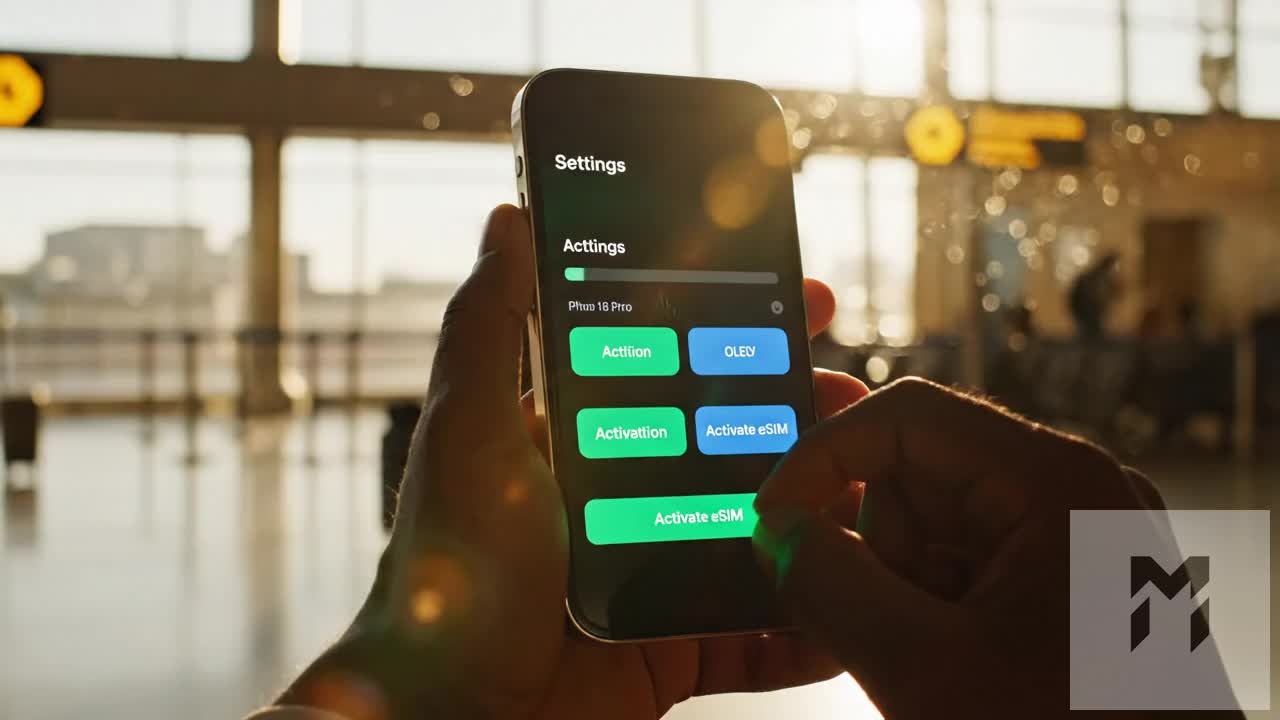
Configuring your connectivity profile before touching down at Heathrow, Gatwick, or St. Pancras ensures that your device establishes an instant radio link the moment you descend into the Transport for London (TfL) network. Below is the exact provisioning protocol and operating system optimization checklist to guarantee zero packet drop across subterranean transit corridors.
1. Pre-Departure Profile Provisioning (iOS & Android)
Install your travel eSIM 12 to 24 hours before your flight while connected to a stable home Wi-Fi network. Do not wait until you are standing at an Underground fare gate.
Method A: Direct QR Code Scan
- Open your device’s network settings:
- iOS: Navigate to
Settings>Cellular(orMobile Service) >Add eSIM. Select Use QR Code. - Android (Samsung/Google Pixel): Navigate to
Settings>Connections(orNetwork & internet) >SIMs>Add SIM>Download an eSIM.
- Scan the activation QR code delivered via your MollySIM confirmation email or dashboard.
- Label the newly added plan as "MollySIM London" or "Travel" to easily distinguish it from your primary line.
Method B: Manual SM-DP+ Server Entry
If scanning fails due to camera reflection or a single-device setup, manually paste the provisioning string:
- SM-DP+ Address:
rsp.truphone.com(or the specific LPA string provided in your MollySIM activation portal) - Activation Code: Paste your unique alphanumeric activation token.
- Confirmation Code: Leave blank unless explicitly specified in your receipt.
2. Dual SIM Routing: Preserving Home 2FA While Locking Data
To avoid accidental roaming charges from your domestic carrier while retaining SMS bank verification codes (2FA), configure your device in Dual SIM Dual Standby (DSDS) mode.
+-------------------------------------------------------------------------------+
| DUAL SIM CONFIGURATION MATRIX                                                 |
+------------------------------------+------------------------------------------+
| Setting Field                      | Target Configuration                     |
+------------------------------------+------------------------------------------+
| Primary Data Line                  | MollySIM (Travel eSIM)                   |
| Default Voice / SMS Line           | Home Carrier SIM (Standby for 2FA)       |
| Data Roaming (MollySIM)            | ON (Required for UK local breakout)     |
| Data Roaming (Home SIM)            | OFF (Prevents domestic carrier fees)     |
| Allow Cellular Data Switching (iOS)| OFF (Prevents failover to home SIM)      |
| Auto Data Switching (Android)      | OFF                                      |
+------------------------------------+------------------------------------------+
Critical Step: Disabling "Allow Cellular Data Switching" is mandatory. If you enter a subterranean dead zone and this toggle is active, your phone may automatically ping your home carrier's roaming network, triggering unintended daily roaming charges.
3. APN Verification & Cellular Mode Optimization
Most modern profiles provision the Access Point Name (APN) automatically. If your data fails to register upon arriving in the UK, manually verify your cellular settings:
- Go to
MollySIM Plan>Cellular Data Network. - Ensure the APN field reads
globaldataorinternet(refer to your MollySIM configuration payload). Leave Username and Password empty. - Voice & Data Spectrum Settings: Set your voice & data toggle to 5G Auto on iOS or 5G (recommended) on Android.
- Setting to 5G On continuously forces your modem to search for high-frequency millimeter-wave/sub-6GHz bands, accelerating battery drain inside deep tube shafts. 5G Auto drops cleanly to LTE Band 3 (1800 MHz) and Band 20 (800 MHz) inside tunnels without draining power.
4. Underground Troubleshooting: Deep-Level Interchanges & Signal Recovery
Navigating complex multi-level transit hubs—such as King’s Cross St. Pancras, Oxford Circus, or the deep-level walkways of Bank-Monument—can lead to RF attenuation (faraday cage effect) or delayed base station handshakes.
Apply these operational tactics when traveling through subterranean corridors:
- Force Microcell Re-Association via Airplane Mode: When transitioning between older deep-level Tube tunnels and newly fitted 4G/5G Distributed Antenna System (DAS) platforms, cellular modems occasionally get stuck on an unresponsive baseband state. Toggle Airplane Mode ON for 3 to 5 seconds, then turn it OFF. This dumps the dead cell association and forces your device to register the nearest platform microcell.
- Pre-Cache Complex Interchange Maps: Before taking escalators down into Zone 1 interchange labyrinths, launch Citymapper or TfL Go while at street level. If you hit an unexpected network blind spot during a cross-platform transfer, cached route vectors remain fully accessible.
- Continuous FUP Throughput Assurance: In high-congestion scenarios where temporary throttling or data caps might trigger on conventional eSIMs (often dropping users to an unusable 128 kbps), MollySIM sustains a 384 kbps Fair Use Policy (FUP) baseline. This provides 3x higher baseline throughput, guaranteeing that background API calls for Apple Pay/Google Wallet token refresh, TfL contactless status checks, and vector map tile rendering complete without throwing network timeout errors.
🇬🇧 United Kingdom High-Speed Travel eSIM & SIM Plans
Instant QR code activation, hotspot enabled, with guaranteed 384kbps fallback speed to keep Maps & Digital Wallets active.