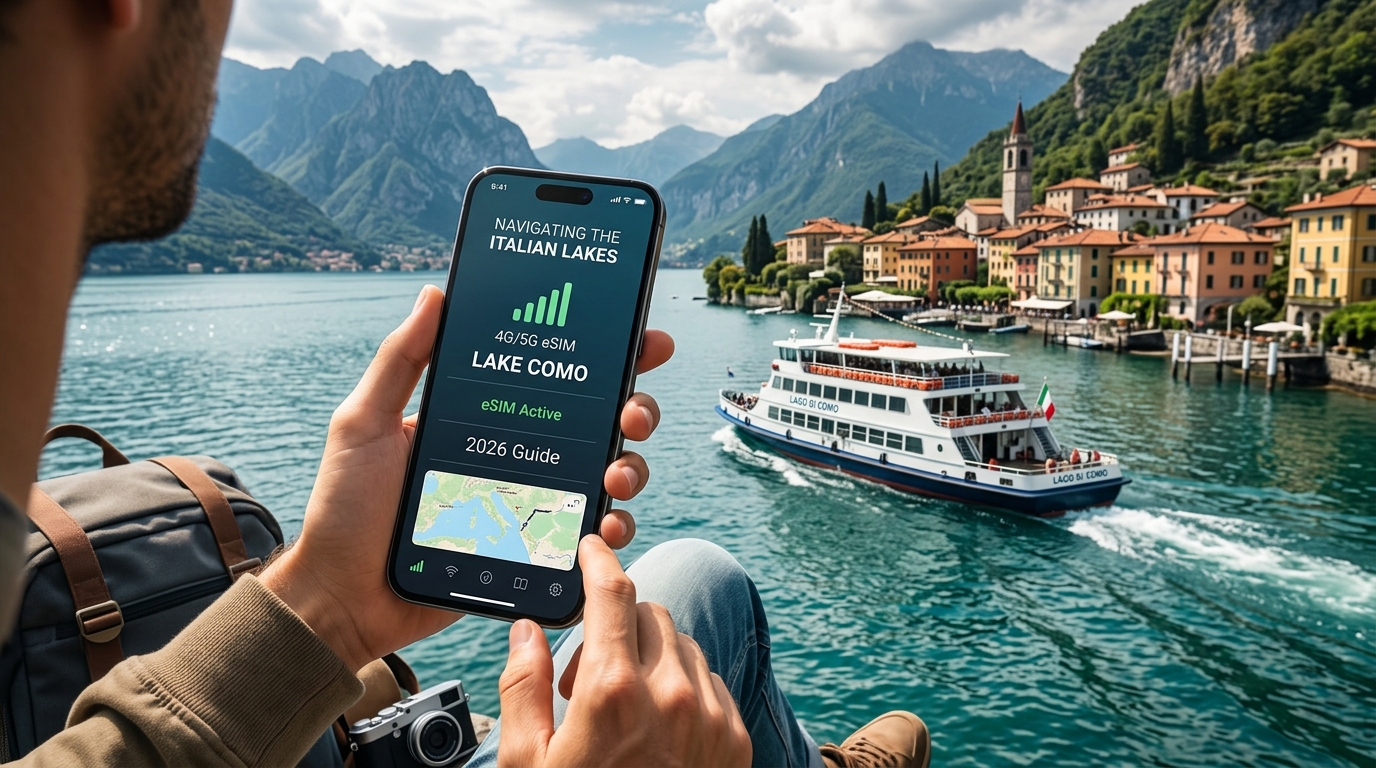
Les réalités de la connectivité dans la région des lacs du nord de l'Italie
La géographie spectaculaire qui fait la renommée mondiale des lacs subalpins du nord de l'Italie — d'imposants massifs calcaires plongeant à la verticale dans de profondes fosses glaciaires — est précisément ce qui transforme la région en un environnement impitoyable pour les télécommunications mobiles. Que vous naviguiez le long du « Y » inversé du lac de Côme, que vous traversiez l'immense étendue du lac de Garde ou que vous glissiez le long des îles Borromées sur le lac Majeur, la fiabilité de la connexion cellulaire est constamment mise à rude épreuve par des contraintes physiques et électromagnétiques.
                  [Crête préalpine / Monte Grona]
                               / \
   [Antenne relais (BTS)]     /   \
         |                   /     \  <-- Zone d'ombre optique (NLOS)
         v                  /       \
      (( o ))              /         \
        \ \               /           \
         \ \  (Direct)   /             \
          \ \           /               \
           \ v         /                 \
~~~~~~~~~~~ [Ferry : Chargement billet QR dynamique] ~~~~~~~~~~~ [Villa au bord du lac / Ponton]
             ^         \                 ^                        (Villa del Balbianello)
              \         \ (Rebond eau)  /
               \_________\_____________/
                 Interférences par trajets multiples RF
Interférences topographiques : vallées glaciaires et zones d'ombre RF alpines
Les infrastructures cellulaires primaires desservant le lac de Côme et le lac de Garde sont concentrées le long d'étroits couloirs riverains, installées soit sur des pylônes côtiers à basse altitude, soit juchées sur des crêtes préalpines exposées. Cette configuration engendre trois anomalies majeures de propagation des radiofréquences (RF) :
- Masquage de la ligne de visée directe (LoS) : Les parois abruptes des vallées créent de profondes poches hors de visée directe (NLOS). Dès qu'un bateau contourne un promontoire — comme la Punta Spartivento à Bellagio ou les falaises vertigineuses sous Tremosine sur le lac de Garde —, l'accès direct aux antennes relais est immédiatement coupé.
- Évanouissement par trajets multiples sur la surface de l'eau : Les grandes étendues d'eau libre agissent comme de gigantesques réflecteurs électromagnétiques. Les signaux cellulaires directs interfèrent avec les ondes secondaires réfléchies par la surface du lac, provoquant une annulation de phase sévère (interférence par trajets multiples) qui se traduit par des pics de latence soudains et des pertes silencieuses de paquets sur les connexions 4G et 5G.
- Atténuation liée aux architectures séculaires : Les villages côtiers comme Varenna, Menaggio et Sirmione sont bâtis en pierres épaisses et poreuses et en maçonnerie renforcée. Quitter un ponton ouvert pour s'engager dans une ruelle médiévale ou entrer dans un hall de billetterie historique peut réduire la puissance du signal de 15 à 25 dBm en seulement trois pas.
| Zone géographique | Défi cellulaire dominant | Impact sur les performances des données mobiles |
|---|---|---|
| Côme central (Triangle d'or) | Basculements d'antennes rapides entre Bellagio, Menaggio et Varenna au-dessus de l'eau | Pics de latence (300 ms+) et réinitialisations fréquentes des sessions SSL |
| Côme nord (Colico et Domaso) | Faible densité de pylônes, oscillation des mâts due au vent et atténuation par les parois montagneuses | Rétrogradation de la 5G vers une LTE B20 (800 MHz) à une seule barre |
| Haut-Garde (De Limone à Riva del Garda) | Falaises verticales extrêmes ; obstruction sévère de la zone de Fresnel | Zones d'ombre intermittentes lors des trajets en hydroptère et en ferry pour voitures |
| Bas-Garde (Sirmione et Desenzano) | Terrain plat mais congestion extrême du réseau en haute saison | Saturation de la bande passante malgré un affichage complet des barres de réseau |
Le vide de connectivité au milieu du lac : traversées en ferry Navigazione Laghi
L'un des phénomènes les plus perturbants pour les voyageurs se produit à bord du réseau de ferries publics Navigazione Laghi. Lorsque vous naviguez entre les ports centraux (Bellagio, Varenna, Menaggio et Cadenabbia) ou empruntez les hydroptères rapides (aliscafi) vers les extrémités nord comme Colico ou Riva del Garda, votre appareil est contraint d'effectuer des transferts intercellulaires (handovers) incessants et rapprochés à travers de larges bras d'eau.
Les antennes relais situées sur les rives opposées se disputent fréquemment la connexion de votre smartphone. Alors que votre ferry se trouve au milieu du chenal, votre appareil peut osciller rapidement entre une antenne Vodafone à Griante et un mât TIM à Varenna. Cet « effet ping-pong » bloque les négociations TCP (handshakes), figeant les flux de données en plein chargement alors même que l'indicateur de signal affiche trois barres de couverture.
Frictions opérationnelles : billetterie dynamique, accès aux villas et stationnement
Ce déficit de connectivité au milieu des lacs ne représente pas seulement une gêne pour consulter les réseaux sociaux ; il génère de véritables blocages opérationnels lors des étapes clés de votre voyage :
- Titres de transport à QR code dynamique : Navigazione Laghi et les compagnies de bus locales (ASF Autolinee) utilisent de plus en plus des codes QR cryptographiques dynamiques et temporisés sur leurs portails d'achat. Si un passager tente d'afficher sa carte d'embarquement à l'approche du quai de Bellagio pendant un basculement d'antenne, l'application web reste souvent bloquée sur un écran blanc, empêchant l'accès à la passerelle.
- Affichage des réservations pour les villas : Les sites culturels très prisés — tels que la Villa del Balbianello à Lenno et la Villa Carlotta à Tremezzo — exigent des créneaux horaires réservés à l'avance. L'approche de ces domaines en bateau ou par des sentiers piétons bordés de murs en pierre place directement les voyageurs dans des zones d'ombre, empêchant l'ouverture des billets stockés sur le cloud ou des e-mails de confirmation.
- Validation du stationnement au bord du lac : Le stationnement le long des rives étroites (comme sur le lungolago à Menaggio ou Salò) repose quasi exclusivement sur des applications telles qu'EasyPark. Les conducteurs se retrouvent fréquemment dans l'incapacité de lancer ou de prolonger une session de stationnement en raison de la dégradation du signal contre les falaises abruptes, risquant une contravention immédiate.
Atténuer les goulets d'étranglement avec une architecture eSIM résiliente
Pour contourner ces zones blanches localisées, dépendre du profil d'un seul réseau national constitue un risque structurel. Naviguer sur les lacs subalpins requiert une architecture eSIM capable de basculer dynamiquement entre les principales infrastructures italiennes de premier rang (Tier-1) — à savoir TIM, Vodafone et WindTre. Ainsi, si une antenne située derrière une falaise devient inaccessible, l'appareil négocie immédiatement une connexion avec un mât actif sur la rive opposée.
De plus, la consultation d'itinéraires et de titres de transport en temps réel nécessite un débit minimal de secours ininterrompu. Les profils de voyage haute performance tels que MollySIM intègrent un plancher de bridage à 384 kbit/s dans leur politique d'utilisation équitable (FUP). Contrairement aux eSIM classiques qui chutent à un débit quasi inutilisable de 128 kbit/s dès que les quotas sont épuisés ou que la couverture faiblit, un débit de base de 384 kbit/s offre une bande passante trois fois supérieure. Cela garantit que la navigation sur Google Maps, la génération de billets dynamiques, l'authentification Apple Pay et les messageries instantanées restent parfaitement fonctionnelles, même au cœur des environnements radio les plus complexes du nord de l'Italie.
Analyse de la couverture réseau : TIM vs Vodafone Italia vs WindTre vs MollySIM
🌐 Global Travel High-Speed Travel eSIM & SIM Plans
Instant QR code activation, hotspot enabled, with guaranteed 384kbps fallback speed to keep Maps & Digital Wallets active.
Choisir la configuration cellulaire idéale pour les lacs subalpins italiens nécessite de comprendre l'interaction entre la topographie locale et les réseaux d'accès radio (RAN) des quatre opérateurs de réseaux mobiles (MNO) italiens : TIM, Vodafone Italia, WindTre et Iliad. Le relief vertical très marqué du lac de Côme et les impressionnantes falaises calcaires du nord du lac de Garde engendrent des défis de propagation uniques : réflexions sur les plans d'eau, blocages de la ligne de visée derrière les pointes rocheuses et phénomène d'« étouffement de cellule » (cell breathing) en haute saison touristique.
                    PROPAGATION RF PRÉALPINE & RÉFLEXION SUR L'EAU

       [Monte Baldo / Antenne sur falaise]
                 \
                  \  LOS directe (Ligne de visée)
                   \
  ~~~~~~~~~~~~~~~~~~\~~~~~~~~[Ferry / Milieu du lac]~~~~~~~~~~~~~~~
                     \            /
                      \          / Réflexion par trajets multiples
                       \        /
                        \ v    /
   ~~~~~~~~~~~~~~~~~~~~~~~\~~~/~~~~~~~~~~~~~~~~~~~~~~~~~~~~~~~~~~~~
                           \ /
                            v
Infrastructure régionale et répartition des macro-sites
Bassin du lac de Côme (Côme, Bellagio, Tremezzo, Varenna et Brunate)
La forme en « Y » inversé du lac de Côme agit comme une série de couloirs RF étroits. Les macro-antennes sont concentrées dans les pôles urbains : la ville de Côme, Lecco et le promontoire central de Bellagio.
- Le Triangle central du lac (Bellagio–Varenna–Menaggio) : Vodafone et TIM exploitent des macro-antennes à haute capacité sur la pointe Spartivento à Bellagio. Ces installations émettent des faisceaux directionnels au-dessus de l'eau directement vers Menaggio et Varenna. Si la couverture sur l'eau est globalement excellente, des zones d'ombre apparaissent dès qu'un ferry contourne les avancées rocheuses près de la Villa Carlotta (Tremezzo) ou les falaises surplombant Varenna, où d'imposantes parois de granit masquent la visée vers Bellagio.
- Montée du funiculaire de Brunate : L'ascension de Côme à Brunate (un dénivelé positif de 500 mètres) oblige les téléphones à effectuer des transferts rapides entre les microcellules urbaines de Côme et les secteurs régionaux en altitude. TIM et WindTre dominent ce secteur grâce à de solides déploiements en Bande 20 (800 MHz) qui pénètrent la végétation dense, tandis qu'Iliad bascule fréquemment sur une liaison 3G à faible débit.
Périmètre du lac de Garde (Sirmione, Limone, Malcesine, Riva del Garda et Monte Baldo)
Le lac de Garde présente deux environnements réseau radicalement opposés :
- Bassin sud (Sirmione, Desenzano, Peschiera) : Le relief plat favorise une large propagation horizontale. Toutefois, au cœur de l'été, les stations de base (BTS) subissent de fortes saturations en raison de la densité touristique. WindTre et Vodafone compensent cette charge grâce à une agrégation étendue de la Bande 7 (2600 MHz) et de la 5G n78 (3,5 GHz).
- Fjord nord et Monte Baldo (Limone, Riva, Malcesine) : La partie nord du lac est encaissée entre de hautes falaises. À Limone sul Garda, les antennes sont adossées directement aux parois rocheuses, créant des zones d'ombre à quelques centaines de mètres seulement du rivage. Lors de l'ascension du téléphérique Funivia Malcesine-Monte Baldo jusqu'à 1 760 mètres, les SIM mono-opérateur subissent des pertes de paquets massives et des échecs de liaison radio (Radio Link Failure) lorsque les appareils tentent d'accrocher de lointains émetteurs de la vallée.
Matrice comparative des opérateurs : repères d'infrastructure sur les lacs
Le tableau suivant compare les infrastructures individuelles des opérateurs italiens à une solution d'itinérance multi-réseaux :
| Opérateur / Fournisseur | Principaux déploiements RF | Stabilité de la connexion en ferry au milieu du lac | Résilience en montée alpine (Brunate / Baldo) | Gestion de la congestion en haute saison | Politique de bridage de secours |
|---|---|---|---|---|---|
| TIM | B3 (1800 MHz), B7 (2600 MHz), B20 (800 MHz), n78 | Élevée (Très bon alignement des secteurs littoraux) | Excellente (Couverture alpine étendue en sous-1 GHz) | Modérée (Priorité accordée aux forfaits postpayés nationaux) | Coupure totale ou 32–64 kbit/s sur profils étrangers |
| Vodafone Italia | B1 (2100 MHz), B3, B20, n78 | Élevée (Macro-sites denses sur les promontoires centraux) | Bonne (Coupures occasionnelles à mi-hauteur des téléphériques) | Forte (Équilibrage dynamique de charge via MIMO massif) | Coupure totale ou 64 kbit/s sur profils étrangers |
| WindTre | B1, B3, B7, B20, B38, n78 | Modérée (Sensible aux trajets multiples au milieu du lac) | Modérée (Zones blanches le long des falaises de la rive ouest) | Modérée (Base d'abonnés locaux importante augmentant la charge) | Coupure totale ou 64 kbit/s sur profils étrangers |
| Iliad Italia | B1, B3, B7, B28 (700 MHz), n78 | Variable (Dépend en partie du partage de réseau avec WindTre) | Faible (Échecs de basculement fréquents sur les fortes pentes) | Médiocre (Limites de capacité marquées dans les zones touristiques) | Coupure totale après épuisement du quota haut débit |
| MollySIM | Itinérance dynamique multi-opérateurs (TIM + Vodafone + WindTre) | Maximale (Bascule instantanément vers l'antenne côtière la plus dégagée) | Maximale (Maintient la liaison sur le meilleur secteur alpin) | Optimisation dynamique (Contourne les cellules saturées d'un seul opérateur) | Plancher FUP garanti à 384 kbit/s |
L'avantage multi-opérateur : éliminer les goulets d'étranglement mono-réseau
Compter sur un seul opérateur national vous expose directement aux aléas du relief : une SIM TIM italienne perdra sa connexion sous les falaises entre Gargnano et Limone, tandis qu'un utilisateur Iliad ou WindTre subira des ralentissements au cœur des ruelles pavées de Varenna ou sur les hauteurs de Bellagio.
                              BASCULEMENT DYNAMIQUE DE RÉSEAU

  [Trajet ferry] --------> [Antenne TIM masquée par la falaise]
         |
         +--> Basculement auto vers [Antenne Vodafone rive opposée] (Zéro perte de paquets)
         |
         +--> Chute de débit ? ---> Le plancher à 384 kbit/s maintient Apple Pay / Maps actifs
MollySIM élimine cette vulnérabilité grâce à une architecture multi-IMSI de niveau entreprise. Au lieu d'enfermer l'appareil sur le réseau d'un opérateur unique, le profil eSIM négocie dynamiquement avec le meilleur réseau d'accès disponible — qu'il s'agisse du signal B20 de TIM sur les pentes du Monte Baldo ou d'une cellule 5G n78 à haut débit de Vodafone depuis la rive opposée à Bellagio.
De plus, si votre quota de données haute vitesse s'épuise dans un secteur isolé, la politique d'utilisation équitable (FUP) à 384 kbit/s de MollySIM garantit que vos outils de voyage essentiels — billetterie de ferry sur Navigazione Laghi, navigation GPS en temps réel sur Google Maps ou paiements sans contact Apple Pay — restent pleinement opérationnels, avec un débit trois fois supérieur à celui des eSIM de voyage standard limitées à 128 kbit/s.
Utiliser les applications indispensables au bord des lacs : ferries, stationnement et trajets en montagne
L'utilisation d'applications de voyage gourmandes en bande passante dans la région des lacs italiens demande une préparation minutieuse. Le relief spectaculaire des lacs de Côme et de Garde — falaises de calcaire à pic, tunnels routiers creusés dans la roche et vallées préalpines encaissées — perturbe fréquemment les échanges de données cellulaires. Adopter une stratégie privilégiant le mode hors ligne, combinée à une itinérance multi-réseaux performante, assure le bon fonctionnement de vos outils de déplacement.
+---------------------------------------------------------------------------------------+
| MATRICE DE CONFIGURATION DES APPLICATIONS CRITIQUES POUR LES TRANSITS SUR LES LACS    |
+----------------------+--------------------------+-------------------------------------+
| Application | Vulnérabilité opération. | Préchargement tactique recommandé🌐 Global Travel High-Speed Travel eSIM & SIM Plans
Instant QR code activation, hotspot enabled, with guaranteed 384kbps fallback speed to keep Maps & Digital Wallets active.