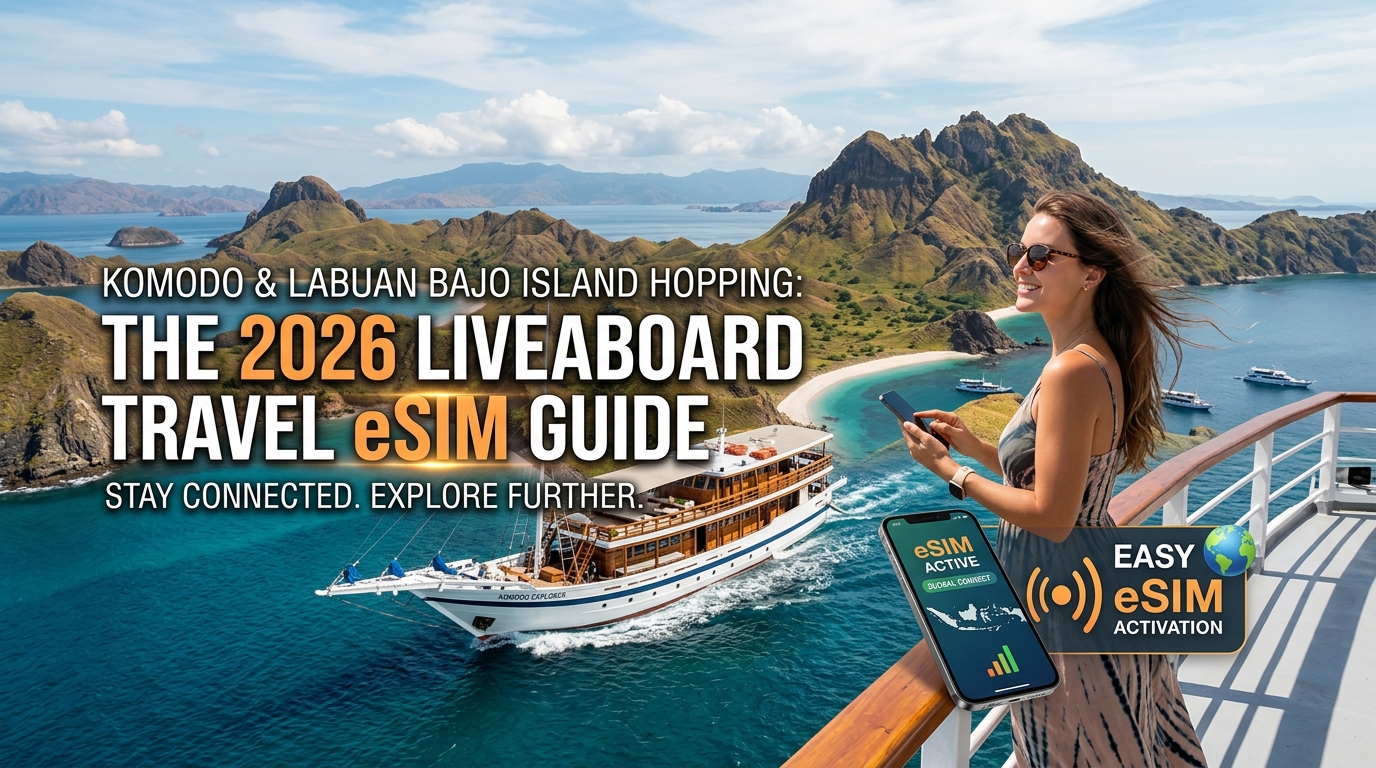
Komodo & Labuan Bajo Island Hopping: The 2026 Liveaboard Travel eSIM Guide
The 2026 Flores Sea Connectivity Landscape: Marine BTS Distribution Across Komodo National Park
Operating a smartphone aboard a wooden phinisi sailing through the Nusa Tenggara archipelago requires an understanding of how marine radio frequency (RF) propagation interacts with dramatic volcanic geography. Unlike mainland urban centers with dense microcell grids, cellular infrastructure across the Komodo National Park relies on a sparse array of high-elevation Base Transceiver Stations (BTS). These macro towers are strategically mounted along the elevated ridgelines of Labuan Bajo, northern Rinca Island (near Loh Buaya), and select high-altitude transmission repeaters on Komodo Island’s eastern spine.
These towers project cellular coverage across open-water channels like the Lintah Strait using low-to-mid frequency bands (primarily 900 MHz for wide-area coverage and 1800/2100 MHz for capacity). However, the physical reality of island-hopping liveaboards presents severe RF challenges that disrupt conventional connectivity assumptions.
       [ Labuan Bajo Ridge BTS ]                     [ Rinca Island Mast ]
               /         \                                   /       \
              /           \                                 /         \
   (Direct LOS)            \                             (Direct LOS)  \
            v               v                                 v         v
     [ Open Channel ]  [ Multipath Fading ]            [ Anchorage ]  [ Island Shadow ]
      Stable 4G/LTE     Water Surface Reflection         Strong 4G      DEAD ZONE
                           (Swell Attenuation)                         (Volcanic Cliff)
The Physics of Oceanic RF: Swell Attenuation and Shadow Zones
Broadcasting cellular signals across open water is complicated by physical dynamics that do not exist on land:
- Sea-Surface Multipath Interference: High-salinity seawater acts as an RF reflector. As waves and tidal swells shift, signals bouncing off the water interfere with direct line-of-sight (LOS) waves, causing rapid fluctuations in Reference Signal Received Power (RSRP).
- Volcanic Topographical Shadowing: The jagged, caldera-formed terrain of islands like Padar and southern Komodo blocks macro BTS signals entirely. Once your vessel slips behind a towering cliff face into a sheltered cove (such as Padar Black Beach or southern Komodo’s Manta Alley), your device enters an immediate RF shadow.
- Microwave Backhaul Constraints: Island-based BTS towers do not connect to subsea fiber-optic cables; they rely on point-to-point microwave backhauls linked back to Flores mainland. High atmospheric humidity and equatorial squalls can introduce jitter and packet loss to the tower itself, degrading throughput even when your phone shows full signal bars.
| Channel / Anchorage Location | Primary BTS Source | Dominant RF Challenge | Average Signal Availability |
|---|---|---|---|
| Labuan Bajo Marina to Hatamin | Labuan Bajo Hills (Macro) | Clear LOS / Minor Multipath | Stable 4G/LTE (30–80 Mbps) |
| Lintah Strait (Current Drift) | Rinca North & Komodo East | Swell Attenuation & Rapid Tower Switching | Intermittent 4G / Dropouts |
| Padar Island (North Bay) | Rinca West Repeater | Partial Cliff Obstruction | Low-band 4G / 3G Fallback |
| Padar Island (South Coves) | None (Blocked by Ridges) | Total Topographical Shadow | Zero Signal (Dead Zone) |
| Batu Bolong & Komodo Central | Komodo East Ridge Mast | Long-distance LOS Path Loss | Weak 4G / Variable Latency |
Mitigating Marine Tower Handoffs
As your liveaboard cruises at 7 to 10 knots between remote channels, your device constantly renegotiates handoffs between distant shore towers. Low-tier roaming profiles often fail during these transitions, dropping packet sessions and forcing manual modem restarts.
High-performance travel solutions mitigate this by establishing stable core-network routing. Using optimized data services like MollySIM ensures your device renegotiates local carrier handoffs (such as switching dynamically between Telkomsel and Indosat infrastructure) with minimal session drops.
Furthermore, when deep channel cruising degrades throughput to baseline speeds, MollySIM's Fair Use Policy maintains a 384 kbps baseline speed limit—triple the standard 128 kbps industry throttle. This bandwidth ensures mission-critical data streams, such as live GPS navigation, satellite-layered marine charts, and emergency digital transactions (Apple Pay/Google Wallet), remain functional even in fringe signal zones.
Liveaboard Route Coverage Breakdown: Signal Mapping from Labuan Bajo to Padar and Beyond
🇺🇸 United States High-Speed Travel eSIM & SIM Plans
Instant QR code activation, hotspot enabled, with guaranteed 384kbps fallback speed to keep Maps & Digital Wallets active.
Navigating the Komodo National Park on a standard 3D2N or 4D3N liveaboard means traversing a complex mosaic of open-water channels, sheltered calderas, and towering volcanic ridges. Cellular performance swings wildly from urban-grade 5G near the mainland to complete RF blackouts behind massive basalt cliffs.
Understanding where your connection will thrive—and where it will stall—is critical for managing onboard productivity, family communications, and offline mapping caches before dropping anchor.
Stop-by-Stop Marine Signal Matrix
| Waypoint / Route Anchor | Primary Tower Vector | Telkomsel Coverage | Indosat (IOH) Coverage | Practical Data Experience |
|---|---|---|---|---|
| Labuan Bajo Marina | Urban Mainland Grid | 5G / 4G+ (-65 dBm) | 4G+ / 4G (-72 dBm) | Full high-speed bandwidth; ideal for large media uploads |
| Kelor & Kanawa Islands | Flores West Coast Mast | Strong 4G (-80 dBm) | Moderate 4G (-92 dBm) | Stable video calls, seamless 4K streaming via direct line-of-sight |
| Padar Island (Summit) | Rinca/Komodo Repeaters | Strong 4G (-78 dBm) | Weak 4G (-105 dBm) | Solid upload speeds at high elevation; patchy at the sea-level trail base |
| Padar North Bay (Mooring) | Obstructed Rinca Mast | Moderate 4G / 3G | Emergency Only / Edge | Intermittent messaging; voice-over-IP may jitter |
| Long Beach / Pink Beach | Padar Ridge Obstruction | Intermittent 4G / No Signal | No Signal (Dead Zone) | Severe shadow zone; signal drops within 200m of the beachline |
| Taka Makassar & Manta Point | Distant Komodo East Mast | Weak 4G / Fading | No Signal | Line-of-sight across water allows basic data; vulnerable to sea swells |
| Loh Liang (Komodo Ranger HQ) | Localized Microcell Repeater | Moderate 4G (-88 dBm) | Intermittent 3G / None | Reliable text and social updates near the jetty and ranger offices |
| Kalong Island (Bat Anchorage) | Rinca North Coastal Mast | Solid 4G (-82 dBm) | Moderate 4G (-95 dBm) | Stable connectivity for sunset live streams during the fruit bat migration |
In-Depth Cellular Realities Across the Archipelago
1. Labuan Bajo Marina to Kanawa Island (The Departure Corridor)
Departing the marina delivers uninterrupted, carrier-aggregated 4G+ and localized 5G signals. As your boat heads west toward Kanawa and Kelor Islands, line-of-sight (LOS) propagation across open water preserves strong Telkomsel and Indosat signals. Kanawa acts as the final high-bandwidth checkpoint where remote workers can clear latency-sensitive tasks before heading into the central park channels.
2. Padar Island & The Pink Beach Shadow Zone
Climbing the iconic staircase to the Padar Island Summit elevates your handset above the surrounding marine topography, capturing strong low-band LTE signals directly from coastal repeaters on neighboring Rinca.
However, rounding the headland toward Pink Beach drops your vessel into a massive volcanic RF shadow. Here, high-frequency cellular bands cannot diffract around the vertical rock walls. Signal drops to zero unless your device connects to low-frequency fallback channels.
3. Taka Makassar, Batu Bolong, and Manta Point
These open-water sandbars and dive sites lie exposed to distant broadcast masts on Komodo's eastern spine. While cellular signals reach these sites across the water, vertical boat roll caused by heavy swells causes frequent RSRP (Reference Signal Received Power) swings. Connections bounce rapidly between usable 4G and dropped packet states.
When cruising in these fringe reception corridors, standard roaming profiles often stall completely. Premium travel setups like MollySIM maintain stable, pre-negotiated connections to local priority nodes. Even when raw signal fades and base throughput engages, MollySIM’s 384 kbps Fair Use Policy (FUP) baseline—three times higher than the typical 128 kbps industry standard—keeps live marine GPS tracks, messaging applications, and authentication protocols (such as Google Wallet and Apple Pay) fully operational.
4. Loh Liang and Kalong Island (The Protected Anchorages)
The official park entrance at Loh Liang (Komodo Island) features a dedicated Telkomsel micro-tower that services the ranger station and adjacent boardwalks, delivering dependable 4G speeds for messaging and web browsing. Further south at Kalong Island, the wide, open bay facing Flores provides clear line-of-sight to mainland repeater towers, making it one of the most reliable evening moorings for processing data-heavy uploads after a day of diving.
Infrastructure Comparison: Telkomsel vs. Indosat Ooredoo Hutchison (IOH)
Telkomsel Marine Footprint:  ■■■■■■■■■□  85% Park Coverage
Indosat (IOH) Footprint: ■■■■■□□□□□ 45% Park Coverage- Telkomsel: The gold standard across East Nusa Tenggara. Telkomsel maintains subsidized rural base transceiver stations (BTS) and low-frequency Band 8 (900 MHz) towers throughout the park's peripheral islands. This frequency penetrates marine weather systems and provides the widest geographical safety net.
- Indosat (IOH): While Indosat delivers competitive speeds within Labuan Bajo town and along primary shipping corridors like Kanawa, its signals rapidly deteriorate once you navigate south of Padar or enter the deep channels of the Komodo Strait.
Komodo Connectivity Comparison: Local SIMs, Pocket Wi-Fi, Roaming, and Travel eSIMs
Choosing the correct connectivity hardware before boarding a liveaboard in Labuan Bajo dictates whether you maintain dependable offshore navigation and communication or spend your voyage staring at a "No Service" status bar.
The matrix below benchmarks the five primary connectivity vectors available for navigating Komodo National Park in 2026:
| Connectivity Solution | Network Access & Multi-Carrier Support | IMEI Registration (Bea Cukai / ECD Tax) | Offshore Marine Reliability | Standard FUP Throttling Speed | Overall Cost Efficiency |
|---|---|---|---|---|---|
| Local Prepaid SIM (Telkomsel / Indosat) | Single carrier locked (Must choose Telkomsel or IOH at purchase) | Mandatory. Complex online ECD declaration + passport/device scan at customs | High (if Telkomsel); Moderate (if Indosat) | Plan-dependent (usually hard cut-off or drops to 64 kbps) | Moderate (Cheap data, but high airport vendor markups & time penalty) |
| Liveaboard Shared Wi-Fi / Pocket Router | Single SIM/4G router or low-tier VSAT split across 8–20 guests | None for guests (Managed by boat operator) | Low to Moderate (Severe packet loss during peak evening hours) | Throttled dynamically by onboard router (often unusable) | Low (Often charged as an expensive daily add-on with poor speeds) |
| International Roaming (Home Carrier) | Varies (Dependent on bilateral agreements; often locks to one carrier) | None (Exempt under foreign roaming protocols) | Moderate (High latency due to remote traffic routing) | Strict daily high-speed caps, drops to unworkable 64–128 kbps | Very Low ($10–$15/day standard daily pass) |
| Standard Generic eSIMs | Single local tier-2 partner or unoptimized dual roaming | None (Exempt from local IMEI whitelisting) | Moderate (Deprioritized routing during cell congestion) | Strict 128 kbps industry baseline (fails on modern web apps) | Moderate ($15–$35 for fixed regional buckets) |
| MollySIM | Dynamic Multi-Carrier Core: Auto-switches between Telkomsel & Indosat | None. Bypasses Indonesian IMEI registration completely | Exceptional (Leverages Telkomsel’s Band 8 + Indosat’s harbor capacity) | 384 kbps True Baseline (3x standard; runs Apple Pay, WhatsApp, & GPS) | High (Transparent prepaid tiers, zero tax queues, zero hardware rental) |
The Indonesian IMEI Registration Bottleneck (Why Local SIMs Fail Liveaboard Logistics)
Indonesia enforces strict anti-black-market device regulations through its centralized Centralized Equipment Identity Register (CEIR), overseen by Bea Cukai (Indonesian Directorate General of Customs and Excise). Under current law, foreign smartphones inserting an Indonesian physical SIM card must have their hardware IMEI registered and cleared through the Electronic Customs Declaration (ECD) system.
For travelers joining a liveaboard departure out of Komodo Airport (LBJ), this creates three severe operational friction points:
- The Customs Tax & Queue Trap: If your device is valued above $500 USD, you are legally subject to import taxes (up to 40% of the excess value depending on your local tax ID status). Registering your IMEI at Jakarta (CGK), Bali (DPS), or Labuan Bajo (LBJ) requires presenting purchase receipts, original physical packaging, and waiting in dedicated customs queues after long international flights.
- Delayed Network Whitelisting: Even after successful physical registration, local carrier activation can take anywhere from 2 to 24 hours to propagate across base towers. If your liveaboard anchors in the park two hours after you land, your freshly purchased local SIM will remain unregistered and completely dead until the boat returns to harbor days later.
- Airport Kiosk Markups and Single-Network Traps: Street vendors and airport kiosks in Labuan Bajo regularly charge 300% to 500% premiums for "tourist packages." More critically, these physical cards lock your device to a single carrier. If you purchase an Indosat SIM in town, you will lose 100% of your data connectivity the moment your vessel sails west into the Telkomsel-dominated Padar channel.
The Liveaboard Pocket Wi-Fi Bottleneck
Many travelers assume their vessel's advertised "Onboard Wi-Fi" provides reliable offshore coverage. In reality, 90% of Indonesian phinisi boats and budget catamarans use consumer-grade 4G/LTE mobile routers running a standard local SIM card positioned on the top deck.
When 10 to 18 guests and crew return from afternoon dives and simultaneously attempt to upload 4K action-camera footage, social reels, or make video calls, the single LTE backhaul suffers critical packet collapse. Signal contention renders shared connections completely unusable precisely during evening anchorages at Padar or Rinca.
The Travel eSIM Advantage: Seamless Offshore Continuity
Digital travel eSIMs completely bypass the Indonesian CEIR IMEI registration system. Because travel eSIMs operate as authorized international data roamers routing through top-tier inter-carrier exchanges, your device is legally exempt from Bea Cukai import taxes and local carrier whitelisting delays.
By utilizing MollySIM, you secure instant remote profiling before touchdown in Labuan Bajo, pairing Telkomsel's dominant 900 MHz rural cell footprint with dynamic fallback to Indosat in crowded harbors. Furthermore, MollySIM's 384 kbps Fair Use Policy (FUP) threshold ensures that even if you exhaust your primary high-speed data allocation while tracking live bathymetric charts or streaming satellite forecasts in the Komodo Strait, your connection never drops to the industry-standard 128 kbps "dead zone"—keeping essential marine GPS mapping, two-factor banking authentications, and messaging functional throughout your charter.
Why MollySIM is Engineered for Liveaboard Explorers: Instant Bandwidth & The 384kbps Safety Net
Navigating the remote waters of Komodo National Park demands a cellular solution capable of handling high-bandwidth social streaming one hour and mission-critical telemetry the next. Traditional travel SIM purchasing in Labuan Bajo forces travelers into tedious manual registration queues, where passport scans and device IMEI logs must be manually uploaded to national telecommunication databases.
MollySIM eliminates this operational friction by provisioning directly through automated international roaming profiles. The moment your liveaboard pulls away from Labuan Bajo Marina, the eSIM establishes an active handshake with Indonesia’s top-tier infrastructure, prioritizing Telkomsel’s dominant 900 MHz (Band 8) offshore macro towers—the primary frequency responsible for cutting through maritime ducting and island topography across the park.
Real-World Komodo Scenarios: High-Throughput Uplinks on the Water
Whether anchored in the calm bays of Gili Lawa Darat or navigating the heavy rip currents of the Linta Strait, liveaboard guests and crew rely on immediate, unthrottled connectivity:
- Instant Content Uploads at Padar Summit: After hiking the rugged stone steps of Padar Island for sunrise, access immediate LTE bandwidth to upload uncompressed 4K drone reels and high-bitrate video stories directly to Instagram, TikTok, and cloud backups before descending back to the tender.
- Continuous Marine Navigation & Live Telemetry: Stream real-time bathymetric layers, tidal current overlays, and vector charts via Navionics, C-MAP, and Google Maps while cruising between dive sites, bypassing offline map caching limitations.
- Tender Dispatch & Vessel Coordination: Maintain direct, high-definition WhatsApp voice and video links with your liveaboard's dive masters and tender skippers when separated during drift dives at Castle Rock or shore excursions at Pink Beach.
The 384kbps Fair Usage Policy (FUP): An Offshore Safety Net
A common hazard of digital nomadism and maritime travel is exhausting your high-speed primary data bucket while anchored miles from the nearest port. Standard competitor eSIMs penalize exhausted allocations by throttling speeds down to 64 kbps or 128 kbps. At these sub-dial-up rates, modern web protocols suffer fatal packet dropouts: SSL handshakes fail, live radar maps freeze, and two-factor authentication (2FA) requests time out entirely.
MollySIM resolves this vulnerability by establishing an industry-leading 384 kbps Fair Usage Policy (FUP) floor. Operating at three times the speed of conventional 128 kbps throttles, MollySIM's sustained baseline provides adequate network throughput to keep essential maritime utilities and secure transactions fully operational even after your high-speed allocation reaches zero.
| Critical Liveaboard Utility | 64 kbps (Standard Roaming) | 128 kbps (Budget eSIMs) | MollySIM 384 kbps Safety Net |
|---|---|---|---|
| BMKG Marine Radar & Swell Forecasts | Connection Timeout / Failed Render | 45–90s Slow Tile Load | Smooth Vector & Radar Refresh (<10s) |
| Windy.com High-Res Isobar Layers | Crashes / Partial Asset Render | High Latency / Dropped Frames | Fully Interactive Layer Caching |
| Navionics & Live GPS Tracking | Map Canvas Fails to Load | Intermittent Coordinate Drops | Continuous Real-Time Marine Routing |
| Compressed WhatsApp Voice Notes | Constant Upload/Download Errors | 15–20s Buffer Delays | Near-Instant Transmission (<3s) |
| Bank 2FA & Digital Wallet Authorizations | SSL Session Expiration / Failure | Frequent Verification Timeouts | Instant Push Token Authentication |
By preserving functional bandwidth across critical network services, MollySIM transforms your smartphone into a dependable offshore tool, ensuring you are never stranded in the Flores Sea without weather intelligence, navigational backups, or vital communication channels.
Step-by-Step Installation & Marine Optimization Guide for Labuan Bajo Departures
To guarantee seamless connectivity across the Komodo archipelago, device configuration must take place on solid ground before your vessel unties from the Labuan Bajo Marina. Once you depart the harbor basin, network handshakes degrade rapidly if your SIM profile is misconfigured.
Follow this chronological pre-departure workflow to calibrate your hardware for maximum oceanic range and battery efficiency.
+-------------------------------------------------------------------------------+
|                      PRE-DEPARTURE SETUP TIMELINE                             |
|                                                                               |
|  [ Komodo Airport (LBJ) ]  -->  [ Labuan Bajo Marina ]  -->  [ Open Waters ]  |
|   • Install MollySIM eSIM        • Lock carrier to Telkomsel  • Top-deck line |
|   • Toggle Data Roaming "ON"     • Cache offline map tiles    • Pause backups |
+-------------------------------------------------------------------------------+
Step 1: Profile Installation & Activation at Komodo Airport (LBJ)
Do not wait until you board your pinisi or liveaboard boat to install your data profile. The shared 2.4 GHz satellite Wi-Fi at the marina frequently drops provisioning tokens during the eSIM cryptographic handshake.
- Procure Profile: Order your Indonesia or Southeast Asia regional data bundle from MollySIM prior to landing.
- Connect to Terrestrial Wi-Fi: Connect to the high-throughput terminal Wi-Fi at Komodo International Airport (LBJ) or execute setup via domestic cellular data upon deplaning.
- Install Profile:
- iOS: Navigate to
Settings>Cellular>Add eSIM> Scan your MollySIM activation QR code (or complete 1-tap direct provisioning inside the app). - Android: Navigate to
Settings>Network & Internet>SIMs>Add SIM>Download eSIM.
- Label Your Line: Set the custom label for this profile to
MollySIM Komodoto avoid cross-line billing confusion.
Step 2: Dual-SIM Architecture & Manual Carrier Selection
Fringe waters between Komodo Island, Padar, and Rinca cause dual-SIM smartphones to hunt aggressively for signals. Setting rigid cellular rules prevents your device from dropping into endless reconnection loops.
  Primary Voice Line (Home SIM)      MollySIM eSIM (Data Line)
 ┌─────────────────────────────┐    ┌─────────────────────────────┐
 │ • Cellular Data: OFF        │    │ • Cellular Data: ON         │
 │ • Data Roaming: OFF         │    │ • Data Roaming: ON          │
 │ • Calls/SMS: ON (for 2FA)   │    │ • Network: Manual Telkomsel │
└─────────────────────────────┘ └─────────────────────────────┘- Set Cellular Data Route: Assign
Cellular Dataexclusively to your MollySIM profile. - Enable Data Roaming: Go to your MollySIM profile settings and toggle Data Roaming to ON. Note: Because MollySIM acts as a direct international travel partner, roaming must be enabled on the eSIM profile to route data through low-latency local breakout gateways.
- Disable Cellular Data Switching: Turn off
"Allow Cellular Data Switching"(iOS) or"Auto Data Switching"(Android). This prevents your phone from silently burning exorbitant roaming charges on your primary domestic carrier when marine signals fluctuate. - Manual Network Locking: Set Network Selection from
AutomatictoManualand choose Telkomsel. In the outer Flores Sea, overlapping weak signals from alternate providers (such as Indosat or XL) can cause your antenna to switch continuously, draining power and stalling data packets. Locking your device to Telkomsel keeps your modem attached to the strongest coastal towers.
Step 3: At-Sea Power Management & Line-of-Sight Elevation
Liveaboards rely on shared auxiliary diesel generators, meaning cabin charging outlets may experience voltage spikes or scheduled nighttime shutdowns. Optimize your digital footprint to preserve battery and maintain network line-of-sight.
| Marine Optimization Vector | Action Item | Technical Benefit |
|---|---|---|
| Offline Marine Caching | Download offline sectors in Google Maps and Navionics prior to leaving the dock. | Saves 80% background data throughput; maintains vector rendering in signal blindspots. |
| Cloud Sync Throttling | Pause Google Photos, Apple iCloud, and Dropbox automated uploads. | Stops large 4K dive-video syncs from exhausting bandwidth over shared connections. |
| Antenna Elevation | Position devices on the top sun deck or flybridge inside a splashproof pouch. | Eliminates hull shadow attenuation; gains line-of-sight to mountain Base Transceiver Stations (BTS) up to 25 km away. |
| Low Power Mode Staging | Engage Low Power Mode when cruising through deep channel transits. | Curtails background app refresh cycles while your modem searches for distant coastal base stations. |
Even if you exhaust your premium high-speed allowance mid-voyage, MollySIM's dedicated 384 kbps Fair Usage Policy (FUP) baseline ensures that navigational layers, Google Maps, Apple Pay, and emergency messaging apps remain completely functional without requiring an emergency top-up at sea.
Essential Liveaboard Digital Toolkit: Nautical Apps, Safety Protocols, and Offline Contingencies
Navigating the dynamic waters of the Komodo National Park requires real-time telemetry, maritime safety monitoring, and seamless communication between tender skiffs and the mothership. Equipping your smartphone with the correct digital toolkit before casting off from Labuan Bajo ensures you stay ahead of localized squalls, manage park compliance, and maintain situational awareness.
                  DIGITAL MARITIME SAFETY STACK
   +---------------------------------------------------------+
   |  WEATHER & HYDROLOGY  |  Info BMKG & Windy (ECMWF/GFS)  |
   +---------------------------------------------------------+
   |  COMMUNICATIONS       |  WhatsApp (Tender Skiff Comms)  |
   +---------------------------------------------------------+
   |  REGULATORY ACCESS    |  Cached e-Simaksi / KNP QR Pass |
   +---------------------------------------------------------+
   |  NETWORK RESILIENCE   |  MollySIM Dynamic Roaming Core  |
   +---------------------------------------------------------+
Primary Marine & Logistical Digital Stack
- Info BMKG (Badan Meteorologi, Klimatologi, dan Geofisika): The official Indonesian meteorological app. Essential for monitoring real-time wave height forecasts, sea surface temperatures, and localized marine swell warnings for the Sape Strait and northern Flores Sea.
- Windy.com: Switch between ECMWF and GFS forecast models to track localized thermal gusts through narrow channels like the Linta Strait. Live wind barbs show current conditions before tender skiffs launch for drift dives.
- WhatsApp: The operational standard across Indonesian waters. Used by liveaboard cruise directors, divemasters, and tender skiff operators to coordinate diver pick-ups, bridge-to-shore updates, and harbor clearance notices.
- e-Simaksi / Komodo National Park Digital Portal: Digital entrance permits, ranger fees, and trekking passes must be validated via QR code upon arrival at Loh Liang (Komodo Island) and Loh Buaya (Rinca Island). Download and screenshot all digital passes to your device wallet while still tied up at the Marina Labuan Bajo dock.
Dead Zone Safety Protocols: Horseshoe Bay & South Rinca
The southern reaches of the park—specifically Horseshoe Bay (Nusa Kode), South Rinca, and the deep caldera walls surrounding Cannibal Rock—are surrounded by sheer volcanic cliffs that block line-of-sight to terrestrial cellular towers on Flores and Padar.
       [ Flores / Padar BTS Mast ]
                  \
                   \  (Signal Shadow)
       ==================\=================
       [ Volcanic Ridge ] \
                           \   [ Horseshoe Bay / South Rinca ]
                            x  (Total Cellular Blindspot)
When entering these blind spots, follow these offshore safety protocols:
- Broadcast Last Known Telemetry: Send a departure timestamp, vessel coordinates, and planned dive window via WhatsApp to your shoreside emergency contact prior to rounding the southern cape of Rinca.
- Enable Offline Bathymetry: Switch your nautical charting apps (Navionics or C-MAP) to full offline mode so vector depth soundings render without active data pings.
- Halt Background Connection Polling: Place secondary devices in Low Power Mode to prevent the radio modems from constantly scanning for absent towers, which drains battery life and heats up hardware.
Rapid Network Re-Attachment with MollySIM
Traditional travel eSIMs often struggle with stale Home Location Register (HLR) loops when emerging from maritime dead zones, leaving devices stuck in "No Service" mode for up to 20 minutes unless manually power-cycled.
MollySIM eliminates this friction by utilizing dynamic multi-core network routing that instantly re-negotiates the cellular handshake the millisecond your vessel clears the headland into tower range.
| Feature Vector | MollySIM Travel eSIM | Standard Travel eSIMs |
|---|---|---|
| Dead Zone Recovery | Sub-second automatic BTS re-attachment | Requires manual airplane mode toggle/reboot |
| Throttled FUP Baseline | 384 kbps (Functional for maps & telemetry) | 64 kbps – 128 kbps (Complete data stall) |
| Core Network Routing | Low-latency local APN handshakes | High-latency transatlantic packet routing |
| Critical App Readiness | WhatsApp, Apple Pay, Google Maps fully responsive | Timeouts on TLS/SSL security certificates |
Even if high-speed data balances run out during an extended crossing, MollySIM’s sustained 384 kbps Fair Usage Policy (FUP) baseline—3x faster than the 128 kbps industry standard—ensures continuous access to live GPS vector routing, Apple Pay verification, and emergency messaging across all connected nautical corridors.
🇺🇸 United States High-Speed Travel eSIM & SIM Plans
Instant QR code activation, hotspot enabled, with guaranteed 384kbps fallback speed to keep Maps & Digital Wallets active.