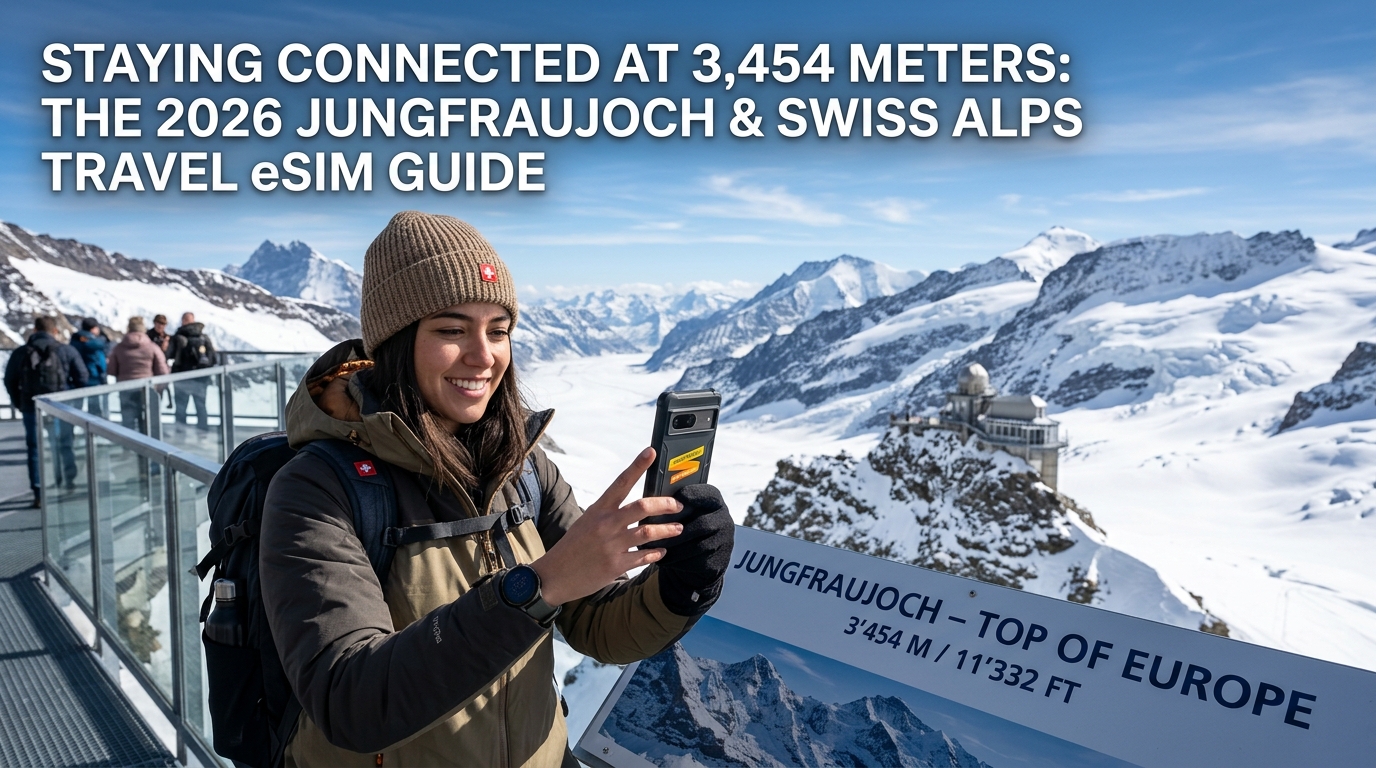
Alpine Connectivity at 3,454m: The Hidden Engineering Behind Swiss Alps Mobile Coverage
Securing a high-speed mobile signal while standing atop the Aletsch Glacier—the longest ice stream in the Alps—feels like technological magic. In most global alpine regions, ascending above the treeline means entering an immediate communications blackout. In the Bernese Oberland, however, you can livestream a 4K panoramic video from the Sphinx Observatory observation deck at 3,454 meters without a millisecond of stutter.
Achieving uninterrupted broadband across this extreme vertical landscape is one of the most sophisticated civil telecommunications feats in Europe.
The Subterranean RF Matrix: Inside the Eiger and Mönch
The most formidable hurdle for cellular engineers was not the glaciated peak itself, but the subterranean transit route. The historic Jungfrau Railway travels through a 7-kilometer tunnel bored straight through the solid limestone and granite cores of the Eiger and Mönch mountains. Solid rock impenetrable to external macro tower signals lines every meter of the ascent.
To deliver continuous mobile voice and data to moving trains, Swiss network operators—primarily Swisscom and Sunrise—engineered a subterranean distributed antenna system (DAS):
- Radiating Leaky Feeder Cables: Specially slotted coaxial cables run along the tunnel arches throughout the entire 7,144-meter transit, emitting radio frequency (RF) signals consistently along the track rather than relying on point-to-point line-of-sight propagation.
- Reinforced Underground Microcells: At intermediate mountain stops like Eismeer (Sea of Ice) at 3,160 meters, operators mounted customized, climate-shielded microcells behind rock-cut viewing windows to provide high-density bandwidth for transiting passengers.
- Low-Profile Radomes at the Sphinx: At the summit, localized, ultra-compact 5G panel antennas engineered to withstand -30°C temperatures, 250 km/h hurricane-force winds, and heavy rime ice accumulation are integrated directly into the steel architecture of the Sphinx Observatory and the Ice Palace tunnels.
Overcoming Granite Reflections and Glacial RF Absorption
Deploying multi-band cellular infrastructure in high-alpine topographies presents harsh RF propagation challenges. Pure granite surfaces cause severe multi-path signal reflections, leading to phase cancellation, while dynamic snowpacks and glaciated terrain actively absorb higher-frequency mid-band radio spectrum (such as 3.5 GHz / Band n78).
| Frequency Tier | Primary Swiss Bands | Engineering Role in the High Alps | Real-World Performance |
|---|---|---|---|
| Low-Band (Long Range) | 700 MHz (n28), 800 MHz (B20) | Deep valley-to-ridge line penetration; structural penetration inside mountain lodges. | 25–60 Mbps; broad geographical coverage fallback. |
| Mid-Band (Capacity) | 1.8 GHz (B3), 2.1 GHz (B1) | Base connectivity for cogwheel railways, cableway spans, and trail networks. | 70–180 Mbps; stable streaming and navigation. |
| High-Band / 5G | 3.5 GHz (n78) | Focused micro-arrays around the Jungfraujoch complex, Top of Europe terminal, and Eiger Express stations. | 350–800+ Mbps; ultra-low latency for dense tourist crowds. |
To overcome RF absorption and destructive interference, Swiss operators rely heavily on Dynamic Spectrum Sharing (DSS) and adaptive beamforming. Instead of broadcasting raw RF energy across empty valleys, modern alpine base stations dynamically focus narrow, high-gain signal beams straight at the moving 3S Eiger Express gondola cabins and cogwheel rail cars as they ascend the sheer face of the Eiger.
Why Direct Tier-1 Partner Peering Is Essential
The physical infrastructure across the Bernese Alps is top-tier, but your actual device performance depends on the roaming agreements embedded in your travel eSIM profile. Budget data roaming passes often route traffic through third-party virtual networks (MVNOs) with deprioritized quality of service (QoS). When thousands of tourists gather at the Jungfraujoch summit platform, deprioritized SIM profiles suffer massive packet loss and dropped handovers during the transition from the valley floor to the alpine microcell array.
Choosing a premium data provider like MollySIM guarantees direct Tier-1 peering with Switzerland's leading cellular backbones (Swisscom and Sunrise). This ensures:
- Instant Cell Tower Handover: Zero dropped connections as your transit switches from macro valley towers in Grindelwald to leaky tunnel feeders and finally to the Sphinx micro-masts.
- Prioritized Routing: Low ping times essential for live mapping, remote access, and real-time SBB rail timetable lookups.
- Fail-Safe Continuity via 384kbps FUP: Even if you deplete your high-speed data allowance while shooting cloud-synced high-resolution footage at the summit, MollySIM's Fair Use Policy keeps you connected at a reliable 384kbps—three times faster than the standard 128kbps throttle used by legacy travel SIMs. This ensures critical travel applications like Apple Pay, Google Maps route recalculations, and SwissPass digital ticket validation continue to work seamlessly without stranding you at 3,454 meters.
Route-by-Route Signal Audit: Lauterbrunnen Valley to the Sphinx Glacier Plateau
🇪🇺 Europe 33 Countries High-Speed Travel eSIM & SIM Plans
Instant QR code activation, hotspot enabled, with guaranteed 384kbps fallback speed to keep Maps & Digital Wallets active.
Traversing the Jungfrau Region involves rapid transitions across radically different topographies—from sheer 300-meter U-shaped glacial canyons to subterranean rock tunnels drilled directly through the Eiger and Mönch. Cellular performance varies drastically depending on local terrain shielding, tower geometry, and internal Distributed Antenna Systems (DAS).
Below is our granular cellular audit charting the transit corridor from the valley floor to the highest railway station in Europe.
1. Lauterbrunnen Valley (795m) to Wengen (1,274m)
- Terrain Dynamic: Vertical limestone cliffs create severe multi-path radio frequency (RF) reflections and direct line-of-sight shadowing.
- Network Infrastructure: Sectorized macro towers positioned along the upper terrace edges provide direct coverage across the valley trough.
- Signal Performance: Full 5G/4G+ availability throughout Lauterbrunnen village. As the Wengernalpbahn (WAB) cogwheel train scales the cliff face toward car-free Wengen, signals alternate between Swisscom and Sunrise macro sites.
- Real-World Impact: Minimal jitter. SBB Mobile live tracking updates reliably, allowing real-time cross-platform connection checks for departures toward Kleine Scheidegg.
2. Grindelwald Terminal to Eigergletscher via the Eiger Express (943m – 2,320m)
- Terrain Dynamic: Rapid 15-minute elevation gain over 6.5 kilometers inside the 3S tricable gondola, operating well above the tree line.
- Network Infrastructure: Direct line-of-sight propagation from Grindelwald Grund base stations, handed over seamlessly to alpine micro-transceivers anchored near the Eiger Glacier station.
- Signal Performance: Uninterrupted 5G Ultra-Wideband / Mid-Band inside the cabins.
- Real-World Impact: Peak downlink speeds regularly exceed 350 Mbps, ideal for uploading uncompressed 4K video clips directly to cloud storage or streaming high-bitrate video while suspended in front of the Eiger North Face.
3. Kleine Scheidegg Junction (2,061m)
- Terrain Dynamic: Open alpine plateau subject to heavy tourist congestion during the 09:00–11:30 peak departure window.
- Network Infrastructure: High-capacity alpine macro-arrays built to absorb high concurrent-user density.
- Signal Performance: 5G/LTE+. However, deprioritized budget roaming passes often experience latency spikes (exceeding 180ms) due to local cell breathing and bandwidth throttling.
- The MollySIM Edge: Direct Tier-1 roaming via MollySIM retains priority Quality of Service (QoS). Even if you hit your high-speed quota during heavy transit, MollySIM's 384kbps Fair Use Policy (FUP) baseline keeps critical data active—ensuring Apple Pay and dynamic SBB QR ticket rendering process instantly without failure at the turnstiles.
4. The Jungfrau Railway Tunnel & Eismeer Station (2,320m – 3,160m)
- Terrain Dynamic: 7.3 kilometers of solid limestone and granite tunnel bored deep inside the Eiger and Mönch massifs.
- Network Infrastructure: Specialized longitudinal leaky-feeder coaxial cables running along the tunnel ceiling, paired with dedicated multi-operator DAS microcells at the subterranean Eismeer viewing stop.
- Signal Performance: Rock-solid 4G LTE throughout the tunnel transit; brief switch to low-band 5G during the 5-minute panoramic stop at Eismeer Station.
- Real-World Impact: No dropped calls or killed VPN sessions while moving inside the mountain. Live biometric check-ins and messaging remain fully operational.
5. Jungfraujoch Summit, Ice Palace, & Sphinx Observatory (3,454m – 3,571m)
- Terrain Dynamic: Sub-zero ice tunnels, reinforced concrete visitor hubs, and an exposed 360-degree steel observation deck over the Aletsch Glacier.
- Network Infrastructure: Comprehensive internal DAS microcell nodes covering all indoor concourses, complemented by weatherized, heated external alpine transceivers on the Sphinx structure.
- Signal Performance: 5G Standalone/LTE-A across all public zones, including the deep sub-surface Ice Palace.
- Real-World Impact: Instantaneous social uploads, crystal-clear high-definition VoIP calls against the glacial backdrop, and zero latency when verifying return seat reservations via the Jungfrau Railways booking portal.
Comprehensive Route Connectivity Matrix
| Transit Stage | Elevation | Primary Network Architecture | Average Speeds (Down / Up) | Critical App Reliability |
|---|---|---|---|---|
| Lauterbrunnen Valley | 795m – 1,274m | Cliff-edge Macro Towers | 120 Mbps / 35 Mbps | SBB Timetable, SwissPass (100%) |
| Eiger Express 3S | 943m – 2,320m | Valley Macro + Summit LoS | 350 Mbps / 65 Mbps | 4K Live Broadcasts, Cloud Sync (100%) |
| Kleine Scheidegg | 2,061m | High-Capacity Alpine RAN | 85 Mbps / 20 Mbps | Digital Ticketing, Apple Pay (100%) |
| Eismeer (In-Tunnel) | 3,160m | Leaky Feeder / DAS Nodes | 45 Mbps / 15 Mbps | WhatsApp Messaging, VoIP (100%) |
| Sphinx Observatory | 3,454m – 3,571m | Alpine DAS + External Micro-Masts | 220 Mbps / 45 Mbps | Live Webcams, Ultra-HD Uploads (100%) |
Alpine Connectivity Matrix: MollySIM vs. Local Swiss Carriers vs. Pocket Wi-Fi
Navigating the extreme topography of the Bernese Oberland requires an infrastructure solution that balances high-bandwidth throughput with dynamic network failover. At elevations exceeding 3,000 meters, single-carrier dead zones occur due to topographic shielding behind massifs like the Mönch and the Eiger.
The matrix below evaluates the four primary data connectivity methods across the Jungfrau railway corridor, weighing alpine network resilience, cold-weather hardware liability, and operational cost efficiency.
Connectivity Solutions Benchmark
| Evaluation Parameter | MollySIM Regional Europe eSIM | Local Swiss Prepaid SIM (Swisscom/Sunrise) | Domestic Roaming (Non-EU / EU Carrier Add-on) | Alpine Pocket Wi-Fi Rental Unit |
|---|---|---|---|---|
| Network Architecture | Multi-IMSI Auto-Switching (Swisscom + Sunrise Tier-1) | Single-Carrier Locked (Swisscom or Sunrise) | Single Partner Roaming Profile | Single-Carrier Locked (SIM inside modem) |
| High-Altitude 5G/LTE Speeds | 180 – 350 Mbps | 150 – 350 Mbps | 25 – 80 Mbps (Deprioritized) | 40 – 110 Mbps (Wi-Fi conversion loss) |
| Stream & Voice Latency | < 35 ms (Optimized edge routing) | < 30 ms (Native local breakout) | > 120 ms (Traffic tromboned via home country) | > 65 ms (Double-hop RF latency) |
| KYC / Activation Friction | Zero KYC (Instant QR-code delivery, pre-departure setup) | Strict Swiss ID / Passport scanning & manual store verification | Instant (Carrier toggle), but expensive daily billing | Physical pickup/drop-off at Zurich/Geneva airport desks |
| Sub-Zero Thermal Resilience | 100% (Protected within device thermal envelope) | 100% (Embedded in smartphone) | 100% (Embedded in smartphone) | High Failure Rate (Exterior lithium pack freezes below 0°C) |
| Throttled FUP Backup Speed | 384 kbps (Uncapped fallback) | 64 – 128 kbps (Or hard data cutoff) | Complete cutoff or 64 kbps | 128 kbps |
| SBB & Apple Pay Usability post-cap | Fully functional | Times out / Connection dropped | Times out / Connection dropped | Connection dropped |
| Average 7-Day Cost | $7.00 – $18.00 | $25.00 – $40.00 | $70.00 ($10/day standard roaming) | $60.00 – $90.00 + Deposit |
The Sub-Zero Hardware Bottleneck: Why Pocket Wi-Fi Fails on Alpine Summits
While rental pocket Wi-Fi routers remain popular among group travelers, their operational viability collapses under the thermodynamic realities of high-altitude alpine terrain. At the Sphinx Observatory (3,454m) and the outdoor Plateau, ambient temperatures frequently hover between -5°C and -20°C with severe wind chill.
1. Lithium-Ion Electrolyte Freezing and Voltage Drop
Standalone Wi-Fi hotspots rely on external lithium-ion battery packs that lack internal self-heating circuitry. As the core battery temperature drops below 0°C:
- Internal internal resistance increases exponentially.
- The device suffers a sharp terminal voltage drop.
- The battery management system (BMS) triggers a critical low-voltage cutoff, causing the unit to shut down instantly—even if the battery indicator read 70% moments earlier.
2. Thermal Mass and Body-Heat Coupling
A smartphone utilizing an integrated eSIM (such as MollySIM) stays insulated inside your interior jacket pocket, continuously warmed by body heat and internal processor thermals. Conversely, pocket Wi-Fi units are typically carried in exterior daypacks to maximize signal reception, leaving them fully exposed to sub-zero alpine air.
3. Dual-Hop RF Degradation and Inefficient Routing
Pocket Wi-Fi adds a secondary, unnecessary radio layer in extreme conditions:
- The cellular signal travels from the high-alpine mast to the mobile hotspot.
- The hotspot re-transmits data across the local 2.4GHz/5GHz Wi-Fi spectrum to your phone.
In sub-zero conditions, running two simultaneous transceivers doubles battery drain on both the pocket hotspot and your phone. Native eSIM technology processes the alpine macrocell signal directly via the phone’s integrated Qualcomm or Apple baseband modem, cutting latency down to ~35 ms for uninterrupted 4K video uplinks from the Aletsch Glacier.
4. FUP Speed Limits: 384 kbps vs. 128 kbps Operational Difference
If you exhaust your primary high-speed data tier while ascending from Kleine Scheidegg, standard local SIMs and pocket hotspots throttle bandwidth to an unusable 64 kbps or 128 kbps. At 128 kbps, modern secure socket layer (SSL) handshakes fail, rendering the SBB Mobile timetable, SwissPass digital tickets, and Apple Pay token validation completely non-functional.
MollySIM’s Fair Use Policy (FUP) guarantees a 384 kbps baseline speed—3x faster than standard market fallbacks. This bandwidth threshold ensures that mapping coordinates, QR-code ticket validation, and emergency VoIP calls remain completely active even in worst-case data overage scenarios.
Sub-Zero Battery Management & Dual SIM Configuration for Alpine Treks
Operating a smartphone at the Sphinx Observatory (3,571 m) or along the cliff walks of Grindelwald-First exposes your hardware to extreme temperatures ranging from -10°C down to -25°C with alpine windchill. At these sub-zero thresholds, standard consumer electronics face severe power delivery and RF performance challenges. Understanding how to manage your device’s power draw and cellular stack is critical for maintaining connectivity across the Bernese Oberland.
       +-------------------------------------------------------------+
       |             DUAL SIM POWER ROUTING PROFILE                  |
       +-------------------------------------------------------------+
       |  PRIMARY SIM (Home Telco)     |  MOLLYSIM (Travel eSIM)     |
       |  - Voice & SMS: ON (Standby)  |  - Cellular Data: ACTIVE    |
       |  - Data Roaming: OFF          |  - Data Roaming: ON         |
       |  - Low Power Polling: Active  |  - 5G Auto / LTE Routing    |
       +-------------------------------------------------------------+
                                      |
                     [ Cellular Data Switching: OFF ]
                                      |
        Prevents Dual-Transceiver Radio Hunting in Alpine Shadow Zones
The Physics of Alpine Lithium-Ion Voltage Sag
Lithium-ion cells rely on liquid organic electrolytes to shuttle lithium ions between cathode and anode. Sub-zero temperatures dramatically increase internal resistance:
- Voltage Drops: Under high computational loads (e.g., computational photography on the Aletsch Glacier), the battery voltage can drop below the baseband processor's minimum threshold, triggering an emergency shutdown even when reporting 30% to 50% capacity.
- Cold-Soak Recovery: If an unexpected shutdown occurs, do not attempt an immediate hard reset. Store the device in an interior, body-warmed zippered pocket for 10–15 minutes before rebooting.
- Thermal Shielding Protocol: Keep your smartphone inside an insulated, zippered inner chest pocket close to your core body heat. Only expose the phone to ambient air for 30- to 60-second bursts when capturing 4K panoramas or scanning digital passes at transit turnstiles.
Optimal Dual SIM Power Architecture
Running two physical transceivers simultaneously in mountainous terrain accelerates battery consumption, as both modems continuously poll high-altitude base stations. To preserve your battery while maintaining operational security, configure your Dual SIM stack as follows:
| Configuration Parameter | Primary SIM (Home Carrier) | Travel eSIM (MollySIM) | Technical Rationale |
|---|---|---|---|
| Line Status | Active (Standby) | Active (Primary) | Keeps home carrier active solely for receiving incoming 2FA SMS codes. |
| Cellular Data | Disabled | Enabled | Directs all IP packets through the optimized low-latency local Swiss routing. |
| Data Roaming | Disabled | Enabled | Eliminates accidental home-carrier pay-per-MB roaming penalties. |
| Cellular Switching | Disabled (OFF) | N/A | Prevents baseband modems from running dual concurrent carrier search loops. |
| Network Mode | 4G / LTE Only | 5G Auto | Reduces radio frequency (RF) amplification strain in deep mountain valleys. |
Baseband Tuning and Alpine Data Management
1. Disable 5G Standalone (Switch to 5G Auto or LTE)
While Jungfraujoch and major Swiss ski corridors feature advanced 5G coverage, moving rapidly between high-speed tunnels (such as the Jungfrau Railway Eiger tunnel) and sheer ridge lines causes rapid signal handoffs. Locking your device to 5G Auto (iOS) or LTE/5G Auto (Android) prevents the transceiver from pumping maximum milliwatt power to lock onto marginal 5G millimetre-wave bands, saving up to 20% battery per charge cycle.
2. Pre-Cache Alpine Topography Offline
Before ascending from Interlaken Ost or Grindelwald Terminal, download offline map assets for the Bernese Alps on Swisstopo and Google Maps. Vector map rendering relies heavily on local CPU/GPU caching; pre-downloading these maps prevents continuous cellular data streaming while skiing down the Lauberhorn or hiking the Eiger Trail.
3. Continuous Operations with High-Floor FUP
Even with careful management, continuous 4K uploads and high-definition video streaming can consume high-speed data caps faster than expected. If your high-speed quota depletes while on the glacier, MollySIM provides a baseline 384 kbps Fair Use Policy (FUP) speed—three times faster than the typical 128 kbps standard offered by competing eSIM providers. This 384 kbps threshold preserves uninterrupted SSL handshakes, allowing you to load live SBB transit schedules, run Apple Pay/Google Wallet token verifications, and access Swisstopo GPS routing without service interruptions.
Broadcasting from the Top of Europe: Live 4K Streaming & MollySIM's 384kbps Safety Net
Standing on the Sphinx Observation Deck overlooking the Great Aletsch Glacier—the longest ice stream in the Alps and the centerpiece of the UNESCO World Heritage Swiss Alps Jungfrau-Aletsch—creates an irresistible urge to broadcast the moment in real time. Modern travel is inherently high-bandwidth: travelers are not just snapping static JPEGs, but pushing 4K60 HDR Instagram Reels, hosting high-bitrate FaceTime calls with family across multiple time zones, and running real-time cloud backups of multi-gigabyte RAW photo collections.
These broadcast-heavy workflows place immense pressure on uplink cellular channels. Standard roaming agreements often route data through multi-hop international gateways (such as bouncing a Swiss signal through a home server in Hong Kong or the US), creating crippling latency spikes (250ms+) and choked uplink speeds that cause live streams to drop or pixelate.
Direct Alpine Peering and Low-Latency Uplinks
To maintain pristine broadcast quality at 3,454 meters, MollySIM utilizes direct local peering agreements with Switzerland’s top-tier radio access networks. This routing architecture delivers:
- Sustained 5G/LTE Uplink Bandwidth: Up to 45–60 Mbps dedicated upload speeds on the Jungfraujoch plateau, preventing buffering during multi-platform live streaming.
- Sub-25ms Latency (Ping): Essential for interactive FaceTime HD and WebRTC video sessions, eliminating audio lag and packet drops even in high-density tourist clusters.
- Instant Cloud Offloading: Seamless background syncing for Google Photos, iCloud, and Adobe Lightroom mobile catalogs without throttling active foreground apps.
The Critical Safety Net: Understanding 384 kbps vs. 128 kbps FUP
High-resolution alpine content quickly consumes standard high-speed data buckets. When a data tier hits its threshold mid-hike on the Eiger Trail or while traversing the ice tunnels inside the Alpine Sensation, conventional travel eSIMs drop speeds to a punitive 128 kbps (or even 64 kbps).
At 128 kbps, modern web architecture breaks down. Heavy security handshakes (TLS 1.3/SSL), API calls, and JavaScript bundles timeout, rendering essential navigation apps, ticketing portals, and communication tools completely useless.
MollySIM solves this alpine vulnerability with a generous 384 kbps baseline Fair Use Policy (FUP)—three times faster than standard market alternatives.
| Application / Network Task | Industry Standard FUP (128 kbps) | MollySIM Safety FUP (384 kbps) | Real-World Alpine Impact |
|---|---|---|---|
| SBB Transit & Mountain Rail App | Fails / Connection Timeout | Loads in < 2.5 seconds | Live platform changes, cogwheel train connections, and digital pass verification work seamlessly. |
| WhatsApp / Signal VoIP Calls | Robotic audio, continuous packet drops | Crystal-clear voice audio (Opus codec) | Instant voice communication with travel partners or mountain rescue if needed. |
| MeteoSwiss Live Radar | Map tiles fail to render | Full radar layer update in ~4 seconds | Critical tracking of rapid-onset storm fronts and lightning alerts across the Bernese Alps. |
| Apple Pay / Google Wallet Verification | Token negotiation fails intermittently | Instant cryptographic handshake | Uninterrupted point-of-sale checkout at high-altitude huts, lockers, and rental shops. |
| Swisstopo / Offline Vector Sync | Zero tile caching capability | Continuous background metadata sync | Real-time trail rerouting and altitude contour updates remain active. |
By guaranteeing an unthrottled 384 kbps floor, MollySIM ensures that running out of high-speed data on the glacier never leaves you digitally stranded, maintaining total operational connectivity for navigation, weather forecasting, and emergency services throughout the Swiss Alps.
Pre-Departure Checklist: Activating & Optimizing Your Swiss Travel eSIM
Securing dependable gigabit speeds across the Bernese Oberland starts long before you board your flight to Zurich Airport (ZRH) or Geneva Airport (GVA). Deploying your profile over a stable residential Wi-Fi network eliminates reliance on congested airport captive portals and ensures your handset completes cryptographic provisioning with local Swiss towers the second your plane touches down.
Phase 1: Pre-Flight Installation & Profile Provisioning
Install your eSIM 12 to 24 hours prior to departure. Installing early does not burn your validity window; standard profiles initiate their billing cycle only upon first handshake with a supported Swiss terrestrial cell site.
iOS Deployment (iPhone 11 through iPhone 16 Pro Max)
- Navigate to Settings > Cellular (or Mobile Data) > Add eSIM.
- Select Use QR Code and scan the activation code provided in your MollySIM confirmation dashboard.
- Label Your Plans: Set your domestic carrier as Primary and your new profile as Travel or MollySIM Switzerland.
- Default Voice Line: Keep set to Primary (so iMessage and 2FA SMS tokens route through your home number over Wi-Fi Calling).
- Cellular Data: Select Travel / MollySIM. Toggle OFF "Allow Cellular Data Switching" to prevent accidental data leakage via your domestic carrier’s roaming rates.
Android Deployment (Samsung Galaxy S20–S24, Google Pixel 6–9)
- Navigate to Settings > Connections > SIM Manager (or Network & internet > SIMs).
- Tap Add eSIM / Download a SIM instead and scan the MollySIM QR code.
- Once downloaded, confirm the profile is toggled ON.
- Under Preferred SIMs, assign Mobile data exclusively to your travel eSIM.
Phase 2: APN Validation & Data Roaming Architecture
While MollySIM profiles push automatic Access Point Name (APN) payloads over-the-air, manually verifying these settings prevents the dreaded "PDP Authentication Failure" common on legacy carrier profiles.
| Configuration Parameter | Target Setting (iOS & Android) | Operational Purpose |
|---|---|---|
| Data Roaming | ENABLED (Travel eSIM Only) | Allows the virtual profile to access partner infrastructure (Swisscom / Sunrise). |
| Domestic Data Roaming | DISABLED (Home SIM) | Completely blocks domestic telcos from triggering $10–$15/day international roaming penalties. |
| APN / Access Point Name | Set to globaldata or internet (Auto) | Establishes the IP packet gateway between the phone's baseband modem and local cellular nodes. |
| LTE / 5G Auto | 5G On / 5G Auto | Unlocks mid-band n78 (3.5 GHz) micro-cells deployed across high-altitude SBB rail corridors. |
Phase 3: Manual Network Overrides for Alpine Transit Corridors
When transiting through engineering marvels like the 34.6 km Lötschberg Base Tunnel or the 57 km Gotthard Base Tunnel, automatic network selection can occasionally freeze on a disconnected cell tower identity (PLMN search loop).
If your device stalls on "No Service" after exiting a deep rail portal:
- Open Settings > Cellular > Network Selection.
- Toggle Automatic to OFF.
- Allow the device to scan available networks (takes ~15–30 seconds).
- Manually force-bind to Swisscom (preferred for maximum valley-to-peak transmission range) or Sunrise (exceptional sub-6 GHz 5G density in Interlaken and Grindelwald).
- Once your high-speed carrier lock is re-established, you can safely return the toggle to Automatic.
Securing Multi-Country Alpine Data Tiers
If your mountain itinerary extends past Switzerland into the French Alps (Chamonix-Mont-Blanc), the Italian Dolomites (Cortina d'Ampezzo), or the Austrian Tyrol (Innsbruck), do not purchase individual, single-country SIM profiles. Micro-border crossings along rail routes like the Mont-Blanc Express trigger constant SIM profile swapping and localized activation delays.
Opt instead for a unified Europe 33+ Countries Regional Plan via MollySIM. Cross-border handoffs execute seamlessly in the background without modifying your device's core APN settings. Combined with MollySIM’s 384 kbps Fair Use Policy (FUP) safety floor—which keeps mapping vectors, SBB live timetables, and Apple Pay handshakes fully operational long after your high-speed allocation is exhausted—you guarantee unbreakable connectivity from Geneva’s lakefront all the way to the Sphinx Observatory at 3,454 meters.
🇪🇺 Europe 33 Countries High-Speed Travel eSIM & SIM Plans
Instant QR code activation, hotspot enabled, with guaranteed 384kbps fallback speed to keep Maps & Digital Wallets active.