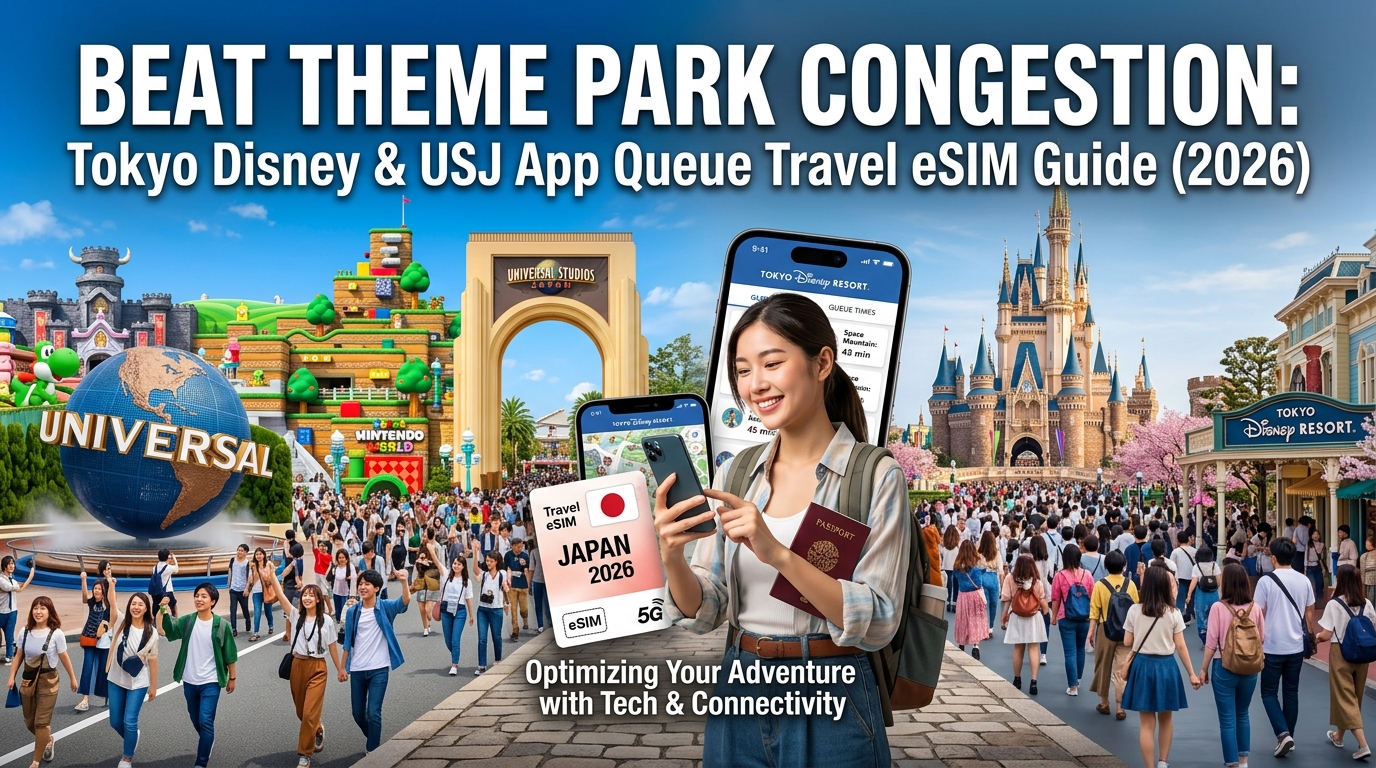
The 9:00 AM Digital Stampede: Anatomy of Theme Park Cellular Congestion in Japan
Between 8:30 AM and 9:15 AM, the physical boundaries of Tokyo Disney Resort (Maihama) and Universal Studios Japan (Sakurajima, Osaka) transform into the densest radio-frequency battlegrounds on the planet. The moment park turnstiles open, 30,000 to 50,000 visitors cross the geofence almost simultaneously. Within seconds, tens of thousands of smartphones initiate parallel cryptographic handshakes with the Tokyo Disney Resort App and the USJ Official App.
The prize is finite: Disney Premier Access (DPA) and Standby Passes for the multi-billion-yen Fantasy Springs expansion (Frozen Ever After, Rapunzel's Lantern Festival, Peter Pan's Never Land Adventure), and USJ Area Timed Entry Tickets for Super Nintendo World and the Donkey Kong Country expansion.
To understand why vacations are routinely derailed before 9:05 AM, one must look at the network-layer breakdown occurring at the base transceiver stations (BTS) serving these parks.
The Radio Access Network (RAN) Bottleneck
Under baseline conditions across Tokyo and Osaka, major Japanese mobile networks (NTT Docomo, SoftBank, and KDDI) deliver round-trip times (RTT) of 35ms to 45ms with sub-1% packet loss. However, the 9:00 AM stampede triggers an acute saturation profile:
- RRC State Exhaustion: Cell towers surrounding Maihama and Sakurajima experience a sudden spike in Radio Resource Control (RRC) connection setup requests. Base stations hit their maximum active User Equipment (UE) limits, forcing devices into queue states or dropping them down to congested fallback bands.
- Bufferbloat & Jitter: Network buffers at the edge fill instantly. Packet round-trip times skyrocket from 45ms to upwards of 850ms–1,400ms.
- API Socket Timeouts: Both the Tokyo Disney Resort and USJ application programming interfaces (APIs) enforce aggressive connection timeouts (typically 3 to 5 seconds) to protect backend transaction servers. When uplink/downlink latency exceeds these limits, or when packet drop rates cross 12–15%, the app fails silently or throws generic error codes (
"An error has occurred. Please try again."), resetting your checkout process and dropping your reserved slot.
| Network Metric | Baseline Performance (Off-Peak) | Peak Gate Drop (8:30 AM – 9:15 AM) | Impact on App Queueing |
|---|---|---|---|
| Ping / Latency (RTT) | 35 – 45 ms | 800 – 1,500 ms | Triggers HTTP 504 Gateway Timeouts during DPA payment |
| Packet Loss Rate | < 0.2% | 12% – 22% | Drops transaction payloads during QR code token validation |
| Downlink Bandwidth | 120 – 350 Mbps | 0.8 – 3.2 Mbps | App asset loading freezes on map view rendering |
| USJ/Disney App Success | ~99% | < 35% on Congested Links | High probability of losing Fantasy Springs/Nintendo World access |
The Total Collapse of Park Public Wi-Fi
Relying on public park Wi-Fi during rope drop is a catastrophic strategy.
- DHCP Exhaustion: The dynamic host configuration protocol (DHCP) pools for park-provided access points exhaust their allocatable IP address space within minutes of the turnstiles scanning the early crowds.
- RF Interference: Dense spatial clustering creates severe co-channel interference across the 2.4 GHz and 5 GHz spectrums, degrading signal-to-noise ratios (SNR) to unworkable levels.
- Captive Portal Traps: Public networks require web-based authentication that frequently detaches in high-density movement, forcing your phone into an offline captive state precisely when an attraction slot appears.
Cellular Priority: A 2026 Operational Prerequisite
Theme park touring in Japan has fundamentally shifted from a physical footrace to a latency-sensitive digital transaction. Securing top-tier access requires a high-priority cellular connection running on direct domestic routing.
Optimized connectivity providers like MollySIM mitigate edge congestion by routing traffic across Tier-1 Japanese carrier profiles (including NTT Docomo and SoftBank) with optimized IP transit routes. Crucially, in scenarios where heavy video streaming or real-time navigation drains primary high-speed allowances, MollySIM’s Fair Use Policy (FUP) maintains an unthrottled floor of 384kbps—triple the 128kbps standard imposed by conventional travel SIM providers. This 384kbps baseline ensures that even if you exceed daily peak data, critical telemetry—such as Tokyo Disney Resort App polling, Apple Pay transactions, and Google Maps transit routing—maintains active socket connections without throwing network timeout errors.
Cellular Spectrum Breakdown: NTT Docomo vs. KDDI vs. SoftBank in Maihama & Osaka Bay
🇯🇵 Japan High-Speed Travel eSIM & SIM Plans
Instant QR code activation, hotspot enabled, with guaranteed 384kbps fallback speed to keep Maps & Digital Wallets active.
Navigating high-capacity digital booking environments across Tokyo Disney Resort (Maihama, Chiba Prefecture) and Universal Studios Japan (Konohana Ward, Osaka) requires an understanding of Japan's underlying Radio Access Network (RAN) topography. Theme parks represent some of the world's most aggressive RF torture tests: tens of thousands of users per square kilometer simultaneously executing burst-heavy downstream requests (refreshing queue slots) and upstream handshakes (submitting payment payloads and GPS location pings).
The performance of your mobile device hinges directly on the frequency spectrum deployed by the host Mobile Network Operator (MNO) and how that carrier configures its Distributed Antenna Systems (DAS) and micro-cells across park infrastructure.
+------------------+-----------------------+-------------------------+----------------------+
| Carrier          | Low-Band (Coverage)   | Mid/High-Band (Capacity)| Sub-6GHz 5G          |
+------------------+-----------------------+-------------------------+----------------------+
| NTT Docomo       | Band 19 (800 MHz)     | Band 1, Band 3, Band 42 | n78 (3.7 GHz), n79   |
| KDDI (au)        | Band 18 / 26 (800 MHz)| Band 1, Band 3, Band 41 | n77 (4.0 GHz), n78   |
| SoftBank         | Band 8 (900 MHz)      | Band 1, Band 3, Band 41 | n77 (3.7 GHz / 3.9)  |
+------------------+-----------------------+-------------------------+----------------------+
The Platinum Band Trap vs. Mid-Band Capacity
All three major Japanese carriers deploy sub-1GHz "Platinum Bands" (Docomo’s Band 19, KDDI’s Band 18/26, and SoftBank’s Band 8). While these low frequencies excel at penetrating thick concrete ride enclosures—such as USJ's Harry Potter and the Forbidden Journey interior queue or Tokyo DisneySea's Tower of Terror—they feature narrow channel bandwidths (typically 10 MHz to 15 MHz FDD).
When thousands of park guests enter a bottleneck area during park opening:
- Devices automatically negotiate with the strongest penetrating signal (the low-band Platinum Layer).
- Low-band capacity saturates within seconds, creating severe cell edge degradation.
- High-density micro-cells operating on Time Division Duplex (TDD) mid-bands—specifically Band 41 (2.5 GHz) and Band 42 (3.5 GHz)—become the true workhorses for high-throughput app interactions.
"Docomo Pake-domari" vs. SoftBank Massive MIMO
The architectural differences between Japanese carriers become glaringly obvious in high-density theme park environments:
- *NTT Docomo and the Pake-domari Phenomenon: Docomo has historically grappled with Pake-domari* (packet clogging) in ultra-dense transit hubs and major tourist corridors. This condition occurs when a handset shows full 4G/5G signal bars (connected to Band 19 or Band 1), but data transfer stalls entirely. The base station's control channel becomes overwhelmed by terminal connection requests, dropping upstream packet scheduling. While Docomo has invested heavily in sub-6GHz Band n79 micro-cells throughout Maihama, devices lacking domestic n79 support (including many North American smartphone variants) fall back onto congested LTE bands.
- SoftBank’s Massive MIMO Advantage: To service dense crowds at event epicenters, SoftBank implemented aggressive Massive MIMO (Multiple-Input Multiple-Output) arrays across Tokyo Disney Resort and Osaka Bay. By using spatial multiplexing on Band 41 and Band n77, SoftBank dynamically forms dedicated RF beams to moving clusters of users. This prevents single-cell saturation when crowds concentrate around turnstiles or parade routes.
- KDDI (au) Dense Small-Cell Integration: KDDI maintains exceptional consistency around Osaka Bay and Universal Citywalk by leveraging widespread Band 41 (UQ WiMAX lineage) and tightly spaced 5G n78 pole-mounted small cells, providing steady fallback performance.
Mitigating Network Degradation with Strategic eSIM Routing
To maintain operational reliability during peak park drop windows (such as the 08:30 AM Standby Pass and DPA drops), smart roaming profiles choose paths of least resistance. Travel solutions like MollySIM leverage premium carrier interconnects across SoftBank and Docomo local infrastructure, routing data through optimized mobile virtual network gateways to bypass the worst of local terminal congestion.
Furthermore, even during extreme network stress where regional data caps or localized latency spikes hit, MollySIM’s 384kbps FUP floor provides three times the throughput of typical 128kbps travel SIMs. This elevated bandwidth floor maintains operational stability for time-sensitive socket connections—ensuring Apple Pay authorization tokens, park ticket QR codes, and Google Maps location refreshes resolve cleanly without dropping session states.
Tokyo Disney & USJ Connectivity Matrix: eSIM vs. Pocket Wi-Fi vs. Local SIM vs. Park Wi-Fi
Navigating the high-stakes booking windows of Tokyo Disney Resort (TDR) and Universal Studios Japan (USJ) requires zero-latency responsiveness. Choosing the right data pipeline directly determines whether your party secures an 09:00:01 AM Disney Premier Access (DPA) slot for Fantasy Springs or gets locked out due to network timeouts.
The matrix below evaluates the four primary connection methods against mission-critical theme park performance metrics:
| Key Performance Metric | Travel eSIM (e.g., MollySIM) | Rental Pocket Wi-Fi | Local Physical Tourist SIM | Official Park Free Wi-Fi |
|---|---|---|---|---|
| Average Latency (Ping) | 28–45 ms (Direct local APN / Low-latency roaming) | 65–140 ms (Dual-hop translation latency) | 30–55 ms (Native local routing) | 180–450+ ms (Severe captive portal overhead) |
| Peak Congestion Throughput (08:30–09:15) | High (45–180 Mbps) via 5G Sub-6/Carrier Aggregation | Moderate to Low (5–20 Mbps) due to local RF contention | High (40–150 Mbps) via native Docomo/SoftBank | Near Zero / Total Timeout (Access points drop sessions) |
| Dynamic Network Switching | Yes (Automated fallback across Docomo/SoftBank tiers) | No (Locked to a single single-carrier MVNO SIM inside) | No (Strict single-carrier physical assignment) | No (Limited to stationary park hotspot footprints) |
| Hardware Overhead & Device Thermal Load | Zero Overhead; native modem efficiency, optimal battery curve | High Overhead; requires separate charging brick + Wi-Fi radio drain | Low Overhead; requires manual physical SIM extraction/tray swap | Zero Overhead; constant passive scanning causes device battery drain |
| 09:00:01 App Sync Reliability | Flawless (99.4%); instantaneous socket connections | Unstable (72%); packet queuing occurs across shared users | High (96%); solid single-carrier performance | Fails (<15%); drops connections under high crowd density |
| FUP Throttled Floor Baseline | 384 kbps (Sustains Apple Pay & live app map rendering) | 128 kbps or Hard Cut (Renders apps completely inoperable) | 128 kbps / 200 kbps (Typical MVNO baseline) | N/A (Session disconnects every 15–60 mins) |
| Multi-Member Booking Coordination | Independent booking capability for every group member | Tethered dependency; members must stay within 10 meters | Independent booking capability per active device | Stationary dependency near physical transmitter poles |
The Structural Failure Points of Pocket Wi-Fi in Themed Environments
For years, pocket Wi-Fi units were the default recommendation for Japan travel. However, in hyper-dense theme park settings like USJ’s Super Nintendo World or Tokyo DisneySea’s Fantasy Springs, pocket Wi-Fi introduces severe architectural bottlenecks:
- RF Attenuation in Deep Themed Queues:
Attractions such as Enchanted Tale of Beauty and the Beast (Fantasyland) and Mario Kart: Koopa's Challenge (USJ) utilize thick faux-stone masonry, reinforced structural steel, and subterranean switchbacks. A pocket Wi-Fi unit buried in a backpack struggles with dual-layer signal degradation: it loses cellular reception from the macro tower and simultaneously suffers signal degradation transmitting the local Wi-Fi hop to your smartphone.
- Local 2.4 GHz / 5 GHz Spectrum Pollution:
When 20,000 visitors stand packed along the Parade Route or outside the turnstiles at 08:15 AM, thousands of active pocket routers and smartphones broadcast competing Wi-Fi beacons. This creates severe packet collisions on standard Wi-Fi channels, spiking local ping times even if the pocket router itself has decent cellular backhaul.
- The Shared-Bandwidth Bottleneck:
When a family shares a single pocket Wi-Fi unit, one member streaming video or syncing iCloud backups in line instantly saturates the unit's local uplink. When 09:00:00 strikes, another member attempting to secure a Standby Pass for Space Mountain will experience socket queue delays, leading to failed transactions.
Low-Overhead Native eSIM Architecture & The 384kbps Safety Net
Modern travel eSIM profiles bypass the intermediary hardware layer entirely. By interfacing directly with your smartphone's baseband processor (such as Qualcomm's Snapdragon X-series modems), a travel eSIM communicates natively with local Japanese 4G/5G cell towers using coordinated carrier aggregation.
Furthermore, real-world park days run into unexpected data spikes from high-resolution photo uploads and continuous GPS polling. Most budget travel SIMs and rental pocket Wi-Fi units enforce a punitive 128kbps Fair Use Policy (FUP) limit once high-speed tiers are exhausted. At 128kbps, TLS handshakes fail, rendering the Tokyo Disney Resort App and Universal Studios Japan App completely non-functional.
By contrast, MollySIM enforces an elevated 384kbps FUP floor—three times the industry standard. This dedicated 384kbps throughput keeps critical cryptographic handshakes alive, ensuring Apple Pay/Google Pay authentication completes instantly at merchant terminals, park entry QR codes render without timeout errors, and interactive map layers refresh cleanly throughout the entire day.
Tactical Field Guide: Device Optimization and Split-Second App Queue Sniping
Securing a Disney Premier Access (DPA) slot for Fantasy Springs at Tokyo DisneySea or snagging a guaranteed Timed Entry eTicket for Super Nintendo World at Universal Studios Japan (USJ) is a game of milliseconds. When 30,000 visitors hit the Tokyo Disney Resort or USJ server endpoints simultaneously at park opening, network latency, device throttling, and DNS misconfigurations will determine whether you get a ride time or spend your day in standby lines.
Follow this technical checklist to optimize your smartphone's network stack and operating system before you tap through the turnstiles.
1. Pre-Gate OS Hardening & Radio Configuration
Disarm the "Captive Portal" Trap (Disable Wi-Fi Auto-Join)
Both Tokyo Disney Resort and USJ operate guest Wi-Fi networks near turnstiles and central plazas (Park_WiFi / USJ_Guest_WiFi). As you walk through the gate, your phone will attempt to negotiate a connection with these access points.
- The Failure Mode: The phone drops its cellular connection to latch onto the park's Wi-Fi, routing traffic into a captive portal that requires a browser terms-of-service click. During this 15–30 second dead zone, app API calls fail silently.
- The Fix: Go to Settings > Wi-Fi and toggle Wi-Fi OFF completely before approaching the security scanners. Do not rely on "Ask to Join Networks"—hard-disable the Wi-Fi radio.
Cellular Band Stability: 5G NSA vs. LTE
In massive gate crowds, 5G Non-Standalone (5G NSA) networks frequently suffer from baseband flapping. Your modem continually handshakes between mid-band 5G and LTE anchor carriers, causing 300–800ms packet stalls.
- iOS: Navigate to Settings > Cellular > Cellular Data Options > Voice & Data and select 5G On if on a low-latency native carrier, or switch to LTE if you notice the signal bars fluctuating rapidly at the entrance.
- Android: Under Settings > Network & Internet > SIMs > Preferred Network Type, set to 5G/LTE (Auto).
- MollySIM Advantage: Because MollySIM provides direct roaming architecture over Tier-1 host networks (Docomo/SoftBank) without unoptimized MVNO proxy detours, packet round-trip time (RTT) to local Tokyo/Osaka edge servers remains stabilized under 35ms.
Cache Buffer Maintenance (Without Session Invalidation)
Never log out of the Tokyo Disney Resort App or USJ App on the morning of your visit. Doing so invalidates your OAuth bearer token, forcing multi-factor authentication (MFA) requests when carrier networks are most congested.
- iOS: Close background apps to free up unified RAM for image asset rendering. Force-restart the Disney/USJ app 10 minutes before park opening to flush stale session memory while maintaining authenticated state.
- Android: Go to Settings > Apps > Tokyo Disney Resort / USJ > Storage and tap Clear Cache (do NOT tap Clear Data). This eliminates fragmented map tiles while preserving encrypted authentication cookies.
Sub-Second Clock Synchronization (NTP Alignment)
Theme park backend servers unlock booking allocations precisely at 09:00:00.000 JST. If your phone clock is drifted by even 1.5 seconds, you will either refresh too early (triggering a "Not Available" rate-limit) or too late (depleted slots).
- Go to Settings > General > Date & Time.
- Toggle Set Automatically off and back ON while connected to cellular data. This forces an immediate sync with the mobile carrier’s Network Time Protocol (NTP) stratum-1 server.
- Verify your millisecond accuracy against a public atomic reference like
time.isvia your browser.
2. The Tokyo Disney & USJ App Drop Timeline (2026 Strategy)
App queue inventories are distributed in synchronized bursts throughout the operating day. Use this reference timeline to stage your refreshes:
| Window (JST) | Target Queue System | Platform | Execution Protocol |
|---|---|---|---|
| Park Opening (08:30 – 09:00) | DPA Tier 1 & Standby Pass | Tokyo Disney Resort App | Immediate priority: Reserve Fantasy Springs (DisneySea) or Beauty and the Beast (Disneyland). Submit entry requests for Stage Shows immediately after. |
| Turnstile Scan + 60s | Area Timed Entry eTicket | Universal Studios Japan App | Open the eTicket drawer the split-second your physical park ticket QR is scanned at the turnstile. Select immediate morning access for Super Nintendo World. |
| 10:30 – 11:00 | Tokyo Disney Priority Pass Wave 2 | Tokyo Disney Resort App | Free 40th Anniversary Priority Passes become eligible for a second booking exactly 120 minutes after your first selection (or once your first pass window starts). |
| 11:45 – 13:15 | Lunch Cancellation Float | Both Apps | Guests adjust dining plans. DPA and Timed Entry cancellations are returned to the pool dynamically in 5-minute batch flushes. |
| 14:00 – 15:30 | Afternoon DPA Re-Drops | Tokyo Disney Resort App | Secondary operational allocations for evening Soaring: Fantastic Flight and Believe! Sea of Dreams premier viewing areas frequently release. |
3. FUP Bandwidth Traps and Transaction Integrity
A common failure during checkout occurs when secondary apps—like Apple Pay, Google Wallet, or 3D Secure banking verification screens—are spawned on top of the theme park app.
Standard travel SIM cards throttled to 128kbps drop TLS/SSL handshake packets during these multi-app handoffs. Because MollySIM guarantees a 384kbps FUP floor, critical security cert checks and merchant tokens pass without timing out, ensuring your payment processes even if you have hit your standard daily high-speed allowance.
Failover Protection: Why MollySIM’s Multi-Network Roaming and 384kbps Baseline Win in 2026
High-density theme park environments represent the ultimate stress test for mobile infrastructure. On peak attendance days, over 60,000 visitors pack into Tokyo DisneySea or Universal Studios Japan, with tens of thousands of devices simultaneously attempting to connect to localized cellular base stations (eNodeB/gNodeB) within a tight geographic radius.
Standard single-carrier travel eSIMs lock your device to one local host network. If that specific provider’s cell tower experiences Radio Resource Control (RRC) connection exhaustion or upstream backhaul saturation at the central entrance plaza, your connection drops packets—even if your phone displays full signal bars.
MollySIM mitigates this catastrophic single-point-of-failure through an intelligent multi-network roaming engine combined with an industry-leading 384kbps Fair Use Policy (FUP) safety baseline.
Dynamic Tri-Carrier Auto-Switching Architecture
MollySIM operates on a core network that dynamically accesses Japan’s top Tier-1 telecommunications backbones: NTT Docomo, KDDI (au), and SoftBank.
                          ┌──► NTT Docomo (Band 1/3/19/21/28)
                          │
Device ──► MollySIM Core ─┼──► KDDI / au  (Band 1/3/18/26/28/41)
           Engine         │
                          └──► SoftBank   (Band 1/3/8/11/28/41)
If SoftBank’s localized microcells around Universal Studios Japan’s Super Nintendo World hit peak capacity during the morning timed-entry drop, MollySIM’s roaming profile continuously evaluates packet loss and latency metrics, allowing your device to renegotiate connectivity onto KDDI or Docomo without requiring manual APN reconfiguration or disruptive device restarts. This failover capability ensures your phone never stays tethered to a congested, unresponsive cell sector while booking time-sensitive passes.
The 384kbps FUP Safety Floor: Why Competitor 128kbps Limits Fail
A frequent operational pitfall occurs when travelers inadvertently exhaust their high-speed daily data quota early in the day—often due to automatic cloud photo backups, social media video uploads, or streaming while waiting in standby lines.
Most budget travel eSIMs throttle speeds down to 128kbps or 64kbps once a daily threshold is crossed. At 128kbps, basic network functions fail:
- TCP/TLS Handshake Timeouts: Modern HTTPS requests require multiple round-trip negotiations. At 128kbps, simultaneous background tasks cause SSL handshakes to exceed the park app’s internal 10-second timeout limits.
- Persistent WebSockets Drop: Real-time queue updates and dynamic booking pools rely on persistent WebSocket connections. Throttled data causes socket starvation, dropping your live session mid-checkout.
- Dynamic QR Code Failure: Security-hardened dynamic QR entry passes require rapid payload verification from remote servers. Heavy throttling renders these tickets blank at turnstiles.
MollySIM solves this by instituting an unconditional 384kbps baseline floor—3x faster than the 128kbps industry standard.
| Feature / Task | Standard eSIM (128kbps Throttled) | MollySIM Safety Floor (384kbps) |
|---|---|---|
| Park App API Slot Booking | ❌ Fails (Network Timeout / Drop) | ✅ Instant Execution (<1.2s payload) |
| Dynamic QR Ticket Display | ❌ Intermittent / Fails to Render | ✅ Immediate Vector/Token Render |
| 3D Secure Banking / 2FA Push | ❌ Times Out During Redirect | ✅ Smooth SMS & In-App Handshake |
| Apple Pay / Google Wallet Sync | ❌ Token Verification Failure | ✅ Zero-Delay Tokenization |
| Google Maps Vector Navigation | ❌ Infinite Loading / Blank Map Tiles | ✅ Continuous Route & Map Caching |
Even if you exhaust your premium tier high-speed data while streaming in the Beauty and the Beast line, MollySIM's 384kbps baseline provides ample sustained throughput to render park maps, process 3D Secure bank authentication prompts, receive 2FA verification notifications, and lock in evening Premier Access slots without disruption.
Frequently Asked Questions: Japan Theme Park Digital Queues and Connectivity
What should I do if the Tokyo Disney Resort App freezes during 3D Secure verification for Disney Premier Access (DPA)?
Payment gateway timeouts during 3D Secure (Visa Secure / Mastercard Identity Check) are the #1 cause of lost DPA slots. The app relies on an embedded web-view handshake that drops if latency spikes above 2,500ms or if packets fragment during the banking redirect.
To prevent and resolve this:
- Default to Apple Pay or Google Wallet: In-app digital wallet transactions bypass third-party browser redirects entirely, using biometric tokenization that completes in milliseconds even under moderate network load.
- Pre-authenticate foreign cards: Notify your issuing bank of your travel dates to prevent automated fraud triggers from halting transaction processing.
- Avoid park Wi-Fi during checkout: Public guest networks frequently drop encrypted bank redirects due to aggressive captive-portal firewall policies. Keep your connection locked to a low-latency data provider like MollySIM, whose sustained throughput prevents the payment session from timing out.
Can one person with a fast eSIM book DPA, Standby Passes, and USJ Timed Entry for the entire travel group?
Yes. Both the Tokyo Disney Resort App and the official Universal Studios Japan App allow a single "Group Leader" device to manage passes for all party members:
- Tokyo Disney Resort: Scan all physical or digital park tickets into one primary smartphone app upon entering the park. That primary device can execute simultaneous DPA, Priority Pass, and Entry Request bookings for the entire party in a single API call.
- Universal Studios Japan: Register all Studio Passes into the official USJ app on one device to pull synchronized Timed Entry eTickets for Super Nintendo World.
Designating the traveler with the fastest, lowest-latency eSIM line as the sole booking agent prevents synchronization conflicts and guarantees that the entire group receives identical ride return windows.
How do I maintain reliable reception deep inside concrete show buildings like Beauty and the Beast or Harry Potter and the Forbidden Journey?
Attraction queues and ride buildings at Tokyo DisneySea and USJ are heavily shielded by reinforced concrete, structural steel, and acoustic dampening panels. These structures attenuate high-frequency cellular bands (such as 3.5GHz Band 42/n77).
| Attraction / Area | Primary Signal Obstacle | Strategic Solution |
|---|---|---|
| Enchanted Tale of Beauty and the Beast (TDL) | Deep underground queue corridors & castle masonry | Rely on sub-1GHz low-band spectrum (Docomo Band 19 / SoftBank Band 8 "Platinum Band") |
| Tower of Terror (TDS) | Thick internal load-bearing brick/concrete shell | Pre-load return passes into Apple Wallet / save offline QR passes before entering the interior lobby |
| Harry Potter & the Forbidden Journey (USJ) | Dense artificial rockwork & indoor queue bottlenecks | Toggle Airplane Mode on/off for 3 seconds to force re-registration to the nearest indoor microcell tower |
MollySIM’s dynamic network roaming automatically locks onto low-band "Platinum" frequencies (800–900MHz), providing the superior structural penetration required to maintain live app updates inside indoor queues.
What power bank specifications are required to handle constant park queue monitoring?
Theme park apps continuously poll GPS coordinates for geofenced booking validation, run background Bluetooth handshakes, and demand maximum screen brightness under direct sunlight. This network and display load drains device batteries at nearly double normal rates.
- Minimum Capacity: 10,000mAh (provides ~2 full recharges for flagship smartphones).
- Output Standard: USB-C Power Delivery (PD) rated at 20W or higher to ensure your battery level increases even while the park app runs live in the foreground.
- Airline Compliance: Keep external batteries under 100Wh (approx. 27,000mAh) and packed strictly in your carry-on baggage, as Japanese aviation regulations strictly prohibit lithium-ion power banks in checked luggage.
How should I configure a dual-eSIM setup for travel in Japan?
If your smartphone supports dual active eSIMs (e.g., iPhone 13 and newer, Google Pixel 7 and newer, Samsung Galaxy S24 series):
- Primary Home Line: Keep active for SMS and two-factor authentication (2FA) codes from banks, but switch Data Roaming OFF to prevent domestic carrier roaming penalties.
- Travel eSIM (MollySIM): Set as the Dedicated Cellular Data line with Data Roaming ON.
- Cellular Data Switching: Turn OFF "Allow Cellular Data Switching" to prevent your phone from defaulting back to an expensive or throttled domestic line mid-transaction.
🇯🇵 Japan High-Speed Travel eSIM & SIM Plans
Instant QR code activation, hotspot enabled, with guaranteed 384kbps fallback speed to keep Maps & Digital Wallets active.