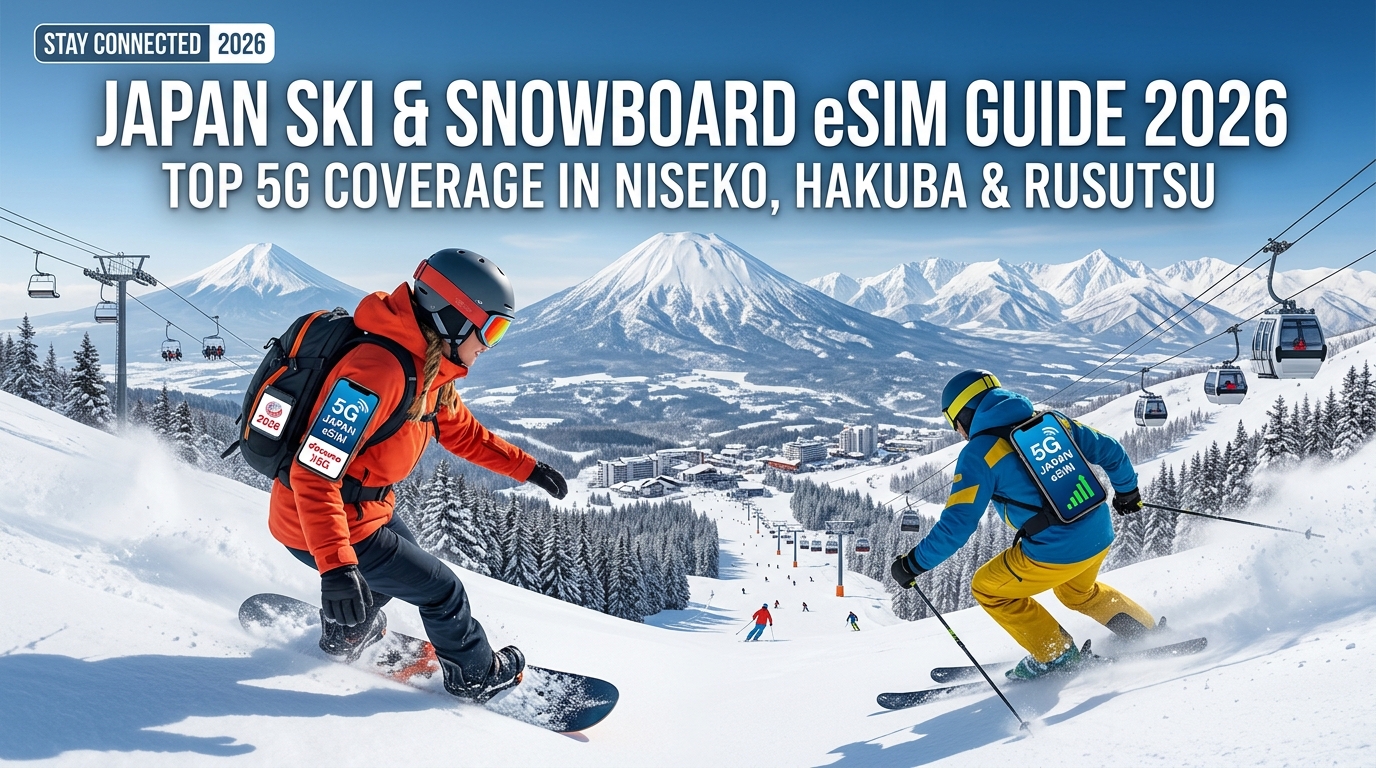
Japan Ski & Snowboard eSIM Guide 2026: Top 5G Coverage in Niseko, Hakuba & Rusutsu
The 2026 Alpine Connectivity Challenge: Why Japan's Powder Slopes Demand Resilient 5G
Ripping through waist-deep Ja-pow in Niseko’s legendary strawberry fields or navigating the steep, technical bowls of Hakuba’s Happo-One demands absolute focus. Yet, beneath the allure of the world’s most consistent snowfall lies one of the most hostile operating environments on the planet for mobile consumer electronics.
For winter sports enthusiasts in 2026, mobile connectivity is no longer just about posting real-time 4K clips to Instagram; it is an indispensable safety system for backcountry gate tracking, digital lift passes, emergency SOS dispatches, and avalanche beacon coordination. However, keeping a smartphone reliably connected across Hokkaido and the Japanese Alps involves overcoming severe atmospheric, thermodynamic, and radio-frequency (RF) bottlenecks.
The Sub-Zero Hardware Drain: Li-Ion Physics and RF Transceivers
When temperatures drop between -10°C and -20°C on the peak of Mount Annupuri or Hakuba's ridge lines, your smartphone faces immediate thermodynamic degradation:
- Electrolyte Solidification & Voltage Sag: Extreme cold dramatically increases the internal impedance ($R_{int}$) of standard lithium-ion batteries. As chemical reactivity slows, the battery cannot deliver sustained voltage under load.
- Amplified Transceiver Power Consumption: When cellular signal strength drops—common in deep ravines or blizzard conditions—the phone’s baseband modem drives the RF power amplifier to its maximum transmission limit (often up to +23 dBm).
- The Sudden-Death Loop: The combination of elevated current draw from the struggling modem and cold-induced battery resistance causes an abrupt voltage drop below the device’s power management IC (PMIC) threshold, triggering an unprompted 0% battery shutdown—even if your gauge read 40% moments prior.
Snowpack Attenuation and Low-Band Spectrum: Docomo vs. SoftBank
High-frequency 5G bands (such as 3.7 GHz n77 and 4.5 GHz n79) deliver incredible gigabit speeds in urban hubs like Tokyo, but they fail catastrophically in mountain environments. Heavy snowfall acts as a dielectric scattering medium; dense flakes, moisture-laden maritime air, and deep tree cover (Ezo spruce and Japanese beech) absorb high-frequency millimeter-wave and mid-band radio waves.
To maintain continuous line-of-sight and non-line-of-sight (NLOS) penetration into off-piste valleys, Japan’s major Mobile Network Operators (MNOs) deploy targeted sub-1GHz "Platinum Bands":
| Operator | Primary Alpine Low-Bands | 5G Alpine Allocation | Mountain Footprint Strengths | Weaknesses on the Slopes |
|---|---|---|---|---|
| NTT Docomo | Band 19 (800 MHz) | n28 (700 MHz) / n78 (3.5 GHz) | Best high-altitude backcountry and remote valley penetration; dominant mountain-rescue mast coverage across Hokkaido. | Peak congestion at base lodge gondola stations during 8:30 AM rush. |
| SoftBank | Band 8 (900 MHz) / Band 28 (700 MHz) | n28 (700 MHz) / n77 (3.4/3.7 GHz) | Exceptional capacity around village centers (Hirafu, Echoland), high transmission speeds on main groomers. | Signal drops faster in unpatrolled, deep-cut backcountry ravines. |
NTT Docomo’s Band 19 (800 MHz) remains the undisputed gold standard for backcountry stability. Its long wavelength diffracts effectively around mountain ridges, allowing signals to bend into deep powder bowls where cell towers are physically shielded.
SoftBank’s Band 28 (700 MHz) and Band 8 (900 MHz) provide a robust counter-balance, heavily optimized for high-density resort zones like Niseko United and Hakuba Valley, ensuring rapid speeds even when thousands of skiers hit the network simultaneously.
Choosing the Right Alpine Roaming Architecture
Because sub-zero conditions penalize devices that spend excessive battery searching for a signal, using an eSIM optimized for Tier-1 local Japanese carriers is critical. Budget roaming profiles often route traffic through distant third-country servers with weak roaming agreements, dropping your device onto congested secondary bands or high-latency fallback circuits.
High-performance options like MollySIM interface directly with Japan’s top-tier local infrastructure (NTT Docomo / SoftBank), giving your hardware direct access to life-saving Band 19 and Band 28 sub-1GHz frequencies.
Crucially, when data allowances hit their cap mid-mountain, standard international eSIMs throttle speeds down to an unusable 128 kbps—instantly breaking map rendering, real-time messaging, and translation services. In contrast, MollySIM implements a 384 kbps Fair Use Policy (FUP) baseline. Operating at three times the speed of conventional throttles, this 384 kbps floor ensures that live topographical tracking on Google Maps, ski tracking telemetry, emergency messaging, and contactless Apple/Google Pay lodge transactions remain fully operational even in the midst of a whiteout.
Resort-by-Resort 5G Coverage Audit: Niseko United, Hakuba Valley, and Rusutsu
🇯🇵 Japan High-Speed Travel eSIM & SIM Plans
Instant QR code activation, hotspot enabled, with guaranteed 384kbps fallback speed to keep Maps & Digital Wallets active.
Topographical isolation, maritime snowpacks, and multi-faceted alpine ridges create stark micro-climates of mobile connectivity across Japan's premier ski resorts. Navigating these zones requires understanding exactly where carrier spectrum holds up and where alpine shadow zones threaten communication.
1. Niseko United: Base Densification vs. Peak Backcountry Gates
The Mount Annupuri massif hosts four interconnected resorts featuring vastly different RF (radio frequency) propagation environments:
- Grand Hirafu & Hanazono: Thanks to extensive commercial development, base areas and mid-mountain lift hubs (such as the Hanazono EDGE and Hirafu Gondola Station) feature dense 5G Sub-6 (n77/n78) deployments. Speeds routinely exceed 250–400 Mbps on native networks.
- Annupuri & Niseko Village: Solid mid-band coverage spans groomed trails, but speeds decline to 40–70 Mbps inside tree-dense glades like Strawberry Fields.
- Backcountry Gate System (Gates 1–11): Dropping through Gate 3 (Hirafu Peak) toward the North Face or descending into the Mizuno no Sawa (Gate 11) natural avalanche control area pushes your hardware outside line-of-sight base stations. Here, standard roaming profiles lose synchronization immediately. Profiles accessing NTT Docomo Band 19 (800 MHz) maintain an emergency voice/data link the longest down into the valley floor.
2. Hakuba Valley: Ridgeline Propagation & Deep Valley Shadows
Stretching across 30 kilometers of the Japanese Northern Alps, Hakuba presents the most demanding RF environment in Honshu.
- Happo-One & Hakuba 47 / Goryu: High-altitude ridgelines—such as the top of Happo’s Grat Quad (1,830m) and Kurobishi T-Bar—benefit from clean, unobstructed line-of-sight to cell towers located in Hakuba Village. On clear days, 5G signal locks on seamlessly. However, in heavy blizzards, signal scatter reduces speeds significantly.
- Tsugaike Mountain Resort: The expansive lower slope (Kane-no-naru-oka) holds unbroken 5G, but the high-altitude Tsuga-no-mori zone and access routes toward the Hiyodori backcountry gate drop to sub-1GHz LTE fallback.
- Hakuba Cortina & Norikura: Cortina is a notorious alpine "signal bowl." Enclosed within steep terrain, base-level coverage from budget carriers frequently collapses into No Service. Connecting via an eSIM loaded with SoftBank Band 8 or Docomo Band 19/28 is mandatory to prevent dropouts while tree-skiing in Cortina's sidecountry basins.
3. Rusutsu Resort: Triple-Mountain Penetration & Sidecountry Bowls
Rusutsu’s layout spans three distinct peaks: West Mountain, East Mountain, and Mt. Isola.
- West Mountain: Immediate proximity to the Rusutsu Resort Hotel complex provides uninterrupted, high-capacity 5G service across all night-skiing terrain.
- East Mountain & Mt. Isola: As you transition across the East Gondola to Mt. Isola (994m), mobile data shifts entirely to mast towers positioned on ridge spurs along the Isola Grand Course and Heavenly Canyon.
- Off-Piste & Tree Glades: Deep descents into the Isola Bowl and Shirakaba glades isolate devices behind ridgelines. While high-frequency 5G drops out instantly, low-band LTE maintains connectivity for real-time safety coordination.
Resort Coverage & Spectrum Audit (2026 Season)
| Alpine Area | Dominant Carrier | 5G Reliability | Backcountry / Off-Piste Stability | Critical Band |
|---|---|---|---|---|
| Niseko (Hirafu / Hanazono) | Docomo / SoftBank | Excellent (Base & Mid) | High (Docomo via Ridge LOS) | Band 19 / Band 28 / n77 |
| Niseko (Gates 2, 3, 11) | Docomo Native | Fair (Peak only) | Moderate (Low-band fallback) | Band 19 (800 MHz) |
| Happo-One (Kurobishi/Ridgetop) | SoftBank / Docomo | Very Good | High (Direct line-of-sight) | Band 1 / Band 8 / n78 |
| Hakuba Cortina Bowl | SoftBank / Docomo | Poor (Base only) | Low to Moderate (Shadow zone) | Band 19 / Band 8 |
| Rusutsu (Mt. Isola / Heavenly) | Docomo / SoftBank | Moderate (Lifts only) | Moderate (Ridge reliance) | Band 28 / Band 19 |
Maintaining Critical Data Access on the Slopes
When cold weather drains device batteries and continuous 4K video uploads or GPS tracking exhaust your daily primary data allowance, budget eSIMs drop straight to a 128 kbps throttle. At that speed, snow navigation maps fail to render, leaving you without critical trail mapping.
Choosing a high-tier travel eSIM like MollySIM mitigates this risk by routing traffic natively over NTT Docomo and SoftBank infrastructure. Furthermore, MollySIM's 384 kbps Fair Use Policy (FUP) floor provides three times the bandwidth of conventional roaming packages. This extra throughput ensures that topographical maps on Google Maps, instant messaging for slope meetups, and Apple/Google Pay terminal transactions at mountain huts remain functional throughout your session.
Hardware Breakdown: Pocket Wi-Fi Freezes vs. Travel eSIM Reliability on Chairlifts
Navigating the sub-zero alpine conditions of Hokkaido and the Japanese Alps exposes critical hardware vulnerabilities in mobile communication setups. While pocket Wi-Fi rentals have long been a default travel staple in Tokyo, their real-world utility degrades rapidly when exposed to winter sports environments at -15°C across high-altitude lift lines.
The Physical Hazards of Pocket Wi-Fi in Alpine Conditions
Relying on an external battery-powered router while skiing or snowboarding introduces four distinct failure modes:
- Sub-Zero Lithium Shutdowns: Uninsulated lithium-ion cells suffer dramatic internal resistance spikes when exposed to ambient mountain temperatures. On windy, exposed chairlifts—such as Happo-One's Alpen Quad or Niseko's Ace Pair—pocket Wi-Fi units stored in outer shell pockets frequently suffer sudden voltage drops, cutting power from 60% straight to 0% in seconds.
- Condensation and Moisture Damage: Shuttling repeatedly between freezing ridgetops and humid mountain huts creates rapid condensation inside the plastic housing of rental routers. Moisture ingress can trigger internal liquid contact indicators, voiding rental terms and incurring expensive damage penalties.
- Deep Powder Loss Liability: Pocket Wi-Fi units require external battery tethering or loose pocket placement. Dropping an unsecured router into waist-deep powder outside marked gates (such as Niseko’s Gate 11 or Rusutsu’s Heavenly Canyon) guarantees total loss, resulting in replacement fees ranging from ¥20,000 to ¥45,000.
- Bulky Layering Constraints: Managing transceivers, action cameras, and hydration systems leaves no room for an additional 150g–200g router in your thermal base layers, where electronics must be stored to stay operational.
Hardware Comparison: Connectivity Solutions for Japan Skiing
The table below contrasts modern digital travel eSIMs, local physical SIM cards, and pocket Wi-Fi units across essential mountain sports operational metrics:
| Metric | MollySIM Travel eSIM | Local Physical SIM | Rental Pocket Wi-Fi Router |
|---|---|---|---|
| Cold Resistance | High (Protected inside inner phone pocket) | High (Internal to phone) | Critical Risk (Rapid battery shutdown below -5°C) |
| Battery Drain Factor | Low (Integrated native cellular modem) | Low (Integrated native cellular modem) | High (Constant Wi-Fi searching + Phone battery) |
| Setup Simplicity | Instant (QR scan via iOS/Android before departure) | Low (Requires tray tool, glove removal, micro-chip handling) | Moderate (Airport pickup/drop-off queues, charging management) |
| Latency on Mountain Towers | Low (Direct Docomo/SoftBank 5G/4G tower handshake) | Low (Direct local interconnect) | Moderate to High (Extra Wi-Fi hop adds 15–30ms latency) |
| Hardware Loss Liability | Zero (100% digital profile) | Zero (Protected inside device) | ¥20,000 – ¥45,000 (Full device replacement charge) |
| 5G Roaming Access | Enabled (High-speed multi-band n77/n78/n79) | Varies (Often locked to MVNO 4G bands) | Carrier Restricted (Most rental units locked to 4G LTE) |
| Throttled Bandwidth (FUP) | 384 kbps Floor (Maintains GPS, Apple Pay, Messaging) | 128 kbps or Hard Cut | 128 kbps (Fails to load map tiles) |
Why Native eSIM Integration Wins on the Slopes
Digital profiles installed directly onto your device's motherboard eliminate the mechanical vulnerabilities of physical SIM swapping and external tethering. By storing your device safely inside an insulated chest pocket, your smartphone relies on natural body heat to maintain operating temperatures, ensuring uninterrupted transceiver and cellular operation.
Furthermore, routing data natively through MollySIM removes the Wi-Fi transmission hop between your phone and an external hotspot, saving up to 25% of your phone's battery over an eight-hour ski day. If high-resolution video transfers exceed your primary daily quota on the slopes, MollySIM's 384 kbps safety floor ensures you can still load topographic trail maps and process digital payments at remote base lodges without dealing with a completely frozen connection.
The Critical Safety Margin: Why MollySIM's 384kbps Fallback Speed Keeps Ski Groups Connected
In high-altitude backcountry and expansive resort terrain like Niseko United or the Hakuba Valley, mobile data is an essential safety tool. Most budget travel eSIMs market "unlimited" data packages that hide aggressive Fair Usage Policies (FUP). Once your primary daily high-speed tier (typically 1GB to 3GB) is spent on uploading 4K action cam footage or syncing cloud drives, standard providers throttle speeds down to 64 kbps or 128 kbps.
At 128 kbps, modern encrypted mobile applications break down. Transport Layer Security (TLS) handshakes time out, vector map tiles fail to render, and messaging apps display persistent "Connecting..." loops.
MollySIM engineers its network policy with a dedicated 384 kbps safety floor—three times the industry average. This technical distinction provides a functional safety net that prevents digital isolation on the mountain.
Technical Performance Under Throttle: 128 kbps vs. 384 kbps
The difference between 128 kbps and 384 kbps determines whether essential safety and navigation services remain operational when cellular bandwidth is constrained:
| Mobile Service / Application | Standard Competitor Throttle (128 kbps) | MollySIM Safety Floor (384 kbps) | Real-World Mountain Impact |
|---|---|---|---|
| WhatsApp / iMessage Live Location | Fails / Stalls (Frequent packet drops & sync timeouts) | Operational (Low-latency telemetry streaming) | Pinpoints off-piste group members in real time. |
| VoIP Emergency Voice Calling | Unusable (Jitter >300ms, garbled audio codecs) | Functional (Clean Opus codec transmission at 16–24 kbps) | Enables critical phone calls to ski patrol or mountain rescue. |
| FATMAP / AlpineQuest Topo Maps | Times Out (Map layers fail to load, showing grey grids) | Functional (Progressive vector/contour line rendering) | Prevents navigational errors near avalanche terrain and cliffs. |
| Group Audio Voice Notes | 50–90s Upload Delay (Prone to transmission failures) | Near Instant (2–4s dispatch for 10-second notes) | Enables quick updates on gate closures and rendezvous points. |
| Apple Pay / Google Wallet Verification | Transaction Timeout (Gateway token exchange fails) | Instant Clear (Fast TLS key exchange) | Smooth digital payments at base lodges and transit gates. |
Real-World Mountain Scenario: Whiteout Separation at Niseko Gate 11
Consider a scenario where a group enters the Annupuri peak gates during deteriorating weather conditions. Dense fog and sudden snowfall drop visibility to under five meters, separating one rider from the group:
- The Navigation Dilemma: The separated rider has exhausted their daily high-speed 5G allowance. On a standard 128 kbps plan, loading topographical contour lines on outdoor mapping apps stalls entirely, leaving a blank screen. At MollySIM’s 384 kbps floor, the device continuously pulls cached vector layers and terrain elevation data, allowing the rider to identify ridgelines and avoid terrain traps.
- Telemetry and Tracking: Background location sharing on messaging platforms requires sustained two-way UDP/TCP packets. While 128 kbps connections drop continuous pings due to mountain tower latency, 384 kbps bandwidth effortlessly sustains continuous coordinates without dropping the connection.
- Voice Over IP Dispatch: Low-bitrate VoIP protocols require a consistent, unchoked data stream. MollySIM’s 384 kbps floor gives your device enough headroom to clear audio packets while running background telemetry, ensuring you can quickly establish a call with your group to coordinate a safe rendezvous at the lift base.
Maintaining a reliable data floor ensures that crossing daily usage thresholds never compromises navigational awareness or group communication in harsh alpine environments.
Optimizing Dual-SIM Performance & Battery Life in Sub-Zero Japanese Ski Conditions
Operating a dual-SIM setup in sub-zero alpine environments like Niseko Annupuri or Hakuba Happo-One introduces two distinct technical challenges: RF transceiver battery drain caused by searching for distant mountain base stations, and accidental roaming charges on your primary carrier line. Configuring your device correctly before you step off the gondola guarantees reliable data delivery while keeping your battery operational through last chair.
Pre-Departure Setup: iOS & Android Dual-SIM Configuration
To ensure zero downtime upon landing at New Chitose (CTS) or Tokyo Haneda (HND), install your MollySIM profile 24 hours before your flight while connected to a stable Wi-Fi network.
Step 1: Install and Label the eSIM Profile
- iOS: Navigate to Settings > Cellular > Add eSIM. Scan the QR code provided by MollySIM. Label the new plan as
"Japan Data"and your physical/primary line as"Home". - Android (Google Pixel / Samsung Galaxy): Go to Settings > Network & internet (or Connections) > SIMs > Add SIM. Download the eSIM profile via QR code and designate it as
"MollySIM Japan".
Step 2: Lock Down Cellular Data Routing & Prevent Carrier Leaks
To prevent your home carrier from triggering $10–$15 daily roaming passes when your phone searches for data:
- Set Cellular Data default to MollySIM.
- Set Default Voice Line to your Home SIM (enabling SMS two-factor authentication without using overseas data).
- Disable "Allow Cellular Data Switching" (iOS) or "Auto data switching" (Android). This prevents the OS from falling back to your expensive home carrier data if you hit a brief dead zone in a deep backcountry bowl.
- On your Home SIM profile, toggle Data Roaming to OFF.
- On your MollySIM profile, toggle Data Roaming to ON.
Step 3: APN & Network Selection
MollySIM automatically configures Access Point Name (APN) settings upon connection to Japanese infrastructure. If an APN profile prompt appears, set the APN field to globaldata (leave username and password blank).
Set Network Selection to Automatic. MollySIM dynamically negotiates handshakes between NTT Docomo and SoftBank:
- NTT Docomo: Superior penetration in remote Hokkaido tree runs and deep valley terrain (Rusutsu East/Isola).
- SoftBank: High-density capacity across developed base villages (Hirafu, Hakuba Wadano).
Cold-Weather Battery Preservation Protocols
Lithium-ion batteries rely on liquid electrolytes that experience increased internal resistance as temperatures plummet below 0°C (32°F). At -10°C on a Niseko peak, an unprotected smartphone can lose 40–60% of its operational capacity in under an hour if exposed to ambient air.
| Optimization Layer | Default Setting | Recommended Alpine Setting | Technical Impact |
|---|---|---|---|
| 5G Radio Mode | 5G On | 5G Auto / LTE Only | Prevents continuous millimeter/sub-6GHz polling in fringe tree zones |
| Background Refresh | Enabled for all apps | Disabled (Except GPS/Safety) | Reduces background processor wakeups in sub-zero temps |
| OS Power Mode | Standard | Low Power Mode (Engaged at 100%) | Throttles CPU cycles, reducing thermal drain on battery cells |
| Display Brightness | Auto-Max HDR | Manual 60% with Dark Mode | Minimizes OLED power draw against high snow-glare reflection |
Strategic Thermal Pocket Management
- Internal Layering: Never store your phone in an outer shell or pant pocket. Place your device in an inside zippered chest pocket of your mid-layer or fleece, directly facing your core body heat.
- Insulated Pouches: Use an aerogel- or neoprene-lined thermal phone pouch if skiing in exposed backcountry terrain below -15°C.
- Cold Recovery: If your phone cold-shuts down with a black screen, do not repeatedly press the power button. Place it flat against your base layer inside your jacket for 10 minutes to normalize electrolyte conductivity before restarting.
Hybrid Navigation & Data Efficiency on the Slopes
Constant satellite tracking combined with live vector rendering drains mobile hardware rapidly. Optimize your daily bandwidth and battery profile using a hybrid offline-online strategy:
- Pre-Cache Offline Topography: Download offline map regions in Google Maps and FATMAP/AllTrails over hotel Wi-Fi the night before.
- Real-Time Layer Sync: Keep your MollySIM 5G connection active for live telemetry, companion tracking, and mountain advisory updates.
- The Bandwidth Safety Net: If heavy video streaming or photo syncing triggers your plan's high-speed threshold mid-day, MollySIM's 384 kbps Fair Use Policy (FUP) provides a baseline that is 3x faster than standard 128 kbps throttles. This ensures Google Maps contour rendering, location pins, and NFC transactions via Apple Pay at resort lodges remain fully operational without lag.
Digital Mountain Toolkit: Essential Winter Apps, Avalanche Bulletins & Emergency Protocols
A standard backcountry gear list requires a beacon, probe, and shovel. In 2026, real-time cellular connectivity functions as the indispensable fourth piece of safety equipment. Rapid weather shifts across the Sea of Japan can turn a bluebird morning into a zero-visibility whiteout in minutes. Having a low-latency data connection allows you to monitor snowpack stability, track your group across tree runs, and summon search-and-rescue teams with sub-meter coordinate precision.
Critical Snow, Forecast & Safety Applications
Equip your device with these mission-critical applications before heading up the gondola:
| App / Platform | Core Functionality | Network Dependency | Best Used In |
|---|---|---|---|
| Yukiyama | Japan's official ski-tracking platform; live resort maps, digital lift status, friend radar, and SOS triggers. | Continuous 4G/5G pinging for live companion positioning. | All major Japanese resorts (Niseko, Hakuba, Nozawa, Rusutsu). |
| Nadare (Japan Avalanche Network - JAN) | Real-time avalanche danger scale, pit-test telemetry, and danger-zone bulletins. | Daily live updates; required before entering sidecountry gates. | Hakuba Valley, Niseko United Gate System, Myoko. |
| JMA Weather Radar (Japan Meteorological Agency) | High-resolution X-band precipitation radar and freeze-line tracking. | High-bandwidth raster map data rendering. | Nationwide resort tracking. |
| Windy.com / ECMWF Model | Micro-elevation wind vectors, gust forecasting, and cloud-base ceilings. | Live model rendering. | Ridge lines, exposed bowls, and alpine peaks. |
- Yukiyama: The gold standard in Japanese resorts. The app displays high-resolution, interactive trail maps and syncs with your GPS chip to show real-time coordinates of everyone in your group. It operates direct SOS dispatch integrations with ski patrols in partner resorts.
- Japan Avalanche Network (Nadare.jp): If you ski out-of-bounds or access terrain through designated gates (such as Niseko’s 11 Gate System or Hakuba’s Happo North Face), reviewing JAN's daily avalanche bulletin is non-negotiable. Bulletins update early morning, detailing facet layers, wind slabs, and crown risks.
- JMA High-Resolution Radar: Japan’s microclimates can dump 30cm of snow on one side of a ridge while leaving the other dry. The JMA radar gives you real-time 250-meter resolution precipitation scans, enabling you to chase localized powder bands effectively.
Emergency Protocols: Contacting Mountain Rescue (110 vs. 119)
If an accident occurs in the resort boundary, contact the local Ski Patrol dispatch directly via the emergency number printed on your trail map or within the Yukiyama app.
For backcountry, off-piste, or severe sidecountry incidents, use standard Japanese emergency infrastructure:
┌─────────────────────────────────────────────────────────────┐
│                 JAPAN EMERGENCY DISPATCH                    │
├──────────────────────────────┬──────────────────────────────┤
│ 119: Fire / Rescue / Medical │ 110: Police (Mountain SAR)   │
│ • Direct medical evacuation  │ • Backcountry search units   │
│ • Paramedic response         │ • Prefectural SAR helicopter │
└──────────────────────────────┴──────────────────────────────┘
Step-by-Step Distress Protocol:
- Secure the Scene: Ensure no secondary avalanche or terrain hazard threatens the group. Turn companion transceivers to "Search" if a burial has occurred.
- Extract Precise Coordinates: Open Apple Maps, Google Maps, or your compass app. Note down the Decimal Degrees (e.g., 36.6982° N, 137.8619° E) or generate a What3Words address.
- Dial 119 (Ambulance/Rescue) or 110 (Police):
- State clearly: "Mountain Rescue needed in [Prefecture/Resort, e.g., Nagano, Hakuba Happo-One Backcountry]."
- If you do not speak Japanese, say: "Eigo o hanaseru hito wa imasu ka?" (Is there an English speaker?) or rely on your real-time translation app.
- Broadcast Location via Cellular Data: Send your exact live pin via messaging apps (LINE/WhatsApp/iMessage) to your resort accommodation or local emergency contacts who can liaise with local authorities on your behalf.
Why eSIM Data Reliability Is Critical Safety Gear
Off-piste navigation apps, high-resolution topographic layers, and continuous companion tracking consume significant battery and background data. Standard roaming SIMs often suffer from carrier deprioritization or severe throttling once daily limits are met. Dropping to a 128 kbps speed makes rendering map tiles impossible and introduces severe latency when sending critical location pins.
Using a high-performance profile via MollySIM ensures that even if you exceed your daily high-speed quota while capturing 4K run clips, the 384 kbps Fair Use Policy (FUP) safety net remains active. At 384 kbps—three times faster than conventional market throttles—vector contours on Google Maps, emergency GPS coordinate rendering, and digital payment systems at high-altitude mountain huts remain operational when you need them most.
🇯🇵 Japan High-Speed Travel eSIM & SIM Plans
Instant QR code activation, hotspot enabled, with guaranteed 384kbps fallback speed to keep Maps & Digital Wallets active.