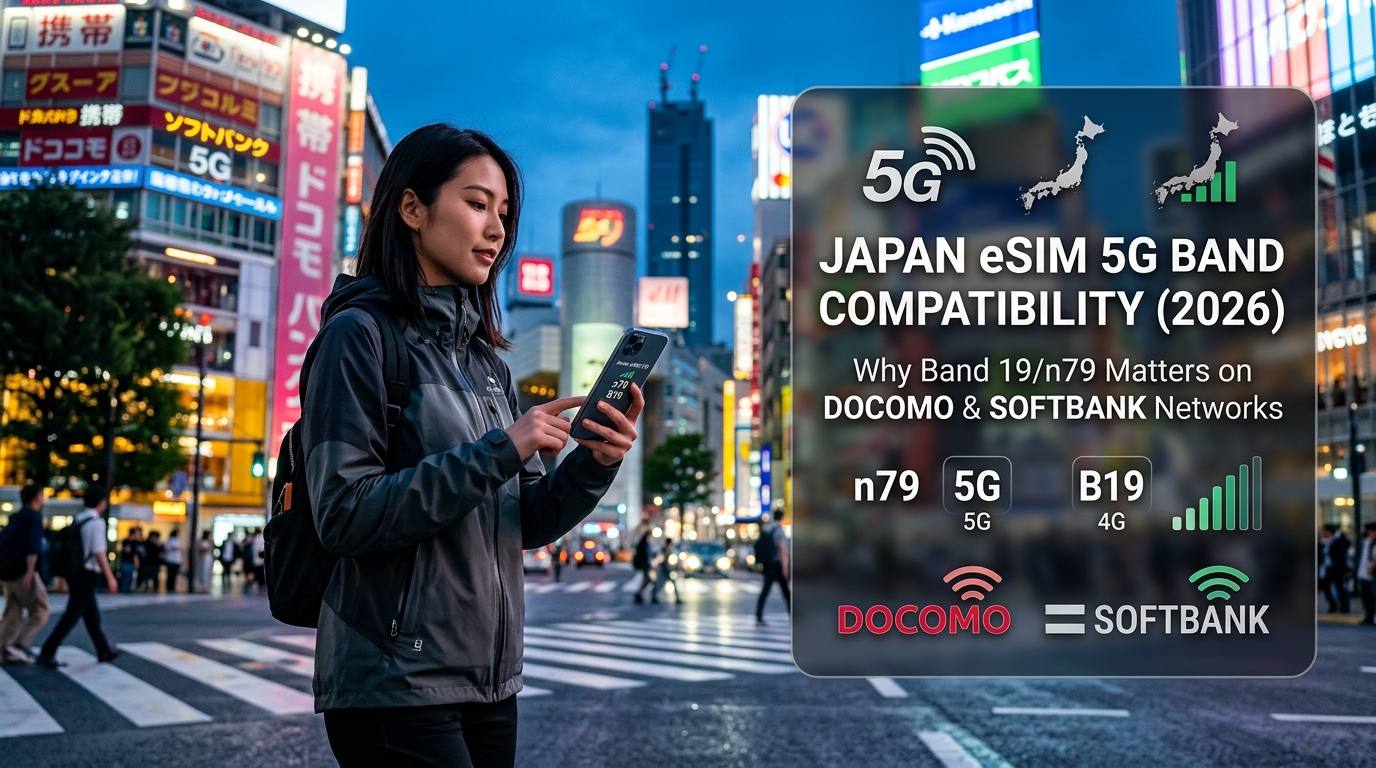
Japan eSIM 5G Band Compatibility (2026): Why Band 19/n79 Matters on Docomo & SoftBank Networks
The Hidden Reason Tourists Lose Signal in Japan: Spectrum Allocation Explained
Every year, thousands of international travelers land at Narita or Haneda Airport, install a top-rated "unlimited" Japan eSIM, and expect flawless gigabit speeds across Tokyo. Instead, the moment they descend into the subterranean corridors of Shinjuku Station, board the Tokyo Metro Oedo Line, or explore rural prefectures like Nagano and Hokkaido, their screens drop from 5G to a single unstable bar of 4G LTE—or display "No Service" altogether.
This sudden network blackout is rarely a malfunction of the eSIM profile itself. Rather, it is the direct result of a fundamental hardware-network mismatch dictated by Japan’s Ministry of Internal Affairs and Communications (MIC) and its unique radio spectrum management policies.
The Sub-1GHz "Platinum Band" Divide (LTE)
Sub-1GHz spectrum—often referred to in Japan as the "Platinum Band" (プラチナバンド)—is vital for mobile connectivity. Because lower radio frequencies feature longer wavelengths, they easily penetrate concrete walls, travel deep underground into subway platforms, and diffract around mountainous terrain.
Japan’s MIC distributed these low-band frequencies across the major mobile network operators (MNOs) using country-specific channelizations:
- NTT Docomo (Band 19 / 800 MHz): Docomo’s primary coverage backbone across rural corridors and subterranean transit. Band 19 is an exclusive Japanese allocation (a distinct subset of the wider Band 5/6 family).
- au by KDDI (Band 18 / Band 26 / 800 MHz): KDDI’s primary low-band layer, heavily integrated across nationwide municipal networks.
- SoftBank (Band 8 / 900 MHz): SoftBank’s low-band anchor. Unlike Docomo’s B19, Band 8 is a standard E-GSM frequency widely adopted across Europe, the UK, and most of Asia.
| Operator | Primary Sub-1GHz Band | Frequency Range | Global Compatibility Level |
|---|---|---|---|
| NTT Docomo | Band 19 | 800 MHz (UL: 830-845 / DL: 875-890) | Low (Japan-specific; absent in most US Androids) |
| au KDDI | Band 18 / 26 | 800 MHz (UL: 815-830 / DL: 860-875) | Moderate (Supported on broad roaming profiles) |
| SoftBank | Band 8 | 900 MHz (UL: 880-915 / DL: 925-960) | High (Universal standard in EMEA & APAC) |
Because NTT Docomo holds the highest market share in Japan, many generic travel eSIM resellers default exclusively to Docomo profiles. However, if your phone lacks hardware filters for Band 19, your device is blind to Docomo’s sub-1GHz layer. While a local Japanese phone maintains 4 bars of signal inside a basement izakaya, a foreign phone on the same network will experience dropped packets and rapid battery drain as it frantically searches for high-band cell towers.
+--------------------------------------------------------------------+
|                JAPAN SPECTRUM PENETRATION COMPARISON               |
|                                                                    |
| High Frequencies (Band 1/3, n77/n79): High Speed / Blocked by Walls|
| [ Cell Tower ] ======> [ Concrete Wall / Subways ] X (Drops Signal)|
|                                                                    |
| Low "Platinum" Bands (B8 / B18 / B19): Superior Physical Range     |
| [ Cell Tower ] ----------------------------------> [ Basement / 5G ]|
+--------------------------------------------------------------------+
The 5G Frequency Conflict: Docomo’s n79 vs. SoftBank’s n77
The hardware incompatibility becomes even more severe when moving to 5G New Radio (NR) networks. In urban centers like Shibuya, Ginza, and Roppongi, Japanese carriers deploy mid-band 5G to carry massive data loads. However, the MIC allocated spectrum to avoid interference with domestic satellite and public safety services, resulting in a stark division:
- Docomo’s 5G Anchor (Band n79 / 4.5 GHz – 4.9 GHz): To circumvent satellite C-band interference that throttles other frequencies in Tokyo, Docomo poured billions of yen into deploying Band n79. While exceptionally fast in dense crowds, Band n79 is virtually nonexistent on North American Android smartphones (including US carrier variants of the Samsung Galaxy S-series and Google Pixel).
- SoftBank & KDDI’s 5G Anchor (Band n77 & n78 / 3.4 GHz – 3.8 GHz): SoftBank and KDDI built their 5G networks largely around Band n77, which aligns with international 3.7 GHz C-band standards.
Why Foreign Devices Fail on Unoptimized eSIMs
When an international tourist enters a dense Tokyo transit hub with an unoptimized Docomo eSIM, a foreign device without Band 19 (LTE) and Band n79 (5G) is forced to fall back onto Band 1 (2.1 GHz) or Band 3 (1.8 GHz). These higher frequencies lack structural penetration, resulting in immediate signal degradation.
If that travel eSIM enforces aggressive speed throttles down to an unworkable 128 kbps upon reaching a daily cap, the traveler is left completely stranded without access to navigation or station transit transfers.
For travelers who cannot guarantee complete domestic Japanese band compatibility on their devices, choosing dynamic, multi-network solutions like MollySIM mitigates these spectrum traps. MollySIM pairs flexible carrier switching with a sustained 384 kbps Fair Use Policy (FUP) throttle rate—nearly three times faster than typical 128 kbps competitor limits. This ensures that even in congested subway dead zones or during carrier fallbacks, mission-critical applications like Google Maps, Apple Pay, and Suica transit top-ups remain fully operational throughout Japan.
Japan Major Carrier Frequency Matrix: NTT Docomo vs. SoftBank vs. au KDDI
🇯🇵 Japan High-Speed Travel eSIM & SIM Plans
Instant QR code activation, hotspot enabled, with guaranteed 384kbps fallback speed to keep Maps & Digital Wallets active.
To understand why international roaming profiles behave unpredictably in Japan, you must look at how the Ministry of Internal Affairs and Communications (MIC) allocated radio frequency spectrum across the three tier-1 Mobile Network Operators (MNOs).
While all three carriers provide world-class cellular infrastructure to local subscribers using domestic hardware, foreign-market smartphones (particularly North American and European variants) interface with each carrier's network topology very differently.
The following frequency matrix details the specific band deployments across Japan’s primary networks and their real-world interoperability with imported consumer hardware.
Comprehensive Carrier Spectrum & Compatibility Breakdown
| Metric / Frequency Layer | NTT Docomo | SoftBank | au by KDDI |
|---|---|---|---|
| Primary Urban LTE Bands | Band 1 (2.1 GHz)<br>Band 3 (1.8 GHz, Tokyo/Nagoya/Osaka) | Band 1 (2.1 GHz)<br>Band 3 (1.8 GHz) | Band 1 (2.1 GHz)<br>Band 3 (1.8 GHz) |
| Sub-1GHz Low-Band LTE (Penetration) | Band 19 (800 MHz)<br>Band 28 (700 MHz) | Band 8 (900 MHz "Platinum Band")<br>Band 28 (700 MHz) | Band 18 / 26 (800 MHz)<br>Band 28 (700 MHz) |
| Supplementary Capacity LTE Bands | Band 21 (1.5 GHz)<br>Band 42 (3.5 GHz) | Band 11 (1.5 GHz)<br>Band 41 (2.5 GHz / AXGP)<br>Band 42 (3.5 GHz) | Band 11 (1.5 GHz)<br>Band 41 (2.5 GHz / WiMAX 2+)<br>Band 42 (3.5 GHz) |
| Primary 5G Sub-6 Spectrum | Band n78 (3.7 GHz)<br>Band n79 (4.5 GHz) | Band n77 (3.4 GHz – 3.7 GHz)<br>Band n3 / n28 (DSS Re-farmed) | Band n77 (3.7 GHz / 4.0 GHz)<br>Band n78 (3.7 GHz) |
| 5G mmWave Spectrum | Band n257 (28 GHz) | Band n257 (28 GHz) | Band n257 (28 GHz) |
| Foreign Device Compatibility Rating | Moderate (Severe Sub-6 & Low-Band fragmentation) | Excellent (Universal 3GPP Band Alignment) | Moderate-to-High (Dependent on B18/B26 support) |
| Geographic Strengths | Deep alpine regions, remote coastal routes, high-speed rail tunnels | Dense urban centers, underground shopping malls, suburban transit | National highway systems, regional prefectural hubs |
SoftBank: The Architectural Gold Standard for Foreign Smartphones
SoftBank is fundamentally the most interoperable network for tourists carrying non-Japanese hardware. This advantage stems directly from their core spectrum design:
- The "Platinum Band" (LTE Band 8 / 900 MHz): When SoftBank acquired its 900 MHz spectrum block, it adopted the globally harmonized 3GPP Band 8. Because Band 8 is an essential foundation of cellular networks across Europe, the UK, Australia, and Asia—and is universally embedded in global baseband modems (including North American Qualcomm and Apple silicon)—unlocked foreign phones effortlessly latch onto SoftBank’s low-band signal inside steel-reinforced structures, subterranean metro stations, and baseline rural cell sites.
- Universal 5G Mid-Band (Band n77): SoftBank avoided standard fragmentation by deploying 5G heavily on Band n77 (3.7 GHz) alongside 700MHz/1.8GHz DSS re-farming. Since Band n77 covers the foundational C-band frequencies used worldwide, almost every 5G-capable foreign device automatically links to SoftBank’s 5G mid-band layer without driver or antenna mismatches.
NTT Docomo: High Performance Constrained by Domestic-First Bands
NTT Docomo boasts Japan's most extensive total landmass coverage, but its network architecture relies on radio spectrum rarely included in non-Japanese handsets:
- The Low-Band Trap (Band 19 / 800 MHz): Docomo routes its foundational coverage layer through Band 19 (an 800 MHz block paired with Japan-specific spectrum offsets). Standard European and North American carrier-locked or unlocked regional Androids frequently omit Band 19 from their RF front-end modules to save on licensing and component costs. If your phone lacks Band 19, you are restricted solely to Docomo's high-frequency Band 1 (2.1 GHz) and Band 3 (1.8 GHz), leading to sudden signal drops inside bullet trains (Shinkansen), building basements, and rural tourist regions like Hakone or the Japanese Alps.
- The 5G Exclusion Zone (Band n79 / 4.5 GHz): Docomo holds a vast 100 MHz allocation in the 4.5 GHz range (Band n79). However, almost no North American carrier phones (and very few global Android flagships) support n79, as North American carriers focus purely on n77/n78 C-band and millimeter-wave. Consequently, a traveler with a US-purchased flagship on a strict Docomo eSIM will regularly drop back to congested 4G LTE while standing directly underneath a 5G tower.
au by KDDI: The Hybrid Alternative
KDDI mirrors Docomo’s low-band challenges while matching SoftBank’s 5G versatility:
- LTE Bands 18 and 26: KDDI relies on Band 18 (and its superset, Band 26) for non-line-of-sight structural penetration. While Band 26 is widely supported on modern global iPhones, support remains hit-or-miss on mid-tier imported Android devices.
- 5G Alignment (n77 / n78): KDDI utilizes both 3.7 GHz and 4.0 GHz within the n77 and n78 frameworks, allowing international devices that support universal C-band to connect smoothly to high-speed 5G when in line of sight.
Mitigating Band Restrictions with Smart Carrier Selection
When securing connectivity for travel in Japan, relying on a locked, single-carrier Docomo or KDDI eSIM profile introduces unnecessary hardware-compatibility risks. If your handset lacks Band 19 or n79, a hard carrier lock will result in coverage blackouts in the exact moments you need data most.
Modern multi-carrier roaming architectures, such as MollySIM, bypass these hardware constraints by intelligently routing traffic through universal pipelines like SoftBank’s globally compliant Band 8/n77 footprint while retaining failover switching capabilities.
Furthermore, because unexpected signal handoffs or dense station congestion can trigger temporary connection dips, MollySIM implements a sustained 384 kbps Fair Use Policy (FUP) speed limit. Unlike typical budget travel eSIMs that drop throttled users to an unworkable 128 kbps—rendering mapping vector assets completely unrenderable—a continuous 384 kbps stream provides enough throughput to keep Google Maps recalculating routes, Apple Pay authenticating transactions, and Tokyo Metro transit applications executing in real time.
Device Model Variance: US vs. European vs. Asian iPhones & Androids
The physical antenna arrays and baseband modem filters embedded within your smartphone vary significantly based on where the device was purchased. Manufacturers tailor regional Stock Keeping Units (SKUs) to minimize licensing royalties and component costs, prioritizing the dominant spectrum allocations of the home market.
For travelers heading to Japan, these regional hardware divergences create major discrepancies in cellular performance. While one traveler might experience seamless multi-gigabit 5G, another with the exact same phone model from a different country may face persistent network drops.
1. Apple iPhone: The North American mmWave vs. Global n79 Divide
Apple produces distinct hardware iterations for each iPhone generation. While modern iPhones offer broad global LTE compatibility, their 5G sub-6 GHz and millimeter-wave (mmWave) configurations diverge across sales regions:
- North American Models (US/Canada/Puerto Rico): Engineered specifically for US carrier deployments, North American SKUs (e.g., iPhone 14 A2649, iPhone 15 A2846, iPhone 16 A3081) include dedicated 5G mmWave antennas (bands n258, n260, n261). However, to accommodate this hardware footprint, Apple omits 5G Band n79 (4.5 GHz) from all North American variants. While these models retain Docomo’s LTE Band 19, their complete lack of n79 cuts them off from over 60% of NTT Docomo’s active 5G urban grid.
- European, UK, and Global Models: Models sold across Europe, the Middle East, and standard Asian channels (excluding China/Hong Kong dual-physical SIM variants) natively support both Band 19 (LTE) and Band n79 (5G) alongside universal n77/n78 bands.
- Japanese Domestic Models: Feature factory-calibrated radio-frequency front-end (RFFE) modules configured specifically for domestic carrier spectrums, including full support for NTT Docomo’s n79, KDDI’s n77/n78, and SoftBank’s sub-6 and Band 8 configurations.
2. Android Ecosystem: Samsung Galaxy & Google Pixel Fragmentation
Android flagships exhibit even more severe regional hardware fragmentation than iPhones, particularly concerning low-band LTE 800 MHz (Band 19) support.
+---------------------------+-----------------------+-----------------------+
| Device Variant            | LTE Band 19 (800 MHz) | 5G Band n79 (4.5 GHz) |
+---------------------------+-----------------------+-----------------------+
| Apple iPhone (US/CA)      | Supported             | NOT Supported         |
| Apple iPhone (EU/Global)  | Supported             | Supported             |
| Samsung Galaxy (US Models)| NOT Supported / Locked| NOT Supported         |
| Samsung Galaxy (Global)   | Supported             | Hit-or-Miss (Model-dep)|
| Google Pixel 7/8/9 (US)   | Supported             | NOT Supported         |
| Google Pixel 7/8/9 (JP/EU)| Supported             | Supported             |
+---------------------------+-----------------------+-----------------------+
Samsung Galaxy S23 / S24 / S25 Series
- US Carrier & Unlocked Models (SM-S9xxU / SM-S9xxU1): Equipped with Qualcomm Snapdragon silicon tuned for North American bands. Crucially, these devices completely lack LTE Band 19 and 5G Band n79 support at the baseband radio layer. They rely almost entirely on Bands 1, 3, and 5 for Japanese LTE, and Band n77 for 5G.
- Global / European Models (SM-S9xxB / SM-S9xxB/DS): Include LTE Band 19 support, but n79 availability remains inconsistent across sub-variants.
Google Pixel 7, 8, and 9 Series
- North American Hardware (e.g., G0DZQ, G1AZG): Includes Docomo’s LTE Band 19, but lacks 5G Band n79.
- Japanese SKUs (e.g., G-2882, GEC77): Include full, native integration for both Band 19 and Band n79, allowing uninterrupted handoffs across NTT Docomo’s entire macro and micro-cell architecture.
The Real-World Consequence: The "Docomo Blackout" Trap
When a traveler uses a North American device on a pure NTT Docomo direct eSIM, the lack of hardware compatibility creates distinct operational failures:
- Urban Indoor Attenuation: In dense metropolitan zones like Shinjuku, Ginza, or Umeda, Docomo’s high-frequency mid-band signals (Bands 1 and 3) struggle to penetrate structural steel and reinforced concrete. Japanese domestic devices seamlessly fail over to 800 MHz Band 19 or low-band 5G. A US Samsung Galaxy device, lacking Band 19, immediately drops to zero bars, showing "Emergency Calls Only" inside basement izakayas, subway platforms, and department store interiors.
- Rural Signal Dropouts: In mountainous tourist regions—such as the onsen valleys of Hakone, Mount Fuji’s Five Lakes, the Japanese Alps (Takayama/Shirakawa-go), or Hokkaido ski resorts (Niseko/Furano)—Docomo’s coverage relies almost exclusively on Band 19 towers. Without Band 19, foreign Android devices experience complete signal loss for hours at a time.
- Urban 5G Downgrades: A US iPhone user in central Tokyo on Docomo will frequently see an "LTE" icon instead of "5G," simply because the surrounding macro-cell relies on 4.5 GHz n79 rather than n77.
Bypassing Device Limitations with SoftBank-Aligned eSIMs
Because SoftBank builds its entire sub-6 GHz 5G and primary rural LTE networks on globally standard frequencies—Band 8 (900 MHz LTE) and Band n77 (3.7 GHz 5G)—virtually every international iPhone, Samsung Galaxy, and Google Pixel can connect to SoftBank with zero hardware friction.
Choosing a smart provider like MollySIM mitigates regional hardware blind spots by routing through SoftBank’s globally harmonized network framework.
Even in challenging network conditions or congested event hubs (like Comiket or Shibuya Crossing), MollySIM protects your connectivity with a built-in safety net: an active 384 kbps Fair Use Policy (FUP) speed limit. Operating at 3x the speed of standard 128 kbps travel eSIM throttles, this 384 kbps baseline guarantees that mission-critical travel tools—such as Google Maps live routing, Apple Pay token authentications, and translation engines—remain fully functional regardless of your phone's country of origin.
Pre-Flight Modem Check: Step-by-Step Hardware Audit for Japan Travelers
Before purchasing a travel profile, you must audit your smartphone’s baseband hardware. Marketing labels like "Global 5G Ready" are often deceptive; a single device name (such as "iPhone 15 Pro" or "Samsung Galaxy S24 Ultra") contains up to five distinct regional hardware variants, each equipped with different RF frontend filters and power amplifiers.
Follow this step-by-step diagnostic audit to determine your exact modem variant, unlock status, and optimal Japan network match.
Step 1: Extract Your Exact Hardware Model Number (SKU)
Carrier band filters depend entirely on your device’s internal hardware model, not its marketing name.
- Apple iPhone (iOS):
- Open Settings > General > About.
- Locate the Model Number row. By default, iOS displays the commercial part number (e.g.,
MQ8D3LL/A). - Tap the part number once to toggle it to the actual hardware model identifier (e.g., A2848, A3106, or A2849).
- Samsung Galaxy & Google Pixel (Android):
- Open Settings > About Phone.
- Tap Model & Hardware (or Regulatory Information).
- Note down the full alphanumeric SKU (e.g.,
SM-S928U1for US Unlocked,SM-S928B/DSfor Global/European, orGE92Bfor Pixel).
Step 2: Confirm Carrier Lock Status
An eSIM profile cannot be downloaded to a device that has an active carrier subsidy lock.
- On iOS: Navigate to Settings > General > About > Carrier Lock. It must state:
No SIM restrictions (If it displays a carrier name, contact your domestic provider to process an unlock before boarding).
- On Android: Navigate to Settings > Connections (or Network & Internet) > Mobile Networks > Network Operators. Toggle off automatic selection to verify if foreign SIM profiles are permitted, or check Status Information > SIM Card Status.
Step 3: Inspect Active Bands Using Field Test Mode
To verify which cellular frequencies your device leverages in real-time, launch the native baseband diagnostic menu:
- Apple Field Test Mode:
- Open the Phone app keypad and dial:
3001#12345#then press Call. - Select the Dashboard or navigate to Serving Cell Info / Serving Cell Measurements.
- Identify the Band Indicator or Downlink Frequency Band (EARFCN/NR-ARFCN). This diagnostic engine confirms your active LTE/5G band connection in real time.
- Android Diagnostics:
- Open the dialer and enter
##4636##to access the hidden Testing utility, then tap Phone Information. - Alternatively, download diagnostic engines like CellMapper or Network Cell Info Lite to view continuous RF metrics, EARFCN mappings, and active MIMO layer states.
Step 4: Hardware Compatibility Decision Matrix
Match your audited hardware SKU against the primary Japanese cellular infrastructures:
| Device Region / SKU | Band 19 (800 MHz Docomo) | Band n79 (4.5 GHz Docomo) | Band 8 (900 MHz SoftBank) | Band n77 (3.7 GHz SoftBank) | Recommended Network Route |
|---|---|---|---|---|---|
| North America (e.g., iPhone A2848/A3101, Galaxy S-Series ...U1) | ❌ Poor / Incomplete | ❌ Not Supported | Fully Supported | Fully Supported | SoftBank Primary (e.g., MollySIM) |
| Europe / UK / Australia (e.g., iPhone A3106, Galaxy ...B/DS) | Supported (Most) | ❌ Absent on Pixel/Galaxy | Fully Supported | Fully Supported | SoftBank Preferred |
| Japan Domestic (e.g., iPhone A3102, Carrier Pixel/Galaxy models) | Fully Supported | Native Filter | Fully Supported | Fully Supported | Any Carrier Profile |
Pre-Flight Strategy: Selecting Your eSIM Profile
If your audit reveals a North American or European hardware variant lacking n79, routing through NTT Docomo leaves your device vulnerable to high-frequency cell-edge disconnects and rural dead zones.
For these devices, procuring an eSIM engineered for SoftBank's Band 8 and Band n77 architecture—such as MollySIM—ensures native baseband handshake across all 47 prefectures. In addition, MollySIM’s built-in 384 kbps Fair Use Policy (FUP) baseline speed provides a reliable safety net: while typical 128 kbps throttles fail under modern SSL handshakes, 384 kbps (3x faster) keeps navigation, messaging, and mobile payments fully responsive even during heavy network congestion.
MollySIM Smart-Routing: Eliminating Band Incompatibility with SoftBank & KDDI Auto-Switching
The primary pitfall of conventional travel eSIMs in Japan is single-carrier locking—predominantly to NTT Docomo. While Docomo boasts extensive national coverage, its heavy reliance on Band 19 (800 MHz LTE) and Band n79 (4.5 GHz 5G) creates a structural bottleneck for international hardware lacking these specific baseband filters.
MollySIM engineers around this hardware limitation by utilizing an intelligent, multi-IMSI dynamic routing architecture that natively bridges SoftBank and KDDI (au) networks. Instead of tethering your device to a single carrier’s proprietary frequencies, the eSIM profile dynamically negotiates the strongest available cell tower using frequencies universally supported by international device variants.
The Baseband Advantage: Universal 3GPP Standard Alignment
By steering primary traffic through SoftBank and KDDI, MollySIM matches the native RF front-end modules (FEM) of virtually all North American, European, and Australasian smartphones.
- SoftBank Band 8 (900 MHz "Platinum Band"): Standardized globally under 3GPP specifications, Band 8 provides long-range propagation and exceptional structural penetration through concrete, steel, and subterranean retail complexes without requiring specialized domestic Japanese RF filters.
- KDDI & SoftBank Band 1 / Band 3 (2.1 GHz / 1.8 GHz): The foundational global LTE backbone, integrated into 99.9% of all 4G/5G chipsets produced over the last decade.
- Band n77 (3.7 GHz 5G) & Band n78 (3.5 GHz 5G): The international sub-6 GHz standard supported natively by North American (US/Canada) iPhones, Google Pixels, and Samsung Galaxy devices, unlocking full 5G speeds without the n79 void.
Dual-Network Redundancy: Single-Carrier vs. MollySIM
| Network Vector | Single-Carrier Docomo Profile | MollySIM Dual-Core SoftBank + KDDI |
|---|---|---|
| NA / EU Device Compatibility | ⚠️ Limited (Prone to 3G fallbacks/drops) | ~99% Native Hardware Handshake |
| 5G Sub-6 Access | ❌ Fails on NA iPhones/Pixels (n79 lock) | Native n77/n78 5G Transmission |
| Subterranean Metro Handover | Frequent signal drops at cell edge | Seamless Handover to KDDI/SoftBank nodes |
| Congestion Resilience | Subject to Docomo suburban capacity limits | Auto-switches to least-congested PLMN |
| APN Reconfiguration | Manual profile resets often required | Zero-Configuration Autonomous Switching |
Field Performance: Subways, Shinkansen, and Rural Prefecture Handovers
MollySIM’s multi-network core constantly evaluates RSRP (Reference Signal Received Power) and RSRQ (Reference Signal Received Quality) metrics. When signal degradation occurs, the baseband modem initiates an autonomous PLMN (Public Land Mobile Network) handover between SoftBank and KDDI without interrupting active data streams or requiring manual APN reconfiguration.
- Subterranean Metro Systems (Tokyo, Osaka, Fukuoka): While navigating complex underground hubs like Otemachi or Shinjuku Station, the SIM locks onto SoftBank’s dense sub-surface micro-cells, bypassing the severe packet loss often experienced on overloaded single-carrier nodes.
- High-Speed Rail Corridors (Tokaido & Sanyo Shinkansen): Traveling at 300 km/h through mountainous terrain between Tokyo and Kyoto involves rapid cell-tower switching. As terrain blocks one carrier’s line-of-sight, MollySIM automatically diverts to the parallel carrier's trackside macro-towers, eliminating the dead zones common in Shizuoka and Kanagawa mountain tunnels.
- Regional Transit & Remote Tourism (Hakone, Arashiyama, Mount Fuji 5th Station): In dense foliage and mountainous topography where Docomo non-Band 19 connections drop entirely on foreign phones, SoftBank’s 900 MHz (Band 8) combined with KDDI’s auxiliary regional spectrum maintains an uninterrupted sub-100ms latency profile.
Built-in FUP Redundancy: Sustaining Core Travel Functionality
Network reliability extends beyond raw radio bands to bandwidth management policies. Typical Japanese travel eSIMs throttle speeds down to 128 kbps once high-speed allocations are exhausted—a threshold that systematically breaks modern encrypted connections due to SSL/TLS session timeouts.
MollySIM enforces a robust 384 kbps Fair Use Policy (FUP) baseline. At 3x the standard market speed, the 384 kbps data floor reliably maintains:
- Asynchronous TLS Handshakes: Continuous cryptographic key exchanges required for Apple Pay, Google Wallet, and digital Suica/Pasmo transit gate taps.
- Vector Map Caching: Smooth continuous tile loading and routing calculations on Google Maps and Apple Maps.
- VoIP & Messaging Pipelines: Uncompressed audio packet transfer over WhatsApp, FaceTime Audio, and LINE without jitter or dropped calls.
By combining broad baseband compatibility across SoftBank and KDDI with a functional FUP safeguard, international travelers eliminate the technical risks associated with Japan's unique cellular band fragmentation.
Unbroken Connectivity: Why MollySIM's 384kbps Fair Usage Policy (FUP) Beats 128kbps Traps
When international travelers hit their daily or total high-speed data threshold on a roaming plan, they encounter the industry's most overlooked operational hazard: aggressive Fair Usage Policy (FUP) throttling.
Most budget travel eSIM providers throttle depleted connections to 128 kbps—or in extreme cases, 64 kbps. While marketed as "unlimited low-speed data," a 128 kbps connection is effectively non-functional on the modern mobile web. In contrast, MollySIM establishes an industry-leading throttled floor of 384 kbps (a 3x performance multiplier), deliberately calculated to maintain mission-critical travel operations without stranding users in transit.
+-------------------------------------------------------------------------+
|                  FUP Throttling Speed vs. Usability                     |
+-------------------------------------------------------------------------+
|  64 kbps  | Connection drop / Continuous SSL Timeouts                   |
| 128 kbps  | Text-only messaging; Maps & Payments fail consistently     |
| 384 kbps  | [MollySIM Baseline] Functional Navigation, Payments & VoIP  |
+-------------------------------------------------------------------------+
The Technical Failure Point of 128 kbps Throttling
Modern smartphone applications do not operate like legacy 2G text protocols. Modern HTTPS connections rely on TLS 1.3 handshakes, cryptographic token exchanges, and multi-endpoint API polling before displaying a single interface element:
- TCP/TLS Handshake Latency: Under a congested 128 kbps throttle with typical roaming packet loss, a standard 5KB to 10KB TLS certificate handshake frequently hits HTTP request timeout ceilings (typically set between 5 to 15 seconds by iOS and Android network stacks).
- API Chokepoints: An app like Google Maps requests multiple concurrent vector tiles (Protocol Buffers), traffic overlays, and point-of-interest (POI) metadata simultaneously. At 128 kbps (16 KB/s theoretical maximum), parsing a single 250KB map sector takes over 15 seconds, causing rendering pipelines to freeze and trigger network error screens.
At 384 kbps (48 KB/s real throughput), bandwidth clears the essential threshold required to complete asynchronous handshakes and pipeline critical data payloads smoothly.
Empirical App Benchmarks: 128 kbps vs. MollySIM 384 kbps
The table below outlines real-world application performance when high-speed allowances are exhausted:
| Application / Service | Standard Competitor (128 kbps) | MollySIM FUP Floor (384 kbps) | Traveler Impact |
|---|---|---|---|
| Google Maps / Apple Maps | Infinite tile-loading spinner; search queries fail | Vector tiles render in 1.5–3.0s; live GPS re-routing functional | Navigation remains fully active in complex train hubs |
| Japan Travel by NAVITIME / Jorudan | Timetable queries timeout; platform numbers fail to load | Route queries, transfer delays, and platform data load in <2s | Smooth navigation through complex transit hubs like Shinjuku |
| Apple Pay / Mobile Suica / PayPay | Token authorization times out at ticket gates or registers | Instant cryptographic token validation (<1s) | No gate rejections or payment lockouts at retail checkout |
| DeepL / Google Translate | Voice translation fails; photo OCR times out | Text translation instant; offline-assisted voice translation works | Seamless real-time communication with station staff |
| LINE / WhatsApp Messaging | Text messages delayed; media/voice notes fail completely | Text instant; uncompressed voice calls (Opus codec) stable | Crisp VoIP audio connectivity without dropouts |
Preserving Mission-Critical Travel Infrastructure
Exceeding a data cap while navigating Japan's labyrinthine train systems should not result in a digital blackout. MollySIM’s 384 kbps threshold is engineered specifically around core survival utility:
- Vector Transit Mapping: Unlike rasterized image tiles, modern vector tiles used by Apple Maps and Google Maps require between 20KB and 50KB per viewport update. At 384 kbps, these lightweight packets stream continuously, allowing dynamic re-routing while exiting complex subways like Tokyo Metro or Osaka Loop Line.
- Low-Overhead VoIP Pipelines: Standard WhatsApp and FaceTime Audio calls running the low-bitrate Opus voice codec require an unbroken 16 to 24 kbps stream. While a 128 kbps pipe suffers heavy jitter due to background OS polling, MollySIM's 384 kbps buffer effortlessly isolates voice packets, preventing dropped calls.
- Fintech & Ticketing Security: Digital transit cards (Express Transit Suica/Pasmo) and QR payments (PayPay) require active, low-latency secure server validation. A 384 kbps link clears SSL verification instantly, ensuring you never face an error buzzer at a busy Shinkansen ticket barrier.
🇯🇵 Japan High-Speed Travel eSIM & SIM Plans
Instant QR code activation, hotspot enabled, with guaranteed 384kbps fallback speed to keep Maps & Digital Wallets active.