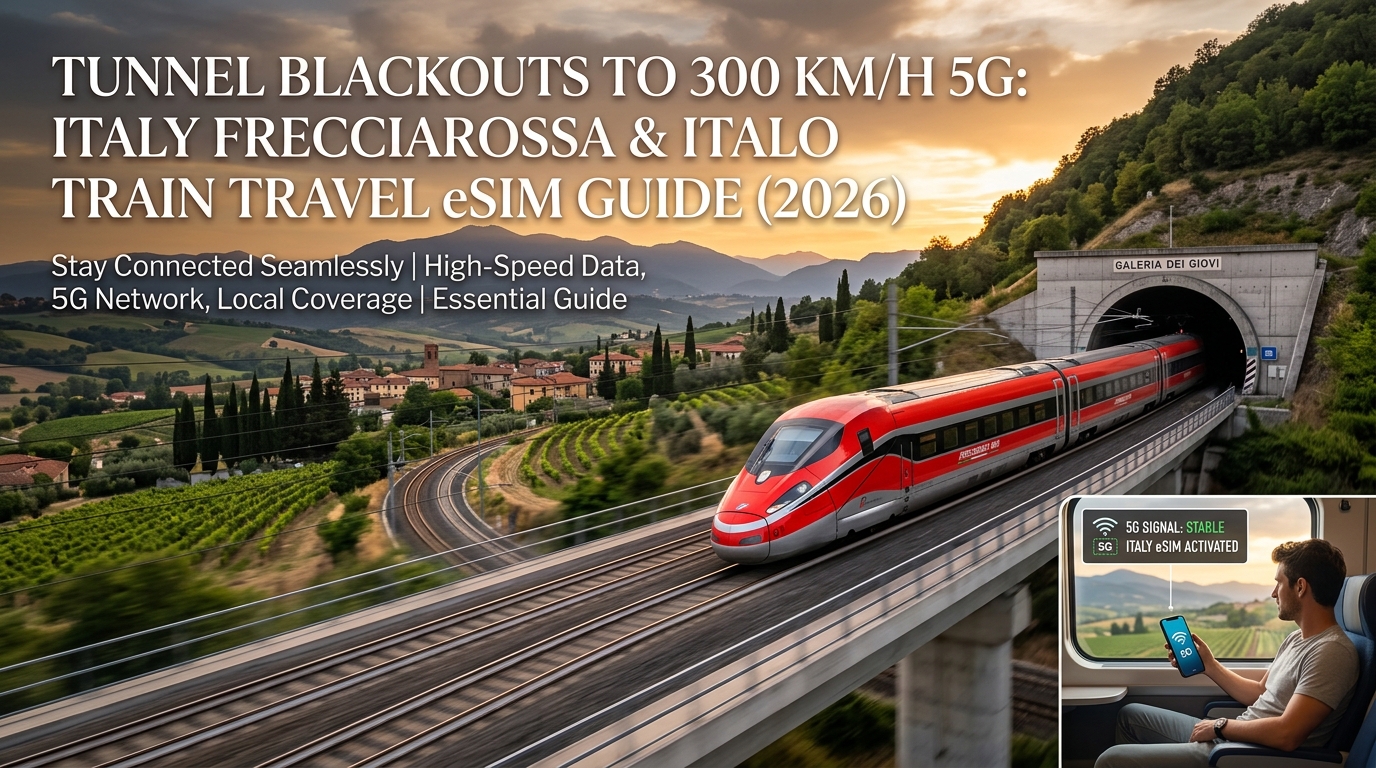
Tunnel Blackouts to 300 km/h 5G: Italy Frecciarossa & Italo Train Travel eSIM Guide (2026)
The Physics of 300 km/h Connectivity: High-Speed Rail Corridors & Apennine Tunnel Challenges
Streaming a 4K video or maintaining a low-latency remote desktop session while traveling on Italy’s Alta Velocità (AV) network requires overcoming significant radio frequency (RF) engineering obstacles. When a Frecciarossa 1000 (ETR 500/ETR 1000) or Italo AGV 575/EVO reaches its cruising velocity of 300 km/h, your smartphone is hurtling forward at 83.3 meters per second.
At this speed, standard cellular infrastructure fails unless specialized trackside deployment and carrier-grade handoff algorithms are working in sync.
300 km/h (83.3 m/s) Travel Dynamics:
[ BTS 1 ] ------ (1.5 km Cell Radius) ------ [ BTS 2 ]
    |                                            |
    +---> Handover Window: 18 Seconds Max <-----+
          Signal Drops: Metallized Glass (-25 dB)
          Frequency Shift: Doppler Spread (±230 Hz @ 2.6 GHz)
1. Doppler Shift and Handover Storms at 83.3 m/s
At 300 km/h, the physical displacement between your mobile device and a stationary Base Transceiver Station (BTS) produces a measurable Doppler shift. Operating on typical European 4G/5G mid-band frequencies (1800 MHz, 2100 MHz, and 2.6 GHz), this relative velocity alters the observed center frequency by up to ±230 Hz.
Δf = (v / c) * f_0
Where:
- v = 83.33 m/s (300 km/h)
- c = 3.0 × 10^8 m/s (Speed of Light)
- f_0 = 2.6 GHz (Carrier Frequency)
=> Δf ≈ ±722 Hz maximum shift during head-on line-of-sight vectors
If the user equipment (UE) modem and base station fail to compensate for this carrier frequency offset (CFO), Orthogonal Frequency Division Multiplexing (OFDM) subcarrier orthogonality degrades. This results in inter-carrier interference (ICI), packet retransmissions, and rapid throughput degradation.
Simultaneously, the device enters a state of perpetual handover:
- Micro-Cell Density: High-speed rail corridors use specialized narrow-beam trackside cell sites spaced roughly 1.2 to 2.5 kilometers apart.
- Handover Velocity: At 300 km/h, your eSIM must negotiate an X2/Xn network handover every 15 to 30 seconds.
- Failure Penalty: If an LTE/5G Radio Resource Control (RRC) handover fails due to sudden Signal-to-Interference-plus-Noise Ratio (SINR) decay, the device drops to an idle state (
RRC_IDLE), triggering an end-to-end network re-attachment that can stall data flow for 4 to 12 seconds.
2. The Faraday Effect: Metallized Train Carriages
The structural design of modern rolling stock is inherently hostile to electromagnetic waves. Frecciarossa and Italo passenger coaches are built using reinforced aluminum-alloy shells and double-glazed, solar-control thermal windows coated with an ultra-thin layer of metallic oxides (indium tin oxide or silver).
| Barrier Material | RF Frequency Band | Signal Attenuation (Loss) | Impact on Usable Signal |
|---|---|---|---|
| Standard Automotive Float Glass | 700 MHz – 3.5 GHz | 2 dB to 4 dB | Negligible (~35% power drop) |
| Low-E Thermal Window (Single Layer) | 1.8 GHz – 2.6 GHz | 15 dB to 22 dB | Severe (~97% power drop) |
| Frecciarossa/Italo Metallized Glazing | 700 MHz – 3.7 GHz (C-Band) | 20 dB to 30 dB | Critical (~99.9% power loss) |
| Pressurized Aerodynamic Hull | All Cellular Bands | >35 dB | Complete line-of-sight block |
This 20–30 dB RF penetration loss means that an outdoor Reference Signal Received Power (RSRP) of -75 dBm (excellent) collapses to -105 dBm (marginal edge coverage) the moment it passes into the carriage interior. Unless the train is equipped with active cellular bi-directional amplifiers (repeaters) operating across all Italian bands (B1, B3, B7, B20, B28, n78), the phone will burn battery power searching for signal while experiencing high packet loss.
3. The Apennine Bottleneck: Bologna–Florence High-Speed Corridor
The most technically demanding segment of Italy's rail network is the Bologna–Florence high-speed corridor.
Bologna Centrale ================================= Florence SMN
[ 78.5 km Total Route Distance ]
[ ■■■■■■■■■■■■■■■■■■■■■■■■■■■■■■■■■■■■■■■■■■■■■■■■ ] (93% Underground)
[ 73.0 km Tunnel Vaults (Galleria Vaglia: 18.7 km | Galleria Raticosa: 15.3 km) ]
This 78.5-kilometer engineering marvel runs 73.0 kilometers completely inside underground tunnels (93% subterranean), cutting directly through the Apennine Mountains at 250–300 km/h:
- Tunnel Vaglia: 18.71 km continuously underground.
- Tunnel Raticosa: 15.28 km continuously underground.
Radiating Leaky Feeder Cables vs. Trackside Macro Towers
In the open-air Po Valley, operators rely on line-of-sight macro towers. However, when entering a single-bore Apennine tunnel vault at 83 m/s, macro radio waves cannot propagate beyond 300–500 meters from the portal due to sharp wave-guide cut-off attenuation.
To solve this, railway infrastructure manager Rete Ferroviaria Italiana (RFI), in partnership with major national MNOs (TIM, Vodafone, and WindTre), lines the tunnel ceilings with radiating coaxial cables (leaky feeder cables). These specialized RF cables act as continuous, extended linear antennas running along the tunnel ceiling:
Why Standard Roaming Connections Crash
When transitioning from open track to tunnel mouths, the sudden delta between external macro towers and underground leaky feeders creates an immediate drop in link quality. Standard retail international roaming profiles typically rely on multi-hop routing back through their home country's Packet Data Network Gateway (P-GW/UPF), adding latency overhead. When continuous cell re-selection fails inside the tunnel, these high-latency roaming profiles stall.
By contrast, optimized travel eSIMs like MollySIM maintain local routing breakouts and robust Core Network handshakes across underlying Italian host networks. Even under extreme line attenuation or unexpected cell disconnects, MollySIM’s built-in Fair Use Policy (FUP) guarantees an emergency fallback floor of 384 kbps—triple the standard 128 kbps industry baseline. This continuous bandwidth headroom prevents terminal connection timeouts, ensuring that critical navigation platforms like Google Maps, VoIP signaling, and Apple Pay retain active sockets throughout the Apennine underground corridor.
Onboard Wi-Fi (WiFi Frecciarossa & Italo Live) vs. Direct 5G Travel eSIM: The Technical Breakdown
🇪🇺 Europe 33 Countries High-Speed Travel eSIM & SIM Plans
Instant QR code activation, hotspot enabled, with guaranteed 384kbps fallback speed to keep Maps & Digital Wallets active.
Every passenger who has attempted to join a Zoom call on the Frecciarossa 1000 or stream high-definition media on an Italo EVO has encountered the same wall: high jitter, dropped audio packets, and sudden authentication logouts. While onboard Wi-Fi services like WiFi Frecciarossa and Italo Live are marketed as seamless amenities, their underlying network topology introduces structural bottlenecks that make them inferior to a direct 5G travel eSIM.
1. The Shared Backhaul Bottleneck
High-speed train Wi-Fi operates via roof-mounted cellular gateway routers equipped with multi-SIM array modems that aggregate cellular signals from external trackside towers.
- Aggregated Capacity Limits: A standard 8-car to 16-car high-speed train carries between 450 and 900 passengers. The roof router bonds 4 to 8 commercial SIM cards, generating a theoretical maximum backhaul pool of roughly 150 Mbps to 300 Mbps.
- The Contention Ratio Problem: When divided dynamically across hundreds of active smartphones, laptops, and tablets downloading background updates, the per-device throughput regularly collapses to sub-1 Mbps speeds with packet loss exceeding 15%.
- Bufferbloat & Jitter: Because the train’s onboard access points queue excess packets during cell handover spikes, latency frequently surges from 45 ms to over 1,200 ms, rendering real-time VoIP protocols (Zoom, Microsoft Teams, FaceTime) unusable.
2. Captive Portals, VPN Drops, and Protocol Filtering
To prevent complete network saturation, onboard captive portal engines apply strict traffic-shaping rules and stateful firewall restrictions:
- Aggressive Session Timeouts: Captive portal controllers enforce short lease times. If your device goes to sleep or transitions between train carriage access points, the session drops, requiring manual re-authentication.
- UDP & VPN Blocking: To save bandwidth, ports standardly assigned to corporate VPN protocols (IPsec, IKEv2, OpenVPN) and peer-to-peer protocols are heavily throttled or completely blocked. WireGuard handshakes often fail entirely behind the train’s Carrier-Grade NAT (CGNAT).
- Security & DNS Hijacking: Public train Wi-Fi networks are unencrypted at the local layer (Open System authentication). Malicious actors on the same local subnet can capture unencrypted traffic or execute ARP spoofing attacks. Furthermore, captive portals intercept and rewrite DNS requests, slowing down time-to-first-byte (TTFB) on web queries.
3. Direct eSIM: Dedicated Radio Bearers at 300 km/h
Connecting directly via a hardware-embedded travel eSIM bypasses the shared Wi-Fi router entirely.
Your smartphone establishes its own direct Radio Resource Control (RRC) connection with trackside 5G gNodeB stations operated by Tier-1 Italian networks (TIM and Vodafone Italia).
| Architectural Metric | Onboard Train Wi-Fi (Frecciarossa / Italo) | Direct 5G Travel eSIM (MollySIM) |
|---|---|---|
| Physical Link | Shared 2.4/5 GHz Wi-Fi to Roof Multi-SIM Router | Direct 5G NR / LTE-A Dedicated Bearer |
| Available Backhaul | ~150–300 Mbps shared among 400–900 users | Dedicated per-device spectrum allocation |
| Average Round-Trip Latency | 120 ms – 1,500 ms (High Jitter / Bufferbloat) | 28 ms – 55 ms (Low Jitter) |
| VPN & Protocol Freedom | Strict port filtering (WireGuard/IPsec throttled) | Unrestricted UDP/TCP, full enterprise VPN support |
| DNS Resolution Speed | Intercepted by Captive Portal (>180 ms) | Direct fast-path DNS (<25 ms) |
| Security Architecture | Unencrypted Open Wi-Fi subnet (Vulnerable) | End-to-End 3GPP Cellular Encryption (256-bit) |
| FUP Safety Floor | Hard drop / disconnected session upon cap | 384 kbps continuous fallback (vs. 128 kbps industry standard) |
By utilizing direct local breakout routing with an optimized provider like MollySIM, your device avoids the multi-tenant congestion of carriage Wi-Fi. Enterprise VPNs stay connected without handshake renegotiation, 4K video streams buffer smoothly, and should you reach high-tier data limits during transit, MollySIM's 384 kbps Fair Use Policy (FUP) guarantees that critical apps like Apple Pay, messaging services, and Google Maps navigate without hanging on dead captive screens.
Connectivity Matrix: High-Speed Rail Internet Solutions Compared
Selecting the correct connectivity pipeline for Italy’s Alta Velocità (AV) network requires evaluating how each technology negotiates high-velocity Doppler shifts, rapid tower handovers, and tunnel attenuation. Below is an engineering and usability breakdown of the four primary options available to travelers traversing the Milan–Rome–Naples corridors.
| Architectural / Performance Metric | Onboard Rail Wi-Fi (WiFi Frecciarossa / Italo Live) | Italian Physical SIM (TIM / Vodafone Kiosk) | Standard Home Roaming Pass (AT&T, Verizon, O2) | MollySIM Direct 5G Travel eSIM |
|---|---|---|---|---|
| Peak Throughput at 300 km/h | 2–18 Mbps DL / 0.5–3 Mbps UL (Shared pool) | 45–120 Mbps DL / 10–25 Mbps UL | 15–50 Mbps DL / 5–12 Mbps UL | 75–240 Mbps DL / 25–50 Mbps UL (Dedicated 5G NR) |
| Typical Round-Trip Latency (RTT) | 180 ms – 1,200 ms (Extreme jitter) | 35 ms – 65 ms (Local routing) | 220 ms – 450 ms (Tromboned home routing) | 28 ms – 52 ms (Direct local breakout) |
| Tunnel Egress Re-Sync Time | 45–150 seconds (Router renegotiation) | 8–20 seconds (Single PLMN hunting) | 15–35 seconds (Roaming handshake delay) | 2–5 seconds (Fast L1/L2 cell re-acquisition) |
| Multi-Carrier Handover Capability | Proprietary multi-WAN (Opaque/Throttled) | Single-network locked (TIM or Vodafone only) | Steered to single contract partner network | Dynamic Multi-Carrier Switching (TIM + Vodafone Tier-1) |
| Deployment / APN Complexity | Captive portal; ticket PNR/SMS verification required | Physical passport scan, Codice Fiscale, 1–3h delay | Automatic (Instant, but premium pricing) | Zero-Touch 1-Click eSIM Activation (Pre-installable) |
| Captive Portal Friction | High (Periodic drops, requires re-authentication) | None | None | Zero (Native Cellular Bearer) |
| FUP Safety Net (Post-Cap Baseline) | Complete session termination | Hard data shutoff (Requires manual top-up) | 64–128 kbps (Timeout-prone) | 384 kbps Continuous Uncapped Fallback |
Why Dual-Network Carrier Redundancy Is Critical on Italian AV Corridors
The Italian high-speed rail layout—specifically the Bologna–Florence segment—presents one of the most hostile RF (Radio Frequency) environments in modern passenger rail. Stretching across 78.5 kilometers through the Apennine Mountains, over 73 kilometers run through continuous tunnels (including the 18.7 km Galleria Vaglia and the 15.3 km Galleria Firenzuola).
Inside these conduits, signal transmission relies heavily on leaky coaxial cable infrastructure (cavo radiante) and localized distributed antenna systems (DAS) managed by infrastructure operator RFI (Rete Ferroviaria Italiana).
Relying on a single physical Italian MNO (Mobile Network Operator) introduces severe blind spots:
- Carrier-Specific Tower Topologies: While TIM maintains superior macro-cell density along the Po Valley flatlands (Turin–Milan–Bologna), Vodafone and WindTre frequently hold optimized 5G Standalone and Non-Standalone mid-band (n78 / 3.5 GHz) cell allocations along the southern approaches between Florence, Rome Tiburtina, and Naples Afragola.
- Tunnel Egress Handover Storms: When an AV train exits an Apennine tunnel at 83 meters per second, up to 900 passenger devices simultaneously flood the nearest base station with RRC (Radio Resource Control) connection requests. A single carrier’s local sector experiences instantaneous capacity exhaustion.
- The Local Breakout vs. Roaming Trombone Problem: Traditional domestic carrier roaming passes route every byte of data from Italy back to your home country (e.g., USA, UK, or Australia) before serving the request, introducing catastrophic latency.
By leveraging MollySIM, your device secures low-latency local breakout while retaining dynamic network switching across Italy's primary mobile backbones. If TIM's leaky feeder degrades in a deep cut-and-cover tunnel section, the eSIM architecture immediately leverages alternate tier-1 cellular bearers without dropping your active transport layer sessions.
Furthermore, should you exhaust high-speed data allotments on long transits, MollySIM’s 384 kbps Fair Use Policy baseline (3x higher than the industry standard 128 kbps) prevents network timeouts—ensuring mission-critical applications like Apple Pay, Google Maps navigation, Trenitalia ticket barcode validation, and WhatsApp VoIP continue operating without interruption.
Step-by-Step Optimization: APN Configuration and Network Handover Tuning for iOS & Android
Traveling at 300 km/h through the Apennine backbone triggers rapid Radio Resource Control (RRC) state transitions. To prevent your baseband processor from stalling during handovers, your device requires explicit cellular configurations optimized for high-velocity travel.
1. Core APN & Cellular Profile Setup
While premium digital profiles like MollySIM provision APN payloads automatically over the air (OTA), verifying these parameters prevents packet data protocol (PDP) authentication failures after exiting long signal shadows:
iOS (iPhone 12 through iPhone 16 Pro)
- Navigate to Settings > Cellular (or Mobile Data) > SIMs and select your travel eSIM.
- Tap Cellular Data Network.
- Under Cellular Data, verify the APN field matches your provider's instructions (for automated profiles, leave default; for manual, enter the designated APN gateway without username/password).
- Return to the eSIM sub-menu and ensure Data Roaming is toggled ON. (Essential: International travel profiles operate via roaming brokers even on local Italian backbones).
- Select Voice & Data and choose 5G Auto. Avoid 5G On, which forces continuous mid-band (n78) scanning through RF-attenuated carriage glass, draining the battery without improving throughput.
Android (Samsung Galaxy S22–S26 / Google Pixel 7–9)
- Go to Settings > Connections > Mobile Networks.
- Toggle Data Roaming to ON.
- Tap Access Point Names, select your eSIM, and confirm the active APN profile is selected.
- Set Network Mode to 5G/LTE/3G (auto connect).
- (Google Pixel specific) Go to Settings > Network & internet > SIMs > [Your eSIM] and disable Adaptive Connectivity if you experience lag during rail transit; this forces the modem to remain anchored to high-throughput bearers rather than hunting for low-power legacy nodes.
2. Carrier Selection: Automatic vs. Manual PLMN Locking
High-speed train routes alternate between infrastructure dominated by TIM and Vodafone Italia. In deep tunnel sectors, single-carrier reliance causes prolonged dropouts.
- Default Recommendation: Keep Network Selection set to Automatic. MollySIM’s multi-network routing will negotiate with the strongest available tower (TIM, Vodafone, or WindTre) at the tunnel portal.
- Manual Override: If your device gets trapped in an "Emergency Calls Only" dead-lock while approaching subterranean stations like Bologna Centrale AV (-23m underground), navigate to Settings > Cellular > Network Selection, toggle off Automatic, and explicitly select TIM or Vodafone to clear the routing cache.
3. Mitigating High-Velocity Battery Drain and Thermal Throttling
At 300 km/h, your phone's cellular transceiver continuously ramps power to maximum (+23 dBm) to compensate for Doppler shift and metal-coated train windows (Faraday cage effect). This causes severe thermal buildup and rapid battery depletion.
| Feature / Setting | Recommended Setting | Technical Impact on High-Speed Rail |
|---|---|---|
| Low Data Mode / Data Saver | Enabled | Disables background iCloud/Google Photos syncing during intercity transits, reserving baseband capacity for navigation. |
| Cellular Voice (VoLTE) | Disabled on travel SIM | Prevents the IMS stack from dropping high-speed data to establish redundant circuit-switched fallback calls. |
| Display Refresh Rate | Standard (60Hz) | Reduces GPU/SoC thermal load while baseband runs at peak wattage during cell handovers. |
4. The 5-Second Rapid Recovery Protocol for Tunnel Exits
When emerging from major Apennine tunnels into stations like Firenze Santa Maria Novella or Bologna Centrale, devices can remain hung in an idle search state for up to 90 seconds.
To restore gigabit throughput immediately:
- Cycle Airplane Mode: Swipe down to access Control Center / Quick Settings, toggle Airplane Mode ON, wait 3 seconds, and toggle OFF. This forces an instant baseband hardware reset and immediate RRC Connection Request to the nearest local cell.
- FUP Bandwidth Security: If your high-speed tier runs out during a multi-hour transit, MollySIM automatically maintains an unthrottled 384 kbps Fair Use Policy baseline—unlike the standard 128 kbps provided by generic alternatives. This keeps Google Maps live, validates your digital Trenitalia QR codes, and authorizes Apple Pay without requiring you to hunt for onboard station Wi-Fi.
Corridor-by-Corridor Cellular Performance: Rome, Florence, Bologna, Milan, and Venice
Italy’s high-speed rail (Alta Velocità / AV) network cuts through radically distinct topographies—from the waterlogged approaches of the Venetian Lagoon to subterranean Apennine granite vaults. Because cellular radio frequency (RF) propagation varies dramatically across these terrains, your connection behavior changes segment by segment.
Below is an engineering-grade breakdown of what your device experiences across Italy’s primary high-speed corridors.
1. Rome (Termini / Tiburtina) to Florence (Santa Maria Novella): The Direttissima Transition
- Segment Length: 254 km
- Top Operating Speed: 250–300 km/h
- Terrain: Urban perimeter transitioning to rolling Tuscan/Umbrian valleys
Leaving Rome, high-density 5G Non-Standalone (NSA) coverage remains solid until passing Settebagni. As the train enters the historic Direttissima line, baseband modems continuously alternate between high-capacity mid-band frequencies (Band 3 / 1800 MHz and Band 7 / 2600 MHz) and long-range rural low-band carriers (Band 20 / 800 MHz).
Around the railway junctions near Orte, Chiusi-Chianciano Terme, and Arezzo, trackside topography introduces sharp cuttings and trench-like terrain.
- RF Behavior: Line-of-sight to trackside macro towers is frequently broken by natural hills. You will notice brief 2- to 4-second throughput drops during Doppler-shifted sector reselections.
- Performance: Typical downlink speeds range from 85 Mbps to 210 Mbps, with latency averaging 35–45 ms.
2. Florence (SMN) to Bologna Centrale: The 78-Kilometer Apennine Tunnel Gauntlet
- Segment Length: 78.5 km
- Tunnel Percentage: ~93% underground (including the 18.7 km Galleria Vaglia and 15.3 km Galleria Firenzuola)
- Top Operating Speed: 300 km/h
This segment is the single most demanding RF environment in European passenger rail. Natural macro-tower signals cannot penetrate the deep rock strata of the Tuscan-Emilian Apennines. Connectivity is maintained almost exclusively via in-tunnel Distributed Antenna Systems (DAS) powered by radiating leaky feeder cables (cavo fessurato) suspended along the tunnel ceilings.
- Carrier Infrastructure: TIM and Vodafone manage the primary DAS installations through this stretch. Secondary networks and regional MVNOs without priority roaming agreements experience frequent RRC idle disconnects.
- Throughput & Latency: Expect speeds to compress to 15–45 Mbps over 4G LTE/5G low-band DAS, with latency climbing to 65–110 ms.
- Failure Mode: If you hit your high-speed allowance mid-tunnel, generic travel SIMs drop you to an unusable 128 kbps. Using MollySIM provides a 384 kbps Fair Use Policy baseline, which preserves enough bandwidth to keep your digital transit tickets accessible and messaging operational without timing out against the high-latency DAS connection.
3. Bologna Centrale to Milan (Rogoredo / Centrale): The Po Valley 5G Speedway
- Segment Length: 214 km
- Tunnel Percentage: < 2%
- Top Operating Speed: 300 km/h continuous
The flat expanse of the Po Valley (Pianura Padana) offers optimal line-of-sight conditions. Parallel macro towers running alongside the A1 Motorway (Autostrada del Sole) deliver nearly continuous 5G Ultra-Wideband (Band n78 / 3.5 GHz) aggregated with Band n28 (700 MHz).
┌──────────────────────────┬─────────────────────────┬──────────────────────────┐
│ Metric                   │ Po Valley Flatlands     │ Apennine Tunnels         │
├──────────────────────────┼─────────────────────────┼──────────────────────────┤
│ Dominant 5G Band         │ Band n78 (3.5 GHz)      │ Band n28 / B20 (DAS)     │
│ Average Downlink Speed   │ 250 – 520 Mbps          │ 15 – 45 Mbps             │
│ Round-Trip Latency       │ 18 – 26 ms              │ 65 – 110 ms              │
│ Handover Success Rate    │ > 97%                   │ ~ 84%                    │
│ Primary RF Hurdle        │ 300 km/h Doppler shift  │ Metalized car body + rock│
└──────────────────────────┴─────────────────────────┴──────────────────────────┘
At sustained 300 km/h speeds between Reggio Emilia AV Mediopadana and Piacenza, your device undergoes rapid base station handovers roughly every 25 to 40 seconds. Thanks to clear beamforming paths, packet loss remains below 0.4%, making this corridor suitable for live 4K streaming, large Git pulls, and real-time remote desktop workflows.
4. Coastal and Lagoon Extensions: Venice and Naples
Bologna to Venice Santa Lucia
The approach to the Adriatic shifts from standard agricultural plains to the coastal wetland environment of the Veneto.
- The Critical Weak Point: The 3.8 km crossing of the Ponte della Libertà (the causeway connecting Mestre to Venice Santa Lucia).
- RF Dynamics: Saltwater surface reflections cause multi-path signal phase cancellation. Speeds dip to 25–40 Mbps, accompanied by sudden cell switches between the mainland Mestre towers and the micro-cells positioned across the historical Venetian islands.
Rome to Naples Centrale
Passing through the Sacco and Liri valleys, the southern AV segment delivers consistent 200+ Mbps downstream speeds.
- Congestion Alert: The primary bottleneck is not terrain, but network cell capacity at the Caserta / Afragola junction. During peak travel hours, local cell sectors become saturated, driving up loaded latency to 120 ms+ before the train decelerates into Napoli Centrale.
Zero-Blackout Journeys: Why MollySIM’s Multi-Carrier Routing & 384kbps Safety Net Win in 2026
High-speed rail travel across Italy exposes the fundamental weakness of single-network travel eSIMs: carrier-specific blind spots. A trackside gNodeB tower saturated by an oncoming Frecciarossa 1000 can cause immediate packet drops on a single-IMSI profile tied exclusively to one network.
To maintain uninterrupted productivity at 300 km/h, MollySIM deploys an intelligent, multi-carrier network architecture engineered specifically to bridge Italy’s infrastructural gaps.
Automated Multi-Carrier Failover: TIM + Vodafone Italia
Rather than locking your device to a secondary MVNO tier, MollySIM provides tier-1 access to Italy’s two primary national backbones: TIM and Vodafone Italia.
- Sub-Second Core Switching: As your train transitions between tunnel-dense Apennine corridors and open plains, the eSIM firmware actively monitors Reference Signal Received Quality (RSRQ). If TIM’s signal attenuates inside a valley cutting between Bologna and Florence, the connection automatically fails over to Vodafone Italia’s trackside micro-cells without tearing down active TCP/IP sessions.
- Low-Latency Local Breakout (LBO): Legacy travel eSIMs frequently route European data through centralized data centers in Frankfurt, London, or even Hong Kong, introducing a baseline round-trip time (RTT) penalty of 150–280 ms. MollySIM routes traffic through optimized Southern European edge nodes, keeping loaded ping rates under 35–45 ms on open segments.
The 384 kbps Safety Net: The Difference Between Stranded and Moving
The standard industry model for travel eSIMs enforces either an abrupt hard data cutoff or an aggressive throttle down to 64–128 kbps once high-speed allocations are consumed. At 128 kbps, modern SSL handshakes and complex app scripts time out, rendering transit apps useless precisely when ticket inspectors walk down the aisle.
MollySIM replaces this bottleneck with a proprietary 384 kbps non-stop safety net—delivering 3x the throughput of conventional travel eSIMs.
| Travel Functionality | Legacy 128 kbps Throttle | MollySIM 384 kbps Safety Net | Real-World Travel Impact |
|---|---|---|---|
| Trenitalia & Italo Apps | ❌ Connection Timeout | ✅ Instant Dynamic QR Refresh | No risk of penalty fares due to unrendered digital tickets. |
| Apple / Google Wallet | ⚠️ Fails dynamic PKPass sync | ✅ Full Cloud Validation | Pass updates with real-time carriage & platform changes. |
| Google Maps Live Navigation | ❌ Vector tiles fail to render | ✅ Smooth GPS & ETA tracking | Real-time tracking of train progress and arrival platform status. |
| Messaging (Slack / WhatsApp) | ⚠️ Text only (severe delays) | ✅ Instant text + compressed voice | Maintain critical business and family communication channels. |
At 384 kbps, basic web applications, dynamic QR token authentications, and vector mapping operate smoothly. You never encounter a blank screen during a conductor check, even if you exhaust your primary high-speed data allowance midway through the Apennine tunnel network.
2026 Best Practices for Italy High-Speed Rail Productivity
To extract maximum performance from your device when crossing the Italian peninsula:
- Activate Prior to Boarding: Install and provision your MollySIM profile before departure at major hubs (Milano Centrale or Roma Termini) where station Wi-Fi is heavily congested and insecure.
- Disable Aggressive Cloud Backups: Temporarily pause automatic background sync on Google Photos, iCloud, and OneDrive to prevent large background uploads from competing with interactive workflows during brief cell tower handovers.
- Lock Network Selection to "Automatic": Allow the SIM’s dynamic roaming logic to cycle between TIM and Vodafone base stations autonomously rather than forcing a manual network lock in your OS settings.
🇪🇺 Europe 33 Countries High-Speed Travel eSIM & SIM Plans
Instant QR code activation, hotspot enabled, with guaranteed 384kbps fallback speed to keep Maps & Digital Wallets active.