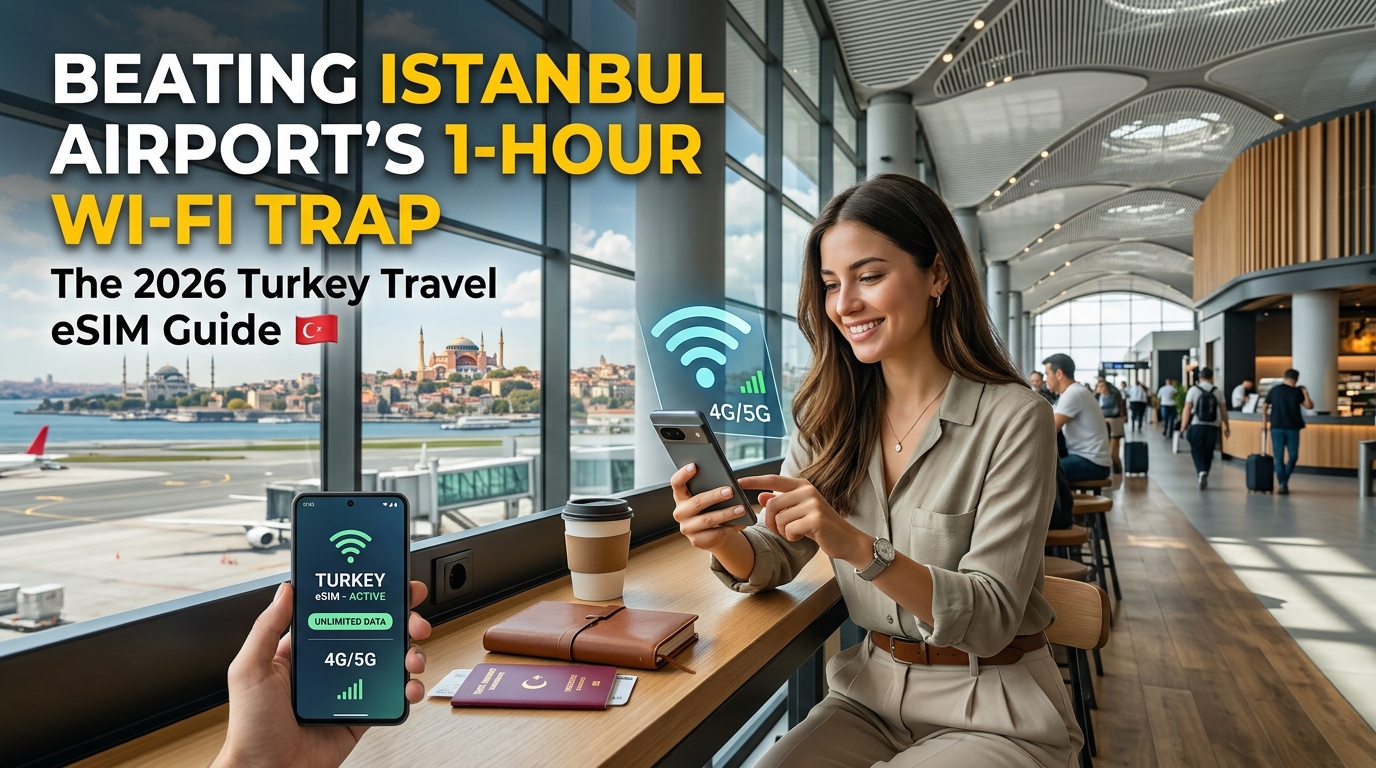
The Istanbul Airport (IST & SAW) 1-Hour Wi-Fi Trap: Why Modern Travelers Get Stranded
Stepping off a flight into Istanbul Airport (IST)—a colossal architectural marvel spanning over 76.5 million square meters—or its high-traffic counterpart on the Asian side, Sabiha Gökçen (SAW), immediately exposes international travelers to one of modern aviation’s most frustrating bottlenecks: the strictly metered 60-minute complimentary Wi-Fi policy.
While modern global hubs increasingly treat unmetered, high-speed data as an essential public utility, Turkey’s primary international gateways gatekeep network access behind rigid digital and physical checkpoints. Understanding the architecture of this limitation is the first step in preventing an arrival-day communication blackout.
The Physical Kiosk Bottleneck: Türk Telekom’s Monopolized Access
Unlike airports that utilize simple one-click terms acceptance, Istanbul Airport operates a captive portal managed exclusively by Türk Telekom. For travelers arriving without an active international roaming package, securing access requires one of two verification methods:
- SMS Authentication: You must input an active mobile number to receive a one-time password (OTP). However, if your home carrier has not established a roaming handshake with Turkish networks (Turkcell, Vodafone Turkey, or Türk Telekom) before touchdown, the SMS gateway fails silently.
- The "Türk Telekom Wi-Fi Kiosk Points": If SMS verification fails, your sole alternative is navigating to one of the blue physical kiosks scattered sparsely throughout the terminal. Here, you must physically scan your passport data page to print an 8-digit numeric access code.
+-----------------------------------------------------------------------------------+
|                           THE 60-MINUTE COUNTDOWN BREAKDOWN                       |
+-------------------+---------------------------------------------------------------+
| Elapsed Time      | Traveler Location & Activity                                  |
+-------------------+---------------------------------------------------------------+
| Minutes 00 – 20   | Disembarking, walking IST's 1.5 km concourses, kiosk hunting  |
| Minutes 20 – 45   | Queuing at Passport Control / E-Visa validation lines         |
| Minutes 45 – 58   | Baggage reclaim & customs clearance                           |
| Minute 60+        | ARRIVAL HALL (CONNECTION TERMINATED: NO RE-AUTHENTICATION)    |
+-------------------+---------------------------------------------------------------+
The fundamental flaw in this operational design is the single-token limit per passport per 24-hour cycle. Once that 60-minute countdown expires, your device's MAC address is blacklisted on the free tier until the following day. Purchasing additional access through the captive portal requires an international credit card—transactions that frequently trigger anti-fraud blocks from home banks via SMS 2FA, which you cannot receive without an active cellular connection.
Anatomy of an Arrival Crisis: Ground Transportation & Logistics
The 60-minute window invariably expires precisely when a traveler is most vulnerable: passing through customs into the chaotic public arrivals concourse.
- Private Transfers & VIP Shuttles: Pre-booked transfer services at IST and SAW do not station drivers inside the terminal; they coordinate via WhatsApp once you reach specific numbered columns outside (e.g., Column 9 or 13 at IST). If your Wi-Fi expired while you waited 40 minutes at immigration, you cannot ping your driver, leading to missed pickups and non-refundable no-show fees.
- App-Based Ride Hailing: Hailing a vehicle via BiTaksi or Uber becomes impossible once you step outside onto the curb where the internal airport Wi-Fi signal degrades rapidly, leaving you at the mercy of unregulated street taxi lines notorious for inflated cash fares.
- Hotel Check-In & Booking Vouchers: Booking confirmations locked inside Agoda, Booking.com, or Airbnb apps that require active authentication will fail to render, leaving you without an offline address or check-in pin.
Captive Portals and Cybersecurity Vulnerabilities
Relying on public Wi-Fi networks in high-density transit environments introduces severe infosec risks. Open captive portals at international hubs operate without internal encryption:
- Man-in-the-Middle (MITM) Exploits: Malicious actors deploy rogue access points mimicking the SSID
TürkTelekom_FreeWi-FiorIstanbulAirport_Guestto capture unencrypted data streams. - Packet Sniffing & Session Hijacking: Unsecured public networks allow eavesdroppers on the same subnet to monitor cleartext traffic, harvest session cookies, and intercept authentication tokens.
- Credential Harvesting Phishing Pages: Cloned captive portal screens prompt weary travelers to enter credit card details or email credentials to "extend free Wi-Fi speed."
The Infrastructure Fix: Autonomous Cellular Connectivity
Relying on legacy public infrastructure in 2026 is an unnecessary operational hazard. Modern international travel requires an immediate, over-the-air cellular handshake the second your aircraft touches the tarmac at IST or SAW.
By pre-installing a dedicated travel eSIM like MollySIM, you bypass the kiosk queues entirely. While standard airport Wi-Fi cuts off abruptly, robust data setups provide a crucial safety net: even under Fair Use Policies, MollySIM sustains a 384kbps throttled baseline—triple the 128kbps industry standard. This ensures mission-critical apps like Google Maps, WhatsApp messaging, and Apple Pay retain flawless functionality, allowing you to walk straight past the kiosk queues directly to your ride.
Decoding Turkey's Mobile Network Landscape: Turkcell, Vodafone Turkey, and Türk Telekom
🌐 Global Travel High-Speed Travel eSIM & SIM Plans
Instant QR code activation, hotspot enabled, with guaranteed 384kbps fallback speed to keep Maps & Digital Wallets active.
Navigating Turkey’s cellular ecosystem requires understanding the underlying Radio Access Network (RAN) infrastructure. The country operates three major Mobile Network Operators (MNOs), each competing across diverse spectrum allocations, geographical terrains, and deployment strategies.
+------------------+-----------------------+-----------------------------+------------------------------------+
| Operator         | Primary LTE Bands     | 5G Status (2026 Rollout)    | Coverage Strengths & Topology      |
+------------------+-----------------------+-----------------------------+------------------------------------+
| Turkcell         | B1, B3, B7, B8, B20   | Commercial Sub-6GHz Trials  | Unrivaled nationwide & rural reach |
| Vodafone Turkey  | B1, B3, B7, B8, B20   | Urban Density Pilots        | Excellent in major metros & highways|
| Türk Telekom     | B1, B3, B7, B20       | Fiber-Backed Urban Clusters | Strong city cores; patchy fringes   |
+------------------+-----------------------+-----------------------------+------------------------------------+
Spectrum Allocation and Frequency Architecture
To ensure high-throughput connectivity across Turkey’s varied terrain—from the dense concrete corridors of Istanbul to the volcanic plateaus of Cappadocia—MNOs rely on specific 4G LTE-Advanced and emerging sub-6GHz frequency bands:
- Band 20 (800 MHz): The low-frequency backbone. Crucial for non-line-of-sight propagation, penetrating the thick stone architecture of Sultanahmet and providing long-range cell radius coverage along Anatolian motorways (O-4, O-5).
- Band 3 (1800 MHz) & Band 7 (2600 MHz): High-capacity mid-bands deployed extensively across high-density urban nodes (e.g., Mecidiyeköy, Levent, Kızılay). These bands deliver multi-carrier aggregation speeds exceeding 300 Mbps under optimal LTE-A conditions.
- Sub-6GHz (3.5 GHz - n78) Pilots: While commercial 5G spectrum auctions have progressed in key metropolitan corridors, wide-scale 5G remains concentrated in enterprise zones, transit hubs, and commercial centers.
The Carrier Breakdown
1. Turkcell: The Infrastructure Heavyweight
Turkcell remains Turkey’s undisputed market leader in geographic reach and overall spectral bandwidth. Investing heavily in distributed antenna systems and rural cell towers, Turkcell delivers continuous LTE-A reception across remote Aegean coves, the Kaçkar Mountains, and high-speed rail lines (YHT). For travelers journeying beyond metropolitan borders, Turkcell provides the most consistent low-latency backhaul.
2. Vodafone Turkey: The Urban Contender
Vodafone maintains formidable capacity in primary metropolitan clusters—including Istanbul, Ankara, Izmir, and Antalya. Its network leverages massive MIMO deployments to handle heavy concurrent user loads during peak transit hours. However, signal degradation to lower-tier legacy bands can occur once you move deep into rural interior valleys or isolated coastal roads.
3. Türk Telekom: The Fiber-Powered Metro Core
Leveraging its national fixed-line fiber monopoly, Türk Telekom provides backhaul for ultra-fast speeds across central urban districts, shopping malls, and transport terminals. Despite this urban strength, its physical RAN footprint in non-urban coastal fringes and mountainous sectors remains thinner than Turkcell's.
The Physical Tourist SIM Pitfall at IST & SAW
Purchasing a physical SIM card upon arrival at Istanbul Airport (IST) or Sabiha Gökçen (SAW) exposes travelers to high markups and regulatory friction:
- Price Gouging: Airport kiosks charge between €40 and €70 ($45–$75 USD) for baseline "Tourist Welcome Packs"—often more than triple the regulated domestic rate.
- Bureaucratic Overhead: Turkey's Information and Communication Technologies Authority (BTK) enforces strict identity verification. Travelers must surrender passports for physical scanning, sign multi-page paper registration documents, and wait for manual IMEI association.
- Provisioning Latency: Physical tourist SIM lines frequently experience 2 to 4 hours of activation lag before clearing the centralized network registry, leaving you entirely offline while negotiating transit from the airport.
Network Aggregation: The Travel eSIM Edge
A physical SIM locks your device to the single infrastructure footprint of the issuing carrier. If your assigned carrier experiences a localized outage or operates a dead zone behind an Aegean headland, you lose connectivity completely.
Next-generation travel eSIMs eliminate this single-point-of-failure through intelligent multi-network roaming profiles. Instead of remaining captive to one domestic provider, solutions like MollySIM integrate multi-carrier interconnects across top Turkish RANs. If a primary carrier's signal drops below acceptable RSRP (Reference Signal Received Power) thresholds, an aggregation-capable eSIM dynamically switches your device to the strongest alternative cell tower.
Furthermore, standard travel data setups frequently disable data entirely or drop throughput down to an unworkable 128kbps once high-speed caps are reached. In contrast, MollySIM guarantees a 384kbps Fair Use Policy (FUP) baseline speed limit—three times higher than legacy alternatives. This 384kbps bandwidth preserves real-time operational functionality: Google Maps vector tiles render seamlessly, Apple Pay and banking token exchanges clear instantly, and encrypted VoIP communication remains completely stable without paying airport kiosk premiums.
Connectivity Breakdown: Airport Wi-Fi vs. Airport Physical SIMs vs. Pocket Wi-Fi vs. MollySIM eSIM
Navigating inbound data connectivity at Istanbul Airport (IST) or Sabiha Gökçen (SAW) typically forces travelers into one of four distinct channels. Each approach carries vastly different trade-offs regarding cost, deployment speed, hardware overhead, and network resilience.
To evaluate these pathways objectively, the table below benchmarks the four primary connectivity methods across seven critical technical and financial parameters.
| Evaluation Parameter | Airport Public Wi-Fi | Airport Physical SIM (Kiosk) | Pocket Wi-Fi Rental | MollySIM Travel eSIM |
|---|---|---|---|---|
| 1. Initial Setup Friction | High (SMS passport validation, kiosk queues) | High (30–60 min passport scan lines, SIM tray swapping) | Medium (Counter queue, device pairing, security deposit) | Zero (Scan QR code pre-flight, auto-activates on landing) |
| 2. Cost & Markups | Free for 60 min; steep per-hour tiers thereafter | €45–€70 ($50–$75) tourist airport surcharges | €6–€10/day ($7–$11/day) + $100+ hold deposit | Low wholesale direct rates (e.g., $4–$20 based on bundle) |
| 3. Network Agility | Zero (Stationary terminal perimeter) | Single-Network lock (Turkcell, Vodafone, or TT) | Single-carrier internal SIM routing | Multi-Network Dynamic Switching (Turkcell + Vodafone) |
| 4. Throttle Speed (FUP) | Hard disconnect after 60 min | Hard cutoff or 64–128kbps | 128kbps post-daily cap | Guaranteed 384kbps baseline (3x standard speed) |
| 5. Device Compatibility | All Wi-Fi devices | Unlocked physical SIM slot devices only | Any Wi-Fi enabled device | All carrier-unlocked, eSIM-capable smartphones/tablets |
| 6. Hardware Footprint | None | Physical nano-SIM storage risk | Bulky unit (150–200g) + dedicated charging cable | Pure digital profile (eUICC software configuration) |
| 7. Arrival Readiness | Delayed (Must locate kiosk post-customs) | Delayed (Must clear baggage claim first) | Delayed (Must locate terminal pickup desk) | Instant (Active immediately upon main gear touchdown) |
The Carrier Roaming & Airport Kiosk Markup Trap
Many travelers default to domestic carrier day-passes (such as AT&T International Day Pass at $12/day, Verizon TravelPass at $10/day, or EE Roaming Add-ons). Over a standard 14-day itinerary across Turkey, these add-ons generate $140 to $170 in pure billing overhead per line, often while subjecting your handset to deprioritized international roaming tiers.
Conversely, purchasing a physical plastic SIM card upon arrival at IST or SAW terminal concourses incurs an immediate "airport convenience tax." Physical retail kiosks capitalize on disoriented arrivals by charging upwards of €50 to €70 for entry-level 15GB–20GB packages that retail for less than half that price in central Istanbul. Furthermore, Turkish telecommunications law mandates that physical tourist SIMs require manual passport verification, data entry, and centralized registration with the Bilgi Teknolojileri ve İletişim Kurumu (BTK)—a bureaucratic process that regularly consumes 45 minutes of line waiting.
Cost Comparison (14-Day Turkey Itinerary):
├── Domestic Carrier Day-Pass ($10-$12/day) ──────> $140 - $168
├── Airport Physical SIM Kiosk (Single Network) ──> $55 - $75
├── Pocket Wi-Fi Rental (Device + Insurance) ────> $85 - $130
└── MollySIM Multi-Carrier eSIM Profile ──────────> $10 - $25 (Average)
The Operational Burden of Pocket Wi-Fi
Pocket Wi-Fi (portable MiFi routers) eliminates the SIM-swap requirement, but it introduces severe logistical friction:
- Hardware Management: You are responsible for carrying, protecting, and recharging an additional 3,000–5,000mAh battery device daily alongside your smartphone.
- Terminal Logistics: Collecting the unit requires locating rental desks in public arrival zones, while departure requires budgeting extra time before check-in to return the hardware and clear security deposit authorizations.
- Proximity Dependency: Traveling companions tethered to a single pocket router must remain within a 10-meter radius; separating in an expansive hub like Grand Bazaar or IST instantly severs connectivity for the rest of the group.
The Modern eSIM Advantage: Direct Provisioning & Carrier Redundancy
A digital travel profile via MollySIM bypasses physical logistics entirely through direct remote SIM provisioning (RSP). Because the profile downloads directly to your device's embedded eUICC chip prior to departure, data connectivity establishes the moment your aircraft touches down and switches off airplane mode.
Unlike airport physical SIM cards that lock your device to a single domestic provider's cellular tower infrastructure, MollySIM maintains multi-carrier roaming agreements across Turkcell and Vodafone Turkey. If you transition from a high-density urban center into mountainous coastal topography, the eSIM dynamically routes your data path to the carrier maintaining the highest signal-to-noise ratio.
Crucially, if your high-speed allowance is consumed while on the move, MollySIM's 384kbps Fair Use Policy (FUP) baseline ensures essential low-latency applications—such as navigation route recalculations on Google Maps, rideshare hailing via BiTaksi, messaging on WhatsApp, and Apple Pay/Google Wallet authentication tokens—continue operating seamlessly without sudden cutoffs.
Regional Field Report: Staying Connected from Cappadocia Valleys to the Turquoise Coast
Navigating Turkey’s diverse geography exposes cellular devices to extreme topological variations. A connection profile optimized solely for high-density Istanbul macro-cells will frequently fail when challenged by the porous volcanic tuff of Central Anatolia or the dramatic limestone drop-offs along the Mediterranean coast.
To benchmark real-world cellular performance, we analyzed bandwidth consumption, network handoffs, and carrier spectrum allocations across Turkey's four most demanding travel corridors.
+-----------------------------------------------------------------------------------+
|                        TURKEY CELLULAR FIELD BENCHMARK                            |
|                                                                                   |
|  [ Cappadocia ]           [ D400 Coastal Corridor ]       [ Istanbul Old City ]  |
|  Göreme / Uçhisar         Antalya -> Kaş -> Bodrum        Sultanahmet & Bosphorus |
|  Elev: 1,000m - 1,800m    Sea Level to Clifftops          Dense Urban Canyons     |
|  Primary Need:            Primary Need:                   Primary Need:           |
|  Low-Band (B20) RF        Inter-Tower Handover            Multipath Resistance    |
|  Penetration in Tuff      on Mountain Switchbacks         for Ride-Hailing & AR   |
+-----------------------------------------------------------------------------------+
1. Cappadocia: Sunrise Balloons & Deep Rock Formations
Operating mobile data in Göreme, Uçhisar, and the Paşabağ Valley introduces two distinct radio frequency (RF) challenges:
- High-Altitude Line-of-Sight Saturation: During sunrise hot air balloon ascents (climbing from ground level up to 800+ meters), your phone maintains a direct line of sight to dozens of base stations simultaneously. This causes rapid tower-switching ("cell breathing"). Uplink speeds for live 4K streaming (requiring sustained 15–25 Mbps upload) depend heavily on robust Band 3 (1800 MHz) and Band 7 (2600 MHz) infrastructure.
- Deep Valley Signal Attenuation: Once inside the rock-cut valleys (such as Love Valley or Rose Valley), high-frequency signals degrade against thick volcanic tuff walls. Devices must fall back to low-band Band 20 (800 MHz) spectrum to maintain GPS tracking and route navigation.
Single-carrier physical tourist SIMs often drop to edge networks (2G) in these crevices. MollySIM mitigates this via dynamic carrier aggregation across Turkcell and Vodafone Turkey, switching radio paths if rock topography occludes one provider’s azimuth.
2. The D400 Coastal Route: Mountain Switchbacks & Hidden Coves
Driving the iconic D400 Highway—which winds along sheer clifftops connecting Antalya, Kaş, Kalkan, Fethiye, and Bodrum—tests a SIM’s handover resilience:
- Switchback Signal Transitions: As you navigate tight hairpins between sea cliffs and the Taurus Mountains, cellular transceivers alternate rapidly between maritime coastal repeaters and inland mountain towers.
- Secluded Cove Dead-Zones: Popular destinations like Kaputaş Beach and Butterfly Valley (Kelebekler Vadisi) sit at the base of vertical ravines. While primary 5G/4G+ downstream signals may drop at sea level, cached routing via Apple Maps or Google Maps remains essential.
If your primary high-speed allotment is depleted while navigating remote D400 stretches, MollySIM's 384kbps Fair Use Policy (FUP) baseline provides 3x the throughput of the standard 128kbps industry throttle. This 384kbps speed floor delivers enough bandwidth to execute live vector map recalculations, update dynamic traffic layers, and run Apple Pay/Google Wallet token verifications without stalling.
+-----------------------------------------------------------------------------------+
|               BANDWIDTH CONSUMPTION & FUP RUNTIME CAPABILITY                      |
+------------------------+-------------------+------------------+-------------------+
| Travel Application     | Typical Bandwidth | Performance at   | MollySIM 384kbps  |
| / Use Case             | Demand            | Competitor 128k  | FUP Behavior      |
+------------------------+-------------------+------------------+-------------------+
| BiTaksi Dispatch       | 50 - 120 kbps     | Severe Lag /     | Instant Pin Drop  |
| (Sultanahmet Alleys)   | (Burst)           | Timeout Failures | & Dispatch Synced |
+------------------------+-------------------+------------------+-------------------+
| Google Maps            | 150 - 250 kbps    | Blank Vector     | Smooth Route      |
| Dynamic Rerouting      | (Vector Pull)     | Grid / Stalled   | Recalculation     |
+------------------------+-------------------+------------------+-------------------+
| Google Lens Live       | 200 - 400 kbps    | Image Upload     | Text Translation  |
| Translation (Bazaar)   | (OCR Uplink)      | Times Out        | Resolves in <3s   |
+------------------------+-------------------+------------------+-------------------+
| Bosphorus Ferry Live   | 80 - 150 kbps     | Route UI Freezes | Continuous Real-  |
| AIS Transit Tracking   | (Telemetry)       |                  | Time GPS Update   |
+------------------------+-------------------+------------------+-------------------+
3. Urban Transit: The Istanbul Micro-Demands
Within Istanbul’s historic core, data challenges shift from natural topography to structural density:
- Sultanahmet & Grand Bazaar: Ancient masonry walls and narrow cobblestone alleys create severe multipath interference. Hailing a cab on BiTaksi or utilizing Google Lens for real-time Ottoman Turkish or modern Turkish text translation in spice markets demands stable, low-latency API handshakes rather than raw downstream throughput.
- Bosphorus Ferry Commutes: Crossing between Eminönü, Karaköy, and Kadıköy exposes devices to shifting shore-to-ship microwave links. Maintaining persistent VoIP calls or streaming telemetry requires continuous base-station coordination across both European and Asian shore nodes.
By utilizing multi-network switching and high-baseline throttling, modern travelers can eliminate connectivity blind spots across every Anatolian micro-climate and urban hub.
The 384kbps Unlimited Safety Net: Why MollySIM's FUP Guarantee Outperforms Hard-Cut Competitors
Most international travelers only discover the fine print of their travel eSIM when their primary data allocation abruptly zeroes out. In the retail eSIM marketplace, providers generally handle data exhaustion in one of two ways: an immediate hard-stop disconnect (dropping the Packet Data Protocol context entirely) or aggressive throttling down to 64kbps–128kbps.
Both outcomes are catastrophic in transit. A hard cut leaves you stranded on an Istanbul airport access road without communication, while a 64kbps throttle triggers cascade timeouts on modern encrypted web sessions. To understand why, one must look at how modern mobile protocols operate.
The SSL/TLS Handshake Trap at Sub-128kbps
Modern mobile applications do not transmit plain text; every API call requires mutual TLS (mTLS) or TLS 1.3 cryptographic handshakes, certificate validation, and asset pre-fetching. When an eSIM throttles down to standard competitor speeds of 64kbps or 128kbps:
- Cryptographic Overhead: The initial multi-round-trip TLS negotiation consumes significant bandwidth before application data even begins to transfer.
- TCP Window Collapse: Packet latency spikes over congested local radio access networks, exceeding TCP connection timeout thresholds (typically 5 to 10 seconds).
- App-Level Failure: Apps like BiTaksi, Google Maps, or WhatsApp register a network drop and throw connection errors, rendering the device functionally offline even though signal bars remain displayed.
By contrast, MollySIM implements an industry-leading 384kbps Fair Usage Policy (FUP) baseline once high-speed quotas are reached—providing 3x the throughput of standard 128kbps throttles.
Technical Throughput Benchmark: Real-World Usability at 384kbps
A 384kbps sustained pipe sits above the operational threshold required for mission-critical travel utilities. This differential prevents travelers from being stranded without route guidance or merchant payment verification:
| Mobile Service / Protocol | Operational Bandwidth Demand | Competitor Fallback (64kbps – 128kbps) | MollySIM Safety Net (384kbps FUP) |
|---|---|---|---|
| WhatsApp Voice Calling (Opus Codec @ 16kHz) | 24 – 40 kbps (Bi-directional) | Severe jitter, packet loss >30%, robotic voice distortion | Crystal-clear voice payload; low latency jitter buffer |
| BiTaksi / Uber Dispatch (Real-time WebSocket) | 15 – 35 kbps (Bursts) | Handshake timeout; vehicle location fails to update | Instant driver dispatch & dynamic map sync |
| Google Maps Live Routing (Vector tile engine) | 15 – 50 kbps (Telemetry) | Gray-screen tile rendering; routing calculation fails | Smooth vector rendering & real-time re-routing |
| Google Translate API (Neural Text Translation) | 5 – 10 kbps (API Payload) | SSL timeout errors during negotiation | Instant bidirectional text & phrase resolution |
| Apple Pay / Google Wallet (Tokenized Auth & Relay) | 10 – 20 kbps (Burst) | Merchant terminal authorization fails due to latency | Instant cryptographic relay & verification |
Mission-Critical Reliability in Turkey
When navigating from Istanbul Airport (IST) to the city center via the M11 metro or hailing a vehicle in congested quarters like Karaköy, maintaining a viable data pipeline is non-negotiable.
With MollySIM, exhausting your dedicated high-speed package never terminates your lifeline. The 384kbps continuous baseline ensures that Apple Pay authentication clears at turnstiles, driver locations track in real time, and VoIP emergency calls remain fully intelligible across every Turkish network node.
Step-by-Step Installation & Pro-Tips for Zero-Friction Connectivity in Turkey 2026
Achieving flawless dual-SIM routing requires configuring your device before your flight departs. Modern smartphones allow you to keep your primary physical SIM active for incoming two-factor authentication (2FA) SMS messages while delegating all data consumption to a secondary digital profile.
Phase 1: Pre-Departure Installation (At Home on Wi-Fi)
Install your travel eSIM profile 12 to 24 hours before your flight to prevent reliance on unstable airport transit networks.
+-------------------------------------------------------------------+
|                     OPTIMAL DUAL-SIM ARCHITECTURE                 |
+---------------------------------+---------------------------------+
| Domestic SIM (Physical/eSIM 1)  | Travel eSIM: MollySIM (eSIM 2)  |
+---------------------------------+---------------------------------+
| • Voice & Calls: PRIMARY        | • Mobile Data: SELECTED         |
| • Data Roaming: OFF             | • Data Roaming: ON              |
| • Inbound SMS (2FA): ACTIVE ($0)| • Network Selection: AUTOMATIC  |
+---------------------------------+---------------------------------+
Apple iOS Configuration
- Navigate to Settings > Cellular (or Mobile Data).
- Tap Add eSIM and select Use QR Code.
- Scan the activation QR code delivered to your confirmation email from MollySIM.
- Label the new profile clearly (e.g., "Turkey Travel" or "MollySIM").
- Set your Default Voice Line to your domestic carrier (Primary).
- Under Cellular Data, select MollySIM.
- Crucial: Toggle Allow Cellular Data Switching to OFF to avoid unexpected domestic roaming charges.
- Tap your MollySIM profile and toggle Data Roaming to ON.
Android Configuration (Samsung Galaxy & Google Pixel)
- Go to Settings > Connections (or Network & Internet) > SIM Manager.
- Tap Add Mobile Plan / Add eSIM and choose Scan Carrier QR Code.
- Scan your MollySIM QR code and confirm the download.
- Set Preferred SIM for Mobile Data to MollySIM.
- Set Preferred SIM for Calls/Messages to your domestic carrier.
- Open the newly added eSIM settings and ensure Data Roaming is enabled.
Phase 2: Touchdown at IST or SAW (Carrier Handshake)
When your aircraft docks at Istanbul Airport (IST) or Sabiha Gökçen (SAW):
- Disable Airplane Mode: Allow your device’s baseband modem to initiate the international IMSI attachment sequence.
- Dynamic Baseband Negotiation: Within 30 to 60 seconds, MollySIM automatically connects to Tier-1 local carriers (such as Turkcell or Vodafone TR).
- APN Auto-Resolution: The Access Point Name (APN) configures automatically. If connection fails, check Settings > Cellular Data Network and confirm the APN matches the value provided in your MollySIM setup instructions (typically set to
globaldataor auto-detected). - Instant Diagnostic Check: If the carrier banner fails to populate immediately, toggle Airplane Mode ON for 10 seconds and OFF again to force a tower re-negotiation.
Phase 3: Field-Tested Pro-Tips for Turkish Travel
| Scenario / Friction Point | The Pitfall | The Zero-Friction Pro Solution |
|---|---|---|
| Airport Arrival Kiosks | Paying €45–€60 for physical tourist SIMs with 1-hour wait times. | Bypass terminal queues entirely; exit the terminal connected to 5G via MollySIM. |
| 3D Secure (3DS) Banking SMS | Inability to authorize credit card purchases online (trains, tickets). | Keep domestic SIM on for free inbound SMS; data routes seamlessly via eSIM without roaming fees. |
| Public Transit & Navigation | Physical card vending machines (Biletmatik) have long queues. | Download the Istanbul Digital Card (İstanbulkart) app to tap via NFC; use eSIM data for live balance top-ups. |
| Ride-Hailing Scams | Overcharging or manipulated taxi meters at street pickup points. | Use BiTaksi or Uber instantly inside the arrival hall to secure metered rates and track routes in real time. |
Optimizing Your Essential Turkey App Stack
- BiTaksi / Uber: Register your payment methods before boarding. Real-time driver matching and map telemetry run uninterrupted, backed by MollySIM's continuous 384kbps baseline safety net.
- Google Translate: Download the offline Turkish dictionary file before departure to ensure zero-latency neural phrase translation in low-reception subterranean metro corridors.
- İstanbulkart Digital App: Create a digital transit wallet. Inbound token refreshes require an active data pipe, which initializes instantly without relying on IST's 1-hour Wi-Fi infrastructure.
🌐 Global Travel High-Speed Travel eSIM & SIM Plans
Instant QR code activation, hotspot enabled, with guaranteed 384kbps fallback speed to keep Maps & Digital Wallets active.