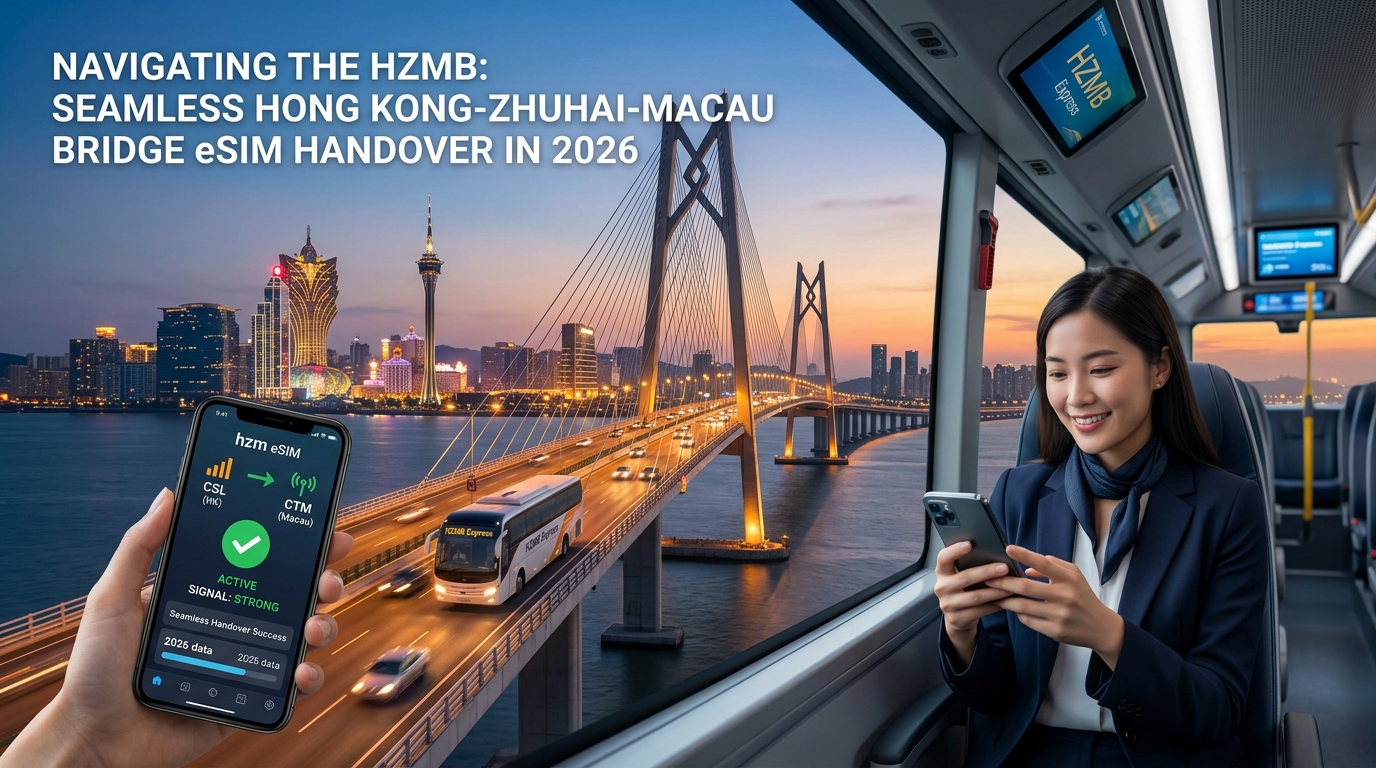
The 55km Tri-Border Bottleneck: Mobile Connectivity Challenges Along the HZMB
Stretching across the waters of the Lingdingyang channel in the Pearl River Estuary, the Hong Kong-Zhuhai-Macau Bridge (HZMB) represents one of the most ambitious engineering feats of the 21st century. However, beneath its architectural triumph lies a telecommunications nightmare: a 55-kilometer corridor where three separate sovereign regulatory frameworks, three distinct mobile network spectrum bands, and multiple competing telecom giants collide in mid-air.
Navigating this transit zone at 80 to 100 km/h aboard a cross-boundary coach (popularly known as the "Golden Bus") or private cross-border vehicle exposes consumer mobile hardware to severe radio frequency (RF) turbulence.
[Hong Kong Boundary] ---> [6.7km Undersea Tunnel] ---> [29.6km Open-Sea Span] ---> [Zhuhai / Macau Port]
   (CSL / SmarTone)         (Leaky Feeder Systems)       (Mainland Tri-Carrier)          (CTM / Multi-IMSI)
The Physical and RF Infrastructure of the Bridge
To maintain unbroken 5G and 4G LTE coverage along the crossing, engineers had to deploy a hybrid network infrastructure across three geographically disparate segments:
- The 12km Hong Kong Link Road: Serviced primarily by coastal macro base stations operated by Hong Kong providers (CSL, SmarTone, and 3HK), transmitting over standard sub-6 GHz FDD-LTE and 5G bands (B1, B3, B7, n78).
- The 6.7km Undersea Tunnel and Artificial Islands: Enclosed beneath the sea floor between the Eastern and Western Artificial Islands, connectivity relies entirely on distributed antenna systems (DAS) and specialized radiating leaky coaxial cables installed along the tunnel walls to shield passenger devices from total signal blackouts.
- The 29.6km Main Bridge Structure: Extending over open waters governed by Mainland China maritime law, telecommunications here are managed via high-gain macro antennas mounted on bridge gantries and marine pylons operated by China Mobile, China Telecom, and China Unicom, which heavily leverage TDD-LTE bands (B39, B40, B41) and 5G n41/n78.
The Tri-Border RF Overlap and the Ping-Pong Effect
Because radio waves travel over open water without natural topographical interference, RF signals from high-powered coastal towers in Zhuhai, Macau, and Hong Kong’s Lantau Island propagate dozens of kilometers beyond their intended territorial borders.
| Bridge Sector | Dominant Carriers | Network Tech & Deployment | Common Failure Modes |
|---|---|---|---|
| HK Boundary to East Island | CSL, SmarTone, 3HK | Macro cells & coastal line-of-sight | High attenuation at border edge |
| Undersea Tunnel | Shared DAS / Leaky Cable | Sub-6 GHz coaxial tunnel repeaters | Rapid handover packet dropouts |
| Main Bridge Span (Open Water) | China Mobile, China Unicom | Gantry-mounted microcells | Signal ping-ponging across water |
| Zhuhai-Macau Artificial Island | CTM, China Mobile, China Telecom | Multi-operator shared micro-arrays | Instant disconnect on single-region SIMs |
When a vehicle speeds across the bridge, a traveler’s smartphone constantly senses competing signals from Hong Kong, Macau (CTM), and the Mainland. Without intelligent routing, devices fall victim to the "ping-pong effect"—rapidly hopping back and forth between foreign cell towers. This results in:
- High Ping Spikes & Jitter: Latency surges from 25ms to over 800ms as the device renegotiates base station handshakes.
- Carrier Authentication Lockouts: Legacy SIM cards attempt to authenticate against distant Mainland or Macau towers using domestic profiles, causing registration timeouts.
- Abrupt Disconnections: Single-destination SIM cards drop carrier connections entirely the moment the bus enters Mainland waters, cutting off navigation, messaging, and digital boarding passes.
Why Legacy Roaming and Single-Destination Profiles Fail
Traditional single-destination tourist SIM cards and rigid travel profiles are fundamentally unsuited for the HZMB transit corridor. A local Hong Kong SIM will drop out near the Eastern Artificial Island, while a Mainland-only eSIM will fail to activate until you have already passed through the undersea tunnel.
Furthermore, when typical roaming eSIMs face network congestion or reach data caps during crossing delays, they throttle throughput to an unworkable 128kbps—effectively rendering maps, biometric border QR codes, and Apple Pay unusable.
Optimized regional multi-IMSI providers like MollySIM bypass these physical and regulatory bottlenecks. By integrating automated multi-carrier fallback profiles and maintaining a 384kbps Fair Use Policy (FUP) floor—three times the industry standard—navigation apps, instant messaging, and mobile payments continue running smoothly even under extreme RF congestion in the middle of the Lingdingyang channel.
Radio Tower Handover Mechanics: Why Standard SIMs Drop in the Undersea Tunnel
🇭🇰 Hong Kong High-Speed Travel eSIM & SIM Plans
Instant QR code activation, hotspot enabled, with guaranteed 384kbps fallback speed to keep Maps & Digital Wallets active.
Traversing the 55-kilometer Hong Kong-Zhuhai-Macau Bridge at highway speeds (80–100 km/h) subjects mobile devices to one of the most hostile radio frequency (RF) switching environments in commercial telecommunications. The route transitions across three sovereign spectrum regulatory zones, requiring continuous coordination between outdoor macro-cells, artificial island micro-cells, and the 6.7-kilometer immersed tube undersea tunnel.
When standard SIM cards attempt this transit, their underlying baseband firmware encounters physical and programmatic bottlenecks that inevitably terminate active sessions.
The Physical RF Topology: Pylons, Islands, and Leaky Coax
Cellular infrastructure along the HZMB relies on three distinct physical deployments:
- Bridge Pylon Macro Base Stations: High-gain directional antennas mounted directly on bridge towers, projecting high-band (1800MHz/2100MHz/3.5GHz) and low-band (700MHz/900MHz) 4G and 5G signals along the viaducts.
- Artificial Island Transition Nodes: Dense cellular sites located on the Eastern and Western Artificial Islands designed to handle extreme density and border security telemetry.
- Undersea Tunnel Leaky Coaxial Cables (LCX): Inside the 6.7-kilometer tunnel—located 40 meters below sea level—standard line-of-sight propagation is impossible. Radiating LCX cables running along tunnel walls broadcast radio frequencies evenly across both bores.
At 100 km/h, your smartphone crosses cell coverage zones every 15 to 45 seconds. In a uniform domestic network, base station controllers execute seamless, make-before-break soft handovers within milliseconds. However, inside the HZMB corridor, this process is disrupted by international roaming barriers.
The Three Deadly Failure Modes of Standard SIM Handover
+------------------------------------+-----------------------------------------------------+----------------------------------------------------+
| Failure Point                      | Technical Root Cause                                | Real-World Impact at 80–100 km/h                   |
+------------------------------------+-----------------------------------------------------+----------------------------------------------------+
| Maritime "Sticky Cell" Trap        | High line-of-sight RF propagation over open water   | Device clings to weak HK signal; packet loss >90%  |
| Tunnel LCX Boundary Desync         | Macro-to-LCX transition cross-PLMN handshake lag     | Instant signal drop upon entering undersea section |
| PLMN Search & Ping-Ponging         | Strict domestic SIM priority files (EF_PLMNsel)     | Baseband freezes in 30–90s network discovery loops |
+------------------------------------+-----------------------------------------------------+----------------------------------------------------+
1. The Maritime "Sticky Cell" Roaming Trap
Radio waves travel with minimal attenuation over open seawater. Consequently, high-power Hong Kong towers on Lantau Island deliver strong Reference Signal Received Power (RSRP) readings miles past the physical boundary into Mainland waters.
Standard tourist SIMs exploit this by exhibiting high handover hysteresis: the device desperately clings to the distant Hong Kong tower despite the Signal-to-Interference-plus-Noise Ratio (SINR) collapsing due to phase reflection off the water. The phone believes it has adequate signal bars, but the uplink budget is exhausted—resulting in 100% packet loss, frozen map caching, and stalled background processes.
2. The LCX In-Tunnel Propagation Boundary
As the shuttle bus plunges into the undersea tunnel at the Eastern Artificial Island, the physical macro-cell signal from the bridge pylon drops by 30–40 dB within fractions of a second.
To maintain connectivity, the User Equipment (UE) must immediately latch onto the tunnel's Leaky Coaxial Cable system. Standard SIMs, locked to domestic carrier profiles, initiate an inter-PLMN (Public Land Mobile Network) search rather than an intra-carrier handover. Finding no authorized domestic carrier inside the LCX partition, the baseband drops the bearer channel entirely.
3. Base Station Ping-Ponging Across Triple Borders
Near the Western Artificial Island, radio emissions from Zhuhai (China Mobile/Telecom/Unicom) and Macau (CTM/3 Macau) overlap significantly. A standard single-network or basic roaming SIM enters a destructive ping-ponging state:
- The device authenticates with a mainland cell tower (PLMN 460-xx).
- Transient cross-border RF interference shifts RSRP toward a Macau cell (PLMN 455-xx).
- The SIM attempts a location update on the new network, which triggers an identity authentication challenge.
- During the 2 to 6 seconds required to complete this cross-border authentication, the bus has already moved through the beam, forcing another teardown and reconnect.
The Solution: Autonomous Multi-IMSI Switching Architecture
To survive the bridge-to-tunnel transition without data interruption, network hardware requires active multi-IMSI (International Mobile Subscriber Identity) orchestration.
Providers engineered for this transit corridor, such as MollySIM, deploy dynamic profile-switching logic. Instead of forcing your phone into a prolonged network search when entering the tunnel, the eSIM automatically switches its core identifier to local routing nodes with pre-cleared authentication parameters for Hong Kong, Guangdong, and Macau infrastructure.
Furthermore, even if severe maritime RF congestion temporarily degrades the high-speed downlink channel, maintaining a 384kbps FUP floor ensures that time-sensitive UDP packets—such as real-time GPS coordinates, Apple Pay NFC token exchanges, and WeChat health/customs QR codes—never time out during the handover sequence.
Greater Bay Area Connectivity Compared: Physical SIMs vs. Pocket Wi-Fi vs. Multi-Region eSIM
Cross-border transit through the Greater Bay Area (GBA) presents a distinct telecommunications challenge: navigating three autonomous regulatory zones, three discrete spectrum allocations, and three separate core carrier networks within a single 55-kilometer trip.
Choosing the wrong roaming architecture leads to dropped calls in the undersea tunnel, customs clearance stalls due to unrendered QR codes, and inflated roaming invoices. The matrix below benchmarks the four dominant connectivity methods across the HZMB transit route:
| Technical & Operational Metric | Tri-SIM Physical Swapping | Rental Pocket Wi-Fi | Home Carrier Data Roaming | MollySIM Multi-Region eSIM |
|---|---|---|---|---|
| Multi-Border Handover Time | 2–5 minutes (Manual swap & boot) | 45–90 seconds (Device re-association) | 60–180 seconds (PLMN search) | < 5 seconds (Autonomous Multi-IMSI) |
| HZMB Undersea Tunnel Stability | Poor (Fails during mid-tunnel PLMN shift) | Unstable (Double hop packet loss) | Moderate (Baseband searching drops) | High (Pre-cleared LCX authentication) |
| Core Routing Latency (Ping) | 20–40ms (Local breakout) | 70–120ms (Local + Wi-Fi overhead) | 250–600ms (Home country trombone routing) | 18–35ms (Direct GBA Edge Breakout) |
| Hardware Management | High (Physical ejector pins, losing micro-chips) | High (Separate device, charging cables, power bank) | Zero (Uses native SIM) | Zero (Over-the-air multi-profile delivery) |
| Smartphone Battery Impact | Baseline | High (Continuous active Wi-Fi scanning) | Extreme (Radio amplifies to find home partner) | Optimized (Native baseband power states) |
| APN / Profile Complexity | Manual setup per region | Zero (Connect to SSID) | Automatic | Single-click automatic APN deployment |
| Throttled FUP Floor Speed | 64kbps – 128kbps | 128kbps | 64kbps – 128kbps | 384kbps (Sustained baseline) |
| Multi-Device Support | Single device only | 3–5 devices (Shared bandwidth) | Single device (Tethering often blocked) | Native Personal Hotspot supported |
The Terminal Flaws of Pocket Wi-Fi and Physical SIMs on the HZMB
Rental Pocket Wi-Fi devices, long considered a reliable fallback for group travel, consistently underperform on high-speed inter-city infrastructure like the HZMB. The architecture introduces a double wireless hop: cellular base station to pocket router (WWAN), and pocket router to smartphone (WLAN).
Inside a high-density HZMB shuttle coach carrying 40 to 60 passengers—many carrying active 2.4GHz and 5GHz devices—the localized RF spectrum becomes saturated. This interference causes severe jitter, frame dropping, and thermal throttling of the pocket router’s battery.
More critically, when the shuttle transitions between the Hong Kong SAR, Mainland Chinese, and Macau maritime radio cells, pocket Wi-Fi units often hang on weak upstream signals until the link completely drops, requiring a manual hardware reboot while you are in the middle of clearing customs at the port.
Physical multi-SIM management presents physical liabilities. Ejecting nano-SIM trays while seated on a moving bridge shuttle risks dropping or damaging critical cards. Furthermore, removing your home physical SIM disables vital SMS channels, breaking two-factor authentication (2FA) verification codes required by enterprise VPNs, banking applications, and regional digital wallet authorizations.
Why Multi-Profile eSIM is the 2026 Commuter Benchmark
The modern standard for GBA transit relies on software-defined multi-IMSI architectures built directly into the smartphone's embedded baseband chip.
- Local Edge Breakout Over Home-Routing: Standard carrier roaming routes your traffic from Zhuhai back to your home country's mobile switching center (e.g., London, New York, or Sydney) before routing it back to local Asian servers. This "trombone routing" inflates ping latency beyond 400ms, making navigation sluggish. Modern travel eSIMs leverage direct local interconnects within Hong Kong and Guangdong data centers, cutting latency to under 35ms.
- True Business-Class FUP (384kbps Floor): While legacy providers throttle high-volume users down to 64kbps or 128kbps—effectively rendering modern TLS 1.3 encrypted data transfers unusable—services like MollySIM enforce a 384kbps baseline floor. This data rate guarantees that if your high-speed quota depletes midway across the bridge, critical operational payloads (Apple Pay tokens, dynamic customs QR codes, WeChat payment handshakes, and turn-by-turn map vector tiles) continue executing without timeout errors.
- Continuous Dual-SIM Active Operation: By provisioning your GBA access via eSIM, your physical primary slot remains active to receive mission-critical voice calls and security SMS codes, while the eSIM manages the multi-network cellular data uplink across all three jurisdictions uninterrupted.
Mission-Critical Crossing Scenarios: Ticketing, Transit Apps, and Custom QR Codes
Transiting the 55-kilometer Hong Kong-Zhuhai-Macau Bridge (HZMB) entails navigating three distinct administrative, customs, and currency zones in under an hour. Because border infrastructure across the Greater Bay Area has shifted almost entirely to cloud-authenticated digital identity verification, transit passes, and mobile payments, a packet drop or network negotiation freeze at the border gate creates immediate physical friction.
Understanding where and why persistent low-latency data is non-negotiable across the three ports of entry (Hong Kong Port, Zhuhai Port, and Macau Port) prevents costly delays at automated turnstiles and customs checkpoints.
1. Dynamic Golden Bus E-Ticketing and Turnstile Synchronization
The backbone of HZMB passenger transit is the 24-hour Shuttle Bus (colloquially known as the Golden Bus). Ticketing workflows rely on real-time server handshakes:
- Cryptographic QR Code Refresh Cycles: Whether booked via WeChat Mini-Programs, official web portals, or on-site digital kiosks, Golden Bus mobile tickets utilize dynamic, time-sensitive QR codes that cycle cryptographic tokens every 30 to 60 seconds. Static screenshots are rejected at the optical turnstiles.
- On-the-Fly Re-Authentication: If a handset loses data connectivity while advancing through the passenger queue inside the Hong Kong or Macau Passenger Clearance Buildings, the ticketing webview drops its session token, forcing a page reload that stalls the boarding turnstile.
2. Dual-Customs Handshakes and Dynamic Declarations
Clearing border control across the HZMB involves entering distinct regulatory environments:
| Port Interface | Critical Data Operations | Network Dependency Failure Mode |
|---|---|---|
| Hong Kong Port (HKIA Side) | Dynamic Departure/Arrival clearance, HKSAR e-Channel verification, Apple Pay / Octopus top-ups | Session drop stalls automated e-Channel authentication; payment app fails to pull updated token |
| Zhuhai Port (Mainland) | Mainland Customs Health Declarations, Mainland Travel Permit verification, Alipay/WeChat Pay cross-border payment switching | App fails to switch to Mainland Wallet (CNY); dynamic customs clearance QR fails to generate |
| Macau Port (Henghua/Post-Clearance) | Macau Health/Customs declarations via the Macao One Account app, MPay local wallet integration | Inability to load clearance barcode; delays at joint inspection counters |
At the Zhuhai-Macau Joint Inspection Hall, the "Co-location" (Joint Inspection and One-Time Release) system processes cross-border movement simultaneously. If your device gets trapped in an APN reconnect loop between mainland Chinese and Macanese spectrum while approaching the counter, mobile payment apps fail to negotiate local currency conversions (HKD/MOP to CNY), halting instant fare settlements.
3. Route Guidance: The Google Maps to Gaode Vector Transition
Navigating the bridge by private car (via the Northbound Travel for Hong Kong Vehicles scheme), cross-boundary coach, or dual-plate vehicle demands continuous navigational handovers:
- Hong Kong Waters to Mid-Span Tunnel: Google Maps delivers accurate spatial intelligence and lane recommendations across the bridge viaducts within the Hong Kong boundary.
- Mainland Boundary Handover: The moment your vehicle crosses the marine boundary line into mainland jurisdiction, Google Maps loses real-time traffic telematics and lane-level navigation due to local data restrictions.
- In-Flight App Switching: Drivers must transition to Gaode Maps (Amap) or Baidu Maps while moving at 100 km/h. This transition requires the device to immediately download high-density vector tiles, mainland speed trap cameras, and artificial island tunnel telemetry over active cellular data.
4. Post-Clearance Ground Dispatch and Ride-Hailing Coordination
Exiting the customs clearance halls into the arrival plazas brings a fresh set of data-heavy requirements:
- Zhuhai Port Ground Transportation Center: Calling a vehicle via Didi requires continuous GPS polling, driver-passenger messaging, and in-app VoIP calls.
- Macau Port Outer Terminal: Booking a Macau Radio Taxi via its dispatch mini-program requires active session continuity to pinpoint dynamic bay allocations.
5. Why Network Fallback Speeds Dictate Clearance Success
When high-speed quotas exhaust or baseband handshakes stutter under bridge-wide network congestion, standard travel eSIMs throttle downstream speeds to an unworkable 64kbps or 128kbps. At 128kbps, the TLS 1.3 handshake required by banking protocols, Apple Pay, and dynamic customs webviews frequently times out.
By maintaining a 384kbps baseline floor under its Fair Use Policy, MollySIM ensures that even if you exceed your daily high-speed tier mid-span, critical payload packets—such as WeChat dynamic codes, Gaode map vectors, and biometric identity tokens—continue transmitting seamlessly without physical disruption at the terminal gate.
The MollySIM Advantage: Intelligent Tri-Border Routing and 384kbps Fallback
Traversing the 55-kilometer expanse of the Hong Kong-Zhuhai-Macau Bridge exposes the architectural flaws of standard travel eSIMs. Traditional data plans rely on single-IMSI profiles that route traffic through distant home routing gateways, forcing your device to endure prolonged PLMN (Public Land Mobile Network) hunting periods whenever cell tower footprints intersect.
MollySIM resolves this friction via a unified Greater Bay Area (GBA) multi-profile routing engine engineered specifically for tri-border transit.
1. Pre-Provisioned Tier-1 Carrier Peering Across All Three Jurisdictions
Rather than treating Macau and Mainland China as generic international roaming destinations, MollySIM establishes direct, pre-provisioned local network profiles on the device baseband. This multi-IMSI architecture enables sub-second autonomous handovers between dominant regional operators:
- Hong Kong SAR: Direct peering with CSL and SmarTone ensures robust 5G carrier aggregation across Lantau Island and the initial bridge approach.
- Mainland China (HZMB Trunk & Zhuhai Port): Instant attachment to China Unicom and China Mobile, providing uninterrupted macro-cell coverage through the 6.7-kilometer undersea tunnel and western artificial islands.
- Macau SAR: Rapid authentication on CTM (Companhia de Telecomunicações de Macau), eliminating the typical 2–4 minute registration stall when exiting the HZMB Macau Port clearance channels.
Because authentication credentials for all three territories reside natively within the profile, baseband switching occurs at the hardware layer. Your device does not drop connection packets or require manual toggling of "Data Roaming" settings at border checkpoints.
2. The 384kbps FUP Floor: The Difference Between Clearance and Lockout
Most travel eSIM providers advertise "Unlimited Data" that drops to 64kbps or 128kbps once high-speed daily quotas expire. Under modern network security protocols, a 128kbps connection is functionally equivalent to complete packet loss:
Modern cross-border webviews (such as the Macau Health Code, WeChat mini-programs, and biometric clearance portals) load heavy JavaScript bundles alongside dynamic API payloads. A 128kbps stream causes these cryptographic TLS handshakes to time out, preventing the generation of critical dynamic departure and entry barcodes.
| Performance Metric | Standard Roaming eSIMs | MollySIM GBA Solution | Practical Transit Impact |
|---|---|---|---|
| Throttled Speed Floor | 64kbps – 128kbps | 384kbps (3x faster) | Continuous payload clearance |
| TLS 1.3 Handshake | Often times out (>4.5s) | Sub-second (<800ms) | Instant dynamic QR generation |
| VoIP / Audio Calls | Heavy packet loss / robotic | Stable Opus Codec streaming | Clear WhatsApp/WeChat voice calls |
| Vector Map Streaming | Tiles fail to render | Real-time GPS tracking | Continuous Gaode & Google Maps navigation |
| Carrier Switch Delay | 90–240 seconds | < 3 seconds (Autonomous) | Zero dead-zones across border gates |
By engineering a continuous 384kbps baseline floor into its Fair Use Policy, MollySIM guarantees sufficient bandwidth headroom. Even if your high-speed quota exhausts mid-span, your real-time GPS telemetry, messaging apps, live border transit updates, and mobile payment interfaces continue functioning seamlessly across the entire Pearl River Delta corridor.
Step-by-Step Setup Guide: Optimizing Your eSIM for Flawless HZMB Crossings in 2026
To avoid border-gate connection dropouts while your shuttle approaches Macau or Zhuhai, complete your device staging before boarding the HZMB Shuttle Bus (the "Golden Bus") or cross-boundary coach.
Follow this protocol to ensure your baseband modem handshakes with local cellular towers instantly upon entering international waters and crossing boundary control points.
Phase 1: Pre-Departure Line Configuration (HKIA / Downtown Hong Kong)
Complete the initial installation while connected to stable broadband or airport Wi-Fi to ensure the Local Profile Assistant (LPA) downloads the cryptographic profile without packet loss.
On iOS (iPhone 13 through iPhone 17 series)
- Navigate to Settings > Cellular (or Mobile Data).
- Select your newly installed cross-border profile under the SIMs section and set its custom label to "GBA Travel" or "HZMB eSIM".
- Toggle Turn On This Line to ON.
- Tap Cellular Data at the top of the menu and select your GBA profile.
- Crucial Step: Toggle Allow Cellular Data Switching to OFF. Leaving this enabled allows iOS to fallback to your home primary SIM during transient 2-second bridge handshakes, triggering expensive international roaming daily passes.
- Tap back into your GBA eSIM sub-menu and ensure Data Roaming is set to ON.
On Android (Samsung One UI, Google Pixel, & ColorOS)
- Go to Settings > Connections (or Network & Internet) > SIM Manager.
- Ensure your travel profile is enabled. Under Preferred SIMs, set Mobile Data exclusively to the travel eSIM.
- Turn Data Switching and Backup Calling to OFF.
- Select the travel eSIM, navigate to Mobile Networks, and toggle Data Roaming to ON.
Phase 2: Network Selection & APN Verification
Modern multi-IMSI and dynamic routing profiles require specific gateway designations to authenticate across three distinct regulatory domains (OFCA in Hong Kong, CTT in Macau, and MIIT in Mainland China).
| Platform | Recommended Network Selection | APN Field Validation |
|---|---|---|
| iOS | Settings > Cellular > Network Selection ➔ Automatic | Automatically provisioned by carrier bundle. Leave default unless prompted. |
| Android | Settings > Mobile Networks > Network Operators ➔ Select Automatically | Ensure APN is set to default gateway. Protocol must be set to IPv4/IPv6 dual-stack. |
Note on Network Selection: Leave the setting on Automatic by default. MollySIM profiles use dynamic SIM applet steering to negotiate line access with CTM (Macau) and China Unicom/China Mobile (Zhuhai) before the bus exits the Western Artificial Island tunnel.
Phase 3: Mid-Bridge & Terminal Troubleshooting (Border Tower Latch-up)
As your bus transits the underwater tunnel segment between the Eastern and Western Artificial Islands, your device may experience "Tower Lock-in"—stubbornly holding onto an ultra-faint, degraded -120 dBm Hong Kong band 8 (900MHz) carrier signal instead of latching onto the local Macau/Zhuhai macros positioned right outside the boundary checkpoint.
If you notice a stalled dynamic QR code or blank clearance app upon pulling into the Macau or Zhuhai Port clearance bays, perform this immediate recovery loop:
- Perform a Baseband Reset: Swipe to your Control Center / Quick Settings, toggle Airplane Mode ON, wait a full 10 seconds to flush the modem’s radio baseband cache, and toggle it OFF.
- Execute a Manual Carrier Override: If the baseband still fails to shift:
- For Macau Clearance: Go to Network Selection, disable Automatic, and manually tap CTM or 3 Macau.
- For Zhuhai Clearance: Go to Network Selection, disable Automatic, and select China Unicom or China Mobile.
- Clear Stalled Webview Cache: If your browser or WeChat mini-program hangs on the health/customs declaration screen, force-close the app rather than refreshing the URL.
Because MollySIM provides an unthrottled 384kbps floor under its Fair Use Policy—3x the throughput of legacy 128kbps alternatives—your device maintains enough active bandwidth to clear transit authentication handshakes, stream dynamic map telemetry on Apple Maps/Google Maps, and execute Apple Pay/Alipay checkouts without session timeouts throughout the entire cross-boundary transit corridor.
🇭🇰 Hong Kong High-Speed Travel eSIM & SIM Plans
Instant QR code activation, hotspot enabled, with guaranteed 384kbps fallback speed to keep Maps & Digital Wallets active.