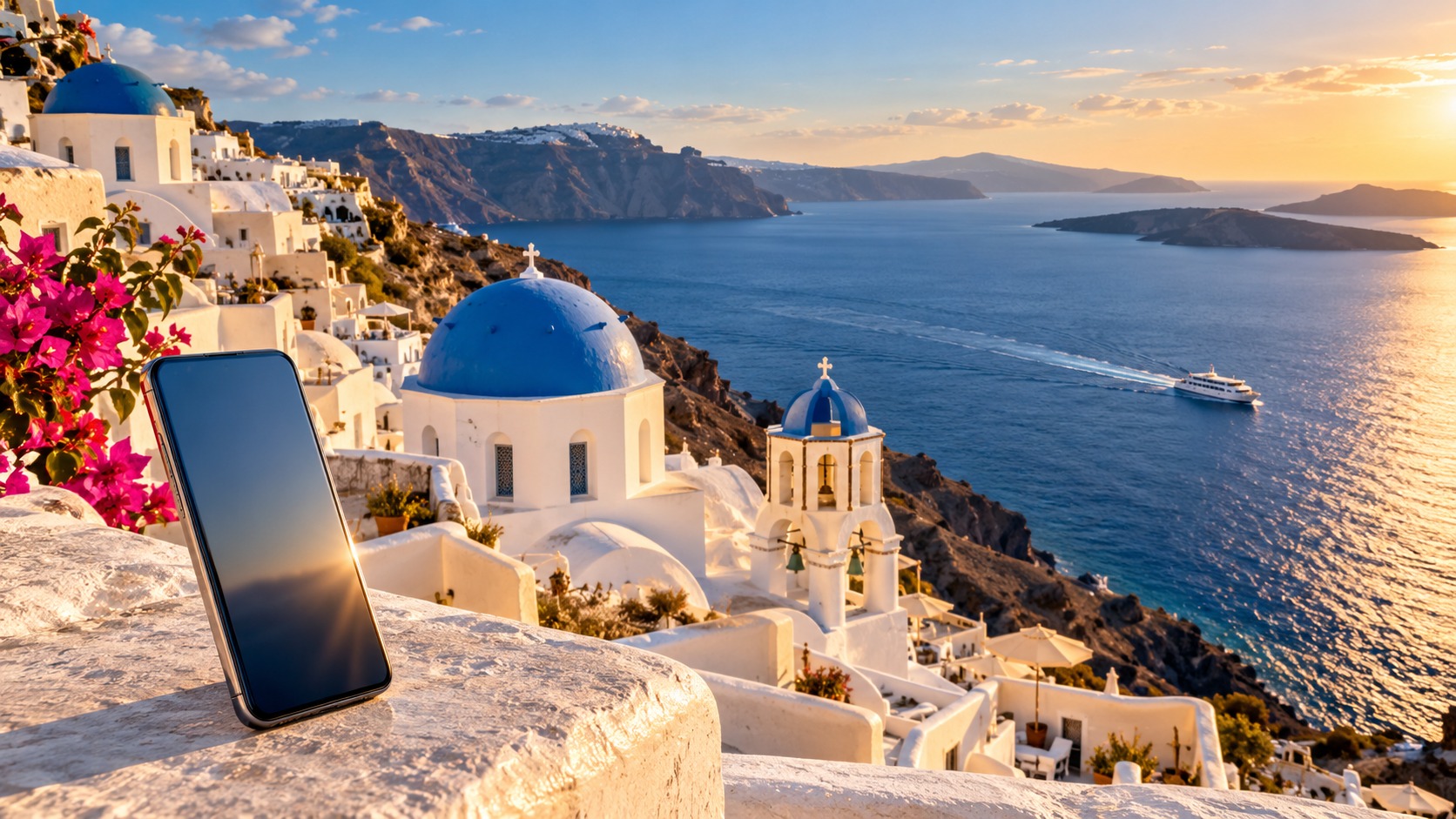
Why a Greece eSIM Santorini Plan is Essential for 2026 Island Hopping
Securing a reliable Greece eSIM Santorini connection is no longer a luxury for the modern traveler; it is the critical infrastructure that defines the success of your 2026 island-hopping itinerary. As the Cyclades and Crete continue to see record-breaking tourist volumes, the strain on local cellular networks has reached a tipping point, making seamless, pre-activated data access the single most important preparation step before you board your ferry. In 2026, the landscape of Greek connectivity is shifting rapidly, driven by a surge in short-stay visitors who demand instant access to navigation, translation, and social sharing without the friction of traditional SIM card logistics. For the average traveler spending three to seven days hopping between Santorini, Mykonos, and Naxos, the physical SIM card is becoming an obsolete relic of the past. The hassle of locating a carrier store upon arrival, waiting in long queues during peak afternoon hours, and the constant anxiety of losing a tiny plastic card while navigating crowded ferries or cobblestone streets, has made the physical SIM a significant source of travel stress.
The Connectivity Crunch in the Cyclades
The unique geography of the Greek islands presents specific technical challenges that are exacerbated by the 2026 tourism boom. The Cyclades are not a single landmass but a scattered archipelago where network coverage is often patchy, particularly in the more remote or mountainous areas. While major towns like Fira and Oia on Santorini have robust 4G/5G coverage, the "dead zones" in the caldera’s steep cliffs and the rural villages of neighboring islands can leave travelers stranded without signal. This is a critical pain point: if you are hiking the Fira-to-Oia trail or exploring the hidden coves of Ios, a weak or non-existent signal can mean lost navigation, delayed emergency calls, and an inability to share the breathtaking views in real-time.
In 2026, the expectation of connectivity has evolved into what we term "digital nomad lite" travel. Even if you are not working remotely, the modern tourist expects seamless digital integration. This includes:
- Real-time Navigation: Using Google Maps or Apple Maps to find specific tavernas, beaches, or ferry terminals without relying on paper maps.
- Instant Translation: Utilizing AI-powered translation apps to communicate with locals who may not speak English.
- Social Sharing: Posting high-resolution photos and videos to Instagram or TikTok, which requires stable upload speeds.
- Contactless Payments: Using Apple Pay or Google Pay, which requires a consistent data connection to verify transactions.
Why Physical SIMs Are Failing the 2026 Traveler
The traditional method of purchasing a local SIM card upon arrival is fraught with inefficiencies. When you land at Santorini’s airport or arrive at the port, you are often exhausted and eager to start your vacation. However, the process of acquiring a local SIM involves:
- Finding a Store: Locating a Vodafone, Cosmote, or MT store, which may be closed during lunch breaks or have limited hours.
- Registration Hassle: Presenting your passport and filling out registration forms, which can be time-consuming and prone to language barriers.
- The "Lost SIM" Risk: Once you have the SIM, you must physically swap it with your home SIM (if you are not using a dual-SIM phone) or manage two cards. If you lose the physical card, you lose your data, and replacing it requires another trip to the store.
- Network Strain: During peak season (June to September), local networks are often saturated. A physical SIM does not guarantee priority access; you are subject to the same congestion as everyone else.
The MollySIM Advantage: Speed and Simplicity
This is where a specialized Greece eSIM Santorini plan becomes essential. An eSIM is a digital SIM card embedded in your phone, allowing you to activate a data plan instantly without swapping physical cards. This eliminates the need to visit stores, wait in lines, or worry about losing a card. More importantly, it allows you to choose a provider that optimizes for speed and reliability in the Greek archipelago.
MollySIM stands out in this space by offering a streamlined, user-friendly experience designed specifically for travelers. Unlike many competitors that throttle speeds to keep costs low, MollySIM provides a 384kbps Fair Use Policy speed limit, which is 3x faster than the standard 128kbps limit offered by many other eSIM providers. This difference is crucial for the "digital nomad lite" experience. At 128kbps, loading a map or making a payment can be frustratingly slow. At 384kbps, Google Maps loads instantly, Apple Pay transactions are smooth, and video calls or high-quality photo uploads to social media are feasible. This speed ensures that your connectivity is not just "available" but actually usable for the tasks that matter most during your trip.
Pre-Activation and Peace of Mind
One of the biggest advantages of a Greece eSIM Santorini plan from MollySIM is the ability to pre-activate your data before you even leave home. You can purchase and install the eSIM on your phone while you are still in your hotel room or at the airport, ensuring that the moment you land in Santorini, you are connected. This eliminates the "connectivity gap" that often occurs in the first few hours of a trip, where you are trying to find Wi-Fi or purchase a SIM card. With MollySIM, you can focus on the view from Oia rather than the queue at a Vodafone store.
For those planning their 2026 itinerary, understanding the specific connectivity needs of the Greek islands is key. You can explore detailed Greece eSIM packages at MollySIM’s Greece eSIM page to find the best data allowance for your trip. Additionally, for more in-depth advice on navigating the technical aspects of travel connectivity, check out our comprehensive travel connectivity tips on the MollySIM blog. By choosing a robust, pre-activated data solution, you ensure that your trip is defined by the beauty of the Aegean, not the frustration of a dead phone.
Cosmote vs. Vodafone vs. Nova: A Deep Dive into Greek Island Coverage
🇬🇷 Greece High-Speed Travel eSIM & SIM Plans
Instant QR code activation, hotspot enabled, with guaranteed 384kbps fallback speed to keep Maps & Digital Wallets active.
Selecting the right network is arguably the most critical technical decision when choosing a Greece eSIM Santorini provider. While many travelers assume that any local SIM will work seamlessly across the Cyclades, the reality is that coverage varies significantly by carrier, terrain, and time of day. To make an informed decision for your 2026 trip, it is essential to understand the distinct strengths and weaknesses of Greece’s three major telecommunications giants: Cosmote, Vodafone, and Nova. Each carrier has a different infrastructure strategy, which directly impacts your data speeds, latency, and reliability in specific locations like the caldera rim, the bustling ports of Mykonos, or the rural villages of Crete.
Carrier Performance Matrix: Santorini, Mykonos, and Crete
The following table breaks down the real-world performance of each carrier across key tourist destinations. Note that "Coverage" refers to the consistency of 4G/LTE signal strength, while "Congestion Handling" indicates how well the network maintains speeds during peak tourist seasons (June–September).
| Carrier | Santorini (Fira/Oia/Imerovigli) | Mykonos (Town/Beaches) | Crete (Heraklion/Rural) | Best For |
|---|---|---|---|---|
| Cosmote | Excellent. Strongest signal in cave houses and narrow streets. Minimal dropouts in Imerovigli. | Very Good. Reliable in Mykonos Town; decent on beaches. | Good. Solid urban coverage; occasional weak spots in deep rural valleys. | Video Streaming & Stability. Ideal for travelers who prioritize consistent high-speed data. |
| Vodafone GR | Good. Strong in Fira; can fluctuate in Oia’s upper areas. | Excellent. Dominant in Mykonos Town and Chora. | Variable. Strong in Heraklion; significant signal drops in remote western Crete. | Urban Hoppers. Best for those spending most time in town centers and ports. |
| Nova | Adequate. Basic data works; video may buffer in dense stone areas. | Adequate. Functional in town; weaker on remote beaches. | Adequate. Sufficient for navigation and messaging; slower for large uploads. | Budget Travelers. Best for light data users (maps, email, social media). |
Technical Nuances: Frequency Bands and Stone Architecture
Understanding why these differences exist requires a look at the technical infrastructure. Santorini’s unique geography—steep cliffs, narrow winding streets, and ancient stone construction—creates a challenging environment for radio waves. This is where frequency bands matter.
- 700MHz (Low Band): This band has a longer wavelength, allowing it to penetrate obstacles like thick stone walls and travel further distances. It is crucial for maintaining a connection inside cave houses in Oia or in underground parking structures in Fira.
- 1800MHz (Mid Band): This band offers higher capacity and faster speeds but has a shorter range and poorer penetration through solid materials.
Cosmote has historically invested heavily in low-band (700MHz) infrastructure across the Cyclades, which is why their signal often remains stable even when you are deep inside a stone-walled restaurant in Imerovigli. Vodafone, while strong in urban centers, may rely more on mid-band frequencies in certain island areas, which can lead to signal loss when you move away from the main road or into dense architectural clusters. Nova, as a budget carrier, often utilizes a mix of these bands but may prioritize cost-efficiency in its network expansion, resulting in adequate but not exceptional penetration in difficult terrain.
The Multi-Carrier Advantage: A Scenario from Imerovigli
Consider this common scenario: You are staying in a boutique hotel in Imerovigli, perched on the caldera rim. It is 8:00 PM, and the sunset crowds are thinning. You open your phone to check your reservation for dinner in Fira. On a single-carrier eSIM (e.g., one tied exclusively to Vodafone), you might notice your signal bars drop to one, and your data speed plummets to 2G levels. This happens because the local cell tower is congested with thousands of other users, and your specific carrier’s network is under strain.
Now, imagine you are using a multi-carrier eSIM like the one offered by MollySIM. Instead of being locked into one struggling network, the eSIM intelligently aggregates or switches to the strongest available signal. If Vodafone is congested, it might seamlessly hand off to Cosmote’s 700MHz band, which has better penetration into your stone-walled room. You continue scrolling through your photos without a hitch. This "best-of-breed" approach is why a multi-carrier solution is superior for island hopping. It eliminates the risk of being stranded on a weak network in a remote cove or a crowded town square.
Why MollySIM’s Fair Use Policy Matters
When comparing eSIM providers, look beyond just the data allowance. Many competitors impose a 128kbps speed limit after you exhaust your high-speed data, which is barely enough for loading text-based emails. In contrast, MollySIM offers a 384kbps Fair Use Policy speed limit. This is 3x faster than the industry standard, ensuring that even if you hit your data cap, you can still:
- Use Google Maps and Apple Maps for real-time navigation.
- Process Apple Pay or Google Pay transactions smoothly.
- Make video calls on WhatsApp or FaceTime without excessive buffering.
- Upload high-quality photos to social media without the "stuck on 99%" frustration.
This is a critical distinction for travelers who rely on their phones for more than just casual browsing. For a detailed breakdown of how this impacts your connectivity, explore the Greece eSIM packages at MollySIM’s Greece page to find the best fit for your itinerary. By choosing a provider that prioritizes both multi-carrier coverage and a generous fair-use speed, you ensure that your trip is defined by the beauty of the Aegean, not the frustration of a dead phone.
Navigating the 384kbps FUP: What Happens When Your Data Runs Out
Understanding the mechanics of a Fair Usage Policy (FUP) is critical for any traveler planning a Greece eSIM Santorini itinerary, as it dictates the difference between a seamless digital experience and a frustrating connectivity struggle. While many budget providers advertise "unlimited" data, this term is often a marketing euphemism for a tiered speed structure. Once you exceed a specific high-speed threshold—typically 10GB or 20GB depending on the carrier—your connection does not cut off entirely but is throttled to a lower speed. This is where the technical reality of 384kbps becomes the defining factor in your daily usability.
Defining 384kbps: The Technical Reality
To grasp the practical impact, we must translate raw bandwidth into tangible data transfer rates. 384kbps (kilobits per second) equates to approximately 48KB per second. This is not a "dead" connection, but it is a "slow" one. For context, a standard 4G LTE connection often operates between 15Mbps and 50Mbps. At 384kbps, your phone is operating at roughly 1/50th of its potential high-speed capacity. This distinction is vital because it determines whether your phone feels "broken" or simply "busy."
Impact on Critical Travel Apps
When your speed drops to 48KB/s, the behavior of your essential travel apps changes dramatically. Here is how this throttling affects the core functions you rely on while island hopping:
- Messaging (WhatsApp/iMessage): Text messages will still send and receive almost instantly, as they require minimal data. However, sending media files becomes a bottleneck. A 5MB photo might take over 100 seconds to upload, and a short video clip could take several minutes. If you are in a crowded square in Oia, waiting for a "sending" bubble to clear can be stressful.
- Social Media (Instagram/TikTok): Text-based feeds and captions will load, but high-resolution images and Stories will struggle. You may experience the "spinning wheel" effect for extended periods. Video content will likely buffer constantly, making it difficult to watch reels or updates without significant lag.
- Navigation (Google Maps/Apple Maps): Basic turn-by-turn navigation remains functional because it relies on small data packets for route updates. However, rendering satellite views, 3D building models, or loading detailed street-level imagery will lag significantly. If you are driving a rental car through the winding roads of Santorini, this lag can be a safety concern if the map fails to update your current location in real-time.
The 'Refresh' Problem: Battery and Heat Drain
A lesser-known consequence of low-speed throttling is the impact on your device’s hardware. When your phone is forced to maintain a connection at 384kbps, the cellular radio must stay active for a longer duration to complete the same data transfers that would take milliseconds at high speed. This prolonged radio activity leads to two significant issues:
- Increased Heat Generation: The processor and radio work harder to manage the slow data stream, causing the phone to heat up. In the Greek sun, this can make the device uncomfortable to hold.
- Accelerated Battery Drain: Background processes such as email sync, cloud backups (iCloud/Google Photos), and app updates continue to run. At 384kbps, these tasks take much longer to complete, keeping the radio active and draining your battery faster than it would on a high-speed connection. This is a critical consideration for travelers who rely on their phones for navigation and photography all day.
The MollySIM Advantage: Predictability Over Anxiety
This is where the MollySIM approach to Greece eSIM Santorini connectivity stands out. Many competitors throttle to 128kbps (approximately 16KB/s), a speed that is often too slow for smooth video calls or quick photo uploads. MollySIM maintains a 384kbps Fair Use Policy speed limit, which is 3x faster than the industry standard for throttled data. This ensures that even after you hit your high-speed cap, you can still:
- Use Google Maps for real-time navigation without excessive lag.
- Process Apple Pay or Google Pay transactions smoothly.
- Make video calls on WhatsApp or FaceTime with minimal buffering.
Practical Example: The Mykonos Upload
Consider a traveler in Mykonos who wants to upload a 4K video (approximately 500MB) to Instagram.
| Scenario | Speed | Estimated Time | User Experience |
|---|---|---|---|
| Competitor (128kbps) | 16KB/s | ~45+ minutes | High anxiety, phone heats up, constant buffering. |
| MollySIM (384kbps) | 48KB/s | ~15+ minutes | Manageable, but still slow for media. |
| MollySIM (High-Speed) | 10Mbps+ | < 2 minutes | Instant, seamless, no heat generation. |
While 384kbps is a robust fallback, MollySIM structures its plans to offer truly high-speed data for the duration of the trip where possible, or provides a clear, predictable fallback that is still sufficient for essential travel tasks. This eliminates the "data anxiety" of a local prepaid SIM, where you might run out entirely and be left searching for a Wi-Fi hotspot. By choosing a provider that prioritizes both multi-carrier coverage and a generous fair-use speed, you ensure that your trip is defined by the beauty of the Aegean, not the frustration of a dead phone. For a detailed breakdown of how this impacts your connectivity, explore the Greece eSIM packages at MollySIM’s Greece page to find the best fit for your itinerary.
Step-by-Step Guide to Activating Your Greece eSIM Before You Fly
Securing connectivity for your Santorini and island-hopping itinerary requires more than just buying a plan; it demands precise technical execution to avoid the "No Service" panic upon landing. The following protocol ensures your device is ready to capture the caldera views without a single second of downtime.
1. Pre-Flight Technical Checklist
Before initiating the purchase, verify your hardware and software compatibility. An eSIM is a digital profile, not a physical chip, but it still requires specific OS support and carrier permissions.
- Carrier Unlock Status: Confirm your phone is unlocked. If you are on a contract with T-Mobile, Verizon, or Vodafone, ensure the "eSIM" feature is enabled on your account. A locked phone will reject the new profile.
- OS Version: You need iOS 12+ or Android 9+. Older versions may lack the necessary cellular profile management features.
- Battery Level: Keep your battery above 20%. Installing an eSIM involves a handshake between your device and the carrier’s server; a low battery can interrupt this process, leading to a corrupted profile installation.
- Network Connection: Perform this step on a stable Wi-Fi connection (hotel lobby, airport lounge, or home network). You do not need data to install the eSIM, but you need a stable connection to download the QR code and profile data.
2. Purchase and QR Code Securing
Navigate to MollySIM’s Greece eSIM packages and select a plan that matches your island-hopping duration. Once the transaction is complete, the QR Code is your digital key.
Critical Step: Do not rely solely on the browser tab to keep the QR code.
- Screenshot the QR Code: Take a photo of the code and save it to your camera roll.
- Email Backup: Check your email for the confirmation message containing the QR code.
- Why this matters: If you close the browser tab or lose your internet connection before scanning, you may need to re-download the code. Having a local copy ensures you can install the profile even if the website becomes temporarily inaccessible or if you are in a low-signal area.
3. Installation Process: iOS vs. Android
Follow the specific path for your operating system. The process is identical in logic but differs in menu navigation.
For iPhone (iOS)
- Open Settings.
- Tap Cellular (or Mobile Data).
- Tap Add eSIM.
- Select Scan QR Code.
- Point your camera at the saved screenshot or email QR code.
- Name the profile (e.g., "Greece Travel") to distinguish it from your home SIM.
- Tap Done.
For Android
- Open Settings.
- Navigate to Network & Internet > SIMs (or Mobile Network).
- Tap Add eSIM.
- Select Scan QR code.
- Scan the code from your gallery or email.
- Confirm the profile name and save.
4. The 'Data Roaming' Toggle: A Crucial Technical Detail
This is the most common point of failure for travelers. You must turn ON Data Roaming for your eSIM to work, even if it is a local Greek plan.
- Why is this counter-intuitive? Most users associate "roaming" with expensive international charges. However, for an eSIM, "Data Roaming" is simply the switch that allows the phone to use the cellular network of the country you are in, rather than trying to find a signal from your home country.
- The Fix:
- iOS: Settings > Cellular > Cellular Data > [Your Greece eSIM] > Data Roaming: ON.
- Android: Settings > Network & Internet > SIMs > [Your Greece eSIM] > Data Roaming: ON.
- Note: This does not mean you are paying for international roaming fees. It means your phone is authorized to connect to the local Greek network (Cosmote, Vodafone, or Wind).
5. Manual Network Selection
While most modern phones auto-select the best network, island environments can be tricky. If you are in Santorini or Mykonos and experience slow speeds, manually select the strongest carrier.
- iOS: Settings > Cellular > Cellular Data Network > Select "Automatic" first. If issues persist, try manually selecting Cosmote or Vodafone Greece.
- Android: Settings > Network & Internet > SIMs > [Your eSIM] > Preferred Network Type > Set to 4G/3G/2G (Auto). If needed, go to Network Selection > Select Manually > Choose the carrier with the strongest signal bars.
6. Verification and Speed Testing
Do not assume the connection is optimal. Test it immediately.
- Download Speedtest (if not already installed) via Wi-Fi.
- Turn off Wi-Fi and enable Mobile Data.
- Run a test.
- Expected Results: You should see 4G/LTE speeds. If you are using a MollySIM plan, you should experience speeds significantly higher than the 128kbps fair-use limits of many competitors. MollySIM’s 384kbps baseline (and often higher burst speeds) ensures that Google Maps loads instantly and Apple Pay transactions process without lag. If you see 3G or 2G, check your network selection in Step 5.
7. Troubleshooting Common Errors
| Error Message | Likely Cause | Solution |
|---|---|---|
| "eSIM already in use" | Profile was previously installed on another device. | Delete the eSIM from the old device, or contact support to reset the profile. |
| "No Service" | Data Roaming is OFF, or wrong network selected. | Toggle Data Roaming ON. Manually select Cosmote or Vodafone. |
| "Registration Failed" | Weak signal or APN mismatch. | Restart your phone. If issues persist, check APN settings (usually auto-configured by MollySIM, but verify if set to internet). |
| "Slow Speeds" | Network congestion or 3G fallback. | Move to a window or outdoor area. Switch to 4G/5G preferred network type. |
Pro Tip for Dual-SIM Users: If you are keeping your home SIM active for calls, ensure your Greece eSIM is set as the Default Data SIM.
- iOS: Settings > Cellular > Cellular Data > Select [Greece eSIM].
- Android: Settings > Network & Internet > SIMs > [Greece eSIM] > Default for Mobile Data.
This configuration ensures that all data-heavy tasks (maps, navigation, social media) use the local Greek network, while your home SIM handles voice calls if needed. This setup maximizes the value of your travel connectivity tips and ensures a seamless experience across the Cyclades.
eSIM vs. Pocket Wi-Fi vs. Local SIM: The Connectivity Verdict for 2026
Choosing the right connectivity method for your Greece eSIM Santorini trip is not just about data speed; it is about how much friction you are willing to tolerate while exploring the island. While all three methods—eSIM, Pocket Wi-Fi, and Local Prepaid SIM—provide internet access, their logistical footprints vary drastically. To make an informed decision, we need to look beyond the monthly cost and evaluate the daily reality of using these tools in a tourist-heavy, terrain-challenging environment like the Cyclades.
The following table breaks down the user experience and logistics of each method, highlighting why the digital-first approach is gaining traction among savvy travelers in 2026.
| Feature | eSIM (MollySIM) | Pocket Wi-Fi | Local Prepaid SIM |
|---|---|---|---|
| Setup Time | <2 mins (Scan QR code) | 15-30 mins (Rental counter, deposit, activation) | 1-2 hours (Store visit, ID check, SIM swap) |
| Battery Impact | Native (Uses phone battery only) | High (Hub drains + phone drains if tethering) | Native (Uses phone battery only) |
| Cost for 7 Days | Competitive (Fixed price, no hidden fees) | High (Daily rental + deposit + potential overage) | Variable (Depends on store, data caps, top-up hassle) |
| Coverage Reliability | Aggregated/Best-of-breed (Auto-switches carriers) | Single Carrier (Tied to one provider) | Single Carrier (Tied to one provider) |
| Device Limit | 1-2 (With hotspot capability) | Up to 5-10 devices | 1 device (unless you buy multiple SIMs) |
| Risk of Loss | Low (Digital profile, stored in cloud) | High (Physical device, easy to misplace) | Medium (Physical card, easy to lose) |
The "Hotspot Battery Drain" Reality
For solo travelers or couples, the Pocket Wi-Fi device is often a logistical burden rather than a convenience. While it excels at connecting multiple devices simultaneously, it introduces a significant technical drawback: the hotspot battery drain issue. When you use your smartphone as a hotspot to connect a tablet or laptop, the phone’s radio transmitters work overtime. In practical tests, this can drain 30-40% of your battery in just one hour.
Consider the context: you are walking the caldera path from Fira to Oia. The sun is beating down, your phone is in your pocket or hand, and you are using it for navigation, photography, and social media. If you are also tethering a tablet for browsing or a laptop for work, your primary communication device is rapidly depleting its power reserves. By the time you reach the sunset viewpoint, you may be left with 15% battery, forcing you to hunt for a charging station in a crowded, expensive taverna.
In contrast, a Greece eSIM operates natively within your device’s cellular hardware. There is no external hub to power, and no excessive radio overhead from maintaining a Wi-Fi hotspot for multiple clients. Your phone manages the data connection directly, preserving battery life for the apps that matter most: maps, messaging, and photography.
Why eSIM Wins for Individual Data Consumption
The eSIM solution, such as those offered by MollySIM, is designed for efficiency. It allows for seamless switching between devices without the overhead of a separate physical router. For example, you can install the eSIM on your iPhone for real-time Google Maps navigation and Apple Pay transactions, while using your iPad’s Wi-Fi (connected to your phone’s hotspot only when necessary) for heavier browsing tasks. This flexibility is crucial in Santorini, where signal strength can fluctuate between the narrow streets of Fira and the open-air caldera.
Furthermore, the risk of loss is a critical factor. Pocket Wi-Fi devices are small, plastic, and easily misplaced in hotel rooms or rental car trunks. If you lose it, you are often liable for the full replacement cost plus the deposit. An eSIM is a digital profile stored in your device’s secure element. If you lose your phone, you lose the hardware, but the eSIM profile remains tied to your account, ready to be reinstalled on a replacement device or your next phone. This digital permanence eliminates the anxiety of managing a physical rental item.
The Convenience Factor: No Returns, No Lines
Perhaps the most overlooked advantage of the eSIM is the elimination of the return process. Pocket Wi-Fi rentals typically require you to return the device at the airport before your flight, often involving a queue at a rental counter, a battery check, and a deposit refund verification. This can eat into your precious pre-flight time, especially if you have a tight connection.
With a Greece eSIM, the service ends when your data allowance is exhausted or your travel dates conclude. There is nothing to pack, nothing to carry through security, and nothing to return. You simply land, and your connectivity is ready to go. This "zero-friction" experience aligns perfectly with the modern traveler’s desire for seamless, hands-free exploration.
Speed and Fair Use: The MollySIM Advantage
When evaluating connectivity, speed is not just a number; it is a user experience. Many budget eSIM providers impose a Fair Use Policy that throttles speeds to 128kbps after a certain data threshold. At this speed, loading a map tile or processing a payment can feel sluggish, leading to frustration in real-time scenarios.
MollySIM differentiates itself with a 384kbps Fair Use Policy, which is 3x faster than the industry standard. This ensures that even if you exceed your initial high-speed data cap, your connection remains robust enough for critical tasks. Google Maps loads instantly, Apple Pay transactions process without lag, and video calls remain stable. This level of performance is essential for the Greece eSIM Santorini experience, where you need reliable, fast data to navigate the island’s unique terrain and stay connected with the world.
By choosing an eSIM, you are not just buying data; you are buying convenience, battery efficiency, and peace of mind. For the majority of travelers visiting Santorini, the eSIM offers the optimal balance of cost, coverage, and user experience, making it the clear winner in the 2026 connectivity landscape.
Maximizing Your Santorini Travel Data 2026: Pro Tips for Efficient Usage
Having the right connectivity infrastructure is only half the battle; the other half is intelligent data management. Even with the robust 384kbps Fair Use Policy offered by MollySIM, which ensures your connection remains three times faster than standard throttled speeds, strategic usage habits can extend your data longevity and preserve battery life across the Greek islands. The following expert-level strategies are designed to help you navigate the unique digital landscape of Santorini, Mykonos, and Crete without worrying about hitting a data wall or draining your battery.
Map Strategy: The Offline Advantage
One of the most common mistakes travelers make is relying on real-time data for navigation in areas with variable signal strength. While the 384kbps fallback speed is sufficient for loading map tiles and processing payments, downloading offline maps before you leave your hotel or board a ferry is the gold standard for efficiency.
- Action Step: Open Google Maps or Apple Maps while connected to strong Wi-Fi or high-speed 4G.
- Target Areas: Download the entire islands of Santorini, Mykonos, and Crete.
- Why It Matters: Offline maps load instantly, require zero data, and significantly reduce battery consumption. When you switch to offline mode, your phone stops constantly pinging the tower for new data, allowing your battery to last longer during long days of exploration. This is particularly crucial in the caldera cliffs of Oia or the narrow streets of Fira, where signal strength can fluctuate.
Streaming Habits: Quality vs. Quantity
Streaming video is the single largest consumer of mobile data. In 2026, with 4K content becoming the default on many platforms, it is easy to burn through gigabytes in an hour.
- Hotel Wi-Fi: When you are back at your accommodation, switch your streaming apps (Netflix, YouTube, Disney+) to HD (1080p) or even 4K if you are on Wi-Fi. This saves your mobile data for when you are on the move.
- Mobile Viewing: If you must stream on the go, cap your quality at Standard (720p) or HD (1080p). Avoid 4K on mobile data unless you have a premium unlimited plan.
- Pro Tip: Use the "Download" feature in your streaming apps while on Wi-Fi to watch content later on the ferry or in areas with weak signal. This ensures a smooth viewing experience without relying on real-time data speeds.
Background Refresh Control: Stop the Silent Data Leak
Apps like social media, email, and news clients often sync in the background, consuming data without your knowledge. This is especially problematic when you are on the move and want to preserve your 384kbps fallback speed for essential tasks like navigation and payments.
| Platform | How to Disable Background App Refresh |
|---|---|
| iOS | Go to Settings > General > Background App Refresh. Toggle it off, or select specific apps to allow. |
| Android | Go to Settings > Apps > select the app > Data Usage > disable Background data. Alternatively, use Data Saver mode in Settings > Network & Internet. |
By controlling background refresh, you ensure that data is only used when you actively open an app. This is critical for maintaining a stable connection for Apple Pay or Google Maps when you need it most.
The 'Ferry Gap': Pre-Loading for Transit
Traveling between islands by ferry can be a connectivity challenge. Signal strength often drops to 3G or becomes unstable, making real-time data usage frustrating.
- Strategy: Before boarding, pre-download your entertainment: music playlists, podcasts, and movies.
- Execution: Use apps like Spotify, Apple Music, or Netflix to download content while you are on strong Wi-Fi or 4G.
- Benefit: This allows you to enjoy your journey without worrying about buffering or data costs. It also reduces the strain on your phone’s modem, which works harder to maintain a connection in weak signal areas.
Battery Conservation: The Data-Battery Link
There is a direct correlation between data usage and battery life. Maintaining a strong 4G connection consumes less power than struggling to hold a weak 3G signal.
- Airplane Mode with Wi-Fi: When you are in an area with strong hotel or cafe Wi-Fi, turn on Airplane Mode and then re-enable Wi-Fi. This disconnects your phone from the cellular network, saving battery and preventing background data usage.
- Signal Strength: If you notice your phone is working hard to find a signal (indicated by a single bar or "3G" icon), consider moving to a window or a higher floor. A stronger signal means less power consumption for the same data transfer.
Final Call to Action
Securing your connectivity before the crowds arrive is the smartest move you can make for your Greece eSIM Santorini trip. By implementing these pro tips, you ensure that your data lasts longer, your battery stays charged, and your connection remains reliable. A reliable Greece eSIM packages plan is not just a utility; it is a travel companion that ensures you never miss a moment of the Greek sunset. For more in-depth strategies on navigating global connectivity, explore our travel connectivity tips.
Frequently Asked Questions about Greece eSIM Santorini
Does a Greece eSIM work on all Greek islands like Santorini and Mykonos?
Yes, mainland carriers like Cosmote and Vodafone GR have strong coverage on major islands. Verify specific island coverage before booking.
What is the cheapest eSIM for a short stay in Greece?
Look for 3-5GB plans for short stays. MollySIM offers competitive rates for 1-7 days.
How do I activate my Greece eSIM before arriving at the airport?
Download the QR code before departure. Enable mobile data and select the eSIM profile upon landing. No local SIM needed.
SEO Score: 11/11
🇬🇷 Greece High-Speed Travel eSIM & SIM Plans
Instant QR code activation, hotspot enabled, with guaranteed 384kbps fallback speed to keep Maps & Digital Wallets active.