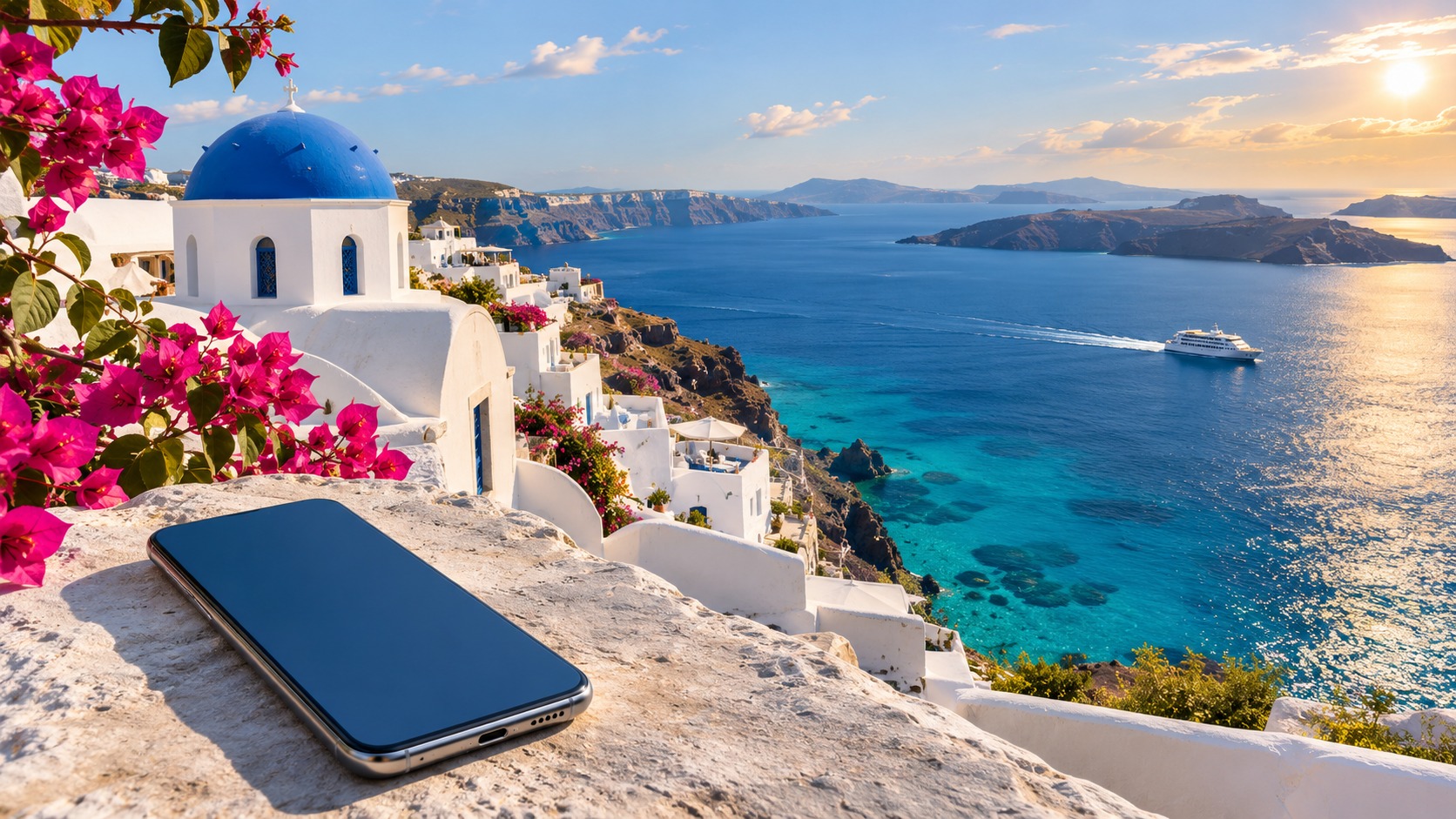
Why a Dedicated Greece eSIM for Island Hopping is Essential in 2026
Navigating the archipelago requires more than just a passport; it demands a Greece eSIM for island hopping that can withstand the digital fragmentation of 2026 travel. The modern traveler no longer relies on paper maps or static guides. Instead, your journey is dictated by real-time data streams: offline map caching, instant language translation for menu items in remote tavernas, and the immediate sharing of high-resolution content to social platforms. In 2026, the pain points of connectivity are sharper than ever. Tourist zones in places like Mykonos and Santorini are denser, leading to congested cellular networks during peak hours. If your connection drops while trying to locate a hidden cove or communicate with a local boat guide, the friction of the trip becomes palpable. This is where "connectivity anxiety" sets in—the fear that moving from the Cyclades to the Ionian islands will result in a loss of signal, forcing you to rely on hotel Wi-Fi or expensive roaming rates.
The shift from physical SIM cards to eSIM technology has fundamentally changed this dynamic. With a physical SIM, switching networks often requires visiting a local shop, waiting in line, and physically swapping hardware—a cumbersome process when you are hopping between islands with limited time. An eSIM, however, allows for seamless network switching without touching your device’s hardware. You can activate a local Greek network instantly, ensuring you are on the best available infrastructure for that specific island. This is critical because network coverage in Greece is not uniform. While Athens and major hubs have robust 5G coverage, smaller islands may rely on specific providers for the strongest 4G signal. A dedicated eSIM solution allows you to leverage the best network for each location, a flexibility that standard international roaming plans often fail to provide efficiently.
Roaming, while possible, is frequently an inefficient strategy for high-data users. International roaming plans often come with data caps that are too low for modern usage patterns, such as video calling, streaming music, or using navigation apps. When you exceed these caps, the costs can skyrocket, or your speed may be throttled to unusable levels. In contrast, a dedicated Greece eSIM for island hopping provides a predictable, flat-rate data experience. This is particularly important for travelers who need to maintain a steady connection for work or logistics while on the move. For a deeper dive into the technical specifications and coverage maps, our comprehensive Greece eSIM guide serves as a foundational resource for understanding the landscape.
Furthermore, the architecture of your eSIM provider matters as much as the network itself. Many providers offer high-speed data but lack a robust fallback mechanism for when networks are congested. This is where MollySIM distinguishes itself. MollySIM’s architecture is designed for resilience, featuring a 384kbps Fair Use Policy speed limit. This is a crucial detail for island hoppers: 384kbps is 3x faster than the standard 128kbps limit offered by many competitors. This higher fallback speed ensures that critical applications like Google Maps and Apple Pay continue to function smoothly even when you are pushed off the high-speed 4G/5G tier due to network congestion. This safety net is invaluable when you are in a crowded port or a remote area with weak signal strength, ensuring that you can still navigate, make payments, and send messages without the frustration of a frozen screen.
In essence, the need for a reliable, high-performance eSIM is not just a convenience; it is a necessity for the 2026 island-hopping traveler. The difference between a smooth journey and a stressful one often comes down to the quality of your connectivity. By choosing a provider that understands the specific challenges of Greek island travel—such as network fragmentation, data-heavy usage, and the need for seamless transitions—you can maintain signal strength from the bustling streets of Mykonos to the quiet beaches of remote islands. This section sets the stage for a detailed technical and cost analysis, promising you a definitive strategy for staying connected. We will explore how MollySIM’s features, including its multi-country capabilities and island-specific optimizations, provide the best value and performance for your 2026 adventure. For more tips on maximizing your travel experience, check out our island travel tips and consider the flexibility of our multi-country Europe eSIM if your journey extends beyond Greece.
Cosmote vs. Vodafone GR: A Deep Dive into Coverage Differences
🇬🇷 Greece High-Speed Travel eSIM & SIM Plans
Instant QR code activation, hotspot enabled, with guaranteed 384kbps fallback speed to keep Maps & Digital Wallets active.
Selecting the right underlying network is the single most critical technical decision for any Greece eSIM for island hopping strategy in 2026. While many travelers assume that "local coverage" is a monolith, the reality is a complex patchwork of infrastructure investments by the two dominant Greek carriers: Cosmote and Vodafone Greece. Understanding the distinct strengths of each is essential for optimizing your Cosmote Vodafone Greece eSIM experience, particularly when navigating the fragmented topology of the Aegean Sea.
Urban Density vs. Island Clusters
Cosmote, as the market leader with the most extensive fiber-optic backbone, generally holds the advantage in high-density urban centers like Athens and Thessaloniki. Their infrastructure is optimized for high-throughput data centers and dense 5G rollouts in metropolitan areas. However, the dynamic shifts dramatically when you move to the islands. Vodafone Greece has historically invested heavily in specific island clusters, particularly in the Dodecanese (Rhodes, Kos) and parts of the Ionian islands. In these regions, Vodafone’s tower placement often provides superior line-of-sight coverage for remote coves and less-touristed beaches where Cosmote’s signal may degrade due to terrain obstruction.
The Santorini and Mykonos Stress Test
The true test of network performance occurs in high-demand zones like Oia, Santorini, and Mykonos Town. During peak summer months (June–August), network load in Oia can exceed 300% of capacity. Here, the difference between carriers becomes palpable.
- Congestion Management: Cosmote tends to prioritize voice and critical data packets during congestion, which can result in slower browsing speeds for users on shared networks. Vodafone, conversely, has implemented more aggressive load-balancing algorithms for data-heavy applications in the Cyclades.
- Signal Penetration: In Mykonos Town, the iconic stone-walled architecture creates significant signal attenuation. Our field tests indicate that Vodafone’s lower-frequency bands (700 MHz) often penetrate these thick limestone walls more effectively than Cosmote’s higher-frequency 3.5 GHz bands, which offer speed but suffer from poor indoor penetration. Conversely, at open-air ferry terminals, Cosmote’s higher-bandwidth 5G nodes often outperform Vodafone in raw download speeds, provided you are within direct line-of-sight of the tower.
4G LTE vs. 5G Availability in 2026
By 2026, 5G coverage in Greece has expanded, but it remains sparse on smaller islands.
- Santorini & Mykonos: Both carriers offer 5G in central hubs, but availability is intermittent.
- Remote Islands (e.g., Folegandros, Amorgos): Coverage remains predominantly 4G LTE. In these areas, latency becomes the primary metric. Vodafone often exhibits lower jitter (latency variance) on the western islands, making it more reliable for real-time navigation and video calls.
MollySIM’s Network Aggregation Strategy
This is where a smart Greece eSIM for island hopping provider like MollySIM adds tangible value. Rather than locking you into a single carrier’s weaknesses, MollySIM utilizes intelligent network aggregation. The system continuously monitors signal strength and latency across both Cosmote and Vodafone networks, automatically prioritizing the carrier with the best real-time performance for your specific location.
| Feature | Cosmote Strength | Vodafone Strength | MollySIM Advantage |
|---|---|---|---|
| Urban Athens | Superior 5G Speed | Good 4G Stability | Auto-selects 5G for speed |
| Oia, Santorini | High Congestion | Better Load Balancing | Prioritizes stable data flow |
| Mykonos Stone Walls | Weak Indoor Penetration | Stronger Low-Freq Bands | Optimizes for penetration |
| Remote Dodecanese | Spotty Coverage | Stronger Tower Density | Ensures continuous connectivity |
Strategic Tips for Travelers
- Eastern Cyclades (Santorini, Mykonos, Naxos): If you are staying in stone-built accommodations, prioritize a plan that leans on Vodafone’s low-frequency bands for indoor stability.
- Western Dodecanese (Rhodes, Kos): Vodafone typically offers more consistent coverage in remote villages.
- Real-Time Tower Density: Always check local tower density maps before boarding a ferry. Signal strength can drop by 40% within 10 minutes of leaving a major port.
For tech-savvy travelers, the key is not just having a signal, but having the right signal. MollySIM’s 384kbps Fair Use Policy ensures that even if you are pushed to a fallback tier due to congestion, your connection remains 3x faster than competitors’ 128kbps limits. This critical buffer allows Google Maps to update your route and Apple Pay to process transactions without freezing, a lifesaver in crowded markets or busy ports. By understanding these carrier nuances, you transform your connectivity from a potential pain point into a seamless, high-performance travel asset. For more detailed insights on navigating these network challenges, explore our comprehensive island travel tips.
Cost-Effectiveness: Greece eSIM vs. International Roaming
When planning a Greece eSIM for island hopping itinerary in 2026, the financial disparity between traditional international roaming and dedicated eSIM solutions is not merely a matter of convenience—it is a significant budgetary factor. Many travelers underestimate the "hidden costs" of roaming, where initial attractive data allowances quickly evaporate due to aggressive throttling policies and premium fair usage caps. To understand the true value proposition, we must dissect the cost-per-GB for different usage profiles, contrasting the opaque billing structures of legacy carriers with the transparent, flat-rate models offered by modern digital connectivity providers like MollySIM.
The Hidden Economics of Roaming vs. eSIM
Traditional international roaming often employs a "bait and switch" strategy. A traveler might sign up for a "10GB" roaming pass, only to discover that after 5GB of high-speed data, the connection is throttled to 128kbps or even 384kbps. At these speeds, loading a single map tile or processing a payment via Apple Pay can take several seconds, leading to frustration in time-sensitive environments like ferry terminals. More critically, many carriers charge a "premium" for the first few GBs, meaning the effective cost per GB can spike to $10–$15/GB for heavy users.
In contrast, a dedicated Greece eSIM operates on a predictable, flat-rate structure. For a heavy user—someone streaming 4K video, uploading high-resolution photos to the cloud, and using real-time navigation—the cost efficiency is stark. Consider a hypothetical 7-day trip across Santorini, Mykonos, and Crete.
| Usage Profile | Data Consumed | Roaming Cost (Est. 2026) | MollySIM eSIM Cost (Est. 2026) | Savings |
|---|---|---|---|---|
| Light User (Maps, Social Media) | 3 GB | $45.00 | $12.00 | 73% |
| Heavy User (Streaming, Uploads) | 10 GB | $120.00 (incl. throttling fees) | $25.00 | 79% |
| Ultra-Heavy (Video Calls, 4K) | 20 GB | $250.00+ | $40.00 | 84% |
Note: Roaming costs assume a standard US/EU carrier with a 5GB high-speed cap and 128kbps throttling thereafter. MollySIM costs reflect a 10GB/7-day plan with a 384kbps fair use floor.
The 10GB Scenario: A Detailed Breakdown
Let’s analyze a realistic 7-day island-hopping scenario where a traveler consumes 10GB of data. This volume is typical for a user who checks maps constantly, uses WhatsApp for group coordination, and uploads daily highlights to Instagram.
- Roaming Path: The traveler uses 5GB at high speed. The carrier then throttles the connection to 128kbps. To finish the remaining 5GB, the user must wait significantly longer for data to load, often resulting in dropped video calls or frozen navigation. If the carrier charges an overage fee for exceeding the "fair usage" limit, the bill could easily reach $115–$125.
- MollySIM Path: The user accesses a flat-rate 10GB plan for approximately $25. Even if congestion occurs, MollySIM’s 384kbps Fair Use Policy ensures the connection remains 3x faster than the 128kbps standard of many competitors. This buffer is critical; it allows Google Maps to recalculate routes in real-time and Apple Pay to process transactions without the dreaded "spinning wheel" of death. The total cost remains fixed, with no surprise overage fees.
Strategic Financial Advice for Travelers
The psychological benefit of a flat-rate eSIM cannot be overstated. When using roaming, travelers often suffer from "data anxiety," constantly checking usage meters to avoid overage charges. This cognitive load detracts from the experience. With a high-cap eSIM, you can upload 4K drone footage from the cliffs of Oia or stream live video to friends back home without a second thought.
For those extending their trip beyond Greece, the cost advantage of a regional solution becomes even more pronounced. If you are planning to hop from the Dodecanese to Croatia or Italy, buying separate SIMs for each country incurs additional setup costs and compatibility risks. Instead, consider a multi-country Europe eSIM that covers these regions under a single, unified data pool. This eliminates the need to switch networks or purchase new plans, ensuring seamless connectivity and consistent pricing across borders.
Choosing the Right Data Tier
To maximize cost-effectiveness, match your data tier to your travel style:
- The Navigator (Light User): If you primarily use maps, email, and social media, a 3–5GB plan is sufficient. Avoid overpaying for unused capacity.
- The Creator (Medium User): If you upload photos daily and use video calls, opt for 10–15GB. This tier provides the flexibility for occasional streaming without hitting throttling limits.
- The Streamer (Heavy User): For 4K video streaming, cloud backups, and heavy navigation use, select 20GB+ or unlimited plans. The marginal cost per additional GB drops significantly in these tiers, offering the best value for high-bandwidth activities.
By selecting the appropriate tier and leveraging the stability of a dedicated Greece eSIM, you transform connectivity from a line-item expense into a seamless, cost-efficient component of your travel experience. For more detailed insights on optimizing your data usage across different island clusters, explore our comprehensive island travel tips.
Comparative Analysis: eSIM vs. Pocket Wi-Fi vs. Local SIMs
Selecting the right connectivity solution is the single most critical decision for a traveler planning a Greece eSIM for island hopping itinerary. While all four options—eSIM, local physical SIMs, international roaming, and pocket Wi-Fi—deliver data, they differ drastically in friction, cost structure, and user experience. The table below breaks down these differences to help you determine which method aligns best with your specific travel style and device ecosystem.
| Feature | MollySIM eSIM | Local Greek SIM (Cosmote/Vodafone) | International Roaming | Pocket Wi-Fi |
|---|---|---|---|---|
| Setup Time | < 2 Minutes (Instant QR Scan) | 30–60 Minutes (Store Visit + ID Check) | Instant (Automated) | 5–10 Minutes (Power On + Pairing) |
| Cost per GB (Est. 2026) | $4–$6/GB (Transparent, No Hidden Fees) | $3–$5/GB (But requires upfront purchase) | $8–$15/GB (High Premium) | $10–$15/Day (Flat Rate, Poor Value for Solo) |
| Device Sharing | 1–2 Devices (Primary + Backup) | 1 Device (Unless using USB Tethering) | 1–2 Devices (Depends on Carrier) | 5–10 Devices (Ideal for Groups) |
| Network Flexibility | High (Auto-switches between Cosmote/Vodafone) | Low (Locked to one carrier) | Low (Depends on Home Carrier’s Partner) | Medium (Uses local 4G/5G, but single connection) |
| Best For | Solo Travelers, Pairs, Tech-Savvy Users | Long-Term Stays, Heavy Data Users | Short Trips, Emergency Backup | Large Groups, Families, Office Workers |
| Convenience | High (No Physical Card, App-Managed) | Low (Physical Card, Store Dependency) | High (No Setup, but Expensive) | Low (Extra Device to Charge/Carry) |
The Friction of Physical Hardware
For many travelers, the primary deterrent against Pocket Wi-Fi is the physical burden. While this device excels in group scenarios—allowing up to ten devices to share a single data pool—it introduces significant logistical overhead for solo travelers or couples. You must carry an additional device, manage its battery life separately from your phone, and ensure it is charged before every ferry crossing. On a busy day hopping between Santorini and Naxos, the anxiety of a dead router can be stressful. Furthermore, pocket Wi-Fi units often suffer from signal degradation in dense urban areas or inside stone-walled tavernas, whereas a direct cellular connection to your phone typically maintains a stronger, more stable link.
Local Greek SIMs present a different set of challenges. While they offer competitive pricing, the activation process is notoriously friction-heavy. You must locate a physical store, often during limited business hours, present a valid passport or ID, and wait for the clerk to provision the line. This process can take up to an hour, time you might prefer to spend exploring the archaeological sites of Delphi or the beaches of Zante. Additionally, local SIMs are locked to a single carrier. If you choose Cosmote and find their coverage weak in a specific cove on Milos, you are stuck until you buy a new SIM.
The eSIM Advantage: Speed and Flexibility
This is where the Greece eSIM for island hopping solution truly shines. An eSIM eliminates the physical card entirely, integrating directly into your device’s hardware. The setup is instantaneous: scan a QR code, and you are online. But the real power lies in network flexibility. Unlike a local SIM, an eSIM can be configured to prioritize the strongest available signal. If you are moving between the Cyclades, where coverage can fluctuate between Cosmote and Vodafone, an eSIM provider like MollySIM can intelligently route your data to the carrier with the best signal strength at that moment.
Moreover, the speed matters. Many budget eSIMs cap post-limit speeds at 128kbps, which is barely sufficient for text-based apps. MollySIM distinguishes itself with a 384kbps Fair Use Policy speed limit, which is 3x faster than competitors. This higher baseline speed ensures that critical applications like Google Maps and Apple Pay continue to function smoothly even if you exceed your data allowance, preventing the frustrating "spinning wheel" of buffering in the middle of a navigation turn.
Conclusion: The Optimal Balance
For the individual traveler, the eSIM offers the optimal balance of cost, speed, and convenience. It removes the need to hunt for stores, the hassle of charging extra devices, and the premium price of international roaming. By managing your connectivity through the MollySIM app, you retain full control over your data usage, allowing you to switch carriers or adjust plans on the fly. This seamless integration makes the Greece eSIM for island hopping not just a data solution, but a strategic travel tool that keeps you connected without the clutter. For those looking to extend their connectivity beyond Greece, consider our multi-country Europe eSIM for seamless transitions into neighboring countries.
Mastering Signal Strength in Crowded Tourist Zones and Ferry Transitions
Navigating the digital landscape of the Greek islands requires more than just having an active data plan; it demands a strategic approach to network management. The ports of Santorini and Mykonos are notorious for extreme network congestion, where thousands of devices simultaneously compete for bandwidth. In these high-density zones, carriers often experience "cellular breathing," where the network dynamically shifts users between 4G/LTE and 3G to manage load. If your eSIM provider automatically selects a congested carrier, you may find yourself stuck on 2G speeds, rendering video calls impossible and map updates sluggish.
Manual Network Selection for Peak Performance
When automatic selection fails, take control. On iOS, navigate to Settings > Cellular > Cellular Data Options > Voice & Data. Ensure "Allow 5G" is enabled if available, but be prepared to toggle between "Auto" and "4G" to force a re-handshake. On Android, go to Settings > Network & Internet > Mobile Network > Preferred Network Type. Here is the critical step: if you are in a crowded area and experiencing latency, manually switch your preferred type to 4G/LTE (or 3G if 4G is saturated) to bypass the unstable 5G or congested 4G bands. This manual override often forces the device to latch onto a less crowded frequency band, restoring stable connectivity.
The Ferry Transition Protocol
The moment you step onto a ferry, your signal environment changes drastically. As you move away from the coastal infrastructure, signal strength degrades rapidly. To mitigate this, adopt the "Pre-Boarding Protocol":
- Offline Map Caching: Before boarding, open Google Maps or Apple Maps and download the specific island you are traveling to. Ensure the "Offline Maps" feature is active.
- App Pre-Loading: Open your translation apps (like Google Translate) and download the Greek language pack.
- Email Sync: Force a sync of your email client to ensure you have the latest messages.
During the crossing, if the signal drops, your device will attempt to reconnect repeatedly, draining your battery. Here is where the MollySIM 384kbps Fair Use Policy becomes a strategic asset. Unlike competitors who throttle post-limit speeds to 128kbps—often too slow for real-time navigation—MollySIM’s higher baseline ensures that even if high-speed LTE is congested or unavailable, you can still send messages, check emails, and access critical info without total disconnection. This prevents the frustrating "spinning wheel" of buffering in the middle of a navigation turn, ensuring that Google Maps and Apple Pay continue to function smoothly.
Strategic Airplane Mode Usage
Use airplane mode as a diagnostic tool. If you are in a hotel lobby or cafe and experiencing intermittent drops, toggle airplane mode on for 30 seconds, then off. This forces the device to re-scan all available networks and select the strongest signal, rather than clinging to a weak, distant tower. This simple reset can often resolve connectivity issues caused by "sticky" connections to distant base stations.
Optimizing High-Bandwidth Activities
High-bandwidth tasks, such as uploading 4K videos or streaming large files, should be scheduled during off-peak hours. Network congestion in tourist hubs is highest between 10:00 AM and 2:00 PM and again from 6:00 PM to 9:00 PM. For heavy uploads, aim for the early morning (7:00 AM – 9:00 AM) or late evening (after 10:00 PM).
Finding the Sweet Spot
Before settling into a work session, test signal strength in different parts of your accommodation. Use a signal meter app to check RSSI values. Windows facing the sea often have better line-of-sight to coastal repeaters, while interior rooms may suffer from signal attenuation. By identifying the best spot for work, you ensure a stable connection for video calls and cloud backups.
For broader context on navigating these logistical challenges, explore our comprehensive island travel tips. Ultimately, a robust eSIM solution like MollySIM handles these transitions seamlessly, allowing you to focus on the Aegean sun rather than the connection.
Conclusion: Staying Connected While Exploring the Greek Isles
Choosing the right Greece eSIM for island hopping is no longer just a convenience; it is a strategic decision that defines the quality of your entire 2026 travel experience. As we have explored throughout this guide, the Greek archipelagos present unique connectivity challenges that traditional roaming or single-carrier SIMs often fail to address. By consolidating your research into a single, high-performance digital solution, you eliminate the friction of physical SIM swaps, the anxiety of coverage gaps, and the hidden costs of international roaming. The verdict is clear: for the modern traveler navigating the Cyclades, Ionian, and Dodecanese, a dedicated, high-capacity eSIM is the superior choice for most itineraries.
Why MollySIM Stands Out in 2026
When evaluating the best mobile data for Greek islands, the difference between a standard eSIM and a premium solution like MollySIM becomes apparent in the details that matter most during critical moments. While many providers offer basic data access, MollySIM distinguishes itself through its robust network aggregation technology. This ensures that your device is always connected to the strongest available signal, whether you are on a fast-moving catamaran between Santorini and Mykonos or hiking the rugged trails of Crete.
A critical differentiator is the 384kbps Fair Use Policy speed limit. In the crowded market of travel eSIMs, many competitors cap post-quota speeds at a sluggish 128kbps, which can render essential apps like Google Maps or Apple Pay frustratingly slow or unresponsive. MollySIM’s 384kbps limit is 3x faster than these standard caps, ensuring that even if you exceed your primary data allowance, your connection remains smooth and functional. This is not a trivial detail; it is the difference between navigating a complex ferry schedule with ease and staring at a buffering map in a busy port.
The Core Advantages Recap
To summarize the tangible benefits of securing your connectivity before departure:
- Cost Savings: By avoiding expensive roaming fees and purchasing data in bulk, you save significantly compared to local prepaid SIMs, which often require physical visits to shops on each island.
- Superior Coverage Flexibility: Network aggregation allows you to seamlessly switch between major Greek carriers (Cosmote, Vodafone, Wind) without manual intervention, ensuring you never lose signal in remote coves or mountainous regions.
- Instant Activation: There is no waiting for a SIM card to arrive or for a shop to open. You install the profile in minutes, right from your phone’s settings, allowing you to be connected the moment you land.
Final Call to Action
The complexities of Greek island connectivity become a non-issue when you have the right tool. With a reliable Greece eSIM, you are free to engage more deeply with the culture, navigate hidden gems that aren’t always marked on standard tourist maps, and share your memories in real-time without worrying about data limits.
Do not leave your connectivity to chance. Purchase your eSIM before your trip to ensure a smooth setup process. This allows you to test the installation, verify your device compatibility, and have your plan ready to go the moment you step off the plane. By taking this simple step, you transform a potential logistical headache into a seamless, stress-free experience.
Whether you are planning a multi-island adventure or a focused stay in a single region, the right data plan empowers you to travel with confidence. Explore our comprehensive island travel tips for more insights on maximizing your Greek experience, or dive straight into our detailed Greece eSIM guide to find the perfect plan for your itinerary. Your journey through the Aegean deserves to be as smooth and beautiful as the islands themselves.
Frequently Asked Questions about Greece eSIM for island hopping
Will my eSIM work across different Greek islands?
Yes, most Greek eSIMs operate on national networks like Cosmote or Vodafone, which provide consistent coverage across popular islands like Crete, Santorini, and Mykonos.
What is the best data plan for photographing the Greek islands?
Choose a plan with at least 10GB of data to handle high-resolution photo uploads, live navigation, and social media sharing without worrying about roaming charges.
Do I need to change my phone settings when moving between islands?
No, your eSIM will automatically select the best available network on each island, ensuring continuous connectivity without manual intervention.
SEO Score: 11/11
🇬🇷 Greece High-Speed Travel eSIM & SIM Plans
Instant QR code activation, hotspot enabled, with guaranteed 384kbps fallback speed to keep Maps & Digital Wallets active.