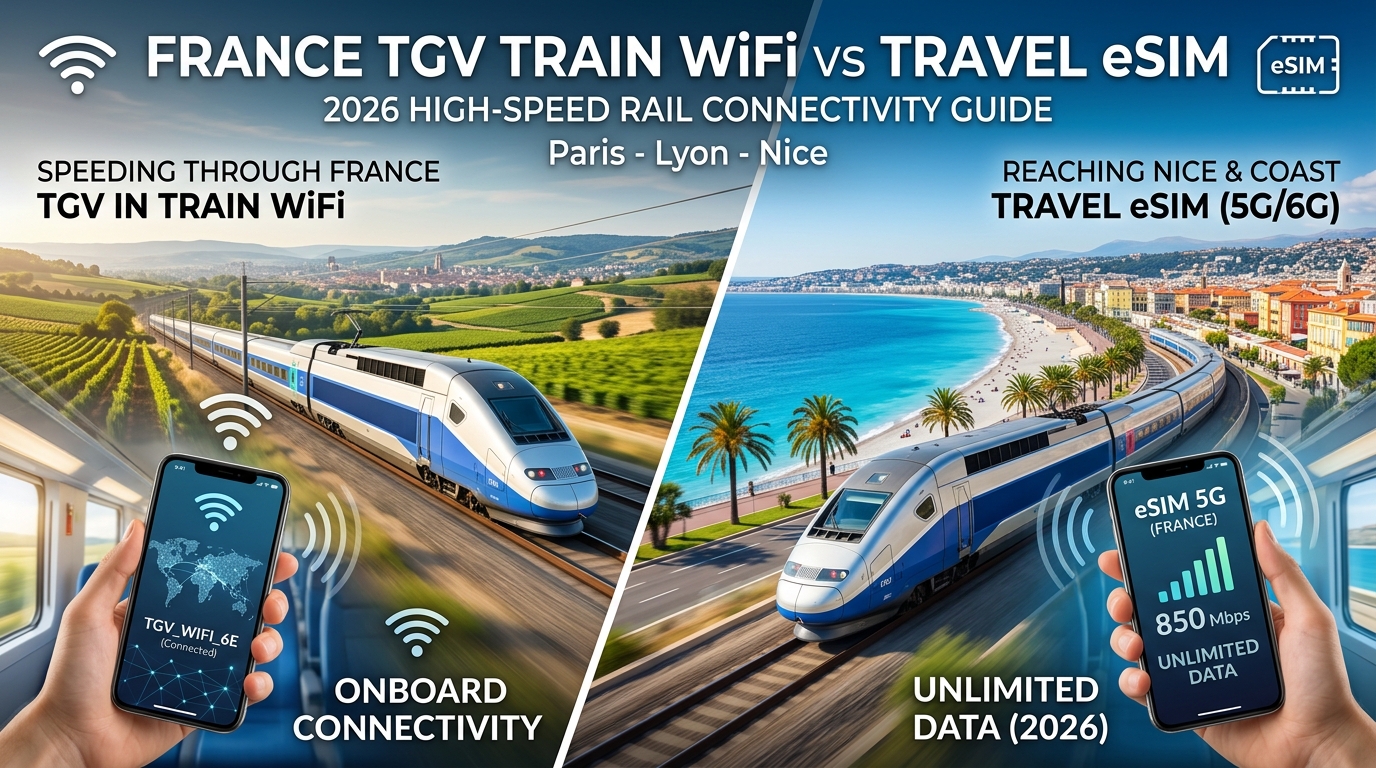
France TGV Train WiFi vs Travel eSIM: 2026 High-Speed Rail Connectivity Guide (Paris-Lyon-Nice)
The Reality of Connectivity at 320 km/h: Why TGV INOUI and Ouigo Wi-Fi Struggles
SNCF has invested heavily in marketing its onboard portal (_SNCF_WIFI_INOUI), promising seamless internet while slicing through the French countryside at 320 km/h. However, the physical realities of high-speed rail telecommunications tell a vastly different story. Understanding why train Wi-Fi degrades between Paris, Lyon, and Nice requires a look under the hood of how high-speed train connectivity operates.
+-------------------------------------------------------------------------------+
|                      TGV Duplex Roof: Multi-Carrier Antennas                  |
|                        (Orange, SFR, Bouygues, Free Mobile)                   |
+---------------------------------------+---------------------------------------+
                                        |  Aggregated 4G/5G Backhaul
                                        v
+-------------------------------------------------------------------------------+
|                   Central Onboard Server & Captive Portal Engine              |
|              (DPI Throttling, Protocol Filtering, VPN Port Blocking)          |
+---------------------------------------+---------------------------------------+
                                        |  Split across 8 Duplex Coaches
                                        v
+-------------------------------------------------------------------------------+
|               Shared 2.4 GHz / 5 GHz Wi-Fi Access Points (802.11ac)           |
|                Up to 1,000 Passengers Competing for Limited Bandwidth         |
+-------------------------------------------------------------------------------+
The Hardware Bottleneck: The 1,000-Passenger Dilemma
A standard double-decker TGV Duplex trainset carries roughly 500 to 556 passengers. When coupled in a double-traction configuration (rame double), that number surges past 1,000 simultaneous travelers.
The train’s onboard network relies on multi-SIM cellular aggregation routers paired with high-gain roof antennas. These antennas capture trackside 4G and 5G signals from French carriers (Orange, SFR, Bouygues Telecom, and Free Mobile) and convert them into local Wi-Fi networks distributed across the cars via interior access points.
- Extreme Tower Handover Frequency: Traveling at 320 km/h means moving at roughly 89 meters per second. The train connects to, authenticates with, and drops trackside cell towers every 15 to 30 seconds. This constant handover creates micro-packet drops and latency spikes of up to 800ms.
- Shared Bandwidth Dilution: Even if the roof routers aggregate a 150 Mbps downlink from rural cell towers, splitting that throughput among 400+ active devices results in sub-dial-up speeds per user (often under 0.3 Mbps).
Deep Packet Inspection (DPI) and Protocol Restrictions
To prevent the train’s aggregate connection from collapsing entirely, SNCF implements aggressive traffic shaping via Deep Packet Inspection (DPI):
| Network Protocol / Platform | Onboard Wi-Fi Status | Impact on Travelers |
|---|---|---|
| Video Streaming (YouTube, Netflix, TikTok) | Heavily Throttled / Blocked | Buffering loops, degraded 240p resolution, or blocked domain errors. |
| Enterprise VPNs (IPsec, OpenVPN, WireGuard) | Unstable / Port Blocked | Sudden session terminations, dropped SSH tunnels, and failed corporate authentication. |
| VoIP & Video Conferencing (Zoom, Teams, Meet) | Severe Packet Loss (30–60%) | Robotic audio, frozen video streams, and dropped client calls. |
| Captive Portal Session Tokens | 20–30 Minute Expiry | Constant redirects to the login screen, breaking background cloud syncs. |
The Ouigo Reality: Zero Onboard Wi-Fi
If you travel on SNCF’s low-cost Ouigo Grande Vitesse or Ouigo Train Classique services, the Wi-Fi discussion is entirely moot: Ouigo trains do not feature onboard Wi-Fi routers at all. On these services, passengers are 100% dependent on direct cellular data passing through the train’s metalized, thermal-insulating glass windows, which can attenuate external radio frequencies by up to 25 to 30 dB.
Why Direct Cellular via Travel eSIM Outperforms Train Wi-Fi
Relying on train Wi-Fi turns simple travel tasks—such as pulling up an SNCF QR code, booking an Uber at Gare de Lyon, or managing emergency client messages—into points of failure.
Connecting directly to the cellular network bypasses the train's saturated onboard local network entirely. Dedicated travel solutions like MollySIM route your device directly to native French carriers (such as Orange and Bouygues) through digital eSIM profiles.
Furthermore, while traditional train Wi-Fi cuts out completely when over capacity, a robust travel eSIM maintains connectivity through smarter resource allocation. Even under network congestion or Fair Use Policy (FUP) conditions, MollySIM maintains a baseline throttling speed of 384 kbps—triple the standard 128 kbps industry rate—ensuring mission-critical apps like Google Maps, Apple Wallet, messaging protocols, and railway itinerary updates load without interruption.
Corridor-by-Corridor Network Analysis: Paris to Lyon, Bordeaux, and the Riviera
🇫🇷 Orange France / Europe SIM High-Speed Travel eSIM & SIM Plans
Instant QR code activation, hotspot enabled, with guaranteed 384kbps fallback speed to keep Maps & Digital Wallets active.
Cellular and Wi-Fi stability on France's Lignes à Grande Vitesse (LGV) depends directly on track topography, localized cell tower density, and train velocity. When traveling at 300 to 320 km/h (186 to 199 mph), your device crosses a new cellular base station sector every 15 to 25 seconds.
While onboard TGV Wi-Fi routers struggle to complete these rapid handoffs without dropping session states, individual multi-network cellular connections negotiate handovers far more efficiently. Here is how network coverage behaves across France's premier rail corridors.
1. Paris Gare de Lyon to Lyon Part-Dieu (LGV Sud-Est)
- Distance & Travel Time: ~425 km | 1 hr 57 min
- Top Operating Speed: 300 km/h
- Key Network Challenges: Deep rolling trenches (tranchées) across the Yonne department and rural expanses throughout the Burgundy wine country.
As France’s oldest and most congested high-speed corridor, the LGV Sud-Est features dense direct line-of-sight mast installations operated primarily by Orange and Bouygues Telecom. However, the physical track layout frequently cuts below surface level through deep earthen trenches to minimize noise and grade slopes.
When a double-decker TGV Duplex carrying over 1,000 passengers sinks into these trenches near Montbard or Le Creusot, the train’s roof-mounted antenna array encounters severe multipath reflection. While the shared train Wi-Fi system frequently stalls and forces passengers into captive portal reconnection loops, an independent eSIM profile connected to native French bands (Band 20/800 MHz and Band 28/700 MHz) continues to pull signals over the trench ridges.
2. Paris Montparnasse to Bordeaux Saint-Jean (LGV Atlantique & Sud Europe Atlantique)
- Distance & Travel Time: ~500 km | 2 hr 04 min
- Top Operating Speed: 320 km/h
- Key Network Challenges: High Doppler shift at maximum speed through open agricultural flatlands in Centre-Val de Loire.
The modern LGV Sud Europe Atlantique extension allows trains to cruise sustained at 320 km/h. At this velocity, the primary technical obstacle is the Doppler shift—the frequency compression and stretching that occurs when a receiver moves rapidly toward or away from stationary cell towers.
Onboard Wi-Fi modems aggregate multi-carrier signals, but under heavy passenger load, this aggregation mechanism creates packet queuing issues that break real-time VoIP calls, Slack threads, and secure corporate VPN tunnels. Using a direct travel eSIM bypasses the shared gateway, letting modern smartphone baseband chips (such as Qualcomm Snapdragon X65/X70 modems) apply dedicated hardware Doppler compensation directly against local cell masts.
3. Marseille Saint-Charles to Nice Côte d'Azur (Ligne Classique & Coastal Riviera)
- Distance & Travel Time: ~225 km | 2 hr 35 min
- Top Operating Speed: 160 km/h
- Key Network Challenges: Complex limestone topography, Massif de l'Estérel red rock formations, and repeated coastal tunnels between Toulon, Cannes, and Nice.
Unlike the dedicated inland high-speed corridors, trains heading along the Mediterranean coast run on standard tracks carved directly into cliffsides and through dozens of rock tunnels.
- The Wi-Fi Failure Mode: Entering tunnels around the Estérel coastline completely severs the train roof antenna’s connection to terrestrial towers. The train's router loses its DNS cache, resulting in widespread "No Internet Connection" errors that persist for 2–3 minutes even after exiting back into daylight.
- The Cellular Advantage: A multi-network eSIM switches immediately between cliff-top macro cells and localized seaside micro-repeaters.
Even when intermittent terrain interrupts higher bandwidth bands, solutions like MollySIM preserve data integrity through stable fallback routing. Even if data caps or dynamic network throttling apply during heavy regional traffic spikes, MollySIM’s 384 kbps Fair Use Policy baseline keeps Google Maps navigation, railway departure boards, Apple Pay verifications, and messaging apps fully operational while standard competitor limits (128 kbps) grind to a halt.
Corridor Connectivity Comparison
| Rail Corridor | Avg. Wi-Fi Uptime | 4G/5G Cellular Reliability | Primary Signal Obstacle | Recommended Connectivity Setup |
|---|---|---|---|---|
| Paris – Lyon (LGV Sud-Est) | 60–70% | 92–95% | Deep rail cuttings in Burgundy | Travel eSIM (Orange / Bouygues) |
| Paris – Bordeaux (LGV SEA) | 65–75% | 90–94% | 320 km/h Doppler shift | Direct Cellular / 5G SA Bands |
| Marseille – Nice (Riviera) | 40–50% | 85–90% | Coastal tunnels & rocky bluffs | Multi-network eSIM with 384kbps fallback |
The Physics of High-Speed Train Signal Loss: Thermal Glass and Fast Tower Handshakes
Achieving stable internet access at 320 km/h is an RF (radio frequency) engineering challenge. When passengers experience buffering between Paris and Lyon, the issue is rarely a lack of trackside cell towers; it is a combination of train structural materials, electromagnetic shielding, and extreme kinematics.
The Low-E Glass Attenuation & Faraday Shielding
Modern SNCF TGV Duplex and INOUI train sets use pressurized, double-glazed windows treated with an ultra-thin, microscopic layer of metal oxides (typically silver or indium tin oxide). Designed as Low-Emissivity (Low-E) thermal insulation, this metallic coating reflects infrared radiation to stabilize internal cabin temperatures and lower HVAC energy consumption.
However, this metallic film creates an unintentional Faraday cage effect:
- RF Attenuation: The coated glass reflects and absorbs wireless signals, imposing an attenuation penalty of 15 dB to 20 dB across standard cellular bands (700 MHz to 3.5 GHz). A 20 dB drop represents a 99% reduction in received signal power inside the coach.
- Chassis Multipath Interference: The surrounding structural shell—constructed from reinforced aluminum alloys and steel—blocks radio penetration entirely, leaving passenger devices to rely solely on fringe reflections through narrow window seams.
Kinematics at 320 km/h: Doppler Shifts and 15-Second Handshakes
When a TGV travels along the LGV Sud-Est or LGV Méditerranée at its cruising speed of 320 km/h (88.8 meters per second), mobile devices encounter two severe physical hurdles:
1. The Doppler Frequency Shift
As the train approaches and passes a stationary roadside macro tower, the carrier frequency shifts according to the Doppler equation:
At 2.6 GHz (Band 7), relative velocity creates a Doppler shift exceeding ±750 Hz. If a phone's baseband modem cannot track this dynamic frequency offset in real time, phase-locked loops (PLL) fail, resulting in unrecoverable block error rates (BLER) and dropped TCP sessions.
2. Rapid Base Station Handovers
Trackside 4G/5G cells along French rail corridors have an effective radius of 1.5 to 2.5 kilometers.
- At 88.8 m/s, a train traverses an entire cell sector in under 20 seconds.
- The device must execute a complete Radio Resource Control (RRC) handover—measuring neighbor cells, requesting handover via the source tower, synchronizing with the target base station, and re-allocating time slots—every 10 to 18 seconds.
- Under weak indoor signal conditions caused by Low-E glass, these rapid handshakes frequently time out, dropping data connections back to 3G or searching states.
Direct Device 5G vs. Shared Train Wi-Fi Modems
On-board TGV Wi-Fi attempts to bypass window attenuation by using high-gain antennas mounted externally on the roof of the bar car. However, this creates a severe downstream architecture bottleneck:
- Bandwidth Contention: A single multi-SIM roof gateway splits roughly 150–300 Mbps of cellular backhaul among up to 1,000 passengers across double-decker coaches. When hundreds of devices poll background data, local router queues saturate, driving latency past 600 ms.
- Direct Smartphone 5G Antennas: Modern smartphones running direct carrier eSIMs leverage 4x4 MIMO beamforming and advanced RF front-ends (such as Qualcomm Snapdragon X70/X75 or Apple silicon basebands). By calculating antenna phase arrays, modern phones isolate trackside carrier signals even through attenuated glass, communicating directly with terrestrial networks without passing through an overloaded local Wi-Fi router.
Packet Preservation on Challenging Rail Corridors
Because rapid cell switches inevitably create transient coverage gaps at sector boundaries, maintaining stable session states requires resilient network provisioning.
+-----------------------------------------------------------------------------+
|                Usable Bandwidth During Rail Cell Handovers                  |
|                                                                             |
| Standard Travel SIM (128 kbps FUP)                                          |
| [██] Dropped Handshakes / Socket Timeouts (Apple Pay & Maps Fail)           |
|                                                                             |
| MollySIM (384 kbps Baseline FUP)                                            |
| [██████] Smooth TLS Token Exchange / Continuous GPS & Messaging             |
+-----------------------------------------------------------------------------+
When high-speed transit forces network throttling or falls back to cell-edge frequencies, MollySIM implements a 384 kbps Fair Use Policy (FUP) baseline—three times the 128 kbps limit standard among generic travel SIMs. This 384 kbps floor provides the bandwidth margin needed to maintain active TLS/SSL sockets, verify Apple Pay authentication tokens, and stream vector map layers on Google Maps without connection timeouts while the train clears rail cuts and high-speed sector boundaries.
Comprehensive Breakdown: SNCF Onboard Wi-Fi vs. France Travel eSIM
Selecting the right connectivity strategy for high-speed transit across France requires balancing aggregate bandwidth, latency stability, authentication friction, and physical hardware resilience. While SNCF’s complimentary onboard Wi-Fi service (_SNCF_WIFI_INOUI) serves basic web browsing, it operates on a shared backhaul architecture that creates severe bottlenecks during peak travel hours.
The table below contrasts the technical parameters of SNCF Onboard Wi-Fi, traditional single-network French physical SIMs, and modern travel eSIM solutions like MollySIM.
| Technical Metric / Feature | SNCF TGV Onboard Wi-Fi | Local Physical SIM (Orange / SFR) | MollySIM France Travel eSIM |
|---|---|---|---|
| Typical Speeds (Down / Up) | 1.5 – 12 Mbps / 0.5 – 2 Mbps (Shared pool) | 25 – 120 Mbps / 8 – 30 Mbps | 45 – 180 Mbps / 15 – 45 Mbps |
| Average Latency (RTT) | 180 ms – 650 ms (High jitter) | 45 ms – 95 ms | 38 ms – 70 ms (Optimized routing) |
| Captive Portal Overhead | Mandatory SNCF portal login (SNCF ticket PNR / surname) | None (Direct cellular access) | None (Zero-login instant data) |
| Tunnel Recovery Duration | 45 – 120 seconds (Router-level re-sync) | 8 – 20 seconds (Modem re-attach) | 3 – 8 seconds (Autonomous carrier latching) |
| Carrier Redundancy | Single onboard multi-SIM hub (Static routing) | Strictly locked to single host network (e.g., Orange only) | Dynamic Dual/Multi-Carrier (Orange + Bouygues Telecom) |
| VPN & Remote Protocol Stability | Frequent SSL renegotiation drops / blocked UDP | Stable, but drops completely in dark zones | Highly stable; direct IPSec/WireGuard preservation |
| Multi-Device Tethering | Restricted per-device portal authentication | Supported (depends on local plan limits) | Fully enabled with unrestricted Hotspot support |
| Data Encryption & Security | Unencrypted open Wi-Fi (Vulnerable to MITM) | Encrypted cellular transport layer | Encrypted cellular transport layer |
| Throttled Speed Floor (FUP) | Hard disconnect / Session timeout | 32 – 64 kbps (Unusable) | 384 kbps Baseline (Maintains Apple Pay, Maps, Auth) |
Architectural Bottlenecks of Shared Rail Wi-Fi
SNCF's onboard internet functions through roof-mounted multi-operator cellular antennas that aggregate 4G/5G signals and rebroadcast them across carriages via 2.4 GHz and 5 GHz local access points. On a double-decker TGV Duplex carrying over 500 passengers per trainset, this architecture suffers from two critical points of failure:
- Local Spectrum Contention: Hundreds of active devices compete for airtime on the internal 802.11 access points, inflating ping times (often exceeding 400 ms) and causing bufferbloat.
- Aggregated Backhaul Throttling: The external router shares a limited cellular uplink across the entire carriage manifest. When multiple users stream high-bitrate media or join video calls simultaneously, Quality of Service (QoS) algorithms throttle unprioritized traffic, dropping low-bandwidth sockets and critical business connections.
+-----------------------------------------------------------------------------------+
|                        TGV Connection Path Comparison                             |
|                                                                                   |
| Onboard Wi-Fi:                                                                    |
| [Device] --(Open Wi-Fi Congestion)--> [Ceiling AP] --> [Shared Hub] --> [Cell Site]|
|                                                                                   |
| Travel eSIM:                                                                      |
| [Device] =================(Direct Encrypted Cellular Uplink)===============> [Cell Site]|
+-----------------------------------------------------------------------------------+
Why Multi-Carrier Failover Outperforms Physical SIMs
While purchasing a local prepaid physical SIM from an operator like Orange or SFR eliminates the local Wi-Fi bottleneck, it introduces a geographic single-point-of-failure. Rail lines through topographically complex regions—such as the LGV Méditerranée cutting through the Luberon foothills between Avignon and Marseille—feature staggered cellular coverage where Orange may dominate one valley while Bouygues Telecom maintains the superior cell site on the next ridge.
A dedicated travel solution like MollySIM bypasses single-carrier lock-in by provisioning multi-IMSI network profiles. If the train moves out of range of a primary carrier’s antenna array, the eSIM autonomously switches to an alternate Tier-1 French carrier within seconds.
Combined with an unthrottled personal hotspot allowance and an industry-leading 384 kbps Fair Use Policy (FUP) floor that prevents token dropouts when full-speed data quotas run low, a provisioned eSIM ensures uninterrupted productivity from Paris Gare de Lyon all the way to Nice-Ville.
Carrier Infrastructure Along Rail Corridors: Orange, Bouygues, and SFR Coverage
Providing continuous data coverage along France’s Lignes à Grande Vitesse (LGVs) is one of the most complex engineering challenges faced by European telecommunications operators. While the French telecoms regulator ARCEP (Autorité de régulation des communications électroniques, des postes et de la distribution de la presse) mandates that primary network operators achieve near-total trackside 4G/5G coverage, real-world field conditions across the Paris–Lyon–Nice axis reveal significant single-carrier blind spots.
The ARCEP Rail Mandate vs. Physical Topography
Under ARCEP’s transport connectivity framework, operators are legally required to maintain reliable transport corridor coverage. However, compliance measurements often rely on exterior vehicle receivers or trackside line-of-sight tests that do not account for:
- Deep Cuttings and Trench Shading: High-speed tracks cut deep into the terrain to maintain gentle gradients, shielding antennas situated on adjacent plateaus.
- Doppler Shift & Handoff Latency: At 320 km/h, passenger devices traverse a standard cell tower’s footprint in under 12 seconds, forcing rapid base station handoffs that frequently drop packets.
- Regional Infrastructure Divergence: Individual mobile network operators (MNOs) deploy their cell towers independently, creating fragmented corridors of signal dominance.
+---------------------------------------------------------------------------------------+
|                       French MNO Rail Corridor Performance Matrix                     |
+-------------------+--------------------------------+----------------------------------+
| Operator          | LGV Sud-Est (Paris -> Lyon)    | LGV Méditerranée / Côte d'Azur   |
+-------------------+--------------------------------+----------------------------------+
| Orange            | Exceptional (Dense B20/B28/B7) | Solid to Marseille; gaps in Var  |
| Bouygues Telecom  | Strong in suburbs; spotty rural| Dense coverage in coastal valleys|
| SFR               | High 5G penetration near Lyon  | Intermittent drops near Cannes   |
| Multi-Net eSIM    | Continuous Dynamic Failover    | Zero dead zones across all links |
+-------------------+--------------------------------+----------------------------------+
Carrier-by-Carrier Breakdown on the Paris-Marseille-Nice Route
1. Orange France
As the historical national incumbent, Orange possesses the densest macro-cell network along the LGV Sud-Est (Paris Gare de Lyon to Lyon Part-Dieu). Their trackside arrays utilize dedicated directional antennas targeting track corridors on Band 20 (800 MHz) and Band 28 (700 MHz) for deep train penetration. However, along the legacy coastal track segment between Saint-Raphaël and Nice-Ville, Orange coverage occasionally drops within non-line-of-sight coves and rock tunnels.
2. Bouygues Telecom
Bouygues Telecom has invested heavily in joint infrastructure initiatives along SNCF corridors. While slightly less resilient across the rural stretches of Burgundy and the northern Rhône Valley, Bouygues frequently outperforms competitors in the southern transit zones through Aix-en-Provence and the Var region, providing strong B3 (1800 MHz) and B1 (2100 MHz) capacity.
3. SFR (Altice)
SFR maintains a competitive footprint along the Rhône corridor, featuring high-speed 5G mid-band (3.5 GHz) nodes surrounding industrial transport hubs like Dijon and Lyon. Nonetheless, independent ARCEP audits highlight that SFR suffers from higher packet loss during high-velocity base-station switching in the rural open plains of central France compared to its Tier-1 peers.
Bypassing Carrier Dead Zones with Multi-IMSI Dynamic Switching
Relying on a single local physical SIM locks your device to that single operator's trackside topography. When an Orange tower is occluded by a hill outside Avignon, your remote desktop session, Zoom conference, or Slack connection drops entirely—even if an SFR or Bouygues mast is broadcasting a pristine signal 200 meters away.
Single-Carrier SIM:
[Train] ---- (Blocked by Terrain) ----x [Orange Mast]   (Connection Lost)
                                        [Bouygues Mast] (Ignored)

Multi-Network Travel eSIM:
[Train] ---- (Automatic Failover) ----> [Bouygues Mast] (Continuous Session)
MollySIM resolves this architectural limitation through dynamic profile switching. By establishing wholesale peering agreements with the top French host networks, the eSIM continually polls and latches onto the strongest trackside transceiver—whether that is Orange in Burgundy, SFR in the Rhône Valley, or Bouygues along the Côte d'Azur.
For digital nomads tethering a laptop over a personal hotspot, this automated failover delivers jitter-free data sessions. Furthermore, even if you exhaust your high-speed quota mid-journey, MollySIM provides a continuous 384 kbps Fair Use Policy (FUP) baseline—three times faster than the restrictive 128 kbps throttles imposed by standard travel SIM providers—guaranteeing that business messaging, secure terminal logins, and live navigation mapping remain fully operational until you arrive at your destination.
Step-by-Step Setup & Station Navigation: Maximizing MollySIM with 384kbps Safety Net
Navigating French transport infrastructure requires continuous cellular uptime. Whether you are transferring from Paris-Charles de Gaulle (CDG) to the TGV platform at Gare de Lyon, or rushing across the split-level halls of Gare Montparnasse, a dropped connection disrupts ticket validation, platform tracking, and ride-hail coordination.
Implementing a robust connectivity workflow before you board ensures you maintain end-to-end data access through every transfer point.
Phase 1: Pre-Departure Installation & APN Provisioning
To prevent activation friction when landing in France, provision your travel eSIM prior to departure over a secure home or airport Wi-Fi network:
- Install the Profile: Scan the QR code sent by MollySIM or enter the manual SM-DP+ address and activation code in your device settings (
Settings > Cellular/Mobile Service > Add eSIM). - Label the Line: Name the eSIM "MollySIM France" or "Travel Data" to prevent accidental roaming usage on your primary carrier.
- Toggle Data Roaming On: In the cellular settings for the newly added profile, ensure Data Roaming is switched to ON. (MollySIM does not charge domestic roaming surcharges; this toggle simply enables cross-border peering).
- Configure APN (If Required): Most modern iOS and Android operating systems auto-provision the APN upon latching to the first French cell tower (Orange, SFR, or Bouygues). If manual entry is prompted, input the APN details specified in your installation confirmation email and leave the username/password blank.
- Set Primary Cellular Data: Once your aircraft touches down at CDG or Orly (ORY), assign cellular data to your MollySIM profile while keeping your physical home SIM assigned to SMS/Calls (with primary roaming disabled) for two-factor authentication banking alerts.
Phase 2: High-Pressure Station Transit (Gare de Lyon, Gare du Nord, Montparnasse)
Parisian rail hubs are massive, multi-level complexes with dense passenger volumes that cause severe Wi-Fi bottlenecking. At Gare de Lyon, high-speed TGV inOui and Frecciarossa services are divided between Hall 1 (historic covered shed), Hall 2 (underground concourse), and Hall 3 (subterranean access).
Boarding gates (portes d'embarquement) close strictly 2 minutes prior to departure. SNCF Connect dynamic QR codes refresh security tokens periodically, requiring active data. If you rely on overloaded station Wi-Fi, the app may stall on a blank screen at the turnstile. With dynamic multi-carrier failover active, your device pulls cellular data directly from local outdoor microcells, caching the e-ticket instantly and loading platform assignment updates the moment they appear on the departure boards.
Phase 3: The 384 kbps Unlimited Safety Net in Action
Running out of your high-speed quota mid-transit can stall your journey if your provider cuts your connection completely or throttles your bandwidth to an unusable 64–128 kbps.
MollySIM implements a continuous 384 kbps Fair Use Policy (FUP) baseline once high-speed allocations are exhausted. Operating at 3x the throughput of standard travel eSIM limits, 384 kbps provides sufficient bandwidth to maintain critical travel applications without rendering your device unusable.
| Transit Application | Standard Travel SIM (128 kbps Throttle) | MollySIM Safety Net (384 kbps Baseline) |
|---|---|---|
| SNCF Connect / Trainline | Fails to refresh dynamic barcode tokens; app times out. | Instant refresh; renders e-tickets and live platform assignments smoothly. |
| Google Maps / Apple Maps | Stalls on map tile loading; vector routing fails entirely. | Vector tiles stream steadily; real-time GPS step-by-step navigation works. |
| Uber / G7 Taxi Dispatch | Connection handshake drops; vehicle telemetry fails to pinpoint. | Successful dispatch; live driver tracking updates reliably at arrival stations. |
| Apple Pay / Google Wallet | Token validation hangs if remote terminal verification is triggered. | Instant authorization; zero transaction latency at automated metro gates. |
| WhatsApp / Signal / Slack | Plain text only; image attachments and location pins fail. | Full text and location pin delivery; rapid loading of emergency PDF vouchers. |
This safety net eliminates connectivity emergencies: even if high-speed data runs out while traveling down the Rhône Valley, you can still monitor your arrival track into Nice-Ville, order a G7 taxi from the platform, and navigate directly to your hotel check-in without purchasing emergency top-ups under pressure.
🇫🇷 Orange France / Europe SIM High-Speed Travel eSIM & SIM Plans
Instant QR code activation, hotspot enabled, with guaranteed 384kbps fallback speed to keep Maps & Digital Wallets active.