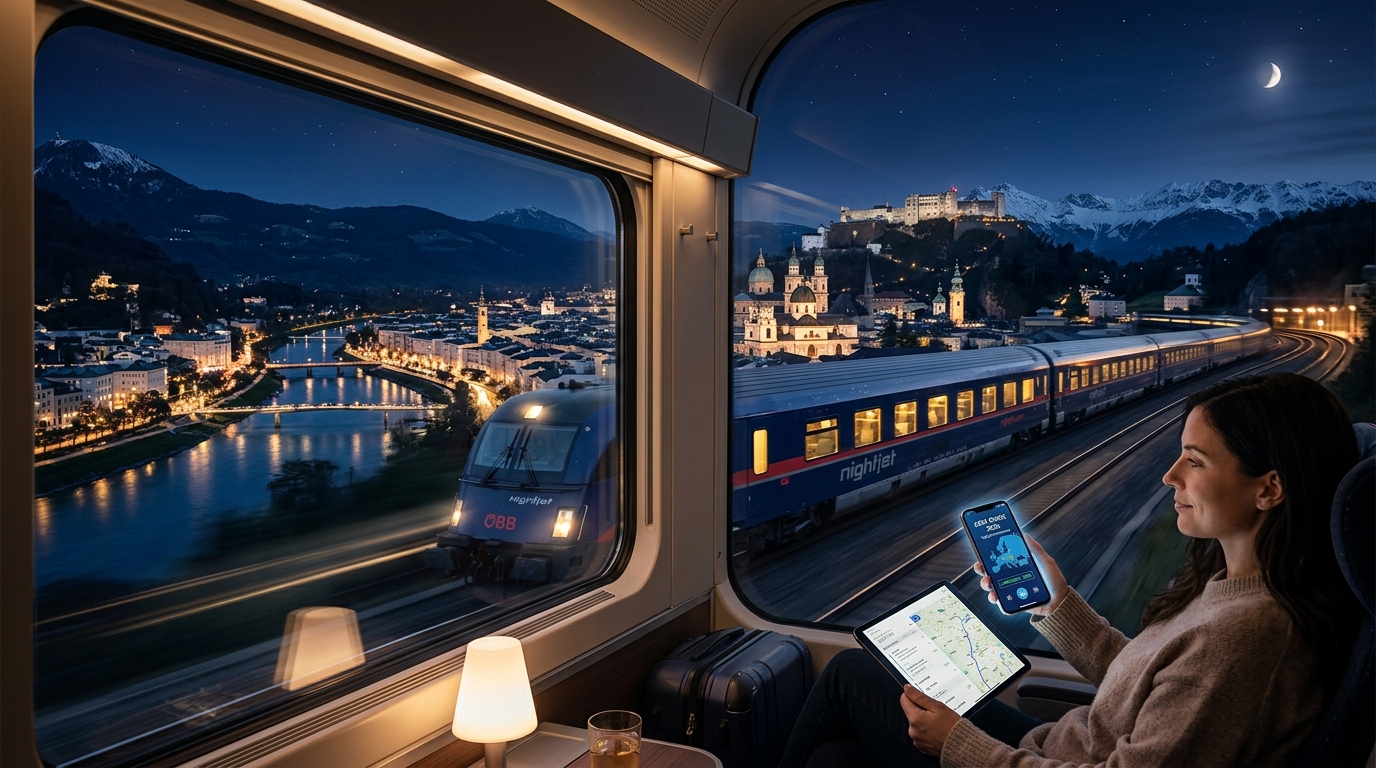
Riding the Nightjet Across Europe: The 2026 Cross-Border Sleeper Train eSIM Guide
The Renaissance of European Sleeper Trains: Nightjet Routes and Connectivity Challenges in 2026
Europe’s nocturnal rail grid has evolved from a nostalgic relic of 20th-century transport into the premier alternative to short-haul aviation. Spearheaded by the Austrian Federal Railways (ÖBB) and its expanding network of next-generation Nightjet and partner EuroNight services, travelers can now fall asleep in one cultural capital and wake up refreshed in another.
By 2026, the newly expanded Nightjet fleet—featuring private single-berth Mini Cabins, modern en-suite sleeper compartments, and ultra-quiet rolling stock—routinely traverses high-demand arteries connecting Vienna, Munich, Zurich, Rome, Paris, Amsterdam, Berlin, and Venice.
  [ Paris / Amsterdam ]
            \
             \
  [ Zurich / Munich ] <====== Alpine Corridors ======> [ Vienna ]
             /                                             \
            /                                               \
    [ Rome / Venice ]                                  [ Budapest ]
This modal shift has fostered a new demographic of sleeper train passengers: the hybrid traveler. Business professionals, remote workers, and leisure tourists embrace sleeper rail not just to eliminate hotel bills and airport security lines, but to maintain productivity on the move. However, blending romantic slow travel with real-time digital demands introduces a severe, recurring friction point: the nocturnal cross-border connectivity drop.
The Infrastructure Reality: High Speeds, Mountain Passes, and Border Gaps
Modern sleeper journeys cut through some of Europe’s most topographically challenging terrain during the dead of night. As you sleep, your train negotiates deep Alpine tunnels, high-altitude passes like the Brenner or Tauern corridors, and heavily forested borderlands between France, Germany, Switzerland, and Italy.
Maintaining a reliable data connection under these conditions is notoriously difficult for several structural reasons:
- Faraday Cage Rolling Stock: Modern passenger carriages are heavily insulated with energy-efficient metallic coatings and reinforced shells that significantly attenuate external cellular radio frequencies (often reducing signal strength by 15–30 dB).
- Remote Cell Tower Density: Trackside mobile infrastructure through rural river valleys (such as the Rhine or Danube) and mountain corridors is sparse compared to urban centers.
- Complex Multi-Operator Handovers: Crossing from Germany into Austria or Switzerland at 3:00 AM requires your device to disengage from its home network and negotiate authentication with a foreign roaming partner.
+---------------------------+-----------------------------------+-----------------------------------+
| Route Segment             | Physical / Network Bottleneck     | Typical Roaming Impact            |
+---------------------------+-----------------------------------+-----------------------------------+
| Munich -> Rome (Brenner)  | Alpine passes, deep rock cuts     | Frequent "No Service", high ping  |
| Zurich -> Amsterdam       | Upper Rhine valley border zones   | 15-45 min dead zones at handovers |
| Vienna -> Paris           | Cross-border Franco-German woods  | Packet loss, IP address changes   |
+---------------------------+-----------------------------------+-----------------------------------+
Why Traditional Mobile Setups Fail on Overnight Trains
While new Nightjet trains feature onboard Wi-Fi, its throughput relies on multi-SIM train-roof antennas that quickly saturate when dozens of passengers stream media or download large work assets simultaneously. When the train passes through cellular dead zones, the train's local Wi-Fi router loses uplink altogether.
Relying on a single domestic physical SIM card or a single-network regional roaming plan often leads to prolonged signal blackouts. When your device loses its primary carrier at an international border, standard roaming profiles can take up to 20 minutes of continuous scanning to latch onto an approved foreign tower.
For travelers who need uninterrupted access—whether to monitor late-night deployments, check live arrival updates, or manage unexpected platform changes—a resilient cross-border data strategy is essential. Advanced eSIM solutions like MollySIM mitigate this by dynamically provisioning local multi-carrier access across every European transit country.
Crucially, even if high-speed data caps are reached mid-journey, MollySIM’s generous 384kbps Fair Use Policy (FUP) baseline keeps essential services—including Google Maps navigation, messaging apps, and Apple Pay/Google Wallet verification—fully operational at three times the speed of traditional 128kbps throttles, ensuring you never wake up completely stranded at a foreign rail terminal.
The Physics of Sleeper Train Disconnection: Faraday Cages and Frontier Tower Handoffs
🇪🇺 Europe 33 Countries High-Speed Travel eSIM & SIM Plans
Instant QR code activation, hotspot enabled, with guaranteed 384kbps fallback speed to keep Maps & Digital Wallets active.
Understanding why cellular signals collapse aboard a sleeper train requires looking past simple carrier coverage maps. The modern European night train is an engineering marvel of acoustic dampening and thermal efficiency, but these exact architectural features turn passenger carriages into hostile environments for Radio Frequency (RF) signals.
1. Structural Attenuation: The Rolling Faraday Cage
Modern rolling stock—such as Siemens Viaggio Next Level carriages used in the latest ÖBB Nightjet fleets—utilizes structural shells constructed from high-tensile corrugated steel and extruded aluminum alloys. These conductive metals create a semi-continuous Faraday cage that reflects and absorbs external electromagnetic radiation.
The primary RF bottleneck, however, lies in the windows:
- Metallized Thermal Insulation: To withstand sub-zero Alpine winters and maintain climate control without excessive energy draw, passenger car windows are treated with multi-layer, low-emissivity (low-E) metallic oxide coatings (typically silver or indium tin oxide vapor barriers).
- RF Attenuation Factor: These metallized layers act as an impenetrable barrier to high-frequency cellular bands (1.8 GHz to 3.5 GHz), degrading incoming and outgoing signal strength by 20 dB to 30 dB.
- Signal Loss Impact: A 30 dB drop represents a 99.9% reduction in RF power. Consequently, a robust 5-bar outdoor signal degrades to an unstable 1-bar connection the moment you step inside a sleeper compartment.
2. Kinematic Strain: Doppler Shifts and Frontier Tower Handoffs
At track speeds ranging between 160 km/h and 230 km/h, your smartphone’s baseband modem operates under extreme kinematic stress. In rural frontier zones—such as the mountainous border passes between Austria and Italy (Brenner Pass) or Germany and the Czech Republic—cellular base stations (eNodeB / gNodeB) are spaced sparsely across ridgelines.
       [Alpine Base Station A]                     [Base Station B]
                 \                                     /
     Doppler +Δf  \                                   /  Doppler -Δf
                   v                                 v
   ======[ Nightjet Car (160–230 km/h) ]========================>
         [ Phone Modem: Max TX Power (+23 dBm) / High Battery Drain ]
This dynamic introduces three distinct technical failure points:
- Doppler Frequency Shifts: High vehicle velocity compresses or stretches radio waveforms relative to the stationary tower, increasing carrier frequency offset and inducing phase jitter on 4G LTE and 5G NR subcarriers.
- Alpine Radio Shadows: Deep granite cuts, avalanche protection sheds, and narrow valleys create sudden Line-of-Sight (LoS) cutoffs, causing severe multipath fading and sudden drops in Reference Signal Received Power (RSRP).
- Rapid Cell Churn and Border Handovers: Traveling at 45–60 meters per second through rural sectors means a handset must negotiate a cell handover every 60 to 90 seconds. When this occurs across international borders, foreign roaming agreements force the baseband modem to perform full-spectrum Public Land Mobile Network (PLMN) searches, causing long Radio Resource Control (RRC) disconnect states.
3. Baseband Battery Drain and Network Recovery
When faced with extreme carriage attenuation and continuous cell boundary crossings, mobile modems automatically ramp their transmission output to maximum power (often hitting +23 dBm / 200 mW). This causes noticeable device warming and rapid battery depletion while the phone repeatedly fails to establish a stable uplink handshake.
Mitigating this strain requires an eSIM architecture capable of dynamic multi-network attachment. By eliminating single-carrier lockouts, solutions like MollySIM allow the handset modem to immediately latch onto the strongest local tower infrastructure across border frontiers—preventing endless PLMN search loops. Even when moving through deeply attenuated Alpine corridors where high-speed bands drop, MollySIM’s built-in 384kbps Fair Use Policy baseline keeps the underlying TCP/IP socket connections alive. This enables background data streams—such as live GPS navigation updates, messaging push notifications, and cryptographic token exchanges for Apple Pay and Google Wallet—to complete successfully without timing out.
Midnight Border Crossings: Why Single-Country SIMs Fail and Switzerland's Roaming Trap
When a Nightjet service barrels past border markers in the dead of night, passenger connectivity faces its most acute architectural hurdle: the international roaming handover. For travelers relying on standard single-country prepaid cards or rigid MVNO profiles, cross-border night transit frequently triggers a total data blackout.
Understanding why this occurs—and why non-EU corridors like Switzerland catch thousands of rail passengers off guard—requires looking directly at how cellular basebands interface with international core networks.
The Architecture of Border Handshake Latency
When a train crosses an administrative border at 140 km/h, your smartphone drops connection with the departing nation’s cell tower and begins a multi-step registration sequence on a new foreign network:
- PLMN Scanning: The baseband modem searches the radio spectrum for available Public Land Mobile Networks (PLMNs).
- Diameter Signaling Exchange: The foreign visited network (VPLMN) sends authentication requests back to the subscriber’s home network (HPLMN) via international IPX (IP Exchange) transit links.
- IMSI Switching & Policy Retrieval: The Home Subscriber Server (HSS) or Unified Data Management (UDM) must authenticate the SIM, verify roaming entitlements, and return a packet-data protocol (PDP) context.
On budget roaming profiles or physical domestic SIM cards, this authentication chain often takes anywhere from 45 seconds to several minutes. If the train enters a tunnel or traverses an unpopulated border valley before this signaling completes, the handshake fails, locking the modem into an aggressive retry loop that drains the battery while leaving the user offline.
The Swiss Roaming Trap: Border Friction on the Alpine Corridor
The most notorious operational failure occurs on Nightjet routes traversing Switzerland—such as the ÖBB Nightjet NJ 408 / NJ 409 (Berlin/Hamburg ⇄ Zurich) and NJ 466 / NJ 467 (Vienna ⇄ Zurich).
Because Switzerland is part of the Schengen zone but not an EU/EEA member state, it falls outside the European Union's "Roam Like at Home" (RLAH) regulations. The consequences of this distinction for unsuspecting rail passengers include:
- Instant Billing Shocks: Many EU-based carriers quietly revert to exorbitant Tier-2 data rates (often €0.05 to €0.20 per megabyte), causing handsets downloading background OS updates to rack up massive invoices within minutes.
- Hard Data Cutoffs: To protect consumers from accidental overdrafts, other carriers implement aggressive zero-limit data blocks the instant the device registers onto a Swiss tower, killing all connectivity.
- Failed Overnight Resumption: When the train exits Switzerland back into Germany, Austria, or Italy, handsets frequently fail to automatically renegotiate EU data tunnels without a manual device reboot or toggling Airplane Mode.
Border Resiliency Comparison: Single-Country vs. Regional eSIM
| Feature / Scenario | Domestic Physical SIM | Budget Travel eSIM (Single-IMSI) | MollySIM Europe Regional Profile |
|---|---|---|---|
| Swiss In-Transit Coverage | Excluded / Heavy Pay-per-MB Fees | Intermittent; high-latency breakout | Included fully (Tier-1 Swisscom & Sunrise) |
| Border Handover Latency | 60–180s (High failure rate) | 45–90s (Frequent routing timeouts) | Near-Instantaneous via dynamic baseband latching |
| Primary Tier-1 Carriers | 1 Single Domestic Partner | Tier-2/Tier-3 Resellers | A1/Magenta (AT), Telekom/Vodafone (DE), Orange (FR), TIM (IT) |
| Post-Cap Throttle Speed | 0 kbps (Hard Cutoff) | 64–128 kbps (Unusable for maps) | 384 kbps FUP Baseline (Maintains Wallet & GPS) |
| Manual Reboots Required | Frequent across borders | Occasional APN reset required | Zero intervention needed |
How MollySIM Eliminates Cross-Border Disconnects
To prevent signal drops and routing failures during late-night border transitions, MollySIM's Europe Regional eSIM deploys a carrier-agnostic architecture. Instead of routing through a single restrictive home carrier, the profile holds direct, pre-authenticated access to dominant Tier-1 domestic networks along major Nightjet arteries:
- Austria: A1 Telekom Austria, Magenta Telekom
- Germany: Deutsche Telekom, Vodafone Deutschland
- Switzerland: Swisscom, Sunrise
- France: Orange, SFR
- Italy: TIM, Vodafone Italia
When the train crosses from Germany’s Upper Rhine Plain into Basel or from Austria’s Vorarlberg into Buchs SG, the modem does not enter a PLMN rejection state. It immediately binds to local infrastructure without requiring physical SIM swaps, APN reconfigurations, or device reboots.
Furthermore, should heavy in-cabin media consumption exhaust high-speed data allowances mid-journey, MollySIM’s 384kbps Fair Use Policy (FUP) baseline ensures continuous operation. Operating at triple the standard 128kbps speed limit imposed by legacy travel eSIM providers, this link provides sufficient bandwidth to maintain live Google Maps navigation, keep instant messaging channels open, and complete cryptographic handshake tokens for Apple Pay, Google Wallet, and digital rail ticket validation without interruption.
Cross-Border Sleeper Connectivity Matrix: Onboard Wi-Fi vs. Traditional Roaming vs. MollySIM
Selecting the correct connectivity architecture dictates whether you wake up to seamless schedule updates or a dead connection at 2:00 AM in the Alps. The table below evaluates the four standard approaches to internet access aboard cross-border night trains across Western and Central Europe.
| Metric / Dimension | Onboard Train Wi-Fi (ÖBB/SBB/DB) | Single-Country Physical SIM | Pocket Wi-Fi Hotspot | MollySIM Europe Regional eSIM |
|---|---|---|---|---|
| Alpine & Rural Signal Penetration | Poor to Fair (Aggregated roof antennas drop in deep valleys) | Variable (Locked to 1 domestic host network per country) | Moderate (Dependent on internal hotspot modem sensitivity) | Exceptional (Dynamic switching across Tier-1 low-band B20/B28 networks) |
| Cross-Border Handover Latency | High (5–20 min gateway reconnects across borders) | High (Manual SIM swap or steep roaming penalty) | Moderate (Requires modem reboot upon carrier rejection) | Instant (<15 seconds) (Pre-authenticated IMSI auto-handover) |
| Non-EU Switzerland Coverage | Inconsistent (Often restricted or subject to portal logouts) | Excluded (Requires expensive out-of-bundle roaming passes) | Carrier-dependent (Frequently incurs supplemental roaming fees) | Fully Included (Native Swisscom & Sunrise network routing) |
| High-Speed Tethering / Hotspot | Severely rate-limited or blocked via captive portal | Supported (Subject to carrier tethering caps) | Native (Device dedicated entirely to tethering) | Fully Supported (Zero carrier-imposed tethering throttles) |
| Device Battery Impact | Minimal (Standard Wi-Fi radio draw) | Moderate (Continuous cellular scanning during dropouts) | High drain on hotspot device; low drain on smartphone | Optimized (Single active eSIM profile with automated PLMN selection) |
| Fallback Redundancy & FUP Speeds | Hard cutoffs or complete loss of portal service | Complete disconnection once high-speed bucket expires | Throttled to 64–128kbps (Inoperable for modern web apps) | 384kbps Uncapped Baseline (Triple standard FUP speed; supports Maps & Apple Pay) |
Why Aggregated Onboard Wi-Fi Collapses on Nightjet Routes
While modern ÖBB Nightjet rolling stock (including the Siemens-built New Nightjet generation) features upgraded roof-mounted multi-SIM antennas and cellular bonding gateways, public onboard Wi-Fi remains a shared commodity that consistently fails under nocturnal passenger demand.
The breakdown stems from three distinct infrastructure limitations:
1. The Peak-Hour Backhaul Bottleneck
Between 21:00 and 23:30, 200 to 400 passengers across sleeping cars, couchettes, and seating carriages simultaneously attempt to stream media, load navigation dashboards, or sync work files. The onboard router splits a single aggregated cellular backhaul link—often limited to 100–300 Mbps in rural rail corridors—across hundreds of concurrent sessions. The captive portal processor quickly saturates, resulting in excessive packet loss, DNS lookup timeouts, and dropped connections.
2. Cross-Border Cellular Gateway Resets
Onboard Wi-Fi gateways rely on corporate cellular pools. When crossing sovereign borders—such as the Tarvisio pass between Austria and Italy, or the Basel SBB frontier between Germany and Switzerland—the train’s primary router must renegotiate roaming profiles across dozens of aggregated modems. This handshake creates a dead zone where devices remain connected to the carriage Wi-Fi SSID, but the local area network cannot resolve external IP routing.
3. Low-Band Frequency Superiority of Dedicated eSIMs
Carriage hulls act as partial Faraday cages, but personal devices running a MollySIM Europe eSIM connect directly to trackside base transceiver stations (BTS) utilizing sub-1GHz frequency bands—specifically Band 20 (800 MHz) and Band 28 (700 MHz). These long-wavelength spectrum bands easily penetrate carriage thermal-insulated glass without being queued behind a congested communal router.
If high-speed data allotments are depleted mid-route, MollySIM’s dedicated 384kbps continuous fallback prevents complete offline lockouts. Unlike train Wi-Fi portals that kick users off entirely, this sustained baseline speed delivers uninterrupted cryptographic handshakes for digital ticketing, Apple Pay tokenization, and live turn-by-turn map caching as the train approaches your morning terminal.
The Sleeper Train Digital Playbook: Ticket Validation, GPS Alarms, and 384kbps Continuous FUP
Navigating a multi-country sleeper route like the Nightjet requires proactive digital management. Sleeper trains frequently undergo mid-journey carriage shunting (splitting cars destined for different endpoints like Vienna and Budapest), dynamic rerouting around track maintenance, and cross-border crew changes. To ensure a seamless overnight journey, execute this digital survival strategy.
1. Live Telemetry & Multi-Operator App Tracking
Do not rely exclusively on the booking platform’s interface. Once your Nightjet departs, real-time routing telemetry must be monitored through the native carrier apps controlling the specific physical territory your train is crossing:
- ÖBB Scotty: The primary operational engine for Nightjet services. Scotty provides exact platform assignments, car order diagrams (Wagenstandsanzeiger), and carriage-specific split notifications.
- DB Navigator: Essential for routes traversing Germany. Enable push notifications for your specific train number to receive immediate notices on speed restrictions or unscheduled passing loops.
- SBB Mobile & SNCF Connect: Critical for services routing through Switzerland (e.g., Zurich–Amsterdam) or France (e.g., Paris–Vienna), offering sub-minute delay tracking that localized station monitors often lag behind on.
+------------------+-----------------------------------+--------------------------------------+
| Railway App      | Primary Territory / Use Case      | Critical Telemetry Feature           |
+------------------+-----------------------------------+--------------------------------------+
| ÖBB Scotty       | Austria, Nightjet Core Routes     | Carriage decoupling / split tracking |
| DB Navigator     | Germany, Central Europe Transit   | Push alerts for track & platform shifts|
| SBB Mobile       | Switzerland                       | Real-time trackside precision updates|
| SNCF Connect     | France, Western Terminals         | Dynamic disruption rerouting         |
+------------------+-----------------------------------+--------------------------------------+
2. Midnight Border Handshakes and Dynamic Ticket Validation
While your sleeper attendant often checks physical tickets or registers your compartment upon boarding, international border handshakes frequently bring secondary inspections by national rail conductors (such as Trenitalia personnel boarding at 03:00 after crossing the Brenner Pass).
Modern international rail passes and dynamic e-tickets rely on asymmetric cryptographic verification. If an app attempts to refresh an active token or fetch an updated secure QR code during a network blackout, you risk failed ticket validation. A direct cellular connection bypasses the train's saturated gateway, keeping in-app wallets synced and verifiable on demand.
3. Geofenced Sleep Alarms vs. Fixed Timers
Relying on a static time-based alarm (e.g., setting your phone for 06:30 AM) on long-distance sleeper rail is a known travel failure point. If your train encounters a 90-minute freight delay in the Alps, your alarm wakes you prematurely; if the train makes up time on open track, you risk sleeping past your destination platform.
Use GPS-based geofence alarm utilities (such as Wake Me Here or native iOS Location Automation Shortcuts). These tools fire based on proximity to your destination coordinates rather than scheduled clock time. Because metallic carriage hulls degrade passive GPS fixes, your phone uses cellular tower triangulation (Assisted GPS) to maintain positional awareness—a process requiring persistent low-bandwidth background data.
4. The 384kbps FUP Advantage: Zero-Lockout Redundancy
Most travel eSIM providers throttle speeds to an unusable 64kbps or 128kbps once high-speed allocations are exhausted—a bandwidth ceiling that causes instant packet timeouts on modern SSL-encrypted apps.
A MollySIM Europe eSIM implements a continuous 384kbps Fair Usage Policy (FUP) baseline speed. Running at triple the speed of conventional throttled SIMs, this sustained bandwidth floor guarantees uninterrupted access to critical low-latency operations:
- Google Maps & Apple Maps: Vector base maps continue to render, cache route lines, and update live location telemetry without UI freezes.
- Encrypted Messaging: Text-based pings, audio voice notes, and coordinate drops via Signal, WhatsApp, and Telegram remain fully operational.
- Dynamic Push Notifications: Platform reassignment alerts and rail delay banners push instantly through Apple APNs and Google FCM pipelines.
- Financial & Ticketing Security: Apple Pay, Google Wallet, and banking verification handshakes resolve without handshake timeout errors as your train enters morning station approaches.
Pre-Departure Setup: Step-by-Step Installation and Optimization for Overnight Rail Trips
Setting up your digital connectivity before boarding an ÖBB Nightjet or European sleeper train is essential. Terminal stations like Wien Hauptbahnhof, Zürich HB, or Berlin Hbf provide high-speed station Wi-Fi, making them the ideal environments to install and validate your profile before entering metal-sheathed rolling stock where signal handshakes become volatile.
Follow this sequential configuration workflow to ensure zero service interruptions across borders.
1. Dual-SIM Hierarchy Configuration (iOS & Android)
To receive critical banking two-factor authentication (2FA) SMS messages without incurring unexpected roaming charges from your home carrier, configure your device into an optimized Dual-SIM standby state:
[Primary Home SIM]  ---> Voice & SMS Only (Data Roaming: OFF)
[MollySIM Europe]   ---> Cellular / Mobile Data (Data Roaming: ON)
On iOS (iPhone):
- Navigate to Settings > Cellular (or Mobile Data).
- Under SIMs, tap your installed MollySIM profile and toggle Turn On This Line to ON.
- Set Cellular Data to your MollySIM profile. Ensure Allow Cellular Data Switching is toggled OFF to prevent your device from silently failing over to expensive home carrier data.
- Tap your Primary SIM, keep it toggled ON, but set Data Roaming to OFF. Set Default Voice Line to Primary.
On Android (Google Pixel, Samsung Galaxy):
- Go to Settings > Network & Internet (or Connections) > SIM Manager.
- Set Mobile Data exclusively to your MollySIM Europe eSIM.
- Set Calls and Messages to your primary physical SIM or home eSIM.
- Open the Primary SIM settings and verify that Roaming data is explicitly disabled.
2. Roaming Toggles and APN Verification
Because cross-border sleeper trains transition through multiple national carrier agreements overnight, your eSIM must be authorized to roam across local partner infrastructures.
| Setting Parameter | Required Configuration | Technical Function |
|---|---|---|
| Data Roaming (MollySIM Line) | Enabled (ON) | Permits dynamic switching between partner networks (e.g., A1 Austria to Deutsche Telekom). |
| Data Roaming (Home Line) | Disabled (OFF) | Blocks your domestic carrier from billing daily roaming passes ($10–$15/day). |
| APN (Access Point Name) | globaldata or internet (Set automatically) | Establishes the mobile gateway route for regional cross-border data routing. |
| Network Selection | Automatic (Default) | Allows autonomous base station handovers at international boundary markers. |
Note: If data does not route immediately upon crossing into a new country, verify your APN field under Cellular Data Network. MollySIM profiles configure this automatically, but entering the APN manually resolves edge-case handshake delays.
3. Battery Preservation: Mitigating "Cell Hunting" Drain
A sleeper train carriage acts as a partial Faraday cage moving at 100–160 km/h through remote Alpine terrain and dense forests. When signal margins drop, smartphone baseband processors ramp up transmitter power to maximum wattage (+23 dBm) searching for towers, causing severe overnight battery drain.
- Cap Maximum Network Mode to LTE/4G: 5G standalone (SA) and non-standalone (NSA) networks frequently drop in rural border corridors, triggering continuous 5G-to-LTE radio polling. Restricting your cellular mode to LTE / 4G in Settings > Cellular > Voice & Data maintains stable connections and reduces transceiver power draw by up to 35%.
- Enable Low Data Mode: Turning on Low Data Mode (iOS) or Data Saver (Android) pauses background cloud syncs (iCloud Photos, Google Drive backups). This preserves device battery and conserves your high-speed allowance for routing telemetry and transit apps. Even if you hit fair use caps during long multi-week journeys, MollySIM's 384kbps baseline floor ensures maps and transit portals remain operational without background task interference.
4. Alpine Valley Troubleshooting: Manual Network Selection
In deep valleys (such as the Tauern Railway or the Gotthard route), your phone’s baseband modem may latch onto a weak micro-cell transmitter rather than switching to a stronger primary tower. If data stalls completely, bypass automatic network selection:
- Go to Settings > Cellular > Network Selection (iOS) or Settings > Connections > Mobile Networks > Network Operators (Android).
- Toggle Automatic to OFF to initiate a manual carrier scan.
- Select the dominant Tier-1 local carrier for your geographic sector:
- Austria: A1 Telekom or Magenta Telekom
- Germany: Telekom.de or Vodafone.de
- Switzerland: Swisscom or Sunrise
- Italy: TIM or Vodafone IT
- Once through the mountainous corridor, switch Network Selection back to Automatic to allow seamless cross-border handshakes at the next frontier.
🇪🇺 Europe 33 Countries High-Speed Travel eSIM & SIM Plans
Instant QR code activation, hotspot enabled, with guaranteed 384kbps fallback speed to keep Maps & Digital Wallets active.